Arch (AUR)
August 12, 2026 · View on GitHub
agentty
AI pair programming in your terminal
One static binary. Sub-millisecond startup. Any model.



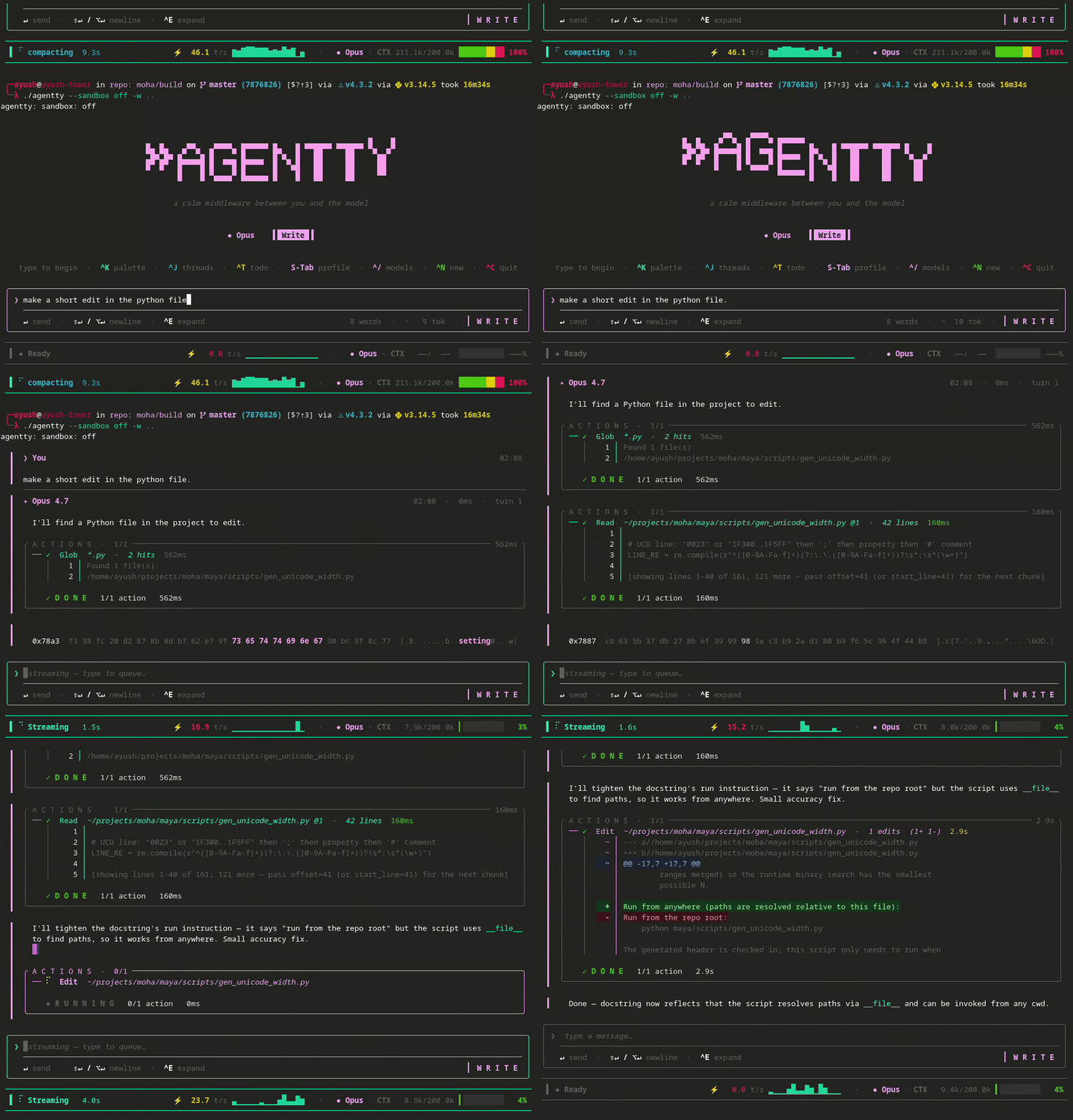
Getting Started
curl -fsSL https://raw.githubusercontent.com/1ay1/agentty/master/install.sh | sh
cd your-project
agentty
First launch opens auth — paste an API key (Anthropic sk-ant-…, or any provider's key) or use a local Ollama model that needs no key at all. You can also sign in with your Claude Pro/Max OAuth if you prefer. Once you're in, a first-run welcome card suggests a few things to try; just type and hit Enter.
Features
⚡ Instant startupCold start under 1ms. No Node, no Python, no npm install. Just a static binary. 🔌 Any modelClaude, GPT, Groq, OpenRouter, Ollama, or any OpenAI-compatible endpoint. Switch live with 🛡️ Sandboxed by defaultEvery shell call runs inside bwrap (Linux) / sandbox-exec (macOS). File tools refuse paths outside your workspace. |
🌐 Air-gapped modeRun on a box with no internet. Your laptop relays the bytes over SSH with TLS pinned end-to-end. 🔧 Full tool suiteread · write · edit · bash · grep · glob · git · web · search_docs · search_code · task — each with a purpose-built widget. 🧠 Learns your codebaseAgent Skills + remember/forget memory, plus a fully local RAG engine — hybrid BM25 + embeddings, RRF-fused, reranked, diversified, and expanded over a GraphRAG document graph — over your docs, skills, and memory. Teach it once, every session knows your conventions. How it works ↓ 🎯 Smart ModeOne flagship model plans; cheaper models do the legwork. Effort scales to each turn's complexity, a cascade retries harder only when a cheap attempt falls short, and the router learns your repo across sessions. Off is a strict no-op. How it works ↓ |
Providers
agentty                                    # bring your own key/model
agentty --provider openai -m gpt-4o        # GPT
agentty --provider groq -m llama-3.3-70b   # Groq
agentty --provider ollama -m qwen2.5-coder # local model, no key
agentty --provider openrouter              # any model via OpenRouter
agentty -m claude-opus-4-5                 # Claude (API key or Pro/Max OAuth)
--provider persists. Switch live in-app with ^P.
Retrieval (RAG)
Retrieval without context dumping
Rather than injecting a repository or every project document into each prompt, agentty retrieves a small, source-tagged set of relevant passages only when the task needs project knowledge. That keeps context focused, leaves more room for the task itself, and avoids paying to repeatedly send irrelevant material.
agentty ships a complete, fully-local retrieval engine behind two tools — no cloud, no dependencies, works offline. The only optional network hop is a localhost Ollama server for embeddings; with none reachable it falls back to keyword search and keeps working.
search_docs— searches your knowledge base: a docs folder, your installed skills, your learnedremembermemory, and (opt-in) connected MCP resources. Useful from the first turn — skills and memory are always indexed, even with no docs folder.search_code— semantic search over your source by meaning, for "where is retry backoff handled" questions where you don't know the identifier. The hybrid complement togrep.
Every returned passage is source-tagged (docs: · skill: · memory: · MCP
URI) with its file + line range, so the model can cite, open, or follow it.
Enable the semantic half (BM25 works with zero setup):
ollama pull nomic-embed-text && ollama serve     # localhost embeddings
export AGENTTY_DOCS_DIR=~/my-project/docs         # optional; skills+memory always indexed
agentty auto-detects the running server and upgrades from BM25-only to full hybrid retrieval — no restart needed.
The retrieval funnel
Every search_docs call runs this pipeline. The default path makes no LLM
calls — it's fast, deterministic, and safe to leave fully on.
- Hybrid retrieval — BM25 (keyword, Porter-stemmed) and dense embeddings
(HNSW-indexed at scale) each rank a wide candidate pool; the two lists are
fused with Reciprocal Rank Fusion (or opt-in Relative Score Fusion,
AGENTTY_RAG_FUSION=rsf). Every dense probe a search fans out — expansion, HyDE, multi-hop — embeds in one batched round-trip, not one per probe. - Pseudo-relevance feedback (RM3) — harvests discriminative terms from the top hits and fuses a second down-weighted probe, recovering the vocabulary you didn't type. Sub-millisecond, no model.
- Contextual retrieval — each chunk is indexed with a breadcrumb of its
doc title + heading path, so
guide.md › Install › Linuxis findable even when the body never says "linux". - Re-ranking — a deterministic feature-fusion reranker (term coverage, phrase proximity, title match, calibrated cosine), plus an optional batched embedding cross-encoder and an opt-in generative 0–10 judge.
- MMR diversification — greedily keeps hits that are relevant and distinct, so duplicate windows don't crowd out real answers.
- Compression — trims each survivor to its best query-relevant span: "20k noisy tokens" → "2k useful tokens."
- Parent-document expansion — stitches the precise hit back into its adjacent sibling chunks so the model reads it in context.
- GraphRAG expansion — builds the corpus's document graph (nodes = docs; edges = markdown links + tf·idf entity co-occurrence), runs PageRank and community detection over it, and pulls in supporting docs from four tiers around the top hits (outbound links, backlinks, entity neighbours, and the community hub). Deterministic, in-memory, no model.
- Corrective retry (CRAG) — on a low-confidence result, de-noises the query, widens the pool, and keeps whichever attempt scored higher.
Opt-in recall boosters (cost a model call, off by default):
RAG-Fusion query expansion (AGENTTY_RAG_EXPAND=1),
HyDE hypothetical-document embeddings (AGENTTY_RAG_HYDE=1), and
GraphRAG community summaries (AGENTTY_RAG_GRAPH_SUMMARY=1 — a cached
natural-language report per topic cluster, generated once per corpus shape).
Beyond the explicit tool, a proactive path runs the funnel before you ask
when your message looks knowledge-shaped, injecting a source-tagged
<retrieved-context> block into the very same turn — grounding without a tool
round-trip. The transcript renders it as one quiet 📚 card that shows a
confidence bar plus exactly which sources grounded the answer (docs · path,
skill · name, memory…) and a passage count, so you can always see — and
weigh — what the model was standing on.
BM25, RRF, HNSW, the reranker, MMR, compression, PRF, the chunker, and the
GraphRAG document graph (PageRank, entity extraction, community detection) are
all in-house C++/STL. Every stage degrades gracefully and is tunable via
AGENTTY_RAG_* env vars. For big corpora, two opt-in vector-cost levers keep
the ANN cheap while the full-precision rerank recovers quality: Matryoshka
dimension truncation (AGENTTY_RAG_ANN_DIM=256, ~2.3× faster walk) and
binary quantization (AGENTTY_RAG_BINARY=1, popcount-Hamming walk + float
rescore, ~2.5×). Full write-up:
docs/website/retrieval.md.
Smart Mode
One model rarely fits every turn. A one-line rename and a cross-file refactor
don't deserve the same effort, and burning flagship reasoning on trivia is
just slow and expensive. Smart Mode (^S) fixes that with an
orchestrator-workers design: a strong model owns the plan and delegates
well-scoped subtasks to cheaper workers.
It's built from three roles and eight independent layers, each a toggle:
- Strategic (flagship) plans and delegates · Implementation (mid) writes
code · Utility (cheap) handles summaries and grunt work. The resolver maps
a role to
(model, effort)— it never checks a model name by string, so pinning any model to any slot is always safe. - Complexity-scaled effort sizes each turn (trivial → complex), and a cascade retries at higher effort only when a cheap attempt actually falls short — the RouteLLM/cascade idea applied inside the agent loop.
- Because the loop sees outcomes a stateless router can't — the build fails, the
test goes red, you correct the next turn — Smart Mode learns per-workspace:
it persists the effort prior the cascade discovered and recalls decompositions
that worked. The second session in a repo is smarter than the first. All
learning is local, on-disk (
.agentty/), and wipeable.
Open the overlay with ^S; the footer shows what it's learned in this repo.
Off is a strict byte-for-byte no-op — zero extra tokens, zero latency.
Full write-up: docs/website/smart-mode.md.
Keys
| Key | Action | Key | Action |
|---|---|---|---|
Enter | Send / queue | ^K | Command palette |
Esc | Cancel / reject | ^J | Thread list |
S-Tab | Cycle profile | ^P | Model picker |
Alt+Enter | Newline | ^N | New thread |
^G | Run code block | ^←/→ or Alt+←/→ | Cycle threads |
The composer is a full readline-style editor:
| Key | Action | Key | Action |
|---|---|---|---|
^←/→ | Move by word | ^W / Alt+D | Delete word back / forward |
^U / Alt+K | Kill to line start / end | ^Z / ^Y | Undo / redo |
^V / Alt+V | Paste image | / @ # | Command / file / symbol picker |
↑ | Recall queue / history | Alt+↑/↓ | Edit queued messages one at a time |
Full keymap: docs/website/keybindings.md.
More
Installation options
Linux
# Debian / Ubuntu
curl -fsSLO https://github.com/1ay1/agentty/releases/latest/download/agentty_amd64.deb
sudo dpkg -i agentty_amd64.deb

# Fedora / RHEL / CentOS
sudo dnf install https://github.com/1ay1/agentty/releases/latest/download/agentty-x86_64.rpm

# openSUSE
sudo zypper install https://github.com/1ay1/agentty/releases/latest/download/agentty-x86_64.rpm

# Arch (AUR)
yay -S agentty-bin

# Alpine
curl -fsSLO https://github.com/1ay1/agentty/releases/latest/download/agentty-x86_64.apk
sudo apk add --allow-untrusted agentty-x86_64.apk
macOS
brew tap 1ay1/tap && brew install agentty
Windows
scoop bucket add 1ay1 https://github.com/1ay1/scoop-bucket; scoop install agentty
# or
winget install agentty.agentty
Termux / Android (no root, no proot)
agentty builds natively against Termux's Bionic/libc++ toolchain. The install
script detects Termux and installs into $PREFIX/bin (on your PATH):
pkg install git cmake clang openssl libnghttp2
curl -fsSL https://raw.githubusercontent.com/1ay1/agentty/master/install.sh | sh -s -- --build
Shell/build tools run unsandboxed on unrooted Android (Bubblewrap needs
user namespaces Android doesn't grant) — everything else works. See
packaging/termux/ for the pkg install agentty recipe.
Anywhere (no package manager)
curl -fsSL https://raw.githubusercontent.com/1ay1/agentty/master/install.sh | sh
If the prebuilt binary won't run on your system (e.g. a libc mismatch), pass
--build to compile from source instead — the installer also does this
automatically when the downloaded binary fails to execute:
curl -fsSL https://raw.githubusercontent.com/1ay1/agentty/master/install.sh | sh -s -- --build
From source (needs a C++26 toolchain — GCC 14+ / recent Clang / MSVC)
git clone --recursive git@github.com:1ay1/agentty.git
cd agentty && cmake -B build && cmake --build build -j
All binaries are a single fully-static executable (x86_64 + aarch64 on Linux, Intel + Apple Silicon on macOS; Termux/Android builds from source). Packaging details: packaging/README.md.
Air-gapped hosts
agentty airgap --setup user@host   # first time: copies credentials
agentty airgap user@host           # every time after
Your laptop relays via SOCKS5-over-SSH. TLS pins on real upstreams — the network in between can't MITM you.
Inside Zed (ACP)
agentty speaks the Agent Client Protocol — the same protocol Zed uses for Claude Code. Add to Zed's settings:
{
  "agent_servers": {
    "agentty": {
      "command": "agentty",
      "args": ["acp"]
    }
  }
}
Run code blocks from replies (Ctrl+G)
The AI hands you a fenced block of commands — don't copy-paste it. ^G lists
the blocks from the last reply; Enter (or a digit) runs one interactively
on your real terminal: the TUI suspends, sudo password prompts work, output
streams live, Ctrl+C kills the command (not agentty). When it exits, a
result card lets you attach the captured output to the composer as a
collapsed chip (a), copy it (y), or discard (Esc) — so "it failed with
X" reaches the model without you re-typing anything.
Runs the right shell per block on every OS: sh/bash blocks through
/bin/sh on Linux/macOS, powershell/pwsh and cmd/bat blocks through
PowerShell / cmd.exe on Windows. Prompt $ markers are stripped, a block
your platform can't run offers edit/copy instead, and capture is capped at
2 MB. Details: docs/RUN_CODE_BLOCK.md
Agent Skills
Drop a SKILL.md anywhere under .agentty/skills/ or ~/.agentty/skills/ — it's live next turn. Compatible with Claude Code's .claude/skills/ format.
On codebases with internal DSLs or tribal conventions, agent accuracy jumps from ~20% to ~85% with curated skills (research).
Architecture
Pure-functional update loop: (Model, Msg) -> (Model, Cmd). View is Model -> Element, rendered by maya. Process management via posix_spawn + poll(2). File writes are atomic (write + fsync + rename).
Deep dive: docs/ARCHITECTURE.md · docs/RENDERING.md
Releasing (maintainers)
Cutting a release is one command:
scripts/cut-release.sh X.Y.Z      # POSIX / macOS / Linux / Git-Bash
scripts\cut-release.cmd X.Y.Z     # Windows cmd.exe
It bumps project(agentty VERSION …) in CMakeLists.txt (the single source
of truth every manifest derives from), promotes CHANGELOG.md's [Unreleased]
section to [X.Y.Z], commits, tags vX.Y.Z, and pushes. The tag push fires
GitHub Actions, which builds every binary + OS package (Linux x86_64/aarch64
on native runners, macOS Intel/ARM, Windows .exe/.msi) and auto-submits to
winget, Homebrew, Scoop, and the AUR — nix/snap/gentoo manifests are attached
to the release. --dry-run previews without writing anything.
Community
Join the Discord to ask questions, share sessions, and get help. The server has an AI helper bot that answers agentty questions using the real agent — @mention it, DM it, or use /ask.
License
MIT — see LICENSE.