README.md
September 13, 2026 · View on GitHub

 Classic 2D · All connections |
 Classic 2D · Selected neuron connections |
 Coaxial Rings 3D · All connections |
 Coaxial Rings 3D · Selected neuron connections |
 Spiral Tokens 3D · All connections |
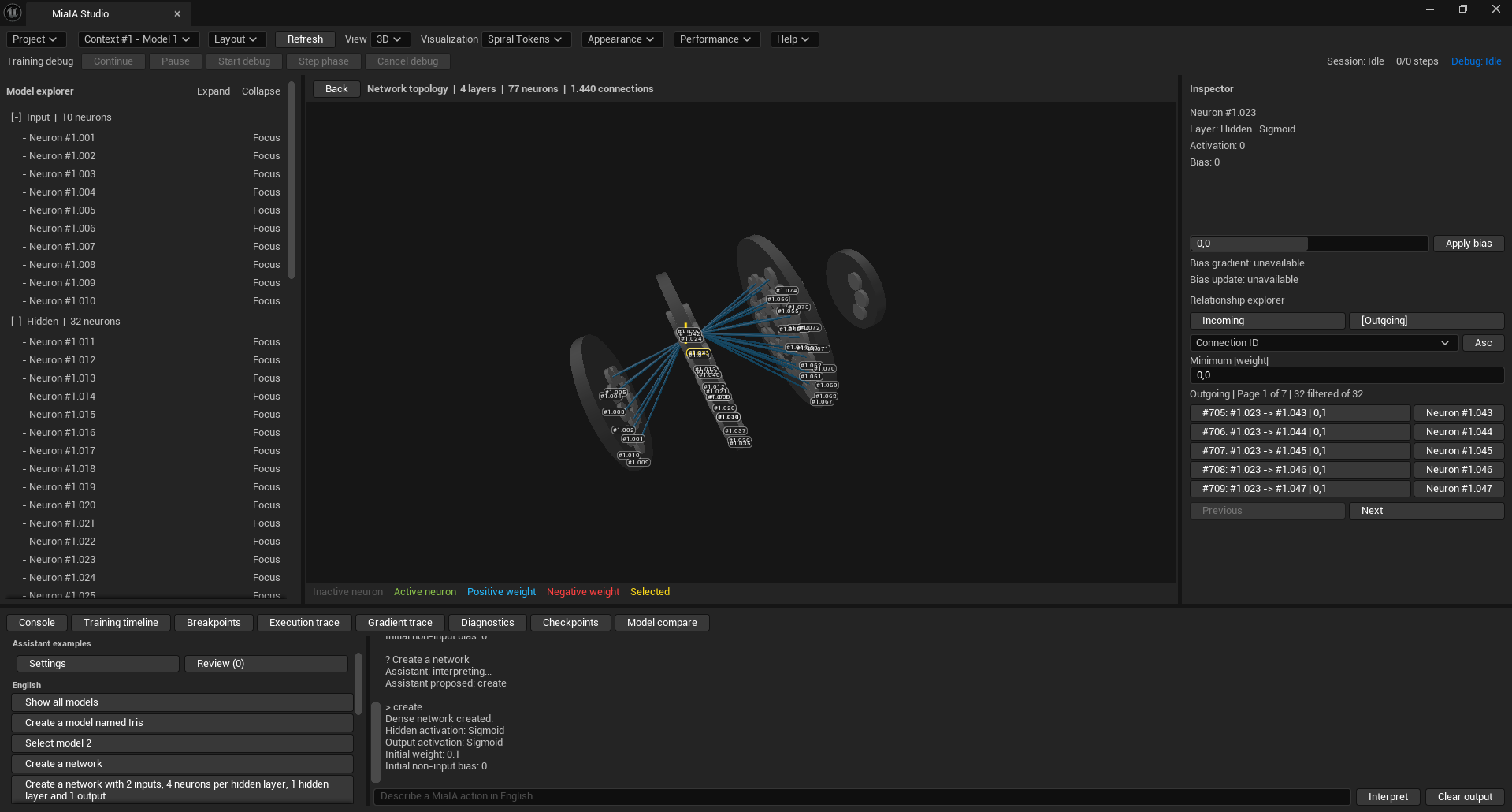 Spiral Tokens 3D · Selected neuron connections |
 Models |
 Coaxial Rings · Network detail |
 Coaxial Rings · Selected connections |
Explore the whole network, then focus on a single neuron. Click any image to open the full-resolution image.
MiaIA Studio
An interactive development environment for understanding neural networks.
VISUALIZE | EXPERIMENT | INSPECT | DEBUG
Website · Documentation · Roadmap · MPL 2.0
Understand the network, not just the output
MiaIA makes neural networks observable. Build or import a model, execute it, inspect activations and gradients, follow parameter updates, and advance training one mathematical phase at a time.
The MiaIA Studio 0.1 Alpha release includes:
- a C++20 neural-network Engine and public SDK;
- direct inference, evaluation, observable backpropagation, and atomic SGD training;
- controlled foreground and background sessions with navigable history;
- phase-by-phase training debug with candidate-state inspection and rollback;
- immutable forward and backward gradient-flow traces with graphical playback;
- multi-model projects built from isolated model contexts, including clean experiment forks with copied networks, datasets, training configurations, and breakpoints;
- immutable comparison of two model contexts with topology compatibility, ranked parameter deltas, and 2D/3D visual overlays;
- model checkpoints with inspection, comparison, transactional restore, and
.maipersistence; - bounded neuron and connection relationship inspection with exact topology counts;
- ONNX model interchange and numeric CSV datasets;
- one shared command processor for the terminal and Unreal clients;
- interactive 2D and 3D topology views in MiaIA Studio;
- a renderer-neutral StudioCore application layer and Windows standalone host.
Project status — 0.1 Alpha: the mathematical and application foundations, versioned
.maiv2 multi-context persistence with v1 migration, execution traces, diagnostics, and model checkpoints are implemented and tested. Persisting session history and visualization layouts remains planned work. APIs and supported file-format behavior may evolve during the alpha series.
Alpha limitations
- The native engine currently focuses on observable feed-forward networks and the activations documented by the project.
- ONNX import and export support the documented dense subset, not arbitrary ONNX graphs or operators.
- Built-in optimization currently focuses on mean squared error and stochastic gradient descent.
.maiversion 3 persists deterministic sample-order configuration but not transient training progress, session history, annotations, or visualization layout; versions 1 and 2 remain readable.- Live model, dataset, training, and checkpoint state is process-local; separate executables do not share one running session.
- The packaged application is currently verified for Windows x64. Other platforms and solution configurations are not release targets yet.
- Alpha APIs and workflows can change; preserve important interoperable models through ONNX exports where supported.
Download the Windows app directly from the Microsoft Store. Visit www.nonop.biz/miaia for official project information. The corresponding source code is maintained in this repository.
Documentation
License
Original MiaIA source code is available under the Mozilla Public License 2.0. Third-party components, Unreal Engine, and MiaIA branding remain subject to their respective terms. See Licensing, third-party notices, and trademark policy.
Copyright 2026 Agostino Mosillo.
The repository is currently author-led and does not accept unsolicited code contributions. Bug reports and focused feedback are welcome as described in CONTRIBUTING.md.