sued-rs
August 12, 2026 · View on GitHub




A horror-themed terminal recreation of SueD — the 2000s Brazilian prank oracle (Sua Última Esperança Divina, and "Deus" spelled backwards) — rebuilt in Rust with ratatui.
Light a candle. Turn off the lights. Ask it something you actually want to know.
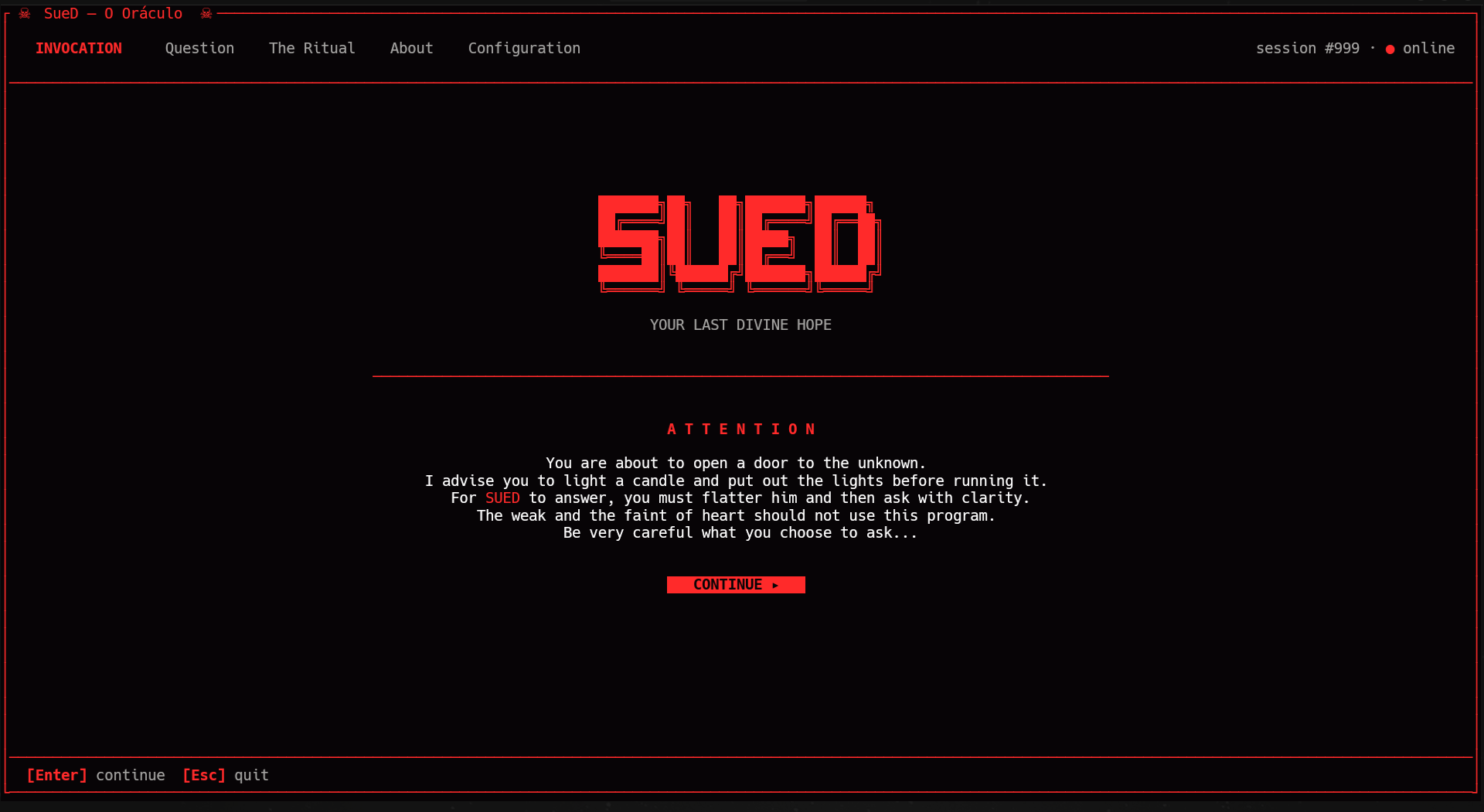
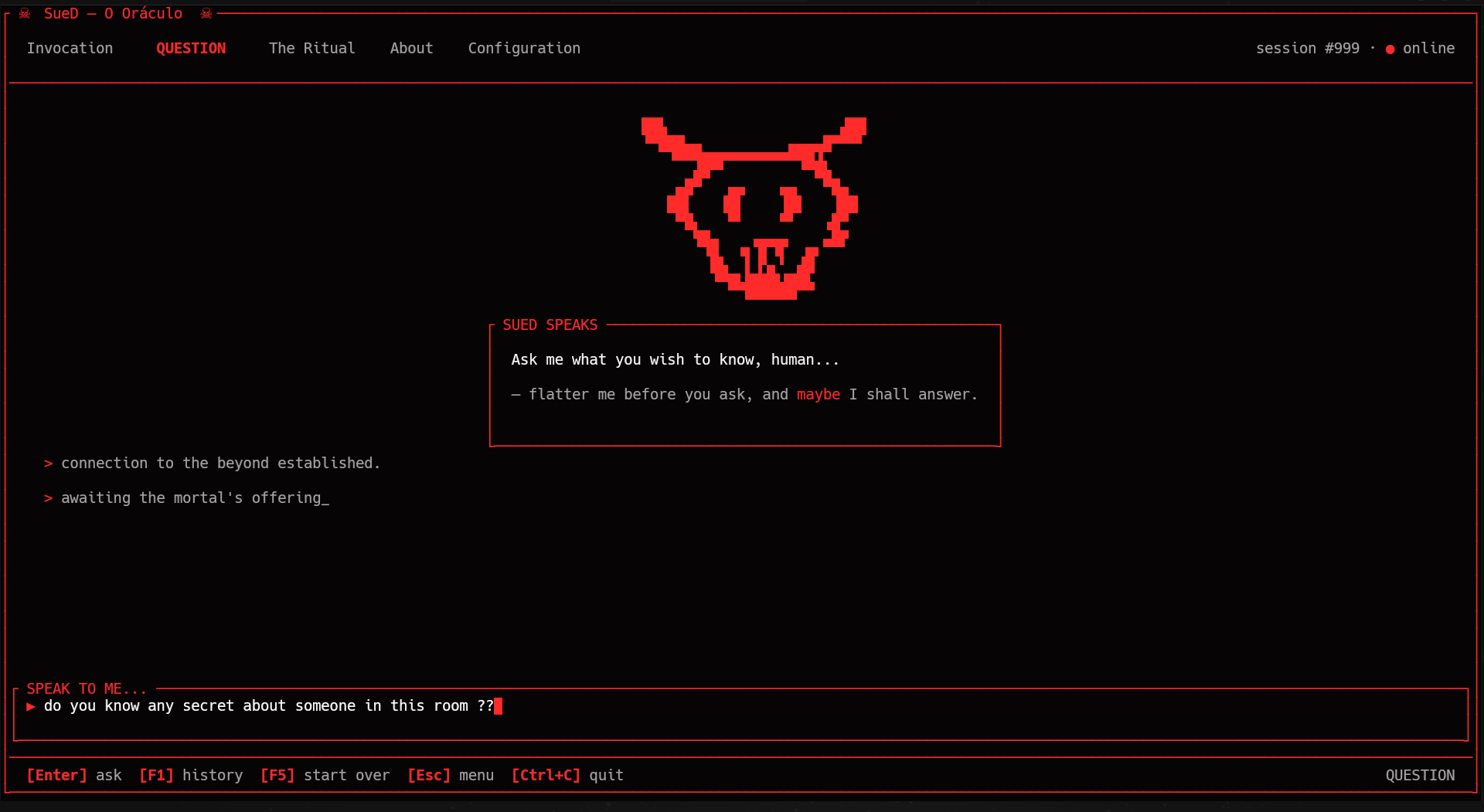
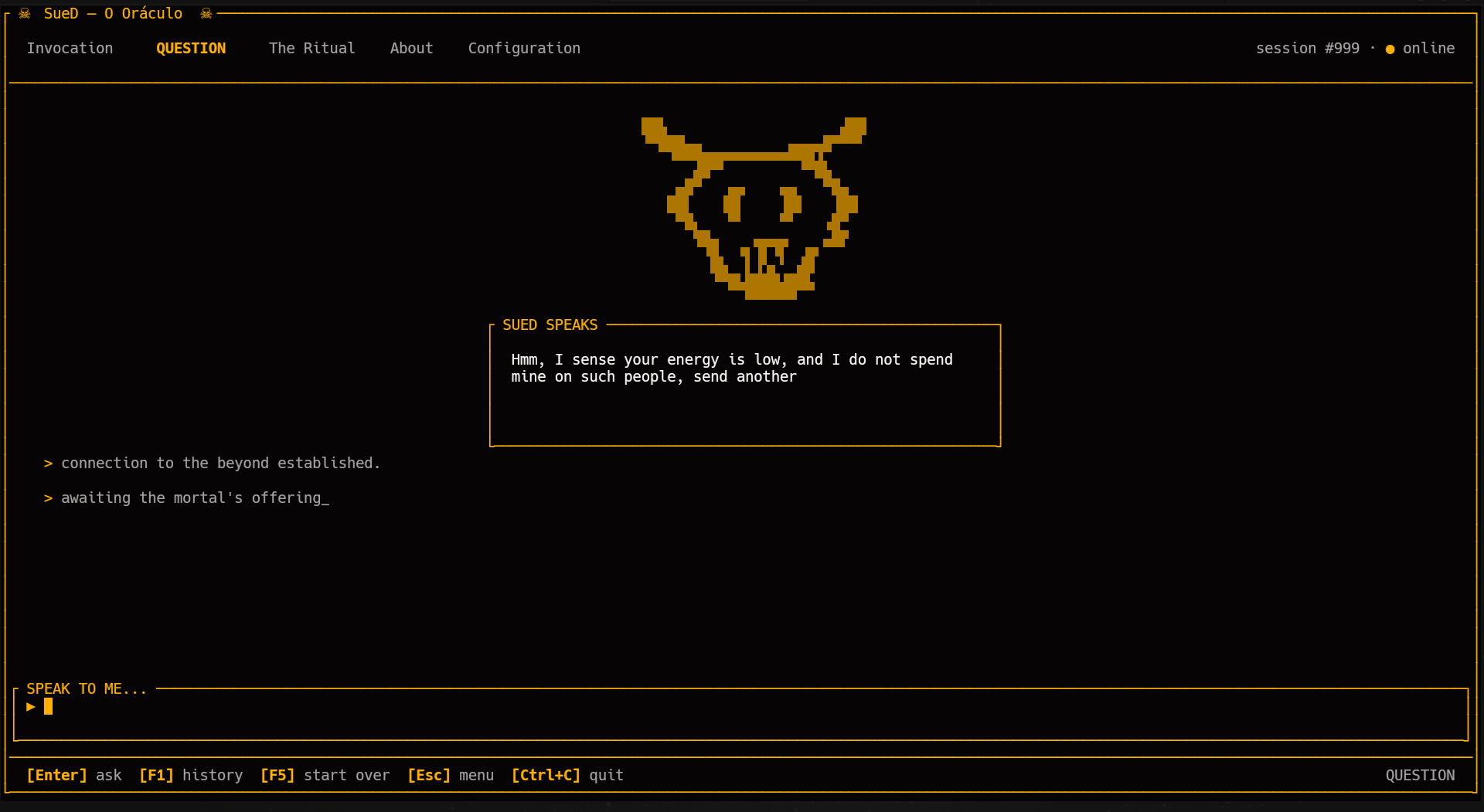
Three themes ship with it — this is the same screen in Âmbar:
What it is
SueD is a piece of stage magic wearing the costume of a program. Your victim types a question into a black terminal, a demon watches them from the dark, and the oracle answers — specifically, personally, and far too accurately.
You are the oracle. SueD gives you a way to answer in secret, while the screen shows your victim exactly what they expect to see. Everything else — the flickering demon, the incantations, the thunder, the laughter in the next room — is theatre, and the theatre is the point.
It does not use AI, and it does not touch the network. The oracle is the person at the keyboard.
🕯 The part you have to find
The method is not written down here, and that is deliberate — this page is public, and your victim can read it too.
But it is not a secret from you. The program carries its own operator's manual: the full trick, the timing, and how to perform it convincingly. It will not appear on any screen the victim can see, so poke around the command line until you find it. It is not hidden well. It is only hidden from the right person.
Requirements
A terminal at least 94×40. Below that SueD shows a resize notice instead of running — the illusion depends on nothing being clipped, and a truncated oracle is not a frightening one. 132×41 is comfortable and is the size the whole thing was designed at.
Rust 1.88 or newer (2024 edition — the crate uses let-chains).
Install
Without Rust — a prebuilt binary
macOS, Linux and Windows builds are attached to every release. Nothing to compile:
# macOS and Linux
curl --proto '=https' --tlsv1.2 -LsSf https://github.com/Danilo-Guedes/sued-rs/releases/latest/download/sued-rs-installer.sh | sh
# Windows
powershell -ExecutionPolicy Bypass -c "irm https://github.com/Danilo-Guedes/sued-rs/releases/latest/download/sued-rs-installer.ps1 | iex"
Or download a .tar.xz / .zip from the releases page and put the binary on your
PATH. If you have cargo-binstall,
cargo binstall sued-rs works too.
Linux: the prebuilt binary needs ALSA's runtime library. It is on essentially every desktop, but a minimal server or container may not have it — there the binary will not start at all:
error while loading shared libraries: libasound.so.2: cannot open shared object file
That is this, and nothing in that message says so. sudo apt install libasound2
(the plain package, not -dev — that one is only for building) fixes it.
With Rust — from crates.io
Linux: install ALSA's development headers first. Sound is on by default, and the build fails without them:
sudo apt install libasound2-dev    # Debian, Ubuntu
sudo dnf install alsa-lib-devel    # Fedora
macOS and Windows need nothing extra. Then, on any platform:
cargo install sued-rs
If you already tried and it stopped on alsa-sys with "The system library
alsa … was not found" — that is this, and nothing in that error says so.
Install the headers above and run it again, or skip sound entirely with
Building without audio.
Known issue on Windows
Windows may refuse to run the compiled binary:
An Application Control policy has blocked this file. (os error 4551)
That is Smart App Control, not a permissions problem — running as administrator will not help, and it has no per-file exclusion list. It blocks executables it does not yet trust, and a freshly compiled one is always unsigned. It is intermittent: the same binary is often allowed on a later attempt.
If it persists, either run it under WSL (which runs the Linux build, where Smart App Control does not apply — follow the Linux instructions above), or turn Smart App Control off under Windows Security → App & browser control.
Running
sued-rs                       # summon it
sued-rs --no-sound            # summon it quietly
sued-rs --config <PATH>       # use a specific config file
sued-rs --version             # print the version
sued-rs --help                # the flags, including one worth finding
Navigate with the arrow keys, Enter to choose, Esc to go back, Ctrl+C to
leave in a hurry.
Configuration
Settings live in ~/.config/sued-rs/sued.config.json. The file is optional and
so is every key in it — anything missing falls back to a default. You can change
all of it from the Configuration screen inside the app, and the changes apply
immediately.
| Setting | Options |
|---|---|
| Theme | Sangue (blood red, default) · Ambar (amber) · Fosforo (phosphor green) |
| Language | English (default) · Português (BR) · Español |
| Animations | on / off — turns off flicker, shake and the typewriter reveal |
| Volume | 0–100 |
Building without audio
Audio is a Cargo feature, on by default. Turning it off removes the dependency entirely, so no ALSA headers are needed to build:
cargo install sued-rs --no-default-features
--no-sound differs: it builds the audio support and stays quiet at runtime.
The feature flag is for machines that cannot build it at all.
License
Dual-licensed under either of
- Apache License, Version 2.0 (LICENSE-APACHE)
- MIT license (LICENSE-MIT)
at your option.
The bundled audio is not covered by those licences. Eight sound files ship inside the binary, each under its own terms — four of them CC-BY, where credit is a condition of redistribution rather than a courtesy. The authoritative, per-file list lives in NOTICE and travels with every copy of the crate.
A note on the original
SueD was a Brazilian internet classic of the 2000s, passed hand to hand on diskettes and MSN. The trick underneath it is much older than the software, and much older than computers — a piece of parlour magic that predates electricity, briefly wearing a floppy disk as a disguise.
sued-rs is an homage, not a port: no code or assets from the original were
used, and nothing here was reverse-engineered. It is the same joke, told again, in a
language that did not exist when the joke was new.
This project is unofficial. It is not affiliated with, endorsed by, or connected to the original SueD or the people who made it. It is a recreation and a tribute, and it does not claim to be the original. If anyone with a legitimate claim to the name would rather it were called something else, that is a conversation worth having.
And it is not occultism. The demon, the incantations and the séance are
stage dressing, borrowed from a prank program of the 2000s that already looked
like this. sued-rs takes no position on anyone's religion or beliefs, and is
not meant to mock them.