dsh-completion-guard
August 31, 2026 · View on GitHub
A task-contract and completion-certification plugin for DeepSeek Harness (DSH). It preserves requirements, prohibitions, acceptance criteria, later corrections, and bounded evidence so a task can be certified only when current successful evidence matches the current contract.

Quick start
Install the published plugin into a DSH Web profile:
dsh plugin --profile web add dsh-completion-guard@0.3.1
Restart DSH Web, open a session, and enable the guard:
/context-guard on
/context-guard status
Activation is opt-in by default. status reports whether the guard is enabled, the current epoch and contract revision, pending and passed item counts, the evidence count, and integrity state. off stops capture and gating for the session while preserving its prior history; clear supersedes every pending requirement/acceptance under a CLEAR: sentinel (prohibitions retained) so an empty-binding checkpoint can certify while the guard stays on; diagnose returns a bounded diagnostic view.
Activation modes
activation accepts two values:
| Value | Behavior |
|---|---|
opt-in | Default. A session remains unprotected until /context-guard on is recorded in that session. |
always | Starts enabled before the session log is replayed. /context-guard off disables the guard for that session until a later /context-guard on. |
To start Context Guard automatically for sessions in a DSH profile, add an ID-targeted override to that profile's cordis.patch.yml. For the default Web profile on macOS or Linux, this file is normally ~/.dsh/profiles/web/cordis.patch.yml:
- id: context-guard
  name: dsh-completion-guard
  config:
    activation: always
Restart that DSH profile after changing the configuration, then run /context-guard status in a session to confirm that the guard is enabled. Because always enables the guard before replay, applying it to a profile that already has persisted sessions can cause earlier user messages in those sessions to be captured when their logs are rebuilt. Use opt-in when protection should begin only after an explicit per-session command.
Once enabled, Context Guard captures direct user requirements and acceptance criteria. Tool results become citable evidence only after DSH persists them. Before the model claims the whole task is complete, it must call the injected context_guard_checkpoint tool with matching evidence IDs; an incomplete or stale binding cannot certify completion.
What it protects
- Captures requirement, acceptance, and prohibition clauses with stable identities and append-only supersession.
- Derives bounded, redacted evidence from persisted DSH tool calls and results.
- Requires method, operation, subject, surface, and outcome to match where the contract makes them explicit.
- Re-verifies certificates when a session is rebuilt or resumed and fails closed on integrity loss.
- Blocks the Guard-owned model-tool Goal completion path while enabled unless a current certificate exists; trusted in-process direct Goal/session writes are detected as integrity violations, not universally prevented.
Status and compatibility
Version 0.3.1 is the current release line. Its npm package and GitHub release are authoritative only when the exact-artifact public readback recorded in docs/LOCAL_ACCEPTANCE.md is complete. Verify those linked identities before installing.
The 0.3.0 npm artifact passed same-byte native validation, but npm omitted its required gitHead metadata because a prebuilt tgz was published. Its version identity cannot be reused, and no GitHub Release is created for v0.3.0; the npm version remains installable for audit history but is deprecated with a migration warning to use 0.3.1. Version 0.3.1 preserves the runtime behavior while repairing the release provenance path.
The project was renamed from
dsh-context-guardtodsh-completion-guardon 2026-08-29 to avoid a name collision with an unrelated DSH plugin (kpl0111/dsh-context-guard, tool-result pruning). The internal Cordis bundle id stayscontext-guard, and every published version of the previous npm packagedsh-context-guardis deprecated in favor of this package. It targets DSH0.1.1-rc.2, Node.js>=22, and pnpm>=11.
Earlier v0.2.x evidence
The 0.2.1 release suite contains 138 tests (105 domain/core). It attributes shell evidence to the session cwd when the tool omits workdir, supports literal 2>&1 diagnostics and read-only inspection commands, maps process verbs to run evidence, and exposes actionable hints when a checkpoint binding is rejected. 0.2.1 adds a session-layer capture filter so clarification questions, meta comments, and bare progression phrases (继续, continue) never become contract items; de-duplicates repeated recovery notifications; adds /context-guard clear; and documents how a goal completes when the guard is disabled or blocked. A macOS live Web run loaded the published profile package and certified a real pnpm test result.
The Windows TEMP readback verifies the b75868e9e73d29f50530ddaba15cfaef82e03ece source matrix and the exact-source tarball → isolated installation → dump-config → Web startup log and cleanup chain. HTTP 200 appeared only in the first-run stdout, was not persisted, and was not rerun during readback, so the HTTP response itself is not independently confirmed. A real model-session smoke remains not run.
v0.3.1
Version 0.3.1 carries the v0.3 semantic action/target binding, independent state readback for stateful actions, typed boundaries, digest-v3 certificates, exact active-host identity, and paired optional Goal integration introduced in 0.3.0. It adds a deterministic release packer that binds the full Git HEAD inside the frozen tgz before native-platform acceptance and registry publication. The 19-file deterministic suite passed 351 tests with one Windows-only capability skip on macOS and all 352 tests without skips on native Windows for the unchanged runtime baseline. docs/LOCAL_ACCEPTANCE.md keeps source, artifact, CI, model-session, and publication evidence scopes separate.
The release uses manifests/action-manifest.v1.json, manifests/git-command-manifest.v2.json, and manifests/supported-host.v1.json. Goal integration requires the exact optional peers @deepseek-ai/dsh-goal@0.1.1-rc.2 and @deepseek-ai/dsh-tool-goal@0.1.1-rc.2 together. It fails closed unless the active DSH runtime/profile graph injects the exact hostLockPackages, platform, and profile identity. A nearest lockfile is not accepted because DSH core and profile plugins use separate package graphs. The default bundled patch deliberately contains no fabricated lock.
After installing the release into a profile, generate and verify its active identity with the packaged CLI. Use absolute paths for the actual DSH installation; the dump is an inspection artifact, not a configuration source:
DSH_RUNTIME_ROOT=/absolute/path/to/.dsh-runtime
DSH_PROFILE_ROOT=/absolute/path/to/.dsh/profiles/web
DSH_COMPOSED_DUMP=/tmp/dsh-web-composed.yml
GUARD_HOST_LOCK="$DSH_PROFILE_ROOT/node_modules/.bin/dsh-completion-guard-host-lock"

"$GUARD_HOST_LOCK" inspect --runtime-root "$DSH_RUNTIME_ROOT" --profile-root "$DSH_PROFILE_ROOT"
"$GUARD_HOST_LOCK" inject --runtime-root "$DSH_RUNTIME_ROOT" --profile-root "$DSH_PROFILE_ROOT"
dsh --profile web --dump-config > "$DSH_COMPOSED_DUMP"
"$GUARD_HOST_LOCK" verify-dump --runtime-root "$DSH_RUNTIME_ROOT" --profile-root "$DSH_PROFILE_ROOT" --dump-config "$DSH_COMPOSED_DUMP"
inspect and inject reject missing, duplicate, multi-version, or drifted critical packages. verify-dump then proves that DSH composed the same bounded tuple that was read from the active graphs. Repeat the flow after any DSH/profile/package upgrade. Until it succeeds, certification, Goal-dependent completion, and affected action capabilities remain unavailable. Release validation used fresh isolated profiles and did not overwrite the user's existing DSH profiles.
context_guard_evidence is read-only: it resolves targets, validates persisted effects, and performs independent state readback. Mutating install/apply/restart/publish and exact Git commit/push/pull/fetch operations use the separately named context_guard_action tool. A resolution is not mutation authority: the caller must identify the exact pending root-owned requirement and revision, repeat the persisted target digest, and match every action-specific identity field before any executable, HTTP request, or restart intent runs. Prohibitions and acceptance clauses never authorize mutation. Package/apply/publish authority is exact-version-only in v0.3; Git authority requires an explicit remote and canonical full ref/refspec. The presentation surface shows the canonical target and command-manifest digest before execution.
Publish targets use one canonical HTTPS registry base with no credentials, query, fragment, ambiguous path, or control characters; the same base is frozen in the root contract, npm argv, and registry readback. Create and modify resolutions freeze the expected post-write digest before effect; modify re-hashes the source bytes against the frozen pre-digest before applying the pinned unique UTF-8 replacement semantics, so either prestate drift or different post-effect bytes fail closed.
Context Guard recognizes only a small, auditable shell and PowerShell command subset. Unsupported or ambiguous syntax stays incomplete instead of being partially trusted. Compound commands, variables, non-whitelisted executables, file-target redirects, and in-place sed remain outside the certifiable surface. See docs/COMPATIBILITY.md for the exact grammar and platform evidence.
Boundaries
Context Guard certifies completion; DSH still owns Goal, Todo, Compaction, continuation, permissions, and tool execution. This plugin is not a security sandbox, semantic proof system, token-pruning tool, or replacement for those DSH facilities.
Evidence is bounded and redacted. Complete prompts, stdout, file contents, credentials, Authorization headers, URL query values, image bytes, and raw transcripts are not stored by the guard. See docs/PRIVACY.md.
Relationship to Codex Context Guard
This project ports deterministic behavior from GreenLv/codex-context-guard, with v0.8.8 as its semantic baseline. The two repositories serve different runtimes:
codex-context-guardis the Codex Hook/Python implementation with Codex plugin-cache and Hook lifecycle integration.dsh-completion-guardis an independent TypeScript implementation over native DSH Session events, commands, tools, and agent lifecycle.
They do not share runtime state, installers, caches, or release histories. Fixes are contributed to the repository that owns the affected runtime and are ported deliberately when the same behavior belongs in both products. See docs/UPSTREAM_BASE.md and docs/PORTING_NOTES.md for the exact reused and replaced boundaries.
npm download history
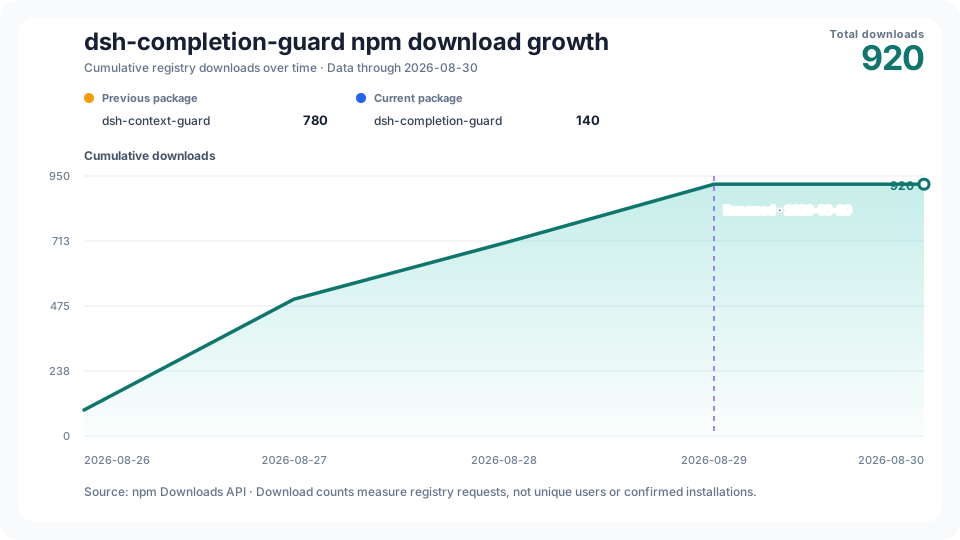
The cumulative chart keeps the old and new npm package totals visibly separate, marks the 2026-08-29 rename, and combines them only for the project growth line. npm download counts measure registry requests; they are not counts of unique users or confirmed installations. The workflow runs daily and can also be triggered manually.
Documentation
CHANGELOG.md— versioned user-visible changes.docs/ARCHITECTURE.md— ownership, durable state, and certification pipeline.docs/COMPATIBILITY.md— supported DSH versions and certifiable command subset.docs/LOCAL_ACCEPTANCE.md— deterministic, isolated, native, and public-package validation scopes.docs/distribution.md— verified public distribution destinations and the rename note.docs/PRIVACY.md— stored facts, prohibited data, and failure behavior.docs/UPSTREAM_BASE.md— semantic baseline and repository authority boundary.docs/PORTING_NOTES.md— behavior retained from Codex and DSH-specific replacements.
Development
pnpm install --frozen-lockfile
pnpm run test:stats
pnpm run typecheck
pnpm test
pnpm run lint
pnpm run build
pnpm run pack:check
These commands validate a local source tree and package. CI, native-platform acceptance, npm publication, GitHub release identity, and runtime-profile installation remain separate evidence scopes.