dsh-code-navigator
September 4, 2026 · View on GitHub
dsh-code-navigator is an independent DSH plugin that keeps a language-server process and its opened documents alive per workspace. It supports DSH 0.1.2-alpha.3 and newer releases in the 0.1.2 line.
It packages the LSP service definition required by its stdio provider, so a normal profile installation does not depend on a separately installed DSH LSP plugin.
It exposes ctx.codeNavigator to other host plugins and /code-navigator/api/* for browser adapters. It deliberately owns neither a sidebar nor ctx.lsp, so it can coexist with dsh-better-sidebar, the stock LSP provider, and other UI plugins.
Supported servers are clangd for C/C++, Pyright for Python, and typescript-language-server for JavaScript/TypeScript. Pyright, TypeScript Language Server, and TypeScript are installed with this package. clangd is an LLVM native executable and remains a system dependency; install it with Xcode Command Line Tools, an LLVM package, or your operating system's package manager. The status bar explains when clangd is unavailable while the rest of the plugin remains active.
The plugin probes all supported servers during activation and caches the result. An unavailable server does not prevent the plugin or workbench from loading. In particular, a missing clangd skips C/C++ warm-up, indexing, document notifications, and definition requests while leaving file browsing, editing, syntax highlighting, Python, and TypeScript operational.
Screenshots
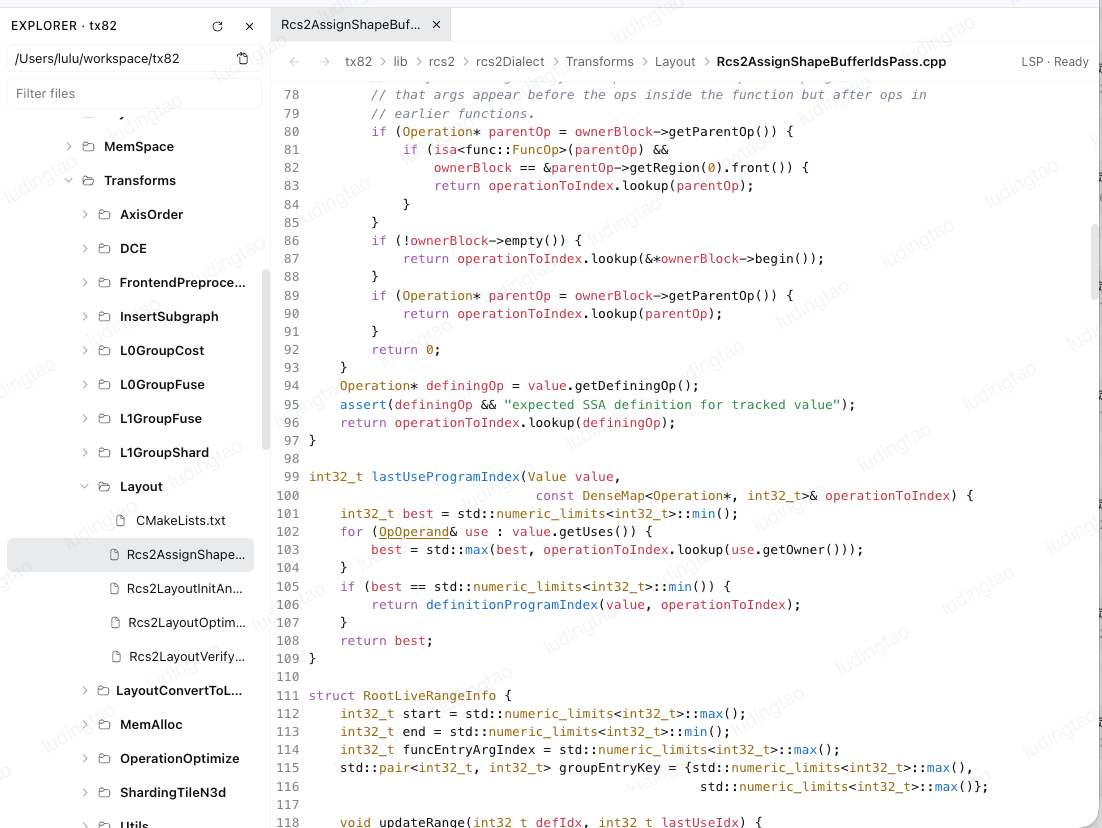
Standalone workbench — Explorer, tabs, breadcrumb, editor, and LSP status
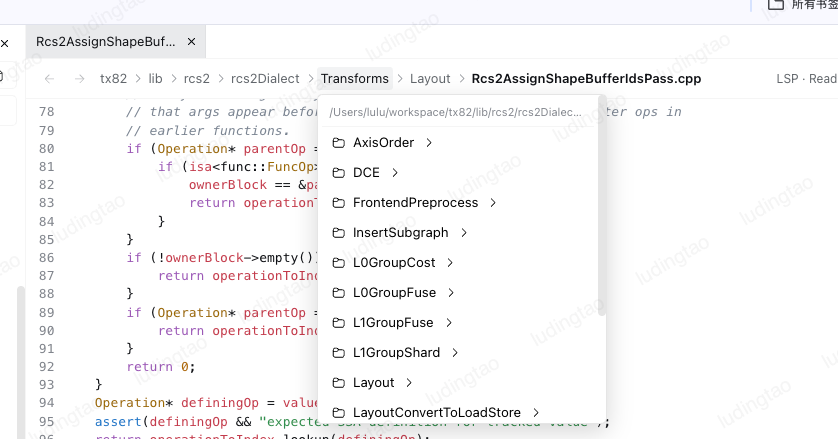
Clickable breadcrumb directory picker
Back and forward navigation controls

Install clangd for C/C++ navigation
clangd is optional for the plugin but required for C/C++ indexing and definition lookup. Check and install it before opening a C/C++ workspace:
clangd --version

# macOS
brew install llvm

# Debian / Ubuntu
sudo apt-get install clangd
Windows users can install an official LLVM release and add clangd.exe to PATH. If the executable is installed elsewhere, set clangdCommand to its absolute path. Current downloads and platform instructions are maintained by the clangd project.
clangd discovers compile_commands.json from the active workspace, preferring the root, build/, and out/build/. When clangd is available, the standalone workbench starts that discovery and initializes the server as the workspace opens, before the first source file is selected.
Installation
Install the npm package into the Web profile, inspect the composed layer, and restart DSH:
dsh plugin --profile web add dsh-code-navigator
dsh --profile web --dump-config
dsh web
For a local package archive, replace the package name with the archive path. A GitHub dependency is not supported from this development monorepo because the publishable package lives under packages/code-navigator; registry and tarball releases contain the prebuilt entry points.
Configuration
Defaults work without a profile override. To customize native clangd or discovery bounds, replace the bundle row in the profile's cordis.patch.yml:
- id: code-navigator
  name: dsh-code-navigator
  config:
    clangdCommand: /opt/homebrew/opt/llvm/bin/clangd
    clangdArgs: [--background-index, --clang-tidy]
    projectSearchDepth: 4
    projectSearchDirectoryLimit: 500
    quickOpenFileLimit: 50000
    maxDocumentBytes: 4000000
pyrightCommand and typescriptLanguageServerCommand optionally select external executables. Leave them empty to use the versions bundled with the plugin.
The public lifecycle is open, change, definition, and close. A UI adapter should call open when a code tab opens, change as its document changes, and close when the last matching tab closes; definition calls then avoid the transient didOpen/didClose work of the standard provider.
When dsh-better-sidebar is also enabled, the optional browser adapter adds Cmd/Ctrl-click definition lookup to code tabs, back and forward controls in the sidebar's top-right control strip, and a compact LSP project/server status line below the editor. The host navigator remains usable by other plugins without this adapter.
Without BetterSidebar, the browser module mounts a lightweight right-side workbench. It selects the current DSH session's workspace, loads its root directory automatically, and opens a file in a tab when the user clicks its tree row. The workbench uses the Sidebar's visual and interaction model: an Explorer tree, tabs, a token-driven CodeMirror editor with C/C++, Python, JavaScript/TypeScript, JSON, and YAML highlighting, a status toolbar, and Cmd/Ctrl-click or Cmd/Ctrl+Enter definition lookup. Right-clicking a file tab offers Close, Close Others, and Close All. The toolbar renders the active file as a workspace-relative breadcrumb; clicking a directory segment opens that directory and lets the user descend into folders or open a sibling file. Ctrl+P on Windows/Linux or Cmd+P on macOS opens a filename-first fuzzy search across the current workspace; Arrow Up/Down selects a result, Enter opens it, and Escape closes the palette. The workspace file index starts in the background and is reused for later searches. The workbench owns its bundled React, icon, and CodeMirror runtime, so it does not load a Sidebar chunk. It keeps its own back/forward history and sends debounced editor changes to the persistent server. The workbench is not mounted when BetterSidebar is available, so the two plugins never create competing editor panes.
UI adapters
The host plugin owns project detection, persistent language-server processes, document lifecycle, and navigation requests. Browser adapters only supply the editor and file-browser experience.
dsh-better-sidebar is one optional adapter. Its generic editor lifecycle and top-bar extension points let the navigator add document notifications, modifier-click navigation, status, and history controls without importing the sidebar implementation. If it is absent, the built-in workbench uses the same HTTP API and provides the required file browser, editable text view, navigation history, and server status. A future UI plugin can call ctx.codeNavigator directly or use the HTTP API without depending on either adapter.
Development and release checks
pnpm install
pnpm --filter dsh-code-navigator check:release
pnpm --filter dsh-code-navigator pack
check:release runs strict type checking, unit tests, a clean production build, and npm package linting. prepack always rebuilds lib/, so a registry tarball never depends on stale local output.
Marketplace status
The stable package is published to npm under the latest tag. Community Market discovery requires this exact stable version, the public repository declared by repository, and compatibility with the DSH/Cordis runtime shipped by the current Desktop release. Use prerelease versions only for tarball or npm prerelease testing.
Security and resource limits
All file and project requests resolve through the active DSH filesystem service and are rejected when the canonical target is outside the selected workspace. Request bodies, displayed source files, project discovery, and Quick Open indexing are bounded. Language servers run through the DSH subprocess service and are terminated when the plugin unloads.