README.md
March 19, 2026 · View on GitHub

The CISO Council
Can't afford a 7-figure CISO? Assemble a 6-member AI security council instead.





Quick Start • How It Works • The Council • Models • Security • LinkedIn
How It Works
Instead of asking a security question to your favourite LLM, you assemble a council of six AI models, each embodying a distinct cybersecurity leadership persona with their own risk appetite, organisational context, and regulatory lens. Your query goes to all six independently, a scoring engine evaluates each response across five dimensions, and a Chief Arbiter synthesises the final verdict.
Stage 1: Independent Deliberation. Your cybersecurity dilemma is given to all 6 council members individually. Each responds from their persona's perspective: a startup CISO reasons differently from a bank CRO, a DPO prioritises differently from a Head of Internal Audit.
Stage 2: Multi-Dimensional Scoring. Each response is scored by a separate model across five dimensions: Regulatory Defensibility, Practicality, Board-Readiness, Specificity, and Risk Quantification. No self-grading: the scoring model is independent of the council members.
Stage 3: Consensus and Dissent. The Chief Arbiter analyses all scored responses and identifies where the council agrees, where they split, and what those disagreements reveal about the decision's inherent ambiguity.
Stage 4: Board-Ready Report. Export a clean PDF report with the full council deliberation, individual scores, consensus positions, dissenting views, and the Chief Arbiter's recommendation.
This is not a chatbot. It is a cybersecurity advisory board that runs on localhost.
The War Room
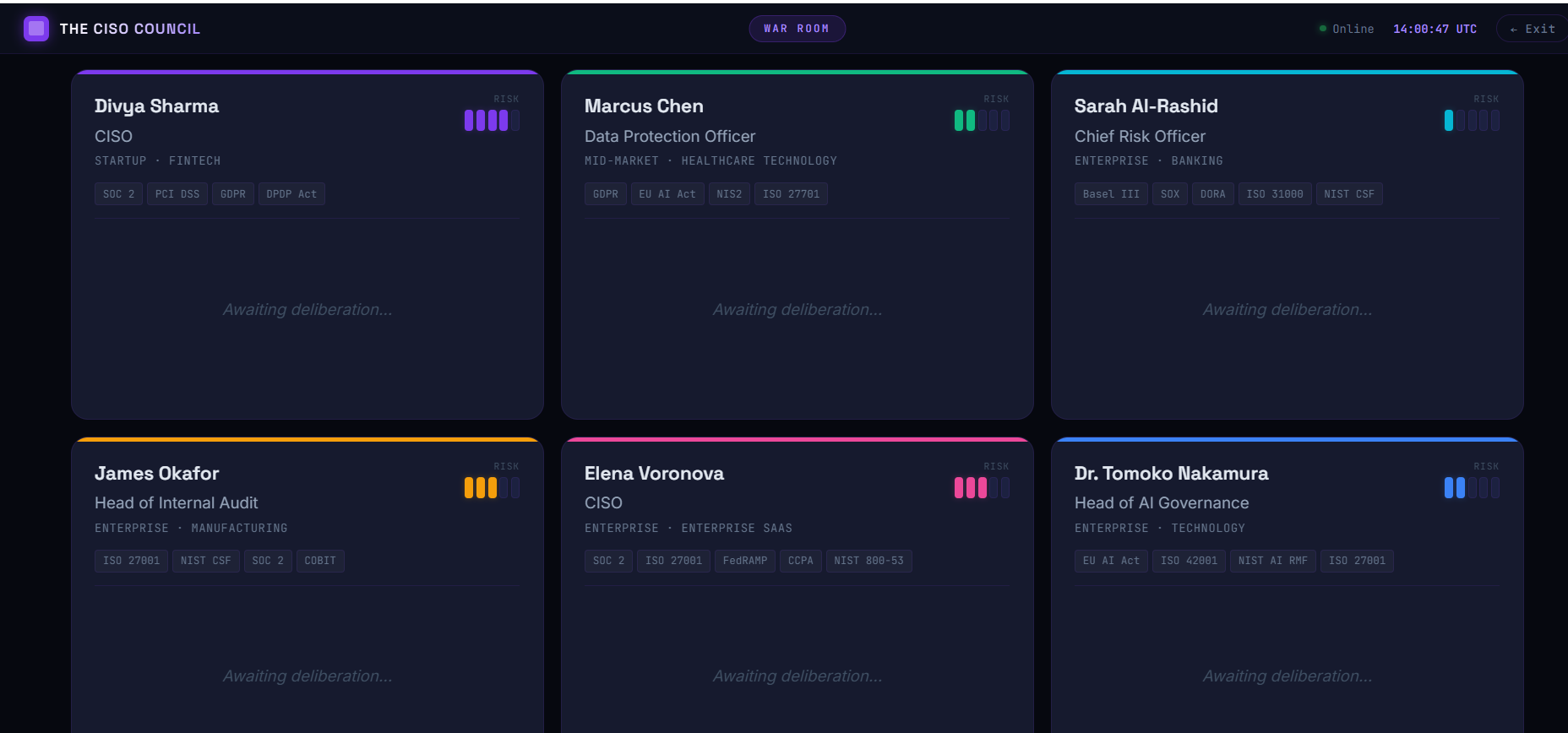
The CISO Council runs as a local web application with a dark, command-centre-style interface. Select a pre-built scenario or type your own cybersecurity dilemma, hit "Convene Council", and watch six AI security leaders deliberate in real time.
Features
| Feature | Description |
|---|---|
| 🎭 6 AI Personas | Each with distinct risk appetite, org context, and regulatory lens |
| 🤖 Multi-Model | Uses different AI models from different providers for genuine diversity |
| 📊 5-Dimension Scoring | Regulatory Defensibility, Practicality, Board-Readiness, Specificity, Risk Quantification |
| ⚖️ Chief Arbiter | Independent model synthesises the final verdict from all responses |
| 🤝 Consensus/Dissent | Identifies where the council agrees and where they split |
| 🔍 Ambiguity Analysis | Reveals what disagreements tell you about the decision's complexity |
| ✍️ Custom Scenarios | Type any cybersecurity dilemma directly into the War Room |
| 📄 PDF Export | Board-ready report with full deliberation, scores, and recommendations |
| 💰 Zero Cost | Runs entirely on free-tier API keys |
| 🔒 Fully Local | Nothing leaves your machine except API calls to your configured providers |
The Council
Six personas, each with a different risk appetite, organisational context, and decision-making style.
| Name | Role | Sector | Risk Appetite | Regulatory Focus | |
|---|---|---|---|---|---|
| 🟣 | Divya Sharma | CISO | Fintech Startup | 🟥🟥🟥🟥⬜ Tolerant | SOC 2, PCI DSS, GDPR, DPDP |
| 🟢 | Marcus Chen | Data Protection Officer | Healthtech | 🟩🟩⬜⬜⬜ Conservative | GDPR, EU AI Act, NIS2, ISO 27701 |
| 🔵 | Sarah Al-Rashid | Chief Risk Officer | Banking | 🟩⬜⬜⬜⬜ Ultra-Conservative | Basel III, DORA, SOX, ISO 31000 |
| 🟡 | James Okafor | Head of Internal Audit | Manufacturing | 🟧🟧🟧⬜⬜ Moderate | ISO 27001, NIST CSF, SOC 2, COBIT |
| ⚪ | Elena Voronova | CISO | Enterprise SaaS | 🟧🟧🟧⬜⬜ Moderate | SOC 2, ISO 27001, FedRAMP, NIST 800-53 |
| 🔴 | Dr. Tomoko Nakamura | Head of AI Governance | Technology | 🟩🟩⬜⬜⬜ Conservative | EU AI Act, ISO 42001, NIST AI RMF |
Quick Start
1. Clone
git clone https://github.com/KunalCyber/The-CISO-Council.git
cd The-CISO-Council
2. Install
python -m venv venv
source venv/bin/activate        # macOS/Linux
# venv\Scripts\activate         # Windows
pip install -r requirements.txt
3. Get Free API Keys
| Provider | Free Tier | Get Your Key |
|---|---|---|
| 🔷 Google AI Studio | ~500 requests/day | aistudio.google.com/apikey |
| ⚡ Groq | 14,400 requests/day | console.groq.com/keys |
| 🔶 Mistral | 1B tokens/month | console.mistral.ai/api-keys |
| 🧠 Cerebras | Generous free tier | cloud.cerebras.ai |
You only need 2 providers minimum to run a council session. Start with Google and Groq.
4. Configure
cp .env.example .env        # Add your API keys
cp config.yaml.example config.yaml
5. Launch the War Room
python -m council serve
Open http://localhost:8000 in your browser. Select a scenario or type your own. Hit "Convene Council".
Recommended Models
🏢 Production Setup (Best Results)
For serious decision support, use frontier models. The quality of deliberation is dramatically better.
| Council Seat | Provider | Model | Why |
|---|---|---|---|
| Divya Sharma | Anthropic | claude-opus-4 | Deepest reasoning, most nuanced analysis |
| Marcus Chen | OpenAI | gpt-4o | Strong regulatory knowledge, structured output |
| Sarah Al-Rashid | gemini-2.5-pro | Excellent quantitative reasoning, large context | |
| James Okafor | Anthropic | claude-sonnet-4.6 | Fast, high-quality, cost-effective |
| Elena Voronova | xAI | grok-3 | Independent reasoning, contrarian perspectives |
| Dr. Nakamura | OpenAI | o3 | Superior reasoning for complex governance questions |
| Scoring Model | Anthropic | claude-sonnet-4.6 | Best balance of reasoning depth and speed for evaluation |
💡 The scoring model is the most important model choice. It evaluates every council member's response and generates the consensus/dissent analysis. A stronger scoring model produces dramatically more accurate and useful verdicts.
🆓 Free Tier Setup (Getting Started)
Start here. Zero cost, works out of the box.
| Council Seat | Provider | Model | Cost |
|---|---|---|---|
| Divya Sharma | gemini-2.5-flash | Free | |
| Marcus Chen | Groq | llama-3.3-70b-versatile | Free |
| Sarah Al-Rashid | Mistral | mistral-small-latest | Free |
| James Okafor | Groq | mixtral-8x7b-32768 | Free |
| Elena Voronova | gemini-2.5-flash-lite | Free | |
| Dr. Nakamura | Cerebras | llama3.1-8b | Free |
| Scoring Model | gemini-2.5-flash | Free |
🔄 Switching to Production
- Get API keys from the providers you need:
| Provider | What You Get | Sign Up |
|---|---|---|
| Anthropic | Claude Opus 4, Claude Sonnet 4.6 | console.anthropic.com |
| OpenAI | GPT-4o, o3 | platform.openai.com/api-keys |
| xAI | Grok-3 | console.x.ai |
| Gemini 2.5 Pro (same key from free tier) | Already set up |
- Add the new keys to your
.env:
ANTHROPIC_API_KEY=sk-ant-...
OPENAI_API_KEY=sk-...
XAI_API_KEY=xai-...
GOOGLE_API_KEY=already set from free tier
-
Edit
config.yaml: comment out the free tier section and uncomment the production section. Both blocks are ready in the file, just swap which one is active. -
Restart:
python -m council serve
💡 You can mix and match. Use frontier models for 3 seats and free models for the other 3. Use a paid scoring model with free council members. Any combination works.
Scoring Dimensions
Every council response is evaluated independently on five dimensions:
| Dimension | What It Measures | Score Range |
|---|---|---|
| 📋 Regulatory Defensibility | Would this position hold up under regulatory scrutiny? | 1-10 |
| 🔧 Practicality | Can this be implemented with realistic resources? | 1-10 |
| 🏛️ Board-Readiness | Could you present this to a board without caveats? | 1-10 |
| 🎯 Specificity | Concrete actions or just "conduct a risk assessment"? | 1-10 |
| 📈 Risk Quantification | Does it frame risk in business terms? | 1-10 |
Built-in Scenarios
| Domain | Scenario | What It Tests |
|---|---|---|
| 🚨 Incident Response | Third-party vendor breach with customer data exposure | Notification timing, vendor management, board communication |
| ⚖️ Risk Acceptance | Accepting residual risk in accelerated cloud migration | Risk thresholds, compensating controls, audit implications |
| 🤖 AI Governance | Deploying AI credit scoring model with known demographic bias | EU AI Act compliance, bias thresholds, phased deployment |
Plus: type any cybersecurity dilemma directly into the War Room's custom scenario input.
Security
| Principle | Implementation |
|---|---|
| 🔑 Keys stay local | All API keys in .env only, never committed, never logged, never exported |
| 🏠 Runs on localhost | No public server, no external access |
| 📡 No telemetry | Zero analytics, zero data collection, zero tracking |
| 📄 Clean exports | PDF reports contain only scenario text and model responses, never credentials |
| 🛡️ Sanitised errors | API keys are redacted from all error messages and logs |
| 🚫 Gitignored | .env, config.yaml, outputs/, .claude/ are all blocked from git |
Project Structure
The-CISO-Council/
├── council/
│   ├── cli.py              # CLI with serve command
│   ├── config.py           # Configuration loader
│   ├── models.py           # Pydantic data models
│   ├── personas.py         # 6 council member definitions
│   ├── prompts.py          # System prompts and scoring rubrics
│   ├── providers.py        # Multi-provider LLM abstraction
│   ├── scoring.py          # 5-dimension scoring engine
│   ├── session.py          # Council session orchestrator
│   ├── report.py           # Report generator
│   ├── pdf_report.py       # Board-ready PDF export
│   └── server.py           # FastAPI server (War Room backend)
├── static/
│   ├── index.html          # War Room frontend
│   └── council-hero.png    # Landing page hero image
├── scenarios/              # YAML scenario bank
├── outputs/                # Generated reports (gitignored)
├── docs/                   # Write-up and documentation
├── .env.example            # API key template
├── config.yaml.example     # Council configuration template
├── requirements.txt
└── CLAUDE.md               # Project context for Claude Code
Contributing
We welcome contributions, particularly new scenarios, new personas, and provider integrations. See CONTRIBUTING.md for guidelines.
Inspired By
Andrej Karpathy's LLM Council for the original concept of assembling multiple LLMs to deliberate on hard questions. The CISO Council takes that idea and builds it into a complete cybersecurity decision-support tool with personas, scoring, consensus analysis, and board-ready exports.





Built by Kunal RK
Taking the hardest security decisions and making them a council vote.