README.md
June 11, 2026 · View on GitHub
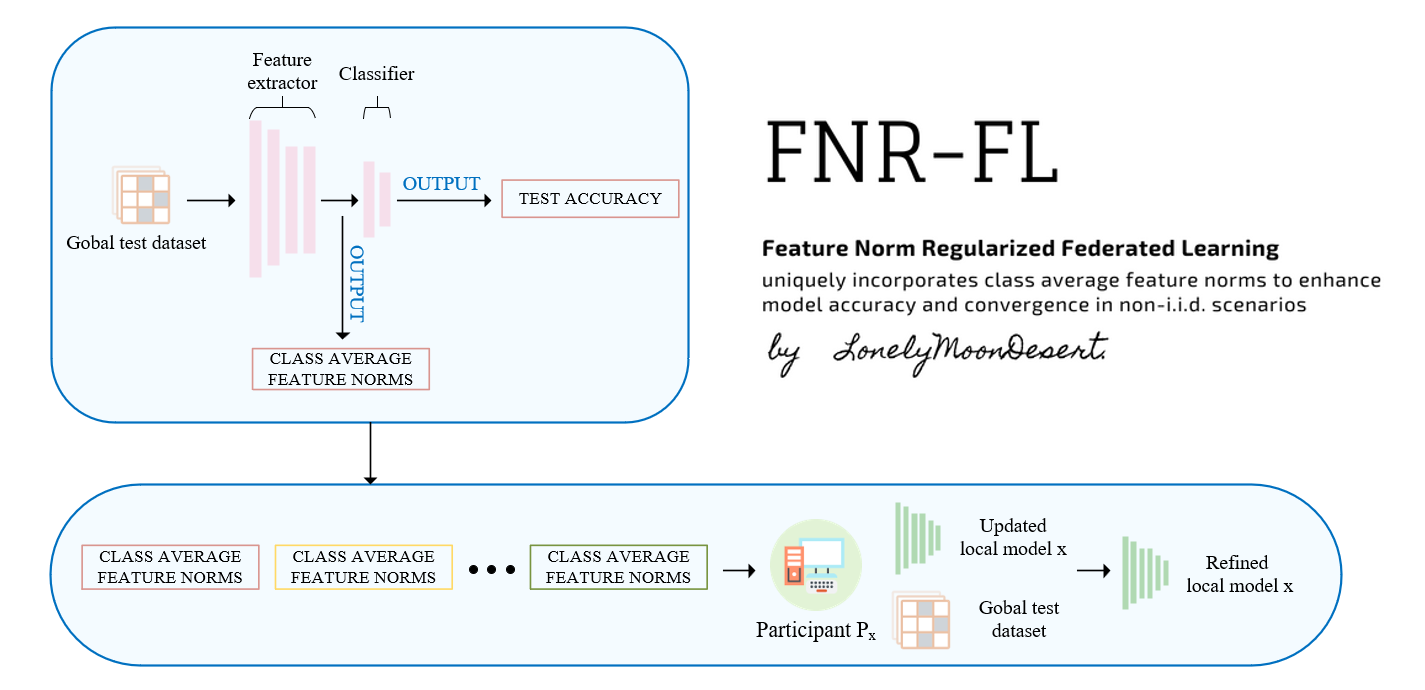
FNR-FL
The official implementation of Feature Norm Regularized Federated Learning (FNR-FL) algorithm, which uniquely incorporates class average feature norms to enhance model accuracy and convergence in non-i.i.d. scenarios.
Paper: Feature Norm Regularized Federated Learning: Utilizing Data Disparities for Model Performance Gains (Under reviewing)
Table of Contents
- FNR-FL
- Table of Contents
- Introduction to codes
- Experimental settings
- Installation
- Usage
- Contribute
- Citation
- Acknowledgements
- License
Introduction to codes
│  config.py
│  criteo-dis.npy
│  datasets.py             # Dataset-related
│  draw_noisy_image.py     # (Additional) Observe samples with added Gaussian noise, use `alg=fedavg` when calling
│  femnist-dis.npy
│  LICENSE_FNR-FL          # MIT LICENSE for this project (FNR-FL)
│  LICENSE_NIID-Bench      # MIT LICENSE for the base code of this project (NIID-Bench)
│  model.py                # Define some models
│  partition.py            # Define partitioning functions to achieve different non-i.i.d distributions
│  README.md
│  requirements.txt        # Project dependencies
│  resnetcifar.py          # Define ResNet
│  train.py                # (Main) Training entry point (for ResNet)
│  utils.py
│  vggmodel.py             # Define VGG
│
├─models                    # Folder to store model files
│     celeba_model.py
│     mnist_model.py
│     svhn_model.py
Experimental settings
| Non-i.i.d settings | Partition | Beta | Noise | |
|---|---|---|---|---|
| Label Distribution Skew | Distribution-based label imbalance | noniid-labeldir | 0.5 | 0 |
| Feature Distribution Skew | Noise-based feature imbalance | homo | 0 | 0.5 |
| Quantity Skew | / | iid-diff-quantity | 0.5 | 0 |
| Mixed skew | distribution-based label imbalance + quantity skew | mixed | / | / |
| Mixed skew | distribution-based label imbalance + noise-based feature imbalance | noniid-labeldir | 0.5 | 0.5 |
Installation
Install dependencies by running:
pip install -r requirements.txt
Usage
For example, to run the tests on ResNet18:
python train.py
--model=resnet
--dataset=cifar10
--alg=fnr
--lr=0.01
--cc_optimizer=sgd
--batch-size=64
--test_batch_size=32
--epochs=10
--calibration_epochs=5
--n_parties=10
--mu=0.01
--rho=0.9
--comm_round=10
--partition=mixed
--noise=0.0
--beta=0.5
--device=cuda:0
--datadir=../data/
--logdir=./logs/
--sample=1
--init_seed=0
--ccreg_w=0.5
The parameters and their descriptions are listed as follows:
| Parameter | Description |
|---|---|
model | The model architecture. Default = resnet. |
dataset | Dataset to use. Options: mnist, cifar10, fmnist, svhn. Default = mnist. |
alg | The training algorithm. Options: fedavg, fedprox, scaffold, fednova, moon,fnr. Default = fnr. |
lr | Learning rate for the local models, default = 0.01. |
batch-size | Batch size, default = 64. |
epochs | Number of local training epochs, default = 10. |
calibration_epochs | Number of calibration epochs, default = 5. |
ccreg_w | Weight of calibration regularization term. Default=1.0 |
n_parties | Number of parties, default = 2. |
mu | The proximal term parameter for FedProx, default = 0.001. |
rho | The parameter controlling the momentum SGD, default = 0. |
comm_round | Number of communication rounds to use, default = 10. |
partition | The partition way. Options: homo, noniid-labeldir, iid-diff-quantity. Default = homo |
beta | The concentration parameter of the Dirichlet distribution for heterogeneous partition, default = 0.5. |
device | Specify the device to run the program, default = cuda:0. |
datadir | The path of the dataset, default = ./data/. |
logdir | The path to store the logs, default = ./logs/. |
noise | Maximum variance of Gaussian noise we add to local party, default = 0. |
sample | Ratio of parties that participate in each communication round, default = 1. |
init_seed | The initial seed, default = 0. |
Contribute
Thanks goes to these wonderful people:
 LonelyMoonDesert 💻 🎨 🤔 |
This project follows the all-contributors specification. Contributions of any kind welcome!
Citation
(Back to top) If you find our work useful in your research, please consider citing our paper:
hided
Acknowledgments
(Back to top)
We would like to express our sincere gratitude to the Xtra-Computing Group for their NIID-Bench repository, which has been instrumental in the development of our project. Our codebase is built upon the foundational work provided by their extensive research and resources in non-independent and identically distributed (non-i.i.d.) data for federated learning. We appreciate the opportunity to contribute to the ongoing dialogue in this field and thank the Xtra-Computing Group for their valuable contributions to the community.