readme.md
June 23, 2026 · View on GitHub
One engineer. Ten years. A bindless, GPU-driven engine with real-time path-traced global illumination.
A personal R&D engine, not a commercial product. No roadmap promises, no support queue, no compromises on the vision.



The Engine
Spartan started as a university project. Ten years of nights and weekends later, its rendering technology runs in Godot Engine and S.T.A.L.K.E.R. Anomaly, ships in a published programming book, and anchors a community of 600+ engineers on Discord.
It is built around one philosophy: favor real-time over baked, dynamic over static, modern over safe. Every system here exists to serve that.
There is a destination that gives all this tech a purpose. Curious? Read the plan →
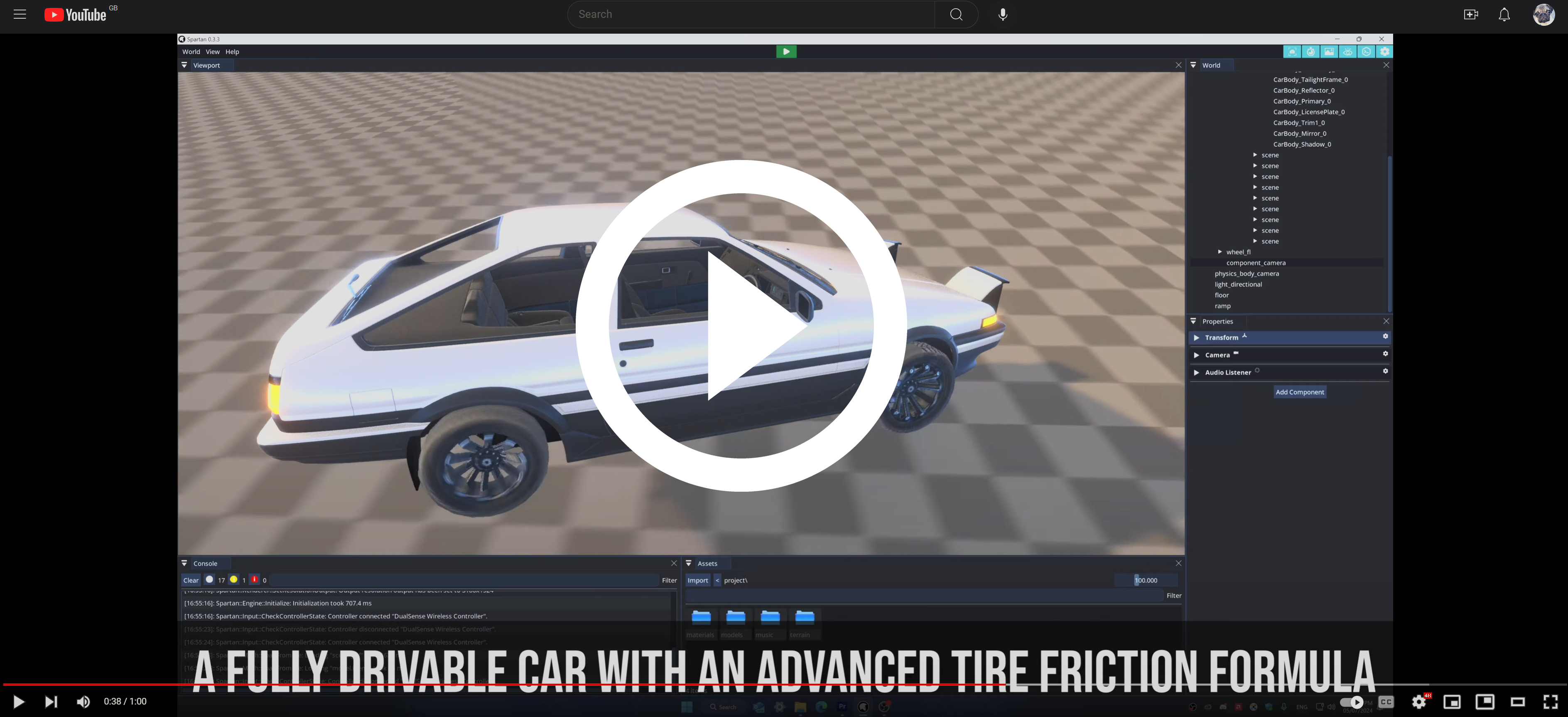
The Trailer
Worlds
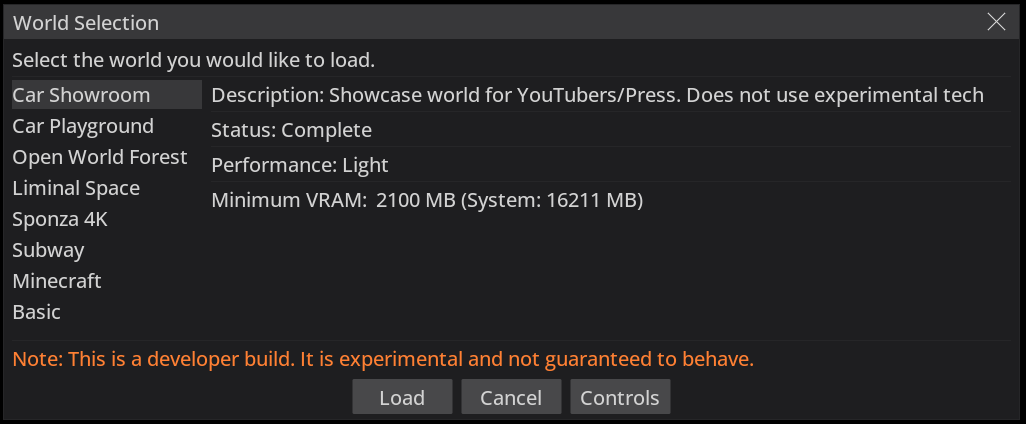
Launch the engine and choose from a selection of default worlds. Each is physics-enabled—walk around, pick up objects with your mouse, or take a car for a spin.
Forest

The most demanding world: 256 million procedurally generated grass blades (inspired by Ghost of Tsushima), spanning 64.1 km² covered with thousands of trees and rocks.
More Worlds
| Sponza 4K | Basic |
|---|---|
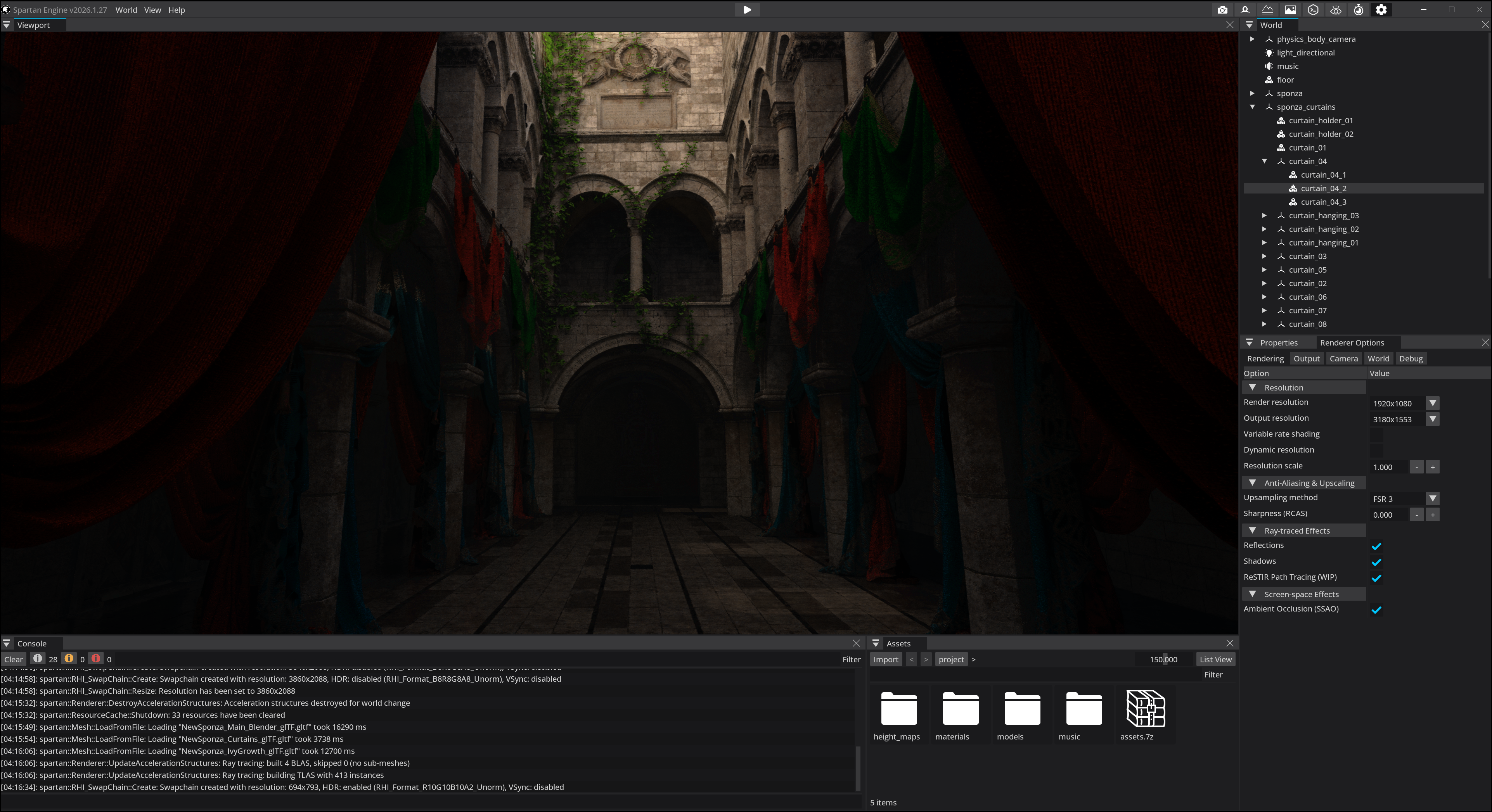 Classic Dubrovnik building—ideal for path tracing | 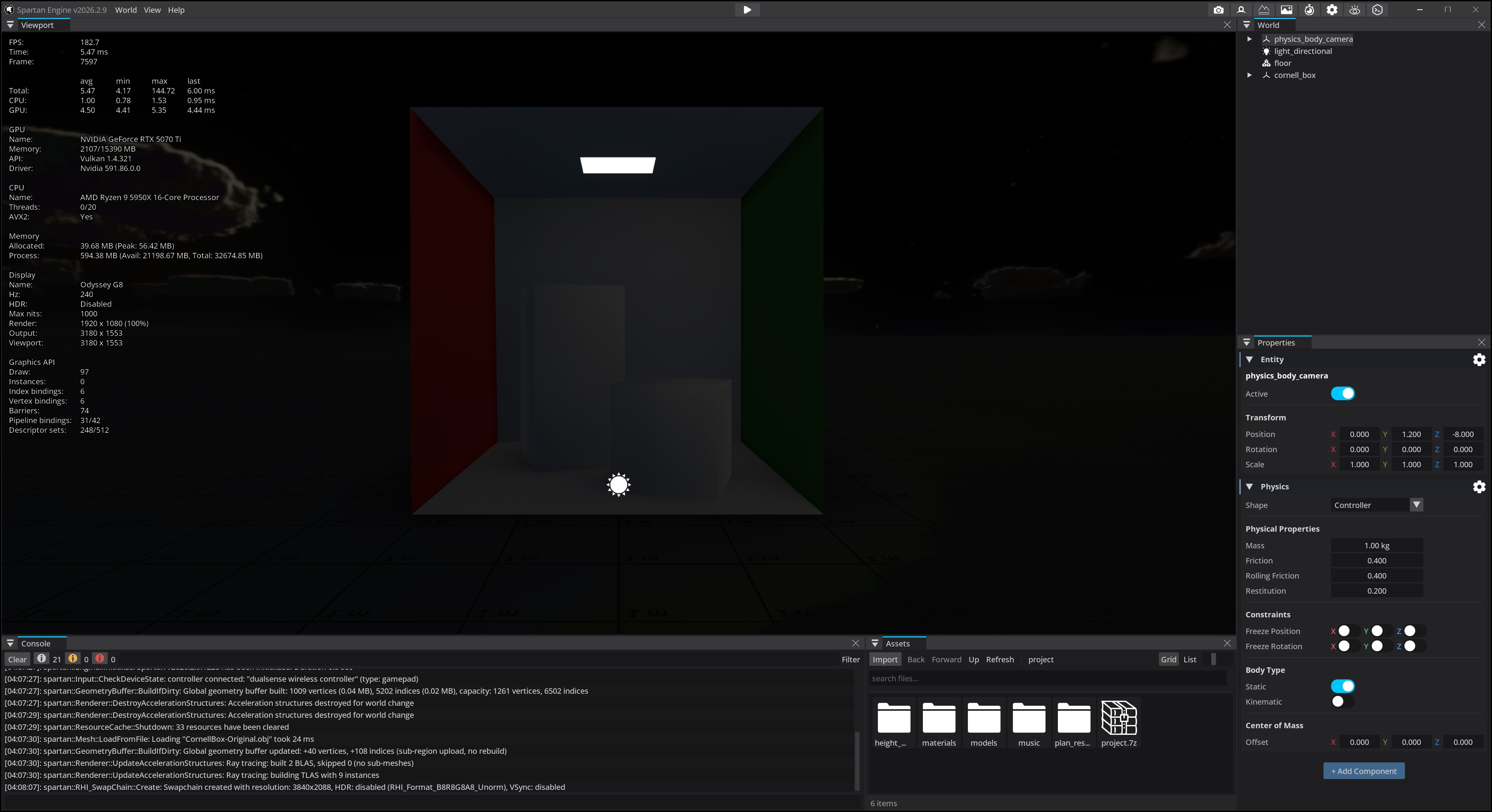 Contains some render test objects |
| Liminal Space | Showroom |
|---|---|
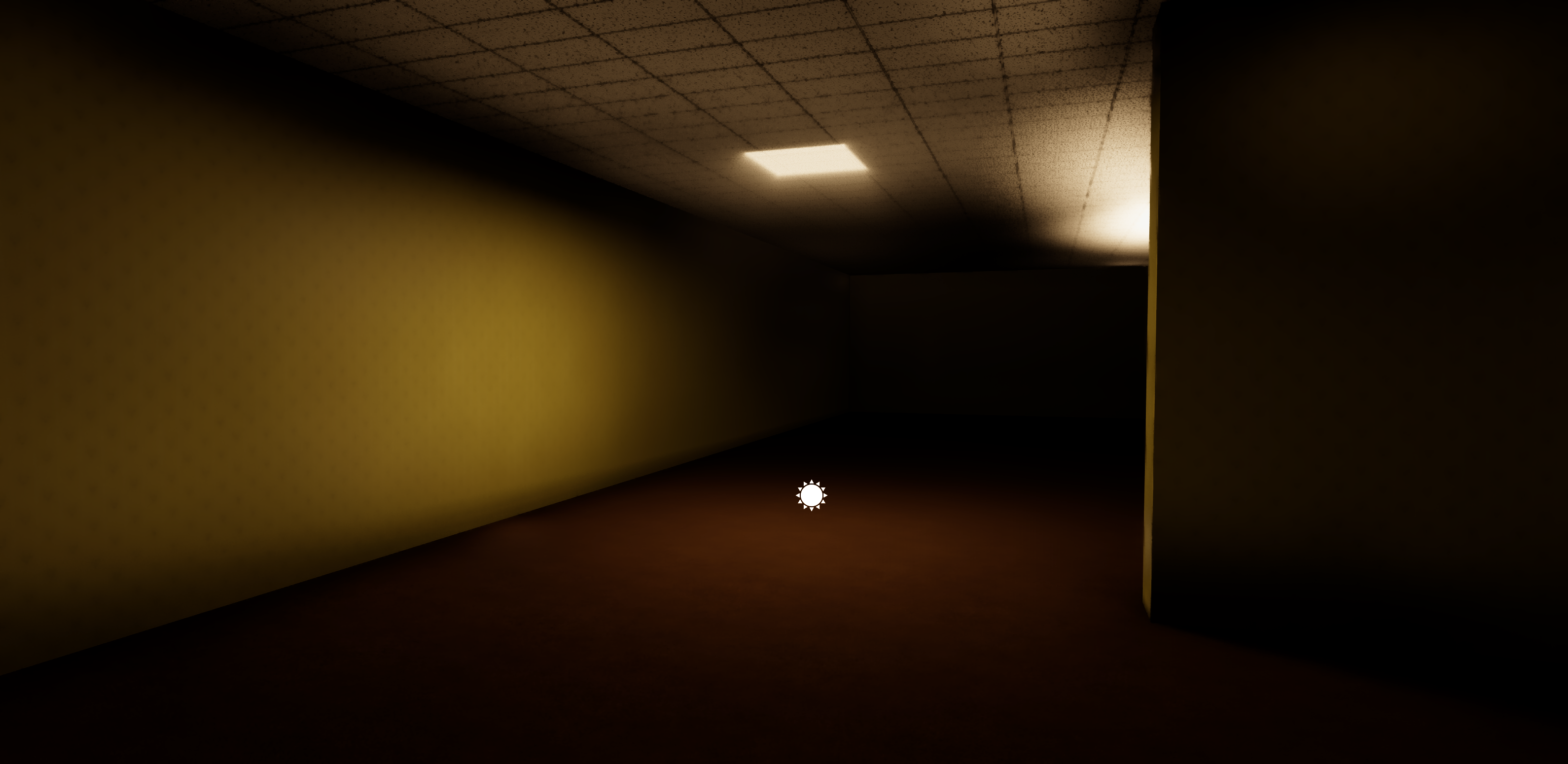 Reality shifts to a nearby frequency | 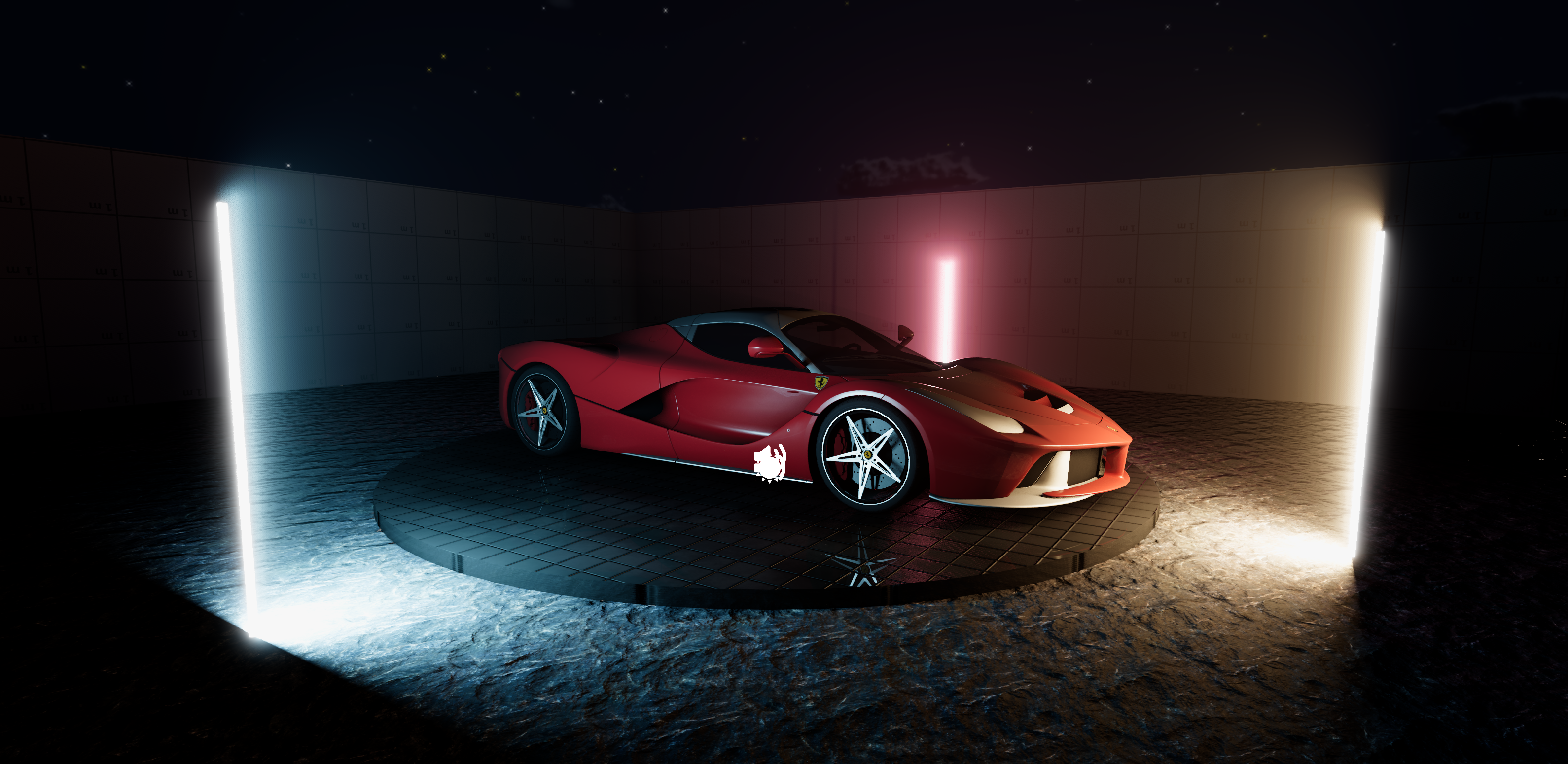 Clean showcase—no experimental tech |
| The Plan |
|---|
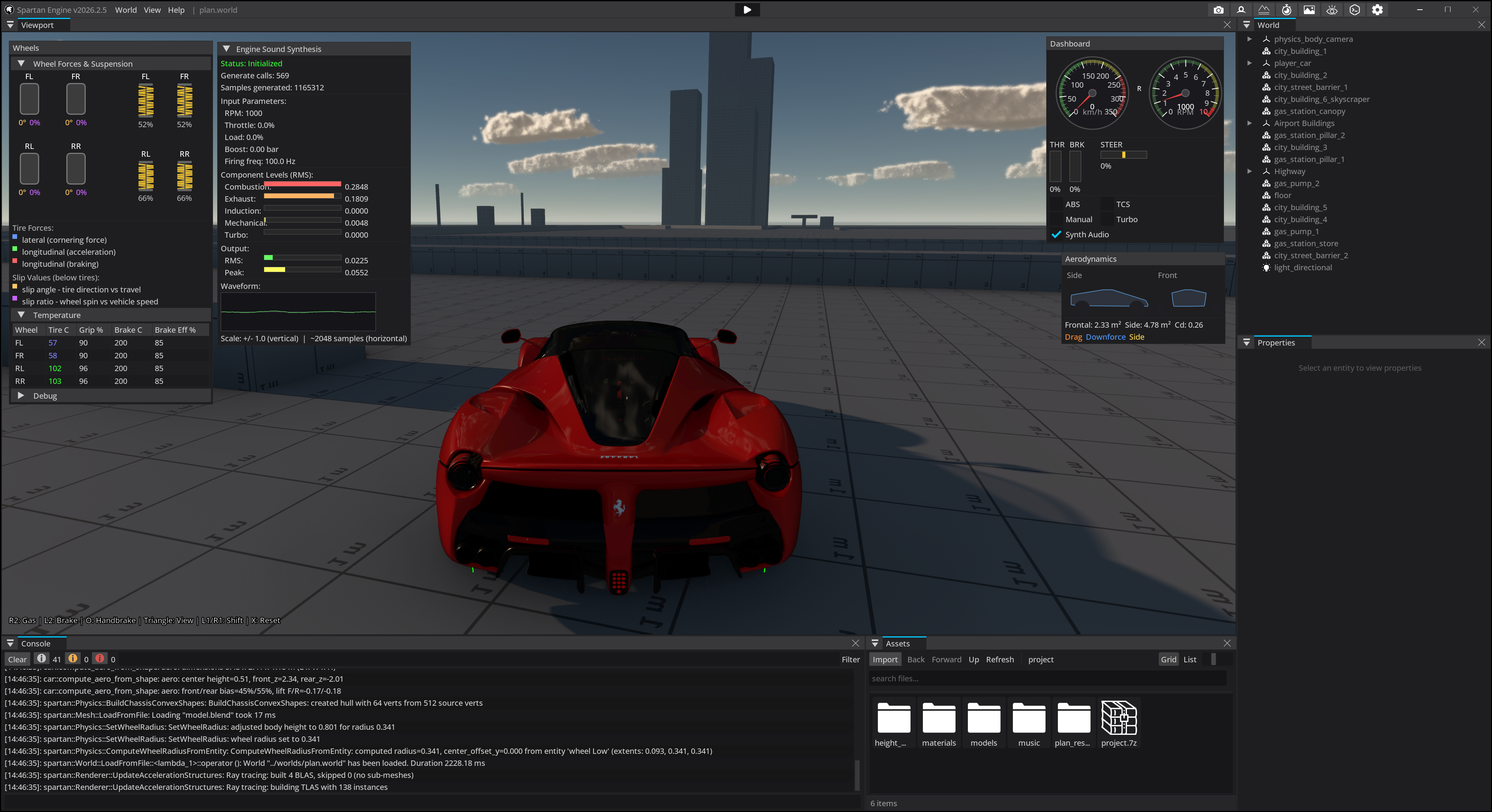 A neon-soaked city, built to push the engine toward real-time path-traced driving through rain-slicked streets at 60fps, that's the plan. |
Rendering
The renderer is built around one principle: the GPU owns the data. Every resource (geometry, materials, textures, lights, transforms, AABBs) lives in persistent, globally accessible buffers. No per-draw descriptor updates, no per-draw resource binding, no CPU-side draw loops.
Architecture
- Zero-binding draw path, all per-draw data lives in a single bindless storage buffer, push constants carry only an index
- Single global vertex and index buffer for all geometry (inspired by id Tech), with vertex pulling that bypasses the Input Assembler and is shared by rasterization and ray tracing
- GPU-driven indirect rendering with per-meshlet frustum, Hi-Z occlusion, and backface cone culling, the CPU issues a single
DrawIndexedIndirectCountper pass - Meshlet clustering via meshoptimizer, no mesh shader dependency
- Bindless everything: materials, lights, samplers, uber shaders, minimal PSO permutations
- Universal HLSL compiled for both Vulkan (SPIR-V) and DirectX 12
- GPU-side asset processing: mip generation (FidelityFX SPD) and texture compression (Compressonator) at load time, not baked offline
- Unified deferred rendering, opaque and transparent surfaces share the same BSDF and render path
- Async compute for SSAO and screen-space shadows, parallel with shadow rasterization
Lighting and Global Illumination
- Clustered deferred shading with a GPU-built logarithmic-Z grid and cone-vs-AABB culling for spots, scales to many local lights at near-constant per-pixel cost
- ReSTIR path tracing with spatiotemporal reservoir resampling for real-time multi-bounce global illumination
- Hardware ray-traced reflections and shadows via ray queries
- Atmospheric scattering and image-based lighting with bent normals
- Volumetric clouds (Nubis-style) baked into the sky panorama, with cumulus and cirrus layers, multi-scatter lighting and aerial perspective
- Volumetric fog with temporal reprojection and shadow casting
- FFT ocean with a Tessendorf spectrum and multi-cascade IFFT in compute, driving a camera-following clipmap with choppy displacement, dynamic normals and crest foam
- Screen-space shadows (inspired by Days Gone) and XeGTAO ambient occlusion
- Shadow map atlas with fast filtering and penumbra estimation
Performance and Upscaling
- Variable rate shading and dynamic resolution scaling
- TAAU, temporal anti-aliasing with built-in upsampling, Halton-jittered with variance-clip history reprojection
- Intel XeSS 2 upscaling
- FXAA
- Custom breadcrumbs for GPU crash tracing and post-mortem debugging
Camera and Post-Processing
- Physically based camera with auto-exposure and physical light units (lumens and kelvin)
- Tonemappers: ACES, AgX, Gran Turismo 7 (default)
- HDR10 output
- Bloom, motion blur, depth of field, chromatic aberration, film grain, sharpening (CAS)
Car Simulation — 200Hz
A full vehicle dynamics simulation running inside the PhysX fixed-timestep loop.
| System | Details |
|---|---|
| Tires | Pacejka MF 5.2 with combined slip, thermal model, pressure, wear, multiple surfaces |
| Suspension | Convex hull sweep contact, spring-damper, anti-roll bars, bump stops, bump steer, camber/toe |
| Weight transfer | Geometric + elastic lateral split via roll center heights and roll stiffness |
| Drivetrain | Engine torque curve, turbo, 7-speed gearbox, rev-match, open/locked/LSD differentials, RWD/FWD/AWD |
| Brakes | Thermal model with fade, front/rear bias, slip-threshold ABS |
| Aerodynamics | Drag, front/rear downforce, ground effect, DRS, rolling resistance |
| Steering | Ackermann geometry, high-speed reduction, self-aligning torque |
| Assists | ABS, traction control, handbrake |
| Integration | Semi-implicit Euler with consolidated net-torque per wheel |
| Input | Controllers and steering wheels with haptic feedback |
| Camera | GT7-inspired chase camera with speed-based dynamics |
Engine Systems
| System | Details |
|---|---|
| Particles | GPU-driven with compute emission and simulation, depth-buffer collision, soft blending |
| Animation | Skeletal hierarchies with keyframed clips and four-bone vertex skinning |
| Physics | PhysX with rigid bodies, character kinematics, and vehicle dynamics |
| Scripting | Lua 5.4 via Sol2 with full engine API and lifecycle callbacks |
| Audio | 3D positional audio, streaming, reverb, procedural synthesis via SDL3 |
| Input | Keyboard, mouse, controllers, and steering wheels with haptic feedback |
| Entity system | Component-based with transform hierarchies, prefabs, and XML serialization |
| Threading | Hardware-aware thread pool with parallel loops and nested parallelism detection |
| VR (WIP) | OpenXR with Vulkan multiview single-pass stereo across the full pipeline |
| Profiling | Nsight/RGP-style timeline with separate graphics and async compute lanes, RenderDoc integration |
| Asset import | 40+ model formats (Assimp), 30+ image formats (FreeImage), 10+ font formats (FreeType) |
| Editor | ImGui-based with hierarchy, asset browser, inspector, script and shader editors, gizmos, profiler |
Getting Started
Building
One-click project generation—see the Building Guide for details.
Learning the Engine
Start with Game.cpp, it shows how default worlds are loaded and is the best entry point for understanding the engine's structure. For gameplay scripting, check out the Lua Scripting Guide, it covers the full API, lifecycle callbacks, and examples.
Podcast
 |
Exploring the tech world and beyond Meeting the brightest minds across cutting-edge industries. 📺 Watch on YouTube 🎧 Listen on Spotify |
Community
Contributing
Contributors get access to exclusive perks designed to accelerate learning and skill development.
Sponsorship
I cover the Dropbox hosting that makes the one-click setup work. If Spartan has taught you something, or if you just want to fuel another decade of this, sponsorship goes directly into keeping the lights on and the project moving.
Projects Using Spartan
| Project | Description |
|---|---|
| Godot Engine | Integrates Spartan's TAA (view source) |
| S.T.A.L.K.E.R. Anomaly | Rendering addon using Spartan's source (ModDB) |
| Programming Book | Jesse Guerrero's beginner programming book features Spartan's code and community |
| University Thesis | Originally created as a portfolio piece while studying at the University of Thessaly with Professor Fotis Kokkoras |
Using code from Spartan? Reach out, I'd love to showcase your project!
License
MIT License, free to use with attribution.