Spatio-Temporal-Graph-Convolutional-Networks-A-Deep-Learning-Framework-for-Traffic-Forecasting
July 9, 2018 · View on GitHub
reference
- https://www.zhihu.com/question/54504471
- https://en.wikipedia.org/wiki/Laplacian_matrix
- https://tkipf.github.io/graph-convolutional-networks/
- https://www.inference.vc/how-powerful-are-graph-convolutions-review-of-kipf-welling-2016-2/
- http://cs229.stanford.edu/section/cs229-moregaussians.pdf
abstract
- Spatio-Temporal Graph Convolutional Network
- tackle the time series prediction problem in traffic domain
- complete convolutional structures.
introduction
- linear regression perform well on short interval forecast instead of long terms
- this is a data-driven and using spotio-temporal information method.
- fully utilize spatio-information instead of treating it as discrete units

- where , n is an observation vector of n road segments at time step t
Convolutions on Graphs

-
normalized Laplacian
- Random walk normalized Laplacian
- analogy to The Multivariate Gaussian Distribution

- Symmetric normalized Laplacian L:
- Random walk normalized Laplacian
-
first generation of GNC
-
second generation of GNC
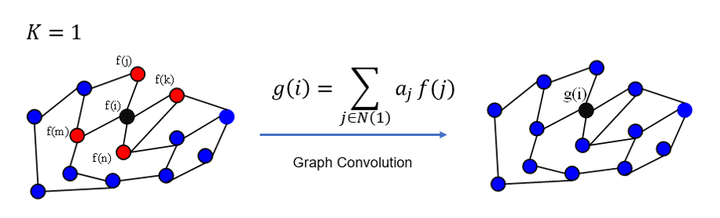
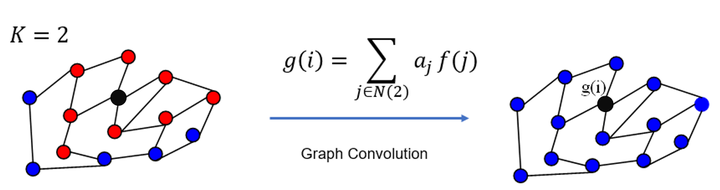
- if k == n, receptive field is n hop
-
third generation of GNC

- where , and are fixed
- The only trainable parameters are and
- in the final version the authors even further fix





Network Architecture
- main architecture

- GLU architecture

- main equation

- final equation

Experiments
- linear interpolation method for missing values
- normalized by standard score method((x-mean)/std)
- adjacency matrix
 10,0.5
result

