testtruth
August 26, 2026 · View on GitHub


All tests are green. That's exactly the problem.
An agent is told to fix a bug. It changes the implementation and the tests. CI goes green. The pull request gets merged.
Nobody checks whether the tests still test anything.
testtruth measures the strength of your test suite before and after a change — using the same mutants on both sides — so a pull request that weakened the tests cannot hide behind a green checkmark.
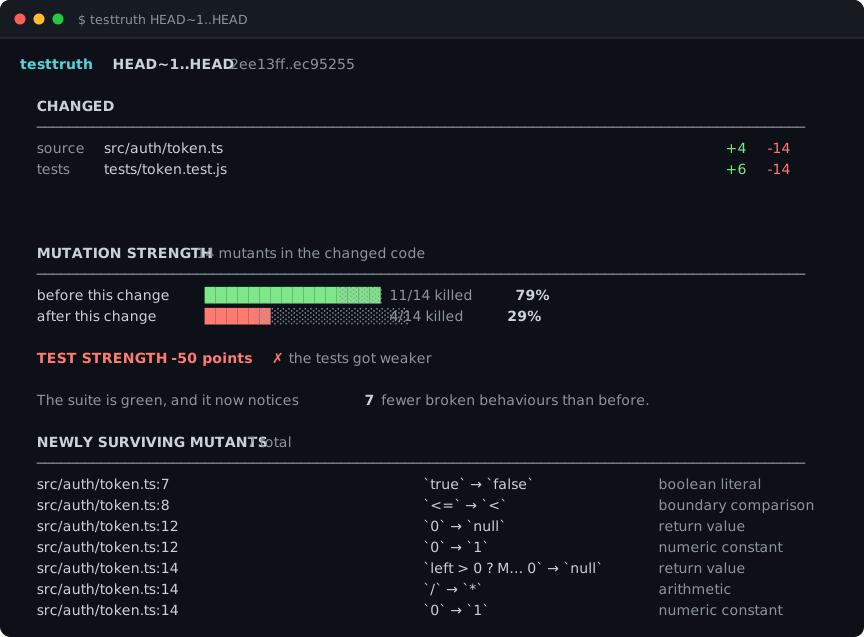
Seven ways to break that code that the old tests caught and the new tests do not. Every one of them still passes CI.
See it in 60 seconds
git clone https://github.com/T4LEL/testtruth && cd testtruth
npm install && npm run build
npm run demo
examples/ generates a two-commit repository whose second commit is exactly the
pull request above: the source is refactored without changing behaviour, and the
tests are quietly replaced with assert.equal(typeof result, 'boolean'). Both
commits are fully green. Only the mutation score moves.
Use it on a real change
npx testtruth                       # HEAD~1..HEAD
npx testtruth main..HEAD
npx testtruth origin/main...HEAD    # merge-base, like a pull request
npx testtruth abc1234               # one commit against its parent
Point it at your suite if npm test is not right:
npx testtruth --test-cmd "npx vitest run"
npx testtruth --test-cmd "npx vitest run {tests}"   # only the changed test files
What it actually does
- Read the diff with
--unified=0, so it knows the exact lines that changed. - Parse the changed source files with the TypeScript compiler's own parser and generate mutants from expressions on those lines only.
- Check the suite is green before touching anything.
- Score every mutant against the tests as they are now.
- Swap the changed test files back to their base-revision content and score the same mutants again.
- Report the difference.
Step 5 is the whole point. Because the mutants are identical on both sides and only the test files moved, the delta is attributable to the test change and nothing else.
Why the parser matters
The naive way to build a mutation tool is a regex over the source. It cannot
tell a < b from Array<string>, so it emits mutants that do not compile.
Those make the suite error out — which scores as killed. Enough of them and
every test suite looks strong, which is precisely backwards.
testtruth generates mutants from the AST, and has a property test asserting
every mutant it can produce still parses, in both .ts and .tsx.
Mutation operators
| Category | Mutation |
|---|---|
| Boundary | < ↔ <=, > ↔ >= |
| Equality | === ↔ !==, == ↔ != |
| Logic | && ↔ ||, ?? → ||, !x → x |
| Arithmetic | + ↔ -, * ↔ /, % → * |
| Literals | true ↔ false, 0 ↔ 1, n → n+1 |
| Return | return expr → return null |
Enum members and type-level literals are skipped — they are not runtime behaviour.
Use it in CI
- run: npx testtruth origin/${{ github.base_ref }}...HEAD --fail-under 10
Exits 1 when test strength drops by more than the given number of points. A
refactor that genuinely removes redundant assertions will drift a few points; a
pull request that gutted the suite will not.
Safety
testtruth edits files in your working tree, because that is the only place your
project's own test command reliably runs — node_modules, path aliases,
generated files and all.
So it is careful about it:
- It refuses to start on a dirty working tree. Commit or stash first, or
pass
--allow-dirtyif you accept the risk. - Every file is snapshotted before its first write and restored afterwards.
- The restore also runs on Ctrl+C and
SIGTERM. - It only ever writes to files that appear in the diff you asked about.
Options
--test-cmd <cmd>     how to run the suite (default: npm test)
--max-mutants <n>    cap the mutant count (default: 30)
--timeout <sec>      per-run timeout (default: 120)
--limit <n>          survivors listed (default: 12)
--repo <dir>         repository root (default: .)
--fail-under <pts>   exit 1 if strength drops more than this
--allow-dirty        run despite uncommitted changes
--json               machine-readable result
--no-color           disable colour
TESTTRUTH=1 and CI=1 are set in the test command's environment.
Honest limits
- TypeScript and JavaScript only.
.ts,.tsx,.js,.jsx,.mjs,.cjs. Python and Go are not supported yet. - One suite run per mutant. With the default cap of 30 mutants and a
before/after comparison, that is up to 61 runs of your test command. Scope it
with
--test-cmd "... {tests}"if your suite is slow. - No before/after when the old tests cannot run. If the change altered an API the base-revision tests called, they will not compile against the new source. testtruth says so and reports the after-side score alone rather than inventing a comparison.
- Equivalent mutants exist. Some surviving mutants are behaviourally identical to the original and no test could ever kill them. They are noise in the absolute number, but they appear on both sides, so they cancel out of the delta — which is the number this tool asks you to read.
- A drop is a question, not a verdict. Sometimes deleting a brittle assertion is right. testtruth makes the trade visible; the judgement is still yours.
License
MIT