README.md
April 3, 2022 · View on GitHub
LF-DFnet: Light Field Image Super-Resolution Using Deformable Convolution, TIP 2021
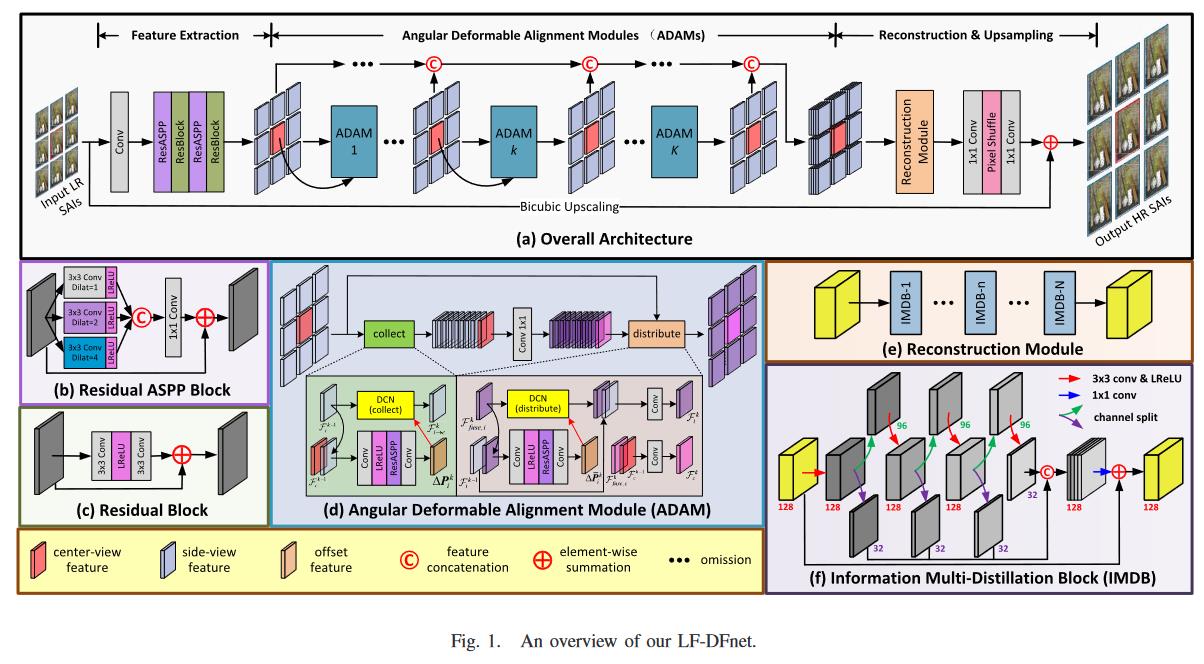
News: We recommend our newly-released repository BasicLFSR for the implementation of our LF-DFnet. BasicLFSR is an open-source and easy-to-use toolbox for LF image SR. A number of milestone methods have been implemented (retrained) in a unified framework in BasicLFSR.
Directly Download the Results of LF-DFnet:
We share the super-resolved LF images generated by our LF-DFnet on all the 5 datasets for 4xSR. Then, researchers can compare their algorithms to our LF-DFnet without performing inference. Results are available at Baidu Drive (Key: nudt).
Datasets:
We used the EPFL, HCInew, HCIold, INRIA and STFgantry datasets for both training and test. Please first download our dataset via Baidu Drive (key:nudt) or OneDrive, then place the 5 datasets to the folder ./Datasets/.
Requirement:
- PyTorch 1.3.0, torchvision 0.4.1. The code is tested with python=3.7, cuda=9.0.
- Matlab (For training/test data generation and result image generation)
Compile DCN:
- Cd to
code/dcn. - For Windows users, run
cmd make.bat. For Linux users, run bashbash make.sh. The scripts will build DCN automatically and create some folders. Seetest.pyfor example usage.
Train:
- Run
GenerateTrainingData.mto generate training data. The generated data will be saved in./Data/TrainData_UxSR_AxA/(U=2,4; A=3,5,7,9). - Run
train.pyto perform network training. Note that, the training settings intrain.pyshould match the generated training data. Checkpoint will be saved to./log/.
Test on our datasets:
- Run
GenerateTestData.mto generate input LFs of the test set. The generated data will be saved in./Data/TestData_UxSR_AxA/(U=2,4; A=3,5,7,9). - Run
test.pyto perform network inference. The PSNR and SSIM values of each dataset will be printed on the screen. - Run
GenerateResultImages.mto convert '.mat' files in./Results/to '.png' images to./SRimages/.
Results in Our Paper:
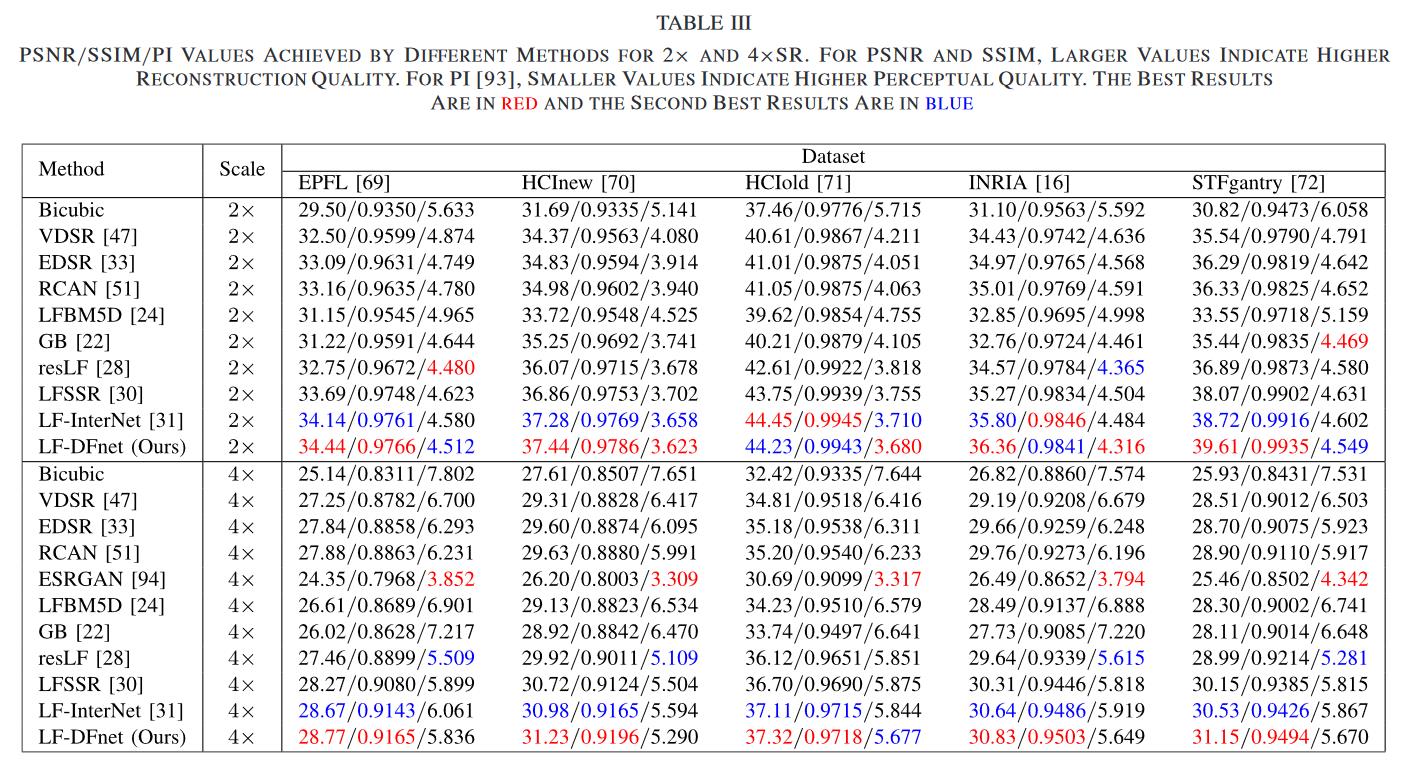
Quantitative Results:
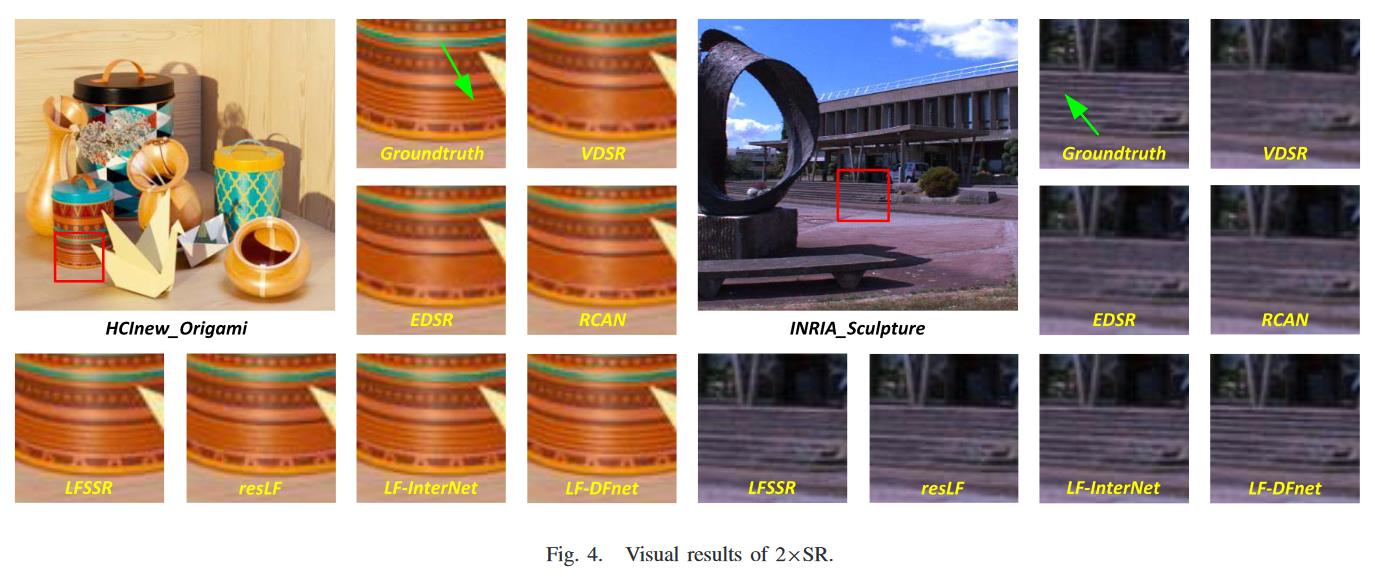
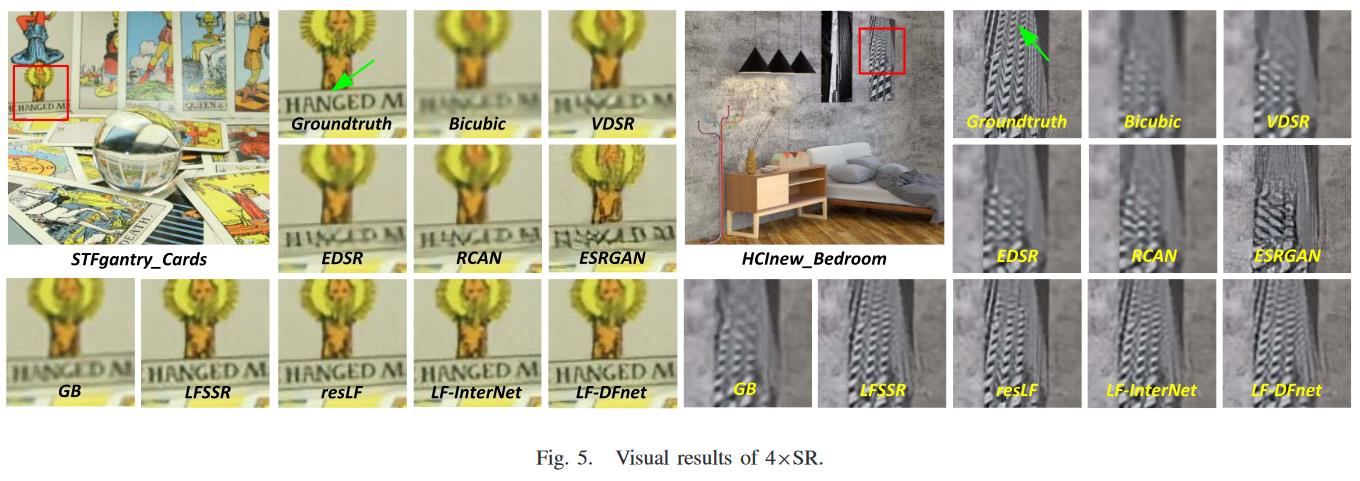
Visual Comparisons:
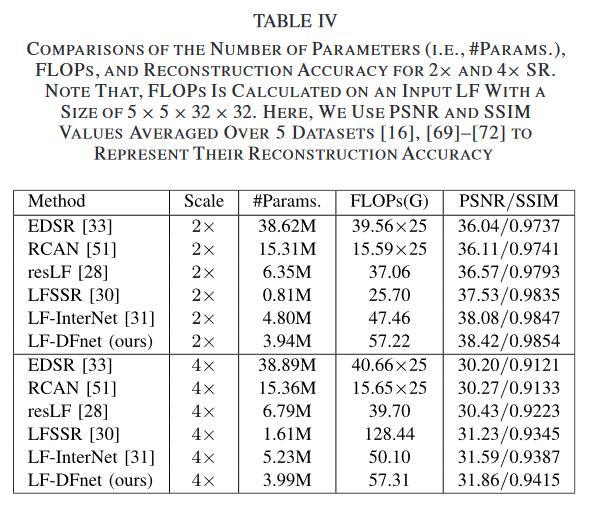
Efficiency:
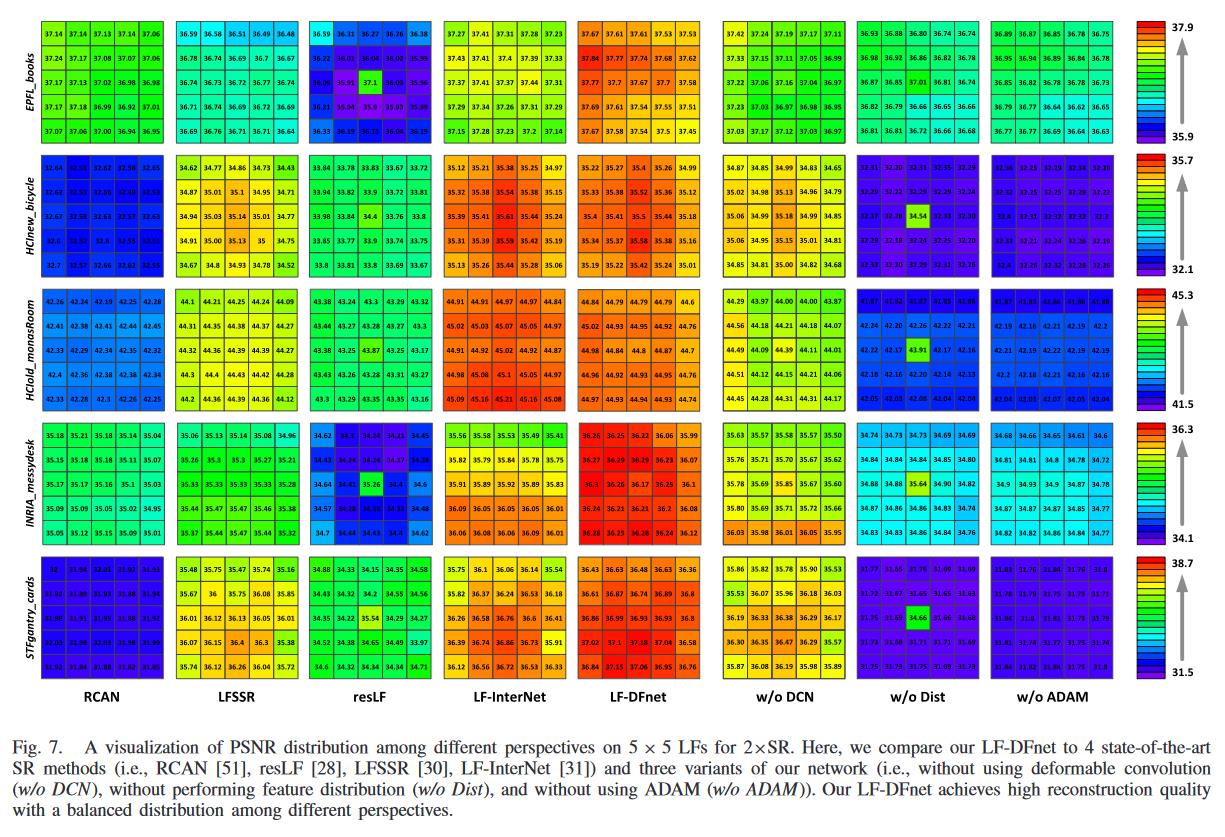
Performance w.r.t. Perspectives:
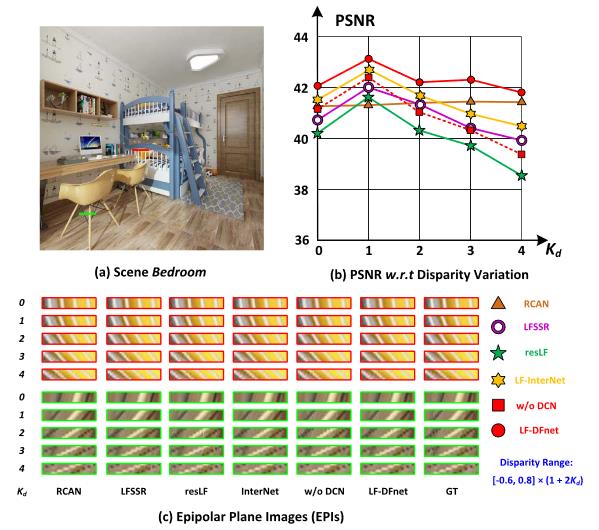
Performance w.r.t. Baseline Lengths:
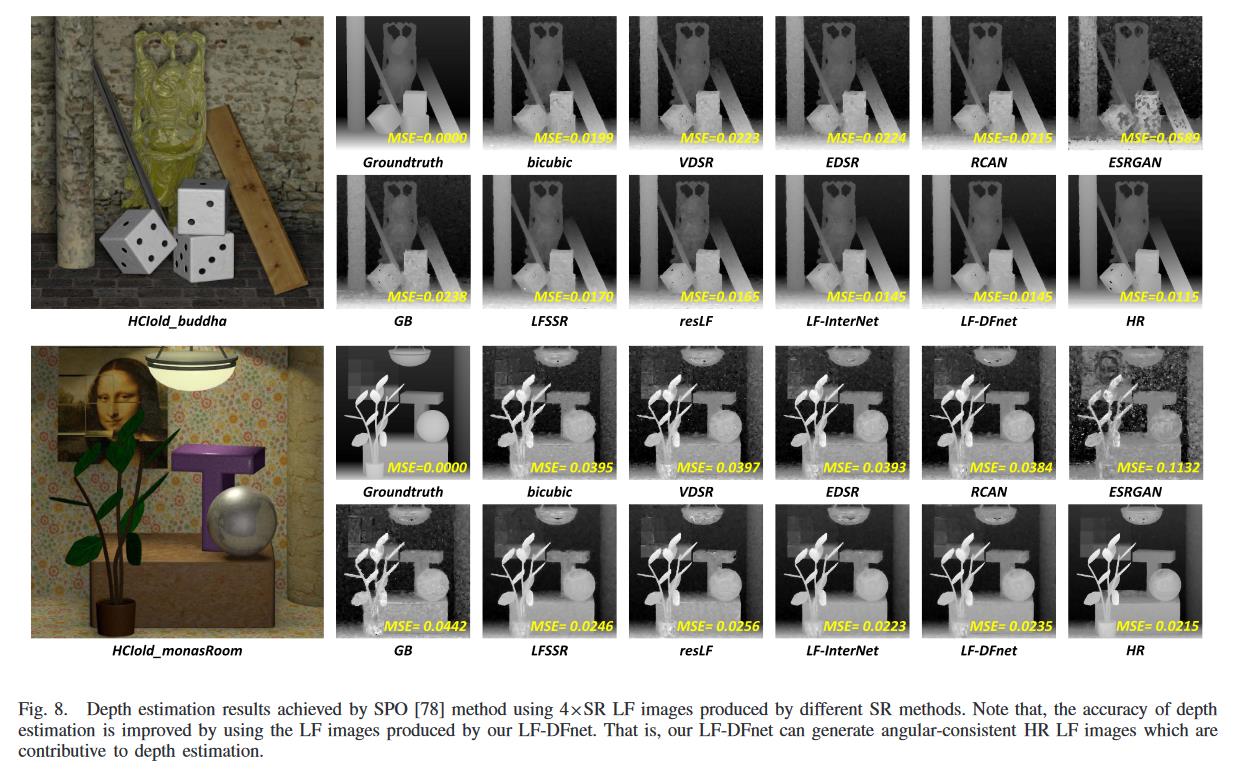
Benefits to Depth Estimation (i.e., Angular Consistency):
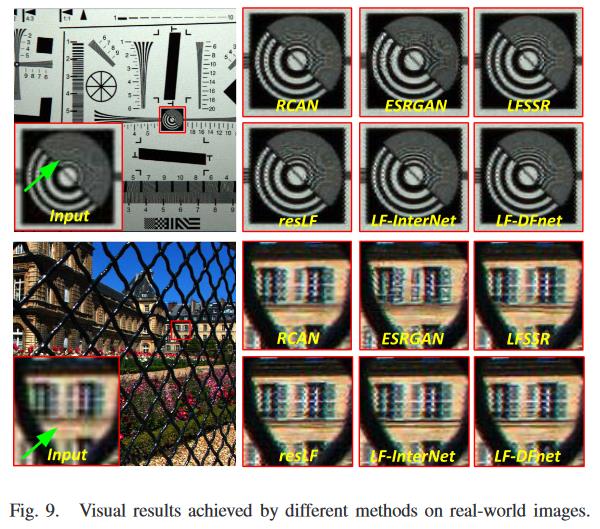
Performance on Real LFs:
Citiation:
If you find this work helpful, please consider citing the following paper:
@article{LF-DFnet,
  author  = {Wang, Yingqian and Yang, Jungang and Wang, Longguang and Ying, Xinyi and Wu, Tianhao and An, Wei and Guo, Yulan},
  title   = {Light Field Image Super-Resolution Using Deformable Convolution},
  journal = {IEEE Transactions on Image Processing},
  volume  = {30),
  pages   = {1057-1071},
  year    = {2021},
}
Acknowledgement
The DCN part of our code is referred from DCNv2 and D3Dnet. We thank the authors for sharing their codes.
Contact
Any question regarding this work can be addressed to wangyingqian16@nudt.edu.cn.