linemake Atomic and Molecular Line List Generator
April 20, 2021 · View on GitHub
Differences
This repository is Alex Ji's fork. He has changed compared to the main repository:
- Using the fixed Masseron line list from http://cdsarc.u-strasbg.fr/viz-bin/qcat?J/A+A/571/A47
- note that I have included ALL C-H lines, including incredibly weak ones. You'll almost certainly want to do a cut (in my experience loggf > -6 has been fine)
- Added/updated some atomic lines to goodgf:
- O I: 6300, 6363, 777nm triplet, 8446, (from VALD/Caffau+08)
- Na: 5682, 5688, 5889, 5895 from NIST (AA for D lines, A for the other two). Note for 5688 I merged the loggf a strong and a weak line at the same wavelength.
- Mg: I put in 9 lines from NIST of varying quality. Probably of particular note is that the Mg b lines now have NIST A and NIST B+, and they are a bit different from Kurucz by 0.01 dex.
- Al: I put in four Al lines 3944, 3961 (NIST B+) and 6696, 6698 (NIST C+)
- Si: I put in a bunch of lines with NIST values. Except for 3905, they are grade C and below.
- K: I put in the NIST AAA values for 7665 and 7699, which are within .01 of the Kurucz values.
- Sr: For 4215 I updated from an older NIST/A to NIST AA value.
- Y II: I added a line at 4883 from HANNAFORD that is strong and has been reliable
Changes compared to Alex's previous version of linemake (used for the first S5 paper)
- Possibly a lot of other changes below 3000A, I did not bother to modify this.
- I no longer have included all the NIST Fe II lines into the synthesis. I guess they have decided Kurucz is better than bad NIST.
- There are more melendez et al lines for Fe II
- The Ca lines have been replaced with an upcoming Lawler+ measurement. A quick glance suggests they are similar to the good VALD lines, though in individual cases can differ by 0.10 dex.
- They have removed Roederer + Lawler lines for 33.0
- They have added all of the Nils02 lines for Th and U
- Some lines of Lu (71.1) have been removed
- Some lines of Os (76.0) have been added from Quinet06
- I appear to have made an energy miscalculation (or zero-point offset) of about 0.004 eV for Cr I lines, not a big deal
The big differences from before are Fe II and Ca I.
For posterity, here is the choice I made previously for Fe II:
UPDATE 2019-08-18 (APJ): I replaced loggf values for Fe II using Den Hartog et al. 2019 https://ui.adsabs.harvard.edu/abs/2019ApJS..243...33D/abstract and Melendez & Barbuy 2009 https://ui.adsabs.harvard.edu/abs/2009A%26A...497..611M/abstract.
The number of Fe II lines in goodgf and replaced is:
N_total = 2579
N_den19 = 118/131 [the remaining lines have lambda < 3000A so I didn't worry about it]
N_mel09 = 69/142 [8 of these are in Den Hartog]
About
linemake is an open-source atomic and molecular line list generator. Rather than a replacement for a number of well-established atomic and molecular spectral databases, linemake aims to be a lightweight, easy-to-use tool to generate formatted and curated lists suitable for spectral synthesis work. We stress that the users of should be in charge of all of their transition data, and should cite the appropriate sources in their published work, given below.
Contributors
- Chris Sneden - Department of Astronomy and McDonald Observatory, The University of Texas, Austin, TX
- Vini Placco - Community Science and Data Center/NSF’s NOIRLab, Tucson, AZ
- Ian Roederer - Department of Astronomy, University of Michigan, Ann Arbor, MI
- James E. Lawler - Department of Physics, University of Wisconsin-Madison, Madison, WI
- Elizabeth A. Den Hartog - Department of Physics, University of Wisconsin-Madison, Madison, WI
- Neda Hejazi - Department of Physics and Astronomy, Georgia State University, Atlanta, GA
- Zachary Maas - Department of Astronomy and McDonald Observatory, The University of Texas, Austin, TX
- Peter Bernath - Department of Physics and Department of Chemistry and Biochemistry, Old Dominion University, Norfolk, VA
Citing linemake in your published work
If you use linemake in your work, please cite the presentation paper Placco et al. (2021, Res. Notes AAS, 5, 92), this github repository (as a footnote), and the relevant articles listed below.
Disclaimer
The choices of which lines of which species to include in linemake have often been driven by the authors' own spectroscopic interests (e.g., note the large number of entries for transitions of neutron-capture elements that can only be detected in vacuum-UV spectroscopy). However, we would welcome hearing from users who can suggest other strongly-sourced species (with recent reliable lab/theory results) that might be added to our database.
Compiling the code and known idiosyncrasies
First, edit the linemake.f file (line 34) at the start of the program, to point the code to its species linelists linepath='/path/to/linemake/mooglists'. Then, compile the code:
gfortran linemake.f -o linemake.go
There is one linemake oddity that we have no interest in addressing for the foreseeable future. The code will refuse to work (and will say so) when the requested beginning and ending wavelengths bridge the divide between two files of atomic line data, each of which covers 1000 Å. As a result, if you have a desired line list from, e.g., 5990 Å to 6010 Å, the code would crash without the built-in exit. The simple work-around is to run the code twice, in the example case from 5990 Å to 5999.999 Å, and from 6000 Å to 6010 Å.
Description of the database and current status
The periodic table below shows a summary of the current curated transitions available in the linemake database. Click here for an interactive version. A substantial number of additional transitions can be found in the mooglists/moogatom* files.
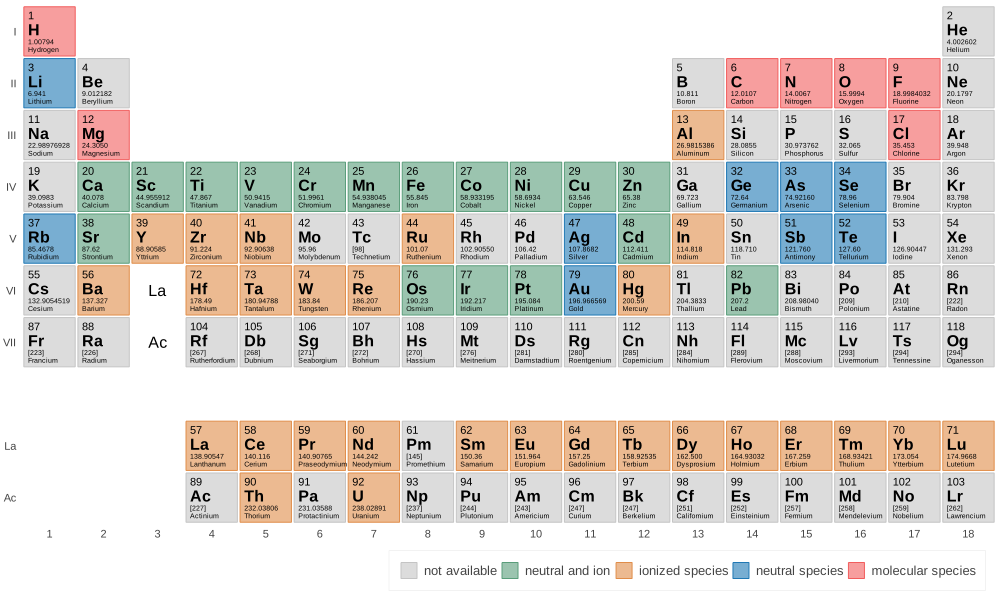
In succeeding sections we discuss first atomic and then molecular data sources. The Fe-group atomic species are considered first, followed by neutron-capture species, and finally a few other elements. The molecular species then are discussed in a bit more detail, because of the decisions needed to maximize the utility of their line lists for high-resolution spectroscopic studies.
Atomic Species: Fe-group Elements
| Species | References & Notes |
|---|---|
Sc I | Lawler et al. (2019, ApJS, 241, 21); includes HFS |
Sc II | Lawler et al. (2019, ApJS, 241, 21); includes HFS |
Ti I | Lawler et al. (2013, ApJS, 205, 11) |
Ti II | Wood et al. (2013, ApJS, 208, 27) |
V I | Lawler et al. (2014, ApJS, 215, 20) and Wood et al. (2018, ApJS, 234, 25). Holmes et al. (2016, ApJS, 224, 35) suggested some problems with the Lawler et al. transition probabilities in the wavelength range > 9000 Å, but Wood et al. showed that the Lawler et al. gf's are correct; Wood et al. also has extensive new HFS data |
V II | Wood et al. (2014, ApJS, 214, 18); there is additional HFS information in the Kurucz database, collected in vI.kurhfs |
Cr I | Sobeck et al. (2007, ApJ, 667, 1267); the line wavelengths have been adjusted to conform to those given at the NIST website |
Cr II | The most current and tested transition probabilities are from Lawler et al. (2017, ApJS, 228, 10). We added in earlier good results from Nilsson et al. (2006, A&A, 445, 1165) and Gurell et al. (2010, A&A, 511, A68), but adjusted their wavelengths to agree with NIST values (which are in better agreement with those seen in solar/stellar spectra) |
Mn I | Den Hartog et al. (2011, ApJS, 194, 35); there is additional HFS information in the Kurucz database, collected in scI.kurhfs |
Mn II | Den Hartog et al. (2011, ApJS, 194, 35); there is no additional HFS information in the Kurucz database |
Fe I | Recent laboratory studies are by Ruffoni et al. (2014, MNRAS, 441, 3127), Den Hartog (2014, ApJS, 215, 23), and Belmonte et al. (2017, ApJ, 848, 126). The first two of these papers deal with lines arising (in absorption) from levels with E.P. > 2.3 eV. One of the good things about the last paper is that it overlaps the older-but-still-mostly-reliable study of O'Brian et al. (1991, JOSAB, 8, 1185) for lower-excitation transitions. Here we have chosen to adopt the new lab values, and have added in the O'Brian values not included in the Belmonte paper AND with E.P < 2.2 eV. We consider this list to be as close to an "internally consistent single source" as we are likely to get for a while. |
Fe II | Den Hartog et al. (2019, ApJS, 243, 33); most of the new laboratory data are for UV lines, but enough blue lines (10 of them) are included that it is clear that the Meléndez & Barbuy (2009, A&A, 497, 611) empirical values were more reliable than those at the NIST website. Our choice here is to use the Den Hartog values when available, otherwise to use the Meléndez & Barbuy values |
Co I | Lawler et al. (2015, ApJS, 220, 13); Co I with and without HFS are in different files here |
Co II | Lawler et al. (2018, ApJS, 238, 7); there are 12 lines in this paper with good laboratory HFS patterns. To these we have added another 4 lines with new gf values but approximate HFS patters from the Co I paper; these appear with the notations LAW??? in a linelist generated by linemake |
Ni I | Wood et al. (2014, ApJS, 211, 20); there is isotopic information in the file niI.moogiso, but this is not part of the automated linemake procedure; one can manually substitute in the relevant structures into a line list |
Ni II | Discussed in the Ni I paper, but awaits a fresh study; not included here; this will be the subject of a future Wisconsin laboratory effort; note that Ni II lines in the Kurucz database have no HFS information. |
Cu I | Not done recently, so Kurucz log(gf) and HFS information should be treated with caution. We have assembled these data in cuI.kurhfs for convenience, and that is what the user will get in linemake |
Cu II | Roederer & Lawler (2012, ApJ, 750, 76) for UV lines, and NIST for optical lines |
Zn I | Roederer & Lawler (2012, ApJ, 750, 76) |
Zn II | Bergeson & Lawler (1993, ApJ, 408, 382) |
Atomic Species: Neutron-Capture Elements
Atomic Species: Other Elements
| Species | References & Notes |
|---|---|
Li I | Resonance line. Nothing special needs to be done here to get the full isotopic and hyperfine substructure. The total gf from Kurucz, has been adopted; it is close to that recommended by NIST |
Al II | Roederer & Lawler (2021, in preparation). This is the HFS for one UV resonance line |
Ca I | Den Hartog et al. (2021, ApJS, submitted). This is a combined lab and theoretical study, and the included transitions have transition probabilities now with very small uncertainties |
Ca II | Den Hartog et al. (2021, ApJS, submitted). No new lab data here, but Ca II is a well-studied single electron species |
Molecular (mostly diatomic) Species
| Species | References & Notes |
|---|---|
MgH | Hinkle et al. (2013, ApJS, 207, 26) |
C2 | Swan bands. Ram et al. (2014, ApJS, 211, 5); note that 0.089 eV has been added to all of the excitation energies to account for the fact that the lower level of the Swan system is not exactly at the lowest possible vibrational state |
CH | Masseron et al. (2014, A&A, 571, 47); files obtained from Bertrand Plez |
CN | Sneden et al. (2014, ApJS, 214, 26); violet and red |
CO | Pretty much the relatively simply CO parameters in the IR ro-vibrational bands have been known for a couple of decades. However, in trial syntheses conducted by Chris Sneden and Melike Afsar it was noticed that that K-band Δv = 2 first overtone band strengths were too strong for the C and O abundances derived from optical data. But they also clashed with the H-band Δv = 3 "second overtone" bands in similar fashion. Therefore we decided to raise the gf-values of the Δv = 2 lines by 0.15 dex, and leave the Δv = 3 lines alone. This small pragmatic alteration is in the CO line list here; users need to be aware of this if CO is used for abundance determinations. To be updated with HITRAN line parameters from Li et al. (2015, ApJS, 216, 15) |
OH | Ro-vibrational bands: Brooke et al. (2015, JQSRT, 168, 142); these are only for the IR transitions |
HCl | HITRAN; IR transitions only |
HF | HITRAN; IR transitions only |
SiO | Kurucz database; IR transitions only |
SiH | Kurucz database; in earlier linemake versions SiH was lumped in with the other hydrides but this is unsatisfactory. Now it will be included only if the user desires it. Since the solar isotopic fractions are 28,29,30Si = 92.22%, 4.69%, and 3.09%, in other words dominated by a single isotope, the solar isotopic fractions are included in the effective gf values of SiH lines |
H2O | HITRAN; the whole list has 84K lines, so to limit that a bit we include here only those in the 1-5μm wavelength regime. It would be easy to add optical-region lines if a need arises. Note that the MOOG version from November 2019 has the ability to do triatomic molecules; earlier versions cannot work on H2O |
TiO | ExoMol. This molecule has many electronic-vabrational-rotational band systems, leading to nearly 8 million transitions cataloged in HITRAN. Additionally, Ti has 5 isotopes with substantial contributions to the solar-system Ti elemental abundance. The major isotope is 48Ti, with 72.73% of the fractional contribution, and 46,47,49,50Ti isotopes have 8.25%, 7.44%, 5.41%, and 5.18% fractions, respectively. Briefly we outline our line cut-down procedures here. We define a species-specific relative strength as log(gf) - θχ, where χ is the excitation energy in eV, and θ = 5040/T. We choose θ = 1.5 (T = 3600K) as a representative very cool stellar temperature. Then for 48TiO we retained all lines whose strengths were predicted to be >0.1% of the strongest line in a 10 Å wavelength interval, thus cutting out a large number of extremely weak TiO lines. This reduced the original 8 x 10⁶ list to about 1.7 x 10⁶, still large but manageable. For the other isotopes we used the same procedure, but cut individual line strengths down by the additional factor of the isotopic ratio with respect to 48Ti. In linemake for TiO the user has options of including only 48TiO or adding in the other isotopic lines also. For now we have cut down the gf's of the minor isotopic lines by their solar-system abundance ratios. This may be revisited in the future it is not satisfactory to users |
FeH | There appear to be two sources for FeH line data that can be used in synthesis lists. First, the Kuruz website has lines from Dulick et al. (2003, ApJ, 594, 651). These were translated into MOOG style in a straightforward manner. Second, Hargreaves et al. (2010, AJ, 140, 919) studied a different FeH electronic band system, creating a list of about 6300 lines with wavelengths, measured intensities, and excitation energies. For a small subset of about 260 lines they computed transition probabilities. We combined the Kurucz/Dulick and Hargreaves lines. After examining the relative strengths of the total FeH line list, we elected to eliminate those lines that were ≃10-7 weaker than the maximum FeH line strengths. Fe exists predominantly as 56Fe (91.7%) and the minor isotopes have not gotten much attention, so they were ignored. The data sources tabulate FeH lines from ~ 6200 Å to far into the IR, but there are relatively few lines beyond 5μ, and we ignored them |
MgO | Probably in the near future from ExoMol |
Acknowledgements
Our development of linemake has benefitted from many sources of support over the years, including:
-
The work of V.M.P. is supported by NOIRLab, which is managed by the Association of Universities for Research in Astronomy (AURA) under a cooperative agreement with the National Science Foundation (NSF).
-
I.U.R. acknowledges financial support from NASA (HST-GO-12268, HST-GO-12976, HST-AR-13246, HST-AR-13879, HST-AR-13884, HST-GO-14151, HST-GO-14231, HST-GO-14232, HST-GO-14765, HST-AR-15051, HST-GO-15657) and NSF (AST-1815403).