The syscall ABI & CLI reference
June 16, 2026 · View on GitHub
The syscall ABI & CLI reference
← Part of the DOS README. The full lookup surface: every syscall by the question it answers, the
dosCLI verbs, the three live read-only screens, and the verdict journal.
The syscall ABI
Every syscall answers a question you'd otherwise have to take the agent's word for. "Reach for this when…" is the plain-English trigger; the rest is the contract — and the module names are auditable.
| Syscall | Reach for this when… | What it is | Module |
|---|---|---|---|
verify() | an agent says a unit of work is done and you don't want to take its word | the truth syscall — "did (plan, phase) actually ship?" registry-first, ancestry-checked, from git history if there's no plan at all | dos.oracle, dos.phase_shipped |
liveness() | a long run says it's "making progress" and you want to know if it actually is | the temporal verdict — "is the run ADVANCING, or just SPINNING / STALLED?" from the git/journal delta and the clock | dos.liveness |
verify-result() | a subagent hands a result back to an orchestrator that folds it as a finding — but the result string may be a harness-synthesized error the worker never authored | the fold-site result-state witness (docs/197) — classifies a subagent transcript's terminal record, gating on message.model == "<synthetic>" (the unforgeable harness-authorship marker), never the agent's self-report; exit 3 = DEAD (a harness 429 / quota / auth / server error), 0 = HEALTHY / UNREADABLE | dos.result_state |
resume() | a run died or paused mid-flight and you need to continue without re-doing work or double-applying it | the third ARIES phase — "how far did the fossils say it got, and what's the residual?" over a run-id-keyed intent ledger; re-enters from a git-VERIFIED SHA, never the dead run's self-report (RESUMABLE / COMPLETE / DIVERGED / UNRESUMABLE) | dos.resume, dos.intent_ledger |
complete() | you need to know if the whole declared job is verifiably done, not just one phase | the completion verdict — residual = declared − verified, asked forward; read-only, never self-certifies | dos.completion |
rewind() | a run thrashed and you want to excise the dead-end turns without the kernel authoring a correction | the conversation-rewind verdict — replays the ledger for a minted checkpoint and PROPOSES the excision (never truncates; the host owns the transcript) | dos.rewind |
productivity() | a long run is burning turns and you want to know if it's still doing work, or fading | the loop-economics verdict (docs/218) — classify(work-deltas) -> PRODUCTIVE / DIMINISHING / STALLED over a trend of per-step work; pure, no I/O | dos.productivity |
efficiency() | you want to know if the tokens a run spent actually bought work (a run can be productive yet burn 10× its work's worth) | the token-effectiveness verdict (docs/263) — work / tokens -> EFFICIENT / COSTLY / WASTEFUL; both counts are env-authored, so a run can't narrate its way to EFFICIENT | dos.efficiency |
improve() | a self-improving loop proposes a change to its own code and you must decide keep or revert — without trusting the loop's own claim that it helped | the keep-gate (docs/280) — KEEP / REVERT / ESCALATE from witnesses the candidate's author didn't write: the suite green on the candidate-only tree, the truth syscall clean, and a strictly-measured metric gain; a regression always REVERTs, a run of non-keeps ESCALATEs to a human | dos.improve |
reward() | a fine-tune is about to train on an agent's trajectory and the "it worked" label came from the agent itself | the reward-set admission verdict (docs/230) — ACCEPT / REJECT_POISON / ABSTAIN off a witness the agent authored zero bytes of, so no answer text can flip a reject to an accept (the non-distillable label) | dos.reward |
breaker() | a failure class keeps tripping and you want to stop retrying and escalate | the circuit-breaker primitive (docs/223) — a pure two-counter state machine, CLOSED / OPEN, tripping on consecutive or total failures; an OPEN verdict names the escalation rung (none / judge / human) | dos.breaker |
hook_exit() / exec_capability() | you wire a plain shell hook into a runtime, or need to know if a command grants arbitrary code execution | two classifier leaves the cheapest integrations consult — hook_exit maps an exit code to an intervention (docs/226: 0 pass / 2 BLOCK / other WARN), exec_capability classifies the invoked program token — never a substring — as GRANTS_ARBITRARY_EXEC / BOUNDED (docs/224) | dos.hook_exit, dos.exec_capability |
refuse(reason) | you need to say why a pick was blocked in a way a machine can act on | structured refusal — a closed, declared reason vocabulary (dos.reasons, extensible per-workspace), every reason emittable, verifiable, and refusable | dos.wedge_reason, dos.picker_oracle |
lease() / arbitrate() | two agents might touch the same files and you need to admit one without a collision | the pure admission kernel — arbitrate(request, live_leases, config) -> decision, state-in / decision-out, no I/O | dos.arbiter |
spawn() / reap() | you need every run to carry a traceable identity and its effects to be replayable | the correlation spine (sortable, lineage-carrying run-ids) + the lease write-ahead log | dos.run_id, dos.lane_journal |
enumerate() / pickable() / cooldown() / reconcile() | an unattended loop must know is there anything pickable, why-not, have I tried it, and did the claim hold? — without re-storming a known drain or believing a "done" the git can't confirm | the picker substrate (docs/207) — enumerate is the phase-list producer (the declared set, never a silent empty); pickable the pre-dispatch gate (OFFERABLE / HELD(reason)); cooldown the anti-churn fold over pick-attempts (CLEAR / RECENTLY_ATTEMPTED); reconcile the quiet-completion join (VERIFIED / QUIET_INCOMPLETE / HONEST_OPEN, fail-closed on the claim) | dos.enumerate, dos.pickable, dos.cooldown, dos.reconcile |
Three terms the table assumes: a plan (e.g.
AUTH) groups phases — a phase is a named unit of work (e.g.AUTH1); a lane is a leased region of the file tree an agent works in. All are defined in the quickstart.
The newest catch — a result that died. When a subagent hands a result back to an orchestrator that folds it as a finding (an ultracode
Workflow, an Agent-SDK fan-out), the result string itself may be a harness-synthesized error the worker never authored — and ~32% of real subagents return exactly that (a 429 / quota / auth string) where the fold expects a finding (docs/197).verify-resultreads the transcript's terminal record and refuses to believe a harness-authored death:dos verify-result --transcript dead.jsonl # DEAD SYNTHETIC class=OTHER — harness-authored terminal # (model=<synthetic> + stop_reason=stop_sequence) — not a finding; route to DEAD, do not fold echo $? # → 3 (count it in the denominator; never bank it as a result) dos verify-result --transcript real.jsonl # HEALTHY — terminal assistant record is real-model authored with content echo $? # → 0It gates on
message.model == "<synthetic>"— the marker the agent's own model cannot forge (the runtime harness authored those bytes, not the worker) — which is broader than rate-limits alone: quota, auth, and server deaths are caught too.
Around these sit ~30 supporting kernel modules — the file-tree disjointness algebra, the timeline reader, the gate/loop classifiers, the typed-verdict contract, the JUDGE-rung seam. The full map is in CLAUDE.md.
CLI
One dos entrypoint over the syscalls. Here are the dozen verbs you reach for
first (see QUICKSTART.md for
a runnable tour) — the full reference, every verb grouped, is
docs/CLI-REFERENCE.md:
# --- the core verdicts ---
dos verify PLAN PHASE                  # truth: did (plan,phase) ship? (works with no plan)
dos commit-audit [REF] [--sweep]       # truth: does a commit's SUBJECT match its own diff? (--sweep = drift rate over a range)
dos liveness --run-id R --start-sha S  # temporal: ADVANCING / SPINNING / STALLED?
dos status --run-id R                  # one fail-closed digest of a run (liveness + verified progress + lease)
dos resume --run-id R                  # replay a run's intent ledger, re-verify against git, PROPOSE the continuation

# --- admission (let a lane in, or refuse the collision) ---
dos arbitrate --lane L --kind K --leases '[…]'   # may a lane start without collision? (decision only)
dos scope-gate --lane L [--staged]     # binding pre-effect scope gate: may this PROPOSED write land? (ALLOW/REFUSE)

# --- workspace & live projections ---
dos init [DIR]                         # scaffold a dos.toml workspace config
dos doctor [--json] [--check]          # report the active workspace + taxonomy + predicates
dos top [--once] [--json]              # live fleet watchdog: lanes, leases, verdicts, commits
dos decisions [N]                      # the operator-decision queue (what's waiting on you)
dos plan [--once] [--json]             # every phase: the plan's claim vs the oracle's verdict
Most verbs take --workspace . (or honor $DISPATCH_WORKSPACE / cwd) and
--json for machine-readable output. For verdict-bearing commands (verify /
liveness / gate) the exit code is the verdict (dos exit-codes prints
the table). The other ~55 verbs — the picker substrate, loop-economics
verdicts, observability exporters, portable-proof attestation, the eval
harnesses — and the pluggable --output <name> renderer
(HACKING.md) are all in
docs/CLI-REFERENCE.md.
Three live projections (read-only TUIs)
A fleet leaves its state scattered across git history, a write-ahead log, and a pile of verdict envelopes. DOS folds that into three read-only screens, each answering a different operator question. They are projections, not stores: every one reads kernel state, mutates nothing, takes no lease, launches nothing — delete any of them and you lose the screen, not the data. Pick by the question you're asking:
| Screen | Answers | Reads |
|---|---|---|
dos top | What's running right now? — the lanes, the leases holding them, recent verdicts, live git activity. The screen you leave open in a side terminal during a run. | leases (WAL) + per-lane liveness + verdict envelopes + git |
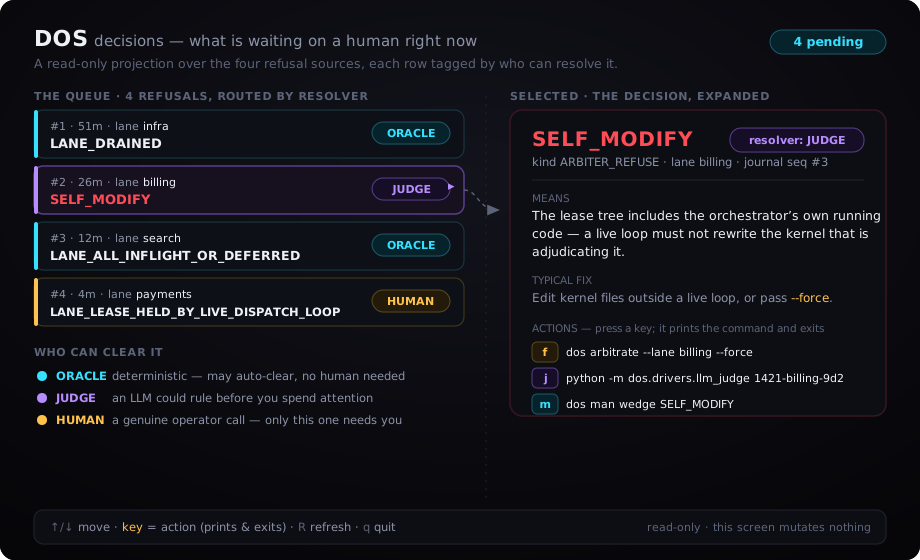
dos decisions | What's waiting on me right now? — the no-picks (refusals, wedges, open gates) that need a decision, each tagged by who can resolve it. | the four refusal sources, joined |
dos plan | Does the plan's claim match the ground truth? — every declared phase, the plan's self-reported status beside the oracle's verdict, so an over-claim is its own cell. | the plan source × verify() per phase |
In dos top a held lane's status chip is its liveness verdict — green
ADVANCING / yellow SPINNING / red STALLED — so "which one is wedged" is one
glance, not a log dig. dos decisions tags each row by resolver — a deterministic
ORACLE (may auto-clear), an LLM JUDGE (could rule before you spend
attention), or a HUMAN (a genuine operator call) — and on a keypress prints
the exact shell command and exits; you run it, the screen never mutates
substrate. dos plan is a verify() fan-out, not a plan reader: a human runs
it from outside the agent loop, so an over-claiming loop is caught by ground
truth, not by re-reading its own narration.
All three have a plain-text floor that needs no dependencies — the live rich
redraw is the optional [tui] extra, but --once (one frame) and --json
work on a bare core install (no extras). Here is dos top --once on a fresh
checkout (no leases yet, so every lane is FREE and the git strip carries the
content):
┌─ dos top · /path/to/repo · 2026-06-07T17:14:32+00:00 ──────────────────────
LANES
   benchmark     ⚪ FREE
   docs          ⚪ FREE
   …                                  (one concurrent lane per source dir)
  *global        ⚪ FREE              (* = the exclusive whole-repo lane)
  8 lanes · 0 advancing · 0 spinning · 0 stalled · 8 free
RECENT VERDICTS        [trust = ship-oracle cross-check]
  (no verdicts yet)
RECENT COMMITS        [ground truth — git history]
  0857bd4    docs/206 Appendix A: the whole program in plain words
  …                                  (last 10 commits — the content even a
                                      zero-lease repo always has)
──────────────────────────────────────────────────────────────────────────────
read-only · q quit · this screen mutates nothing
The stuck-fleet walkthrough that drives all three end-to-end is Debug a stuck fleet.
Observability: the verdict journal, drained to your dashboards
Those three screens read a fleet's running state. Underneath, every verdict
the kernel computes — each verify / liveness / efficiency / breaker /
reward / hook decision — also lands in a verdict journal: a
run_id-correlated write-ahead log of the kernel's own adjudications
(docs/262).
Two verbs make it useful. dos observe is the read-only projection — fold the
journal by run, syscall, or verdict, or replay one run's verdict history. dos export is the delivery seam: it drains the journal outward to an observability
backend through the dos.exporters entry-point group, with three shipped
transports — file (JSONL), statsd (DogStatsD counters), and otlp
(OpenTelemetry log records → Datadog / Honeycomb / Grafana), the null default
reporting only (docs/266).
So "how often did the fleet over-claim this week, and on which lanes?" becomes a
dashboard panel, not a log grep — and adding a transport is a driver, never a
kernel edit (the same kernel/driver split as judges and notifiers).
Next: operating a fleet day-to-day · extend it without forking · back to why a referee.