README.md
July 20, 2026 · View on GitHub

A multi-agent collaboration system for open-domain information seeking








Schedule search the way an operating system schedules processes: compile an open-domain question into a normalized coverage map, dispatch its empty cells to pipelined-parallel sub-agents, write every piece of evidence — with its source — into a shared evidence graph, and synthesize a citation-grounded answer from search state — state that lives in the system, not in conversation history.


🎬 Full product walkthrough (English)
▶️ Quick run:
./install.sh
source .venv/bin/activate
searchos "Top-5 universities per subject in the 2025 QS rankings, with application deadlines"
install.shprepares the Python environment, bundled Access Skill dependencies, Chromium, and the Web frontend. The first run then launches a setup wizard: pick a model provider (vendor coding plans / pay-as-you-go APIs / local deployment), paste an API key, and you're up. Runsearchoswith no query for the full-screen TUI to watch task dispatch, tool streams, and the coverage map grow in real time. You can also run./web/start.shto bring up the REST/WS API (:8000) + web frontend (:3000) and launch searches from the browser with a live agent wall and coverage map.
📣 News
- 2026-07-17 — SearchOS-V1 is now on arXiv. Read the paper on arXiv or Hugging Face. 📄
- 2026-07-11 — Start faster. Search wider. See every step. A new one-command installer gets SearchOS running; parallel Explore waves scout the web in batches, while live progress and evidence grouped by entity make every discovery easier to follow. Skills now run in hardened, isolated workers. ⚡
- 2026-07-10 — A whole new way to research. Draw the structure of your question. SearchOS turns it into citation-backed research you can explore, refine, and export. 🧩
- 2026-07-09 — Pick up exactly where you left off. Every session returns with its conversation, progress, evidence, and live activity intact. ⏪
- 2026-07-08 — Everything in one place. Models, providers, search, skills, and budgets now come together in one beautifully simple control center. ⚙️
- 2026-07-07 — SearchOS is now open source. Multi-agent search, structured research, TUI, and Web UI. All together. Ready for everyone. 🚀
✨ Highlights
- 🗂️ Search state as a system asset — SOCM (Search-Oriented Context Management) keeps the task queue, evidence graph, and coverage map in one persistent state shared by all agents: snapshot, restore, replay — nothing drowns in conversation history.
- 🧩 Coverage-map-driven, recall-first — the question becomes normalized entity × attribute tables; dispatch keeps targeting empty cells until every one holds a sourced value.
- ⚡ Pipelined-parallel sub-agents — search → open → find stages overlap across agents; wall-clock approaches the slowest single chain, not a serial sum.
- 🔗 Every cell carries a citation — extraction middleware writes (entity, attribute, value, source) into the evidence graph; every answer traces back to its source.
- 🛡️ Sensor safety net — five kinds of loop / stall detection on every tool call: remind first, re-dispatch from a new angle if it persists.
- 🧰 Skills + multi-provider out of the box — access skills crack anti-bot / login-walled sites, strategy skills handle rankings / multi-hop / disambiguation;
SF_PROVIDERconnects any vendor in one line.
📊 Leads on all headline F1 metrics on WideSearch / GISA, including Set · F1 +13.4 over the next-best baseline on enumeration questions (see Evaluation).
🎥 Gallery
 ▶️ SearchOS-Web Demo
|
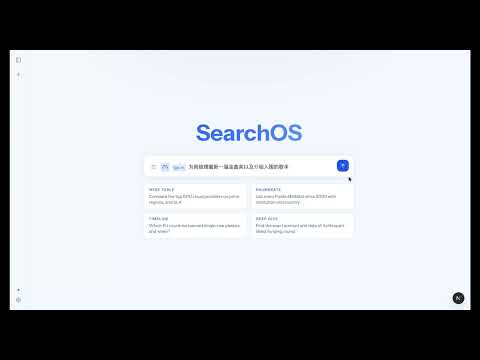 ▶️ SearchOS-Web Demo 2
|
 ▶️ SearchOS-demo1
|
 ▶️ SearchOS-demo2
|
 ▶️ SearchOS-demo3
|

▶️ SearchOS-demo4 |
Click a cover to watch on YouTube (more demos coming)
💡 Why SearchOS
Pointing a general-purpose agent or deep-search agent at long-horizon search tasks commonly produces these failure modes:
- Opaque process — intermediate search results drown in dozens of turns of conversation history; facts get lost after context compression; mid-run you can neither see progress nor resume or replay.
- Easy to loop — no memory of what has already been checked: the same query gets re-issued with different phrasing, and the same entity's attributes are searched again in different subtasks.
- Blurred roles — sub-agents must search, read, remember, and summarize all at once; on long tasks something always slips: extracted fields use inconsistent conventions, sources get dropped.
- Can't get in, can't search well — anti-bot walls, login gates, and deep directories keep hard sites unreachable; ranking, multi-hop, and disambiguation questions aren't solved by simply searching more.
SearchOS answers each of the four failures with a mechanism-level fix:
- Search state lives in the system, not in conversation history — SOCM keeps the task queue, evidence graph, and coverage map in one shared persistent state (
search_state.json): snapshot, restore, replay at any time; sub-agents run on a three-layer context (SOCM snapshot → episodic summaries → recent working memory) instead of full history, keeping a stable prompt-cache-friendly prefix. - Entity-centric modeling + loop-breaking sensors — a normalized multi-table schema (primary keys + attributes, with foreign keys) means each fact is fetched once and dispatch always targets empty cells; LoopSensor runs five loop checks on every tool call — remind first, mark
loopedand re-dispatch from a different angle if it persists. - Search and extraction are separated — sub-agents just find the right pages; on every page open, a judge model extracts (entity, attribute, value, source, confidence) into the evidence graph, with unit normalization and excerpts anchored to the original text — consistent conventions, traceable sources.
- Role-aligned three-layer skill system for open-domain information seeking — orchestrates methodology, search strategies, and site-level executable access skills in one system (details in Skill system).
🧩 Framework
User query
   │
   ▼
┌─────────────────────────── Orchestrator (sole decision maker) ───────────────────┐
│   Explore scouting → create_schema builds the coverage map → enqueue_tasks       │
│   dispatch → check_agents polling → assess/adjust → enough coverage or budget    │
│   exhausted → synthesize                                                         │
└──────┬──────────────────────────┬─────────────────────────────┬──────────────────┘
       ▼                          ▼                             ▼
  explore_agent              search_agent × N              writer_agent
 (query typing / hub pages / (searches the web per         (consumes SOCM, writes
  candidate entities /        subtask, never writes         cited sections)
  search plan)                state directly)
       │                          │                             │
       └────────────┬─────────────┴─────────────────────────────┘
                    ▼
      Three middleware layers: Context → Sensor → Extraction
     (prompt assembly / budget & loop monitoring / judge-based auto extraction)
                    │
                    ▼
┌──────────── SOCM · Search-Oriented Context Management (shared search state) ────┐
│  Frontier Memory   task queue: priority + blocked_by DAG, three task types in   │
│                    one shared pool                                              │
│  Evidence Graph    findings / sources / confidence, support-conflict edges      │
│  Coverage Map      entity × attribute, multi-table + foreign keys, per-column   │
│                    types / formats / validation                                 │
│  Strategy Memory   strategy & failure memory · Writer Outline · Budget          │
└─────────────────────────────────────────────────────────────────────────────────┘
A session loops through six steps:
- Explore — a scout goes first: classifies the query type, locates hub pages, produces candidate entities and a search plan; it does not extract attribute values.
- Schema — the Orchestrator builds a normalized coverage map by entity type (multiple tables + relations); every entity Explore found is seated as a seed row.
- Dispatch — gaps are split into self-contained natural-language subtasks and dispatched to search agents in parallel by priority and dependency.
- Extract — after every page open, the Extraction middleware automatically extracts (entity, attribute, value, source, confidence) into the evidence graph and lights up the coverage map.
- Assess — subtasks are polled and harvested: new entities join the table, bad sources are blacklisted, conflicts go to arbitration, empty cells get targeted follow-ups.
- Synthesize — once the coverage self-check passes, the answer is joined out of SOCM in the user's requested format, citation by citation.
What the output looks like
Every cell carries a back-anchored source number, with the sources listed at the end — this is what "citation-grounded relational schema completion" looks like in the final product (excerpt from a real run; the query, in Chinese, was survey Hong Kong's popular insurance products in recent years):
### Major insurers in Hong Kong
| Company     | English name   | 2024 APE rank | 2023 premiums  |
|-------------|----------------|---------------|----------------|
| 友邦保险     | AIA [6]        | #1 [6]        | HK\$87.1B [6]   |
| 保诚         | Prudential [6] | #2 [6]        | HK\$65.3B [6]   |
| 汇丰保险     | HSBC Life [6]  | #3 [6]        | HK\$55.5B [6]   |
| 宏利         | Manulife [6]   | #4 [6]        | HK\$49.8B [6]   |

### Sources
[6] https://www.ia.org.hk/tc/infocenter/press_releases/20250425.html, https://inews.hket.com/…
The full artifact (a replayable directory with the trajectory, page cache, and SOCM state) lives under searchos_workspace/<timestamp>/.
🚀 Installation
Requires Python ≥ 3.11:
./install.sh                # recommended: Python env + Access Skills + Chromium + Web frontend
source .venv/bin/activate

pip install -e .            # manual: core CLI/TUI and Web API dependencies
pip install -e ".[access]"  # manual: bundled Access Skill executors
pip install -e ".[eval]"    # manual: evaluation dependencies
pip install -e ".[all]"     # manual: all optional runtime dependencies
The full installer also requires Node.js ≥ 20.9. Use ./install.sh --core to skip Access Skill and browser runtimes, --no-web to skip frontend dependencies, or --all --dev for a complete development environment. See the installation guide.
⚙️ Configuration
The first run launches a setup wizard automatically: when no usable model configuration is detected, searchos walks you through picking a provider and entering an API key, then writes .env (re-run anytime with searchos --setup). The Web Settings page and TUI commands /model, /search, and /config write to the same web_settings.json overlay, so CLI, TUI, and Web runs share one configuration.
You can also configure secrets manually: copy .env.example to .env and add only the API keys you use. Choose providers, models, search backends, and other runtime settings through the setup wizard, Web Settings, or TUI; those choices are stored in web_settings.json.
ZHIPU_API_KEY=xxx             # example model-provider key
SERPER_API_KEY=xxx            # example search-provider key
JINA_API_KEY=xxx              # optional: higher Jina fetching quota
All presets (each vendor's endpoints, model IDs, how to get keys, and known quirks) are in docs/providers.md. Advanced environment-only configuration through SF_PROVIDER and other SF_* overrides remains supported and is documented there.
All configuration is centralized in settings.py; SF_-prefixed environment variables override it, with __ separating nested fields (partial overrides deep-merge with defaults, changing only the fields you set). Models are bound by role (11 roles → model profiles), which makes provider mixing, rate control, ablations, and cost reduction straightforward:
| Common settings | Description |
|---|---|
SF_MODEL / SF_FAST_MODEL | Override the preset's main / lightweight-tier model |
SF_API_BASE | Override the endpoint (e.g. switch to the international domain) |
SF_SEARCH_PROVIDER | Search backend: serper | tavily | ragflow (inferred from available keys if unset) |
SF_BROWSER_BACKEND | Fetch backend: jina | aiohttp | crawl4ai | search_engine |
SF_ROLES__JUDGE=main | Rebind a single role's model profile (advanced / ablation) |
SF_PROFILES__MAIN__TEMPERATURE=0.3 | Field-level override on one profile (advanced / ablation) |
SF_PROFILES__MAIN__RPM=60 / ...__TPM=100000 | Per-profile sliding-window request/token limits; 0 disables a limit |
SF_MAX_PARALLEL_AGENTS | Sub-agent concurrency cap (default 8) |
SF_ENABLE_EXPLORE_BATCH / SF_EXPLORE_MIN_WAVES / SF_EXPLORE_MAX_WAVES | Parallel Explore mode and adaptive wave bounds (default 2–3) |
SF_ENABLE_EXPLORE / SF_ENABLE_SKILLS | Ablation switches: disable Explore / disable Skills |
SF_SKIP_SYNTHESIS | Evaluation mode: skip synthesis and export the table straight from the coverage map |
🧭 Quick start
| Command | What it does |
|---|---|
python -m searchos "<query>" | Single query; results land in searchos_workspace/<timestamp>/output/report.md |
python -m searchos | Full-screen Textual TUI: live panels, mid-run steering, multi-turn follow-ups, /skill skill management |
python -m eval.run --benchmark widesearch --range 1-50 | Run evaluations (see the next section) |
Interactive TUI
python -m searchos opens the full-screen interface: a live dashboard on top (task dispatch, sub-agent status, coverage map growth) and the tool stream below. One input box routes by timing:
| When | What typing natural language does |
|---|---|
| Idle | Starts a new search run |
| Mid-run | Live steering — your text is injected into the running Orchestrator immediately, without interrupting sub-agents; use it to add constraints ("2024 data only"), correct course, or point at good sources |
| After a run | Multi-turn follow-up — reuses the previous round's coverage map and evidence: if the answer is already in the table it is answered directly (no new search); otherwise the existing table is extended incrementally, never rebuilt from scratch |
Slash commands work at any time (including mid-run):
| Command | Alias / shortcut | What it does |
|---|---|---|
/new | /clear · Ctrl-N | New topic: clears conversation history and the coverage map; the next question starts from a fresh workspace |
/resume [session-id] | /load | Restore a previous session with its conversation, trajectory, coverage, and evidence; omit the id to open the picker |
/effort [low|medium|high|max] | — | Effort tier: adjusts iteration cap, concurrency, per-agent search budget, wall-clock limit, and skill-routing top-k in one go; with no argument it opens an interactive picker; mid-run changes take effect next round |
/skill | — | Skill management: no argument opens a grouped multi-select dialog; subcommands list, only <names…> (whitelist, fuzzy prefix match), on / off <names…>, all (reset to router control) for fine-grained control |
/model | — | Open shared model settings: provider connections, model cards, role bindings, and per-profile limits |
/search [auto|serper|tavily|ragflow] | — | Inspect or switch the shared search backend |
/config [key value] | /set | Open the shared settings panel or quickly change supported run defaults |
/verbose | /detail · Ctrl-T | Toggle compact / detailed tool stream |
/stop | /cancel · Esc | Interrupt the current run (Esc exits the program when idle) |
/help | /? | Command help |
/quit | /exit · Ctrl-D | Exit SearchOS |
The four /effort budget tiers at a glance (these modify global settings and take effect immediately for the current session; parallel sub-agents stay fixed at 8 across tiers):
| Tier | Orchestrator iterations | Searches per agent | Wall-clock cap | Routing top-k |
|---|---|---|---|---|
low | 25 | 10 | 10 min | 20 |
medium (default) | 50 | 20 | 30 min | 40 |
high | 100 | 35 | 60 min | 60 |
max | 150 | 50 | 120 min | 80 |
🧰 Skill system
Three categories of skills, all under searchos/skills/library/:
| Category | Count | Description |
|---|---|---|
| access | 248 | Site-level data access, named by domain (e.g. en_wikipedia_org); auto-routed on URL match, or invoked proactively by sub-agents as typed tools |
| strategy | 40+ | Reasoning methodology: ranking_top_n, entity_disambiguation, multi_hop_bridge…, optionally with anti-pattern checklists |
| orchestrator | a few | Orchestration-level methodology, injected wholesale as a playbook |
At runtime an LLM router pre-filters the access catalog to a query-relevant top-k (fail-open); each dispatched sub-agent carries at most 3 skills; pages that match no access skill fall back to the generic extraction middleware.
SEARCHOS_SKILL_ONLY=en_wikipedia_org,ranking_top_n   # whitelist
SEARCHOS_SKILL_LAYERS_DISABLED=access                # disable by layer
SEARCHOS_SKILLS_DISABLED=1                           # disable all
After a session, high-frequency domains can optionally be mined and baked into new access skills for later runs. Enable this under Settings → Skills or TUI /config; generation uses the configured skill_evolver role. The legacy SF_ENABLE_ACCESS_SKILL_GENERATION variable remains migration-only.
📊 Evaluation
On WideSearch (wide-table retrieval) and GISA (open-domain information seeking), compared against 2 single-agent baselines (ReAct / Plan-and-Solve) and 3 multi-agent systems (Table-as-Search / A-MapReduce / Web2BigTable). All scores are max@3 (best of three runs per case, ×100); bold marks the best in each row. Item scores cells independently; Row requires a fully correct row.
| Benchmark | Metric | ReAct | Plan-and-Solve | Table-as-Search | A-MapReduce | Web2BigTable | SearchOS |
|---|---|---|---|---|---|---|---|
| WideSearch | Item · Precision | 82.9 | 83.8 | 82.4 | 83.1 | 78.3 | 83.9 |
| Item · Recall | 70.2 | 72.9 | 73.5 | 74.2 | 73.4 | 79.7 | |
| Item · F1 | 72.9 | 75.2 | 75.4 | 76.0 | 73.8 | 80.3 | |
| Row · Precision | 58.0 | 58.7 | 57.1 | 56.9 | 57.5 | 59.0 | |
| Row · Recall | 48.8 | 50.2 | 51.6 | 49.8 | 54.0 | 55.8 | |
| Row · F1 | 50.9 | 52.2 | 52.7 | 51.4 | 54.5 | 56.5 | |
| GISA | Table · Item · F1 | 74.8 | 71.2 | 73.4 | 72.5 | 68.1 | 76.9 |
| Table · Row · F1 | 58.1 | 50.7 | 54.1 | 52.1 | 45.3 | 59.7 | |
| Set · F1 | 61.6 | 63.1 | 60.9 | 62.5 | 56.7 | 76.5 | |
| List · F1 | 67.1 | 53.8 | 54.2 | 57.4 | 65.5 | 68.1 | |
| Item · EM | 0.0 | 16.7 | 16.7 | 33.3 | 50.0 | 50.0 |
SearchOS leads on all F1 metrics across both benchmarks, with gains driven primarily by recall — coverage-map-driven dispatch keeps filling empty cells until every schema cell has a sourced value; on enumerating complete sets, Set · F1 beats the next-best baseline by +13.4.
🗺️ Roadmap
SearchOS is under active development. The roadmap below highlights our current priorities and may evolve as the project and research progress.
- SearchOS-V1 Technical Report — Released on arXiv, covering the system design, hierarchical skill architecture, evaluation methodology, and reproducible results.
- Automated Skill Generation Pipeline — Develop an end-to-end pipeline for discovering, generating, validating, and maintaining reusable search skills. More details will be presented in follow-up research.
- Multimodal Search — Extend search and evidence grounding beyond text to images, charts, audio, and video.
- Broader Data-Source Support — Add more integrations for academic, enterprise, and domain-specific information sources.
This roadmap reflects current priorities rather than fixed release commitments. Suggestions and contributions are welcome through GitHub Issues.
🗂️ Project layout
searchos/
├── agents/        Orchestrator plus Explore, Search, and optional Writer agent definitions
├── harness/       SearchSession, Context/Sensor/Evidence Intake middleware, repair planning, synthesis, telemetry
├── socm/          Shared search state: Frontier / Evidence Graph / Coverage Map / Strategy
├── tools/         Tools grouped by role: schema, tasks, writer, simple_browser …
├── skills/        Contracts/manifests, routing, isolated runtime, creation/evolution workflows, skill library
├── tui/           Textual interface: live dashboard, resume, settings, Skills, follow-ups, steering
├── config/        providers, model cards/roles, rate limits, effort presets, env + shared settings overlay
└── cli.py         `searchos` / `python -m searchos` entry point

web/api/           FastAPI REST/WS service: runs, history/assets, snapshots/branching, repair, settings, Skill jobs
web/frontend/      Next.js research workspace: composer, live run, evidence, versions, usage, history library

eval/              Evaluation framework: run.py entry, runner, benchmarks, scorers, reformat
datasets/          Bundled WideSearch and GISA benchmark data
eval_results/      Evaluation output (one directory per case, with a fully replayable session)
searchos_workspace/ Session workspaces for interactive runs (timestamped directories)
👥 Authors
Yuyao Zhang1,2,*,‡ · Junjie Gao2,* · Zhengxian Wu2 · Jiaming Fan2 · Jin Zhang2 · Shihan Ma2 · Yao Yao2 · Weiran Qi2 · Guiyu Ma2 · Xingzhong Xu2 · Kai Yang2 · Ji-Rong Wen1 · Zhicheng Dou1,†
1 Renmin University of China · 2 Ant Group
🙏 Acknowledgements
SearchOS was developed through the joint efforts of the authors and contributors listed above. We thank Ant Insurance for its strong support throughout the project.
📚 Citation
If SearchOS helps your research, please cite our paper:
@article{zhang2026searchos,
  title={SearchOS-V1: Towards Robust Open-Domain Information-Seeking Agent Collaboration},
  author={Zhang, Yuyao and Gao, Junjie and Wu, Zhengxian and Fan, Jiaming and Zhang, Jin and Ma, Shihan and Yao, Yao and Qi, Weiran and Jin, Chuyan and Ma, Guiyu and others},
  journal={arXiv preprint arXiv:2607.15257},
  year={2026}
}
📄 License
MIT — see LICENSE. Additional terms about source-code comments are described in LEGAL.md.