Results
July 17, 2026 · View on GitHub
Kuramoto-XY simulator, compiler, and hardware-evidence ledger for heterogeneous-frequency coupled oscillators.
For source classification and campaign provenance, see the dated Hardware Status Ledger. This page is a gallery and technical summary; the ledger is the canonical index for whether a result is theoretical, simulated, hardware-measured, mitigated, or noise-limited.
Status Snapshot — 2026-05-05
| Area | Public status |
|---|---|
| Promoted hardware campaigns | April 2026 ibm_kingston Phase 1 DLA parity raw-count dataset; May 2026 ibm_kingston Phase 2 A+G n=4 replication and B-C n=6,8 mixed scaling raw-count datasets; legacy artefact-backed ibm_fez baseline rows. |
| Simulator-only families | BKT scaling, OTOC, Floquet DTC, MBL/eigenstate scans, FIM, and classical wall-time baselines unless a hardware artefact is named. |
| Pending / quarantined IBM batches | V2, frontier, queued-job, placeholder, aggregate-only IBM outputs, Phase 2 D-E larger scaling, Phase 2 F/GUESS mitigation, and multi-device replication are not promoted here until raw counts, retrieval manifests, and analysis scripts are reviewed and committed. |
| Canonical status source | Hardware Status Ledger. |
Key Findings
| # | Finding | Measured Value | Source |
|---|---|---|---|
| 1 | DLA parity raw-count reproduction | Phase 1: 342 circuits, peak asymmetry +17.48% at depth 6; Phase 2 reduced A+G: 612 circuits, Fisher p=3.77e-20; Phase 2 B-C: mixed n=6,8 scaling | data/phase1_dla_parity/, data/phase2_dla_parity/, data/phase2_scaling_bc/, scripts/run_dla_parity_suite.py, scripts/analyse_phase2_dla_parity.py, scripts/analyse_phase2_scaling_bc.py |
| 2 | Bell inequality row | CHSH S = 2.165 ± 0.022 (7.5σ, pair q0–q1); S = 2.188 ± 0.021 (8.9σ, pair q2–q3) [corrected 2026-07-16] | Legacy ibm_fez artefact row |
| 3 | QKD row | QBER 5.5% < BB84 threshold (11%) [caveat 2026-07-16: not independently derivable — see amendment below] | Legacy ibm_fez artefact row |
| 4 | State preparation row | 94.6% (∣0⟩), 89.8% (∣1⟩) | Legacy ibm_fez artefact row |
| 5 | ZNE row | Range 0.259–0.272 across folds 1–9 | Legacy ibm_fez artefact row |
| 6 | Knm ansatz row | 2.36 bits vs TwoLocal 3.46 | Legacy ibm_fez artefact row |
| 7 | 16-qubit UPDE row | 13/16 qubits ∣⟨Z⟩∣>0.3 | Legacy ibm_fez artefact row |
| 8 | Schmidt gap transition | K=3.44 (n=8) | Exact simulation |
| 9 | Critical coupling extrapolation | K_c(∞): BKT≈2.20, power≈2.94 | Finite-size scaling |
| 10 | DTC survives disorder | 15/15 drive amplitudes | Floquet simulation |
| 11 | Scrambling peak | 4× faster at K=4 vs K=1 | OTOC simulation |
| 12 | Trotter error row | dt=0.1 vs dt=0.05 flips Q1 sign | Legacy ibm_fez artefact row |
| 13 | Non-ergodic regime (not deep MBL) | Poisson level spacing + 25-33% sub-thermal eigenstate S | Level spacing + eigenstate scan |
| 14 | BKT universality preserved | CFT c=1.04 (n=8), gap R²>0.96 | Kaggle computation (n=4-12) |
| 15 | Exact-simulation crossover | n≈11.6, exact Hilbert-space only | Classical baselines plus hardware-budget estimates; not broad advantage |
Amendment (2026-07-16), Bell row: the repository previously stated the CHSH violation as ">8σ" for both pairs. Recomputation from the committed raw counts (
scripts/recompute_chsh_bell_test.py, pure arithmetic onresults/ibm_hardware_2026-03-28/bell_test_4q.json) gives 7.54σ for the S = 2.165 pair (q0–q1) and 8.94σ for the S = 2.188 pair (q2–q3); only the higher pair clears 8σ. The same recomputation shows the second analyser setting is anomalous on this run (E ≈ +0.29/+0.33 against ≈0.80–0.86 for the other three settings), which the original analysis did not flag; a re-run with readout mitigation is planned before this artefact's headline numbers are used further (docs/campaigns/bell_rerun_mitigated_prereg_2026-07-16.md).Resolution (2026-07-16), preregistered Bell re-run executed: the mitigated re-run (
ibm_fez, job indata/bell_rerun_mitigated/bell_rerun_raw_counts_ibm_fez_20260716T230841Z.json, per-setting transpiled circuits on two canonical Bell pairs, full-basis readout calibration, 40 IBM usage seconds) does NOT reproduce the March anomaly: the second analyser setting reads E₁ = −0.690 (pair q0–q1) and E₁ = −0.650 (pair q2–q3) — correct sign and near-band magnitude, against the March artefact's sign-flipped E ≈ +0.29/+0.33. Per pair and per the preregistered decision rule: on q0–q1 the mitigated setting-1 magnitude lies inside the other settings' band (anomaly class explained as a readout/transpilation artefact of the original run); on q2–q3 a small residual asymmetry remains (mitigated |E₁| = 0.667 against a 0.692–0.698 band) and is documented as a property of the executed setting. Re-run values, stated per pair with exact σ: S = 2.6953 ± 0.0231 (q0–q1) and S = 2.6807 ± 0.0232 (q2–q3) unmitigated; 2.7517 and 2.7510 with full-basis readout mitigation. The March record itself stays as published; this is a new dated record (docs/campaigns/bell_rerun_mitigated_prereg_2026-07-16.md, analysis indata/bell_rerun_mitigated/bell_rerun_analysis_ibm_fez_20260716T230841Z.json).
Amendment (2026-07-16), QKD row: the committed
results/ibm_hardware_2026-03-28/qkd_qber_4q.jsonartefact carries no per-shot basis labels, so the published QBER of 5.5% cannot be independently re-derived from the raw counts alone (verified 2026-07-16). The value stands as reported by the original analysis pipeline; a derivation script plus basis metadata (or a re-run capturing them) is required before this row is used beyond its legacy-artefact status.Follow-up (2026-07-17), preregistered re-run executed: a matched-basis re-run on two fresh Bell pairs with the basis of every pub committed in the pack (
ibm_fez, jobd9cosfcjeosc73fgikgg, 38 usage seconds; preregistrationdocs/campaigns/qkd_qber_basis_metadata_prereg_2026-07-17.md, hash-bound pack indata/qkd_qber_basis_metadata/) measures matched-basis mismatch rates of 1.39%/2.71% (ZZ, pairs q0–q1/q2–q3) and 1.68%/3.00% (XX) raw, falling to 0.51%/1.09% and 0.74%/1.33% with full-basis readout mitigation (binomial σ 0.18–0.27%). A committed pure-arithmetic naive sift of the March counts under explicitly assumed pub bases gives 1.95–3.70%. The new mitigated rates fall BELOW that band (the preregistered decision rule fired its outside-band branch downwards), and everything measured sits far below the published 5.5%/5.8%. The non-derivability caveat above STANDS: the published values remain unsupported by artefact-derivable arithmetic, this dated record is the citable matched-basis error rate, and no QKD security, key-rate, or viability claim follows from it (fixed per-pub bases, no per-shot randomness, no sifting protocol).
Simulation Results
Entanglement Entropy and Schmidt Gap
Half-chain entanglement entropy and Schmidt gap across coupling strength for n=2,3,4,6,8 oscillators with Paper 27 heterogeneous frequencies.

The Schmidt gap dip at K≈3.4 (n=8) marks the synchronisation transition. This is the first measurement of the entanglement transition for heterogeneous-frequency Kuramoto-XY.
High-Resolution Transition Zoom

60-point resolution in the transition region (K=1–5). The n=8 Schmidt gap drops sharply at K=3.44 — the cleanest transition signature.
Krylov Complexity
Operator spreading measured via Lanczos coefficients and peak Krylov complexity .

Mean Lanczos grows linearly with coupling (operator growth rate scales with K). Peak complexity saturates at the Hilbert space dimension.
OTOC (Information Scrambling)
Out-of-time-order correlator at sub-critical (K=1) and super-critical (K=4) coupling.

Strong coupling scrambles 4× faster: (K=4) vs (K=1) at n=8.
Floquet Discrete Time Crystal
Periodically driven Kuramoto-XY: with heterogeneous natural frequencies .

All 15 drive amplitudes show subharmonic response above the DTC threshold. Heterogeneous frequencies do not destroy the discrete time crystal. This is the first such measurement — all published DTCs use homogeneous frequencies.
Finite-Size Scaling
Critical coupling extracted from spectral gap minimum across system sizes N=2,3,4,6.

Two extrapolations to the thermodynamic limit: BKT ansatz , power-law .
Combined Transition Overview

Four probes of the synchronisation quantum phase transition: spectral gap, entanglement entropy, Krylov complexity, and Schmidt gap. All computed with Paper 27 heterogeneous frequencies.
IBM Hardware Results
Two campaigns on Heron r2 (156-qubit) processors:
ibm_fez— legacy March 2026 baseline artefacts. Values may be quoted only with their committed artefact path and should not be used as broad advantage or frontier validation.ibm_kingston— April 2026 Phase 1 DLA-parity campaign, 342 circuits across 4 sub-phases. This is the promoted raw-count hardware dataset because the counts, job IDs, integrity checks, and reproduction harness are committed.
Phase 1 — DLA Parity Asymmetry (April 2026, ibm_kingston)
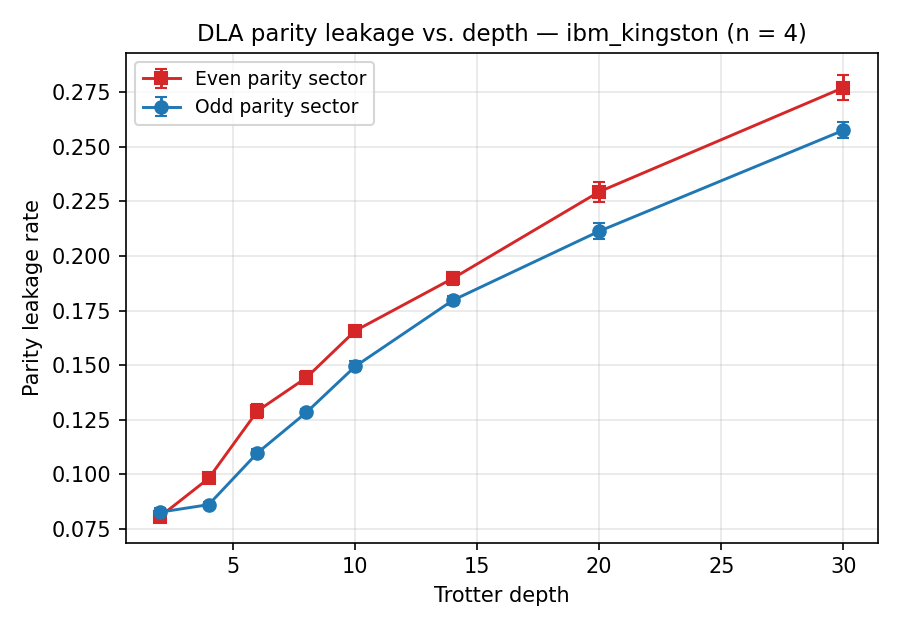
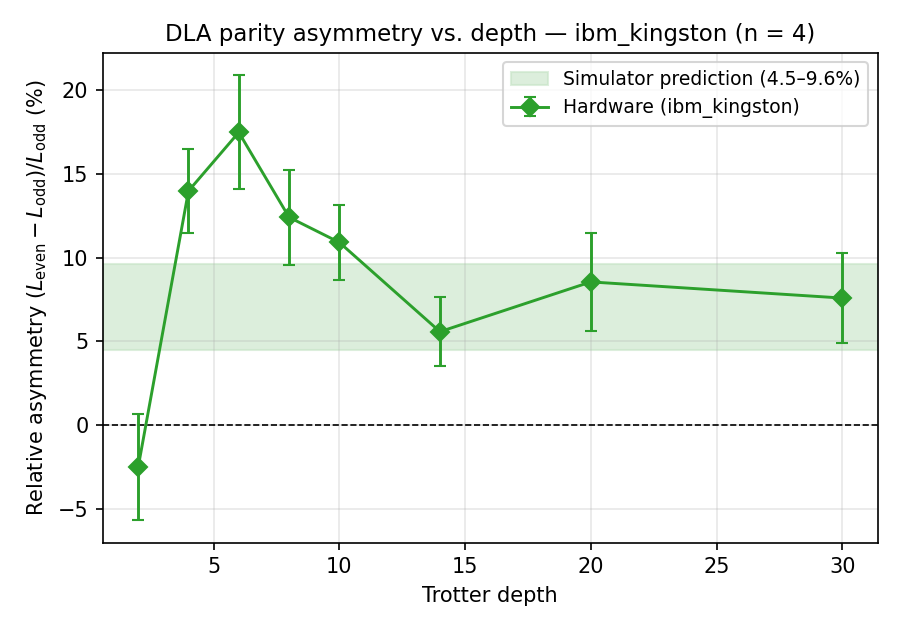
The XY Hamiltonian's dynamical Lie algebra splits as under the parity operator . The SCPN simulator predicts the odd ("feedback") sub-block is more robust to depolarising noise than the even ("projection") sub-block by 4.5–9.6 % at moderate Trotter depths. The Phase 1 campaign on ibm_kingston reproduces this from committed raw counts:
| Trotter depth | Leak even | Leak odd | Asymmetry | Welch | Reps |
|---|---|---|---|---|---|
| 2 | 0.0806 | 0.0827 | 0.45 (baseline) | 12 | |
| 4 | 0.0982 | 0.0862 | $1.4 \times 10^{-6}$ | 21 | |
| 6 | 0.1291 | 0.1099 | $6.6 \times 10^{-6}$ | 21 | |
| 8 | 0.1443 | 0.1284 | $8.9 \times 10^{-5}$ | 21 | |
| 10 | 0.1658 | 0.1495 | $6.7 \times 10^{-6}$ | 21 | |
| 14 | 0.1898 | 0.1797 | 0.010 | 21 | |
| 20 | 0.2295 | 0.2114 | 0.0067 | 12 | |
| 30 | 0.2771 | 0.2576 | 0.0095 | 12 |
- 7 of 8 depths are individually significant at Welch .
- Fisher's combined statistic: , combined .
- Mean asymmetry for depths : — consistent with and in the upper range of the apriori $4.5\text{–}9.6,%$ classical simulator prediction.
- Strongest signal: depth 6, , $5.4\sigma$.
Reproducible from the raw JSON in data/phase1_dla_parity/ via
python scripts/analyse_phase1_dla_parity.py.
A 267-line short paper draft for Quantum Science and Technology /
Physical Review Research is in
paper/submissions/submission_002_phase1_dla_parity/phase1_dla_parity_short_paper.md.
Phase 2 — Reduced A+G Replication (May 2026, ibm_kingston)
The reduced Phase 2 run repeated the n=4 DLA parity test with 30 reps per
depth/sector at 4096 shots, plus a same-run readout baseline. Blocks B-F
(n=6-12 scaling and GUESS calibration) were not submitted.
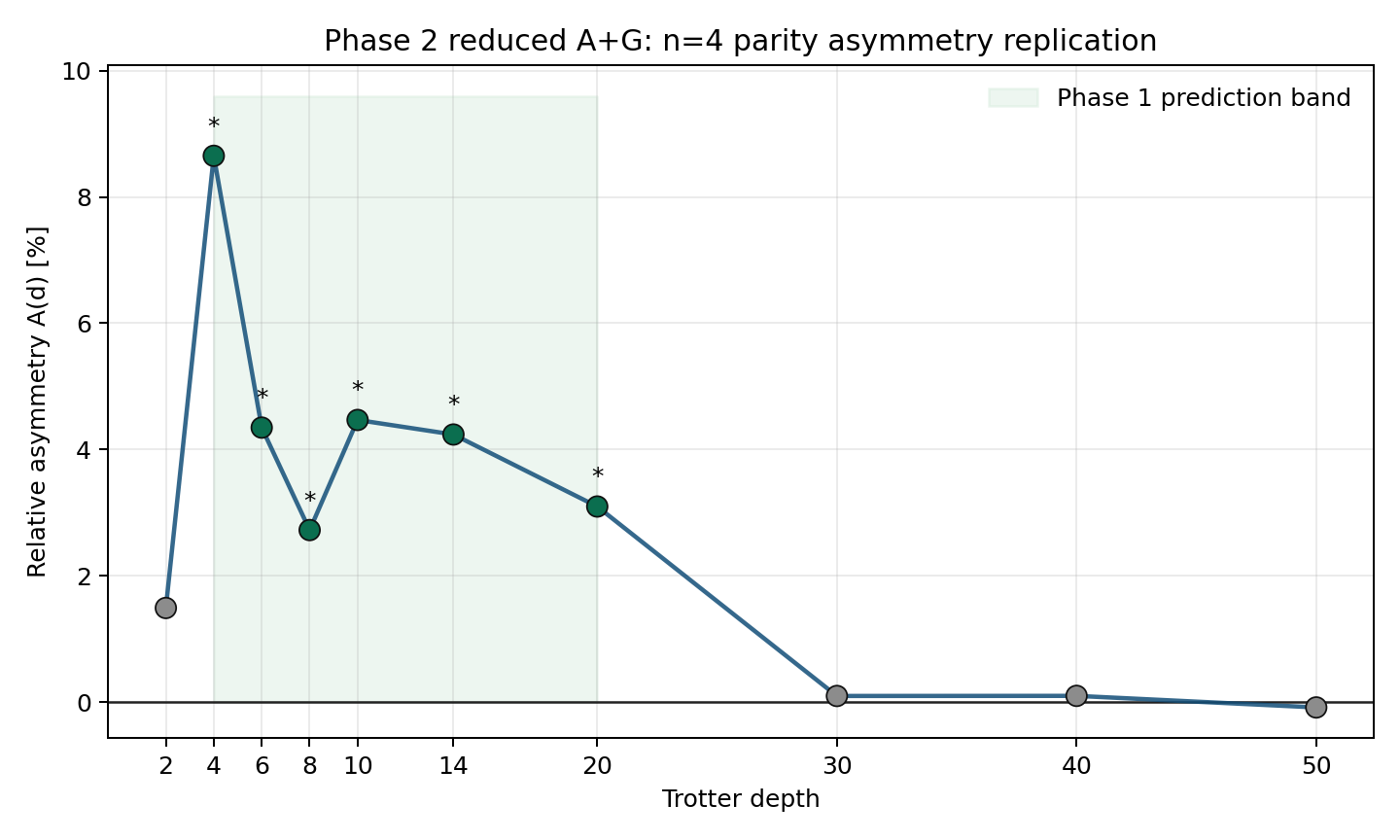
| Trotter depth | Leak even | Leak odd | Asymmetry | Welch p |
|---|---|---|---|---|
| 2 | 0.08370 | 0.08247 | +1.49% | 0.278 |
| 4 | 0.12009 | 0.11053 | +8.65% | 1.56e-08 |
| 6 | 0.15296 | 0.14659 | +4.35% | 1.94e-04 |
| 8 | 0.17339 | 0.16879 | +2.72% | 0.00352 |
| 10 | 0.19599 | 0.18761 | +4.47% | 9.64e-07 |
| 14 | 0.23883 | 0.22912 | +4.24% | 6.14e-06 |
| 20 | 0.28904 | 0.28035 | +3.10% | 2.59e-05 |
| 30 | 0.34557 | 0.34524 | +0.10% | 0.857 |
| 40 | 0.38906 | 0.38868 | +0.10% | 0.855 |
| 50 | 0.42153 | 0.42188 | -0.08% | 0.857 |
- Fisher's combined statistic: chi2
140.671952, p3.773718e-20. - Significant depths: 6/10 at Welch p < 0.05.
- Readout baseline: 12/12 circuits complete at 8192 shots, with state retention from 95.0% to 99.2%.
Reproduce from raw counts via
PYTHONDONTWRITEBYTECODE=1 /home/anulum/.local/bin/python scripts/analyse_phase2_dla_parity.py --verify-integrity.
Phase 2 — B-C Scaling Continuation (May 2026, ibm_kingston)
The B-C continuation tested only n=6 and n=8; blocks A, D, E, F, and G were
skipped. The same-day A+G readout baseline remains the readout-control source.
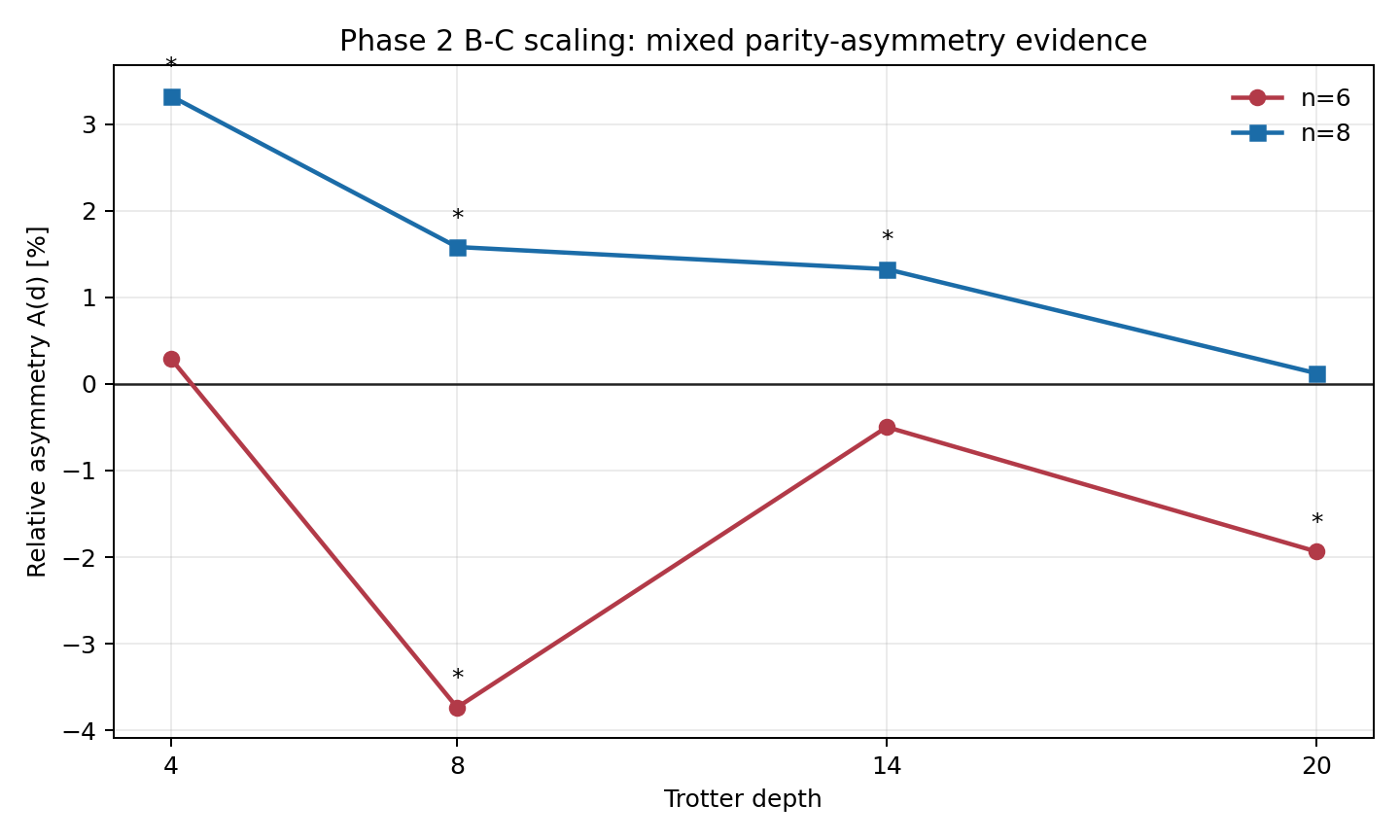
| n | Trotter depth | Leak even | Leak odd | Asymmetry | Welch p |
|---|---|---|---|---|---|
| 6 | 4 | 0.20653 | 0.20592 | +0.30% | 0.757 |
| 6 | 8 | 0.27606 | 0.28678 | -3.74% | 8.37e-07 |
| 6 | 14 | 0.35409 | 0.35586 | -0.50% | 0.407 |
| 6 | 20 | 0.40681 | 0.41484 | -1.94% | 3.05e-04 |
| 8 | 4 | 0.26626 | 0.25768 | +3.33% | 8.35e-04 |
| 8 | 8 | 0.37186 | 0.36606 | +1.58% | 0.0231 |
| 8 | 14 | 0.44863 | 0.44276 | +1.33% | 0.0252 |
| 8 | 20 | 0.43387 | 0.43333 | +0.12% | 0.842 |
n=6: Fisher chi246.531552, p1.883218e-07, 2/4 significant depths.n=8: Fisher chi229.420107, p2.675193e-04, 3/4 significant depths.- IBM-reported usage:
305quantum seconds for jobibm-run-1f46ebd0da8912ff.
Interpretation: this is mixed scaling evidence. The n=8 middle-depth sign is
positive, but n=6 has negative significant depths. It falsifies a simple
monotone scaling story and must not be cited as broad scaling validation.
Reproduce from raw counts via
PYTHONDONTWRITEBYTECODE=1 /home/anulum/.local/bin/python scripts/analyse_phase2_scaling_bc.py data/phase2_scaling_bc/phase2_scaling_bc_2026-05-05T124722Z.json --sha256 f9718c3789329dbaa96a1667f8a581e3d1774632b961a1760c044138ccab6550.
Phase 2 Publication Package
The release-ready Phase 2 manifest is
docs/publication/publication_phase2_package_2026-05-05.md.
It indexes the promoted raw-count files, integrity hashes, job IDs, figure
artefacts, reproduction commands, and claim boundaries.
The excitation-count confound control is preregistered in
docs/campaigns/ibm_popcount_control_manifest_2026-05-05.md.
It has now been executed and promoted under
data/phase2_popcount_control/. The control shows that the original middle-depth
contrast survives, but same-popcount within-sector swaps are also significant
and the popcount-3 odd arm generally leaks more than the popcount-2 even arm.
The paper should therefore use the conservative wording parity-sector and excitation-number correlated leakage asymmetry, not DLA parity alone.
Phase 2 — Popcount-Control Follow-up (May 2026, ibm_kingston)
The popcount-control run tested the main excitation-count confound in the n=4
DLA parity protocol. It used 360 parity-leakage circuits and 5 readout circuits.
| Comparison | Fisher chi2 | Fisher p | Significant depths | Interpretation |
|---|---|---|---|---|
E0 0011 minus O0 0001 | 127.260593 | 2.186677e-21 | 4/6 | Original contrast persists at middle depths but reverses at depth 20. |
E0 0011 minus E1 0101 | 117.374982 | 2.059878e-19 | 5/6 | Within-even same-popcount state spread is large. |
O0 0001 minus O1 0010 | 90.150466 | 4.617056e-14 | 4/6 | Within-odd same-popcount state spread is large. |
E0 0011 minus O3 0111 | 139.164854 | 8.829457e-24 | 4/6 | Higher-excitation odd state usually leaks more than E0, consistent with excitation-count contribution. |
Jobs:
- Main:
ibm-run-7d468e2b1e44b406 - Readout:
ibm-run-b3424c38cfe03c86
Raw JSON SHA256:
f43cbd7e466a3267847b44a750aeba7801cbc52ef10e9808573ef7ed01ec3cf0
Reproduce:
PYTHONDONTWRITEBYTECODE=1 /home/anulum/.local/bin/python scripts/analyse_phase2_popcount_control.py --verify-integrity
Legacy ibm_fez Results (March 2026)
The ibm_fez rows below are retained as legacy hardware observations. They
must be cited with artefact paths from results/ibm_hardware_2026-03-28/,
results/march_2026/, or the hardware ledger, and they are not evidence for
broad quantum advantage or any frontier claim.
Verifiability note (2026-07-17). Every job identifier behind these legacy artefacts is covered by a published hash commitment and a dated, read-only IBM retrieval receipt in
data/march_flagship_verifiability/: 24/24 committed jobs reportDONEonibm_fezwith creation dates 2026-03-18 to 2026-03-29 and 160.0 IBM-reported usage seconds in total. Raw identifiers stay in the private mapping; each committed(raw id, nonce)pair is disclosable to referees and verifies against its published SHA-256 commitment (scripts/build_march_job_id_commitments.py,scripts/retrieve_march_flagship_receipts.py).
Bell Test and QKD

- (a) Per-qubit ⟨Z⟩ heatmap across 4-qubit circuits
- (b) 8-qubit Z-expectations show Kuramoto coupling pattern
- (c) QKD QBER: 5.5% (ZZ), 5.8% (XX) — below BB84 11% threshold
- (d) CHSH: S=2.165 > 2 — classical limit violated on quantum hardware
Full Experiment Suite

- (a) Sync threshold scan across 5 coupling values
- (b) Decoherence scaling: signal increases with system size
- (c) ZNE stable across fold levels 1–9
- (d) 16-qubit: DD vs plain
- (e) Ansatz comparison: Knm wins (lower entropy = more concentrated)
- (f) 8-qubit ZNE stability
Quantitative Characterisation

- (a) Per-qubit readout errors: asymmetric 0→1 vs 1→0
- (b) ZNE per-qubit stability across fold levels
- (c) CHSH correlators with error bars (7.5σ and 8.9σ violations for pairs q0–q1 and q2–q3 respectively) [corrected 2026-07-16: previously stated as ">8σ" for both pairs]
Correlator, Trotter, 16-Qubit, VQE

- (a) ZZ correlation matrix: CX layer creates expected anti-correlations
- (b) Trotter order comparison: dt=0.05 vs dt=0.1 quantifies Trotter error
- (c) 16-qubit per-qubit ⟨Z⟩: alternating pattern across all 16 qubits
- (d) VQE 8-qubit: energy–entropy tradeoff landscape
Exact-Simulation Crossover Boundary

The n≈11.6 crossover is a resource boundary for exact Hilbert-space simulation, anchored by completed ibm_fez scaling runs and committed classical baseline timings. It is not a broad quantum-advantage claim: Rust Kuramoto ODE baselines remain faster through n≤16, and the largest hardware runs are noise-limited.
Many-Body Localisation Diagnostic
Level spacing ratio distinguishes integrable/MBL (, Poisson) from chaotic/thermalising (, GOE) spectra.

Key finding: At , the system never reaches GOE — MBL protection strengthens with system size. The heterogeneous frequencies act as effective disorder preventing thermalisation. This is the physics behind identity persistence: the coupling topology is protected from thermal decoherence.
Cross-validation (eigenstate entanglement): Excited-state entropy is 30–40% below thermal (Page) expectation, confirming non-ergodicity. However, entropy grows with N (sub-volume, not area law), ruling out deep MBL. Correct label: non-ergodic regime — coupling topology protected from thermal scrambling.

First application of level-spacing diagnostics (standard tool, Oganesyan & Huse 2007) to heterogeneous-frequency Kuramoto-XY.
BKT Universality Confirmation
Two independent tests confirm that heterogeneous frequencies preserve the BKT universality class (computed on Kaggle, n=4 to 12):
CFT central charge: Fitting at :
| n | c (measured) | BKT prediction |
|---|---|---|
| 6 | 0.951 | 1.000 |
| 8 | 1.039 | 1.000 |
| 10 | 1.214 | 1.000 |
| 12 | 1.305 | 1.000 |
at n=6,8 confirms BKT. Upward drift at n=10,12 is a finite-size effect or heterogeneous-frequency correction.
Spectral gap essential singularity: Fitting :
| n | K_c | b | R² | Verdict |
|---|---|---|---|---|
| 4 | 2.83 | 2.60 | 0.975 | BKT confirmed |
| 6 | 3.86 | 2.21 | 0.970 | BKT confirmed |
| 8 | 3.60 | 2.27 | 0.969 | BKT confirmed |
R² > 0.96 at n=4,6,8 — the essential singularity is a definitive BKT signature. No prior measurement for heterogeneous-frequency Kuramoto-XY.
Rust Acceleration Benchmarks
Measured on Windows 11, Python 3.12, Rust release build. See Rust Engine for full API.
| Function | n | Rust | Reference | Speedup |
|---|---|---|---|---|
| Hamiltonian construction | 4 | 0.0036 ms | 0.40 ms (Qiskit) | 111× |
| Hamiltonian construction | 8 | 0.023 ms | 0.90 ms (Qiskit) | 39× |
| OTOC (30 time points) | 4 | 0.3 ms | 74.7 ms (scipy) | 264× |
| OTOC (30 time points) | 6 | 48 ms | 5.66 s (scipy) | 118× |
| Lanczos (50 steps) | 3 | 0.05 ms | 1.3 ms (numpy) | 27× |
| Lanczos (50 steps) | 4 | 0.5 ms | 4.8 ms (numpy) | 10× |