Middleware.md
August 17, 2016 · View on GitHub
Writing Redux-Middleware in PureScript
A simple Logger
We will write a logger in PureScript that is similar to the one from the original Redux' middleware docs.
It looks like this:
simpleLogger :: forall a e. Store ->
                            (Next) ->
                            { "type" :: String, "payload" :: String | a } ->
                            Eff (
                              reduxM :: ReduxM,
                              console :: CONSOLE
                              | e
                              )
                            { "type" :: String, "payload" :: String | a }
simpleLogger = \store next action -> do
                                     log ("Middleware (Logger) :: Action: " <>
                                            action.type <> ", payload: " <>
                                            action.payload)
                                     (next action)
It's a function that takes:
- a
Store(more precisely: a stripped-down of it comprising only of:getState&dispatch) - the
Nextdispatcher call from the chain - and an
Actionto be dispatched (it comprises of two mandatory fields:type&payload)
This function does nothing exceptionally complex but one thing is mandatory for every middleware: calling next with the given Action,
or in PureScript lingo: the application of next to Action. The return value will be yet another dispatch function which then will be executed by another middleware in the chain and so on until it reaches the end and the original Redux' dispatch gets called.
This last dispatch call will activate a chain reaction so that every registered middleware will execute its own logic while the actions fly though Redux.
Registering the Middleware
The application one or more middlewares mandates the usage of Store-creation functions which are different from those we saw in the Tutorial.
-- | Create an array of middlewares
let middlewares = [ (simpleLogger) ]
-- | Initialize a Redux Store while building up a chain of middlewares
store <- (applyMiddleware middlewares counter 1)
We create an array of middlewares and call the applyMiddleware function which expects this array, a valid dispatcher and an optional initial state. Here we simply continue to usage
our counter function from the Tutorial and give 1 as the initial value.
The function applyMiddleware is a foreign import mapping to the original Redux' applyMiddleware.
foreign import applyMiddleware :: forall a b c d. Array a -> (b -> Action c d -> b) -> b -> ReduxEff Store
As with the PureScript version the imported applyMiddleware expects an array of middlewares, a dispatcher and an optional initial state. It returns an effectful Store which is a stripped down version of the full Redux' Store API containing only getState & dispatch.
Using the Middleware
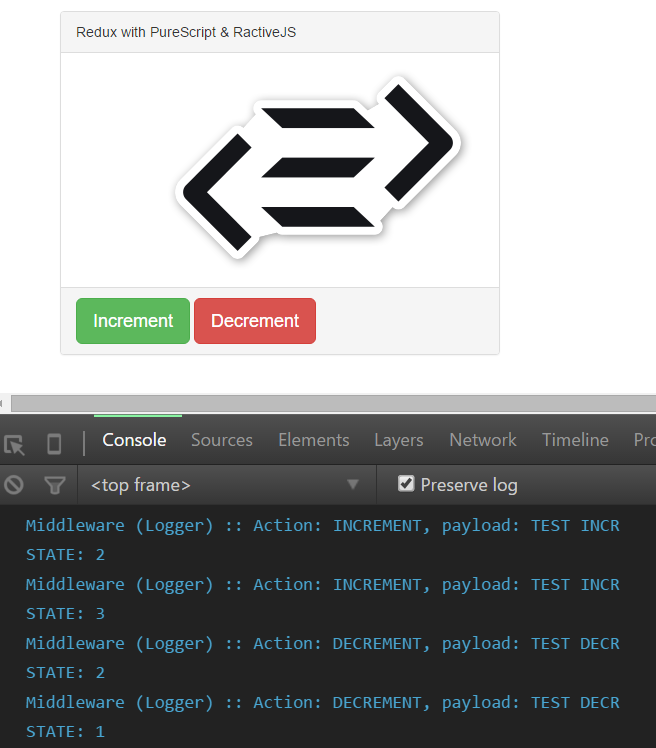
Now when we execute an Action our middleware-logger will get a change to hook into the processing chain and execute its own logic.
Important notice
The currently implemented mappings & logic for the Middleware API are highly experimental (and very buggy!).
Therefore, please, consider it a moving target.