README.md

May 14, 2026 · View on GitHub

Bernstein

"To achieve great things, two things are needed: a plan and not quite enough time." — Leonard Bernstein

why the name?

Bernstein is named after Leonard Bernstein, the American conductor and composer. The project orchestrates a crew of CLI coding agents the way Bernstein conducted the New York Philharmonic — every player on cue, the score deterministic, the conductor accountable for the result. He is the original orchestrator the project takes its name from.

the orchestrator your compliance team will sign off on.

Multi-agent CLI orchestration with an HMAC-signed audit chain, signed agent cards, per-artefact lineage, and an air-gap deploy profile — for teams that have to show their work to a regulator.

CI PyPI GHCR Python 3.12+ License MseeP.ai CodeTrendy

website · docs · install · first run · enterprise eval · glossary · limitations · sponsor


Bernstein is a deterministic Python scheduler that runs a crew of CLI coding agents (Claude Code, Codex, Gemini CLI, and 40 more) against a single goal in parallel git worktrees, with an HMAC-signed audit chain over every step.

at a glance

  • 44 CLI agent adapters ship in v1.10.7 — 41 third-party wrappers, 2 leaf-node delegators, plus a generic --prompt wrapper. Source of truth: the supported agents table below.
  • HMAC-SHA256 audit chain per RFC 2104, one record per scheduling decision, tamper-evident. Operator guide: docs/security/audit-log.md.
  • Signed agent cards use detached JWS (RFC 7515 §A.5) over RFC 8785 (JCS) canonicalization, with Ed25519 / EdDSA keys. Code: src/bernstein/core/security/agent_card_signer.py.
  • Per-artefact lineage records every file write linked back to producer + inputs + prompt SHA + model + cost; customer-key signing for DORA / NIS2 / EU AI Act Article 12 evidence. CLI: bernstein lineage verify <run_id>.
  • Deterministic scheduler: zero LLM in the coordination loop. Plain Python decides who runs, where, with what budget. Replay yesterday's plan, get yesterday's task graph.

why this exists

i wrote bernstein because i was paying $400/month in claude bills running three coding agents in parallel and getting nondeterministic merges.

as of 2026-05-13: 338 stars, 37 forks, ~3,769 pypi downloads/day (mostly bots; ~54k/month), apache 2.0, solo maintained, no funding. numbers will drift; the line above is the source-of-truth date — re-run pip stats / GitHub API to refresh.

install in 30 seconds

pipx install bernstein
bernstein init
bernstein run -g "fix the failing test in tests/test_foo.py"

if bernstein routed a model that saved you a claude bill, $25 covers a month of my coffee.

github.com/sponsors/chernistry →

tier ladder, escalation thresholds, and what each tier gets you live at bernstein.run/sponsors.

who this is for

specific shapes where the value lands:

  • engineering teams running ≥3 cli coding agents in parallel — each agent gets its own git worktree, the merge queue serialises landings, no race conditions
  • regulated or on-prem environments — every routing decision is in plain text, the audit log is hmac-signed and tamper-evident, no saas hop, no third-party data plane
  • platform teams that need an audit log of agent decisions — the orchestrator writes one row per scheduling decision, you can grep it
  • anyone burning more than $1k/mo on cursor/aider/claude-max who wants determinism — you can replay yesterday's plan and get yesterday's task graph
  • forward-deployed engineers dropping into a client repo — credentials stay in your env, not the client's; agents you spawn are whichever cli tool the client already trusts

if you nodded at two of those bullets, this fits.

who this is NOT for

equally specific. these are the cases where you should pick something else:

  • "i want one pair-programmer to chat with about my code" — claude code or cursor alone. bernstein adds orchestration overhead you don't need
  • prototypes where merge gates are overkill — the lint/types/tests/cross-model-review pipeline is value when the cost of a bad merge is real, friction when you're throwing the repo away on friday
  • non-coding tasks (research, writing, data analysis pipelines) — bernstein wraps cli coding agents specifically, not generic llm workflows. crewai or autogen are the right shape there
  • anyone who wants a saas wrapper with a credit card form — bernstein is on-prem only by design. if you want managed, this is the wrong project, not the wrong fit
  • teams that need a vendor with a support sla and a contract — solo open-source project. github issues are how support happens
  • research-shape "let the agents collaborate emergently" use cases — the deterministic scheduler is a hard wall there

how it compares

The honest read: Bernstein is the smaller player on stars in this category. What it has that the bigger ones don't is the auditability surface a regulated buyer needs — HMAC-chained audit, signed agent cards, per-artefact lineage with customer-key signing, and an air-gap deploy profile. If you're a compliance team writing the deployment review for a DORA / NIS2 / EU AI Act Article 12 environment, that's the column that matters.

FeatureBernsteinclaude-flow (49k⭐)Archon (21k⭐)vibe-kanban (26k⭐)claude-squad (7.4k⭐)Composio AO (7k⭐)
Hook they sellregulated / on-prem / auditswarm intelligence, hive-mind, 314 MCP toolsdeterministic + repeatable workflow YAML, web UIkanban board UI for parallel Claudepolished Go TUI, tmux-nativeTypeScript dashboard, CI fixer
LLM in scheduling loopnoyes (swarm)partialyesnoyes
CLI adapter count44~5~10~6~53
HMAC-chained audit logyesnonononono
Signed agent cards (detached JWS)yesnonononono
Per-artefact lineage, customer-key signedyesnonononono
Air-gap / on-prem profileyesno (cloud-leaning)partialnonono
MCP server modeyesyes (314 tools)yesnonono
Python library (importable)yesnonononono
Primary surfaceCLI + lib + MCPCLI + webCLI + webdesktop boardTUICLI + dashboard

Star counts captured 2026-05-12; numbers drift. Source memo: docs/competitors.md. The "hook they sell" column is each project's own framing, not a Bernstein opinion.

Workflow YAML shipped in PR #1117 (merged 2026-05-08); plans are authored as YAML and validated by bernstein workflow validate. The longer feature matrix and the previous-generation Python multi-agent frameworks (CrewAI, AutoGen, LangGraph) are in the Detailed comparison section below; that comparison is kept for completeness, but Bernstein and those projects are different shapes — they orchestrate Python LLM calls, Bernstein orchestrates CLI coding agents in git worktrees.


what is this, in one paragraph

You tell Bernstein what you want built. It splits the work across several AI coding agents, runs them in parallel inside isolated git worktrees, records every handoff in an HMAC-SHA256-chained audit log (RFC 2104), runs the tests, and merges the code that actually passes. You come back to a green PR.

Forward-deployed engineering, on a swarm. Drop Bernstein into a client repo and you get a multi-agent crew with file-based state (.sdd/), per-agent credential scoping, and a signed audit trail running on whichever CLI agents the client already trusts.

Cited as the "deterministic zero-LLM orchestration" pattern reference implementation in nibzard/awesome-agentic-patterns and "the most architecturally interesting tool" by Augment Code's open-source agent orchestrators roundup (2026).

other install methods

curl -fsSL https://bernstein.run/install.sh | sh        # macOS / Linux one-liner
irm https://bernstein.run/install.ps1 | iex             # Windows PowerShell
pip install bernstein                                   # pip
uv tool install bernstein                               # uv
brew tap chernistry/tap && brew install bernstein       # Homebrew

See the full install matrix for dnf copr, npx, optional extras, and the wheelhouse path for air-gapped sites.

why the scheduler is plain Python

Most agent orchestrators use an LLM to decide who does what. That is non-deterministic and burns tokens on scheduling instead of code. Bernstein does one LLM call to break down your goal, then the rest (running agents in parallel, isolating their git branches, running tests, routing retries) is plain Python. Every run is reproducible. Every step is logged and replayable.

No framework to learn. No vendor lock-in. Swap any agent, any model, any provider.

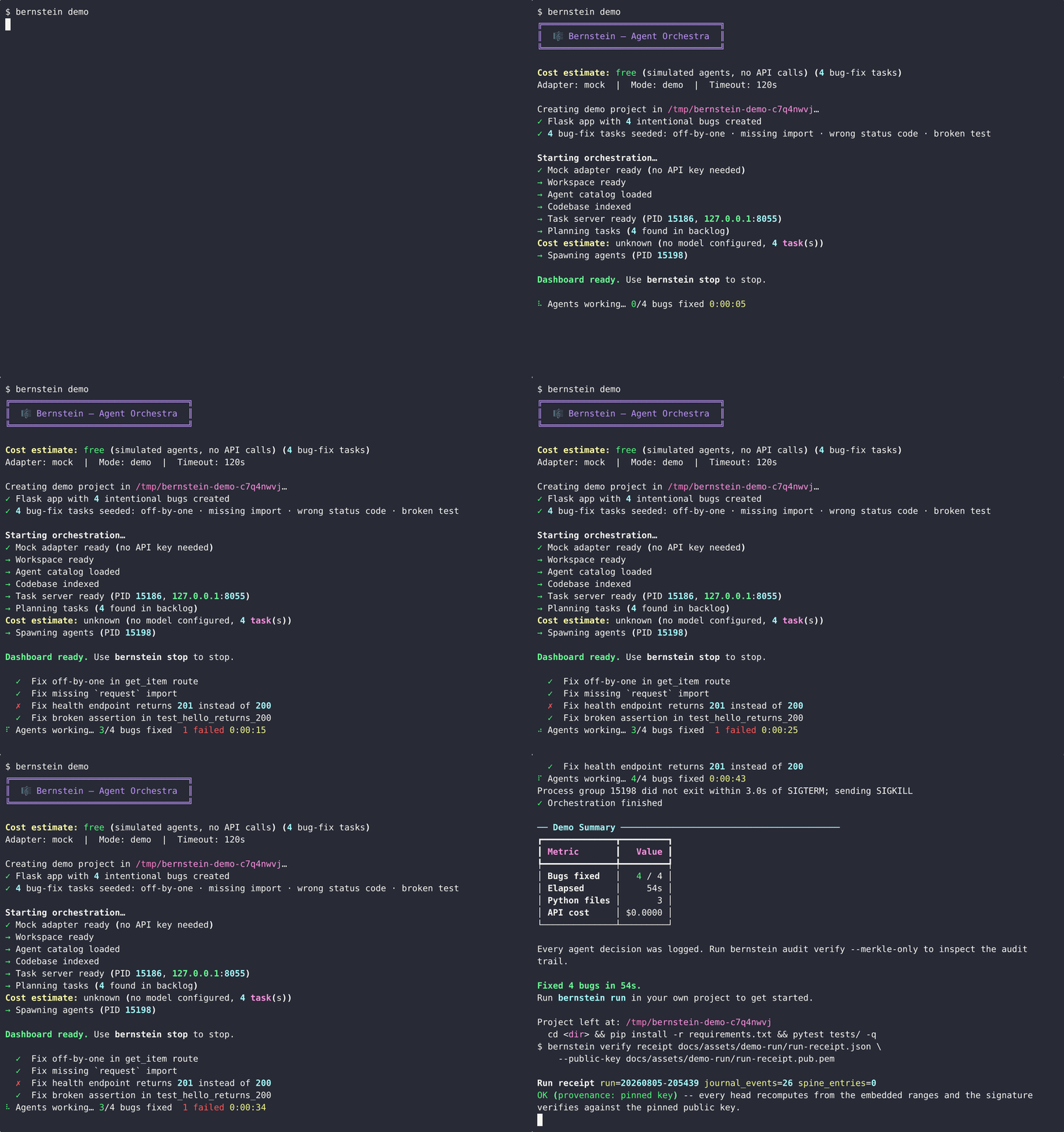
Bernstein in action: parallel AI agents orchestrated in real time

What you see while it runs:

$ bernstein -g "Add JWT auth"
[manager] decomposed into 4 tasks
[agent-1] claude-sonnet: src/auth/middleware.py  (done, 2m 14s)
[agent-2] codex:         tests/test_auth.py      (done, 1m 58s)
[verify]  all gates pass. merging to main.

YAML workflow manifests (optional)

When the open-ended bernstein run -g "<goal>" is too coarse-grained, the bernstein workflow family runs a declarative DAG of agent / command / loop nodes. Manifests are plain YAML, validated up-front, and dispatched through the same AgentSpawner the rest of Bernstein uses. No parallel spawn path, no LLM in the scheduler.

bernstein workflow list                       # bundled + user-installed
bernstein workflow run idea-to-pr -g "Add JWT auth"
bernstein workflow init my-flow               # scaffold a starter manifest
bernstein workflow validate path/to/flow.yaml

Stock workflows that ship with the wheel:

NameWhat it does
idea-to-prresearch → plan → implement → tests → PR
refactor-with-testsfind target → propose → implement → loop until green
security-reviewscan → triage → patch → adversary review
doc-updateaudit → update → docs build
dependency-bumpbump → install → tests-loop → smoke
hot-fixreproduce → fix → regression loop → changelog

Loop nodes re-fire until a bash predicate exits 0 (pytest -x is a typical one). fresh_context: true mints a new agent session per iteration. The interactive: true flag is reserved for the approval-gate work tracked in ticket #1110 and currently raises a clear NotImplementedError.

use cases

  • forward-deployed engineering — drop the swarm onto a client repo when you arrive, take it with you when you leave.
  • self-evolving projects — point Bernstein at its own repo and let it execute the backlog (this codebase is one).
  • CI fleets — run a swarm of agents in parallel on PRs, with per-agent credential scoping and signed audit trail.
  • air-gapped / regulated deployment — install from a signed wheelhouse, run with --profile airgap to deny outbound by default, allow-list specific destinations as needed. See Air-gap installation.

supported agents

Bernstein auto-discovers installed CLI agents. Mix them in the same run. Cheap local models for boilerplate, heavier cloud models for architecture.

44 CLI agent adapters: 41 third-party wrappers, 2 leaf-node delegators (Composio, Ralphex), plus a generic wrapper for anything with --prompt.

AgentModelsInstall
Claude CodeOpus 4, Sonnet 4.6, Haiku 4.5npm install -g @anthropic-ai/claude-code
Codex CLIGPT-5, GPT-5 mininpm install -g @openai/codex
OpenAI Agents SDK v2GPT-5, GPT-5 mini, o4pip install 'bernstein[openai]'
GitHub Copilot CLICopilot-managed (GPT-5, Sonnet 4.6)npm install -g @github/copilot
Gemini CLIGemini 2.5 Pro, Gemini Flashnpm install -g @google/gemini-cli
CursorSonnet 4.6, Opus 4, GPT-5Cursor app
Devin Terminal (Cognition)Devin-managedcurl -fsSL https://cli.devin.ai/install.sh | bash then devin auth login
AiderAny OpenAI/Anthropic-compatiblepip install aider-chat
AmpAmp-managednpm install -g @sourcegraph/amp
CLM gateway (sovereign / on-prem LLM)Any OpenAI-compatible CLM endpointpip install aider-chat, then set CLM_ENDPOINT / CLM_TOKEN
CodySourcegraph-hostednpm install -g @sourcegraph/cody
ContinueAny OpenAI/Anthropic-compatiblenpm install -g @continuedev/cli (binary: cn)
GooseAny provider Goose supportsSee Goose docs
IaC (Terraform/Pulumi)Any provider the base agent usesBuilt-in
JunieBYOK (Anthropic, OpenAI, Google, xAI, OpenRouter, Copilot)curl -fsSL https://junie.jetbrains.com/install.sh | bash
KiloKilo-hostedSee Kilo docs
KiroKiro-hostedSee Kiro docs
AWS Q DeveloperAmazon Q-managed (Claude-backed)brew install --cask amazon-q then q login
Ollama + AiderLocal models (offline)brew install ollama
OpenCodeAny provider OpenCode supportsSee OpenCode docs
QwenQwen Code modelsnpm install -g @qwen-code/qwen-code
Cloudflare AgentsWorkers AI modelsbernstein cloud login
OpenHandsAny LiteLLM-supported (Anthropic, OpenAI, ...)uv tool install openhands --python 3.12
Open InterpreterAny (LiteLLM-backed)pip install open-interpreter
gptmeAnthropic, OpenAI, OpenRouterpipx install gptme
PlandexPlandex Cloud or self-hosted modelscurl -sL https://plandex.ai/install.sh | bash
AIChatOpenAI, Anthropic, OpenRouter, Groq, Geminicargo install aichat
Letta CodeLetta-routed (Anthropic, OpenAI)npm install -g @letta-ai/letta-code
GenericAny CLI with --promptBuilt-in

orchestrator delegation (leaf-node)

A separate, smaller class of adapters that wrap other CLI orchestrators as if they were single agents. Bernstein hands the wrapped tool a prompt or plan and only sees the final exit code; sub-agent costs and quality gates inside the wrapped orchestrator are not visible to Bernstein. Useful when you want to drop an existing workflow built on one of these tools into a step of a larger Bernstein plan.

OrchestratorWrapped asInstall
Composio Agent Orchestrator (@aoagents/ao)composionpm install -g @aoagents/ao
umputun/ralphexralphexgo install github.com/umputun/ralphex/cmd/ralphex@latest

Any adapter also works as the internal scheduler LLM. Run the entire stack without any specific provider:

internal_llm_provider: gemini            # or qwen, ollama, codex, goose, ...
internal_llm_model: gemini-3.1-pro

Tip

Run bernstein --headless for CI pipelines. No TUI, structured JSON output, non-zero exit on failure.

quick start

cd your-project
bernstein init                    # creates .sdd/ workspace + bernstein.yaml
bernstein -g "Add rate limiting"  # agents spawn, work in parallel, verify, exit
bernstein live                    # watch progress in the TUI dashboard
bernstein stop                    # graceful shutdown with drain

For multi-stage projects, define a YAML plan:

bernstein run plan.yaml           # skips LLM planning, goes straight to execution
bernstein run --dry-run plan.yaml # preview tasks and estimated cost

how it works

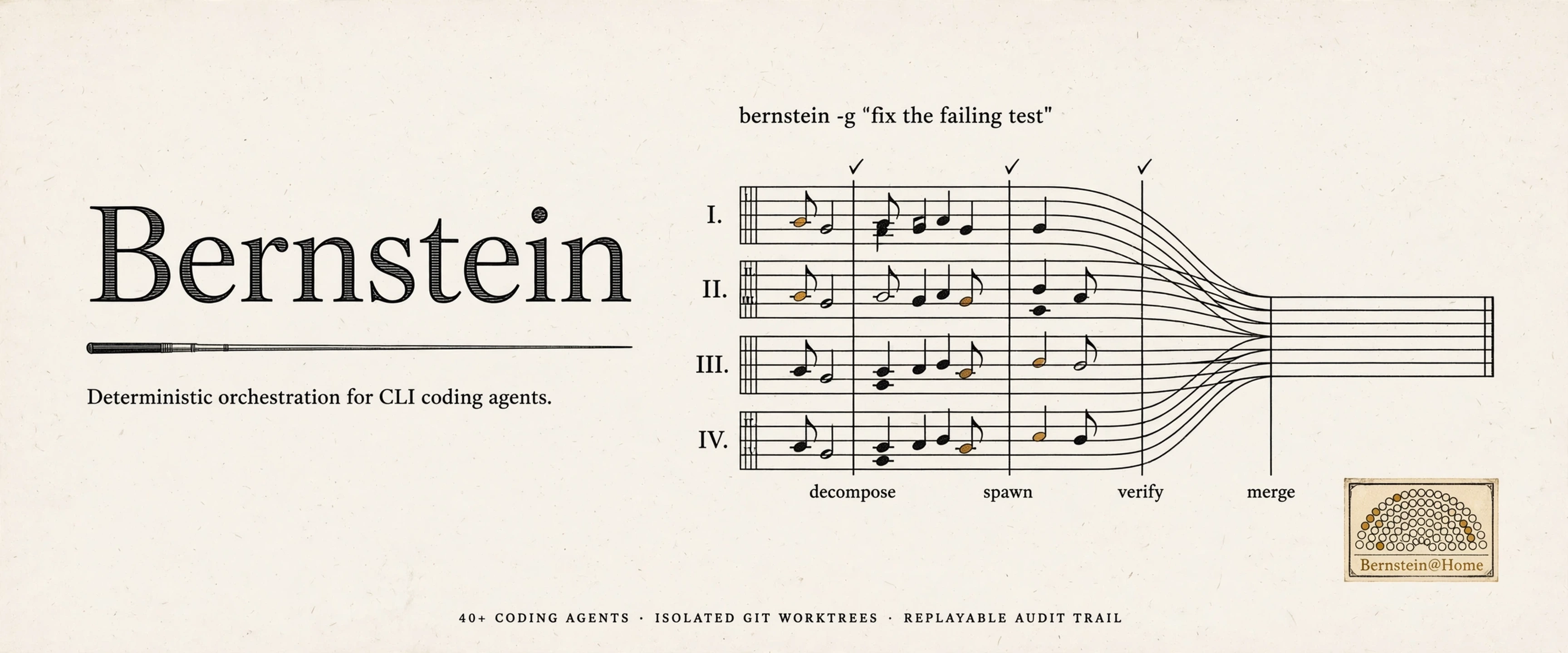
Bernstein runs a four-stage pipeline per goal:

  1. Decompose. The manager breaks your goal into tasks with roles, owned files, and completion signals. One LLM call, then plain Python from there.
  2. Spawn. Agents start in isolated git worktrees, one per task. Main branch stays clean.
  3. Verify. The janitor checks concrete signals: tests pass, files exist, lint clean, types correct.
  4. Merge. Verified work lands in main. Failed tasks get retried or routed to a different model.

The orchestrator is a Python scheduler, not an LLM. Scheduling decisions are deterministic, auditable, and reproducible. Every step writes a record to the HMAC-chained audit log (.sdd/audit/YYYY-MM-DD.jsonl) per RFC 2104 — see docs/security/audit-log.md.

cloud execution (Cloudflare)

Bernstein can run agents on Cloudflare Workers instead of locally. The bernstein cloud CLI handles deployment and lifecycle.

  • Workers. Agent execution on Cloudflare's edge, with Durable Workflows for multi-step tasks and automatic retry.
  • V8 sandbox isolation. Each agent runs in its own isolate, no container overhead.
  • R2 workspace sync. Local worktree state syncs to R2 object storage so cloud agents see the same files.
  • Workers AI (experimental). Use Cloudflare-hosted models as the LLM provider, no external API keys required.
  • D1 analytics. Task metrics and cost data stored in D1 for querying.
  • Browser rendering. Headless Chrome on Workers for agents that need to inspect web output.
  • MCP remote transport. Expose or consume MCP servers over Cloudflare's network.
bernstein cloud login      # authenticate with Bernstein Cloud
bernstein cloud deploy     # push agent workers
bernstein cloud run plan.yaml  # execute a plan on Cloudflare

capabilities

Core orchestration. Parallel execution, git worktree isolation, janitor verification, quality gates (lint, types, PII scan), cross-model code review, circuit breaker for misbehaving agents, token growth monitoring with auto-intervention.

Intelligence. Contextual bandit router for model/effort selection. Knowledge graph for codebase impact analysis. Semantic caching saves tokens on repeated patterns. Cost anomaly detection (burn-rate alerts). Behavior anomaly detection with Z-score flagging.

Sandboxing. Pluggable SandboxBackend protocol; run agents in local git worktrees (default), Docker containers, E2B Firecracker microVMs, or Modal serverless containers (with optional GPU). Plugin authors can register custom backends through the bernstein.sandbox_backends entry-point group. Inspect installed backends with bernstein agents sandbox-backends.

Artifact storage. .sdd/ state can stream to pluggable ArtifactSink backends: local filesystem (default), S3, Google Cloud Storage, Azure Blob, or Cloudflare R2. BufferedSink keeps the WAL crash-safety contract by writing locally with fsync first and mirroring to the remote asynchronously.

Skill packs. Progressive-disclosure skills (OpenAI Agents SDK pattern): only a compact skill index ships in every spawn's system prompt, agents pull full bodies via the load_skill MCP tool on demand. 17 built-in role packs plus third-party bernstein.skill_sources entry-points.

Controls. HMAC-SHA256 audit chain (RFC 2104), policy engine, lethal-trifecta capability gate (refuses spawns whose tool chain combines private data + untrusted input + external comm — Simon Willison's framing, June 2025: "if your AI agent combines all three of these, an attacker can trick it into stealing your data"), PII output gating, WAL-backed crash recovery (experimental, multi-worker safety), OAuth 2.0 with PKCE (RFC 7636) and RFC 8707 resource-indicator binding, per-artefact lineage with customer-key Ed25519 signing (RFC 8037) and regulator export.

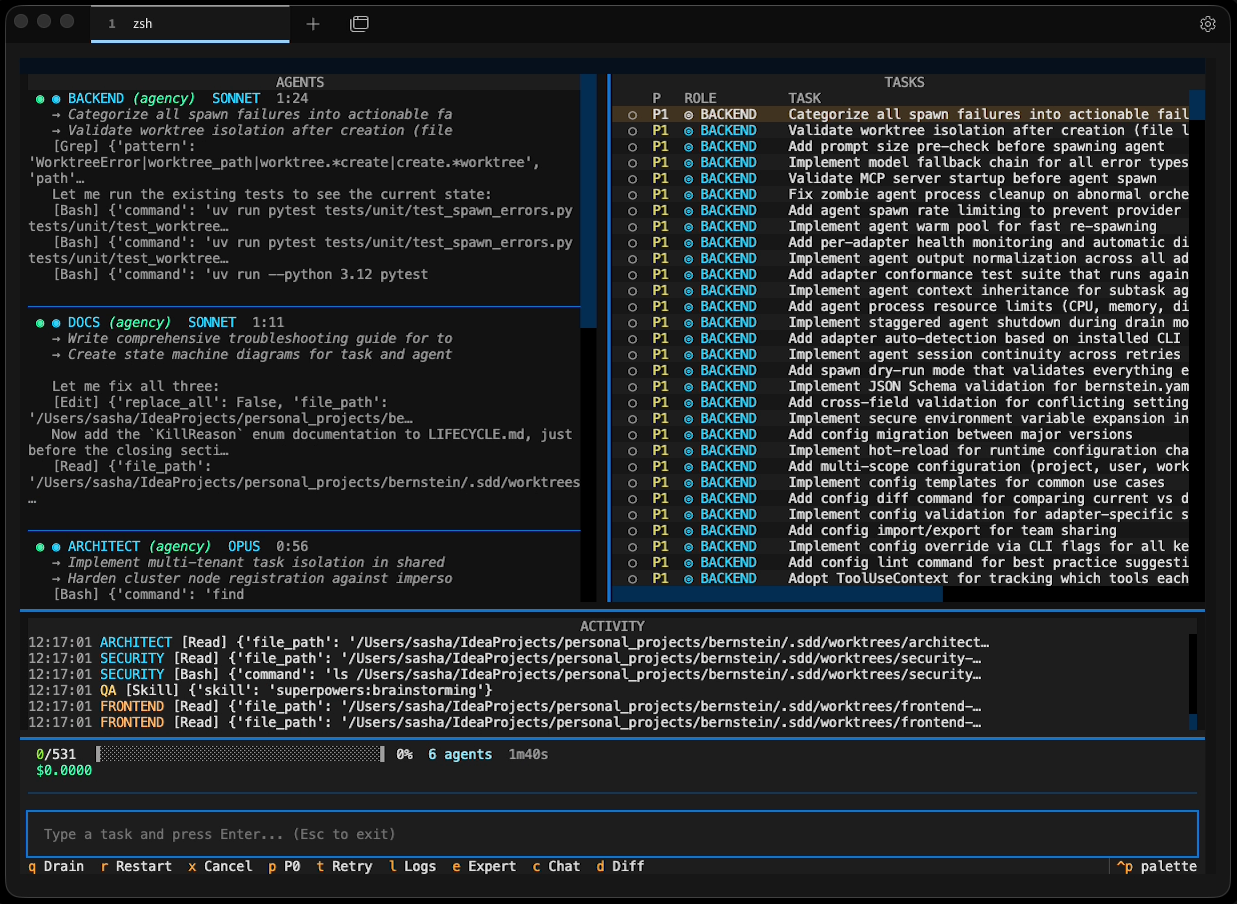
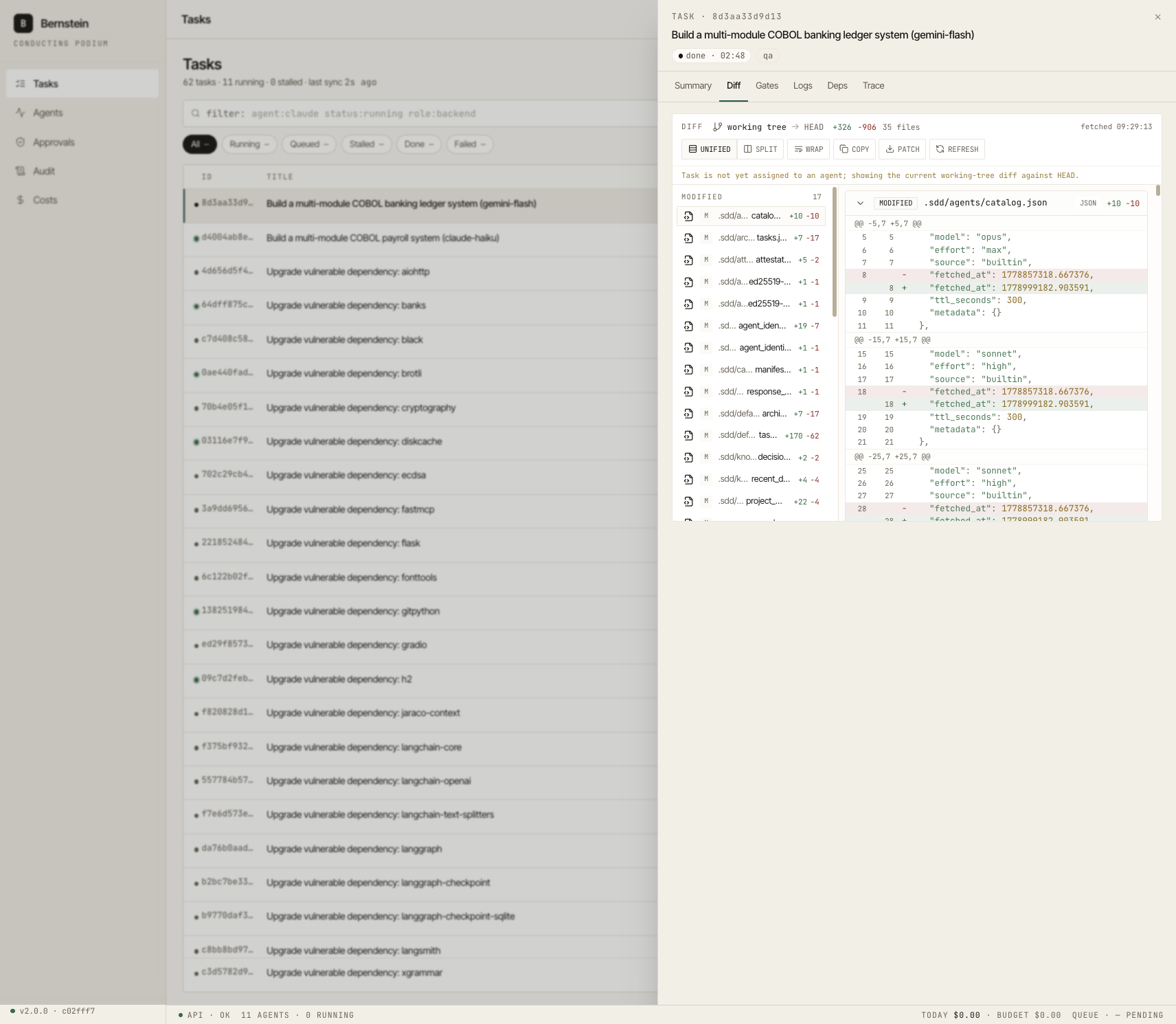
Observability. Prometheus /metrics, OTel exporter presets, Grafana dashboards. Per-model cost tracking (bernstein cost) plus a run savings summary on every bernstein run. Terminal TUI and web dashboard. Agent process visibility in ps.

Ecosystem. MCP server mode, A2A protocol support, GitHub App integration, pluggy-based plugin system, multi-repo workspaces, cluster mode for distributed execution, self-evolution via --evolve (experimental).

Full feature matrix: FEATURE_MATRIX.md · Recent features: What's New

regulatory anchors (as of 2026-05-09)

For compliance reviewers asking "which regulation does Bernstein actually map to":

RegulationMappingBernstein surface
EU AI Act Article 12 (logging)Automatic record-keeping for high-risk AI systemsbernstein audit export --article-12 --since … --until … → deterministic, retention-pinned bundle with audit slice + governance catalog. See docs/compliance/.
SOC 2 Trust Service CriteriaCC4 / CC7 (audit + monitoring)bernstein audit pack --soc2 → per-control evidence checklist with sha-256 pointers.
DORA / NIS2Per-artefact lineage with customer-key Ed25519 signaturebernstein lineage export <run_id> --format jsonld → schema v2 records.
OWASP Agent Security Initiative (ASI06 — memory poisoning, 2026)Memory provenance auditbernstein verify --memory-audit walks the lesson-memory chain.
RFC 2104 (HMAC)Audit chain integrity.sdd/audit/*.jsonl HMAC-SHA256 with secret outside the audit volume.
RFC 7515 §A.5 (detached JWS) + RFC 8785 (JCS) + RFC 8037 (EdDSA)Signed agent cards + lineage signaturessrc/bernstein/core/security/agent_card_signer.py, src/bernstein/core/security/lineage_kms.py.
RFC 7636 (PKCE) + RFC 8707 (resource indicators)Web dashboard auth + MCP audience bindingsrc/bernstein/core/security/oauth_pkce.py, auth.py.

These are mappings, not certifications. Production accreditation (SOC 2 Type II, ISO 27001) is out of scope for a solo-maintained OSS project; the surfaces exist to make a customer's accreditation path shorter.

recent releases

ACP bridge. bernstein acp serve --stdio exposes Bernstein to any editor that speaks the Agent Communication Protocol (Zed, etc.). No plugin code needed on the editor side.

Autonomous CI repair. bernstein autofix watches open Bernstein PRs and, when CI turns red, spawns a fixer agent automatically. Once green, it pushes the fix and re-requests review.

Credential vault. bernstein connect <provider> writes API keys to the OS keychain; bernstein creds lists and rotates them. Agents inherit scoped credentials without touching environment variables.

Preview tunnels. bernstein preview start boots a sandboxed dev server and prints a public URL. Useful for sharing a running branch with a reviewer without deploying to staging.

Full changelog: docs/whats-new.md

operator commands

Commands that eliminate the glue code most teams end up writing around their runs.

CommandWhat it does
bernstein prAuto-creates a GitHub PR from a completed session; body carries the janitor's gate results and token/USD cost breakdown.
bernstein from-ticket <url>Imports a Linear / GitHub Issues / Jira ticket as a Bernstein task. Label-based role + scope inference. Supports --dry-run and --run.
bernstein ticket import <url>Alias / group form of from-ticket for scripting.
bernstein remoteSSH sandbox backend. remote test <host>, remote run <host> <path>, remote forget <host>. ControlMaster socket reuse for fast repeat calls.
bernstein hooksLifecycle hooks for pre_task, post_task, pre_merge, post_merge, pre_spawn, post_spawn; shell scripts or pluggy @hookimpls. hooks list, hooks run <event>, hooks check.
bernstein chat serve --platform=telegram|discord|slackDrive runs from chat with /run, /status, /approve, /reject, /switch, /stop.
bernstein approve-tool / bernstein reject-toolInteractive mid-run tool-call approval. --latest, --id, --always.
bernstein tunnel start <port> [--provider auto|cloudflared|ngrok|bore|tailscale]One wrapper around four tunnel providers. Also tunnel list, tunnel stop <name>|--all. ControlMaster-style process reuse.
bernstein daemon install [--user|--system] [--command="..."] [--env KEY=VAL]...Installs a systemd (Linux) or launchd (macOS) unit for auto-start. Also daemon start/stop/restart/status/uninstall.
bernstein connect <provider> / bernstein credsStores and rotates API credentials in the OS keychain. Agents inherit scoped keys per-run.
bernstein autofixDaemon that monitors open Bernstein PRs; spawns a fixer agent when CI fails and pushes the repair automatically.
bernstein preview startStarts a sandboxed dev server for the current branch and prints a shareable public tunnel URL.
bernstein agents-mdGenerates a canonical AAIF AGENTS.md for the repo and rewrites it into each CLI's native shape. generate (preview), write (single file), sync (canonical + Cursor .cursor/rules/*.mdc + Claude CLAUDE.md + Aider CONVENTIONS.md + Goose .goosehints), verify (CI gate), diff (shows drift between canonical IR and on-disk files).
bernstein scaffold "<prompt>"Bootstraps a project skeleton from a single goal prompt. --template auto|python-cli|..., --output <dir>, --force.
bernstein wiki buildRenders WIKI.md for the current repo from the AST symbol graph. Local, no LLM call, no cloud round-trip.
bernstein identity show / decode / verify / disableOperator-side helpers for the install-rev fingerprint embedded in shared yaml/trace/role-prompt artefacts. No network egress; discovery uses public gh search code.
bernstein security role-adapter-policyInspects and edits the per-role adapter allow-list (deny-list enforcement at spawn time).

retrieval & caching: what's actually under the hood

Bernstein deliberately uses no neural embeddings, no vector databases, and no external embedding APIs. There are two retrieval/caching layers, both keyword/lexical:

  • Codebase RAG (core/knowledge/rag.py); SQLite FTS5 with BM25 ranking and AST-aware chunking for Python files. Built incrementally on file mtime; used to enrich agent task context within token budgets.
  • Semantic cache (core/knowledge/semantic_cache.py); despite the name, fuzzy matching is done with TF (term-frequency) cosine similarity over word counts, not learned embeddings. It deduplicates near-identical LLM planning and agent-output requests so we don't re-spawn agents for the same goal.

If you need real semantic retrieval (vector DB, neural embeddings), wire it yourself via the retrieval role/skill in templates/; nothing in core performs vector search.

detailed comparison

The closest competitors share Bernstein's shape — multi-agent CLI orchestration in git worktrees. Those are compared in the next table.

The table immediately below covers previous-generation Python multi-agent frameworks (CrewAI, AutoGen, LangGraph). Their orchestrator is an LLM that drives Python tool calls; Bernstein's orchestrator is plain Python that drives terminal coding agents. Different problem, different shape — kept here for completeness.

FeatureBernsteinCrewAIAutoGen 1LangGraph
OrchestratorDeterministic codeLLM-driven (+ code Flows)LLM-drivenGraph + LLM
Works withAny CLI agent (44 adapters)Python SDK classesPython agentsLangChain nodes
Git isolationWorktrees per agentNoNoNo
Pluggable sandboxesWorktree, Docker, E2B, ModalNoNoNo
VerificationJanitor + quality gatesGuardrails + Pydantic outputTermination conditionsConditional edges
Cost trackingBuilt-inusage_metricsRequestUsageVia LangSmith
State modelFile-based (.sdd/)In-memory + SQLite checkpointIn-memoryCheckpointer
Remote artifact sinksS3, GCS, Azure Blob, R2NoNoNo
Self-evolutionBuilt-in (experimental)NoNoNo
Declarative plans (YAML)YesYes (agents.yaml, tasks.yaml)NoPartial (langgraph.json)
Model routing per taskYesPer-agent LLMPer-agent model_clientPer-node (manual)
MCP supportYes (client + server)YesYes (client + workbench)Yes (client + server)
Agent-to-agent chatBulletin boardYes (Crew process)Yes (group chat)Yes (supervisor, swarm)
Web UITUI + web dashboardCrewAI AMPAutoGen StudioLangGraph Studio + LangSmith
Cloud hosted optionYes (Cloudflare)Yes (CrewAI AMP)NoYes (LangGraph Cloud)
Built-in RAG/retrievalYes (codebase FTS5 + BM25)crewai_toolsautogen_ext retrieversVia LangChain

Last verified: 2026-04-19. See full comparison pages for detailed feature matrices.

The table above compares Bernstein against LLM-orchestration frameworks (they orchestrate LLM calls). The table below covers the closer category: other tools that orchestrate CLI coding agents:

FeatureBernsteinclaude-flowArchonvibe-kanbanclaude-squadComposio AO
Stars (2026-05-13)33849k21k26k7.4k7k
Their hookregulated / on-prem / auditswarm intelligence + 314 MCP toolsdeterministic + repeatable, web UIkanban board UIpolished Go TUI, tmux-nativeTypeScript dashboard, CI fixer
ShapePython CLI + library + MCP serverCLI + webCLI + webdesktop boardGo TUITypeScript CLI + dashboard
Primary languagePythonTypeScript / NodePythonTypeScriptGoTypeScript
Installpipx install bernsteinnpm install -g claude-flowself-hostnpm install -g vibe-kanbanbrew install claude-squadnpm install -g @aoagents/ao
Agent adapters44~5~10~6~5 (Claude family)3 (Claude Code, Codex, Aider)
Parallel multi-agent executionYesYes (swarm)YesYesYes (tmux multiplex)Yes
Git worktree per agentYesNo (swarm-based)YesYesYesYes
CoordinatorDeterministic Python schedulerLLM swarmWorkflow + partial LLMLLM-drivenPlan executor (no LLM in loop)LLM-driven
HMAC-chained audit replayYesNoNoNoNoNo
Signed agent cards (detached JWS)YesNoNoNoNoNo
Per-artefact lineage (customer-key signed)YesNoNoNoNoNo
Air-gap / on-prem profileYes (--profile airgap)No (cloud-leaning)PartialNoNoNo
MCP server mode (exposes self as MCP)Yes (stdio + HTTP/SSE)Yes (314 tools)YesNoNoNo
Python library (importable)YesNoNoNoNoNo
Autonomous CI-fix / PR flowYes (bernstein autofix)NoNoNoNoYes
LicenseApache 2.0MITMITApache 2.0MITMIT

Star counts and capability snapshots captured 2026-05-12. Earlier-generation CLI-orchestrator competitors (awslabs/cli-agent-orchestrator, emdash, umputun/ralphex) are in docs/competitors.md with the same matrix.

Bernstein's wedge in this category is the auditability column — HMAC-chained audit, signed agent cards, per-artefact lineage, air-gap profile — plus Python-library shape and the widest adapter coverage. None of the bigger projects has the audit-chain stack; that's the column the regulated-buyer cares about. We are not winning on stars or polish. If you want the polished Go TUI for parallel Claude on your Mac, claude-squad is the right tool. If you want the swarm framing with the broadest MCP tool surface, claude-flow is. If you want a kanban board UI, vibe-kanban is. If you want the workflow-YAML primitive with web UI and chat integration, Archon is. If you need to ship a regulator-ready audit export and run on-prem behind a firewall, Bernstein.

what people use it for

These are real workflow patterns from Bernstein's own docs, examples, and project surface, not invented customer quotes.

  • Parallel test generation. Fan out across untested modules with BERNSTEIN_MAX_AGENTS=5 bernstein -g "Generate unit tests for untested modules in src/".
  • CI failure repair. Watch open PRs and dispatch scoped fixers with bernstein autofix start --repo your-org/your-repo --foreground.
  • PR review follow-up. Turn review comments into tracked fix tasks with bernstein review-responder start --repo your-org/your-repo --foreground.
  • Codebase modernization. Run wide refactors like BERNSTEIN_MAX_AGENTS=8 bernstein -g "Migrate callback-based modules in src/ to async/await and update tests".
  • Ticket-to-run workflows. Import GitHub, Jira, or Linear work directly with bernstein from-ticket https://github.com/your-org/your-repo/issues/123 --run.
  • API-change safety checks. Catch downstream breakage before merge with bernstein dep-impact --base main.

See Who Uses Bernstein for the longer version with command examples and notes on when each workflow fits.

monitoring

bernstein live       # TUI dashboard
bernstein dashboard  # web dashboard
bernstein status     # task summary
bernstein ps         # running agents
bernstein cost       # spend by model/task
bernstein doctor     # pre-flight checks
bernstein recap      # post-run summary
bernstein export     # shareable HTML/Markdown report of the latest run
bernstein trace <ID> # agent decision trace
bernstein run-changelog --hours 48  # changelog from agent-produced diffs
bernstein explain <cmd>  # detailed help with examples
bernstein dry-run    # preview tasks without executing
bernstein dep-impact # API breakage + downstream caller impact
bernstein aliases    # show command shortcuts
bernstein config-path    # show config file locations
bernstein init-wizard    # interactive project setup
bernstein debug-bundle   # collect logs, config, and state for bug reports
bernstein skills list    # discoverable skill packs (progressive disclosure)
bernstein skills show <name>  # print a skill body with its references
bernstein fingerprint build --corpus-dir ~/oss-corpus  # build local similarity index
bernstein fingerprint check src/foo.py                 # check generated code against the index

install

MethodCommand
One-liner (macOS / Linux)curl -fsSL https://bernstein.run/install.sh | sh
One-liner (Windows)irm https://bernstein.run/install.ps1 | iex
pippip install bernstein
pipxpipx install bernstein
uvuv tool install bernstein
Homebrewbrew tap chernistry/tap && brew install bernstein
Fedora / RHELsudo dnf copr enable alexchernysh/bernstein && sudo dnf install bernstein
npm (wrapper)npx bernstein-orchestrator
Docker (GHCR)docker run --rm -v "$PWD:/work" -w /work -e ANTHROPIC_API_KEY ghcr.io/sipyourdrink-ltd/bernstein:latest run -g "fix tests/test_foo.py"

The one-liner scripts check for Python 3.12+, bootstrap pipx when it's missing, fix PATH for the current session, and install (or upgrade) bernstein. They handle brew-managed macOS environments and the Windows py -3 launcher fallback. Script sources: install.sh · install.ps1.

optional extras

Provider SDKs are optional so the base install stays lean. Pick what you need:

ExtraEnables
bernstein[openai]OpenAI Agents SDK v2 adapter (openai_agents)
bernstein[docker]Docker sandbox backend
bernstein[e2b]E2B microVM sandbox backend (needs E2B_API_KEY)
bernstein[modal]Modal sandbox backend, optional GPU (needs MODAL_TOKEN_ID / MODAL_TOKEN_SECRET)
bernstein[s3]S3 artifact sink (via boto3)
bernstein[gcs]Google Cloud Storage artifact sink
bernstein[azure]Azure Blob artifact sink
bernstein[r2]Cloudflare R2 artifact sink (S3-compatible boto3)
bernstein[grpc]gRPC bridge
bernstein[k8s]Kubernetes integrations

Combine extras with brackets, e.g. pip install 'bernstein[openai,docker,s3]'.

Editor extensions: VS Marketplace · Open VSX

"powered by bernstein" badge (optional)

If your project ships diffs that bernstein helped land, you can advertise it:

[![signed by bernstein](https://img.shields.io/badge/signed_by-bernstein-FBBF24?logo=githubactions&logoColor=white&style=flat-square)](https://bernstein.run/?utm_source=badge&utm_medium=readme&utm_campaign=powered-by)

bernstein init --add-badge injects it into your README under the existing badge stack. Variants: signed, audited-by, orchestrated-by, crew-managed-by — pass via --badge-variant. Picky maintainers can keep their READMEs untouched: the flag is opt-in.

contributing

PRs welcome. See CONTRIBUTING.md for setup and code style.

support

If Bernstein saves you time: GitHub Sponsors

Contact: forte@bernstein.run

Curated lists, newsletters, and peer projects that picked up Bernstein:

More awesome lists & community curation
Cited as prior art by peer projects

cite

If Bernstein helps your research or industry work, please cite it. Machine-readable metadata lives in CITATION.cff (CFF 1.2.0); GitHub renders the "Cite this repository" button automatically. A Zenodo DOI will be minted on the next release once Zenodo's GitHub integration is enabled — see CITATION.cff for the current canonical citation.

license

Apache License 2.0


Made with love by Alex Chernysh · GitHub · X · bernstein.run

translations

Español · 中文 · العربية · Português · Bahasa Indonesia · Français · 日本語 · Русский · Deutsch · עברית · יידיש

Footnotes

  1. AutoGen is in maintenance mode; successor is Microsoft Agent Framework 1.0.