README.md
September 5, 2026 · View on GitHub
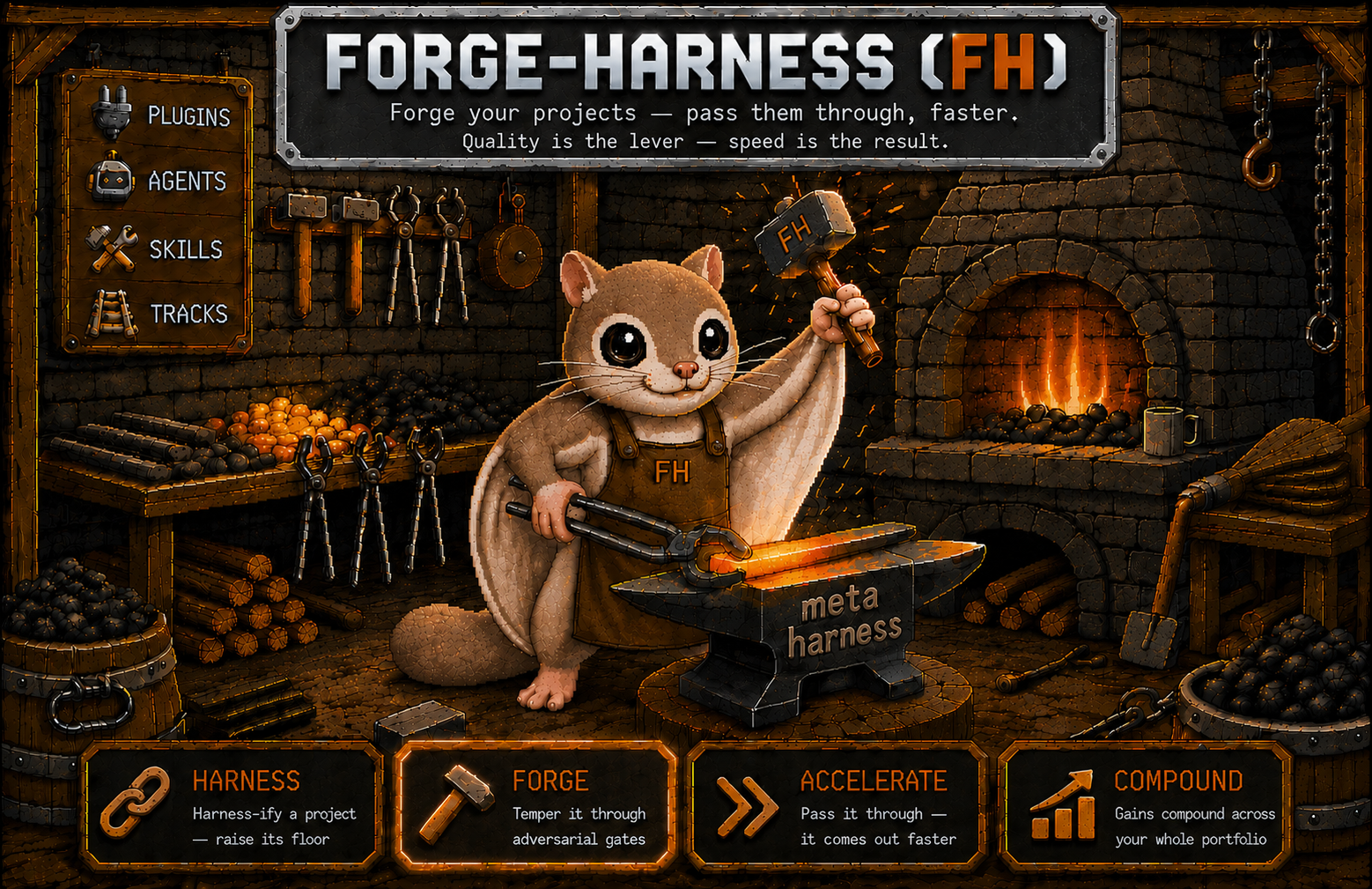






Stop re-explaining your rules to your agent. Put them in the project.
Quality gates that catch you, not just your agent.

A real run, not a mock: an agent “tidied up” a skill spec (SKILL.md) and dropped its Done When section. The guard names the missing section; put it back and the cleanup ships unchanged.
Regenerate: brew install vhs && vhs docs/demo/gate-block.tape
Pick one. They install differently and buy you different things.
① Just the gate — you do not need Claude Code
npx --package @chrono-meta/fh-gate fh-gate          # nothing to install
brew tap chrono-meta/forge-harness && brew install forge-harness   # or this
What you get
- A change is judged before it merges, and the verdict names what the change lost — not that something is "off". The GIF above is that verdict on a real diff.
- The verdict is a typed value, not text you grep:
PASS · PENDING · BLOCKED · ESCALATE. - Runs anywhere a shell runs — CI, a pre-commit hook, a different coding agent. Claude Code optional.
- It reviews your own code, not just an agent's. Point it at a diff and it names the weakness — a verdict
that quietly degrades toward PASS, a reference that does not exist, a secret, a claim with no grounds —
so you fix it and re-run before merge. Where each FH engine applies (harness building · skill/agent
authoring · code review · irreversible-surface gates · context continuity), and what changes by model
tier and effort level:
docs/USE_CASES.md·docs/model_tier_expectations.md. How the gates line up with ISO/IEC AI-testing and AI-quality standards (42119 · 29119-11 · 25059 · 42001), as a self-assessment with evidence pointers:docs/STANDARDS_ALIGNMENT.md.
② The whole harness — inside Claude Code
claude plugin marketplace add https://github.com/chrono-meta/forge-harness.git
claude plugin install -s user fh-meta@forge-harness
claude plugin install -s user fh-qp@forge-harness      # optional: QP (Quality Platform) — plan→run→regress a web/desktop app through the session's Playwright / computer-use MCP
git clone https://github.com/chrono-meta/forge-harness.git ~/projects/forge-harness
cd ~/projects/forge-harness && claude        # then type a greeting: hi · 안녕 · こんにちは · 你好
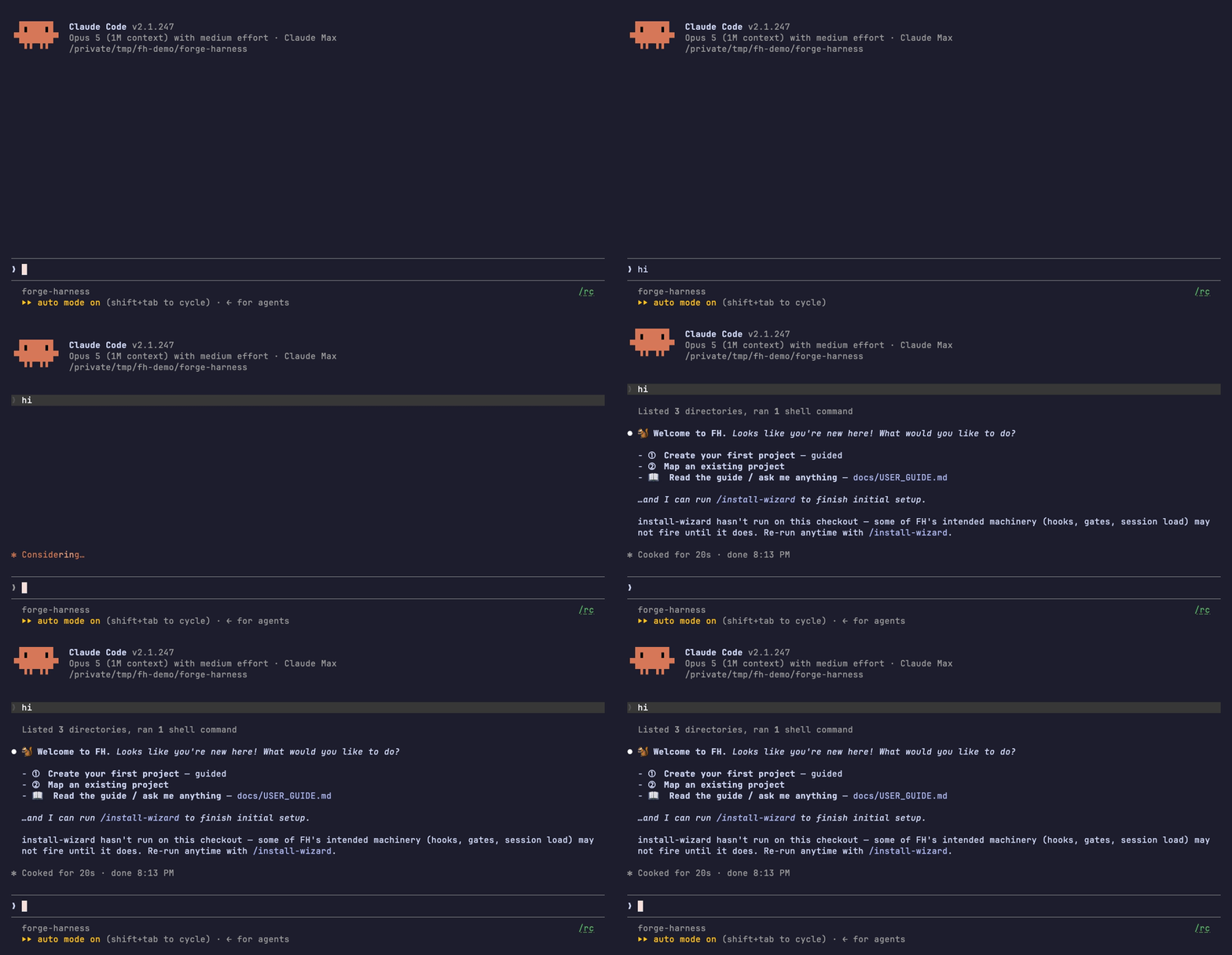
The whole of the fourth line. A clone made minutes earlier: it reads the checkout, sees no session files, opens the new-user menu — and tells you the wizard has not run yet.
Launch and thinking time are hidden; every character is that run's output. Regenerate: vhs docs/demo/door2-menu.tape
What you get, on top of ①
- You stop having to pick the check. The harness reads what you are about to do — publish, delete, rewrite history, open a PR — and names the gate for that moment. ① is one command you remember; ② is the layer that remembers for you.
- 41 skills · 8 agents you can call in plain language: diagnose a project, accelerate one, wire a new one up.
tracks/keeps what each session learned, so session 2 starts where session 1 stopped. This is the part that compounds — and the part you cannot judge on day one.- Ask for the same thing three times and it stops answering: it builds you the harness that answers.
🟥 One thing ② does not give you. FH also carries a 4-axis pre-commit hook, and it is not for your repos: it hard-codes hub paths and hub markers, so installing it into your project blocks your commits instead of helping. The installer treats it as opt-in and tells you to skip it unless you develop FH itself. For your own repos, ① is the gate — wire it into CI or your own pre-commit.
Not sure? Start with ①. It costs one command and nothing to uninstall, and ② is a superset — nothing you learn in ① is thrown away.
What neither door is
It does not replace the review that happens after. It moves the question earlier, so that what reaches a human reviewer is smaller — not so that a human stops reviewing. The bottleneck it targets is the gap between how fast things get generated and how fast a person can check them; it closes that gap from the front, by cutting what has to travel to the back.
What a diff cannot show stays a person's job. Anything that only surfaces when the thing actually runs — on a real screen, against real state — is outside what any of this reaches. That work does not shrink because a gate exists upstream of it. It gets a shorter queue.
Does it actually catch anything?
On real code someone else wrote (2026-05-31). fh-gate ran on OpenCode's AI-generated
permission/arity.ts — 163 lines, agent-written, CI green. Verdict: BLOCKED, on two A-grade
findings CI missed (short-token overflow in the allowlist; executor tools absent from the arity table).
On planted holes, with the model held fixed (2026-07-14). Eight subtle default-toward-PASS (fail-open) holes, authored by two other models so the set was not tuned to us. The model stayed pinned at a mid-tier floor; only the method changed:
| Method | Caught | False alarms |
|---|---|---|
| Plain review | 5/8 — and 2 of those were the wrong bug (false confidence, worse than a clean miss) | — |
| + FH's degrade-direction lens | 6/8 | 0 |
| + a different model family, same lens | 8/8 | 0 |
🟥 The load-bearing line is not the 8/8. Both single-model lanes missed the same two holes — a
falsy error-sentinel, and a separator-negation parse. Same input, same blind spot: a second reviewer of
the same kind would have missed them too. That is the whole argument for decorrelation; the rest is
arithmetic. Small sample (single draw); reps and harder holes are the stated next step. Method:
ship_readiness_gate.md §Dominance · more
dated runs: docs/OUTPUT_EVIDENCE.md.
Quality is the lever; speed is the result. ·
The principles ·
Why it exists ·
The evidence ·
How to use it
If this is useful, a star helps others find it.
| If you're here because… | forge-harness solves it |
|---|---|
| Context disappears when a session ends | Persistent tracks/ — resumable from anywhere |
| You repeat the same setup across projects | Connect once to the hub, share across all projects |
| Team AI know-how lives only in people's heads | Codify it so everyone shares it |
| You want AI to get better as work accumulates | Skills and patterns compound session over session |
| You need a governance layer for AI-generated code | fh-gate wraps any coding agent as a post-generation gate |
This document is for humans. AI operating rules →
CLAUDE.md· command reference →CHEATSHEET.md. The two doors above are the whole decision; everything below is reference for when you want it.
Get going
Type hi — or 안녕, こんにちは, 你好, hola, bonjour. Any of them opens a numbered menu:
pick a door, answer a couple of questions, and it runs the install wizard for you. Say "Connect a
project" and the hub scans ../, finds .git directories, and creates tracks/{project}/.
🟥 Honest about that: matching your language is a prose rule with no mechanical floor, so it
does not always hold — measured blind on a clean clone (2026-08-21) it translated the whole menu, but
whether the menu fires at all is shakier: one greeting variant produced none. Say so and it will
switch. Written up in CLAUDE.md §Voice/Tone rather than smoothed over.
Requirements. Door ② needs the Claude Code CLI (claude --version); door ① does not — that is the
point of it. One gate additionally needs Python + PyYAML (it parses YAML and fails closed without
it, turning all of npm test red): python3 -m pip install --user pyyaml. Why it fails closed:
CHEATSHEET.md §6.
Your first 15 minutes. Setup worked when a greeting shows the 🐿️ door menu and "Connect a project"
creates tracks/{your-project}/. Then take a win in the same session: "accelerate this project" (a
ranked, install-gated plan) or "run /context-doctor" (token-waste scan); for full initial setup —
hooks, gates, baseline, each approved individually and a decline recorded — ask for
/install-wizard. One honest note: FH's payoff is compounding, and it shows from session 2
onward; day one gives you the menu, the plan, and the gates, so don't judge it on day one. Already
cloned elsewhere? That path is your hub. Unfamiliar words →
GLOSSARY.md; trying ② on one project only?
templates/starter_profile.md is one command and a curated first five.
⚠️ Plugin-only is partial synergy. You can install the plugin without cloning the hub (
claude plugin install -s user fh-meta@forge-harness, thencdinto your project). You get the skills and agents, but not the hub-side orchestration — theCLAUDE.mdgovernance, or the compoundingtracks/memory that makes them compound across sessions.🟥 Two version numbers, and they measure different things. The package version (npm badge, top of page) is what you install; the identity-maturity release (
identity-v1.0.0, on the Releases page) is how far along the harness is —0.xby design, because it refuses to call all five identities green when they are not. They are not on one scale, and a high package number is not maturity:ship_readiness_gate.md. 🟢 2026-09-04 — the two counters merge.identity-v1.0.0(every identity 🟢) is the last identity-track tag and the first to carry the Latest badge. From here on a release is one number for both — the next is the package major that carries identity 1.0 — and release notes are written in English with a Korean summary. The paragraph above stays as the reason the tracks were split while not everything was green; it is history, not the current rule.
What makes it a harness, not a toolbox
A harness reads your intent and forges it into a machined form — rules an AI reliably follows, or deterministic code that needs no model at all. The payoff is less trial-and-error on the human side: the request → feedback → regenerate loop relocates into the harness and runs in parallel, so your attention goes only where a change is irreversible. A skill, agent, or plugin is a tool; a harness is a level up — a star: one project's tools, rules, gates, and memory bound into a single working body. forge-harness is the galaxy those stars live in, binding many onto a shared floor so they evolve together instead of drifting apart. It can also run a field harness in simulation inside its own sandbox and then emit it as an independent one — 🟥 read that step as direction of travel, not a shipped feature: the chamber has emitted once, and that run skipped the full flow.
forge-harness/   ← the hub (persistent brain)      Project A ──→ connect hub in CLAUDE.md
├── knowledge/   → shared across all projects      Project B ──→ connect hub in CLAUDE.md
└── tracks/      → work records per project
Structurally it is two layers — a model-agnostic methodology layer (tracks/, knowledge/,
SKILL.md docs) and a Claude-Code-native automation layer (agents, hooks, slash commands,
CLAUDE.md rules). That boundary is deliberate, not a gap to be closed:
docs/codex-compat.md. Where this sits (2026): basic agent orchestration is
commoditizing into standard infrastructure, and FH deliberately stakes nothing on that plumbing — its
durable layer is what does not commoditize: the governance gates, drift control, and the cross-project
compounding loop. Routing and dispatch are means; the gate and the loop are the asset.
The five identities — what FH is for
Not five modules and not five shipped features: the shapes the skills clump into, named after the fact rather than layered on top.
| Identity | What a person gets | |
|---|---|---|
| ① | Harness cluster | One task rides several harnesses, governance computed between them — call a capability you do not have rather than build it, and absorb the one you should have built |
| ② | Project incubator | A new harness comes out walking where it was born, not as an empty scaffold |
| ③ | Governance gate | What must not ship is blocked mechanically, not by remembering to check |
| ④ | Frontier absorption | When you are unsure, what we already have then what the world already built gets searched first — so nothing is rebuilt |
| ⑤ | Amplifier | A short intent gets forged all the way to the finished artifact |
A sixth row is deliberately absent: Ⓑ Project Booster — FH's machinery accelerating another
harness's own development — is real and graded, but sits on a different layer, hence a letter rather
than a number. And the table is not five working features: maturity is graded per identity
(aspirational → partial → RC → REALIZED) with dated evidence, deliberately not copied here — a grade
kept in two files goes stale in one, and this page exists in four languages. Read the grades before
relying on any row: ship_readiness_gate.md. And for how to use each one — which command or door lights which identity — docs/IDENTITIES.md: the grades say how ready, that page says how to call it.
Two properties cut across all five. It rides the frontier instead of patching it — dispatching across families (Claude, Codex, Gemini, local) to co-evolve, not to paper over weak spots. Decorrelation is today's trust lever and the load-bearing word on this page: deliberately making two checks fail differently — another model family, a run against a real target, an outside audit of your own record — so what one is blind to, another is not. And it evolves in two directions: outward, each session's lessons compound into the hub; inward, the same gates turn on the harness itself.
How it is built — three · four · five · six
Three-stage process · four engines · five identities · six-axis verification. The identities above
are what appears where the process and the engines interlock — the five are the forged, graded, stable
ones; other identities surface and recede with how you steer and how far you push (operator's formulation,
2026-09-05); four engines (judgment-circuit · ship-gate · context-continuity ·
external-grounding) are the core every FH-specific output comes from; the three-stage process —
① plant the judgment circuit before design → ② parallel decorrelation in the middle → ③ burn it down on
six axes — is the order every piece of FH work runs in, forging an engine included, with speed as the arrow
at the end, not a fourth box. The whole map — what FH is, how it is implemented (every node a real path), why it is trustworthy (gates · lanes · grades with file paths), and what is operator-local vs generic — is one page: docs/map/FH_MAP.md, with three interactive diagrams beside it — live at chrono-meta.github.io/forge-harness.
 ⚠️ The six
axes are not a fourth layer; they are what stage ③ consists of. Full canon, and why this is
deliberately not a clean stack:
⚠️ The six
axes are not a fourth layer; they are what stage ③ consists of. Full canon, and why this is
deliberately not a clean stack:
fh_three_layer_canon.md — the same three in
the smith's words (forge · quench · temper) are in ETHOS.md.
🟥 Axes are not divided by how adversarial they are, but by what they were given. Hand two reviewers the same input and the same blind spot survives, however many you add:
| Axis | What it gets | What it catches | Typical instrument |
|---|---|---|---|
| ⓐ Different family | the diff + the author's framing | the implementation is wrong | a reviewer from another model family (auto-decorrelation) |
| ⓑ Standpoint | the diff + the target harness's own canon | whether the rule you cited actually says that | run the diff from that harness's own repo and rules (§7) |
| ⓒ Isolated grounding | the sentences the author wrote — their claims and what they declared before starting — + the tree as it stands | the claim is wrong · the delta does not match what was declared | someone who did not write it re-measures what it says |
| ⓓ Third-party encounter | the problem + someone else's codebase | is this already solved · where your change touches someone else's repo | look at the same problem in an unrelated third repo |
| ⓔ First real use | one real target | the way you are measuring is wrong — the instrument's instrument | run it once against one real target and check by hand |
| ⓕ Revert and observe | the tree with the wiring deleted | the anchor is wrong — the check is decorative | delete the thing it guards and confirm that specific check goes red |
You do not run all six every time, and that is the design — do not multiply them, choose:
one-line fix (typo · gitignore)     nothing burns — with one answer, planting a circuit is overhead
ordinary code change (reversible)   ⓔ first real use + ⓕ revert
verdict · gate code                 + ⓐ different family — verdict logic is what a reviewer who
                                    shares the author's optimism misses structurally
change touching another harness     + ⓑ standpoint — bolt on three families and if all three eat
                                    your framing, nobody asks "does that canon actually say so"
very large · irreversible           + ⓒ isolation + ⓓ third-party encounter. Burn all of it
An axis is defined by its input, not by the reviewer's ability, so base-model advances do not
supersede this: a stronger model still cannot see information it was not given. 🟥 Limits before
citing it — the table is n=1 (one artifact, one session, one author), and when 16 findings were
handed with provenance removed to two classifiers from other families, 3 of the 5 the author
attributed to ⓓ were judged to belong elsewhere. A worked day inside these gates, misses named:
docs/GATE_DAY.md.
Where a rule lives — three seats
A harness learns by writing rules down, and the always-loaded file only ever gets longer — so the reasoning ends in a corner: a harness that keeps learning keeps getting more expensive to start. It does not, because a rule has three seats, chosen by when the rule has to fire: always-loaded (triggers that are an intention — nothing can hook one, so salience is the only layer) · the gate's own error message (triggers that are an action; the message that blocks you also teaches the form, and this seat is free) · the hook (properties of a record — present, typed, attributable, non-vacuous). The middle seat is the one that usually goes unused. Full table, and the honest limit that it only fires on failure: gate-locality §Where a rule lives.
Run it outside Claude Code — the fh-gate CLI
FH wraps any coding agent (OpenCode, Codex, …) as a post-generation governance gate.
npx --package @chrono-meta/fh-gate fh-gate                    # default: Claude backend
FH_BACKEND=codex npx --package @chrono-meta/fh-gate fh-gate   # Codex backend
FH_BACKEND=cross npx --package @chrono-meta/fh-gate fh-gate   # BOTH families, findings UNIONed
# → FH_GATE_VERDICT: PASS | PENDING | BLOCKED | ESCALATE
Same governance prompt for every runtime. auto is fallback selection — it runs one leg; cross
runs both families and unions their findings (a finding only one family saw is still a finding), costs
~2x, and is for load-bearing verdict / gate / irreversible-surface changes, not a default. The output
always declares which legs actually ran, so a single-family result never reads as cross-checked.
fh-run (one skill or agent directly), fh-goal and fh-codex-doctor (adapter drift check) ship
alongside it — flags and the full env table in CHEATSHEET.md, spec in
fh_integration_contract.md.
Recommended posture — Claude Code as orchestrator, others as sidecars: a non-CC runtime can be your
main agent and keeps the methodology layer through fh-gate/fh-run, but not the autopilot (hooks do
not auto-fire, dispatch needs the adapter) — tier-by-tier in
docs/codex-compat.md.
Model setup
Claude Code does not auto-select models by task complexity — you configure this once.
| Command | Who runs what | Best for |
|---|---|---|
/model sonnet | Sonnet session; FH dispatches higher-tier sub-agents on declared floors | FH default — operation + routine dev |
/model opus | Opus handles everything | Harness-editing sessions · maximum depth every turn |
/model opusplan | Opus plans · Sonnet executes (when Opus engages) | Cost-conscious routine coding — see caveat |
Measured, operating FH is near model-flat — the rules in context do the work — so FH dispatches the
few depth-sensitive turns itself at a declared floor and never switches your session model; a
below-floor environment gets an explicit below-floor flag rather than a silent degrade. ⚠️
opusplan's Opus engagement is not guaranteed (0 of 10 turns in one measured run). The two
structural laws behind that doctrine, hardware tiers for optional local sidecars, and the multi-model
sidecar posture: docs/MODEL_SETUP.md.
41 skills · 8 agents
Count = non-deprecated skills. Clustered as verification · orchestration · diagnosis · harvesting ·
gates · discovery · simulation · setup, plus 8 agents (challenger · quench-challenger · beginner
· main-player · expert · fact-checker · hub-persona-auditor · persona-innovator) dispatched
by those skills or by name. Full phrasebook — every skill and agent with its one-line definition
and the phrase that triggers it:
CHEATSHEET.md §12.
Learn more
| Resource | Purpose |
|---|---|
docs/USER_GUIDE.md | How to actually use it, start to finish |
CHEATSHEET.md | Full command reference |
docs/ETHOS.md | What FH believes — the forge, the cold reviewer, claims earning their words |
docs/WHY.md | Why it exists |
docs/OUTPUT_EVIDENCE.md | The evidence — papers, dated runs, external convergence |
docs/GATE_DAY.md | One day inside the gates, measured, with the misses named |
docs/MODEL_SETUP.md | Which model to run FH on, hardware tiers, sidecars |
docs/codex-compat.md | Running FH on a non-Claude-Code runtime |
knowledge/shared/GLOSSARY.md | Unfamiliar words |
CLAUDE.md | AI operating rules + sync/push protocol |
AGENTS.md | Runtime agent specs |
CATALOG.md | Past work search index |
fh_three_layer_canon.md | The three-layer canon — process, engines, identities |
ship_readiness_gate.md | Identity grades, the two version tracks, the dominance results |
fh_integration_contract.md | Governance gate spec |
docs/CONTRIBUTING.md | How to contribute skills and patterns |
tracks/_contrib/ | Consent lane — share a de-identified work session; the repo compounds across operators |
FH papers: v1.0 methodology · Zenodo (DOI 10.5281/zenodo.20397566) · cs.SE companion, published · Zenodo (DOI 10.5281/zenodo.20680081) · cs.AI companion in preparation. Those, the independent convergent work, and the caveats on each:
docs/OUTPUT_EVIDENCE.md.