jev-labs
September 19, 2026 · View on GitHub
Never confidently wrong. A consensus kernel around a probabilistic oracle, tested the way you would test a database: model-checked in TLA+, contract-generated into Rust, and run through 1,680 simulated pharmacy decisions under seeded chaos against the live Jev API.
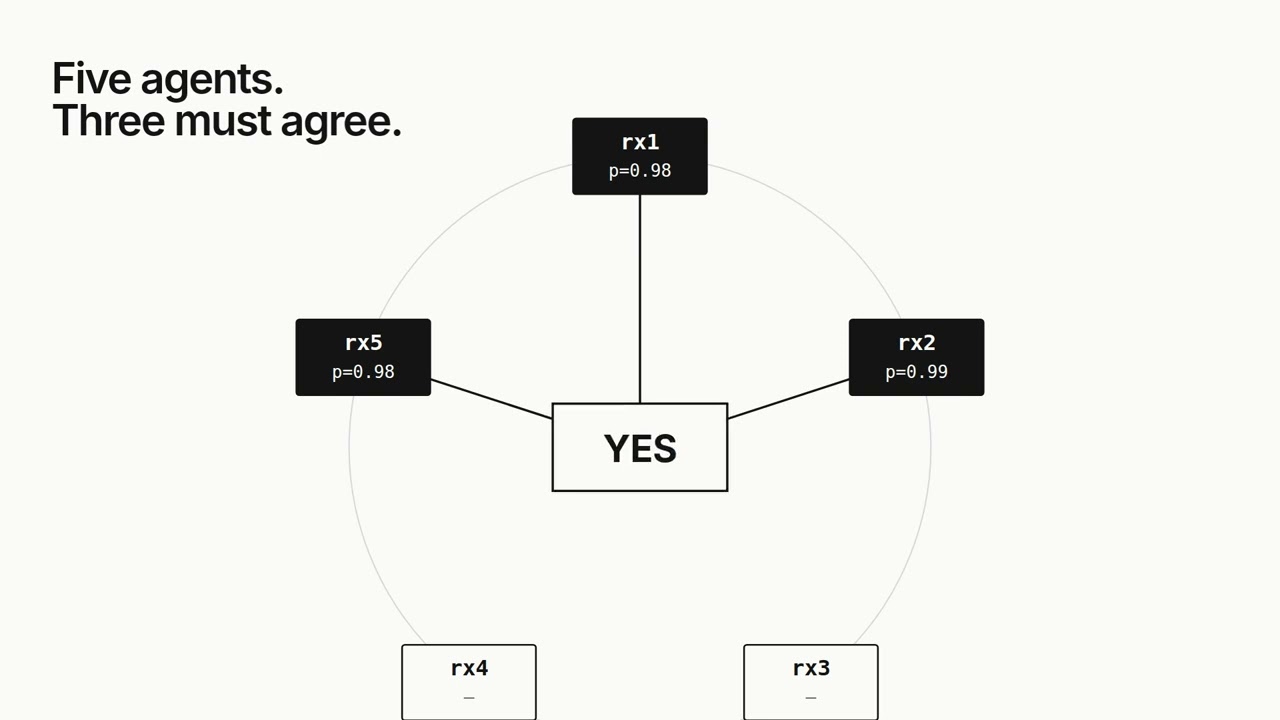
Watch the 4-minute film — every number on
screen is read from story/story_data.json, which is built from the captured
rounds in this repo.
The result
| chaos level | golden rounds | correct | escalated | wrong | accuracy 95% CI |
|---|---|---|---|---|---|
| none | 360 | 360 | 0 | 0 | [0.989, 1.000] |
| realistic | 360 | 360 | 0 | 0 | [0.989, 1.000] |
| severe | 360 | 314 | 46 | 0 | [0.834, 0.903] |
Zero wrong verdicts in 1,080 golden rounds bounds the true violation rate below 0.28% at 95% confidence (rule of three). It does not prove the rate is zero. Severe chaos raised the escalation rate from 5.0% to 18.0% (z = 6.83): the kernel declines more as evidence degrades, which is the designed direction.
Golden cases are the ones a pharmacist answers without hesitation (oxycodone is controlled; amoxicillin conflicts with a documented penicillin anaphylaxis). The invariant is not "always right". It is: the kernel may escalate to a human, and it may never return a confident wrong verdict.
stateDiagram-v2
    direction LR
    [*] --> Consulting
    Consulting --> Consulting : unstable vote, budget left
    Consulting --> Decided : ≥3 stable votes agree
    Consulting --> Escalated : budget spent, no stable quorum
    Decided --> [*]
    Escalated --> [*]

    note right of Decided
        DecisionIsReproducible:
        every supporting vote is stable.
        TLC, 5 agents / quorum 3 / 2 crashes:
        1,049,750 distinct states, 0 errors
    end note
What Jev makes possible
Jev (TypeSafe's System One model) returns a calibrated probability, not prose. That one property is what lets a model's judgment be treated as a signal with a measurable noise floor: gate on it, replay it, and prove things about the protocol wrapped around it.
flowchart TB
    rec["Prescription record"]
    kernel["<b>jev-labs consensus kernel</b><br/>5 agents · stability gate · quorum 3 of 5"]
    jev[("<b>Jev · System One</b><br/>TypeSafe, external<br/>returns a probability")]
    rx(["Pharmacist"])
    ops(["Operator"])

    rec --> kernel
    kernel -- "5 paraphrased questions" --> jev
    jev -- "5 calibrated probabilities" --> kernel
    kernel -- "decide Yes / No" --> out["Order proceeds"]
    kernel -- "ESCALATE" --> rx
    kernel -- "telemetry, request ids, seed" --> ops

    classDef dark fill:#141414,stroke:#141414,color:#fbfbf9
    classDef warn fill:#fff4f0,stroke:#d4410c,color:#d4410c
    class kernel dark
    class rx warn
Measured over 1,490 hash-verified calls to jev-1.13.0:
- Not deterministic. The identical request returned 0.03, 0.03, 0.03, 0.04, 0.04.
- Noise floors: identity 0.042, question-reorder 0.059, paraphrase cohort 0.073.
- Calibration on 240 constructed items: accuracy 0.979, Brier 0.0187, ECE 0.075.
- Latency flat in question count (1 question 96.7 ms mean, n=1,161; 38 questions 98.0 ms).
- Billing meter deterministic and linear:
input_tokens = 0.151 * chars + 281, zero variance across 110 repeated requests.
What we built
flowchart TB
    subgraph chain["Verification chain — each stage gates the next"]
        tla["<b>TLA+ specs</b><br/>4 modules · 11 configs<br/>quorum bound derived by sweep"]
        api["<b>AsyncAPI contract</b><br/>every field traced to a spec variable"]
        rust["<b>Rust kernel</b><br/>types generated from the contract<br/>48 tests · TLC traces replayed"]
        tla --> api --> rust
    end

    subgraph runtime["Runtime"]
        sim["<b>pharmacy_sim</b><br/>14 scenarios · seeded chaos"]
        coord["<b>Coordinator</b><br/>5 agents · gate · quorum"]
        oracle["<b>trait Oracle</b><br/>consult(agent, q, state) → Judgment"]
        sim --> coord --> oracle
    end

    jev[("<b>Jev</b>")]
    db[("<b>forensics.db</b><br/>1,490 calls · verbatim · SHA-256")]
    tele[("<b>sim_*.jsonl</b><br/>1,680 rounds · 5,007 votes")]
    film["<b>story/</b><br/>film built from the data"]

    rust --> sim
    oracle --> jev
    oracle --> db
    coord --> tele --> film

    classDef dark fill:#141414,stroke:#141414,color:#fbfbf9
    class coord dark
consensus/spec/— four TLA+ modules. The quorum bound was derived, not assumed: a 24-configuration TLC sweep confirmedsafe iff 2Q > N and Q > 2f. Two configs are kept as deliberate failures so the invariants keep their teeth.consensus/api/asyncapi.yaml— every message field traces to a TLA+ variable (spec/TRACEABILITY.md).consensus/rust/— 48 tests, including replay of TLC counterexample traces and a live run against Jev. A stability gate excludes any vote whose margin sits inside the measured noise floor; a quorum of 3 of 5 stable votes decides.consensus/verify.sh— runs the whole chain, each stage gating the next.
The measurement changes the behaviour: identical votes decide under the
identity floor and escalate under the cohort floor (calibration_choice_changes_the_outcome).
The simulation
cargo run --release --example pharmacy_sim -- --seeds 40 --chaos severe
flowchart TB
    seed["seed"] --> co["<b>ChaosOracle</b><br/>deterministic fault schedule"]
    co --> inj["inject adversarial text"]
    co --> tr["truncate record"]
    co --> cr["crash agent"]
    co --> rl["rate limit"]
    co --> tx["transport error"]
    inj & tr & cr & rl & tx --> o["trait Oracle"] --> jev[("Jev")]
One round, inside the coordinator:
flowchart TB
    rec["record"] --> fan["<b>fan out</b><br/>rx1 … rx5, one paraphrase each"]
    fan --> jev[("Jev")]
    jev --> gate{"margin > 0.042 ?<br/>measured noise floor"}
    gate -- "no · unstable" --> retry["re-ask, budget 2"]
    retry --> jev
    gate -- "yes · stable" --> q{"3 stable votes agree ?"}
    q -- "yes" --> decide["<b>DECIDE</b>"]
    q -- "no, budget spent" --> esc["<b>ESCALATE</b>"]

    classDef dark fill:#141414,stroke:#141414,color:#fbfbf9
    classDef warn fill:#fff4f0,stroke:#d4410c,color:#d4410c
    class decide dark
    class esc warn
Fourteen scenarios in three tiers (golden, nuanced, ambiguous), five agents each asking a validated paraphrase of the question, seeded chaos: adversarial text spliced into records, truncation, agent crashes, rate limits, transport failures. Any round replays from its seed. Telemetry is one JSON line per round with every vote's probability, margin, stability, and the oracle's own request IDs.
Two things the run caught that we had wrong:
- An "ambiguous" pregnancy case that Jev answered correctly 115 of 120 times. The question had a clear answer; the label was wrong.
- Fail-fast on transport errors voided 71% of rounds under severe chaos. Now a lost agent is marked unavailable and the round continues. Zero rounds aborted across 1,680.
And one genuine limitation: on a record that is underdetermined by construction, Jev escalated 86 of 120 times and decided 34, split both ways. The stability gate is not an answerability check.
Repository
consensus/          spec, contract, kernel, verify.sh
harness/            metamorphic property tests with a measured noise floor and a
                    fault-injection self-test (docs/HARNESS.md)
story/              the film: pure scene model, physics, voice pipeline,
                    frame-stepped capture, provenance check (story/README.md)
forensics.db        1,490 captured calls, verbatim bytes, SHA-256, no headers
docs/               FINDINGS, VENDOR_SELECTION, VERIFIABILITY_GAPS, HARNESS
*.py                calibration, jaggedness probes, meter audit, corpus evals,
                    paraphrase audit, correlation, simulation reports
Reproduce
python3 -m venv .venv && ./.venv/bin/pip install typesafe-sdk pyyaml
export TYPESAFE_API_KEY=...            # never written to disk by anything here

./consensus/verify.sh                  # TLC + AsyncAPI + cargo test, ~3 min
./.venv/bin/python paraphrase_audit.py # 12 batched calls
cd consensus/rust/consensus-kernel && cargo run --release --example pharmacy_sim -- --seeds 2 --chaos none
./.venv/bin/python sim_compare.py      # Wilson intervals, two-proportion z
./.venv/bin/python build_story_data.py && cd story && ../.venv/bin/python provenance.py
TLC needs Java and tla2tools.jar; the AsyncAPI validation needs Node. The
film pipeline additionally needs ffmpeg, Playwright Chromium, and an ElevenLabs
key for regenerating narration (the assembled master is committed).
Scope
The pharmacy scenarios are synthetic, written to have unambiguous answers so the harness can detect protocol failures. Nothing here is clinical guidance or validated against a formulary. The claims are about the protocol under chaos, not about Jev's pharmaceutical competence.
License
MIT. Narration is a synthetic ElevenLabs voice (George); see
story/assets/narration/provenance.json.