Artifact Checklist
June 11, 2026 · View on GitHub
[ Back to index ]
Artifact Checklist
Here we provide a few informal suggestions to help you fill in the Unified Artifact Appendix with the Reproducibility Checklist for artifact evaluation while avoiding common pitfalls. We've introduced this appendix to unify the description of experimental setups and results across different conferences.
Abstract
Briefly and informally describe your artifacts including minimal hardware, software and other requirements, how they support your paper and what key results should be reproduced. Note that evaluators will use artifact abstracts to bid on artifacts. The AE chairs will also use it to finalize artifact assignments.
Checklist
Together with the artifact abstract, this checklist will help us make sure that evaluators have appropriate competency and access to the technology required to evaluate your artifacts. It can also be used as metadata to find your artifacts in Digital Libraries.
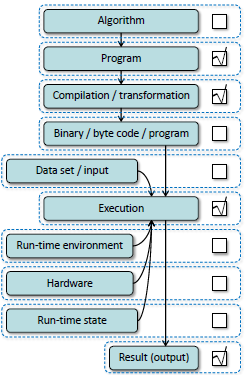
Fill in whatever is applicable with some informal keywords and remove unrelated items (please consider questions below just as informal hints that reviewers are usually concerned about):
- Algorithm: Are you presenting a new algorithm?
- Program: Which benchmarks do you use (PARSEC, NAS, EEMBC, SPLASH, Rodinia, LINPACK, HPCG, MiBench, SPEC, cTuning, etc)? Are they included or should they be downloaded? Which version? Are they public or private? If they are private, is there a public analog to evaluate your artifact? What is the approximate size?
- Compilation: Do you require a specific compiler? Public/private? Is it included? Which version?
- Transformations: Do you require a program transformation tool (source-to-source, binary-to-binary, compiler pass, etc)? Public/private? Is it included? Which version?
- Binary: Are binaries included? OS-specific? Which version?
- Model: Do you use specific models (GPT-J, BERT, MobileNets ...)? Are they included? If not, how can they be downloaded and installed? What is their approximate size?
- Data set: Do you use specific data sets? Are they included? If not, how can they be downloaded and installed? What is their approximate size?
- Run-time environment: Is your artifact OS-specific (Linux, Windows, MacOS, Android, etc) ? Which version? Which are the main software dependencies (JIT, libs, run-time adaptation frameworks, etc); Do you need root access?
- Hardware: Do you need specific hardware (supercomputer, architecture simulator, CPU, GPU, neural network accelerator, FPGA) or specific features (hardware counters to measure power consumption, SUDO access to CPU/GPU frequency, etc)? Are they publicly available?
- Run-time state: Is your artifact sensitive to run-time state (cold/hot cache, network/cache contentions, etc.)
- Execution: Any specific conditions should be met during experiments (sole user, process pinning, profiling, adaptation, etc)? How long will it approximately run?
- Metrics: Which metrics will be evaluated (execution time, inference per second, Top1 accuracy, power consumption, etc).
- Output: What is the output of your key experiments (console, file, table, graph) and what are your key results (exact output, numerical results, empirical characteristics, etc)? Are expected results included?
- Experiments: How to prepare experiments and reproduce results (README, scripts, IPython/Jupyter notebook, MLCommons CM automation language, containers etc)? Do not forget to mention the maximum allowable variation of empirical results!
- How much disk space is required (approximately)?: This can help evaluators and end-users to find appropriate resources.
- How much time is needed to prepare the workflow (approximately)?: This can help evaluators and end-users to estimate resources needed to evaluate your artifact.
- How much time is needed to complete experiments (approximately)?: This can help evaluators and end-users to estimate resources needed to evaluate your artifact.
- Publicly available?: Will your artifact be publicly available? If yes, we may spend an extra effort to help you with the documentation.
- Code licenses (if publicly available)?: If your workflows and artifacts will be publicly available, please provide information about licenses. This will help the community to reuse your components.
- Code licenses (if publicly available)?: If your workflows and artifacts will be publicly available, please provide information about licenses. This will help the community to reuse your components.
- Workflow frameworks used? Did the authors use any workflow framework that can automate and customize experiments?
- Archived?: Note that the author-created artifacts relevant to this paper will receive the ACM "artifact available" badge *only if* they have been placed on a publicly accessible archival repository such as Zenodo, FigShare or Dryad. A DOI will then be assigned to their artifacts and must be provided here! Personal web pages, Google Drive, GitHub, GitLab and BitBucket are not accepted for this badge. Authors can provide the DOI for their artifacts at the end of the evaluation.
Description
How to access
Describe how reviewers will access your artifacts:
- Clone a repository from GitHub, GitLab or any similar service
- Download a package from a public website
- Download a package from a private website (you will need to send information about how to access your artifacts to AE chairs)
- Access artifact via private machine with pre-installed software (only when access to rare or publicly unavailable hardware is required or proprietary software is used - you will need to send credentials to access your machine to the AE chairs)
Please describe approximate disk space required after unpacking your artifact.
Hardware dependencies
Describe any specific hardware and specific features required to evaluate your artifact (vendor, CPU/GPU/FPGA, number of processors/cores, interconnect, memory, hardware counters, etc).
Software dependencies
Describe any specific OS and software packages required to evaluate your artifact. This is particularly important if you share your source code and it must be compiled or if you rely on some proprietary software that you cannot include in your package. In such cases, we strongly suggest that you describe how to obtain and install all third-party software, data sets and models.
Note that we are trying to obtain AE licenses for some commonly used proprietary tools and benchmarks - you will be informed in case of a positive outcome.
Data sets
If third-party data sets are not included in your packages (for example, they are very large or proprietary), please provide details about how to download and install them.
In case of proprietary data sets, we suggest you provide reviewers a public alternative subset for evaluation.
Models
If third-party models are not included in your packages (for example, they are very large or proprietary), please provide details about how to download and install them.
Installation
Describe the setup procedures for your artifact (even when containers are used).
Experiment workflow
Describe the experimental workflow and how it is implemented and executed, i.e. using OS scripts, IPython/Jupyter notebook, MLCommons CM automation language, etc.
Check examples of reproduced papers.
Evaluation and expected results
Describe all the steps necessary to reproduce the key results from your paper. Describe expected results including maximum allowable variation of empirical results. See the SIGPLAN Empirical Evaluation Guidelines, the NeurIPS reproducibility checklist and the AE FAQ for more details.
Experiment customization
It is optional but can be useful for the community if you describe all the knobs to customize and tune your experiments and maybe even try them with different data sets, benchmarks/applications, machine learning models, software environment (compilers, libraries, run-time systems) and hardware.
Reusability
Please describe your experience if you decided to participate in our pilot project to add the non-intrusive MLCommons Collective Mind interface (CM) to your artifacts. Note that it will be possible to prepare and run your experiments with or without this interface!
Notes
You can add informal notes to draw the attention of evaluators.
This document was prepared by Grigori Fursin with contributions from Bruce Childers, Michael Heroux, Michela Taufer and other great colleagues. It is maintained by the cTuning foundation.