README.md
October 6, 2025 · View on GitHub



Secure USB DFU1.1 bootloader for STM32
Features
- Small size. Fits in 4K ROM segment (ASM or no encryption, otherwise a bit more).
- USB DFU1.1 compatible
- Supported by dfu-util
- Supported ciphers:
- No encryption
- ARCFOUR stream cipher
- CHACHA20 stream cipher
- RC5-32/12/16 block cipher (C and ASM implementation)
- RC6-32/20/16 block cipher (C and ASM implementation)
- GOST R 34.12-2015 "MAGMA" block cipher
- RAIDEN block cipher
- SPECK 64/128 block cipher
- XTEA (classic and XTEA-1) block cipher
- RTEA block cipher
- BLOWFISH type block cipher
- Rijndael AES-128/192/256 block cipher
- Supported cipher modes for block ciphers:
- Electronic Codebook (ECB)
- Cipher Block Chaining (CBC)
- Propagating CBC (PCBC)
- Cipher Feedback (CFB)
- Output Feedback (OFB)
- Counter (CTR)
- Supported firmware verification methods:
- CRC (CRC32, CRC64)
- Fowler-Noll-Vo (FNV-1A-32, FNV1A-64)
- Separate interfaces for flash and EEPROM programming
- Autoseal using RDP level 1 or 2 (prevents reading decrypted FW trough debug interface). Be careful when you set RDP to level 2. This operation is irreversible and disables all debug functions and option bytes programming.
- Software for firmware encryption/decryption included
- Supported STM32 families:
- STM32L0x2
- STM32L1xx
- STM32L476xx (OTG FS in device mode)
- STM32F103
- STM32F105, STM32F107 (OTG FS in device mode)
- STM32F0 series
- STM32F3 series
- STM32F4 series
- STM32G4 series
Generic flow
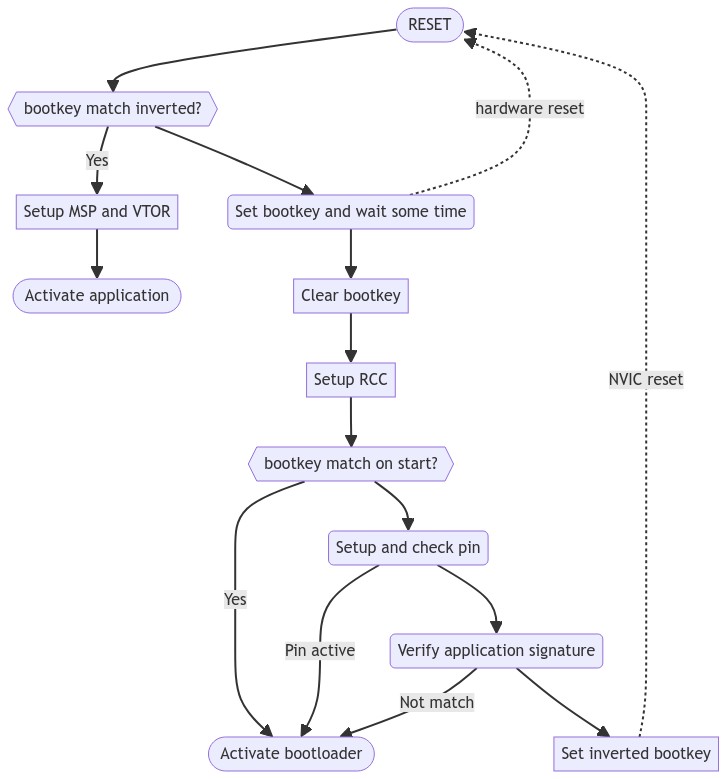
Usage:
Configuring bootloader
The bootloader can be configured through the make parameters. See CONFIG.md for details.
Building bootloader
- Prerequisites
- GNU make
- arm-none-eabi-gcc toolchaipren v4.9 or later to build bootloader
- gcc toolchain to build fwcrypt software
- CMSIS V4 or CMSIS V5.
- Device peripheral access layer header files for STM32. See Vendor Template for details.
- stm32.h STM32 universal header
- optional st-util tool to program bootloader
- Makefile targets
- make prerequisites to download required libs and headers
- make mcu_target to build bootloader
- make program to flash bootloader using st-flash
- make crypter to build encryption software
- Makefile and environmental variables
| Variable | Default Value | Description |
|---|---|---|
| CMSIS | CMSIS | path to CMSIS root folder |
| CMSISDEV | $(CMSIS)/Device | path to CMSIS device folder |
| LIBUSB_PATH | ./usb | path to USB library |
| LOADER_OUT | ./build/firmware.elf | output file for bootloader |
| SCRAMBLER_OUT | ./build/fwcrypt | output file for scrambler |
| OUTDIR | build | output folder for binaries (deprecated) |
| FWNAME | firmware | name for bootloader binary (deprecated) |
| SWNAME | fwcrypt | name for encrypter binary (deprecated) |
- MCU targets
| mcu_target | MCU | remarks |
|---|---|---|
| stm32l100x6a | STM32L100C6-A | |
| stm32l100x8a | STM32L100R8-A | |
| stm32l100xba | STM32L100RB-A | |
| stm32l100xc | STM32L100RC | tested |
| stm32l151x6a | STM32L151C6-A, STM32L151R6-A | |
| stm32l151x8a | STM32L151C8-A, STM32L151R8-A, STM31L151V8-A | |
| stm32l151xba | STM32L151CB-A, STM32L151RB-A, STM31L151VB-A | |
| stm32l151xc | STM32L151CC, STM32L151QC, SRM32L151RC, STM32L151UC | |
| stm32l151xd | STM32L151QD, STM32L151RD, STM32L151VD, STM32L151ZD | |
| stm32l151xe | STM32L151QE, STM32L151RE, STM32L151VE, STM32L151ZE | |
| stm32l152x6a | STM32L152C6-A, STM32L152R6-A | |
| stm32l152x8a | STM32L152C8-A, STM32L152R8-A, STM31L152V8-A | |
| stm32l152xba | STM32L152CB-A, STM32L152RB-A, STM31L152VB-A | |
| stm32l152xc | STM32L152CC, STM32L152QC, SRM32L152RC, STM32L152UC | |
| stm32l152xd | STM32L152QD, STM32L152RD, STM32L152VD, STM32L152ZD | |
| stm32l152xe | STM32L152QE, STM32L152RE, STM32L152VE, STM32L152ZE | |
| stm32l162xc | STM32L162RC, STM32L162VC | |
| stm32l162xd | STM32L162QD, STM32L156RD, STM32L162VD, STM32L162ZD | |
| stm32l162xe | STM32L162QE, STM32L156RE, STM32L162VE, STM32L162ZE | |
| stm32l052x6 | STM32L052K6, STM32L052T6, STM32L052C6, STM32L052R6 | |
| stm32l052x8 | STM32L052K8, STM32L052T8, STM32L052C8, STM32L052R8 | tested, default |
| stm32l053x6 | STM32L053C6, STM32L053R6 | |
| stm32l053x8 | STM32L053C8, STM32L053R8 | |
| stm32l062x8 | STM32L062K8 | |
| stm32l063x8 | STM32L063C8, STM32L063R8 | |
| stm32l072v8 | STM32L072V8 | |
| stm32l072xb | STM32L072KB, STM32L072CB, STM32L072RB, STM32L072VB | tested |
| stm32l072xz | STM32L072KZ, STM32L072CZ, STM32L072RZ, STM32L072VZ | |
| stm32l073v8 | STM32L073V8 | |
| stm32l073xb | STM32L073CB, STM32L073RB, STM32L073VB | |
| stm32l073xz | STM32L073CZ, STM32L073RZ, STM32L073VZ | |
| stm32l476xc | STM32L476RC, STM32L476VC | |
| stm32l476xe | STM32L476RE, STM32L476JE, STM32L476ME, STM32L476VE | |
| stm32l476xg | STM32L476RG, STM32L476JG, STM32L476MG, STM32L476VG | tested |
| stm32f103x6 | STM32F103T6, STM32F103C6, STM32F103R6 | |
| stm32f103x8 | STM32F103T8, STM32F103C8, STM32F103R8, STM32f103V8 | tested |
| stm32f105xb | STM32F105RB, STM32F105VB | tested |
| stm32f107xb | STM32F107RB, STM32F107VB | tested |
| stm32l433xb | STM32L433CB, STM32L433RB | |
| stm32l433xc | STM32L433CC, STM32L433RC, STM32L433VC | tested |
| stm32f070x6 | STM32F070C6 | |
| stm32f070xb | STM32F070CB | tested |
| stm32f429xe | STM32F429xE series (single bank mode) | |
| stm32f429xg | STM32F429xG series (single bank mode) | |
| stm32f429xi | STM32F429xI series (single and dual bank) | tested |
| stm32g431x6 | STM32G431x6, STM32G441x6 | |
| stm32g431x8 | STM32G431x8, STM32G441x8 | |
| stm32g431xb | STM32G431xB, STM32G441xB | tested G431RB |
| stm32g474xb | STM32G471xB, STM32G473xB, STM32G474xB, STM32G483xB | |
| stm32g474xc | STM32G471xC, STM32G473xC, STM32G474xC, STM32G483xC | |
| stm32g474xe | STM32G471xE, STM32G473xE, STM32G474xE, STM32G483xE | tested G747RE |
| stm32f303xe | STM32F303xE | tested |
| stm32f373xc | STM32F373xC | tested |
Adjusting user firmware
- Check bootloader's linker map for the
__app_startaddress. This is the new ROM origin for the user firmware (ISR vectors). - Adjust your linker script to set new ROM origin and ROM length.
Utilizing usbd core and usbd driver from bootloader in the user firmware
- Check bootloader's linker map for the
usbd_pollentry point and usbd driver (usbd_devfs,usbd_otgfs, e.t.c. depends used MCU). It's located just after the.isr_vectorsection. - Add address for usbd_driver structure to your linker script. For example
usbd_drv = 0x08000040; - Add address for usbd_poll entry point to your linker script. For example
usbd_poll = 0x08000074; - Add
extern struct usbd_driver usbd_drv;driver declaration to your code. - Include at least "usbd_core.h" and "usb_std.h" to your code.
Now you can use the usbd core and driver from the bootloader in your application. Don't forget to set GPIO and RCC for USB according to MCU requirements.
Activating bootloader
- Write DFU_BOOTKEY at DFU_BOOTKEY_ADDR (RAM top by default) and make a software reset.
- Assert DFU_BOOTSTRAP_PIN on DFU_BOOTSTRAP_PORT on startup (optional).
- Make a double reset during the DFU_DBLRESET_MS period (optional).
Encrypting user firmware
We provide a utility for encryption and decryption of firmware images. At this moment, only raw binary files are supported.
To encrypt:
fwcrypt -e -i infile.bin -o outfile.bin
To decrypt:
fwcrypt -d -i infile.bin -o outfile.bin