812. Largest Triangle Area
September 27, 2025 · View on GitHub
Description
Given an array of points on the X-Y plane points where points[i] = [xi, yi], return the area of the largest triangle that can be formed by any three different points. Answers within 10-5 of the actual answer will be accepted.
Example 1:
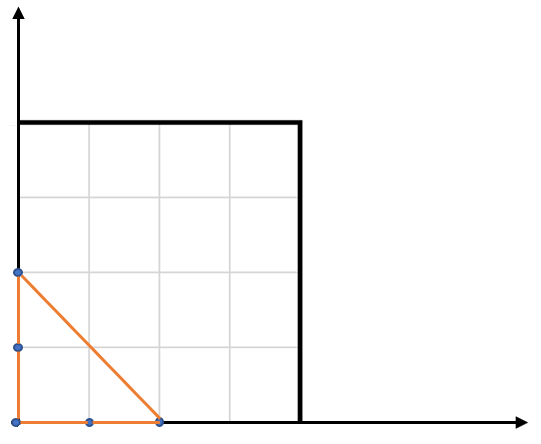
Input: points = [[0,0],[0,1],[1,0],[0,2],[2,0]]
Output: 2.00000
Explanation: The five points are shown in the above figure. The red triangle is the largest.
Example 2:
Input: points = [[1,0],[0,0],[0,1]]
Output: 0.50000
Constraints:
3 <= points.length <= 50-50 <= xi, yi <= 50- All the given points are unique.
Solutions
Solution: Enumerate Triangle Area Formula
Given three points , , on a plane, the area formula is:
We can enumerate all combinations of three points and calculate the maximum area.
The time complexity is , where is the number of points. The space complexity is .
Python3
class Solution:
    def largestTriangleArea(self, points: List[List[int]]) -> float:
        ans = 0
        for x1, y1 in points:
            for x2, y2 in points:
                for x3, y3 in points:
                    u1, v1 = x2 - x1, y2 - y1
                    u2, v2 = x3 - x1, y3 - y1
                    t = abs(u1 * v2 - u2 * v1) / 2
                    ans = max(ans, t)
        return ans
Java
class Solution {
    public double largestTriangleArea(int[][] points) {
        double ans = 0;
        for (int[] p1 : points) {
            int x1 = p1[0], y1 = p1[1];
            for (int[] p2 : points) {
                int x2 = p2[0], y2 = p2[1];
                for (int[] p3 : points) {
                    int x3 = p3[0], y3 = p3[1];
                    int u1 = x2 - x1, v1 = y2 - y1;
                    int u2 = x3 - x1, v2 = y3 - y1;
                    double t = Math.abs(u1 * v2 - u2 * v1) / 2.0;
                    ans = Math.max(ans, t);
                }
            }
        }
        return ans;
    }
}
C++
class Solution {
public:
    double largestTriangleArea(vector<vector<int>>& points) {
        double ans = 0;
        for (auto& p1 : points) {
            int x1 = p1[0], y1 = p1[1];
            for (auto& p2 : points) {
                int x2 = p2[0], y2 = p2[1];
                for (auto& p3 : points) {
                    int x3 = p3[0], y3 = p3[1];
                    int u1 = x2 - x1, v1 = y2 - y1;
                    int u2 = x3 - x1, v2 = y3 - y1;
                    double t = abs(u1 * v2 - u2 * v1) / 2.0;
                    ans = max(ans, t);
                }
            }
        }
        return ans;
    }
};
Go
func largestTriangleArea(points [][]int) float64 {
	ans := 0.0
	for _, p1 := range points {
		x1, y1 := p1[0], p1[1]
		for _, p2 := range points {
			x2, y2 := p2[0], p2[1]
			for _, p3 := range points {
				x3, y3 := p3[0], p3[1]
				u1, v1 := x2-x1, y2-y1
				u2, v2 := x3-x1, y3-y1
				t := float64(abs(u1*v2-u2*v1)) / 2.0
				ans = math.Max(ans, t)
			}
		}
	}
	return ans
}

func abs(x int) int {
	if x < 0 {
		return -x
	}
	return x
}
TypeScript
function largestTriangleArea(points: number[][]): number {
    let ans = 0;
    for (const [x1, y1] of points) {
        for (const [x2, y2] of points) {
            for (const [x3, y3] of points) {
                const u1 = x2 - x1,
                    v1 = y2 - y1;
                const u2 = x3 - x1,
                    v2 = y3 - y1;
                const t = Math.abs(u1 * v2 - u2 * v1) / 2;
                ans = Math.max(ans, t);
            }
        }
    }
    return ans;
}
Rust
impl Solution {
    pub fn largest_triangle_area(points: Vec<Vec<i32>>) -> f64 {
        let mut ans: f64 = 0.0;
        for point1 in &points {
            let (x1, y1) = (point1[0], point1[1]);
            for point2 in &points {
                let (x2, y2) = (point2[0], point2[1]);
                for point3 in &points {
                    let (x3, y3) = (point3[0], point3[1]);
                    let u1 = x2 - x1;
                    let v1 = y2 - y1;
                    let u2 = x3 - x1;
                    let v2 = y3 - y1;
                    let t = ((u1 * v2 - u2 * v1) as f64).abs() / 2.0;
                    ans = ans.max(t);
                }
            }
        }
        ans
    }
}