2196. Create Binary Tree From Descriptions
July 16, 2024 · View on GitHub
Description
You are given a 2D integer array descriptions where descriptions[i] = [parenti, childi, isLefti] indicates that parenti is the parent of childi in a binary tree of unique values. Furthermore,
- If
isLefti == 1, thenchildiis the left child ofparenti. - If
isLefti == 0, thenchildiis the right child ofparenti.
Construct the binary tree described by descriptions and return its root.
The test cases will be generated such that the binary tree is valid.
Example 1:
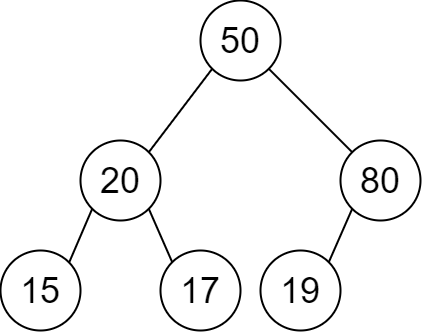
Input: descriptions = [[20,15,1],[20,17,0],[50,20,1],[50,80,0],[80,19,1]]
Output: [50,20,80,15,17,19]
Explanation: The root node is the node with value 50 since it has no parent.
The resulting binary tree is shown in the diagram.
Example 2:
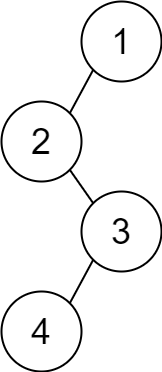
Input: descriptions = [[1,2,1],[2,3,0],[3,4,1]]
Output: [1,2,null,null,3,4]
Explanation: The root node is the node with value 1 since it has no parent.
The resulting binary tree is shown in the diagram.
Constraints:
1 <= descriptions.length <= 104descriptions[i].length == 31 <= parenti, childi <= 1050 <= isLefti <= 1- The binary tree described by
descriptionsis valid.
Solutions
Solution 1: Hash Table
We can use a hash table to store all nodes, where the keys are the values of the nodes, and the values are the nodes themselves. Additionally, we use a set to store all child nodes.
We iterate through the , and for each description , if is not in , we add to and initialize a node with the value . If is not in , we add to and initialize a node with the value . Then, we add to .
If is true, we set as the left child of ; otherwise, we set as the right child of .
Finally, we iterate through , and if a node's value is not in , then this node is the root node, and we return this node.
The time complexity is , and the space complexity is , where is the length of .
Python3
# Definition for a binary tree node.
# class TreeNode:
#     def __init__(self, val=0, left=None, right=None):
#         self.val = val
#         self.left = left
#         self.right = right
class Solution:
    def createBinaryTree(self, descriptions: List[List[int]]) -> Optional[TreeNode]:
        nodes = defaultdict(TreeNode)
        children = set()
        for parent, child, isLeft in descriptions:
            if parent not in nodes:
                nodes[parent] = TreeNode(parent)
            if child not in nodes:
                nodes[child] = TreeNode(child)
            children.add(child)
            if isLeft:
                nodes[parent].left = nodes[child]
            else:
                nodes[parent].right = nodes[child]
        root = (set(nodes.keys()) - children).pop()
        return nodes[root]
Java
/**
 * Definition for a binary tree node.
 * public class TreeNode {
 *     int val;
 *     TreeNode left;
 *     TreeNode right;
 *     TreeNode() {}
 *     TreeNode(int val) { this.val = val; }
 *     TreeNode(int val, TreeNode left, TreeNode right) {
 *         this.val = val;
 *         this.left = left;
 *         this.right = right;
 *     }
 * }
 */
class Solution {
    public TreeNode createBinaryTree(int[][] descriptions) {
        Map<Integer, TreeNode> nodes = new HashMap<>();
        Set<Integer> children = new HashSet<>();
        for (var d : descriptions) {
            int parent = d[0], child = d[1], isLeft = d[2];
            if (!nodes.containsKey(parent)) {
                nodes.put(parent, new TreeNode(parent));
            }
            if (!nodes.containsKey(child)) {
                nodes.put(child, new TreeNode(child));
            }
            if (isLeft == 1) {
                nodes.get(parent).left = nodes.get(child);
            } else {
                nodes.get(parent).right = nodes.get(child);
            }
            children.add(child);
        }
        for (var e : nodes.entrySet()) {
            if (!children.contains(e.getKey())) {
                return e.getValue();
            }
        }
        return null;
    }
}
C++
/**
 * Definition for a binary tree node.
 * struct TreeNode {
 *     int val;
 *     TreeNode *left;
 *     TreeNode *right;
 *     TreeNode() : val(0), left(nullptr), right(nullptr) {}
 *     TreeNode(int x) : val(x), left(nullptr), right(nullptr) {}
 *     TreeNode(int x, TreeNode *left, TreeNode *right) : val(x), left(left), right(right) {}
 * };
 */
class Solution {
public:
    TreeNode* createBinaryTree(vector<vector<int>>& descriptions) {
        unordered_map<int, TreeNode*> nodes;
        unordered_set<int> children;
        for (const auto& d : descriptions) {
            int parent = d[0], child = d[1], isLeft = d[2];
            if (!nodes.contains(parent)) {
                nodes[parent] = new TreeNode(parent);
            }
            if (!nodes.contains(child)) {
                nodes[child] = new TreeNode(child);
            }
            if (isLeft) {
                nodes[parent]->left = nodes[child];
            } else {
                nodes[parent]->right = nodes[child];
            }
            children.insert(child);
        }
        for (const auto& [k, v] : nodes) {
            if (!children.contains(k)) {
                return v;
            }
        }
        return nullptr;
    }
};
Go
/**
 * Definition for a binary tree node.
 * type TreeNode struct {
 *     Val int
 *     Left *TreeNode
 *     Right *TreeNode
 * }
 */
func createBinaryTree(descriptions [][]int) *TreeNode {
	nodes := map[int]*TreeNode{}
	children := map[int]bool{}
	for _, d := range descriptions {
		parent, child, isLeft := d[0], d[1], d[2]
		if _, ok := nodes[parent]; !ok {
			nodes[parent] = &TreeNode{Val: parent}
		}
		if _, ok := nodes[child]; !ok {
			nodes[child] = &TreeNode{Val: child}
		}
		if isLeft == 1 {
			nodes[parent].Left = nodes[child]
		} else {
			nodes[parent].Right = nodes[child]
		}
		children[child] = true
	}
	for k, v := range nodes {
		if _, ok := children[k]; !ok {
			return v
		}
	}
	return nil
}
TypeScript
/**
 * Definition for a binary tree node.
 * class TreeNode {
 *     val: number
 *     left: TreeNode | null
 *     right: TreeNode | null
 *     constructor(val?: number, left?: TreeNode | null, right?: TreeNode | null) {
 *         this.val = (val===undefined ? 0 : val)
 *         this.left = (left===undefined ? null : left)
 *         this.right = (right===undefined ? null : right)
 *     }
 * }
 */

function createBinaryTree(descriptions: number[][]): TreeNode | null {
    const nodes: Record<number, TreeNode> = {};
    const children = new Set<number>();
    for (const [parent, child, isLeft] of descriptions) {
        if (!nodes[parent]) {
            nodes[parent] = new TreeNode(parent);
        }
        if (!nodes[child]) {
            nodes[child] = new TreeNode(child);
        }
        if (isLeft) {
            nodes[parent].left = nodes[child];
        } else {
            nodes[parent].right = nodes[child];
        }
        children.add(child);
    }
    for (const [k, v] of Object.entries(nodes)) {
        if (!children.has(+k)) {
            return v;
        }
    }
}
Rust
// Definition for a binary tree node.
// #[derive(Debug, PartialEq, Eq)]
// pub struct TreeNode {
//   pub val: i32,
//   pub left: Option<Rc<RefCell<TreeNode>>>,
//   pub right: Option<Rc<RefCell<TreeNode>>>,
// }
//
// impl TreeNode {
//   #[inline]
//   pub fn new(val: i32) -> Self {
//     TreeNode {
//       val,
//       left: None,
//       right: None
//     }
//   }
// }
use std::cell::RefCell;
use std::collections::{HashMap, HashSet};
use std::rc::Rc;
impl Solution {
    pub fn create_binary_tree(descriptions: Vec<Vec<i32>>) -> Option<Rc<RefCell<TreeNode>>> {
        let mut nodes = HashMap::new();
        let mut children = HashSet::new();

        for d in descriptions {
            let parent = d[0];
            let child = d[1];
            let is_left = d[2];

            nodes
                .entry(parent)
                .or_insert_with(|| Rc::new(RefCell::new(TreeNode::new(parent))));
            nodes
                .entry(child)
                .or_insert_with(|| Rc::new(RefCell::new(TreeNode::new(child))));

            if is_left == 1 {
                nodes.get(&parent).unwrap().borrow_mut().left =
                    Some(Rc::clone(nodes.get(&child).unwrap()));
            } else {
                nodes.get(&parent).unwrap().borrow_mut().right =
                    Some(Rc::clone(nodes.get(&child).unwrap()));
            }

            children.insert(child);
        }

        for (key, node) in &nodes {
            if !children.contains(key) {
                return Some(Rc::clone(node));
            }
        }

        None
    }
}
JavaScript
/**
 * Definition for a binary tree node.
 * function TreeNode(val, left, right) {
 *     this.val = (val===undefined ? 0 : val)
 *     this.left = (left===undefined ? null : left)
 *     this.right = (right===undefined ? null : right)
 * }
 */
/**
 * @param {number[][]} descriptions
 * @return {TreeNode}
 */
var createBinaryTree = function (descriptions) {
    const nodes = {};
    const children = new Set();
    for (const [parent, child, isLeft] of descriptions) {
        if (!nodes[parent]) {
            nodes[parent] = new TreeNode(parent);
        }
        if (!nodes[child]) {
            nodes[child] = new TreeNode(child);
        }
        if (isLeft) {
            nodes[parent].left = nodes[child];
        } else {
            nodes[parent].right = nodes[child];
        }
        children.add(child);
    }
    for (const [k, v] of Object.entries(nodes)) {
        if (!children.has(+k)) {
            return v;
        }
    }
};