3625. 统计梯形的数目 II
December 15, 2025 · View on GitHub
题目描述
给你一个二维整数数组 points,其中 points[i] = [xi, yi] 表示第 i 个点在笛卡尔平面上的坐标。
返回可以从 points 中任意选择四个不同点组成的梯形的数量。
梯形 是一种凸四边形,具有 至少一对 平行边。两条直线平行当且仅当它们的斜率相同。
示例 1:
输入: points = [[-3,2],[3,0],[2,3],[3,2],[2,-3]]
输出: 2
解释:
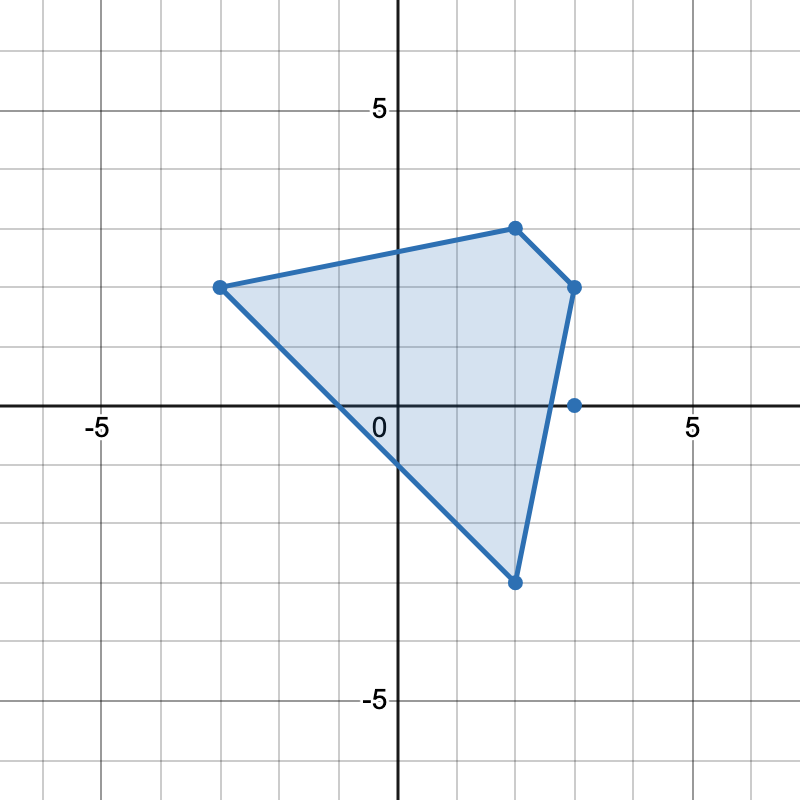
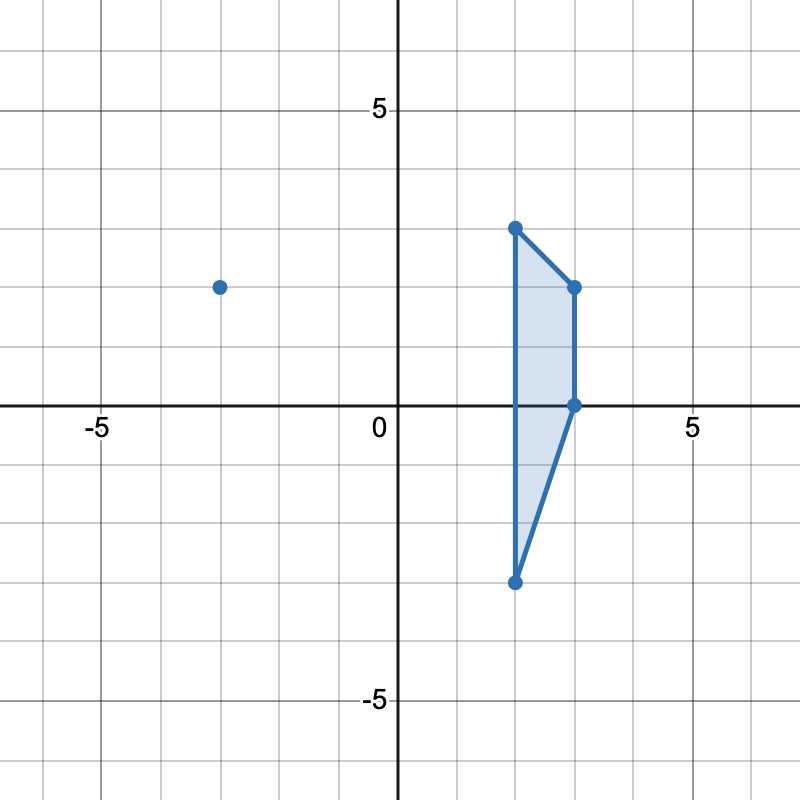
有两种不同方式选择四个点组成一个梯形:
- 点
[-3,2], [2,3], [3,2], [2,-3]组成一个梯形。 - 点
[2,3], [3,2], [3,0], [2,-3]组成另一个梯形。
示例 2:
输入: points = [[0,0],[1,0],[0,1],[2,1]]
输出: 1
解释:
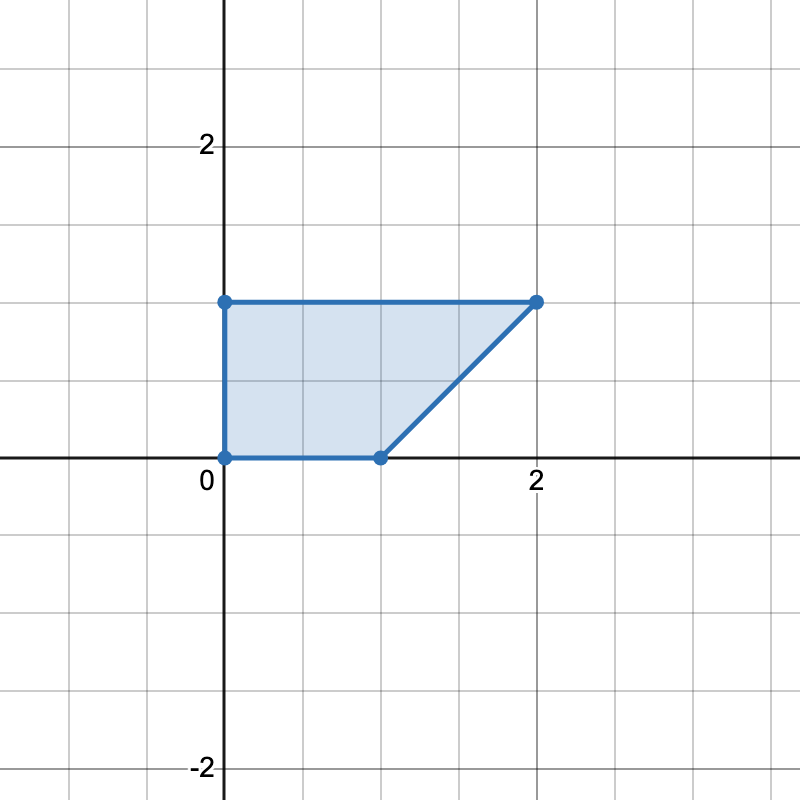
只有一种方式可以组成一个梯形。
提示:
4 <= points.length <= 500–1000 <= xi, yi <= 1000- 所有点两两不同。
解法
方法一:哈希表 + 枚举
我们可以把所有点两两组合,计算出每一对点所对应的直线的斜率和截距,并使用哈希表进行记录,计算斜率相同且截距不同的直线两两组合得到的数量之和。注意,对于平行四边形,我们在上述计算中会被重复计算两次,因此我们需要将其减去。
平行四边形的对角线中点重合,因此我们同样把所有点两两组合,计算出每一对点的中点坐标和斜率,并使用哈希表进行记录,计算斜率相同且中点坐标相同的点对两两组合得到的数量之和。
具体地,我们使用两个哈希表 和 分别记录以下信息:
- 其中 记录斜率 和截距 出现的次数,键为斜率 ,值为另一个哈希表,记录截距 出现的次数;
- 其中 记录点对的中点坐标和斜率 出现的次数,键为点对的中点坐标 ,值为另一个哈希表,记录斜率 出现的次数。
对于点对 和 ,我们记 ,并且 。如果 ,则说明两点在同一条垂直线上,我们记斜率 ,截距 ;否则斜率 ,截距 。点对的中点坐标 可以表示为 ,这里加上偏移量是为了避免负数。
接下来,我们遍历所有点对,计算出对应的斜率 、截距 和中点坐标 ,并更新哈希表 和 。
然后,我们遍历哈希表 ,对于每一个斜率 ,我们计算所有截距 出现次数的两两组合之和,并累加到答案中。最后,我们遍历哈希表 ,对于每一个中点坐标 ,我们计算所有斜率 出现次数的两两组合之和,并从答案中减去。
时间复杂度 ,空间复杂度 。其中 是点的数量。
Python3
class Solution:
    def countTrapezoids(self, points: List[List[int]]) -> int:
        n = len(points)

        # cnt1: k -> (b -> count)
        cnt1: dict[float, dict[float, int]] = defaultdict(lambda: defaultdict(int))
        # cnt2: p -> (k -> count)
        cnt2: dict[int, dict[float, int]] = defaultdict(lambda: defaultdict(int))

        for i in range(n):
            x1, y1 = points[i]
            for j in range(i):
                x2, y2 = points[j]
                dx, dy = x2 - x1, y2 - y1

                if dx == 0:
                    k = 1e9
                    b = x1
                else:
                    k = dy / dx
                    b = (y1 * dx - x1 * dy) / dx

                cnt1[k][b] += 1

                p = (x1 + x2 + 2000) * 4000 + (y1 + y2 + 2000)
                cnt2[p][k] += 1

        ans = 0

        for e in cnt1.values():
            s = 0
            for t in e.values():
                ans += s * t
                s += t

        for e in cnt2.values():
            s = 0
            for t in e.values():
                ans -= s * t
                s += t

        return ans
Java
class Solution {
    public int countTrapezoids(int[][] points) {
        int n = points.length;
        Map<Double, Map<Double, Integer>> cnt1 = new HashMap<>(n * n);
        Map<Integer, Map<Double, Integer>> cnt2 = new HashMap<>(n * n);

        for (int i = 0; i < n; ++i) {
            int x1 = points[i][0], y1 = points[i][1];
            for (int j = 0; j < i; ++j) {
                int x2 = points[j][0], y2 = points[j][1];
                int dx = x2 - x1, dy = y2 - y1;
                double k = dx == 0 ? Double.MAX_VALUE : 1.0 * dy / dx;
                double b = dx == 0 ? x1 : 1.0 * (y1 * dx - x1 * dy) / dx;
                if (k == -0.0) {
                    k = 0.0;
                }
                if (b == -0.0) {
                    b = 0.0;
                }
                cnt1.computeIfAbsent(k, _ -> new HashMap<>()).merge(b, 1, Integer::sum);
                int p = (x1 + x2 + 2000) * 4000 + (y1 + y2 + 2000);
                cnt2.computeIfAbsent(p, _ -> new HashMap<>()).merge(k, 1, Integer::sum);
            }
        }

        int ans = 0;
        for (var e : cnt1.values()) {
            int s = 0;
            for (int t : e.values()) {
                ans += s * t;
                s += t;
            }
        }
        for (var e : cnt2.values()) {
            int s = 0;
            for (int t : e.values()) {
                ans -= s * t;
                s += t;
            }
        }
        return ans;
    }
}
C++
class Solution {
public:
    int countTrapezoids(vector<vector<int>>& points) {
        int n = points.size();
        unordered_map<double, unordered_map<double, int>> cnt1;
        unordered_map<int, unordered_map<double, int>> cnt2;

        cnt1.reserve(n * n);
        cnt2.reserve(n * n);

        for (int i = 0; i < n; ++i) {
            int x1 = points[i][0], y1 = points[i][1];
            for (int j = 0; j < i; ++j) {
                int x2 = points[j][0], y2 = points[j][1];
                int dx = x2 - x1, dy = y2 - y1;
                double k = (dx == 0 ? 1e9 : 1.0 * dy / dx);
                double b = (dx == 0 ? x1 : 1.0 * (1LL * y1 * dx - 1LL * x1 * dy) / dx);

                cnt1[k][b] += 1;
                int p = (x1 + x2 + 2000) * 4000 + (y1 + y2 + 2000);
                cnt2[p][k] += 1;
            }
        }

        int ans = 0;
        for (auto& [_, e] : cnt1) {
            int s = 0;
            for (auto& [_, t] : e) {
                ans += s * t;
                s += t;
            }
        }
        for (auto& [_, e] : cnt2) {
            int s = 0;
            for (auto& [_, t] : e) {
                ans -= s * t;
                s += t;
            }
        }
        return ans;
    }
};
Go
func countTrapezoids(points [][]int) int {
	n := len(points)
	cnt1 := make(map[float64]map[float64]int, n*n)
	cnt2 := make(map[int]map[float64]int, n*n)

	for i := 0; i < n; i++ {
		x1, y1 := points[i][0], points[i][1]
		for j := 0; j < i; j++ {
			x2, y2 := points[j][0], points[j][1]
			dx, dy := x2-x1, y2-y1

			var k, b float64
			if dx == 0 {
				k = 1e9
				b = float64(x1)
			} else {
				k = float64(dy) / float64(dx)
				b = float64(int64(y1)*int64(dx)-int64(x1)*int64(dy)) / float64(dx)
			}

			if cnt1[k] == nil {
				cnt1[k] = make(map[float64]int)
			}
			cnt1[k][b]++

			p := (x1+x2+2000)*4000 + (y1 + y2 + 2000)
			if cnt2[p] == nil {
				cnt2[p] = make(map[float64]int)
			}
			cnt2[p][k]++
		}
	}

	ans := 0
	for _, e := range cnt1 {
		s := 0
		for _, t := range e {
			ans += s * t
			s += t
		}
	}
	for _, e := range cnt2 {
		s := 0
		for _, t := range e {
			ans -= s * t
			s += t
		}
	}
	return ans
}
TypeScript
function countTrapezoids(points: number[][]): number {
    const n = points.length;

    const cnt1: Map<number, Map<number, number>> = new Map();
    const cnt2: Map<number, Map<number, number>> = new Map();

    for (let i = 0; i < n; i++) {
        const [x1, y1] = points[i];
        for (let j = 0; j < i; j++) {
            const [x2, y2] = points[j];
            const [dx, dy] = [x2 - x1, y2 - y1];

            const k = dx === 0 ? 1e9 : dy / dx;
            const b = dx === 0 ? x1 : (y1 * dx - x1 * dy) / dx;

            if (!cnt1.has(k)) {
                cnt1.set(k, new Map());
            }
            const mapB = cnt1.get(k)!;
            mapB.set(b, (mapB.get(b) || 0) + 1);

            const p = (x1 + x2 + 2000) * 4000 + (y1 + y2 + 2000);

            if (!cnt2.has(p)) {
                cnt2.set(p, new Map());
            }
            const mapK = cnt2.get(p)!;
            mapK.set(k, (mapK.get(k) || 0) + 1);
        }
    }

    let ans = 0;
    for (const e of cnt1.values()) {
        let s = 0;
        for (const t of e.values()) {
            ans += s * t;
            s += t;
        }
    }
    for (const e of cnt2.values()) {
        let s = 0;
        for (const t of e.values()) {
            ans -= s * t;
            s += t;
        }
    }

    return ans;
}