nim-typestates
May 29, 2026 · View on GitHub


Compile-time state machine verification for Nim. Encode a protocol — payment lifecycles, file handles, connection states — in the type system, and the compiler refuses to build code that calls operations in the wrong state.
import typestates

type
  Payment = object
    id: string
    amount: int

  Created = distinct Payment
  Authorized = distinct Payment
  Captured = distinct Payment

typestate Payment:
  states Created, Authorized, Captured
  transitions:
    Created -> Authorized
    Authorized -> Captured

proc authorize(p: sink Created): Authorized {.transition.} =
  Authorized(Payment(p))

proc capture(p: sink Authorized): Captured {.transition.} =
  Captured(Payment(p))

proc main() =
  let payment = Created(Payment(id: "pay_123", amount: 9999))
  let authed = payment.authorize()
  let captured = authed.capture()
  echo captured.Payment.id

  # payment.capture()  # type mismatch: got 'Created' but expected 'Authorized'

main()
The wrapper proc main() is required because typestate values can't be lifted to module scope under the default consumeOnTransition = true — the =dup hook is disabled, and module-scope let bindings would fail to compile.
Installation
nimble install typestates
Or pin it in your .nimble file:
requires "typestates >= 0.4.0"
Requires Nim 2.2 or newer. If you're on Nim 2.2.x older than 2.2.8 and using ARC/ORC with static generic parameters, see the note below on a known codegen bug.
What you get from the compiler
Once you've declared a typestate and marked your procs with {.transition.}, the compiler enforces three things:
- Each transition proc moves between states the way you declared. A proc that claims to take an
Authorizedand return aCapturedcannot quietly become a transition fromCreated. - Operations on a state are only callable when a value is in that state.
capture(p)won't compile ifpisCreated. - A value occupies one state at a time. The distinct types make it impossible to hold a
Capturedand anAuthorizedview of the same object simultaneously.
What the compiler can't check is whether your declared state machine matches reality. If your spec says Authorized -> Captured is allowed but your business rules actually forbid it after 7 days, that's a separate problem.
To enable state-aware error messages on transition misuse, end your module with verifyTypestates(). See error handling for details.
There is one channel the type system cannot close: distinct types in Nim are syntactic, so Captured(Payment(...)) will compile and forge a state value out of raw fields. v0.6 introduces opaqueStates = true as an opt-in CLI lint that flags these casts at typestates verify time, with caveats around cross-file resolution, generics, and cast[T](...) form. See Cast Protection for the full caught/missed table.
Usage
Branching transitions
A capture might succeed and settle, partially refund, or fully refund. Declare the alternatives as a union:
typestate Payment:
  states Captured, PartiallyRefunded, FullyRefunded, Settled
  transitions:
    Captured -> (PartiallyRefunded | FullyRefunded | Settled) as CaptureResult
The as CaptureResult names the union type so transition procs can return it. Callers then pattern-match (or use the generated discriminators) to know which branch they got.
Async transitions
Pair {.async, transition.} with Future[T] returns. Bridging through Result works too:
proc authorize(p: sink Created): Future[Authorized] {.async, transition.} =
  await callPaymentGateway(p)
  return Authorized(Payment(p))

proc capture(p: sink Authorized): Future[Result[Captured, GatewayError]] {.async, transition.} =
  ...
Transparent wrappers (Result[State, E], Option[State], Future[State]) are recognized in return positions without losing the typestate guarantees.
Generic typestates
States can carry type parameters, which is useful for typed buffers, containers, and similar:
type
  Container[T] = object
    items: seq[T]
  Empty[T] = distinct Container[T]
  Full[T] = distinct Container[T]

typestate Container[T]:
  states Empty[T], Full[T]
  transitions:
    Empty[T] -> Full[T]
TypestateOp implicit effect
Every {.transition.} proc carries TypestateOp (defined in
typestates/pragmas, an object of RootEffect) in its effect
tag set. Under {.experimental: "strictEffects".} you can declare
{.forbids: [TypestateOp].} on a region to statically assert "no
typestate transition reaches me — not directly, not transitively through
an untagged intermediate caller."
{.experimental: "strictEffects".}
import typestates

type
  EndpointBase = object
  Unbound = distinct EndpointBase
  Bound = distinct EndpointBase

typestate Endpoint:
  consumeOnTransition = false
  strictTransitions = false
  states Unbound, Bound
  transitions:
    Unbound -> Bound

proc bindIt(u: Unbound): Bound {.transition.} =
  Bound(EndpointBase(u))

proc pureRegion() {.forbids: [TypestateOp].} =
  discard  # OK: no transition reachable from here.

# proc badRegion() {.forbids: [TypestateOp].} =
#   let u = Unbound(EndpointBase())
#   discard bindIt(u)   # would fail to compile: TypestateOp forbidden here.

verifyTypestates()
The injection is additive and idempotent:
- Additive. If you already wrote
{.tags: [MyEffect].}on a transition, the macro appendsTypestateOpso the final list is[MyEffect, TypestateOp]. Your own tag is preserved. - Idempotent. If you explicitly listed
TypestateOpyourself, no duplicate is added. (The check useseqIdentonnnkIdent/nnkSym; module-qualified forms likepragmas.TypestateOpor backtick-quoted forms produce a harmless duplicate entry — Nim de-duplicates them semantically. Will be widened in a follow-up.)
Outside strictEffects Nim performs no tag propagation, so existing
callers see zero behaviour change.
Effects are orthogonal to typestates. Typestates describe a value's
position in a state graph; effects describe what a proc can do. The
TypestateOp injection lets you assert the orthogonal property "this
region performs no state transitions" without forcing every author to
remember a separate marker pragma. Combined-pragma forms like
{.transition, tags: [ProducerOp], gcsafe.} work because the v0.10.0
AST verifier walks pragma nodes structurally (no text-scanner).
Note: user-supplied tags become an upper bound
When you write {.transition, tags: [SomeNarrowTag].}, the macro appends
TypestateOp (without RootEffect). Nim's tags: is an upper bound
on the proc's effect set, so if your transition body needs broader
effects (allocation, IO, etc.) you must add RootEffect yourself:
proc bindIt(u: Unbound): Bound
    {.transition, tags: [SomeNarrowTag, RootEffect], gcsafe.} =
  Bound(EndpointBase(u))
Bare {.transition.} procs get {.tags: [TypestateOp, RootEffect].}
synthesised by the macro for exactly this reason — RootEffect keeps
the bound permissive while TypestateOp keeps the forbids: check
load-bearing (forbids matches the literal TypestateOp tag, not its
ancestors).
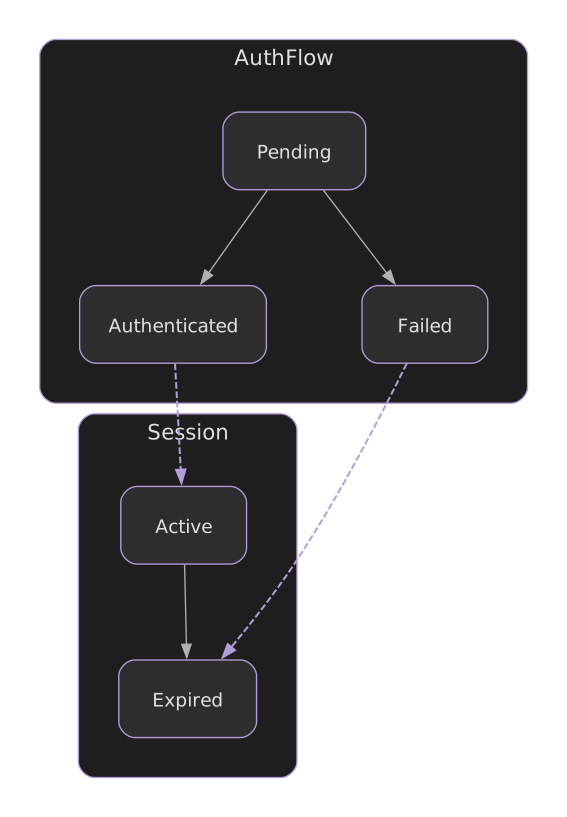
Cross-type bridges
If finishing one typestate hands control to another (auth flow into a session, for example), declare the bridge:
typestate AuthFlow:
  states Pending, Authenticated, Failed
  transitions:
    Pending -> Authenticated
    Pending -> Failed
  bridges:
    Authenticated -> Session.Active
    Failed -> Session.Guest

converter toSession(auth: Authenticated): Active {.transition.} =
  Active(Session(userId: auth.AuthFlow.userId))
Bridges show up in the generated diagrams alongside ordinary transitions.
Features
- States as
distincttypes — no runtime tag, no runtime check, no runtime cost - Branching unions (
A -> (B | C) as Result) and wildcard sources (* -> Closed) - Union source params:
proc cancel(o: Open | PartiallyFilled): Cancelling - Transparent wrappers in return types:
Result[State, E],Option[State],Future[State] - Async transitions via
{.async, transition.} - Generic typestates including states with
staticparameters - Cross-type bridges between separate typestates
- Strict mode that requires every proc on a state to be marked
{.transition.}or{.notATransition.} - Opt-in cast-bypass lint via
opaqueStates = true(CLI-only, warnings only) - Sealed typestates that restrict transitions to the defining module
- Implicit
TypestateOpeffect tag on every{.transition.}proc, enabling{.forbids: [TypestateOp].}regions under{.experimental: "strictEffects".} - A
typestatesCLI that verifies a project tree and exports diagrams
CLI
The typestates binary verifies a directory and produces GraphViz output:
typestates verify src/

typestates dot src/ | dot -Tsvg -o states.svg
typestates dot src/ | dot -Tpng -o states.png
typestates dot --no-style src/ > states.dot   # unstyled, easier to theme
CI integration
Run typestates verify in pre-commit hooks, GitHub Actions, or GitLab CI. The
v0.7 CLI exposes --warnings-as-errors for gating builds and --format=github
for inline PR annotations. See CI Integration
for setup recipes and the documented JSON schema.
Known issue: Nim < 2.2.8 with static generics
If you use a static generic parameter (Buffer[N: static int]) with ARC, ORC, or AtomicARC on Nim 2.2.x before 2.2.8, you may hit a codegen bug. The library detects the affected pattern at compile time and prints workarounds. The options, in rough order of preference:
- Upgrade to Nim 2.2.8 or newer.
- Compile with
--mm:refcinstead of ARC/ORC. - Add
consumeOnTransition = falseto the typestate (changes semantics — read the docs). - Make the base type inherit from
RootObjand setinheritsFromRootObj = true.
Plain generics (Container[T]) are unaffected.
Documentation
The full guide and API reference live at https://elijahr.github.io/nim-typestates/.
The examples/ directory in this repo has runnable versions of the examples used in the docs (payments, OAuth, hardware registers, document workflows, and others).
Contributing
Fork, create a branch, run nimble test and nimble compileExamples before opening a PR. The full guide is in CONTRIBUTING.md.
Prior art
- Typestate pattern in Rust (Cliff Biffle)
typestatecrate for Rust- Plaid, a research language with first-class typestate
- Strom & Yemini, "Typestate: A programming language concept for enhancing software reliability" (1986) — the original paper
License
MIT — see LICENSE.