Mira
July 25, 2026 · View on GitHub

Mira
A Rust-first, code-first evaluation framework for agents and tools — built for multi-turn, tool-using, long-running agent trajectories.






Part of the Everruns ecosystem.
Mira is an evals toolkit. You define evals in Rust (or any language that speaks the protocol), and a generic host CLI runs them across a model matrix, scores the results, and reports — with selective runs, saved and resumable runs, operational-metric budgets, and CI-native output (including a self-contained HTML report).
Mira — Ukrainian міра: measure, metric, standard. The thing an eval framework is for.
Three pieces and how they relate:
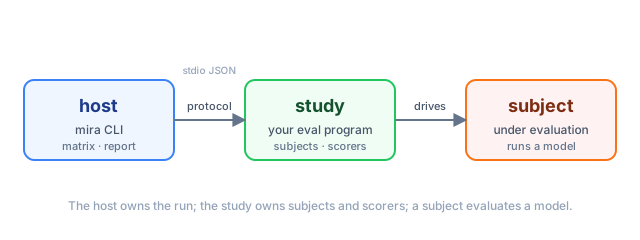
- The host (
miraCLI) owns the run: selection, the model matrix, saved runs, and reporting. - A study is your eval program. It owns the subjects (the things under evaluation) and the scorers, and answers the host over the protocol.
- A subject evaluates a model — in-process, an external binary, or a live runtime session.
Eval = Dataset(Sample…) + Subject + [Scorer…] × model matrix × axes
Subject— the thing under evaluation. One adapter per shape: an in-process closure, an external binary (CliSubject, the polyglot path), or a live runtime session (mira-everruns).Scorer— deterministic built-ins (contains,regex,tool_called,file_contains, …), trajectory-structure scorers over the ATIF trajectory (tool_called_with,tool_arg_matches,observation_contains,steps_within), operational budgets (tokens_within,cost_within,latency_within,ttft_within,tools_used_exactly, …), combinators (all_of/any_of/not), an arbitrary-closure escape hatch, and LLM-as-judge (model_graded) — one open vocabulary, freely composed.- Matrix & axes — the target (a model or harness) is the first-class axis;
add arbitrary axes (
.axis("effort", ["low","high"])) and the runner takes the cross-product. Subset any axis at run time with--targets/--axis/--preset. Missing API keys skip rather than fail, so a fresh run is green offline. - Two processes, one protocol — your eval program (the study) owns
subjects and scoring; the
miraCLI (the host) owns selection, the matrix, saved runs, and reporting. Provider keys never cross the wire. The protocol is versioned and forward-compatible.
Install
The mira host CLI, via Homebrew (recommended):
brew install everruns/tap/mira
Works on macOS (arm64/x86_64) and Linux (x86_64). If your Homebrew enforces tap
trust checks, trust the tap once first with brew trust --tap everruns/tap.
Prefer a prebuilt binary without Homebrew? cargo binstall mira-cli grabs the
same release tarball (installs the mira binary). Building from source instead?
cargo install mira-cli --locked.
Quick start
Add the framework and write an eval study:
cargo add mira-eval
// examples/my_evals.rs
use mira::scorer::{contains, succeeded, latency_within};
use mira::subject::subject_fn;
use mira::{eval, Eval, Transcript};

#[eval]
fn greet() -> Eval {
    Eval::new("greet")
        .sample("hi", "Say hi and tell me the answer to life.")
        .subject(subject_fn(|_sample, _cx| async move {
            // A real subject calls a model; this one fakes a good answer.
            Transcript::response("Hi! The answer is 42.")
        }))
        .scorer(succeeded())
        .scorer(contains("42"))
        .scorer(latency_within(2_000))
        .build()
}

fn main() -> std::io::Result<()> {
    // `serve_blocking()` owns the runtime — the study needs no tokio of its own.
    mira::Study::registered().serve_blocking()
}
Run it with the host CLI:
mira list --study-example my_evals                 # what the study advertises
mira run --study-example my_evals                  # run the whole matrix
mira run --study-example my_evals greet            # selective (substring), like cargo test
mira run --study-example my_evals --tag smoke
mira run --study-example my_evals --format html --out report.html   # self-contained viewer
mira run --study-example my_evals                                   # saves a run folder by default
mira run --study-example my_evals --resume <run_id>                 # resume; run only the missing cases
mira report <run_id>                                          # re-render a saved run's reports
mira export <run_id> --format atif                            # emit standalone ATIF trajectory docs
Every run saves a run folder under ./results/<run_id>/ (configure via
[results].dir in mira.toml); pass --dry-run for an ephemeral run.
See docs/getting-started.md for a full walkthrough,
and examples/ for runnable servers (greet, coding,
cli_subject, metrics, matrix, swe_bench, llmsim, plus the non-Rust
greet-python and greet-typescript):
cargo run -p mira-cli -- run --study-bin metrics
Why Mira
Teams run agents and tools against datasets in incompatible ways — a Python SWE-bench harness here, a bespoke Rust string-check bench there, an rstest matrix somewhere else. Mira is the one framework they can converge on:
- Agent-trajectory-native — the structured trajectory contract is
ATIF
(
Transcript.trajectory): score tool calls with their arguments and observations (tool_called,tools_used_exactly,tool_called_with,observation_contains,steps_within), multi-turn transcripts, and live runtime sessions; saved runs resume long-running payloads that take minutes to play out. - Code-first authoring with
cargo test-style discovery (#[eval]) and selection. - Polyglot by design — the
CliSubjectevaluates any binary in any language that writes an ATIF trajectory file (or, as the advanced path, emits the canonical JSONL transcript), so non-Rust agents are first-class. - Composable scoring that generalizes string checks, operational budgets, and LLM-judge into one trait.
- Operational metrics first-class — tokens (incl. cache/reasoning), cost, wall-clock latency, time-to-first-token, and exact tool usage are scorable fields, surfaced per-case in the JSON/HTML reports.
- Built for CI — JSON, JUnit, Markdown, and a self-contained HTML report; saved runs for resume; non-zero exit on failure.
Workspace layout
| Path | Crate | What |
|---|---|---|
crates/mira-eval | mira-eval (lib mira) | The framework: types, traits, scorers, subjects, protocol, study, host. |
crates/mira-cli | mira-cli (bin mira) | The host CLI that drives eval studies. |
crates/mira-macros | mira-macros | The #[eval] attribute macro (re-exported as mira::eval). |
crates/mira-everruns | mira-everruns | RuntimeSubject over the published everruns-runtime. |
examples/ | per-example crates | Runnable, offline example studies (one self-contained folder each; Rust + a Python study). |
docs/ | — | Public docs: how it works, getting started, extensibility, and the protocol reference. |
Formula/ | — | The Homebrew formula (mirrored to the tap on release). |
Documentation
Indexed in docs/:
- How it works — the model and moving parts, end to end
- Getting started
- Authoring evals
- Scorers
- Metrics — tokens/cost/latency and custom metrics
- Subjects
- Extensibility — the map of every extension seam
- The eval protocol — the wire format, ACP-style reference
Ecosystem
Mira is part of Everruns — a platform for building, running, and evaluating agents:
- everruns.com — the platform.
everruns-runtime— the embeddable in-process agent runtime thatmira-everrunsdrives.- github.com/everruns — the rest of the ecosystem.
Contributing
See CONTRIBUTING.md and AGENTS.md. Run
just check before opening a PR.
License
MIT — see LICENSE.