README_en.md
August 4, 2026 · View on GitHub
A practical Codex guide for global beginners, creators, developers, and teams



English · 简体中文 · Read Online · Learning Path · Quick Start · Advanced · Recipes · Manual · Roadmap
From the first hands-on session to real workflow adoption, CodexGuide helps people use Codex for development, creation, research, automation, and team collaboration. If this project saves you exploration time, a Star helps more people discover it.
Website
CodexGuide is available at codexguide.ai.
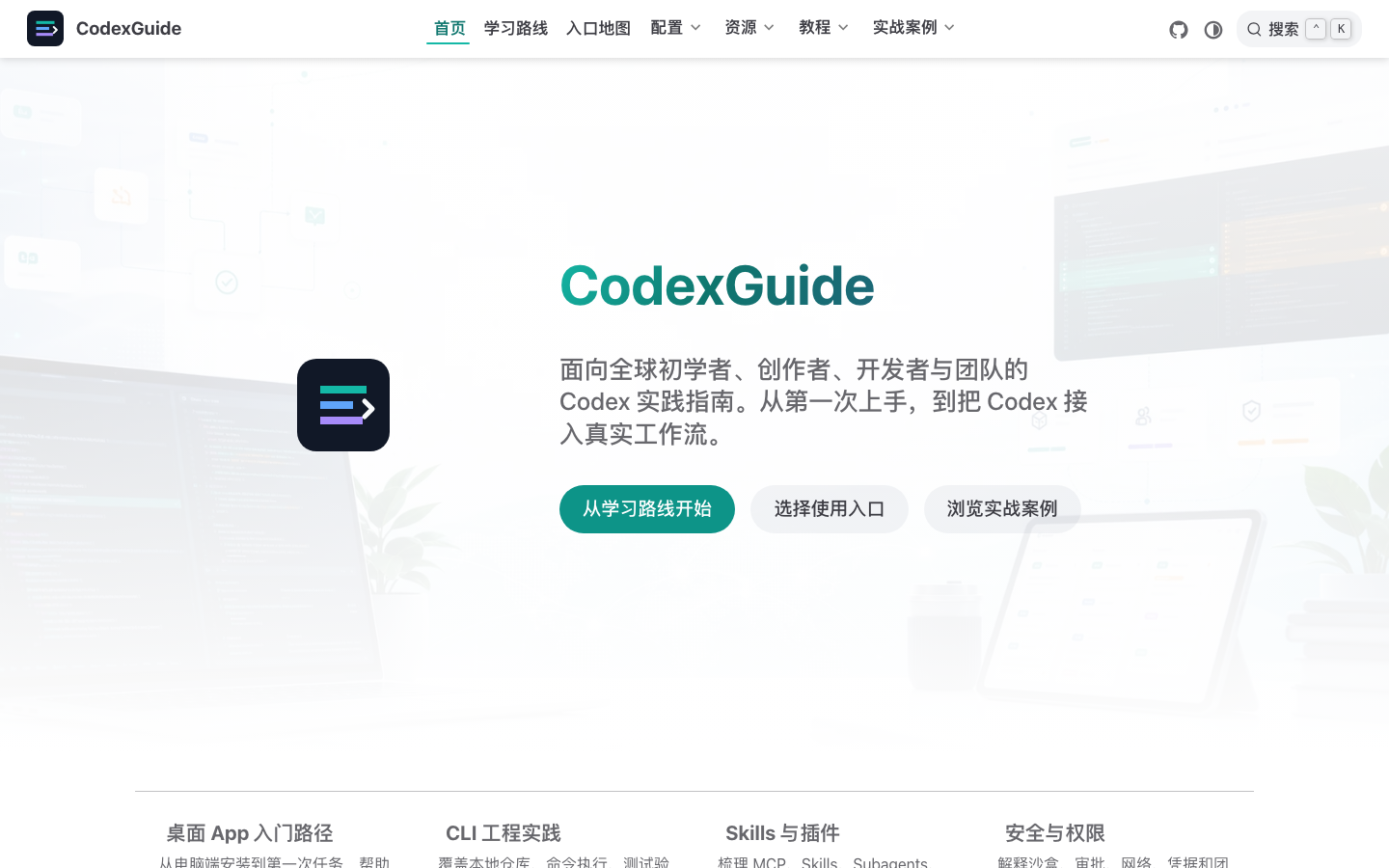
The GitHub README is a quick project overview. For actual learning, the website provides fuller navigation, search, sidebars, screenshots, setup maps, learning paths, and hands-on examples. Key pages are marked with review dates whenever possible, so you can decide when to verify details against official OpenAI sources.
If you are new to Codex, start with the Learning Path. If you already know whether you want CLI, Desktop App, Cloud, or IDE workflows, start from Quick Start and Advanced.
Vision
Codex is evolving from a coding assistant into an AI workflow system across CLI, Cloud/Web, IDE extension, desktop app, mobile collaboration, browser control, and automation.
CodexGuide is a practical knowledge base for real tasks. It focuses on three questions:
- How to start: which entry point, task, and setting should beginners choose first.
- How to deliver: how to describe work clearly so Codex can read projects, edit files, run commands, and return checkable results.
- How to retain learning: how to turn one successful run into reusable templates, rules, cases, and safety boundaries.
The guide is mainly written in Chinese today, but its audience is broader than Chinese-speaking developers. It also covers creators, researchers, product and operations teams, technical writers, and team leads who can benefit from Codex.
Who It's For
- First-time Codex users: follow the Desktop App, subscription, settings, mobile collaboration, and first-task path to complete one full loop.
- Developers bringing Codex into projects: learn CLI, IDE, Git, tests, CI, AGENTS.md, sandboxing, and approvals.
- Creators and knowledge workers: use Codex for writing, slides, research organization, knowledge bases, browsers, and workflow automation.
- Team leads and tool builders: build team rules, task templates, permission boundaries, retrospectives, and portable case libraries.
- People choosing an entry point: compare Desktop App, CLI, Cloud, IDE, ChatGPT mobile, and plugin ecosystems.
❤️ Sponsors
Want to appear here? Add me on WeChat and include your product name plus a short project sponsorship note in the friend request.

| Sponsor | Description |
|---|---|
 | Thanks to Unity2.ai for sponsoring this project. Unity2.ai is a high-performance AI model API relay platform for individual developers, teams, and enterprises. It has long served leading Chinese enterprises, handles more than 30 billion token calls per day, and supports 5000 RPM-level high concurrency. It supports balance-based billing, first top-up bonuses, bundled subscriptions, enterprise invoicing, and dedicated support. Register through this link to receive a $2 balance, then join the official community to receive another $10 balance, for up to $12 in free credits. |
 | PayForChat supports ChatGPT and Claude membership activation and top-ups: pay directly with WeChat, no overseas credit card required, top up your own account through official channels, receive a full refund if it fails, and get Chinese support plus receipts. Click here to register and try it. |
 | GetGPT Pro provides AI subscription activation and top-up services for ChatGPT, Claude, and other tools, with self-service ordering, fast delivery, and after-sales support. |
 | Project sponsor. PPToken provides API relay and key distribution for ChatGPT, Claude, Gemini and other mainstream AI models, with low latency, high availability, pay-as-you-go billing, and flexible subscription plans. |
What You'll Find
| Content | Description |
|---|---|
| Learning path | Installation, login, subscription, settings, mobile collaboration, and the first low-risk task |
| Entry map | How to choose between Desktop App, CLI, Cloud, IDE, ChatGPT, and integrations |
| Configuration | CLI options, config.toml, and project rule configuration |
| Workflow practice | Task design, verification, and team playbooks |
| Recipes | PPT, Draw.io, browser, Obsidian, Feishu, Figma, Notion, CI fixes, and more |
| Official references | OpenAI source material, GitHub repositories, and key fact links |
Recommended Paths
1. First Time With Codex
Read the Learning Path, then continue with Desktop App Download And Installation, Plus / Pro Subscription, Desktop App Overview, and First Task.
2. Use Codex In A Real Project
Start from CLI Installation And Login, then read First Local Code Task, AGENTS.md, and Sandbox And Approvals.
3. Bring Codex Into A Team
Start with the Team Playbook, then add the Manual, Sandbox And Approvals, Troubleshooting, and the Recipe Library.
Quick Links
| Module | Use It For |
|---|---|
| Learning Path | Reading order from beginner use to team adoption |
| Quick Start | Desktop App, account, first task, and task loop |
| Mobile Collaboration | Following desktop tasks from the Codex entry in the ChatGPT mobile app |
| CLI Installation And Login | Installing Codex CLI locally and signing in |
| First Local Code Task | Running Codex CLI in a real repository |
| Advanced | CLI, IDE, Cloud, permissions, AGENTS.md, automation, and team practice |
| Manual | OpenAI source material, Codex updates, and references |
| AGENTS.md | Writing project-level rules and collaboration boundaries for Codex |
| Sandbox And Approvals | Safety boundaries for files, commands, network, credentials, and production resources |
| Cloud, IDE, And Desktop App | Matching Codex entry points to work scenarios |
| Recipes | Reusable task templates and retrospectives for real projects |
Content Structure
CodexGuide
├─ guide         # Learning path
├─ start         # Quick start
├─ advanced      # Advanced tutorials
├─ recipes       # Real-world examples
├─ manual        # Official references and update notes
└─ community     # Roadmap and contribution direction
Local Preview
Requirements:
- Node.js 22.12+ and lower than 25
- pnpm 10.33.0
pnpm install
pnpm dev
Build the static site:
pnpm build
The development server starts the VuePress documentation site. The production site is published at codexguide.ai.
Design Principles
- Official sources first: features, pricing, availability, and safety policies should be checked against OpenAI sources.
- Beginner friendly: onboarding chapters explain why a step matters and when to avoid it.
- Real task oriented: fewer abstract concepts, more repeatable task flows, inputs, outputs, and verification methods.
- Clear safety boundaries: file writes, command execution, network access, credentials, browser control, and computer control all need explicit risk framing.
- Reusable learning: successful runs should become AGENTS.md rules, templates, cases, retrospectives, and team norms.
Star History
Community
The CodexGuide WeChat community has a one-time CNY 9.9 entry fee. The small threshold helps reduce spam and supports ongoing content and community maintenance. Scan the QR code with Alipay or your phone camera to start Alipay, or review the paid community page before deciding whether to join.

Sources
This repository prioritizes official sources and marks important pages with review dates where possible. The current structure references:
- OpenAI Codex product page
- Codex in ChatGPT Help Center
- OpenAI Codex CLI Getting Started
- Codex cloud docs
- openai/codex GitHub repository
Contributing
Contributions are welcome:
- Beginner-friendly rewrites.
- Reproducible real-world cases.
- Common errors and fixes.
- Team practices, templates, and workflows.
- Official documentation change tracking.
Please read the Contribution Guide. If you are not sure where to begin, start from the Roadmap or a good first issue.
License
This project is open-sourced under the MIT License. You may use, modify, distribute, and build on it as long as you keep the license notice.
Disclaimer
CodexGuide is a community-maintained Codex practice knowledge base and is not an official OpenAI project. For time-sensitive details such as features, plans, pricing, availability, and safety policies, please refer to official OpenAI sources.