Features
April 23, 2026 · View on GitHub

Vizia






A declarative desktop GUI framework for the Rust programming language.
Features
-
Cross-platform (Windows, Linux, MacOS)
Build desktop applications which look and behave the same for Windows, Mac, and Linux. -
Declarative
Write GUI code in a declarative way in pure Rust (no DSL macros). -
Reactive
Views derive from application state. Change the state and the views which bind to it update automatically. -
Flexible layout
Create flexible layouts which adapt to changes in size. Powered by morphorm. -
Powerful styling
Take advantage of stylesheets with hot-reloading to fully customize the look of your application. -
Animations
Bring your applications to life with animations. -
Built-in views and themes
Utilize over 25 ready-made views as well as two built-in themes (light and dark) to get you started. Includes 4250+ SVG icons, provided by Tabler Icons. -
Accessibility
Make your applications accessible to assistive technologies such as screen readers, powered by accesskit. -
Localization
Adapt your application to different locales, including translating text with fluent. -
Optimised rendering
Vizia leverages the powerful and robust skia library for rendering, with further optimizations to only draw what is necessary. -
Audio plugin development
Vizia provides an alternative baseview windowing backend for audio plugin development, for example with the nih-plug framework.
Widget Gallery

Explore all of the built-in views in the widget gallery. Run with:
cargo run --release -p widget_gallery
At a Glance
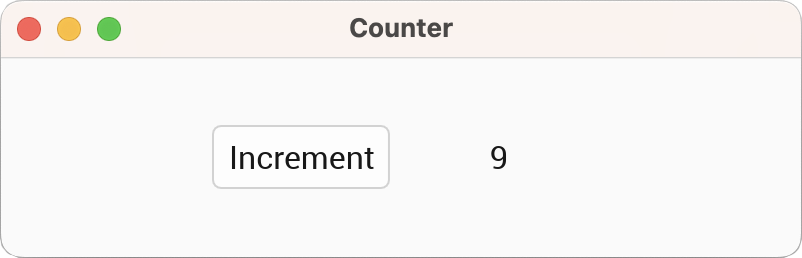
A simple counter application. Run with cargo run --example counter.
use vizia::prelude::*;

// Define some model data
pub struct AppData {
  count: Signal<i32>,
}

// Define events to mutate the data
pub enum AppEvent {
    Increment,
}

// Describe how the data is mutated in response to events
impl Model for AppData {
    fn event(&mut self, _: &mut EventContext, event: &mut Event) {
        event.map(|app_event, _| match app_event {
            AppEvent::Increment => {
        self.count.update(|count| *count += 1);
            }
        });
    }
}

fn main() {
    // Create an application
    Application::new(|cx| {
      let count = Signal::new(0);

        // Build the model data into the tree
      AppData { count }.build(cx);

        // Declare views which make up the UI
        HStack::new(cx, |cx| {

            // Declare a button which emits an event
            Button::new(cx, |cx| Label::new(cx, "Increment"))
              .on_press(|cx| cx.emit(AppEvent::Increment));

            // Declare a label which is bound to part of the model, updating when it changes
            Label::new(cx, count).width(Pixels(50.0));
        })
        .alignment(Alignment::Center)  // Apply style and layout modifiers
        .horizontal_gap(Pixels(50.0));
    })
    .title("Counter") // Configure window properties
    .inner_size((400, 100))
    .run();
}
Learning
Book
A guide book for vizia is available here.
Docs
Auto-generated code documentation can be found here.
Examples
A list of examples is included in the repository.
To run an example:
cargo run --release --example name_of_example
TThere are also example applications which are packages with their own Cargo.toml files. To run, for example, the widget gallery, use the following command:
cargo run -p widget_gallery
Where widget_gallery should be replaced with the name of the example package you wish to run.
Contributing and Community
The Vizia project welcomes contributions from developers of all experience levels! Whether you’re interested in:
- Reporting bugs in the framework or examples
- Improving documentation and examples
- Adding features or optimizations
- Fixing issues or reviewing pull requests
- Writing custom widgets or extensions
All contributions are valuable.
For help with vizia, or to get involved with contributing to the project, come join us on our discord.
License and Attribution
Vizia is licensed under MIT.
Vizia logo designed by Lunae Somnia.