Raven
May 29, 2026 · View on GitHub

Raven
Raven is a linear-time sequence model built on top of Flash Linear Attention. It introduces a routing memory mechanism that selectively writes to a fixed set of persistent memory slots using a learned sparse router — achieving sub-quadratic complexity while maintaining strong associative recall.
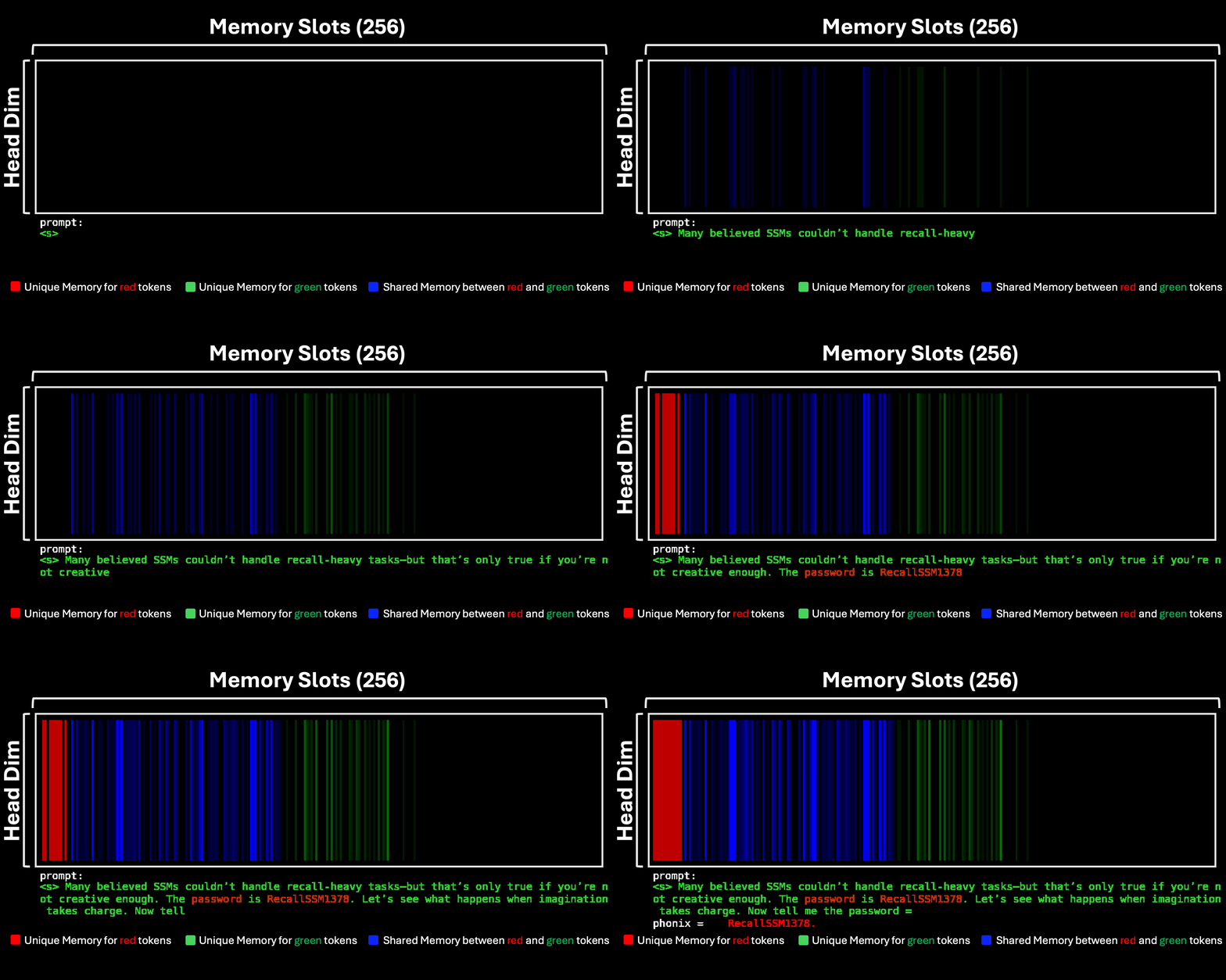
Sparse Memory Routing in Raven. Unlike SSMs that update the entire state densely, or SWA that enforces strict FIFO overwriting, Raven uses an input-dependent router. At each step, only a specific subset of memory slots (highlighted) is selected to undergo decay and receive new information. Unselected slots remain completely untouched, preventing interference and preserving long-range recall.
Architecture

Raven replaces the SSM block with an RSM (Routing State Model) layer. Unlike GLA/Mamba2 which write to all memory slots uniformly, Raven learns a per-token sparse router R that selects which slots to update.
How Raven Works

Each Raven layer maintains a matrix memory state H ∈ R^(slots × d_v). At each timestep the router selects the top-k most relevant slots and performs a gated update:
route_scores = TopK( sigmoid(r_proj(x)) )
decay         = exp( route_scores * f )     # sparse forgetting gate
H             = H * decay + (1 - decay) * k ⊗ v
o             = q · H                       # read
The table below places Raven in the broader landscape of linear models:

Key design choices:
- Sparse top-k routing — each token writes to a small subset of memory slots
- Gumbel noise during training for exploration (optional)
- Mamba2 or GLA decay for the forgetting gate
- Chunked Triton kernels for training, fused recurrent kernels for generation
Results
In-Context Recall Benchmarks

Table 2: In-context recall benchmarks and NIAH accuracy vs. context length. Accuracy (%) on SWDE/FDA/SQuAD and single NIAH-1/2/3 across context lengths. Bold = best, underline = second best.
~400M parameter models
| Model | Params | Mem (M) | SWDE | FDA | SQuAD | N1-1K | N1-2K | N1-4K | N1-8K | N1-16K | N1-32K | N2-1K | N2-2K | N2-4K | N2-8K | N2-16K | N2-32K | N3-1K | N3-2K | N3-4K | N3-8K | N3-16K | N3-32K |
|---|---|---|---|---|---|---|---|---|---|---|---|---|---|---|---|---|---|---|---|---|---|---|---|
| Transformer | |||||||||||||||||||||||
| w. RoPE | 340 | ∞ / 0 | 42.3 | 34.5 | 22.1 | 100 | 100 | 0 | 0 | 0 | 0 | 100 | 100 | 0 | 0 | 0 | 0 | 71.6 | 47.6 | 0 | 0 | 0 | 0 |
| w. Gate (FoX) | 376 | ∞ / 0 | 52.5 | 64.3 | 30.1 | 100 | 100 | 32.2 | 8.0 | 4.2 | 0 | 100 | 100 | 100 | 24.0 | 11.6 | 3.2 | 95.4 | 85.6 | 64.2 | 11.6 | 7.2 | 0 |
| SSM | |||||||||||||||||||||||
| GLA | 475 | 12.5 / 0.4 | 29.0 | 11.4 | 30.3 | 74.6 | 25.1 | 8.2 | 2.2 | 0 | 0 | 91.2 | 37.2 | 21.4 | 3.6 | 0 | 0 | 84.2 | 57.1 | 20.8 | 10.2 | 2.3 | 0 |
| GSA | 399 | 12.5 / 0 | 23.8 | 14.5 | 24.9 | 99.2 | 97.1 | 90.0 | 67.4 | 29.6 | 11.0 | 96.6 | 98.8 | 28.0 | 5.1 | 1.0 | 0 | 60.0 | 30.1 | 13.5 | 1.0 | 0 | 0 |
| GDN | 475 | 12.5 / 0.4 | 29.5 | 8.3 | 31.3 | 99.2 | 100 | 99.8 | 92.0 | 41.8 | 22.1 | 99.2 | 92.0 | 43.6 | 17.8 | 6.2 | 4.0 | 92.6 | 80.6 | 37.8 | 5.2 | 6.8 | 2.5 |
| Mamba-2 | 382 | 12.5 / 0.4 | 25.7 | 14.9 | 31.9 | 99.2 | 95.6 | 52.2 | 12.8 | 5.4 | 2.8 | 99.8 | 98.0 | 68.2 | 15.4 | 4.4 | 3.8 | 53.4 | 53.6 | 17.4 | 1.8 | 2.2 | 3.2 |
| SWA | 374 | 12.5 / 0 | 10.0 | 14.4 | 29.7 | 29.8 | 11.0 | 6.2 | 3.4 | 1.2 | 0 | 36.2 | 14.4 | 10.2 | 3.8 | 3.2 | 0 | 26.2 | 9.2 | 7.4 | 1.4 | 1.8 | 0 |
| Raven | 424 | 12.5 / 0 | 34.1 | 22.7 | 35.4 | 99.8 | 100 | 99.8 | 99.8 | 99.4 | 91.4 | 98.8 | 98.0 | 98.8 | 81.6 | 23.0 | 8.8 | 76.8 | 43.6 | 13.4 | 1.0 | 0 | 0 |
Language Modeling & Zero-Shot Evaluation
Table 3: Language modeling and zero-shot evaluation results. Perplexity on Lambada (LMB.) and zero-shot accuracy across standard benchmarks. Bold = best, underline = second best.
~400M parameter models
| Model | Params | LMB. ppl↓ | LMB. acc↑ | PIQA↑ | Hella.↑ | Wino.↑ | ARC-e↑ | ARC-c↑ | Avg.↑ |
|---|---|---|---|---|---|---|---|---|---|
| Transformer | |||||||||
| w. RoPE | 340 | 42.0 | 31.0 | 64.4 | 30.2 | 51.0 | 44.3 | 18.7 | 39.9 |
| w. Gate (FoX) | 376 | 48.1 | 30.6 | 64.9 | 30.7 | 51.1 | 44.7 | 18.9 | 40.1 |
| SSM | |||||||||
| GLA | 400 | 42.1 | 30.7 | 64.4 | 30.1 | 52.7 | 43.8 | 19.6 | 40.2 |
| GSA | 399 | 44.1 | 30.3 | 64.9 | 30.7 | 51.5 | 45.6 | 20.5 | 40.5 |
| GDN | 475 | 40.1 | 31.6 | 65.6 | 31.4 | 50.2 | 45.7 | 19.3 | 40.6 |
| Mamba-2 | 382 | 43.0 | 29.9 | 65.0 | 31.5 | 51.2 | 47.5 | 20.5 | 40.1 |
| SWA | 374 | 40.7 | 30.5 | 64.5 | 30.4 | 51.6 | 44.9 | 18.6 | 40.0 |
| Raven | 424 | 41.0 | 32.7 | 64.1 | 30.3 | 51.7 | 43.9 | 18.4 | 40.2 |
Hybrid Models Retrieval Ability
Table 4: Hybrid-Raven vs. other hybrid architectures on retrieval tasks. ✓ = no convolutional memory needed.
~400M parameter models
| Model | No Conv. | SWDE | FDA | SQuAD | N1-1K | N1-2K | N1-4K | N1-8K | N1-16K | N1-32K | N2-1K | N2-2K | N2-4K | N2-8K | N2-16K | N2-32K | N3-1K | N3-2K | N3-4K | N3-8K | N3-16K | N3-32K |
|---|---|---|---|---|---|---|---|---|---|---|---|---|---|---|---|---|---|---|---|---|---|---|
| GDN | ✗ | 54.6 | 67.2 | 34.5 | 100 | 100 | 100 | 100 | 93.2 | 70.5 | 100 | 100 | 100 | 8.0 | 0 | 0 | 93.2 | 70.2 | 50.0 | 0 | 0 | 0 |
| Mamba-2 | ✗ | 56.3 | 68.8 | 36.0 | 100 | 100 | 16.4 | 0 | 0 | 0 | 100 | 100 | 85.8 | 0 | 0 | 0 | 76.9 | 80.6 | 60.8 | 0 | 0 | 0 |
| SWA-RoPE | ✓ | 51.0 | 68.1 | 34.1 | 100 | 100 | 100 | 100 | 98.2 | 60.4 | 100 | 100 | 100 | 98.2 | 3.1 | 0 | 93.4 | 78.2 | 12.8 | 60.0 | 4.4 | 0 |
| Raven | ✓ | 51.4 | 64.2 | 31.4 | 100 | 100 | 100 | 100 | 98.4 | 78.6 | 100 | 100 | 100 | 100 | 95.4 | 65.4 | 90.0 | 67.0 | 73.8 | 60.0 | 10.2 | 14.4 |
Model Structure
| Component | Details |
|---|---|
| Layer type | RavenAttention (replaces standard attention) |
| Memory | Fixed-size slot matrix per head (num_slots slots) |
| Router | Linear or MLP projection → top-k sigmoid/softmax |
| Decay | Mamba2 (A_log + dt_bias) or GLA (logsigmoid) |
| Feature map | Swish, ReLU, or T2R |
| Computation | Chunked (training) / Fused recurrent (inference) |
| Hybrid layers | Optional standard attention layers at specified indices |
Installation
Install the FLA dependency first, following the official FLA guide:
pip install flash-linear-attention
Then clone this repo:
git clone https://github.com/AvivBick/RoutingMemory
cd RoutingMemory
pip install -e .
Requirements: PyTorch ≥ 2.5, Triton ≥ 3.0, einops, transformers ≥ 4.45.0
Usage
As a layer
from raven.layers import RavenAttention

attn = RavenAttention(
    hidden_size=1024,
    num_heads=4,
    num_slots=256,
    topk=32,
    decay_type='Mamba2',    # or 'GLA'
    feature_map='swish',
    router_type='lin',      # or 'mlp'
    router_score='sigmoid', # or 'softmax'
).cuda()

x = torch.randn(1, 2048, 1024).cuda()
y, _, _ = attn(x)  # (batch, seq_len, hidden_size)
As a full causal LM
from raven.models import RavenConfig, RavenForCausalLM
from transformers import AutoModelForCausalLM

config = RavenConfig(
    hidden_size=1024,
    num_hidden_layers=24,
    num_heads=4,
    num_slots=256,
    topk=32,
    decay_type='Mamba2',
    feature_map='swish',
    vocab_size=32000,
)
model = AutoModelForCausalLM.from_config(config).cuda()
Training
Raven uses the flame training framework. Add a config from configs/raven_340M_*.json to flame/configs/, then:
CUDA_VISIBLE_DEVICES=0,1,2,3 NGPU=4 bash train.sh \
    --job.config_file flame/models/fla.toml \
    --job.dump_folder exp/raven-340M \
    --model.config configs/raven_340M_1.json \
    --optimizer.name AdamW \
    --optimizer.lr 3e-4 \
    --lr_scheduler.warmup_steps 1024 \
    --lr_scheduler.decay_type cosine \
    --training.batch_size 16 \
    --training.seq_len 2048 \
    --training.gradient_accumulation_steps 4 \
    --training.steps 30720 \
    --training.dataset /path/to/SlimPajama-627B \
    --training.streaming \
    --training.compile \
    --checkpoint.interval 3072
The configs/ directory contains 12 ablation configurations varying the router design (linear vs. MLP, sigmoid vs. softmax, with/without Gumbel noise and bias).
Repository Structure
raven/
├── layers/
│   └── raven.py                # RavenAttention layer
└── models/
    └── raven/
        ├── configuration_raven.py
        └── modeling_raven.py

configs/
└── raven_340M_*.json           # 12 ablation configs (340M scale)

assets/img/                     # figures used in this README
Upstream: Flash Linear Attention
This repo builds on [fla-org/flash-linear-attention] and depends on it for hardware-efficient Triton kernels. In particular, Raven currently reuses FLA’s GSA chunked and fused recurrent kernels rather than vendoring separate Raven ops in this repository.


Citation
@article{afzalbick2026raven,
  title={Raven: High-Recall Sequence Modeling with Sparse Memory Routing},
  author={Arshia Afzal, Aviv Bick, Eric P. Xing, Volkan Cevher, Albert Gu},
  year={2026},
  publisher={MDPI}
}