TLDExtract
August 21, 2026 · View on GitHub




TLDExtract
TLDExtract is a pure Swift library to allows you to get the public suffix of a domain name using the Public Suffix List. You can find alternatives for other languages at publicsuffix.org.
What are domains?
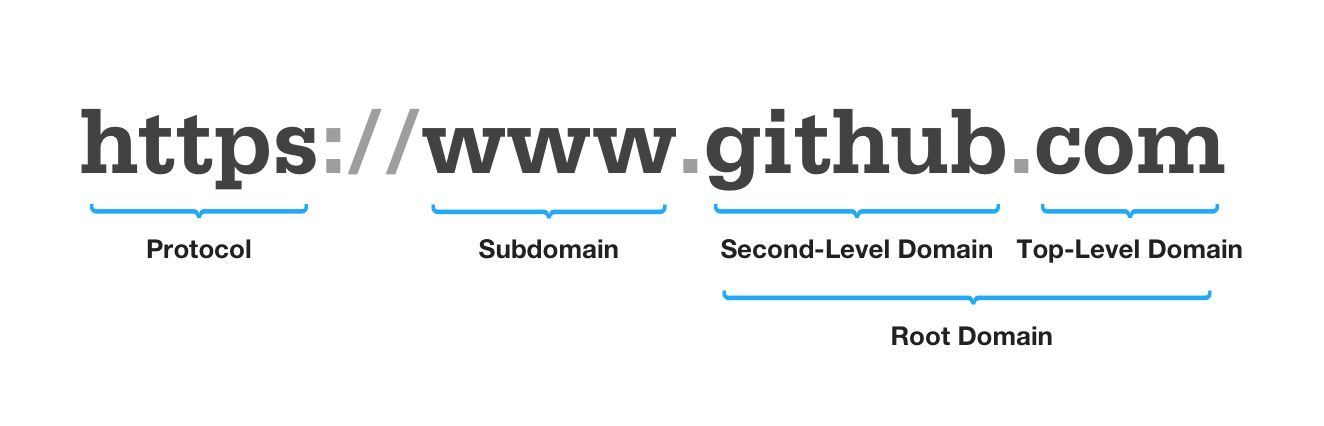
Domain names are the unique, human-readable Internet addresses of websites. They are made up of three parts: a top-level domain (a.k.a. TLD), a second-level domain name, and an optional subdomain.
Changes in 3.0.0
Breaking changes
-
‼️ Library name changed from
TLDExtractTLDExtractSwiftto resolve namespace conflicts. For more details, please check the issue (apple/swift#56573).Please don't forget to update your source code.
- import TLDExtract
+ import TLDExtractSwift
Other changes
- Dropped support for Swift 4.
- Added watchOS and visionOS to supported platforms.
- Changed supported versions for macOS, iOS, and tvOS to match Xcode 15.4.
Feature
- Extract root domain, top level domain, second level domain, subdomain from url and hostname
- Foundation URL and String support
- IDNA support
- Multi platform support
Requirements
- macOS 10.13 or later
- iOS 12.0 or later
- tvOS 12.0 or later
- watchOS 4.0 or later
- visionOS 1.0 or later
- Linux (SPM builds)
- Swift 5.9 or later (Xcode 15 or later) for Swift Package Manager
Installation
Swift Package Manager is the recommended way to install TLDExtractSwift.
Important
CocoaPods distribution has ended: 3.0.0 is the last version published as a pod. Future versions are available via Swift Package Manager (and Carthage on a best-effort basis) only. If you are using CocoaPods, please migrate to Swift Package Manager.
Swift Package Manager
Add the following to your Package.swift file.
-
macOS, iOS, tvOS, watchOS, visionOS, Linux, and Swift 5.9 (Xcode 15) or later
dependencies: [ .package(url: "https://github.com/futamura/TLDExtractSwift.git", .upToNextMajor(from: "4.0.0")) ] -
macOS, iOS, tvOS, watchOS, visionOS, and Swift 5
dependencies: [ .package(url: "https://github.com/futamura/TLDExtractSwift.git", .upToNextMajor(from: "3.0.0")) ] -
macOS, iOS, tvOS, and Swift 5
dependencies: [
    .package(url: "https://github.com/futamura/TLDExtractSwift.git", .upToNextMajor(from: "2.1.1"))
]
Carthage
Note
Carthage itself is in maintenance mode. Carthage compatibility is kept on a best-effort basis and is no longer verified by CI.
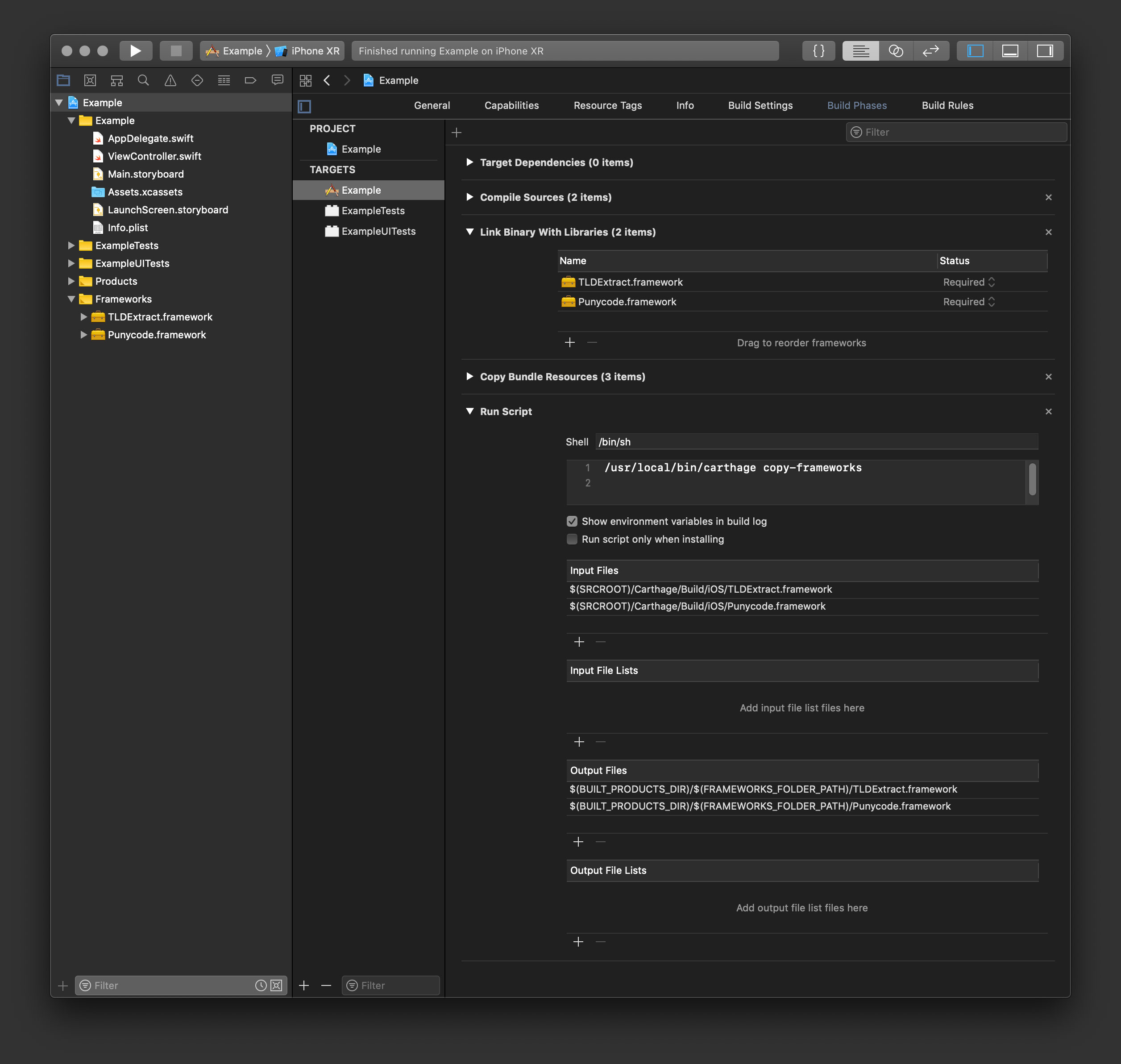
Add the following to your Cartfile and follow these instructions.
-
macOS, iOS, tvOS, watchOS, visionOS, and Swift 5.9 or later
github "futamura/TLDExtractSwift" ~> 4.0 -
macOS, iOS, tvOS, watchOS, visionOS, and Swift 5
github "futamura/TLDExtractSwift" ~> 3.0 -
macOS, iOS, tvOS, and Swift 5
github "futamura/TLDExtractSwift" ~> 2.0 -
macOS, iOS, tvOS, and Swift 4
github "futamura/TLDExtractSwift" ~> 1.0
Do not forget to include Punycode.framework. Otherwise it will fail to build the application.
CocoaPods
Warning
CocoaPods distribution has ended: 3.0.0 is the last version published as a pod. Existing versions remain installable until the trunk archive disappears, but no new versions will be published. Please migrate to Swift Package Manager.
Existing installations reference the pod as follows.
-
macOS, iOS, tvOS, watchOS, visionOS, and Swift 5.0
pod 'TLDExtractSwift', '~> 3.0' -
macOS, iOS, tvOS, and Swift 5.0
pod 'TLDExtract', '~> 2.0' -
macOS, iOS, tvOS, and Swift 4.2
pod 'TLDExtract', '~> 1.0'
Usage
Full documentation is available at https://futamura.github.io/TLDExtractSwift/documentation/tldextractswift/.
Initialization
Basic initialization code. Exceptions will not be raised unless the Public Suffix List on the server is broken.
import TLDExtractSwift

let extractor = try! TLDExtract()
A safer initialization code to avoid errors by using the frozen Public Suffix List:
import TLDExtractSwift

let extractor = try! TLDExtract(useFrozenData: true)
*In SPM builds the default initializer downloads the live Public Suffix List; setting useFrozenData to true uses the bundled snapshot instead. Framework builds always use the bundled list, which is regenerated with python update-psl.py.
Extraction
Passing argument as String
Extract an url:
let urlString: String = "https://www.github.com/futamura/TLDExtract"
guard let result: TLDResult = extractor.parse(urlString) else { return }

print(result.rootDomain)        // Optional("github.com")
print(result.topLevelDomain)    // Optional("com")
print(result.secondLevelDomain) // Optional("github")
print(result.subDomain)         // Optional("www")
Extract a hostname:
let hostname: String = "futamura.dev"
guard let result: TLDResult = extractor.parse(hostname) else { return }

print(result.rootDomain)        // Optional("futamura.dev")
print(result.topLevelDomain)    // Optional("dev")
print(result.secondLevelDomain) // Optional("futamura")
print(result.subDomain)         // nil
Extract an unicode hostname:
let hostname: String = "www.ラーメン.寿司.co.jp"
guard let result: TLDResult = extractor.parse(hostname) else { return }

print(result.rootDomain)        // Optional("寿司.co.jp")
print(result.topLevelDomain)    // Optional("co.jp")
print(result.secondLevelDomain) // Optional("寿司")
print(result.subDomain)         // Optional("www.ラーメン")
Extract a punycoded hostname (Same as above):
let hostname: String = "www.xn--4dkp5a8a.xn--sprr0q.co.jp")"
guard let result: TLDResult = extractor.parse(hostname) else { return }

print(result.rootDomain)        // Optional("xn--sprr0q.co.jp")
print(result.topLevelDomain)    // Optional("co.jp")
print(result.secondLevelDomain) // Optional("xn--sprr0q")
print(result.subDomain)         // Optional("www.xn--4dkp5a8a")
Passing argument as Foundation URL
Extract an unicode url:
URL class in Foundation Framework does not support unicode URLs by default. You can use URL extension as a workaround
let urlString: String = "http://www.ラーメン.寿司.co.jp"
let url: URL = URL(unicodeString: urlString)
guard let result: TLDResult = extractor.parse(url) else { return }

print(result.rootDomain)        // Optional("www.ラーメン.寿司.co.jp")
print(result.topLevelDomain)    // Optional("co.jp")
print(result.secondLevelDomain) // Optional("寿司")
print(result.subDomain)         // Optional("www.ラーメン")
Encode an url by passing argument as percent encoded string (Same as above):
let urlString: String = "http://www.ラーメン.寿司.co.jp".addingPercentEncoding(withAllowedCharacters: .urlQueryAllowed)!
let url: URL = URL(string: urlString)
print(urlString)                // http://www.%E3%83%A9%E3%83%BC%E3%83%A1%E3%83%B3.%E5%AF%BF%E5%8F%B8.co.jp

guard let result: TLDResult = extractor.parse(url) else { return }

print(result.rootDomain)        // Optional("www.ラーメン.寿司.co.jp")
print(result.topLevelDomain)    // Optional("co.jp")
print(result.secondLevelDomain) // Optional("寿司")
print(result.subDomain)         // Optional("www.ラーメン")
Encode a unicode url by using the Punycode Framework. idnaEncodedURL (PunycodeSwift 4.0 or later) encodes the host component only, preserving the scheme and the rest of the URL — idnaEncoded is the hostname-level equivalent and must not be applied to a full URL:
import Punycode

let urlString: String = "http://www.ラーメン.寿司.co.jp".idnaEncodedURL!
let url: URL = URL(string: urlString)!
print(urlString)                // http://www.xn--4dkp5a8a.xn--sprr0q.co.jp

guard let result: TLDResult = extractor.parse(url) else { return }

print(result.rootDomain)        // Optional("xn--sprr0q.co.jp")
print(result.topLevelDomain)    // Optional("co.jp")
print(result.secondLevelDomain) // Optional("xn--sprr0q")
print(result.subDomain)         // Optional("www.xn--4dkp5a8a")
Copyright
TLDExtract is released under MIT license, which means you can modify it, redistribute it or use it however you like.