README.md
June 21, 2026 · View on GitHub
equilib
Processing Equirectangular Images with Python





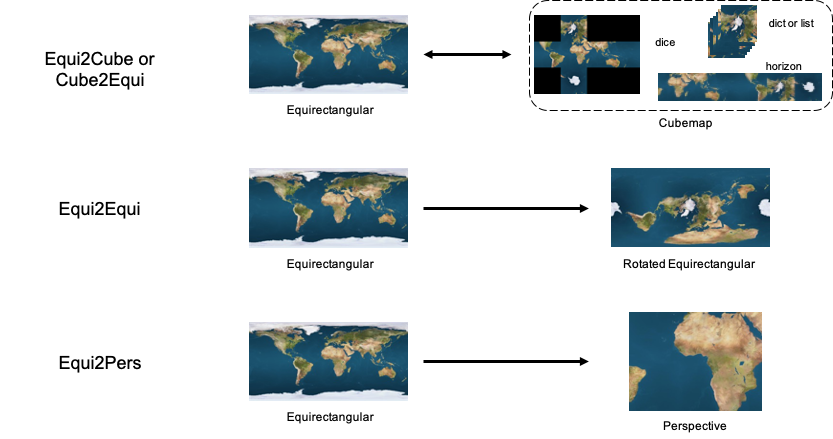
equilib is a library for processing equirectangular (360°) images in Python.
- Pure Python, with
numpyandtorchas the only runtime dependencies. - Runs on CPU and CUDA tensors, with batched and mixed-precision processing.
- Automatic input-type detection (
numpy.ndarrayortorch.Tensor). - Extras such as rotation-matrix creation and a customizable grid sampler.
- Highly modular and extensible.
📖 Full documentation: https://haruishi43.github.io/equilib/
Installation
Prerequisites:
- Python
>=3.9 - PyTorch
>=2.8
pip install pyequilib
Transforms
equilib provides transforms between equirectangular, cubemap, and perspective
images. Each transform ships both a class API and a func API.
| Transform | Description |
|---|---|
Cube2Equi / cube2equi | cubemap → equirectangular |
Equi2Cube / equi2cube | equirectangular → cubemap |
Equi2Equi / equi2equi | equirectangular → equirectangular |
Equi2Pers / equi2pers | equirectangular → perspective |
Pers2Equi / pers2equi | perspective → equirectangular |
The class API instantiates a reusable object configured once; the func API
takes the configuration on every call. The class API calls the func API
internally, so there is no behavioral difference — both are extensible.
Inputs are channel-first (BxCxHxW or CxHxW); the output type matches the
input. Common arguments shared across transforms:
rots: rotation as three angles pitch, yaw, roll in radians.z_down(bool): use a z-axis-down coordinate system. DefaultFalse.mode(str): interpolation mode. Default"bilinear".clip_output(bool): clip values to the input range. DefaultTrue.
Basic usage
Example with Equi2Pers / equi2pers.
class API
import numpy as np
from PIL import Image
from equilib import Equi2Pers

# Input equirectangular image (channel-first: HWC -> CHW)
equi_img = np.asarray(Image.open("./some_image.jpg"))
equi_img = np.transpose(equi_img, (2, 0, 1))

rots = {
    "roll": 0.0,
    "pitch": np.pi / 4,  # rotate vertical
    "yaw": np.pi / 4,    # rotate horizontal
}

equi2pers = Equi2Pers(height=480, width=640, fov_x=90.0, mode="bilinear")
pers_img = equi2pers(equi=equi_img, rots=rots)
func API
import numpy as np
from PIL import Image
from equilib import equi2pers

equi_img = np.asarray(Image.open("./some_image.jpg"))
equi_img = np.transpose(equi_img, (2, 0, 1))

rots = {"roll": 0.0, "pitch": np.pi / 4, "yaw": np.pi / 4}

pers_img = equi2pers(
    equi=equi_img,
    rots=rots,
    height=480,
    width=640,
    fov_x=90.0,
    mode="bilinear",
)
See the documentation for every
transform's arguments, or browse the examples under tests, benchmarks, and
scripts.
Coordinate system
A right-handed XYZ global coordinate system: x-axis faces forward and
z-axis faces up.
roll: counter-clockwise rotation about thex-axispitch: counter-clockwise rotation about they-axisyaw: counter-clockwise rotation about thez-axis
Pass z_down=True to flip the system so the z-axis faces down. See more in the
coordinate system docs.
Grid sampling
To process equirectangular images quickly, equilib relies on grid sampling and
implements its own numpy and torch backends to minimize dependencies and
exploit cuda and batching:
- The
torchbackend uses the built-intorch.nn.functional.grid_sampleby default, with a customizable pure-torchimplementation also available. - The
numpybackend uses a pure-numpyimplementation that is faster thanscipyand more robust thancv2.remap. You can override it withscipyorcv2via theoverride_funcargument.
See the
grid sampling docs and the
benchmark scripts in
benchmarks/.
Development
This project uses uv and
Ruff. Image/video assets are stored with
Git LFS (git lfs install once before cloning).
git clone https://github.com/haruishi43/equilib.git
cd equilib
uv sync --group dev      # create the venv and install package + dev tools

uv run pytest tests      # run tests
uv run ruff check .      # lint
uv run ruff format .     # format
Pull requests and issues are welcome. See CONTRIBUTING.md for the full workflow, including how releases are published.
Roadmap
- Cache the rotation-invariant grid prep in the
classAPI (all rotation-based transforms; bitwise-identical to the func path). Saves ~6–17% per call on thetorchpath and up to ~20% forequi2equi; negligible for thenumpyequi2pers/equi2cubewhere the sampler dominates. Seebenchmarks/cache_benchmark.py. - Optional full-grid cache for the fixed-rotation (static camera) case
- Speed up the pure-
numpygrid_sample(the dominant cost on the numpy path, ~100 ms/call) - Try
torch.compileon grid construction instead of a hand-writtenc++/cudakernel - More accurate intrinsic matrix using vertical FOV for
equi2pers - Multiprocessing support (slow on
torch.distributed) - Compute the torch grid on-device to avoid the per-call CPU→GPU round-trip
- Resolve the
equi2cubez-axis orientation uncertainty and add coverage for the untested paths - Add GPU/CUDA coverage to CI (currently CPU-only due to costs)
Citation
If this project was helpful to your work, please cite it:
@software{pyequilib2021github,
  author = {Haruya Ishikawa},
  title = {PyEquilib: Processing Equirectangular Images with Python},
  url = {https://github.com/haruishi43/equilib},
  version = {0.6.0},
  year = {2021},
}