dsh-thinking-effort
August 30, 2026 · View on GitHub
A DSH (DeepSeek Harness) plugin that adds configurable reasoning effort levels to hand-declared llm-pi-ai models and sets a default reasoning effort for subagents.



- 中文 README
- 日本語 README
- 한국어 README
- Installation guide
- 中文安装指南
- 日本語インストールガイド
- 한국어 설치 안내
- Changelog
- 日本語 changelog
- 한국어 changelog
Compatibility note: DSH
0.1.2-alpha.1and later accept language-pack locale IDs throughLocaleRuntime. This plugin registersjaandkodynamically, so no DSH core fork is required. Older DSH builds that only expose built-in locale IDs supportzhandenonly.
Why use it?
The llm-pi-ai adapter supports hand-declared third-party models, but those entries often do not declare reasoningEfforts. As a result, Composer does not show a reasoning effort selector, and gateway-specific values such as ultra cannot be mapped to DSH's standard levels.
This plugin provides the configuration layer needed to:
- Add default
off,high, andmaxoptions to models without a declaration; - Configure reasoning levels per model from the DSH settings page;
- Map a DSH level such as
highto a gateway value such asultra; - Set a default reasoning effort for subagents while preserving explicit request values;
- Keep existing user-defined model declarations unchanged.
The plugin is usually unnecessary when you only use built-in DSH models and their reasoning controls already work.
Identifiers
These identifiers have different responsibilities:
| Identifier | Purpose |
|---|---|
@hytime/dsh-thinking-effort | npm package, browser bundle path, loader ID, and host/client runtime ID |
thinking-effort | Cordis composition entry ID and settings Slot ID |
Features
| Feature | Description |
|---|---|
| Default levels | Adds off, high, and max without overwriting custom values |
| Per-model editor | Select levels and configure their gateway values from Settings |
| Gateway mapping | Send ultra when the user selects DSH high |
| Subagent default | Apply a default effort only when a subagent request has no explicit value |
| Multilingual settings | Includes Chinese, English, Japanese, and Korean dictionaries; Japanese/Korean switching uses DSH language-pack support |
| Version watermark | Show the installed plugin version in the bottom-right corner |
Install, upgrade, and remove
Use the official DSH CLI to manage the plugin profile. A plain npm install does not register a DSH profile bundle.
# Install the latest version
dsh plugin --profile <profile> add @hytime/dsh-thinking-effort

# Install a specific version
dsh plugin --profile <profile> add @hytime/dsh-thinking-effort@0.1.10

# Upgrade
dsh plugin --profile <profile> update @hytime/dsh-thinking-effort

# Remove
dsh plugin --profile <profile> remove @hytime/dsh-thinking-effort
rm -f "${DSH_HOME:-$HOME/.dsh}/thinking-effort-loaded.json"
See INSTALL.md for profile discovery, migration, validation, and troubleshooting.
Quick use
-
Open DSH Settings → Model capabilities and effort.
-
Use the Page language selector at the top to choose
中文,English,日本語, or한국어. DSH uses the persisted locale first, then the browser language, then English as the fallback. -
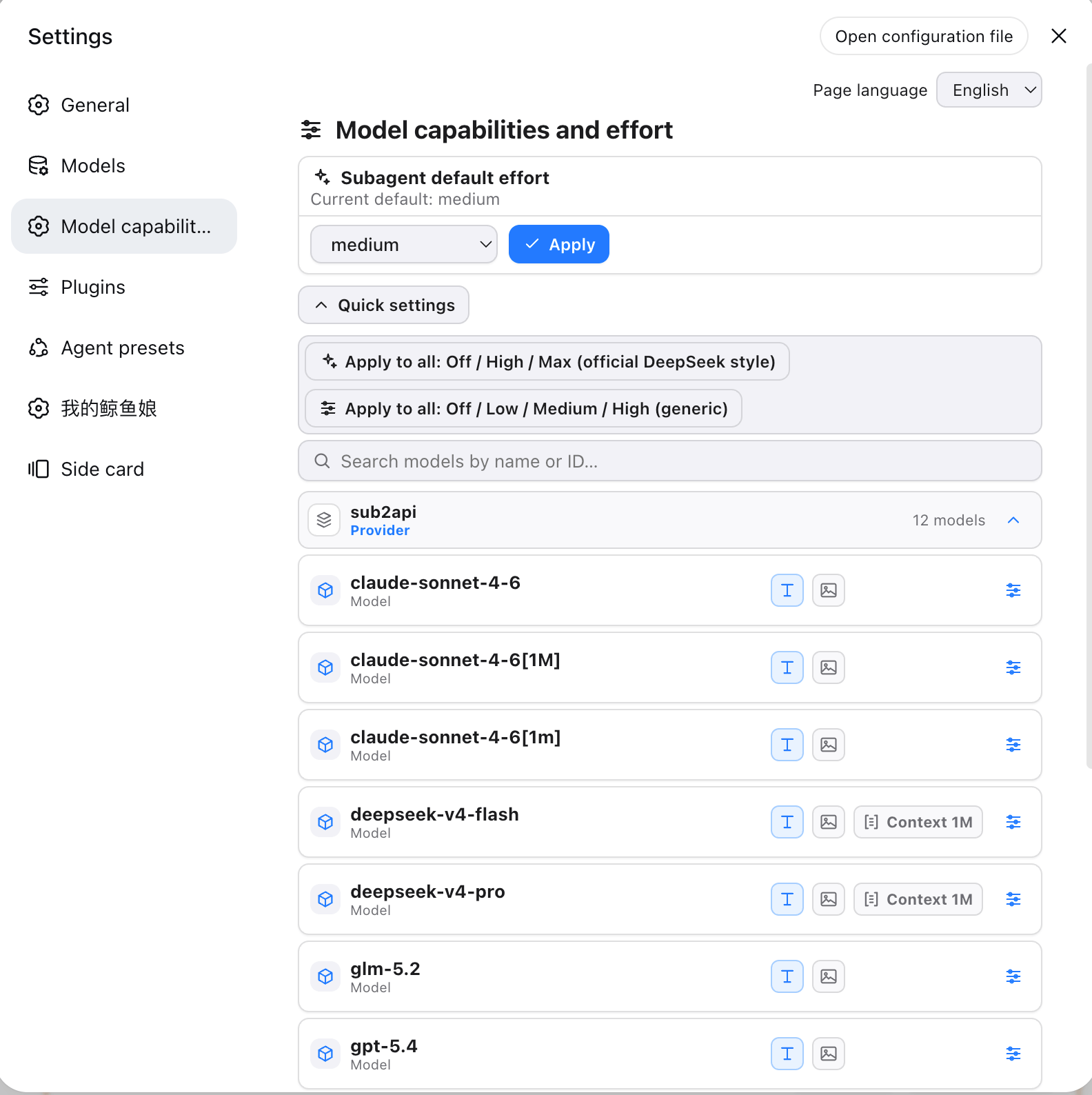
Choose a subagent default from the Subagent default effort card, then click Apply.
-
Use Quick settings to apply the official DeepSeek or generic preset to all models, or expand a provider and model for detailed configuration.
-
Use the search field to filter models by name or ID. Model rows show text/image input capability badges, a context-window badge when declared, and a settings button for per-model editing.
-
Select a reasoning level and enter the exact gateway value. For example:
DSH level Gateway value offLeave empty to omit the parameter highultramaxmax -
Return to Composer and select the model to use its reasoning selector.
The settings page shows the installed version as a small watermark such as v0.1.10 in the bottom-right corner.
Settings page layout
The page header contains the language selector. Below it, the Subagent default effort card controls the default for requests without an explicit effort. The Quick settings controls apply a preset across models. Provider sections can be expanded or collapsed; each model row exposes input capabilities, context length, and a settings control for reasoning levels and gateway values.
How it works
- Host: Scans
llm-pi-aimodelsandmodelOverrideson startup and settings changes, adding defaults only wherereasoningEffortsis missing. - Client: Registers a settings page through the DSH Settings Remote (
ctx.remote.settings) and the official DSH locale service. Chinese, English, Japanese, and Korean dictionaries are maintained separately insrc/locales/zh.json,src/locales/en.json,src/locales/ja.json, andsrc/locales/ko.json, then generated into the client bundle before publishing. - Subagents: Stores the default in the
llm-pi-aiuser layer assubagentEffort. Theagent/requestwaterfall only fills requests that do not already specify an effort. - No configured default: The plugin does not automatically choose
off,high, ormax; the request omitsreasoningand the gateway decides its own default behavior.
Limitations
llm-pi-aiexposes seven standard levels:off,minimal,low,medium,high,xhigh, andmax.- Non-
offlevels require a gateway value. An emptyoffvalue means that the parameter is omitted. - The selected subagent level must be supported by the target model, or the gateway may return
UNSUPPORTED_REASONING_EFFORT. offand an unset effort may both omitreasoning; whether this disables thinking depends on the gateway protocol.- Host changes require a DSH restart. Settings and locale changes are applied in the browser, with a refresh available when needed.