README.md
August 14, 2026 · View on GitHub



Paper · PDF · Project page · Code
ThinkRetrieve makes a reasoning model recall worked examples mid-thought. Instead of only "thinking longer" (which drifts and compounds errors), it pauses at each reasoning step, retrieves the most similar solved example from a bank, and injects it into the thinking trace — guidance on how to reason, not just what facts to use.
It works over any chat API (OpenAI-compatible, Anthropic, Amazon Bedrock, or a local model via Ollama / LM Studio / MLX / llama.cpp) — no GPU or vLLM required.
pip install "thinkretrieve[faiss]"
The local example below requires a running model. With Ollama, download the tutorial model first:
ollama pull qwen3:4b
To verify a cloned repository without downloading a model, dataset, or
embedding encoder, install the core package and run
examples/offline_dummy.py:
git clone https://github.com/itsvaibhav01/ThinkRetrieve.git
cd ThinkRetrieve/thinkretrieve
python -m pip install -e .
python examples/offline_dummy.py
The full tutorial explains local and hosted models, required downloads, small smoke runs, full dataset runs, and troubleshooting.
Quickstart
from thinkretrieve import ThinkRetrieve, FaissRetriever, OpenAICompatBackend

# 1. A bank of solved (question, worked-solution) pairs — a dataset, your docs, past tickets…
bank = FaissRetriever.from_examples([
    ("A jacket costs \$120 and is discounted 25%. Final price?",
     "Discount = 0.25*120 = 30. Final = 120-30 = 90. Answer: \$90"),
    ("What is 15% of 80?", "0.15*80 = 12. Answer: 12"),
])

# 2. Any chat model — local (shown) or hosted.
backend = OpenAICompatBackend(model="qwen3:4b", base_url="http://localhost:11434/v1")

# 3. Reason with mid-thought retrieval.
result = ThinkRetrieve(backend, bank).run(
    "A phone costs \$250 after a 20% discount. What was the original price?")
print(result.answer)          # the final answer
print(result.think_trace)     # full reasoning, with injected examples visible
print(result.retrievals)      # what was retrieved, when, and why
How it works
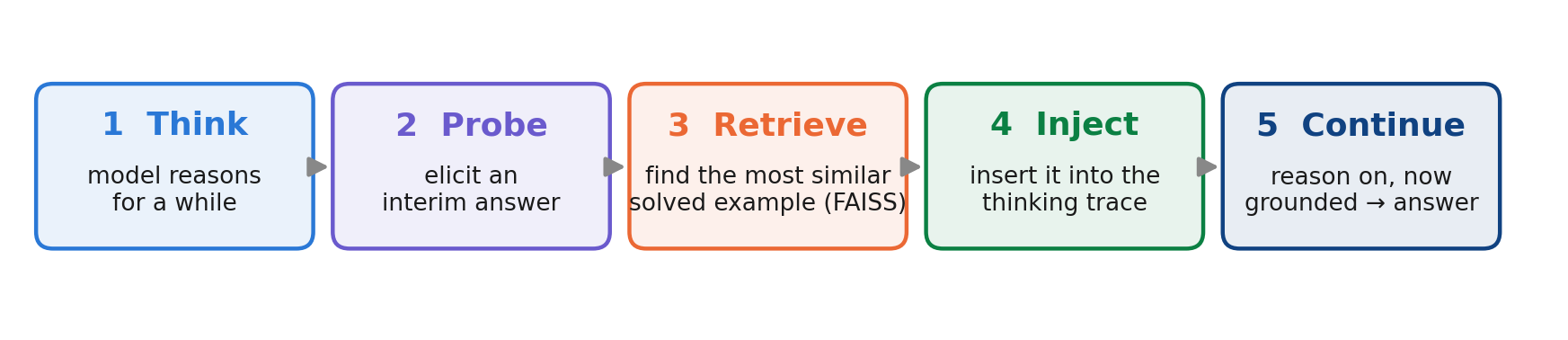
At each reasoning boundary the model elicits an interim answer, retrieves the most
similar solved example (E5 + FAISS by default), injects it into the trace, and
continues — repeating until the thinking budget is spent. Passing
retriever=None gives you the plain "think longer" baseline for A/B comparison.
Results
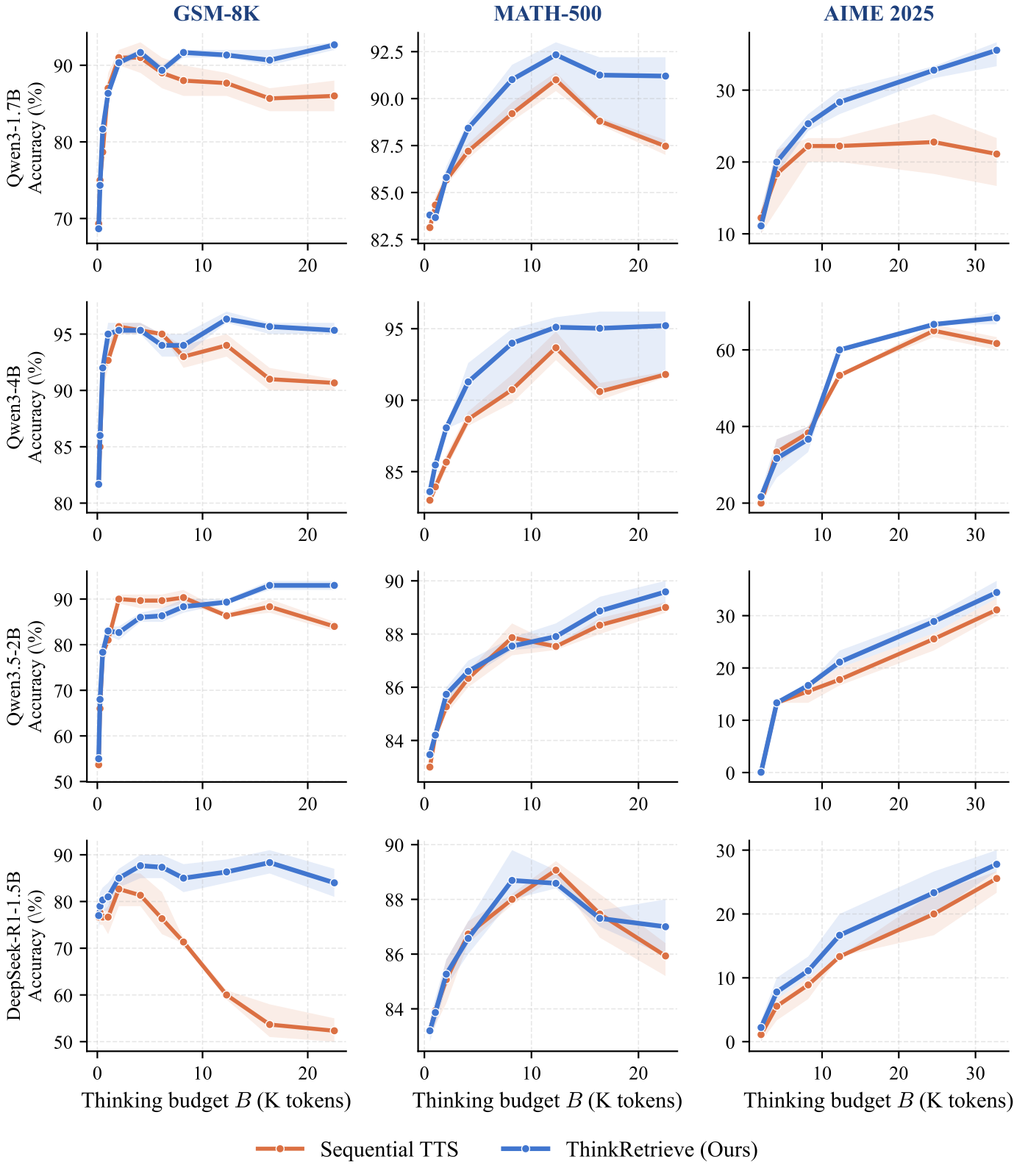
Across 5 reasoning models × 4 benchmarks (paper), ThinkRetrieve beats standard thinking, sequential test-time scaling (TTS), static in-context ICL, and random per-step retrieval on every cell — and, because injected tokens count against the budget but aren't generated, it produces fewer model tokens than TTS at the same budget (~6% wall-clock overhead).
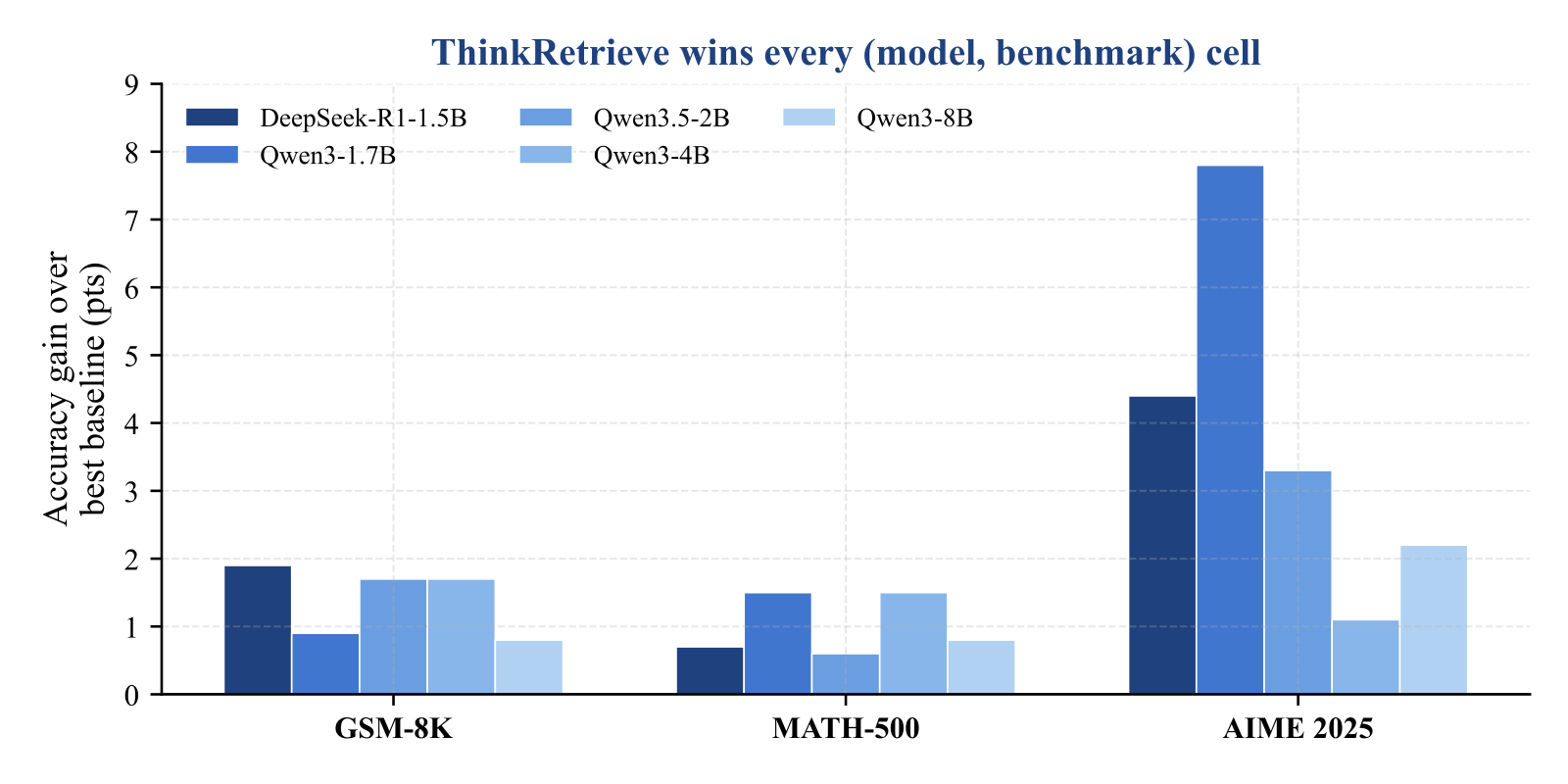
Sequential TTS degrades or plateaus as the budget grows; ThinkRetrieve keeps improving — most dramatically on the hardest benchmark:
| Best accuracy (%) | GSM-8K | MATH-500 | AIME 2025 |
|---|---|---|---|
| TTS / Ours | TTS / Ours | TTS / Ours | |
| Qwen3-1.7B | 90.3 / 92.1 | 91.0 / 92.5 | 22.2 / 35.6 |
| Qwen3-4B | 95.1 / 96.8 | 93.7 / 96.1 | 64.4 / 66.7 |
| Qwen3-8B | 96.4 / 97.2 | 94.0 / 94.8 | 68.9 / 71.1 |
Use cases
1 · Reason over a dataset (math, science QA, …)
Index any dataset with worked solutions and go. See
examples/sciq_example.py for a full SciQ run
(build bank from the train split → answer test questions → score):
python examples/sciq_example.py --limit 30
Ready-made banks: NuminaMath, MetaMathQA, GSM8K, MATH, SciQ — anything with
(question, step-by-step solution) pairs.
2 · Procedural memory for agents
Most agent memory stores facts. A ThinkRetrieve bank stores procedures —
solved tasks — and recalls them mid-reasoning. The bank grows as the agent
works (examples/agent_memory.py):
result = agent.run(task)
if verified(result):            # tests pass / human approves
    memory.add(task, result.answer)   # the agent now remembers HOW
    memory.save("agent_memory")
A measured local example of this pattern is the science diagnosis → tool dispatch case study, including its runner, four controls, raw 4B/9B outputs, and limitations.
3 · Upgrade an existing RAG stack
Prompt-level RAG is ~neutral on reasoning tasks; injecting the same content
inside the trace is what wins (paper §5). Keep your index — wrap it in a 5-line
retriever (examples/rag_integration.py):
from thinkretrieve.types import Example

class MyStore:                              # pgvector / Pinecone / Chroma / …
    def retrieve(self, question, interim_answer="", k=1, exclude_ids=frozenset()):
        hits = my_index.search(f"{question}\n{interim_answer}", k + len(exclude_ids))
        return [Example(id=h.id, question=h.q, solution=h.body)
                for h in hits if h.id not in exclude_ids][:k]

ThinkRetrieve(backend, MyStore()).run(question)
Compare it yourself (one command)
python examples/compare_tts_vs_thinkretrieve.py --backend openai --model qwen3:4b
Runs plain / RAG / long-thinking / ThinkRetrieve at the same budget and prints
the table. Add --backend bedrock --model qwen.qwen3-32b-v1:0 for Amazon Bedrock.
Backends
| Backend | Import | Use for |
|---|---|---|
| OpenAI-compatible | OpenAICompatBackend | Ollama, LM Studio, MLX, llama.cpp, vLLM, OpenAI, Together, Groq, DeepSeek, OpenRouter |
| Anthropic | AnthropicBackend | Claude models (pip install "thinkretrieve[anthropic]") |
| Amazon Bedrock | BedrockConverseBackend | Bedrock models (pip install "thinkretrieve[bedrock]") |
Or subclass ChatTranscriptBackend and implement one _chat() method.
Install options
pip install "thinkretrieve[faiss]"            # core + FAISS retrieval (recommended)
pip install "thinkretrieve[faiss,anthropic]"  # + Anthropic
pip install "thinkretrieve[all]"              # everything
No GPU needed: retrieval runs on CPU / Apple Silicon; generation runs wherever your model lives. Full walkthrough in TUTORIAL.md.
Citation
@article{thinkretrieve2026,
  title  = {ThinkRetrieve: Retrieval-Augmented Reasoning Traces for Test-Time Scaling},
  author = {Singh, Vaibhav and Ghosal, Soumya Suvra and Gharat, Sarvesh and
            Pal, Soumyabrata and Narayanam, Ramasuri and Manocha, Dinesh},
  journal = {arXiv preprint arXiv:2608.10928},
  year   = {2026},
  url    = {https://arxiv.org/abs/2608.10928}
}
License
MIT