LSTM Implementation in Caffe
August 30, 2016 · View on GitHub
Note that the master branch of Caffe supports LSTM now. (Jeff Donahue's implementation has been merged.)
This repo is no longer maintained.
Speed comparison (Titan X, 3-layer LSTM with 2048 units)
Jeff's code is more modularized, whereas this code is optimized for LSTM.
This code computes gradient w.r.t. recurrent weights with a single matrix computation.
- Batch size = 20, Length = 100
| Code | Forward(ms) | Backward(ms) | Total (ms) |
|---|---|---|---|
| This code | 248 | 291 | 539 |
| Jeff's code | 264 | 462 | 726 |
- Batch size = 4, Length = 100
| Code | Forward(ms) | Backward(ms) | Total (ms) |
|---|---|---|---|
| This code | 131 | 118 | 249 |
| Jeff's code | 140 | 290 | 430 |
- Batch size = 20, Length = 20
| Code | Forward(ms) | Backward(ms) | Total (ms) |
|---|---|---|---|
| This code | 49 | 59 | 108 |
| Jeff's code | 52 | 92 | 144 |
- Batch size = 4, Length = 20
| Code | Forward(ms) | Backward(ms) | Total (ms) |
|---|---|---|---|
| This code | 29 | 26 | 55 |
| Jeff's code | 30 | 61 | 91 |
Example
An example code is in /examples/lstm_sequence/.
In this code, LSTM network is trained to generate a predefined sequence without any inputs.
This experiment was introduced by Clockwork RNN.
Four different LSTM networks and shell scripts(.sh) for training are provided.
Each script generates a log file containing the predicted sequence and the true sequence.
You can use plot_result.m to visualize the result.
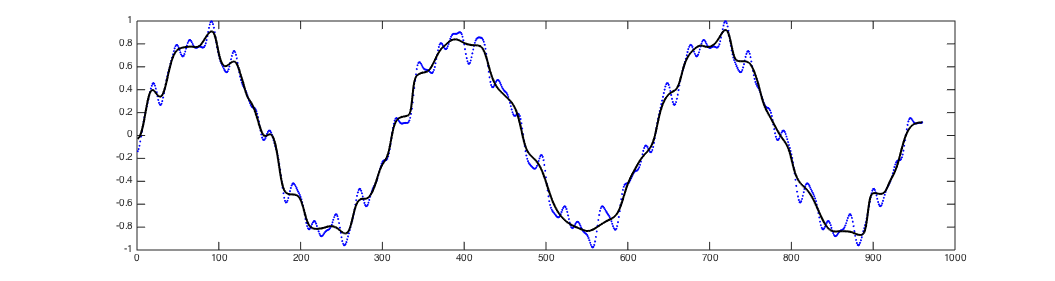
The result of four LSTM networks will be as follows:
- 1-layer LSTM with 15 hidden units for short sequence
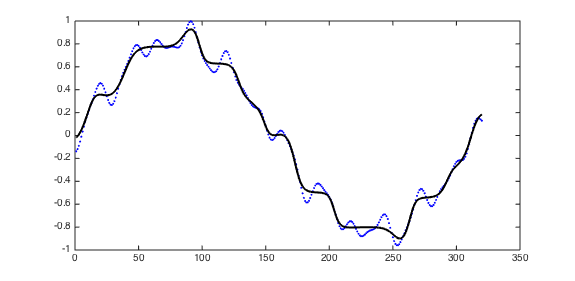
- 1-layer LSTM with 50 hidden units for long sequence
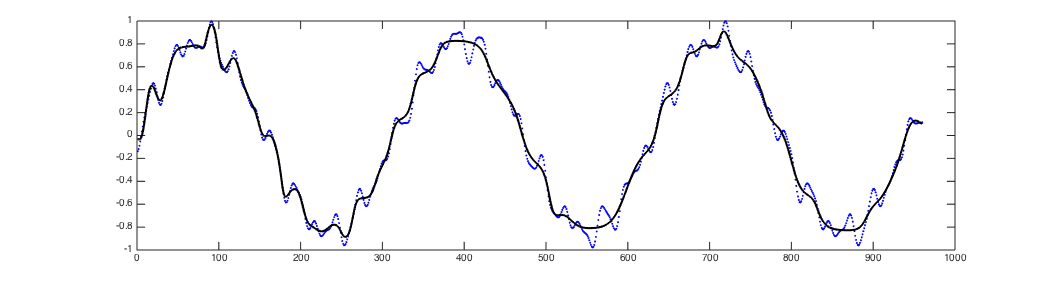
- 3-layer deep LSTM with 7 hidden units for short sequence
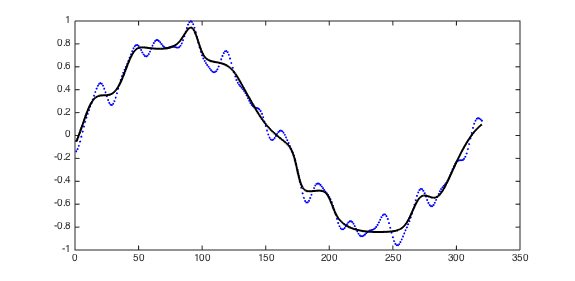
- 3-layer deep LSTM with 23 hidden units for long sequence