Kandy
August 10, 2026 · View on GitHub
A tiny creature that grows as your agents work. It lives in the session top bar and feeds on agent runs, turns, and conversation — evolving forever as real work happens in your kandev instance. The kandy grows through endless procedurally generated forms, scenes, and stage names. It starts as an egg. It never stops.
- Top bar: a small creature portrait next to the session controls, updating live as work lands (no page reload needed).
- Hover or click/tap: the kandy card — its current scene, the creature with idle animations, its stage name, an XP bar, and a mood badge (Happy, Bored, Gloomy, ...).
- Photo Booth: click/tap the kandy, then use the camera icon at the card's top-right to frame its current appearance, habitat and time of day, stage name, level, mood, and bond as a polished portrait. Copy the crisp PNG directly to your clipboard. Rendering and copying happen entirely in your browser — nothing is uploaded, and no surrounding task or app UI enters the image. On plain-HTTP deployments, Kandy uses the browser's native image-copy path when available.
- Token Grotto: ask Kandy to show its grotto and it walks off the card, then walks back in along the water into an underground hub. Each agent CLI/adapter has a chamber; each model used through that adapter has a pile of stones on the chamber floor. Larger piles mean more observed tokens. Hover, focus, or tap a pile for its exact lifetime count. A chamber floor holds ten piles: the biggest and the most recently used models get a spot, and anything left over is merged into one pile that opens into a list.
- Moods: it celebrates when XP lands and gets bored, sad, and eventually gloomy (rain cloud included) when nothing ships for days.
- Care: left-click drops it a treat; right-click dumps a bucket of cold water on it. Neither ever feeds it — only real work does — but it remembers how you treat it, and how you treat it shapes how it grows up. A row of bond hearts on the card shows how much it trusts you — and a heart can crack in a way that never quite heals. Affection also fades if you stop visiting: a neglected bond drifts back to neutral, though it never sours into distrust. Be kind. Or don't, and live with what you raise.
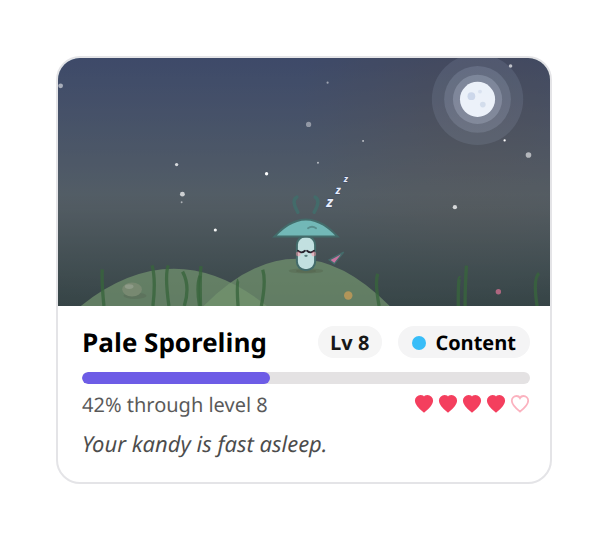
- Day and night: scenes follow your local clock, and every kandy has its own bedtime — at night it sleeps in the top bar, and waking it is on your conscience.
- Seasons: the scene follows the calendar too — snow drifts in winter, petals in spring, fireflies on summer nights, falling leaves in autumn.
- It talks: a speech bubble occasionally appears while the card is open — dry, deadpan, and shaped by how it's been treated. A beloved kandy is warm; a wary one is passive-aggressive; a fearful one is quiet and a little heartbreaking. It greets you when you open its card, notices when you've been gone a while, has opinions about 2am deploys, and occasionally talks in its sleep.
- The cycle: level 100 is the top of the arc, and your kandy rests there — fully grown, in its final form, for a whole level's worth of work. What happens when it finally outgrows even that is the one thing this README will not tell you. It takes about two and a half years to find out, and nothing is lost when you do.
- How XP works: it's a secret. The recipe lives server-side and the UI is never told the breakdown — your kandy simply reacts to how much real work flows through the instance.
Screenshots
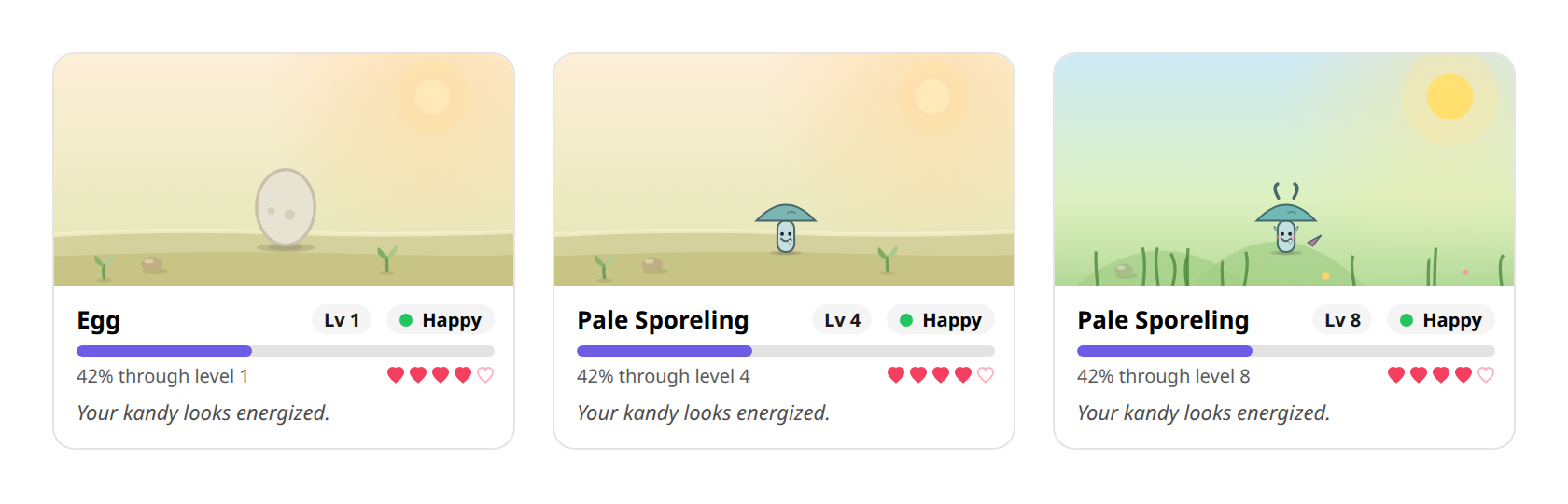
The first week — an egg hatches and starts to grow:
At night, it sleeps:
What it grows into — the species your install rolls, the places it lives, what it looks like months from now, and what waits at the end of the arc — is yours to find out. Ship and see.
Install
Build a package (make package-host for your platform, make package for
all platforms) and install the tarball via Settings > Plugins > Install
or POST /api/plugins/install.
How it works and what it reads
Kandy is a visual, instance-wide companion. It does not call an agent, read a conversation, or analyze work. Kandev sends it three activity notifications for private XP bookkeeping:
- a message was added;
- an agent turn completed; or
- an agent run completed.
For those three notifications, Kandy still uses only the event type. The XP recipe and activity counters remain private and unchanged.
Kandev also sends the typed per-session
session_prompt_usage.updated.* event. Kandy reads only this aggregate usage
metadata:
- source timestamp, transiently for canonical duplicate suppression;
- task/session/lifecycle agent IDs, transiently and only to construct a duplicate-suppression key;
- agent type (the CLI/adapter slug, such as
claude-acporcodex-acp); - observed model name; and
- input, output, cache-read, cache-write, thought, and total token integers,
plus the whole-record
estimatedflag.
Kandy prefers a positive observed total_tokens (which some adapters or
Kandev may infer). When total is missing or zero, it uses positive input plus
output only; Kandy itself never adds cache or thought tokens on top of a
reported total. Fallback, estimated, malformed, missing, or otherwise unusable
usage marks the grotto partial without storing the rejected payload. Missing
agent/model names enter explicit Mystery buckets. Chambers identify the agent
CLI/adapter, not necessarily the model provider, configured profile, person,
or agent run. Kandev v0.83.0 exposes no authoritative provider field on this
typed event, so provider breakdown is unavailable. Aliases and renamed models
remain separate piles.
Chambers are not directly comparable across agents. Whether the upstream
total_tokens folds in cache read/write tokens is decided by each agent
adapter before Kandev ever publishes the event, and it is not uniform: some
adapters report a total that already includes cache tokens, others report
cache-excluded totals or omit cache fields entirely, and at least one adapter
has no per-turn usage frame at all and emits an estimated cumulative
occupancy-delta approximation instead. Kandy has no adapter-agnostic signal to
normalize this, so it stores and displays whatever total each event reports
verbatim, and the grotto UI calls this out rather than implying the totals
share a unit.
The task/session/lifecycle IDs, source timestamps, and usage categories are never persisted, logged, or returned to the browser. Only a SHA-256 digest of the typed, normalized aggregate body survives for practical duplicate suppression; delivery EventID and OccurredAt are excluded, so transport retries with the same body hash identically. Kandy never reads or stores message text, prompts, responses, reasoning, tool calls, files, credentials, or provider-reported cost. The top-bar UI listens for session updates only to know when to refetch Kandy's own webhook. One Kandy and one grotto are shared by the whole Kandev instance, rather than being tied to a person, task, agent, or session.
The plugin stores two instance-scoped aggregate ledgers in Kandev Host state.
The existing creature ledger keeps XP/activity counts, timestamps, appearance
seed, and care temperament. The separate kandy-token-grotto ledger keeps the
Kandy lineage, observation boundary, exact decimal-string lifetime total, one
counter per distinct agent type/model pair, a monotonic per-model recency
ordinal used only for floor presentation, a partial-data flag, and the most
recent 512 duplicate-suppression keys. The ordinal contains no source time and
does not represent per-turn history. Repeated usage updates existing counters;
no per-turn history is stored. Storage therefore grows with genuinely distinct
adapter/model pairs, not event count; distinct aggregates have no artificial
cap because each chamber is part of Kandy's history.
Both ledgers use domain-separated HMAC-SHA256 signatures backed by one key in kandev's encrypted secrets vault. Grotto corruption restarts only token history; it cannot counterfeit or rebirth Kandy. The browser UI uses the local clock only for day/night and sleep, and calls only Kandy's Kandev-hosted webhooks; it has no external service or analytics integration.
Kandy does not use, request, or spend LLM tokens. It observes aggregate usage reported by existing agent work and adds no model calls. Token count is not price, billing history, quota, or cost; Kandy ignores monetary fields and never estimates a price.
Token-Grotto boundary and lifecycle
“Tokens in this grotto” means valid usage events Kandy caught after grotto observation began. The boundary starts when the first valid event is observed; rejected usage can mark the history partial but cannot start that boundary. There is no supported usage reader or cursor for backfill or reconciliation in Kandev v0.83.0, so the first iteration is deliberately best effort. Events can be missed while the plugin is disabled, restarting, overloaded, or when an agent reports no usable usage. Missing or unusable usage marks the history partial. Delivery retries with the same normalized body are suppressed within the most recent 512 keys, including across plugin restarts; changed delivery IDs do not turn an identical body into a second observation. A replay older than that rolling window can count again. The grotto says “observed” and never claims complete billing or lifetime history before its displayed start date.
Host state participates in Kandev database backup/restore and survives plugin restart and upgrade. Disabling preserves captured history but misses events. There is no dedicated grotto export/reset UI in this iteration. A new Kandy lineage starts an empty grotto; rollback ignores the separate state; re-upgrade resumes it when lineage still matches. Uninstall removes the Kandy and ends its grotto history.
Development
Developed against a local checkout of the kandev monorepo (see the
replace directive in go.mod).
make test        # Go unit tests + dependency-free UI render/clipboard tests
make fmt vet     # gofmt + go vet
make package-host
Automation and releases
Pull requests to master run separate verification and packaging workflows.
They check module tidiness, formatting, go vet, tests, a host build, and a
cross-platform package build. Pushing a v* tag verifies the plugin, builds
the all-platform package, and publishes a GitHub Release with the package and
its checksums.txt asset.
State
Two aggregate JSON ledgers in kandev Host state (scope instance) participate
in kandev backups, survive plugin upgrades, and are removed on uninstall.
Uninstalling the plugin is, in the kindest possible terms, the end of that
kandy's story and its Token Grotto.