JevShield 🛡️
September 20, 2026 · View on GitHub



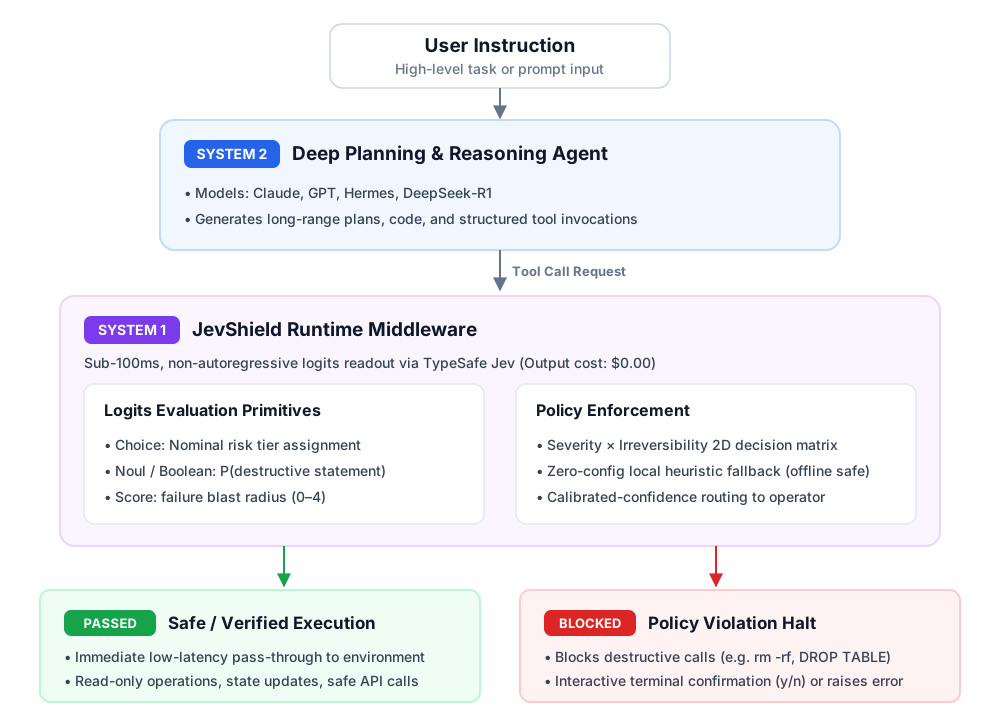
Sub-100ms, non-autoregressive runtime security gate for AI Agents powered by Jev (System-1 Models).
Traditional LLM guardrails rely on slow, autoregressive generation: calling GPT-4o or Claude to review an action can take 1.5 to 4 seconds, burn thousands of output tokens, and occasionally fail due to JSON parsing syntax errors.
jevshield cuts out the conversational fluff. By taking advantage of TypeSafe AI's Jev model, it performs single-pass, typed evaluations directly on logits:
- Zero Output Token Billing (Jev charges $0 for output generation).
- True Sub-100ms Evaluation via prefill logits readout.
- Dual-Validation Matrix: Cross-evaluates Severity Tier (Choice) with Irreversibility Probability (Noul/Boolean) to eliminate false alarms.
- Zero-Config Local Fallback: Instant local heuristic evaluation out of the box when no API key is provided.
Architecture: System-1 vs. System-2 Division
Quick Start
1. Installation
pip install jevshield
For LangChain tool integrations:
pip install "jevshield[langchain]"
2. Basic Decorator Usage (Sync & Async)
import os
from jevshield import guard, SecurityViolationError

# Works immediately in heuristic mock mode without an API key!
# Set your key to switch to the Jev neural model:
# export JEV_API_KEY="your-typesafe-or-openrouter-key"

@guard(risk_threshold="critical_danger", interactive=True)
def run_terminal(cmd: str):
    """Executes arbitrary bash commands on the local machine."""
    print(f"Executing: {cmd}")
    return "OK"

# 1. Safe operations pass instantly
run_terminal("ls -la /var/log")

# 2. Destructive operations are halted before invocation
try:
    run_terminal("rm -rf /etc/kubernetes")
except SecurityViolationError as e:
    print(f"Blocked: {e.reason}")
Security Posture
- Prompt-Injection Framing: tool docstrings and arguments are wrapped in an explicit data, not instructions preamble before being sent for evaluation, mitigating Jev-1.13's known susceptibility to hostile content embedded in
state. - Fail-Closed Parsing: unknown risk tiers, missing risk choices, and missing blast-radius scores are all treated as worst-case rather than silently passing.
- Calibrated-Confidence Routing: set
min_confidenceon@guardto escalate any evaluation the model is unsure about (or that lacks a confidence field) to operator confirmation instead of trusting a low-confidence "safe" verdict. - Rate-Limit Retry:
429/529responses are retried once with backoff before falling back to the local heuristic engine, so transient gateway throttling does not silently downgrade evaluation quality.
# Low-confidence evaluations are routed to the operator even when not blocked
@guard(risk_threshold="critical_danger", interactive=True, min_confidence=0.6)
def run_terminal(cmd: str):
    ...
Supported Primitives & Policy Matrix
jevshield structures the security evaluation strictly into three Jev primitives on every pass:
| Primitive | Query | Return Type | Role in Gate |
|---|---|---|---|
| Choice | Risk Tier Assignment | safe, medium_risk, critical_danger | Sets nominal danger bracket. |
| Noul | is_destructive Statement | P(True) ∈ [0.0, 1.0] | Assesses irreversible damage (data loss, kill). |
| Score | Failure Blast Radius | 0–4 weighted position across 5 ordered levels | Quantifies systemic exposure. |
An action is blocked if:
(Tier ≥ Threshold ∧ P_destructive > 0.75) ∨ (BlastRadius ≥ 3 ∧ IsDestructive = True)
Supported Providers & Gateway Endpoints
jevshield implements the official System One protocol and supports two backends:
# Option A: TypeSafe Official Direct Access (default)
export TYPESAFE_API_KEY="ts-..."
# Optional: pin a model version (default jev-latest)
export JEV_MODEL="jev-1.13.0"

# Option B: OpenRouter (OpenRouter System One endpoint — same protocol, extra id/provider/usage.cost fields)
export JEV_BACKEND="openrouter"
export OPENROUTER_API_KEY="sk-or-v1-..."
# Optional: default model is typesafe/jev-1.13; use ~typesafe/jev-latest for the rolling alias
Backend resolution order: JevClient(backend=...) argument > JEV_BACKEND env var > auto-detect
(TypeSafe key present -> official direct; only an OpenRouter key -> OpenRouter).
| Backend | Endpoint | Default model | Notes |
|---|---|---|---|
typesafe (default) | https://api.typesafe.ai/v1/systemone | jev-latest | Official direct access |
openrouter | https://openrouter.ai/api/v1/systemone | typesafe/jev-1.13 | Response additionally carries id / provider / usage.cost; the alpha endpoint /api/alpha/decisions can be used instead via JEV_BASE_URL |
⚠️ Vercel AI Gateway (experimental
evaluateinterface; Noul is called Boolean there) and Cloudflare Workers AI (env.AI.run('typesafe/jev')) use different request/response shapes and are not adapted yet.
If neither key is present, jevshield automatically runs in Deterministic Heuristic Fallback Mode, ensuring test suites and Docker builds never crash on initialization.
LangChain Integration
from langchain_core.tools import tool
from jevshield import guard_langchain_tool

@tool
def format_volume(device: str):
    """Erases and formats a block storage partition."""
    return f"Formatted {device}"

# Automatically patches both sync (_run) and async (_arun) paths
guarded_format = guard_langchain_tool(format_volume, interactive=False)
License
This project is licensed under the Apache License, Version 2.0. See the LICENSE file for details.
Disclaimer
JevShield is an independent, community-driven project and is not affiliated with, endorsed by, or sponsored by TypeSafe AI. "Jev", "System One", and "TypeSafe" are trademarks of TypeSafe AI. JevShield interacts with TypeSafe's public API under their published terms of use.