Deform360: A Massive Multi-view Visuotactile Dataset for Deformable World Models
July 19, 2026 · View on GitHub
Deform360: A Massive Multi-view Visuotactile Dataset for Deformable World Models
Hongyu Li¹ ², Wanjia Fu¹, Xiaoyan Cong¹, Zekun Li¹, Binghao Huang², Hanxiao Jiang², Xintong He¹, Yiqing Liang¹, Rao Fu¹, Tao Lu¹, Srinath Sridhar¹, Kevin A. Smith³, George Konidaris¹, Yunzhu Li²
¹ Brown University ² Columbia University ³ MIT
Project Page | Dataset | Paper
Accepted to ECCV 2026
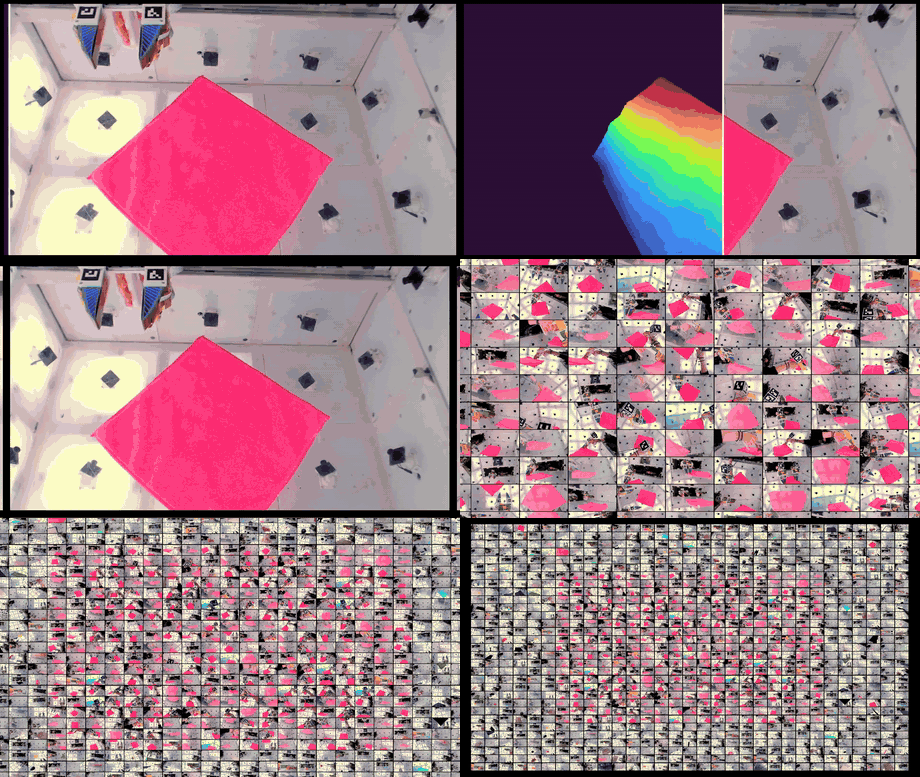
Deform360 is a massive multi-view visuotactile dataset for deformable-object research, captured in the BRICS dome at Brown University. The full collection described by the paper has:
- 198 everyday deformable objects across 13 categories
- 1,980 robotic interactions · 215.7 hours · ~23.3M frames
- 41 synchronized 720p RGB cameras with 360° coverage
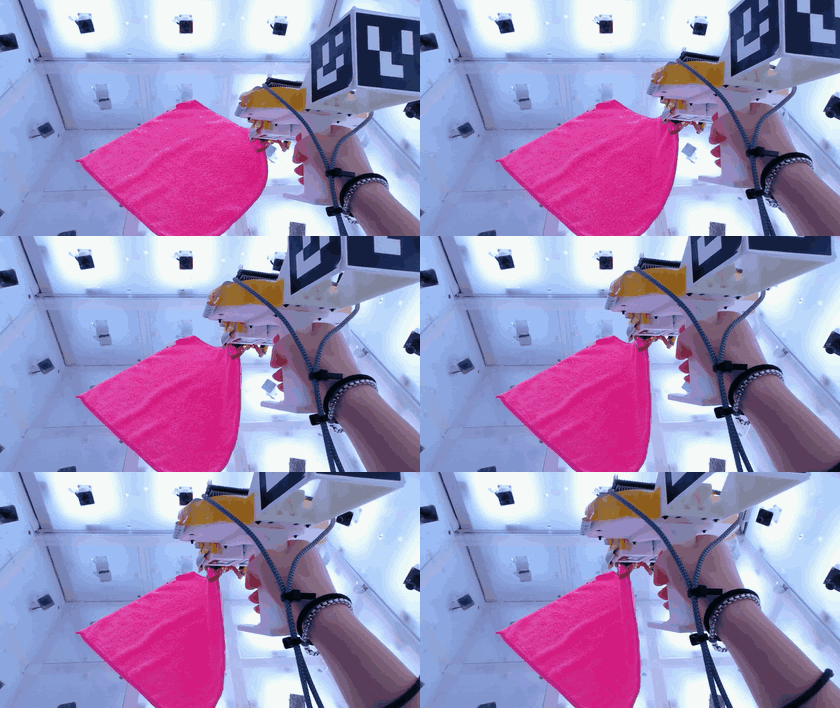
- Bimanual UMI-based tactile grippers with four 16×32 sensor streams
This repository contains dataset access, preprocessing, annotation processing, and multimodal alignment utilities. World-model baselines, training code, and pretrained world-model checkpoints are not released.
Annotation contracts are producer-agnostic: the core package defines their
file formats and model-independent transforms without heavy dependencies.
The optional [processing] extra adds the model-backed stages
(deform360-annotate) that produce those annotations from raw data,
covering the full annotation pipeline: SAM3 masks, ArUco robot poses, URDF gripper masks, Splatfacto reconstruction, rendered depth, CoTracker tracking, cleaned point clouds, and PhysTwin control-point inputs.
Table of Contents
- Installation
- Download Data
- Camera Undistortion and Alignment
- Tactile Processing and Alignment
- Load Aligned Data
- Annotation Processing
- Annotation and Geometry Utilities
- Data Conventions
- Repository Layout
- Release Scope
- Acknowledgments
- Citation
Installation
Python 3.10 or newer is required.
git clone https://github.com/lhy0807/deform360.git
cd deform360

uv venv --python 3.10
source .venv/bin/activate
uv pip install -e .
The core install includes NumPy, OpenCV contrib, and the Hugging Face client. Install all optional readers for HDF5 annotations, binary PLY files, and faster video access with:
uv pip install -e ".[all]"
Individual extras are annotations (h5py), reconstruction (plyfile), and
fast-video (decord). Heavy learning frameworks are not package dependencies.
The model-backed annotation stages need the heavy processing extra plus two
git-pinned model packages:
uv pip install -e ".[processing]"
uv pip install -r requirements-processing.txt
This adds the deform360-annotate command. The robot, pcd, and
control-points stages run on CPU; all other annotation stages require a
CUDA GPU. gsplat compiles its CUDA kernels on first use, so a CUDA
toolkit (nvcc) matching your torch build must be available (set
CUDA_HOME); ninja is installed with the extra.
Installation exposes four independent commands: deform360-download,
deform360-undistort, deform360-process-tactile, and deform360-annotate
(whose stages additionally require the [processing] dependencies). The
files in scripts/ are thin source-tree wrappers around the first three
entry points.
Download Data
The dataset is hosted at brownu/deform360.
The public snapshot may be staged independently of the paper totals: the downloader
uses the object directories currently present under raw/, and --all means every
object currently hosted. Processed annotations are not assumed to be present.
deform360-download \
    --objects 001-rope 008-pink-cloth \
    --output-dir /mnt/data/deform360_data
| Flag | Description |
|---|---|
--objects <names...> | Objects to fetch; defaults to 001-rope 008-pink-cloth. |
--all | Download every object currently hosted. |
--output-dir <dir> | Local dataset root. |
--include-audio | Also fetch tactile WAV/FLAC files; off by default. |
--workers <n> | Parallel download workers. |
Tactile WAV files are not needed when the exact raw .npy, timestamp, and median
sidecars are present. A raw object has this layout:
raw/001-rope/
├── metadata.json
├── calibration_refined/
│   ├── intrinsics.npy              # camera -> (3,3) K
│   ├── extrinsics.npy              # camera -> (4,4) camera-to-world
│   └── dist.npy                    # camera -> [k1,k2,p1,p2]
├── brics-odroid-001_cam0/
│   ├── <camera>_<time>.mp4          # one recording per episode
│   └── <camera>_<time>.txt          # per-frame Unix-microsecond timestamps
├── ...
└── brics-odroid_tactilel_left/
    ├── <sensor>_<time>.npy          # headerless float32 (T,16,32)
    ├── <sensor>_<time>.txt          # per-sample timestamps
    └── median_<time>.npy            # standard NumPy (16,32) baseline
Data and timestamp files are paired by exact stem. This avoids silently pairing independently sorted files from different recordings.
The released calibration files are NumPy dictionaries and therefore use NumPy's pickle-backed container. Load only the official Deform360 calibration files or files from another source you trust.
Camera Undistortion and Alignment
Each camera is independently clocked. The alignment stage chooses the calibrated camera with the fewest frames as its anchor, selects the nearest frame in every other camera, and rectifies images with the shipped calibration.
Raw captures contain 41 camera-stream directories, while the shipped refined calibration currently covers 36 streams. By default the CLI processes the intersection and leaves raw streams without calibration untouched.
deform360-undistort \
    --object-dir /mnt/data/deform360_data/raw/001-rope \
    --output-dir /mnt/data/deform360_data/processed/001-rope
| Flag | Description |
|---|---|
--episodes <ints...> | Episode indices; defaults to all. |
--cameras <names...> | Camera subset; defaults to all calibrated streams. |
--tolerance-us <n> | Flag nearest matches beyond this delta; default 100000. |
--no-overwrite | Validate and reuse existing camera videos. |
--rebuild-timeline | Recompute the anchor explicitly; requires every existing camera and no downstream artifacts. |
Output per episode:
processed/001-rope/episode_0000/
├── alignment.json                   # episode timeline and anchor metadata
├── undistorted_intrinsics.npy       # camera -> rectified K
├── extrinsics.npy                   # camera -> camera-to-world
├── brics-odroid-001_cam0/
│   ├── undistorted.mp4
│   ├── undistorted_000000.png
│   ├── aligned_timestamps.txt
│   ├── alignment.json               # source frame/time/delta for every output
│   └── metadata.json                # input/calibration/output fingerprints
└── ...
The processor rejects truncated videos and mismatched resume outputs rather than
writing a video, timestamp file, and calibration with different lengths.
--no-overwrite verifies hashes for the raw video/timestamps, calibration, encoded
video, preview, aligned timestamps, and manifest before reusing an output.
The first successful camera run locks the episode timeline. Adding another camera
later aligns it to that stored timeline instead of silently changing every frame
index. Use --rebuild-timeline only when intentionally changing the anchor; it
requires all existing cameras and is refused after tactile, robot, reconstruction,
or HDF5 annotations exist because those artifacts already depend on frame indices.
Tactile Processing and Alignment
Run tactile processing after camera alignment. It is a standalone stage and uses the camera timeline already stored in the episode.
deform360-process-tactile \
    --object-dir /mnt/data/deform360_data/raw/001-rope \
    --aligned-dir /mnt/data/deform360_data/processed/001-rope \
    --episodes 0 1
For each named tactile sensor, the default legacy-compatible transform is:
- Decode headerless float32 frames as
(T,16,32). - Subtract the sensor's
(16,32)median baseline. - Divide positive values by the episode-wide positive maximum.
- Set normalized values below
0.3to zero, then clear column 31. - Select the nearest tactile sample for every camera timestamp.
Duplicate raw timestamps use their last sample, matching the original processing.
The default 150 ms tolerance flags timing quality without changing nearest-neighbor
output; choose --out-of-tolerance drop or raise for stricter behavior.
episode_0000/
└── brics-odroid_tactilel_left/
    ├── synced_tactile.npy            # float32 (T,16,32)
    ├── alignment.json                # selected source index/time/delta
    └── metadata.json                 # normalization scale and data contract
Values are unitless peak-relative responses, not calibrated forces. Sensor names
are preserved without assigning ambiguous left/right robot semantics. Exact
processing requires raw .npy, timestamp, and median sidecars; WAV-only objects
fail with an actionable error instead of synthesizing approximate alignment.
The cleaned implementation was checked against all 80 existing tactile outputs
for 001-rope and 008-pink-cloth; every array matched bit-for-bit.
Load Aligned Data
MultiViewDataset returns synchronized RGB frames, calibration, and the common
timestamp. It is compatible with the Dataset protocol but does not require PyTorch.
from deform360 import MultiViewDataset

episode = "/mnt/data/deform360_data/processed/001-rope/episode_0000"
with MultiViewDataset(episode) as dataset:
    sample = dataset[0]

sample["images"]         # list[(H,W,3) uint8 RGB]
sample["intrinsics"]     # list[(3,3)]
sample["extrinsics"]     # list[(4,4) camera-to-world]
sample["cameras"]        # camera names
sample["timestamp_us"]   # shared Unix timestamp in microseconds
When camera provenance files are present, the loader verifies the episode timeline,
video/timestamp fingerprints, and per-camera calibration automatically. Pass
strict_provenance=True to require these files, or False only for a trusted
legacy episode that predates them.
Load all synchronized tactile grids at the same frame index with:
from deform360 import TactileDataset

with TactileDataset(episode) as tactile:
    frame = tactile[0]        # sensor name -> (16,32) float32
The tactile loader validates each sensor's timeline metadata and output fingerprint
by default. Use strict_provenance=False only for a trusted legacy output that
predates these manifests.
Runnable examples:
episode=/mnt/data/deform360_data/processed/001-rope/episode_0000
python examples/load_multiview.py --episode-dir "$episode" --frame 0 --save view.png
python examples/load_tactile.py --episode-dir "$episode" --frame 0
python examples/read_annotations.py \
    --camera-dir "$episode/brics-odroid-001_cam0" --frame 0
Annotation Processing
deform360-annotate <stage> produces the model-backed annotations from an
aligned episode. Stages are independent commands, run per object in the
documented order after deform360-undistort (and deform360-process-tactile
where tactile is used). All eight stages are released: masks, robot, gripper-masks, reconstruct, depth, tracking, pcd, and control-points — run in that order.
Object masks (masks)
Segments every camera's undistorted.mp4 with a SAM3 text prompt and writes
the documented mask_refined.h5 contract ((T,H,W) uint8 binary, one mask per
aligned frame; frames where nothing is found are zero).
deform360-annotate masks \
    --aligned-dir /mnt/data/deform360_data/processed/001-rope \
    --object-dir /mnt/data/deform360_data/raw/001-rope \
    --episodes 0
| Flag | Description |
|---|---|
--prompt <text> | Object text prompt; defaults to sam_prompt from the raw object's metadata.json (via --object-dir). |
--cameras <names...> | Camera subset; defaults to all cameras in the episode. |
--no-preview | Skip the segmented/ preview video and RGBA first frame. |
--no-overwrite | Keep existing outputs whose provenance fingerprints match. |
If the text prompt finds nothing on the first frame and GOOGLE_API_KEY is
set, the stage asks Gemini for a first-frame bounding box and re-prompts SAM3;
without the key it fails with an actionable error instead.
Each stage writes a <output-stem>.meta.json provenance manifest (schema
deform360.processing/<stage>/v1) recording input/output SHA-256
fingerprints, stage parameters, and the model identity. --no-overwrite
reuses outputs only when these fingerprints match.
Robot/gripper poses (robot)
Recovers per-frame gripper poses from multi-view ArUco detections — RANSAC
consensus across cameras and markers, velocity-outlier suppression,
interpolation onto the aligned timeline, and pose smoothing (no bundle
adjustment) — and writes the safe robot/robot.npz contract plus an
opening_dists.png diagnostic. This stage runs on CPU.
deform360-annotate robot \
    --aligned-dir /mnt/data/deform360_data/processed/001-rope \
    --object-dir /mnt/data/deform360_data/raw/001-rope \
    --episodes 0
| Flag | Description |
|---|---|
--bimanual | Force two-gripper processing; defaults to metadata.json sequences[<ep>].bimanual (via --object-dir), else monomanual. |
--seed <n> | RANSAC seed for deterministic reruns; recorded in the manifest. |
--no-plot | Skip the opening_dists.png diagnostic. |
--cameras <names...> | Camera subset; defaults to all cameras in the episode. |
Gripper masks (gripper-masks)
Renders the shipped UMI gripper URDF at each frame's robot pose into every
camera, writing per-camera rendered_urdf.h5 ((T,H,W) bool) silhouettes.
The depth stage uses these to exclude gripper pixels from the object depth.
Requires robot.npz and
an EGL-capable GPU (pyrender offscreen).
deform360-annotate gripper-masks \
    --aligned-dir /mnt/data/deform360_data/processed/001-rope \
    --episodes 0
| Flag | Description |
|---|---|
--urdf <path> | Alternative gripper URDF (default: the shipped umi.urdf). |
--cameras <names...> | Camera subset; defaults to all cameras in the episode. |
Reconstruction (reconstruct)
Fits one Gaussian splat per aligned frame with nerfstudio Splatfacto,
writing the documented splatfacto/splat_<frame>.ply contract. Frame 0 is
seeded from a visual hull carved out of the object masks; every later frame
warm-starts from the previous frame's splat. Temporary per-frame nerfstudio
datasets live in a scratch directory inside splatfacto/ and are removed
after each frame. This is by far the slowest stage (GPU training per frame).
deform360-annotate reconstruct \
    --aligned-dir /mnt/data/deform360_data/processed/001-rope \
    --episodes 0
| Flag | Description |
|---|---|
--first-frame-iterations <n> | Training iterations for the hull-seeded first frame (default 10000). |
--warm-start-iterations <n> | Iterations for warm-started frames (default 5000). |
--cube-half-extent-m <f> | Visual-hull cube half-extent in metres (default 0.5). |
--voxel-resolution <n> | Hull voxels per axis (default 100). |
--keep-scratch | Keep per-frame scratch datasets for debugging. |
With --no-overwrite, existing splat_<i>.ply files are kept and only
missing frames are trained (warm-started from their predecessor).
Rendered depth (depth)
Rasterizes each frame's splat into every camera with gsplat's expected-depth
mode and writes the per-camera rendered_depth.h5 contract ((T,H,W) uint16
millimetres, 0 invalid). Depth is zeroed outside the object mask; when
rendered_urdf.h5 exists, gripper pixels are excluded from the object mask
first (run gripper-masks beforehand, or the stage warns and proceeds).
deform360-annotate depth \
    --aligned-dir /mnt/data/deform360_data/processed/001-rope \
    --episodes 0
| Flag | Description |
|---|---|
--no-preview | Skip the rendered_depth.mp4 colormap preview. |
--cameras <names...> | Camera subset; defaults to all cameras in the episode. |
Dense tracking (tracking)
Tracks the object with CoTracker3 in mask-cropped windows and lifts the
tracks through the rendered depth into per-pixel world-frame velocities,
writing the per-camera tracking/vel.h5 ((T,H,W,3) float16 m/s) and
tracking/visibility.h5 ((T,H,W) bool) contracts. The last 5 frames of an
episode have no velocity (the 5-frame lookahead gap).
deform360-annotate tracking \
    --aligned-dir /mnt/data/deform360_data/processed/001-rope \
    --episodes 0
| Flag | Description |
|---|---|
--checkpoint <path> | Local CoTracker checkpoint; defaults to downloading CoTracker3 offline via torch.hub. |
--cameras <names...> | Camera subset; defaults to all cameras in the episode. |
Cleaned point clouds (pcd)
Seeds a fixed point set from the frame-0 splat (cube crop, farthest-point
sampling to 10000, radius and statistical outlier removal), fuses per-camera
tracking velocities onto it, and advects it through the episode, writing
pcd_clean/<frame>.npz (pts, colors, vels, camera_indices,
visibility_matrix). Runs on CPU. The last 5 frames are skipped (no
velocity lookahead).
| Flag | Description |
|---|---|
--rng-seed <n> | Seed recorded in the manifest for the sampling step. |
Control points (control-points)
Derives PhysTwin-format inputs: per-frame gripper controller points (768
URDF taxels per gripper posed at the recovered robot state), the
tactile-contact frame window, an 80/20 train/test split.json,
start_obj_pcd.ply, and the write-only interchange pickles
calibrate.pkl/final_data.pkl expected by PhysTwin (this release never
loads them back). Runs on CPU.
Annotation and Geometry Utilities
Install .[annotations] to read or write HDF5 arrays. All HDF5 files store one
dataset at key data.
| Dataset artifact | Contract | Public utilities |
|---|---|---|
| Object masks | mask_refined.h5: (T,H,W) bool/uint8 binary | validation and HDF5 I/O |
| Metric depth | rendered_depth.h5: (T,H,W) uint16 millimetres; 0 invalid | metre/mm encoding, masking |
| Dense tracking | tracking/vel.h5: (T,H,W,3) float16/32; visibility.h5: (T,H,W) bool | point sampling/lifting, robust multi-camera fusion |
| RGB-D geometry | metric float depth + RGB + K + camera-to-world | backprojection, projection, multi-view fusion, voxel selection |
| Reconstruction | already-produced .splat or .ply annotations | read-only Gaussian/point loading; no training launcher |
| Robot/gripper pose | safe robot.npz state or configurable ArUco observations | validation, detection, PnP, interpolation, smoothing, opening distance |
For example, convert a masked depth annotation into world points:
from deform360 import H5Array, backproject_depth, decode_metric_depth

with H5Array("mask_refined.h5") as masks, H5Array("rendered_depth.h5") as depths:
    mask = masks[0].astype(bool)
    depth_m = decode_metric_depth(depths[0][None])[0]

points_world = backproject_depth(depth_m, intrinsics=K, camera_to_world=c2w, mask=mask)
The core package consumes these annotations without instantiating learned
models. To produce them yourself, use the model-backed deform360-annotate
stages described in Annotation Processing.
Reconstruction annotations
Where available, per-frame Gaussian PLY annotations use
episode_XXXX/splatfacto/splat_<frame_index>.ply; the numeric suffix is the
zero-based aligned episode frame. list_reconstruction_files() natural-sorts
files, and load_reconstruction() accepts both .ply and compact 32-byte-record
.splat files. The loader does not infer missing frames, so callers should verify
the suffixes against their episode timeline.
GaussianSplat exposes world-frame centres (N,3), principal scales (N,3),
covariances (N,3,3), normalized WXYZ quaternions, RGB colors, and opacities.
For Deform360 annotations, positions/scales are metres and covariances are m²;
units in external compatible files are not inferred or converted. Gaussian PLY
fields use scale_0..2 as log standard deviations, rot_0..3 as WXYZ, opacity
as a logit, and f_dc_0..2 as degree-zero spherical harmonics. Decoded SH colors
are preserved without clipping; byte-style direct RGB fields are normalized by
255. Pass clip_colors=True only for display-oriented [0,1] color.
Robot/gripper annotations
The safe state format is episode_XXXX/robot/robot.npz, a versioned, pickle-free
archive loaded with load_robot_state(). Time index t is the zero-based aligned
episode frame. Monomanual shapes are actions (T,5,3), T_worlds (T,4,4), and
openings (T,); bimanual shapes are (T,2,5,3), (T,2,4,4), and (T,2).
Pass the episode length as expected_num_frames when loading to check
correspondence.
T_worlds maps each end-effector frame into the annotation world frame;
translations and openings are metres. actions is an absolute pose/opening
encoding, not a delta command: row 0 is translation, rows 1–3 are the rotation
matrix, and row 4 is [opening_m,0,0]. Legacy robot.npy is a pickled dictionary
and is refused by default. Only for a trusted file, convert it once with
convert_legacy_robot_state(source, destination, trusted_legacy_pickle=True).
Data Conventions
- RGB arrays are
(H,W,3)uint8in RGB order. - Intrinsics use
K = [[fx,0,cx],[0,fy,cy],[0,0,1]]. - Extrinsics are camera-to-world (
c2w); usew2c = inv(c2w)for projection. - Camera coordinates follow OpenCV: +x right, +y down, +z forward.
- Distortion order is
[k1,k2,p1,p2]; rectified outputs have zero distortion. - Depth is metric camera-z depth. HDF5 depth is uint16 millimetres with zero invalid.
- Timestamps are Unix microseconds. Text rows are
frame_<timestamp>_<index>; tactile rows may include a trailing512payload-size field. - Tactile arrays are
(T,16,32)float32 unitless responses.
Every per-stream alignment.json uses schema deform360.alignment/v1 and records
the target timestamp, selected source record/frame/timestamp, signed delta in
microseconds, tolerance status, acceptance decision, and summary statistics.
Repository Layout
deform360/
├── deform360/
│   ├── annotations.py       # mask/depth/velocity/visibility contracts + HDF5
│   ├── calibration.py       # shipped camera calibration
│   ├── cli.py               # installed independent dataset-stage commands
│   ├── dataset.py           # synchronized multiview RGB loader
│   ├── geometry.py          # metric RGB-D projection and fusion
│   ├── layout.py            # episode/stream discovery and exact file pairing
│   ├── reconstruction.py    # read-only SPLAT/PLY annotations
│   ├── robot.py             # configurable ArUco and rigid-pose utilities
│   ├── tactile.py           # tactile decoding, normalization, alignment, loading
│   ├── timestamps.py        # validated matching + alignment manifests
│   ├── tracking.py          # model-independent track transforms/fusion
│   ├── undistort.py         # camera rectification and alignment
│   └── processing/          # model-backed annotation stages ([processing] extra)
├── scripts/
│   ├── download_data.py
│   ├── undistort.py
│   └── process_tactile.py
├── examples/
└── tests/
Release Scope
Released dataset code:
- Hugging Face dataset downloader
- Calibration, timestamp parsing, and auditable synchronization
- Camera undistortion and rectification
- Synchronized multiview and tactile dataloaders
- Mask, metric-depth, velocity, and visibility array contracts
- Model-independent point sampling, lifting, and velocity fusion
- RGB-D point-cloud projection, fusion, and voxel selection
- Read-only SPLAT/PLY reconstruction annotation loading
- Validated robot-state I/O and configurable ArUco pose processing
- Tactile decoding, normalization, temporal alignment, and manifests
- SAM3 mask annotation stage (
deform360-annotate masks) - ArUco robot-pose annotation stage (
deform360-annotate robot) - URDF gripper-mask rendering stage (
deform360-annotate gripper-masks) - Per-frame Splatfacto reconstruction stage (
deform360-annotate reconstruct) - Rendered metric-depth stage (
deform360-annotate depth) - CoTracker dense-velocity tracking stage (
deform360-annotate tracking) - Cleaned point-cloud stage (
deform360-annotate pcd) - PhysTwin control-point stage (
deform360-annotate control-points)
Each public script is intentionally an independent dataset stage.
Acknowledgments
- Data was captured in the BRICS multi-view system at Brown University.
- The bimanual tactile grippers are based on UMI and FlexiTac.
- Our research builds on work including 4D Gaussian Splatting, CoTracker, SAM, and GroundingDINO.
This work was supported by the Office of Naval Research (ONR) under REPRISM MURI N000142412603, ONR grant N00014-22-1-2592, and ONR DURIP grant N00014-23-1-2804. This work was also partially supported by NSF Award #2409661, Samsung Research America, an Amazon Research Award (Fall 2024), and the Robotics and AI Institute. Hongyu Li was partially funded by Brown University's Research Mobility Fellowship. Wanjia Fu was partially funded by Brown University's Randy Pausch Undergraduate Research Fellowship. This article solely reflects the opinions and conclusions of its authors and should not be interpreted as necessarily representing the official policies, either expressed or implied, of the sponsors.
Citation
If you find Deform360 useful, please cite:
@inproceedings{li2026deform360,
  title     = {Deform360: A Massive Multi-view Visuotactile Dataset for Deformable World Models},
  author    = {Li, Hongyu and Fu, Wanjia and Cong, Xiaoyan and Li, Zekun and Huang, Binghao and Jiang, Hanxiao and He, Xintong and Liang, Yiqing and Fu, Rao and Lu, Tao and Sridhar, Srinath and Smith, Kevin A. and Konidaris, George and Li, Yunzhu},
  booktitle = {European Conference on Computer Vision (ECCV)},
  year      = {2026}
}
License
Released under the MIT License. See LICENSE.