🖐️🎤 Micdrop: Real-Time Voice Conversations with AI
August 26, 2026 · View on GitHub
Micdrop website | Documentation
Micdrop is a set of open source Typescript packages to build real-time voice conversations with AI agents. It handles all the complexities on the browser and server side (microphone, speaker, VAD, network communication, etc) and provides ready-to-use implementations for various AI providers.
📦 Packages
Core Packages (start here)
@micdrop/client- Browser library handling microphone input, audio playback, and real-time communication@micdrop/server- Server implementation for audio streaming and AI integration orchestration
AI Implementations
@micdrop/openai- OpenAI integration providing LLM agent and speech-to-text capabilities@micdrop/ai-sdk- AI SDK agent compatible with a lot of LLM providers.@micdrop/elevenlabs- ElevenLabs text-to-speech integration with streaming support@micdrop/cartesia- Cartesia text-to-speech integration for real-time voice synthesis@micdrop/gradium- Gradium speech-to-text and text-to-speech integration with WebSocket streaming@micdrop/mistral- Mistral AI agent and speech-to-text integration for conversation handling@micdrop/gladia- Gladia speech-to-text integration for audio transcription
Local Implementations
Running on your own machine, with no API key and no data leaving it.
@micdrop/whisper- Local Whisper speech-to-text, in your Node process@micdrop/kokoro- Local Kokoro text-to-speech, in your Node process, English only@micdrop/piper- Local Piper text-to-speech, around forty languages@micdrop/pocket-tts- Local Kyutai Pocket TTS text-to-speech, in your Node process, cloning a voice, English only
The agent runs locally through @micdrop/ai-sdk
pointed at Ollama or any local server speaking the OpenAI protocol.
Utility Packages
@micdrop/react- React hooks for Micdrop
Demo Applications
basic- The smallest possible app, one button in the browser and a WebSocket server, with OpenAI for the agent, the transcription and the voice. Start here.advanced- Full featured demo, a React client and a Fastify server in one folder, with every provider wired in and picked from the browser.demo-world- Immersive 3D demo where a newborn planet talks to you and reshapes itself as the conversation goes. Client and server in one folder, with a test page that runs the whole interface without a call.
🎥 Demo and technical details (video)
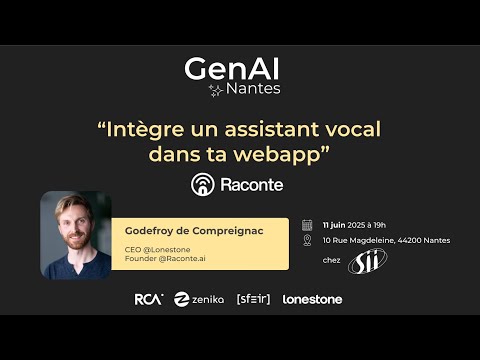
See the author Godefroy de Compreignac talking about Micdrop and voice AI in this video:
🤔 Why Micdrop?
While real-time multimodal models (voice-to-voice) offer impressive capabilities, they often come with limitations in terms of customization and cost. Micdrop takes a different approach by:
- 🎯 Allowing you to choose the best-in-class API for each component:
- Select specific voices from TTS providers
- Use different LLMs optimized for your use case
- Pick STT engines suited for specific languages/accents
- 💰 Reducing costs by letting you:
- Use more cost-effective API providers
- Mix open source and commercial solutions
- Control exactly when APIs are called
- 🔧 Providing granular control over the conversation flow
- 🌐 Supporting a wider range of languages and voices through specialized providers
This modular approach gives you the flexibility to build voice applications that are both powerful and cost-effective.
🌟 Features
- 🎙️ Microphone handling with:
- Streaming support
- Voice Activity Detection (VAD)
- 🔊 Advanced audio playback with:
- Streaming support
- Device selection and control
- 🌐 WebSocket communication
- 📦 AI implementations provided for OpenAI, ElevenLabs, Gradium, Mistral, Gladia, and more
- 🔌 Bring your own AI components (framework agnostic)
- Large Language Models (LLM)
- Text-to-Speech (TTS)
- Speech-to-Text (STT)
🧪 Development
For detailed development instructions, including how to build, test, and publish packages, please see DEVELOPMENT.md.
📄 License
MIT License - see the LICENSE file for details
Author
Originally developed for Raconte.ai, created and open sourced by Godefroy de Compreignac
Acknowledgements
Thanks to ricky0123/vad for their work on voice activity detection.