GameComposer
April 28, 2023 · View on GitHub
GameComposer is a game authoring tool and also a game runtime environment targeting at desktop and mobile devices.
Started as a JavaFX implementation some years ago, it now supports desktop and mobile devices, with support for modern technologies such as HTML5, WebGL, Apache Cordova/Crosswalk and Electron.
Its core is based on Domain-driven Design and a hexagonal architecture. The main game simulation logic stayed the same for years, but replacing presentation logic and adapting it to new technologies is a lot easier compared to traditional layered applications.
To see it in action please visit this page
Current build status: 
GameEngine-Editor
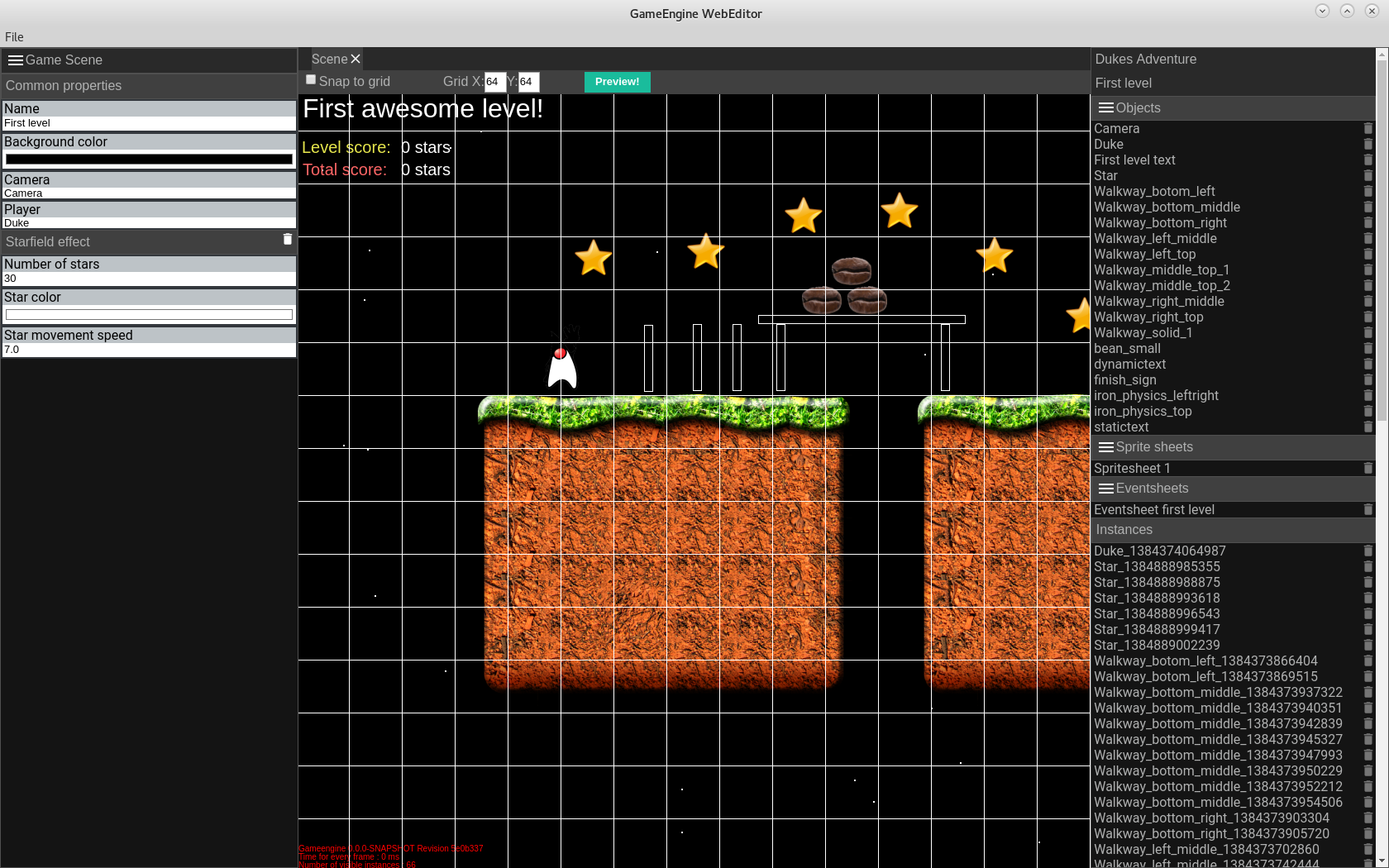
This is the shiny new Web-enabled editor for the GameEngine. It is based on HTML5, Polymer/Webcomponents, Electron and TeaVM.
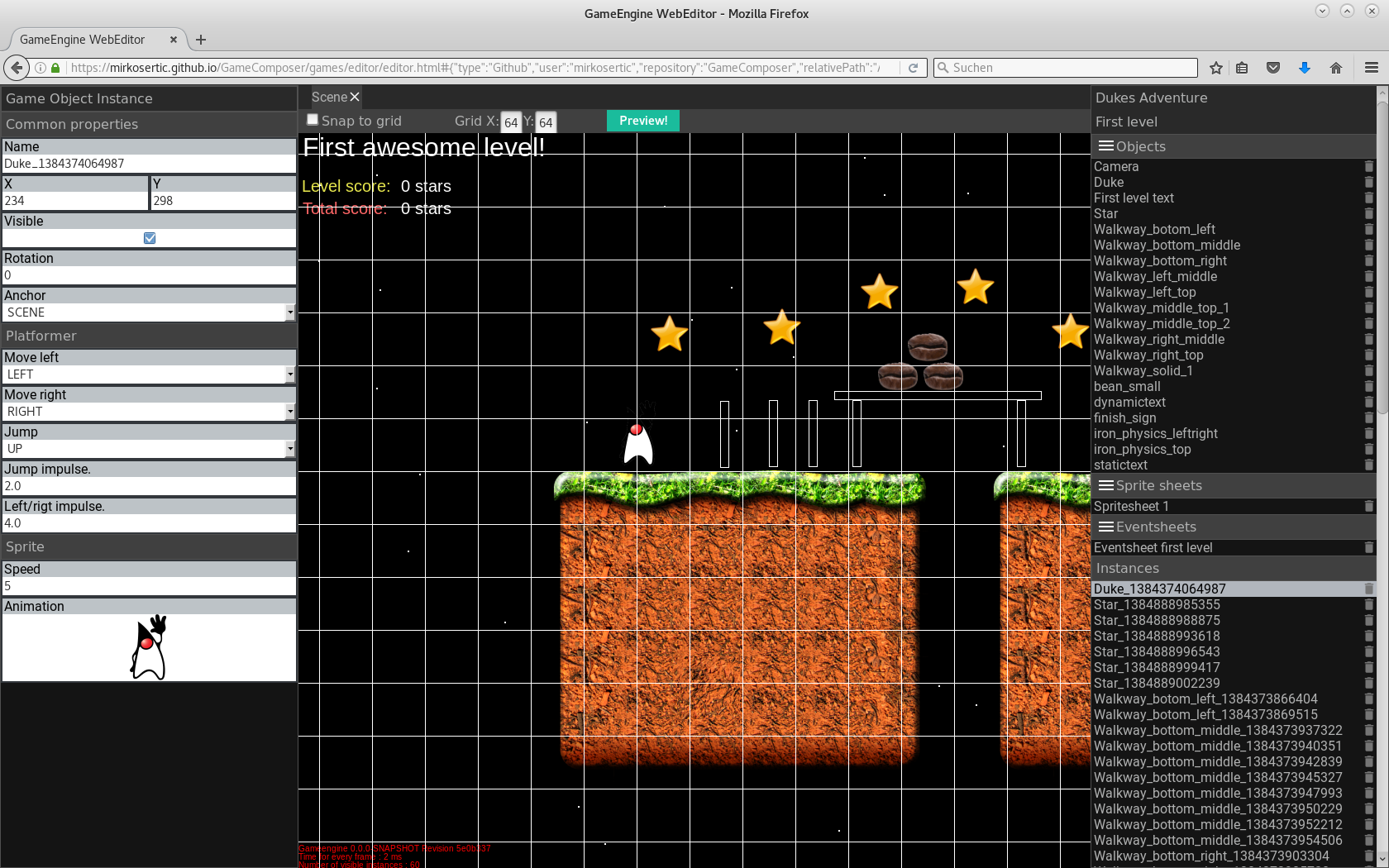
Edit Dukes Adventure Example Game
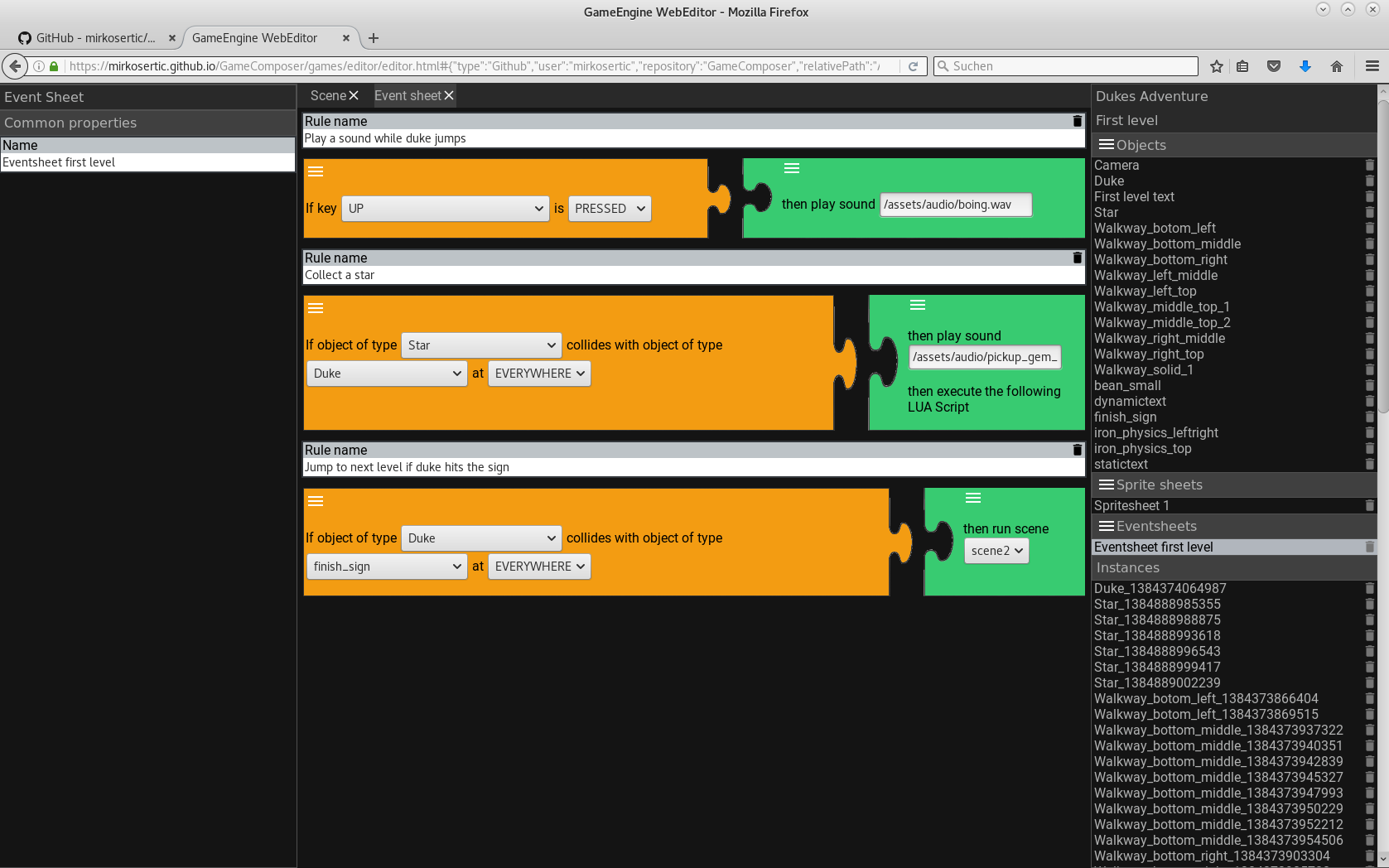
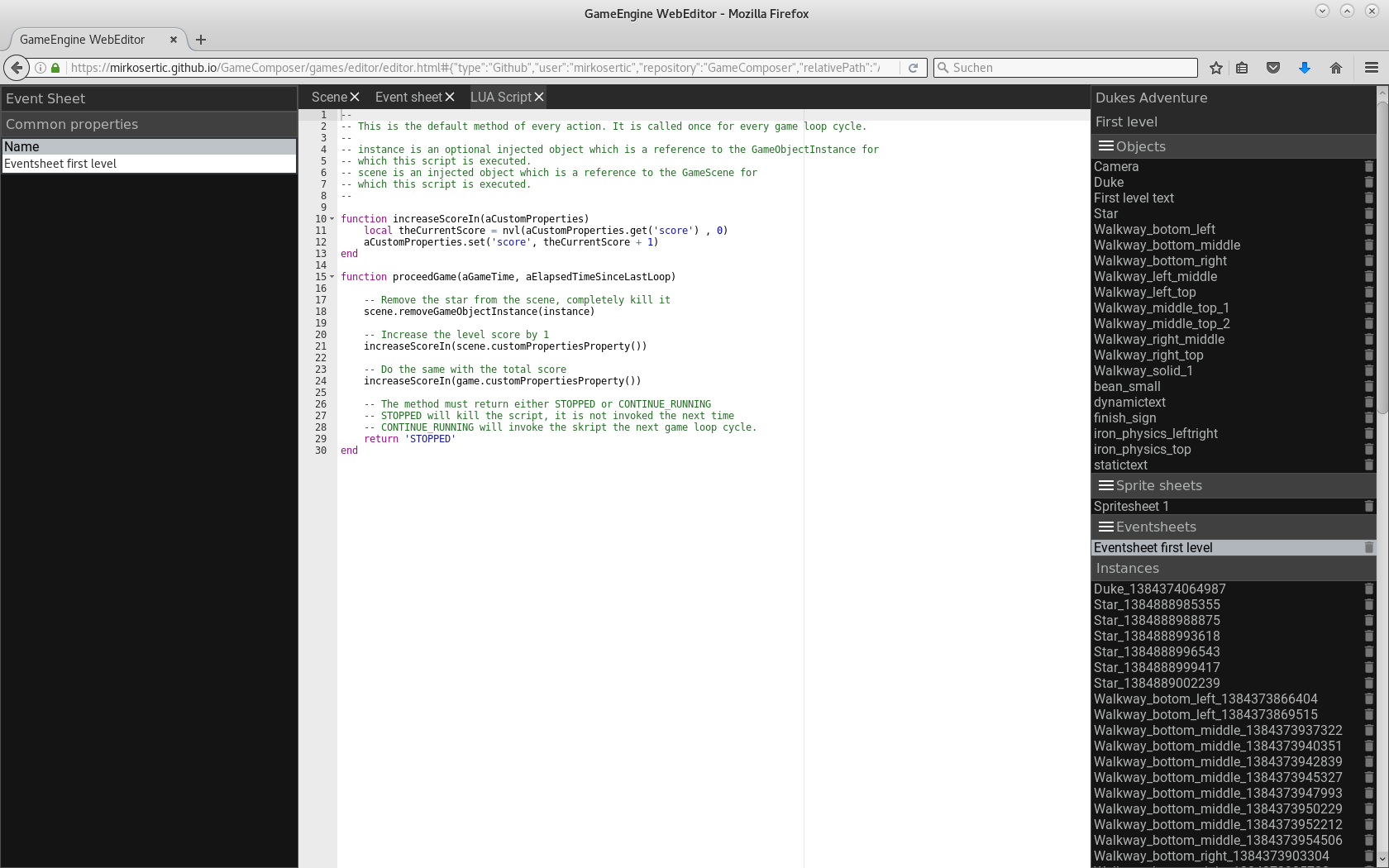
The Electron Releases are available for download at the GitHub Releases section.
Example Games
TeaVM Renderer:
GWT Renderer:
Dragome Renderer:
GameEngine
GameEngine is the cross-platform game engine.
Core concepts and components of the game engine are:
| Concept / component | Description |
|---|---|
| Game | A Game is the top level container. Each Game is split into several GameScenes. |
| GameScene | A Scene is like a level of a game. A Scene has a collection of GameObjects, Assets and Events. |
| GameSystem | A GameSystem defines a subsystem of the game engine. There are GameSystems for physics, sounds and other stuff |
| GameView | A GameView is the presentation of a GameScene to some kind of consumer. This can be a screen renderer or even a remote consumer. |
| GameObject | A GameObject is a template for visible objects. The behavior of a GameObject is defined by GameComponentTemplates |
| BehaviorTemplate | A BehaviorTemplate defines some kind of behavior, e.g. if it is static, a sprite or driven by physics. |
| GameObjectInstance | A GameObjectInstance is an instance of a GameObject. It inherits the defined BehaviorTemplates by copying them into a Behavior |
| Behavior | A Behavior is the behavior status for a BehaviorTemplate and a GameObjectInstance. |
| Event | An Event can be triggered by a consumer by sending it via the GameView to the engine. An Event can also be triggered or consumed by a GameComponent or GameSystem. |
| EventSheet | An EventSheet is the rule engine. Each rule has a condition and some actions. |
| GameLoop | The GameLoop drives the engine by calling the GameSystems, rendering the GameView and dispatching events. |
| GameProcess | A GameProcess is something that takes multiple GameLoop cycles to complete, for instance playing background music or playing an animation. |
GameEngine-Networking
Networking support is implemented as a RemoteGameView. Local events are sent between game instances to sync the distributed game models.
Networking is implemented in a very early beta state only by the TeaVM Renderer. Events are sent to a Firebase instance, which then syncs the events back to other browsers bound to the same Firebase instance. Take a look at the Networking example to see it in action. In this case, Firebase acts as a non-authorative game server. The game models and simulation is still run in the local browser. Only the game state is synchronized using events.
GameEngine-TeaVMRenderer (preferred)
This is the game presentation logic using the TeaVM Java-to-JavaScript Transpiler Framework. It will render the game view using pixi.js, which uses WebGL or the HTML5 Canvas API as a fallback. Sound is done using howler.js
GameEngine-BytecoderRenderer (experimental)
This is a first implementation of a WebAssembly based GameRenderer. Under the hood it uses Bytecoder to compile the Game Runtime to WebAssembly and plain old JavaScript as a fallback. It will render the game view using pixi.js, which uses WebGL or the HTML5 Canvas API as a fallback.
Please note that this is experimental stage!
Example games:
GameEngine-CordovaRenderer (experimental)
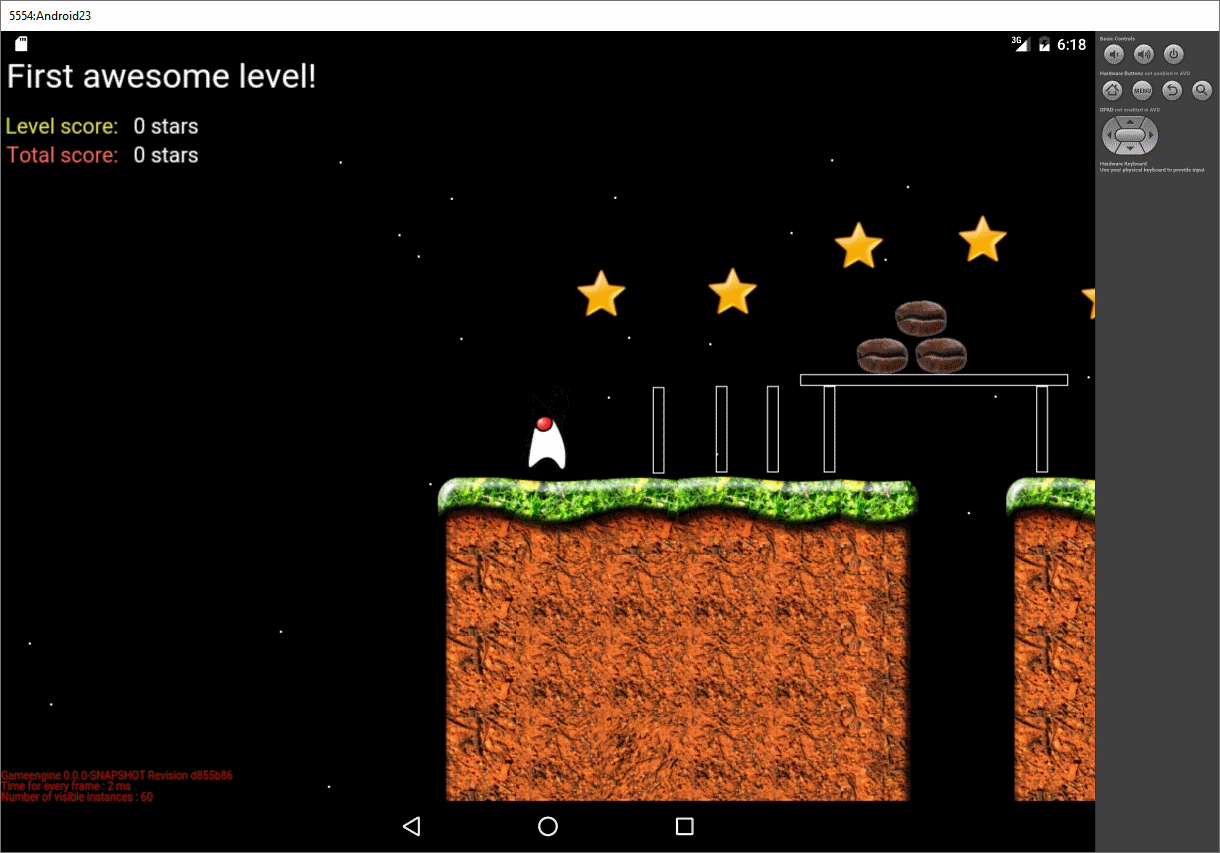
This is basically the TeaVMRenderer packaged as a Cordova Application backed by Crosswalk(Chromium).
GameEngine-FXRenderer (outdated)
This is the game presentation logic by implementing a GameView using JavaFX 2. This also includes a Soundsystem implementation based on Java Sound API.
GameEngine-AndroidRenderer (outdated)
This is the game presentation logic using the Android Java SDK. This also includes a SoundSystem implementation for Android devices. We use an Android SurfaceView for rendering. Future versions will include OpenGL ES support.
GameEngine-GWTRenderer (outdated)
This is the game presentation logic using GWT and HTML5(JavaScript) by implementing a GameView. This also includes a SoundSystem implementation based on HTML5 Media API. Currently the HTML5 renderer tries to use WebGL. If WebGL is not available, it will fallback to the HTML5 Canvas API.
GameEngine-DragomeRenderer (experimental)
This is the game presentation logic using the Dragome Java-to-JavaScript Transpiler Framework. It will render the game view using the HTML5 Canvas API.
GameComposer (outdated)
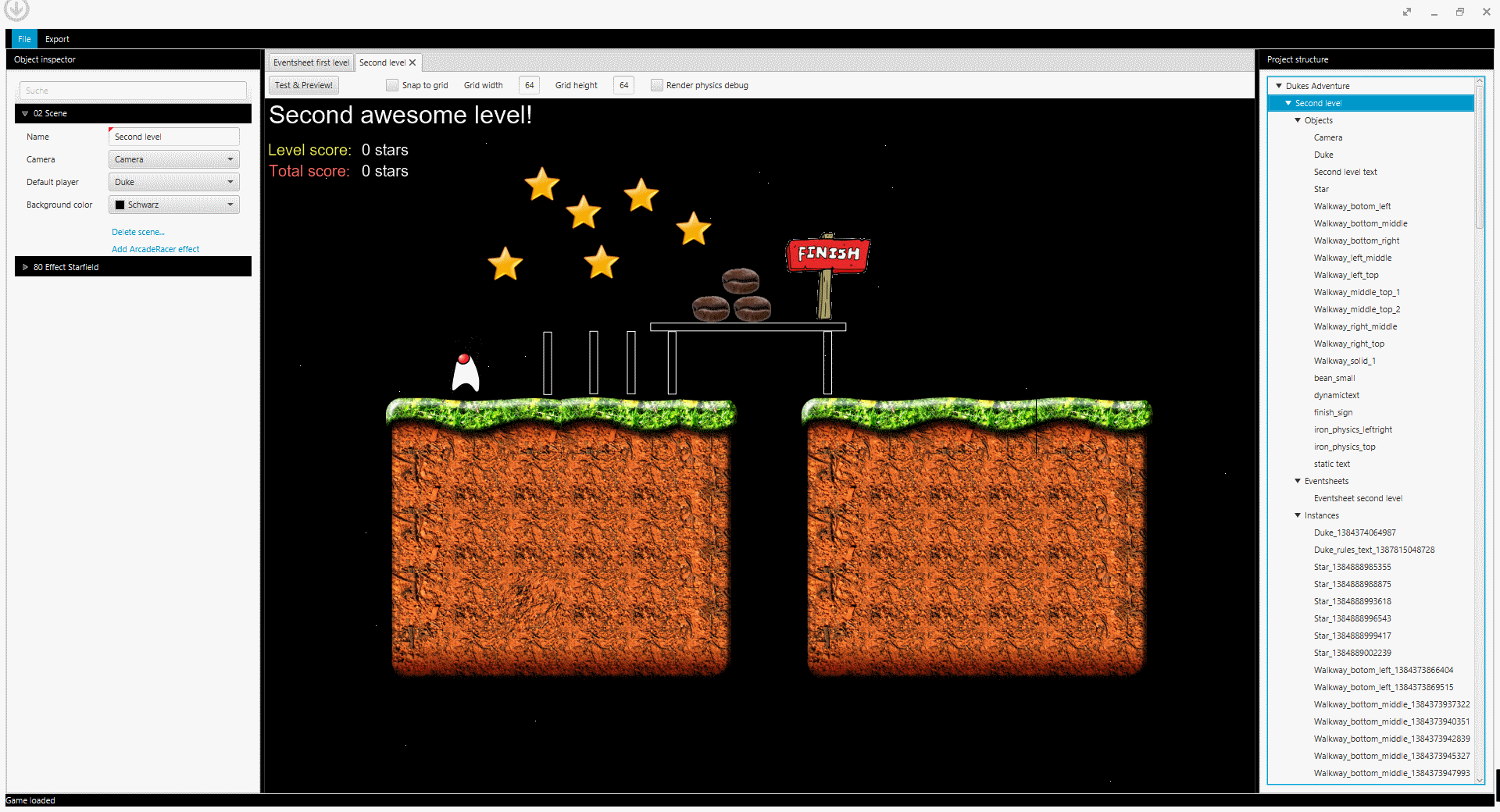
GameComposer is the authoring tool, the IDE. It is a JavaFX2 application. Using this tool, games can be designed and tested. Finally, they can be exported to a target runtime, e.g. HTML5.