runx - Run Linux GUI applications on MS Windows
December 26, 2025 · View on GitHub
runx allows to easily run Linux GUI applications and desktops on MS Windows in Cygwin, MSYS2 or WSL.
- This is especially of interest for WSL in Windows 10 that does not support graphical applications on itself.
Background:
runxstarts an X server, either VcXsrv or XWin, to provide a graphical environment for Linux applications.runxcreates an authorization cookie to restrict access to the X server to allowed clients only.runxruns the desired Linux GUI application with the credentials needed to access the X server.
For similar functionality on native Linux systems use x11docker with options --backend=host or --xonly.
Table of contents
- Linux environments on MS Windows
- Installation
- GPU hardware acceleration
- Usage examples
- Output of
runx --help - Screenshot
Linux environments on MS Windows
runx can run in:
- WSL: Windows subsystem for Linux.
- Cygwin: Cygwin is a large collection of Open Source tools which provide functionality similar to a Linux distribution on Windows.
- MSYS2: MSYS2 is a software distro and building platform for Windows and serves as a base for git for windows and MingW. It is mainly used by developers.
Installation
Installation in general:
- Install an X server, VcXsrv or XWin.
- Copy
runxinto folder/usr/local/binand make it executeable withchmod +x /usr/local/bin/runx. - Install Linux dependencies
telnet,shuf,xhostand (if available)xauthin the system where you will run runx.
Installation of X server
runx needs an X server. Install on MS Windows one or both of:
- VcXsrv to provide X server VcXsrv.
- Easier to install than XWin, and more lightweight.
- Cygwin/X
- This provides X server XWin for Cygwin and WSL.
- XWin has a better
--gpusupport than VcXsrv. - XWin currently fails in setting up cookies. So the X server is less secured than VcXsrv.
runx will automatically use VcXsrv if available. You can specify the desired X server with options --xwin or --vcxsrv.
Installation in WSL
- Run the following commands in WSL/Ubuntu terminal to install
runxand its dependencies:sudo wget https://raw.githubusercontent.com/mviereck/runx/master/runx -O /usr/local/bin/runx sudo chmod +x /usr/local/bin/runx sudo apt update sudo apt install xauth xhost telnet shuf
Installation in Cygwin
- Run the Cygwin/X installer and install packages
xinit,xauth,telnet,shufandwget. - In Cygwin terminal run the commands:
wget https://raw.githubusercontent.com/mviereck/runx/master/runx -O /usr/local/bin/runx
chmod +x /usr/local/bin/runx
Installation in MSYS2
- In MSYS2 terminal run the commands:
mkdir /usr/local/bin wget https://raw.githubusercontent.com/mviereck/runx/master/runx -O /usr/local/bin/runx chmod +x /usr/local/bin/runx - Constraint in MSYS2:
runxonly supports X server VcXsrv, but not XWin.
GPU hardware acceleration
runx supports GPU hardware accelerated graphics with option --gpu.
- GPU access can cause issues with X server VcXsrv, especially with NVIDIA cards. For that reason GPU usage is disabled by default in
runx. - If you encounter issues with option
--gpu, try X server XWin instead of VcXsrv.
Usage examples
- File manager pcmanfm in WSL:
- Installation:
sudo apt update sudo apt install pcmanfm - Run:
runx -- pcmanfm
- Installation:
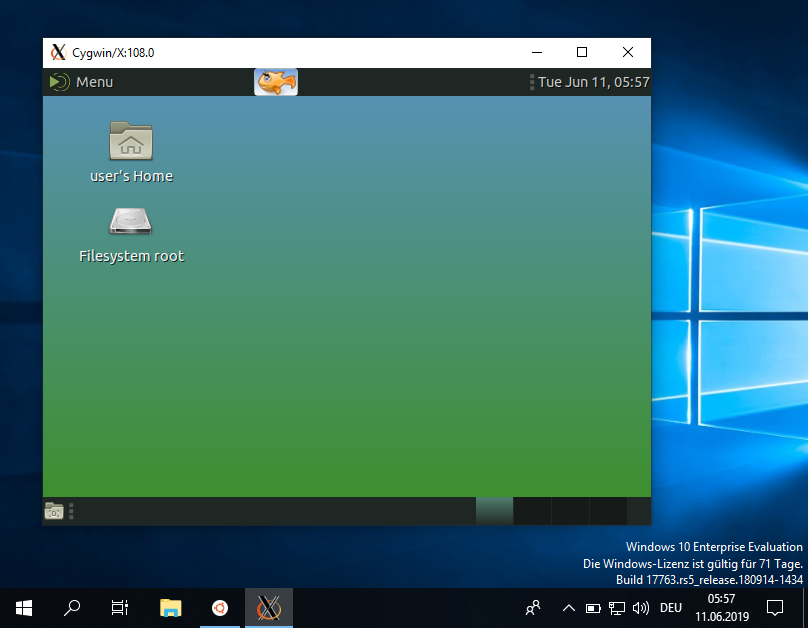
- Mate desktop environment in WSL:
- Installation:
sudo apt update sudo apt install mate-desktop-environment - Run:
runx --desktop --gpu -- mate-session
- Installation:
Providing X server in background
You can make an entry in the file ~/.bashrc to have an X server always available.
Possible entry in ~/.bashrc:
source /usr/local/bin/runx
In future runs of the terminal you can directly run Linux GUI applications, e.g.:
pcmanfm
Use an already running X server
- If you specify option
--display, runx will check if an X server is already running with the specified display number and will only provide the access credentialsDISPLAYandXAUTHORITYinstead of running an additional X server. - The access credentials are also stored in file
~/.Xenv. You can make them available in a new terminal sourcing the file with. ~/.Xenvorsource ~/.Xenv.
Output of runx --help
runx - Run Linux GUI applications on MS Windows.
Provides an X server on MS Windows in Cygwin, MSYS2 or WSL.

Syntax:
  runx [OPTIONS]  --  [COMMAND]

Options:
  -h, --help                   Show this help.
  -d, --desktop                Open a parent window for desktop environments.
  -g, --gpu                    Enable GPU hardware acceleration. Can fail
                               with NVIDIA cards. Works best with XWin.
      --size WIDTHxHEIGHT      Window size for option --desktop, e.g. 800x600.
      --vcxsrv                 Use X server VcXsrv.
      --xwin                   Use X server XWin.
      --clipboard [=yes|no]    Enable clipboard sharing yes/no. Default: yes.
      --display N              Use display number N for new X server.
                               If the display number is already in use, runx will
                               only provide the likely access credentials.
      --ip ADRESS              IP adress to use. Default: First found 192.168.*
      --no-auth                Disable X cookie authentication. Discouraged.
      --cleanup                Stop all X servers and delete cookies.
  -v, --verbose                Be verbose.

Installation of runx in WSL:
 - Copy runx into /usr/local/bin/
 - Make runx executeable:        sudo chmod +x /usr/local/bin/runx
 - Install xauth:                sudo apt update
                                 sudo apt install xauth

Install an X server on Windows:
  runx supports two X servers: VcXsrv and XWin. Install at least one of them.
   - VcXsrv: Download and install from:
       https://sourceforge.net/projects/vcxsrv/
   - XWin: Download and install Cygwin64 with packages: xinit xauth
       https://www.cygwin.com
VcXsrv is easier to install. XWin provides a better GPU support.

WSL, Cygwin: runx starts XWin if available, otherwise it starts VcXsrv.
MSYS2:       runx supports VcXsrv only.

Usage:

Example to directly run an application with runx:
 - Install file manager pcmanfm: sudo apt update
                                 sudo apt install pcmanfm
 - Run pcmanfm with:             runx -- pcmanfm

Example to run Mate desktop:
 - Install Mate desktop with:    sudo apt install mate-desktop-environment
 - Run Mate desktop with:        runx --desktop -- mate-session

Example to get a Wayland environment:
 - Install Wayland compositor:   sudo apt install weston
 - Run Weston with:              XDG_RUNTIME_DIR=/tmp  runx -- weston

Providing an X server in background all the time:
 - Create an entry in ~/.bashrc: source /usr/local/bin/runx
 - In future terminal session you can directly run GUI commands.
   E.g. just type:  'pcmanfm'  instead of 'runx -- pcmanfm'.
 - If you specify a display number with --display, runx will re-use
   a possibly already running X server with same display number
   and only provide the access credentials DISPLAY and XAUTHORITY.
   This allows to use the same X server across several terminals.

runx stores the access credentials DISPLAY and XAUTHORITY in ~/.Xenv
This allows sourcing the file for custom access setups.

runx version 0.4.20
Please report issues and get help at:   https://github.com/mviereck/runx
Screenshot
runx running Mate desktop on MS Windows: