RocketMQ-Rust
July 30, 2026 · View on GitHub












RocketMQ-Rust
🚀 A high-performance, reliable, and feature-rich unofficial Rust implementation of Apache RocketMQ, designed to bring enterprise-grade message middleware to the Rust ecosystem.


✨ Overview
RocketMQ-Rust is a complete reimplementation of Apache RocketMQ in Rust, leveraging Rust's unique advantages in memory safety, zero-cost abstractions, and fearless concurrency. This project aims to provide Rust developers with a production-ready distributed message queue system that delivers exceptional performance while maintaining full compatibility with the RocketMQ protocol.
🎯 Why RocketMQ-Rust?
- 🦀 Memory Safety: Built on Rust's ownership model, eliminating entire classes of bugs like null pointer dereferences, buffer overflows, and data races at compile time
- ⚡ High Performance: Zero-cost abstractions and efficient async runtime deliver exceptional throughput with minimal resource overhead
- 🔒 Thread Safety: Fearless concurrency enables safe parallel processing without the risk of race conditions
- 🌐 Cross-Platform: First-class support for Linux, Windows, and macOS with native performance on each platform
- 🔌 Ecosystem Integration: Seamlessly integrates with the rich Rust ecosystem including Tokio, Serde, and other modern libraries
- 📦 Production Ready: Battle-tested architecture with comprehensive error handling and observability
🏗️ Architecture

RocketMQ-Rust implements a distributed architecture with the following core components:
- Name Server: Lightweight service discovery and routing coordination
- Broker: Message storage and delivery engine with support for topics, queues, and consumer groups
- Producer Client: High-performance message publishing with various sending modes
- Consumer Client: Flexible message consumption with push and pull models
- Store: Efficient local storage engine optimized for sequential writes
- Controller: Advanced high availability and failover capabilities
📚 Documentation
- 📖 Official Documentation: rocketmqrust.com - Comprehensive guides, API references, and best practices
- 🤖 AI-Powered Docs: DeepWiki - Interactive documentation with intelligent search
- 📝 API Docs: docs.rs/rocketmq-rust - Complete API documentation
- 📋 Examples: rocketmq-client/examples - Ready-to-run code samples
🚀 Quick Start
Prerequisites
- Rust toolchain 1.95.0
- A shell with
cargoavailable - Separate terminals for the NameServer, Broker, and client examples
See the toolchain and dependency trust policy for the pinned toolchain, dependency admission rules, and local validation contract.
1. Build the Workspace
git clone https://github.com/mxsm/rocketmq-rust.git
cd rocketmq-rust
cargo build --workspace
If you only want to use the client SDK from your own application, add the current release to Cargo.toml:
[dependencies]
rocketmq-client-rust = "1.0.0"
rocketmq-model = "1.0.0"
rocketmq-protocol = "1.0.0"
2. Start the NameServer
cargo run --bin rocketmq-namesrv-rust
The default NameServer endpoint is 127.0.0.1:9876. To bind explicitly:
cargo run --bin rocketmq-namesrv-rust -- --ip 127.0.0.1 --port 9876
3. Start the Broker
The Broker requires ROCKETMQ_HOME. Point it at an existing RocketMQ home or create a local runtime directory for quick testing.
Linux/macOS:
export ROCKETMQ_HOME="$(pwd)/.rocketmq"
mkdir -p "$ROCKETMQ_HOME/conf"
cargo run --bin rocketmq-broker-rust -- -n 127.0.0.1:9876
Windows PowerShell:
$env:ROCKETMQ_HOME = "$PWD\.rocketmq"
New-Item -ItemType Directory -Force "$env:ROCKETMQ_HOME\conf" | Out-Null
cargo run --bin rocketmq-broker-rust -- -n 127.0.0.1:9876
Use cargo run --bin rocketmq-broker-rust -- --help to inspect configuration flags such as --configFile, --namesrvAddr, and config printing options.
4. Send and Receive Messages
Start the consumer example first:
cargo run -p rocketmq-client-rust --example consumer
Then send messages from another terminal:
cargo run -p rocketmq-client-rust --example producer
The quickstart examples use 127.0.0.1:9876 and TopicTest by default. For more messaging patterns, see:
📦 Components & Crates
RocketMQ-Rust is organized into deployable services, reusable protocol/runtime crates, and operational applications. The tables below focus on responsibility and integration boundaries instead of per-crate maturity labels.
Core Runtime Services
| Crate | Responsibility |
|---|---|
| rocketmq-namesrv | NameServer implementation for broker registration, topic routing, and service discovery. |
| rocketmq-broker | Broker implementation for message storage, dispatch, delivery, and consumer coordination. |
| rocketmq-controller | Controller service for broker coordination and high availability workflows. |
| rocketmq-proxy | Proxy layer for gateway-style client access and protocol integration. |
| rocketmq-proxy-core | Stable proxy contracts, use cases, and ingress-independent models. |
| rocketmq-proxy-cluster | Cluster-mode proxy adapter with keyed execution and remote Broker access. |
| rocketmq-proxy-local | Local-mode proxy adapter. |
Client, Protocol, and Shared Libraries
| Crate | Responsibility |
|---|---|
| rocketmq-client | Async producer, consumer, and admin SDK for application integration. |
| rocketmq-protocol | RocketMQ wire commands, headers, serialization, and compatibility contracts. |
| rocketmq-transport | Runtime-owned network sessions and canonical per-session writers. |
| rocketmq-model | Shared message, route, configuration, and domain models. |
| rocketmq-auth | Authentication, authorization, ACL evaluation, and request context support. |
| rocketmq-security-api | Runtime-neutral authentication, authorization, signing, and maintenance contracts. |
| rocketmq-filter | Message filtering support, including tag and expression-based filtering. |
Storage, Runtime, and Observability
| Crate | Responsibility |
|---|---|
| rocketmq-store | Durable local storage engine for commit logs, consume queues, and message indexes. |
| rocketmq-store-api | Backend-neutral append, read, lifecycle, replication, checkpoint, and health capabilities. |
| rocketmq-store-local | Local CommitLog, ConsumeQueue, Index, mapped-file, and recovery implementation. |
| rocketmq-store-rocksdb | RocksDB-backed store implementation. |
| rocketmq-tieredstore | Tiered storage abstractions for extending message data beyond local disks. |
| rocketmq-runtime | Async runtime abstractions and runtime-friendly coordination utilities. |
| rocketmq-error | Shared error types and result conventions across workspace crates. |
| rocketmq-macros | Procedural macros used by RocketMQ-Rust crates and examples. |
| rocketmq-observability | Metrics and tracing integration for service and client instrumentation. |
The cross-cutting ownership, cancellation, error, limit, compatibility, and failure-mode contracts are documented in the core capability contracts.
Tools, Examples, and Dashboards
| Project | Responsibility |
|---|---|
| rocketmq-example | Standalone examples covering producer, consumer, request/reply, ordering, delay, and transaction flows. |
| rocketmq-tools | Command-line tools and operational utilities. |
| rocketmq-admin-cli | Command-line administration interface for cluster and broker operations. |
| rocketmq-admin-core | Shared admin functionality used by CLI and terminal interfaces. |
| rocketmq-admin-tui | Terminal UI for interactive administration workflows. |
| rocketmq-store-inspect | Storage inspection utilities for broker data files. |
| rocketmq-mcp | Model Context Protocol server for deny-by-default RocketMQ diagnostics and administration. |
| rocketmq-dashboard | Dashboard workspace for desktop, web, and shared management UI components. |
| rocketmq-dashboard-common | Shared dashboard models and reusable dashboard infrastructure. |
| rocketmq-dashboard-gpui | GPUI-based desktop dashboard. |
| rocketmq-dashboard-tauri | Tauri-based cross-platform dashboard shell and backend. |
| rocketmq-dashboard-web | Web dashboard frontend and backend project. |
💡 Capabilities
RocketMQ-Rust focuses on RocketMQ-compatible messaging services and Rust-native integration points.
| Area | What it provides |
|---|---|
| Messaging services | NameServer, Broker, Controller, and Proxy services for routing, storage, delivery, coordination, and gateway access. |
| Client integration | Async producer, consumer, admin, request/reply, batch, ordered, delayed, and transactional messaging APIs. |
| Protocol compatibility | RocketMQ remoting command models, headers, serialization, route discovery, and client/broker interoperability. |
| Storage engine | Durable commit log, consume queue, index, checkpoint, and tiered storage building blocks. |
| Security and governance | Authentication, authorization, ACL evaluation, request context, and broker/client-side integration points. |
| Operations | Metrics, tracing, admin tools, storage inspection utilities, and dashboard projects for cluster visibility. |
🧪 Build & Validation
Quick Start covers the first local run. For regular development and review, use the root workspace commands below.
| Task | Command |
|---|---|
| Build the workspace | cargo build --workspace |
| Run workspace tests | cargo test --workspace |
| Run a focused crate test | cargo test -p rocketmq-client |
| Format Rust code | cargo fmt --all |
| Run clippy with workspace features | cargo clippy --workspace --no-deps --all-targets --all-features -- -D warnings |
| Build local API documentation | cargo doc --workspace --no-deps |
Standalone projects under rocketmq-example/ and rocketmq-dashboard/ are validated from their own project roots.
🤝 Contributing
We welcome contributions from the community! Whether you're fixing bugs, adding features, improving documentation, or sharing ideas, your input is valuable.
How to Contribute
- Fork the repository
- Create a feature branch (
git checkout -b feature/amazing-feature) - Commit your changes (
git commit -m 'Add amazing feature') - Push to the branch (
git push origin feature/amazing-feature) - Open a Pull Request
Contribution Guidelines
- Follow Rust best practices and idiomatic patterns
- Add tests for new functionality
- Update documentation as needed
- Ensure CI passes before submitting PR
- Use meaningful commit messages
For detailed guidelines, please read our Contribution Guide.
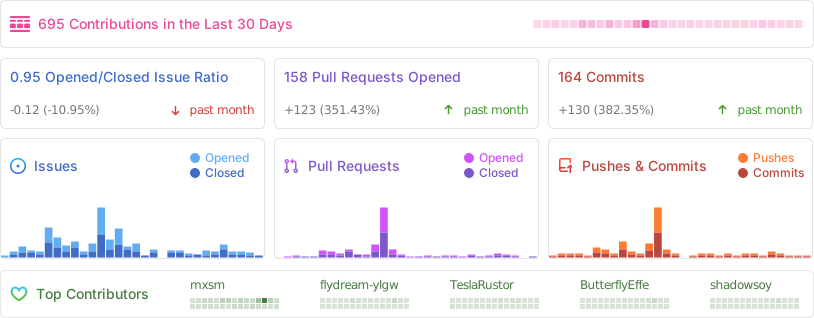
Repository Activity
❓ FAQ
Is RocketMQ-Rust production-ready?
The services are designed for production-oriented deployments, but production readiness is a property of a specific candidate and environment. Promotion requires commit- and digest-bound fault, soak, performance, acknowledgement RPO/RTO, and executable rollback evidence described by the production-readiness runbook.
Is it compatible with Apache RocketMQ?
Yes, RocketMQ-Rust implements the RocketMQ protocol and can interoperate with Apache RocketMQ Java clients and servers.
What's the minimum supported Rust version (MSRV)?
The minimum supported Rust version is stable Rust 1.95.0. The repository pins that exact toolchain for local and production builds; dated nightly toolchains are reserved for explicitly documented specialized checks such as Miri and rustdoc JSON generation.
How does performance compare to Java RocketMQ?
No general comparison is claimed. Component microbenchmarks detect algorithmic regressions; they do not establish production TPS. Candidate performance is accepted only from the target-hardware profile with identical configuration, at least five samples, dispersion checks, and a correctness-valid evidence bundle indexed by the architecture evidence document.
Can I use it with existing RocketMQ deployments?
Yes, you can deploy RocketMQ-Rust components alongside Java RocketMQ. For example, you can use Rust clients with Java brokers, or vice versa.
How can I migrate from Java RocketMQ to RocketMQ-Rust?
Migration can be done incrementally:
- Start by using Rust client SDK with existing Java brokers
- Gradually replace brokers with Rust implementation
- Both implementations can coexist during migration
Refer to our migration guide for detailed steps.
👥 Community & Support
- 💬 Discussions: GitHub Discussions - Ask questions and share ideas
- 🐛 Issues: GitHub Issues - Report bugs or request features
- 📧 Contact: Reach out to mxsm@apache.org
Contributors
Thanks to all our contributors! 🙏
Star History
📄 License
RocketMQ-Rust is licensed under the Apache License 2.0.
See LICENSE-APACHE or http://www.apache.org/licenses/LICENSE-2.0.
🙏 Acknowledgments
- Apache RocketMQ Community for the original Java implementation and design
- Rust Community for excellent tooling and libraries
- All Contributors who have helped make this project better
Built with ❤️ by the RocketMQ-Rust community