README.org
June 24, 2025 · View on GitHub
#+title: octox #+author: Hayato Ohhashi #+email: o8@vmm.dev
octox is a Unix-like operating system inspired by xv6-riscv. octox loosely follows the structure and style of xv6, but is implemented in pure Rust.
[[https://vhs.charm.sh/vhs-6MQBIyAo3DpBrARBxHxL35.gif]]
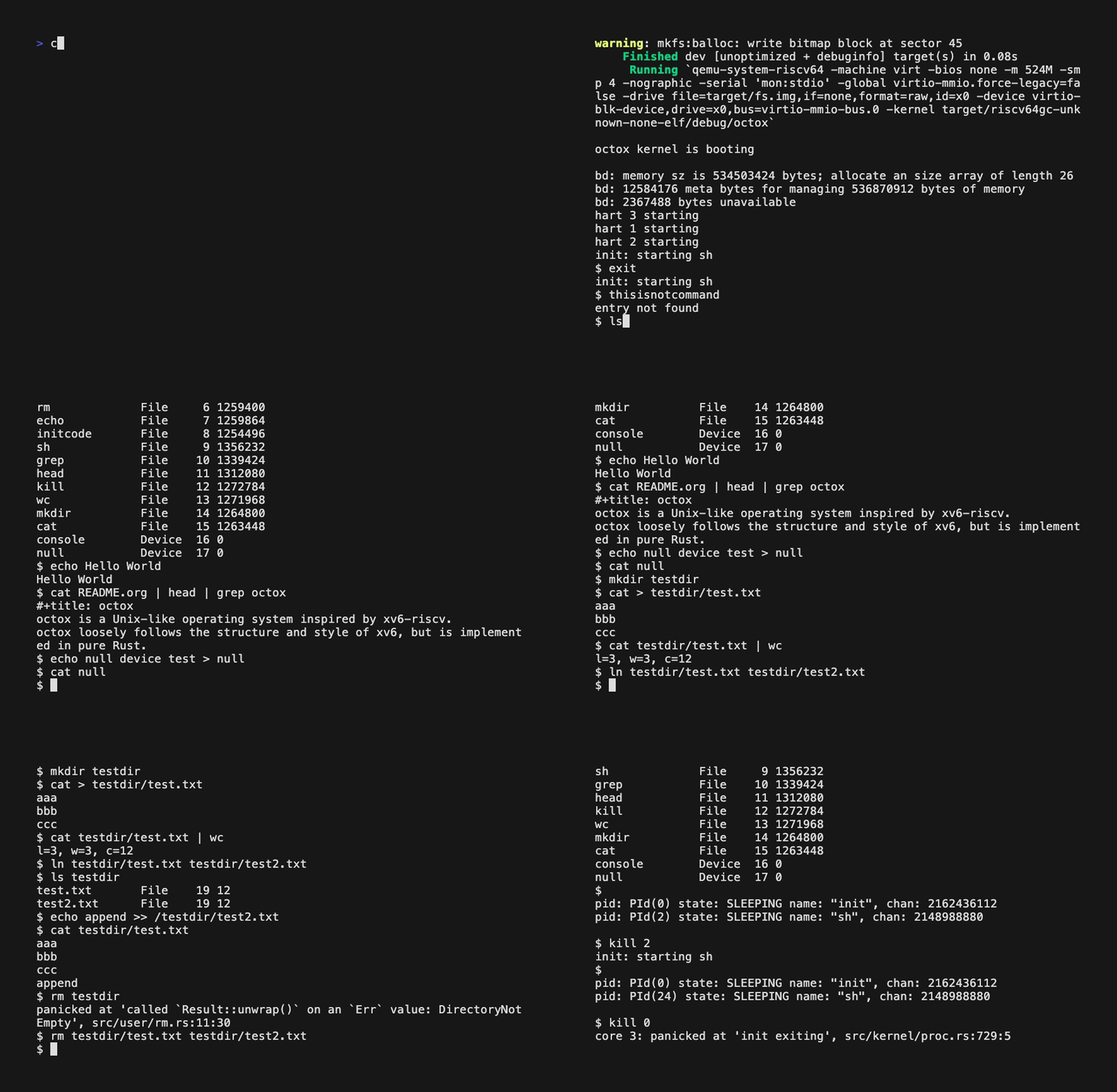
- Everything from kernel, userland, mkfs, to build system is written in safe Rust as much as possible.
- There are no dependencies on external crates.
- The userland has a library similar to Rust’s std with K&R malloc.
- Multi-core support, buddy allocator as kernel-side memory allocator, file system with logging support, etc.
- Getting Started
** Requirements
- Install the rust toolchain to have cargo installed by following [[https://www.rust-lang.org/tools/install][this]] guide.
- Install
qemu-system-riscv - (option) Install
gdb-multiarch
** Build and Run
- Clone this project & enter:
git clone ... && cd octox - Build:
cargo build --target riscv64gc-unknown-none-elf. - Run:
cargo run --target riscv64gc-unknown-none-elf, then qemu will boot octox. To exit, pressCtrl+aandx.
** Play with the Shell
A very simple shell is implemented. In addition to executing commands, you can only do the following things.
- Pipe:
cat file | head | grep test - Dump processes:
Ctrl + P - End of line:
Ctrl + D - Redirect output:
>,>>
- Development
** Userland Application
The userland comes with a user library called ulib (located at src/user/lib)
that is similar to Rust’s std, so you can use it to develop your favorite
commands. If you create a bin crate named _command in src/user/bin, the
build.rs and mkfs.rs will place a file named command in the file system
and make it available for use.
-
In src/user/Cargo.toml, define a bin crate with the name of the command you want to create with a
_prefix #+begin_src toml [[bin]] name = "_rm" path = "bin/rm.rs" #+end_src -
userland is also no_std, so don’t forget to add
#[no_std]. Use ulib to develop any command you like. Here is an example of the rm command. #+begin_src rust #![no_std] use ulib::{env, fs};fn main() { let mut args = env::args().skip(1).peekable();
  if args.peek().is_none() {
      panic!("Usage: rm files...")
  }
  for arg in args {
      fs::remove_file(arg).unwrap()
  }
} #+end_src
-
Then,
cargo run --target riscv64gc-unknown-none-elfin the root of octox. -
To use
VecandString, etc, do the following: #+begin_src rust extern crate alloc; use alloc::{string::String, vec::Vec}; #+end_src
** Kernel
Developing in src/kernel. Here is an example of adding a system call. If you want to add a new system call, you only need to add a definition to the system call table in libkernel, and the userland library will be automatically generated by build.rs.
- Add a variant and Syscall Number to
enum SysCallsin src/kernel/syscall.rs. Here isDup2as an example: #+begin_src rust pub enum SysCalls { Fork = 1, ..., Dup2 = 23, Invalid = 0, } #+end_src - Define the function signature of the system call in the
TABLEofSysCalls. Use the enum typeFnto describe the return type(U(Unit),I(Integer),N(never)) and use&strto represent arguments. then, define kernel-side implementation as a method onSysCalls.cfgflag is used to control the compilation target for kernel and the rest. Here is an example ofdup2: #+begin_src rust impl SysCalls { pub const TABLE: [(fn, &'static str); variant_count::()] = [ (Fn::N(Self::Invalid), ""), (Fn::I(Self::fork), "()"), (Fn::N(Self::exit), "(xstatus: i32)"), ..., (Fn::I(Self::dup2), "(src: usize, dst: usize)"), ]; pub fn dup2() -> Result { #[cfg(not(all(target_os = "none", feature = "kernel")))] return Ok(0); #[cfg(all(target_os = "none", feature = "kernel"))] { let p = Cpus::myproc().unwrap().data_mut(); let src_fd = argraw(0); let dst_fd = argraw(1); if src_fd != dst_fd { let mut src = p.ofile.get_mut(src_fd).unwrap() .take().unwrap(); src.clear_cloexec(); p.ofile.get_mut(dst_fd) .ok_or(FileDescriptorTooLarge)?.replace(src); } Ok(dst_fd) } } #+end_src - With just these steps, the dup2 system call is implemented in both kernel and userland.
- License
Licensed under either of
- [[http://www.apache.org/licenses/LICENSE-2.0][Apache License, Version 2.0]]
- [[http://opensource.org/licenses/MIT][MIT license]]
at your option.
- Acknowledgments
octox is inspired by [[https://github.com/mit-pdos/xv6-riscv][xv6-riscv]].
I'm also grateful for the bug reports and discussion about the implementation contributed by Takahiro Itazuri and Kuniyuki Iwashima.
- Contribution
This is a hobby learning project, but contributions are welcome! However, please note that reviews may take considerable time. Discussions and advice are always appreciated.