Coverage
June 1, 2026 · View on GitHub
Updated: 2026-06-01
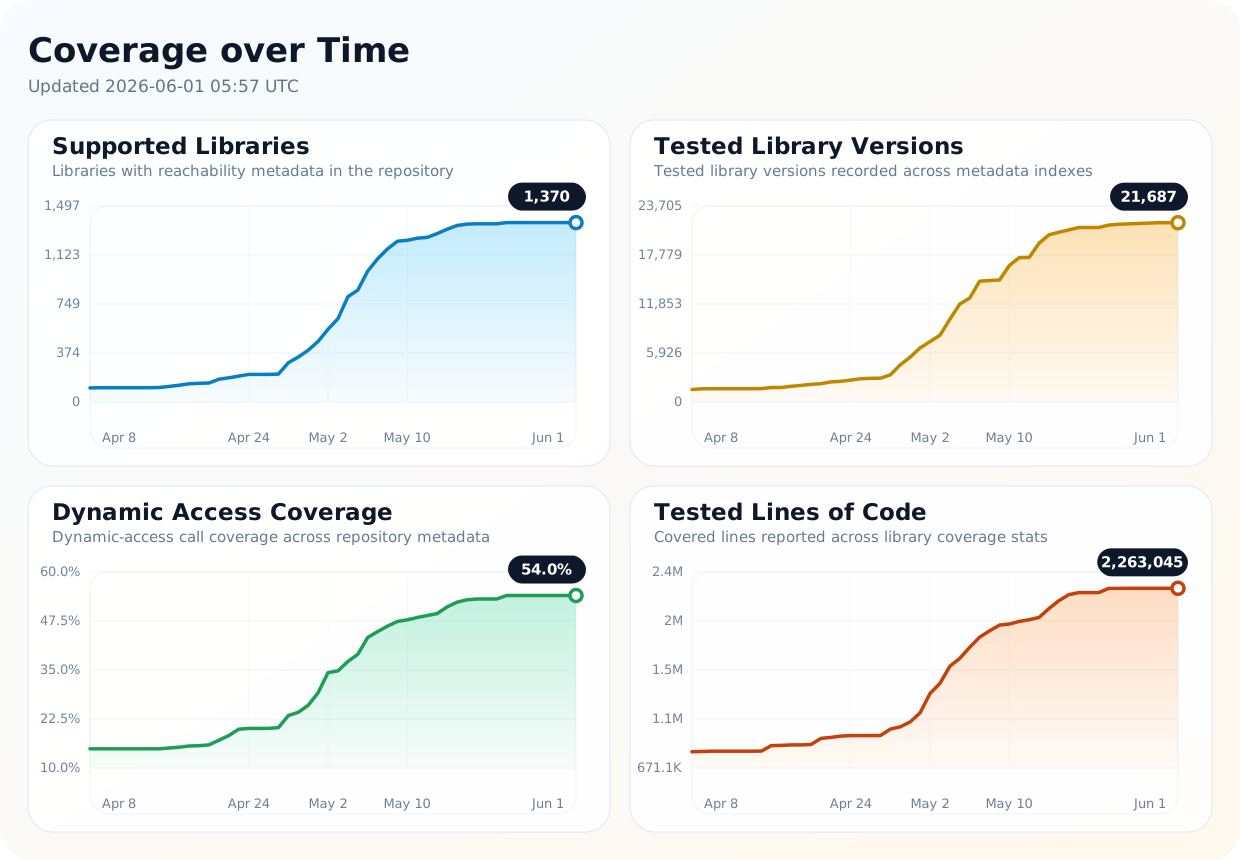
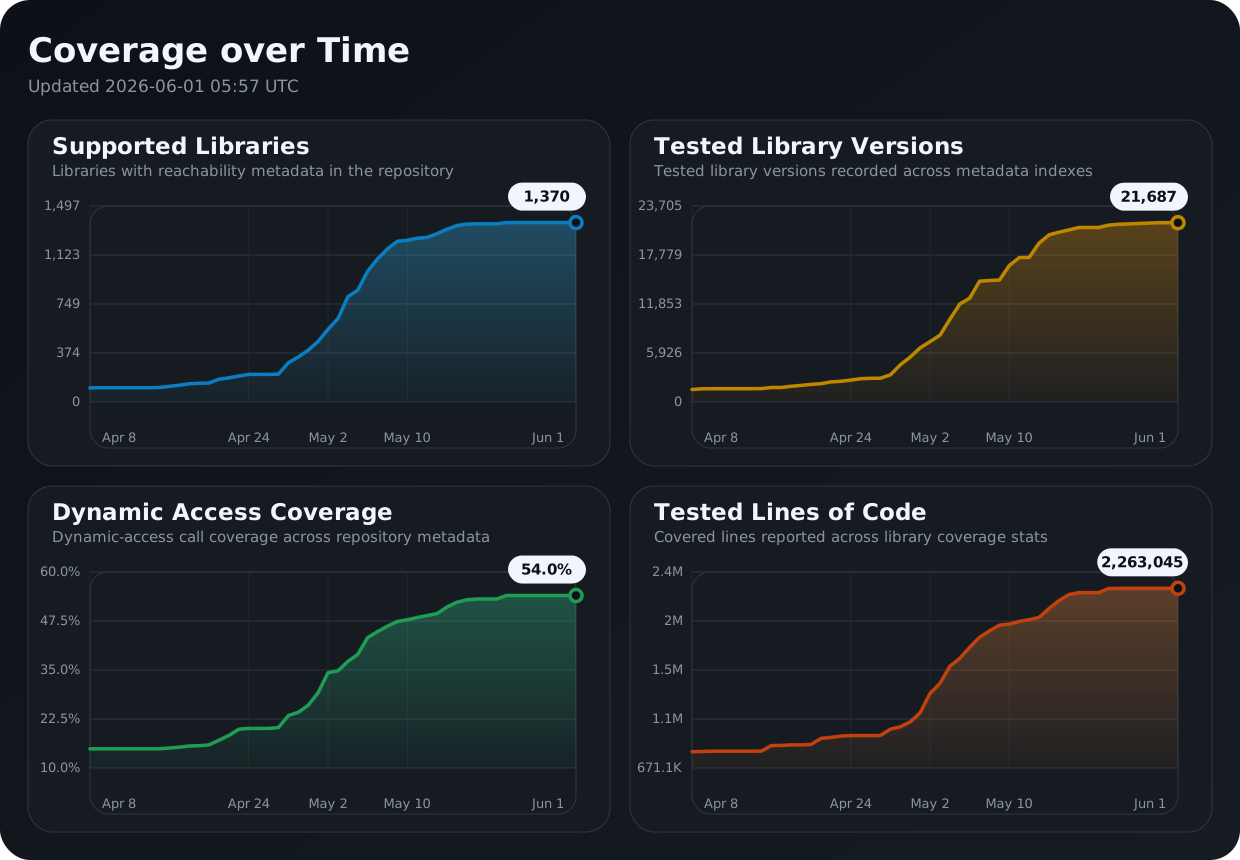
Libraries
| Library | Versions | Description | Dynamic access coverage |
|---|---|---|---|
antlr:antlr | 2.7.6 | ShowANTLR 2 is a parser generator and runtime for building lexers, parsers, tree parsers, compilers, and translators from grammar files. The antlr artifact provides the Java tool and runtime classes used to generate and run parsers, with code generation support for Java, C++, C#, and Python. | 80.0% (12/15 calls) |
aopalliance:aopalliance | 1.0 | ShowAOP Alliance defines a small set of standard Java interfaces for aspect-oriented programming, especially method and constructor interception. Libraries use these interfaces to expose portable advice and interceptor contracts without depending on a particular AOP implementation. | 100.0% (0/0 calls) |
app.cash.sqldelight:async-extensions-jvm | 2.3.2 | ShowSQLDelight Async Driver Extensions provides Kotlin coroutine helpers for SQLDelight asynchronous drivers on the JVM. It adds suspend functions that await driver operations and query results, including list, single-row, and nullable single-row result helpers. | 100.0% (0/0 calls) |
app.cash.sqldelight:coroutines-extensions-jvm | 2.3.2 | ShowSQLDelight Coroutines Extensions provides Kotlin extension functions that expose SQLDelight Query objects as kotlinx.coroutines Flow streams. It also supplies Flow mapping helpers that asynchronously collect one row, optional or default rows, non-null rows, or lists from emitted queries. | 100.0% (0/0 calls) |
app.cash.sqldelight:jdbc-driver | 2.3.2 | ShowSQLDelight JDBC Driver provides a JVM SqlDriver implementation backed by JDBC connections for SQLDelight-generated Kotlin database code. It maps JDBC ResultSet and PreparedStatement operations into SQLDelight cursor, statement, transaction, and connection APIs so applications can use JDBC-accessible databases. | 100.0% (0/0 calls) |
app.cash.sqldelight:runtime-jvm | 2.3.2 | ShowSQLDelight Runtime JVM provides the Kotlin runtime APIs used by generated SQLDelight database code on the JVM. It includes query, transaction, driver, schema, cursor, and logging interfaces that generated code uses to execute SQL and map results. | 100.0% (0/0 calls) |
app.cash.sqldelight:sqlite-driver | 2.3.2 | ShowSQLDelight SQLite Driver provides a JVM SQLDelight SqlDriver implementation backed by SQLite through JDBC. It lets SQLDelight-generated Kotlin database code open SQLite connections, run statements, and manage transactions on the standard JVM. | 100.0% (0/0 calls) |
app.cash.turbine:turbine-jvm | 1.2.1 | ShowTurbine is a Kotlin testing library for kotlinx.coroutines Flow that provides suspending APIs for asserting emitted items, completion, and errors. The turbine-jvm artifact is the standard JVM variant for writing coroutine Flow tests on the JVM, including integration with kotlinx-coroutines-test. | 100.0% (0/0 calls) |
args4j:args4j | 2.0.26 - 2.0.27 | Showargs4j is a Java command-line argument parser that maps options and arguments onto annotated fields and methods. It supports type-specific option handlers, usage generation, and localization so applications can define command-line interfaces with less manual parsing code. | 100.0% (32/32 calls) |
at.yawk.lz4:lz4-java | 1.10.4 - 1.11.0 | Showlz4-java provides Java bindings and pure Java implementations of the LZ4 compression algorithm and XXHash hashing algorithm. It includes compressors, decompressors, and streaming APIs for high-performance data compression in Java applications. | 50.0% (5/10 calls) |
avalon-framework:avalon-framework | 4.1.3 - 4.1.5 | ShowAvalon Framework provides Java interfaces and supporting default implementations for building components that interact with containers through lifecycle, configuration, context, logging, service, and component-manager contracts. It lets applications and containers share a small inversion-of-control style API for wiring, configuring, starting, and managing reusable components. | 100.0% (2/2 calls) |
backport-util-concurrent:backport-util-concurrent | 3.1 | Showbackport-util-concurrent is a backport of the JSR 166 concurrency APIs for pre-Java 5 runtimes. It provides executors, locks, blocking queues, atomics, concurrent collections, and related utilities for applications that need modern Java concurrency support on older Java platforms. | 100.0% (61/61 calls) |
berkeleydb:je | 3.2.76 | ShowBerkeley DB Java Edition is a pure Java embedded database library that provides a transactional key-value store built on a B+Tree access method. It lets applications persist and query local data using direct database APIs, collections bindings, and an object persistence layer. | 90.8% (128/141 calls) |
biz.aQute.bnd:biz.aQute.bnd.annotation | 6.4.1 - 7.2.3 | ShowThe biz.aQute.bnd.annotation artifact provides bnd-specific Java annotations for OSGi bundle metadata, package versioning, capabilities, service metadata, JPMS hints, licenses, and plugin declarations. These annotations are consumed by bnd and related tooling to generate or validate bundle headers and metadata without hard-coding that information in build instructions. | 100.0% (9/9 calls) |
biz.aQute.bnd:biz.aQute.bnd.util | 6.4.1 - 7.2.3 | ShowThis artifact provides Java utility APIs used by bnd, including class-file parsing, functional exception wrappers, memoization, result types, signatures, stream helpers, and immutable collection helpers. It is a compile-time support library for bnd and OSGi tooling, packaging reusable utilities that other bnd components can statically link or consume on the JVM. | 100.0% (6/6 calls) |
ch.qos.cal10n:cal10n-api | 0.7.2 | ShowCAL10N is a Java localization library that uses enum-based message keys and annotations to improve type safety over string-based ResourceBundle lookups. It also provides verification utilities and a Maven plugin to check that enum keys and locale-specific resource bundles stay synchronized. | 100.0% (2/2 calls) |
ch.qos.logback.contrib:logback-jackson | 0.1.5 | Showlogback-jackson provides a Jackson-based implementation of Logback Contrib's JSON formatter API. It converts log event data maps into JSON strings and supports optional pretty-printing through Jackson. | 100.0% (0/0 calls) |
ch.qos.logback.contrib:logback-json-classic | 0.1.5 | ShowProvides a Logback Classic JSON layout that converts logging events into JSON output. It emits standard fields such as timestamp, level, thread, MDC, message, exception, and context. | 100.0% (0/0 calls) |
ch.qos.logback.contrib:logback-json-core | 0.1.5 | ShowProvides the core abstractions for rendering Logback output as JSON, including base layout support and JSON formatting hooks. It serves as the shared foundation for the Logback JSON modules that produce structured log output. | 100.0% (0/0 calls) |
ch.qos.logback:logback-classic | 1.2.11 - 1.5.29 | ShowLogback Classic is the native SLF4J implementation for the Logback logging framework in Java applications. It provides logger configuration, appenders, layouts, and filtering for routing and formatting log events. | 60.3% (73/121 calls) |
ch.qos.logback:logback-core | 1.1.3 - 1.5.32 | ShowLogback Core is the foundational module of the Logback logging framework for Java. It provides appenders, encoders, layouts, rolling policies, filters, and support classes used by higher-level Logback modules. | 100.0% (198/198 calls) |
co.fs2:fs2-core_3 | 2.5.6 - 3.0-130-1713a29 | ShowFS2 Core is the core module of Functional Streams for Scala, providing purely functional, effectful, and polymorphic stream processing abstractions. It defines composable streams and pulls with resource-safe execution, transformation, concurrency, and integration with Cats Effect typeclasses. | 100.0% (0/0 calls) |
co.fs2:fs2-io_3 | 3.9.4 - 3.13.0 | ShowFS2 IO is the FS2 module that adds effectful file, process, networking, UDP, Unix socket, and TLS I/O APIs for Scala applications. It builds on FS2 and Cats Effect so these I/O operations can be composed as functional streams with resource-safe acquisition, transformation, and concurrency. | 100.0% (3/3 calls) |
co.fs2:fs2-reactive-streams_3 | 3.13.0 | ShowFS2 Reactive Streams provides interoperability between FS2 streams and the Reactive Streams Publisher, Subscriber, and Subscription interfaces. It lets Scala 3 JVM applications bridge FS2 streaming code with libraries that consume or expose Reactive Streams APIs. | 100.0% (0/0 calls) |
com.aayushatharva.brotli4j:brotli4j | 1.18.0 - 1.23.0 | ShowBrotli4j provides Java bindings for Brotli compression and decompression using platform-specific native libraries. It exposes encoder and decoder APIs for working with Brotli-compressed data from JVM applications. | 100.0% (1/1 calls) |
com.aayushatharva.brotli4j:service | 1.18.0 - 1.23.0 | ShowBrotli4j provides Brotli compression and decompression bindings for Java backed by native libraries. The service artifact contains the BrotliNativeProvider service interface used by Brotli4j native-provider JARs to advertise which platform-specific Brotli library they contain. | 100.0% (0/0 calls) |
com.akuleshov7:ktoml-core-jvm | 0.7.1 | ShowKToml is a Kotlin Multiplatform TOML library built on kotlinx.serialization for parsing, encoding, and decoding TOML documents. The ktoml-core-jvm artifact provides the JVM implementation of its core serializer/deserializer, AST parser, annotations, configuration, and TOML writer APIs. | 100.0% (0/0 calls) |
com.alibaba:fastjson | 1.2.83 | ShowFastjson is a Java JSON library that parses JSON text into Java objects and serializes Java objects back to JSON. It supports arbitrary Java object graphs, generics, custom representations, JSONPath, and integrations with common Java frameworks. | 99.4% (172/173 calls) |
com.android.databinding:baseLibrary | 1.0-rc5 - 2.3.0 | ShowAndroid Data Binding baseLibrary provides the shared annotation and observable callback APIs used by the Android Data Binding runtime and compiler. It defines types such as @Bindable, @BindingAdapter, @BindingConversion, Observable, ObservableList, ObservableMap, and CallbackRegistry so generated binding code and applications can communicate data changes. | 100.0% (0/0 calls) |
com.android.tools.build:builder-model | 1.5.0 - 2.1.3 | Showbuilder-model defines the public model interfaces used by the Android Gradle build system to describe projects, variants, artifacts, source providers, dependencies, and build configuration. Consumers such as IDE integrations use these model objects to inspect Android project structure without depending on the full builder implementation. | 100.0% (0/0 calls) |
com.android.tools.jack:jack-api | 0.9.0 - 0.13.0 | ShowJack API provides Java interfaces for discovering and configuring Jack compiler providers at runtime. It exposes versioned compilation configuration, task creation, reporting, multidex, collision-policy, and source-version options used by tools that invoke Jack. | 100.0% (0/0 calls) |
com.android.tools:annotations | 24.5.0 - 25.3.0 | Showcom.android.tools:annotations provides the nullability, visibility, and concurrency annotations shared by Android tools libraries. These annotations let Android build and analysis tooling express API contracts for static analysis and documentation without adding runtime behavior. | 100.0% (0/0 calls) |
com.atomikos:transactions | 6.0.0 - 6.0.1 | ShowAtomikos Transactions Core provides the core transaction manager and two-phase commit coordination classes used for distributed transactions. It also includes recovery and log persistence components for durable transaction state and crash recovery. | 100.0% (1/1 calls) |
com.atomikos:transactions-api | 6.0.0 - 6.0.1 | ShowAtomikos Transactions API defines the public interfaces and configuration contracts for Atomikos-managed distributed transactions, participants, and transactional resources. It also exposes recovery and logging abstractions used to coordinate two-phase commit and crash recovery. | 100.0% (0/0 calls) |
com.auth0:java-jwt | 4.5.1 - 4.5.2 | ShowJava JWT is Auth0's Java implementation of JSON Web Token (JWT) for creating and verifying JWTs in server-side JVM applications. It supports common JWS algorithms for signing and verification and integrates as a standard Maven JVM dependency. | 100.0% (1/1 calls) |
com.auth0:jwks-rsa | 0.23.0 - 0.24.1 | ShowThis Java library obtains and parses JSON Web Keys from a JWKS endpoint for use when verifying JWTs and other JOSE-signed data. It provides providers and builders for fetching keys by key ID, with optional caching and rate limiting for repeated lookups. | 100.0% (0/0 calls) |
com.baomidou:mybatis-plus | 3.5.3 - 3.5.16 | ShowMyBatis-Plus is an enhancement toolkit for MyBatis that reduces boilerplate for CRUD operations, query construction, and mapper development. It adds wrappers, pagination, service utilities, and related extensions to speed up database application development. | 100.0% (0/0 calls) |
com.barchart.udt:barchart-udt-bundle | 2.3.0 | ShowBarchart UDT Bundle packages the Barchart Java bindings for the UDP-based Data Transfer protocol together with native libraries for multiple platforms. It lets JVM applications use UDT sockets and channels for high-throughput network communication without assembling the core JAR and native NAR artifacts separately. | 100.0% (15/15 calls) |
com.beachape:enumeratum-circe_3 | 1.9.7 | ShowEnumeratum is a type-safe, reflection-free enumeration library for Scala, and enumeratum-circe adds Circe encoders, decoders, and key codecs for its enum and value enum types. It lets Scala 3 JVM applications serialize and deserialize Enumeratum entries as JSON strings or primitive values while reusing Circe's standard type class APIs. | 100.0% (0/0 calls) |
com.beachape:enumeratum_3 | 1.9.0 - 1.9.7 | ShowEnumeratum is a type-safe, reflection-free enumeration library for Scala that provides richer enum entries and value enums than Scala's built-in Enumeration. This Scala 3 JVM artifact supplies the core enum APIs and compile-time macro support for discovering values, enabling exhaustive matching, primitive-backed value enums, and idiomatic enum definitions. | 100.0% (0/0 calls) |
com.beust:jcommander | 1.72 - 1.82 | ShowJCommander is an annotation-based command-line parsing framework for Java applications. It maps command-line arguments onto Java objects, supports typed converters and validators, and helps generate usage output for command-line tools. | 100.0% (159/159 calls) |
com.charleskorn.kaml:kaml-jvm | 0.104.0 | Showkaml is a Kotlin Multiplatform YAML serialization library that integrates with kotlinx.serialization to encode Kotlin objects to YAML and decode YAML into Kotlin objects. The kaml-jvm artifact provides the JVM implementation, including JVM-specific reader and writer helpers while sharing the common YAML parser, node model, and configuration APIs. | 100.0% (0/0 calls) |
com.chuusai:shapeless_2.13 | 2.3.13 - 2.4.0-M1 | ShowShapeless is a generic programming library for Scala built around type classes, dependent types, generic representations, HLists, coproducts, records, lenses, and type-level operations. It lets Scala code derive boilerplate-free, type-safe behavior over case classes and algebraic data types, supporting abstractions such as polymorphic functions, compile-time operations on products, and automatic type class derivation. | 100.0% (0/0 calls) |
com.clearspring.analytics:stream | 2.9.6 - 2.9.8 | Showstream-lib provides Java data structures and algorithms for summarizing large data streams when retaining every event is impractical. It includes probabilistic utilities for top-k and frequency estimation, membership filters, quantiles, and cardinality estimation such as HyperLogLog. | 100.0% (4/4 calls) |
com.clickhouse:clickhouse-client | 0.9.0 - 0.9.8 | ShowClickHouse Java Client is the core client API for connecting JVM applications to ClickHouse. It provides request and response abstractions, node selection, load balancing, configuration, credentials, transactions, and protocol support used by ClickHouse Java integrations. | 40.0% (2/5 calls) |
com.clickhouse:clickhouse-data | 0.9.0 - 0.9.8 | ShowClickHouse Data provides Java utilities for processing ClickHouse data values and formats without requiring a live ClickHouse connection. It includes support for type mapping, value conversion, serialization, streaming, and compression used by ClickHouse Java client components. | 100.0% (37/37 calls) |
com.clickhouse:clickhouse-jdbc | 0.9.0 - 0.9.8 | ShowClickHouse JDBC Driver is the official Java Database Connectivity driver for connecting JVM applications to ClickHouse. It implements the JDBC API on top of ClickHouse Java client components so applications can execute SQL queries and read or write ClickHouse data through standard JDBC interfaces. | 100.0% (4/4 calls) |
com.clickhouse:jdbc-v2 | 0.9.0 - 0.9.1 | ShowClickHouse JDBC Driver V2 implements the standard Java Database Connectivity API for connecting JVM applications to ClickHouse databases. It builds on the ClickHouse Java client to execute SQL statements, read result sets, handle metadata, and support JDBC DataSource and Driver integrations. | 100.0% (0/0 calls) |
com.clickhouse:org.apache.commons.compress | 1.9.2 | ShowThis artifact repackages Apache Commons Compress under the com.clickhouse group as a JPMS-friendly alias. It provides Java APIs for reading and writing archive and compression formats such as ZIP, TAR, GZIP, BZIP2, LZ4, and Snappy. | 100.0% (5/5 calls) |
com.clickhouse:org.roaringbitmap | 1.9.2 | ShowThis artifact repackages RoaringBitmap with JPMS module metadata for use by ClickHouse Java. It provides compressed bitmap data structures for efficient storage and fast set operations over integer and long sets. | 100.0% (0/0 calls) |
com.codahale.metrics:metrics-core | 3.0.1 - 3.0.2 | ShowMetrics Core provides the core metric types and registry infrastructure for the Dropwizard Metrics library. It helps Java applications record counters, gauges, histograms, meters, and timers so runtime behavior can be observed in production. | 100.0% (2/2 calls) |
com.cognitect:transit-java | 0.8.311 - 1.1.403 | ShowTransit Java is the Java implementation of Transit, a data format for conveying values between applications written in different languages. It provides APIs for reading, writing, and marshalling Transit data in Java using JSON and MessagePack encodings. | 100.0% (0/0 calls) |
com.comcast:ip4s-core_3 | 3.5.0 - 3.8.0 | Showip4s-core_3 provides immutable Scala 3 data types for IP addresses, hosts, ports, socket addresses, CIDR blocks, multicast addresses, and related network values. It emphasizes referentially transparent parsing and validation so applications can model network endpoints without implicit DNS lookups or mutable Java networking objects. | 100.0% (0/0 calls) |
com.datastax.oss:java-driver-core | 4.17.0 | Showjava-driver-core is the core module of the DataStax Java Driver for Apache Cassandra, providing Java client APIs for connecting to Apache Cassandra, DataStax Enterprise, and Astra databases and executing CQL over the native protocol. It manages sessions, request execution, load balancing, authentication, configuration, metrics, and related runtime behavior used by the driver's higher-level modules. | N/A |
com.datastax.oss:java-driver-shaded-guava | 25.1-jre-graal-sub-1 | Showjava-driver-shaded-guava packages Guava 25.1-jre under the com.datastax.oss.driver.shaded.guava namespace for use by the DataStax Java Driver for Apache Cassandra. The artifact avoids repeated shading across driver modules and includes GraalVM substitutions for Guava classes used when building native images. | N/A |
com.datastax.oss:native-protocol | 1.5.1 - 1.5.2 | ShowDataStax Native Protocol is a Java implementation of the Apache Cassandra native protocol. It provides frame and message model types with serialization and deserialization logic for Cassandra and DataStax Enterprise protocol variants. | 100.0% (0/0 calls) |
com.diffplug.durian:durian-collect | 1.2.0 | ShowDurian Collect is DiffPlug's Java 8-oriented fork and package split of Guava's collections library, distributed as a standalone collection utilities jar. It provides immutable collections, multimaps, multisets, range and table types, ordering helpers, tree utilities, and Java 8 collectors under the com.diffplug.common.collect and com.diffplug.common.tree packages. | 100.0% (74/74 calls) |
com.diffplug.durian:durian-core | 1.2.0 | ShowDurian Core is the base module of DiffPlug's Durian, a Java 8-focused fork/repackaging of Guava that removes APIs duplicated by the JRE and keeps core utilities such as base, primitives, math, and annotations. It provides reusable helpers for preconditions, string handling, converters, primitive types, math utilities, and related foundational classes for JVM applications. | 94.1% (16/17 calls) |
com.diffplug.durian:durian-swt.os | 4.2.2 - 5.2.0 | ShowDurian SWT OS provides small Java utilities for detecting the current operating system, CPU architecture, windowing system, and SWT platform identifier. It helps SWT-based tools choose the right platform-specific SWT artifact without depending directly on SWT or JFace. | 100.0% (0/0 calls) |
com.diffplug.spotless:spotless-lib-extra | 2.45.0 - 4.2.0 | ShowSpotless Lib Extra provides optional formatter steps and support classes for Spotless, including Eclipse-based formatters, WTP formatting, git ratcheting, and diff integration helpers. Spotless integrations use it to apply those additional formatter capabilities while keeping the core spotless-lib artifact smaller. | 100.0% (50/50 calls) |
com.ecwid.consul:consul-api | 1.4.5 | ShowThis library is a Java client for the Consul HTTP API. It lets Java applications interact with Consul features such as key-value storage, service registration, health checks, and catalog queries. | 100.0% (0/0 calls) |
com.esotericsoftware:minlog | 1.3.0 | ShowMinLog is a tiny Java logging library that provides concise static logging methods with runtime-configurable log levels. It is designed for minimal overhead, including fixed-level builds that let javac remove disabled logging statements at compile time. | 100.0% (0/0 calls) |
com.fasterxml.jackson.core:jackson-annotations | 2.1.2 - 2.5.5 | ShowJackson Annotations provides core Java annotation types used by Jackson data-binding and related modules to configure JSON serialization, deserialization, type handling, and property naming. It is a small companion artifact that contains annotation APIs rather than runtime data-binding logic. | 100.0% (0/0 calls) |
com.fasterxml.jackson.core:jackson-core | 2.1.3 - 2.21.4 | ShowJackson Core provides the core abstractions and streaming JSON parser and generator implementation for Jackson. It lets Java applications read and write JSON incrementally with a low-level token-based API. | 100.0% (5/5 calls) |
com.fasterxml.jackson.core:jackson-databind | 2.15.2 - 2.21.4 | ShowJackson Databind provides general-purpose data binding and tree-model APIs for Jackson on top of the core streaming API. It converts between JSON and Java objects and can also work with other data formats when compatible parsers and generators are available. | 30.6% (22/72 calls) |
com.fasterxml.jackson.dataformat:jackson-dataformat-cbor | 2.14.3 - 2.21.4 | ShowJackson Dataformat CBOR adds support for reading and writing Concise Binary Object Representation (CBOR) data through Jackson's streaming, data binding, and tree model APIs. It provides CBOR-specific parser, generator, factory, and mapper implementations so Java applications can serialize and deserialize objects and JSON-like structures in a compact binary format. | 100.0% (0/0 calls) |
com.fasterxml.jackson.dataformat:jackson-dataformat-toml | 2.15.2 - 2.21.4 | ShowJackson Dataformat TOML adds Jackson support for reading and writing TOML documents. It provides TOML parsing and generation through Jackson's streaming and databinding APIs. | 100.0% (0/0 calls) |
com.fasterxml.jackson.dataformat:jackson-dataformat-yaml | 2.18.1 - 2.21.4 | ShowJackson Dataformat YAML provides Jackson-backed reading and writing of YAML data through the standard streaming and data-binding APIs. It integrates SnakeYAML as the underlying YAML parser and generator so Java applications can serialize and deserialize YAML alongside other Jackson data formats. | 100.0% (0/0 calls) |
com.fasterxml.jackson.datatype:jackson-datatype-jdk8 | 2.13.5 - 2.21.4 | ShowJackson Datatype JDK8 is an add-on module for Jackson Databind that adds serialization and deserialization support for Java 8 types such as Optional, OptionalInt, OptionalLong, and OptionalDouble. It lets ObjectMapper handle those JDK 8 container types through Jackson's standard module registration mechanism. | 100.0% (0/0 calls) |
com.fasterxml.jackson.datatype:jackson-datatype-jsr310 | 2.13.1 - 2.21.4 | ShowJackson Datatype JSR310 is an add-on module for Jackson that adds serialization and deserialization support for Java 8 Date and Time API types. It lets ObjectMapper handle java.time classes such as LocalDate, LocalDateTime, OffsetDateTime, and Instant using Jackson's standard module registration mechanism. | 100.0% (0/0 calls) |
com.fasterxml.jackson.jakarta.rs:jackson-jakarta-rs-base | 2.18.5 - 2.21.4 | ShowJackson Jakarta RS Base contains shared support code used by Jackson's Jakarta RESTful Web Services providers. It supplies common annotations, configuration, provider base classes, and utilities that integrate Jackson data binding with Jakarta WS RS runtime implementations. | 100.0% (0/0 calls) |
com.fasterxml.jackson.jakarta.rs:jackson-jakarta-rs-json-provider | 2.18.5 - 2.21.4 | ShowJackson Jakarta-RS JSON Provider supplies MessageBodyReader and MessageBodyWriter implementations that let Jakarta-RS runtimes read and write JSON through Jackson data binding. It supports automatic provider registration and Jackson-specific configuration annotations for JSON endpoints. | 100.0% (2/2 calls) |
com.fasterxml.jackson.jakarta.rs:jackson-jakarta-rs-yaml-provider | 2.21.2 - 2.21.4 | ShowJackson Jakarta-RS YAML Provider integrates Jackson data binding with Jakarta RESTful Web Services implementations to read and write YAML request and response bodies. It supplies YAML MessageBodyReader and MessageBodyWriter providers, including JAXB-annotation-aware support, for frameworks such as Jersey and RESTEasy. | 100.0% (2/2 calls) |
com.fasterxml.jackson.jaxrs:jackson-jaxrs-base | 2.9.8 - 2.9.10 | Showjackson-jaxrs-base provides the shared base classes, configuration helpers, annotations, and utilities used by Jackson's JAX-RS message body providers. It supports Jackson-based integration with JAX-RS providers for serializing and deserializing request and response bodies across supported data formats. | 100.0% (0/0 calls) |
com.fasterxml.jackson.jaxrs:jackson-jaxrs-json-provider | 2.9.8 - 2.21.4 | ShowJackson JAX-RS JSON Provider integrates Jackson databinding with JAX-RS implementations such as Jersey and RESTEasy to read and write JSON request and response bodies. It supplies MessageBodyReader and MessageBodyWriter providers plus related JSON/JAXB configuration support for REST endpoints. | 100.0% (1/1 calls) |
com.fasterxml.jackson.jr:jackson-jr-objects | 2.13.4 - 2.21.4 | ShowJackson Jr Objects is a lightweight data-binding module for reading JSON into maps, lists, strings, wrapper types, arrays, and Java beans, and for writing those values back as JSON. It builds on jackson-core with minimal dependencies and provides immutable JSON entry points plus builder-style composer APIs for direct JSON output. | 0.0% (0/53 calls) |
com.fasterxml.jackson.module:jackson-module-jakarta-xmlbind-annotations | 2.18.5 - 2.21.4 | ShowJackson Module Jakarta XML Bind Annotations lets Jackson use Jakarta XML Bind annotations as an alternative to native Jackson annotations for configuring data binding. It integrates with jackson-databind so Java classes annotated with Jakarta XML Bind/JAXB 3 annotations can be serialized and deserialized by Jackson. | 100.0% (3/3 calls) |
com.fasterxml.jackson.module:jackson-module-kotlin | 2.17.2 - 2.21.4 | ShowJackson module that adds support for serializing and deserializing Kotlin classes and data classes. It lets Jackson infer constructor parameter names and work with single-constructor classes without requiring explicit property name annotations or default constructors. | 100.0% (19/19 calls) |
com.fasterxml.jackson.module:jackson-module-parameter-names | 2.13.5 - 2.21.4 | ShowJackson Module Parameter Names is an add-on module for Jackson that lets databind inspect Java constructor and method parameter names without requiring explicit property-name annotations. It is intended for classes compiled with Java 8 parameter metadata so JSON creators and immutable types can be bound using their real parameter names. | 100.0% (0/0 calls) |
com.fasterxml.jackson.module:jackson-module-paranamer | 2.11.4 - 2.21.4 | ShowJackson Module Paranamer adds annotation introspection support that lets Jackson discover constructor and factory method parameter names through the Paranamer library. It helps Jackson databind deserialize types whose creators rely on parameter names when explicit Jackson annotations are not present. | 100.0% (10/10 calls) |
com.fasterxml.jackson.module:jackson-module-scala_2.13 | 2.11.4 - 2.12.1 | ShowJackson Module Scala adds support for serializing and deserializing Scala classes and standard Scala collection types with Jackson Databind. It provides Jackson modules and serializers/deserializers that understand Scala language constructs such as case classes, Option values, tuples, maps, sequences, and iterators. | 100.0% (21/21 calls) |
com.fasterxml:aalto-xml | 1.0.0 - 1.4.0 | ShowAalto XML is a high-performance Java XML processor that implements StAX, StAX2, SAX, and SAX2 APIs. It supports both regular stream processing and non-blocking asynchronous XML parsing for JVM applications. | 100.0% (1/1 calls) |
com.fasterxml:classmate | 1.5.1 - 1.7.3 | ShowClassMate is a Java library for introspecting types with full generic information, including resolved field and method types. It is especially useful for POJO and bean introspection. | 100.0% (5/5 calls) |
com.formdev:flatlaf-extras | 3.7.1 | ShowFlatLaf Extras adds optional utilities and components for the FlatLaf Java Swing look and feel, including SVG icon support, tri-state check boxes, desktop integration helpers, and UI inspectors. It is intended for JVM Swing applications that use FlatLaf and complements the core look-and-feel artifact with reusable extras. | 100.0% (20/20 calls) |
com.geirsson:metaconfig-core_2.13 | 0.12.0 | ShowMetaconfig Core provides the core Scala APIs for representing and decoding application configuration as immutable Scala data structures. It supplies codecs, derivation support, helpful configuration error reporting, and command-line parsing primitives used by Scala tools such as Scalafix and Scalafmt. | 100.0% (0/0 calls) |
com.geirsson:metaconfig-pprint_2.13 | 0.12.0 | ShowMetaconfig PPrint is a Scala module that provides type pretty-printing support for Metaconfig's derived configuration metadata. It supplies the TPrint type class used to render readable type names for Metaconfig settings and surface derivation. | 100.0% (0/0 calls) |
com.geirsson:metaconfig-typesafe-config_2.13 | 0.12.0 | ShowMetaconfig is a Scala configuration library used to define typed configuration codecs and parse configuration data for tools such as Scalafix and Scalafmt. The metaconfig-typesafe-config module integrates Metaconfig with Typesafe Config so HOCON input can be converted into Metaconfig values and decoded into Scala classes. | 100.0% (0/0 calls) |
com.github.ajalt.clikt:clikt-core-jvm | 5.1.0 | ShowClikt is a Kotlin multiplatform library for building command-line interfaces with declarative command, option, and argument parsing. The clikt-core-jvm artifact provides the JVM variant of the core parser, including help output, shell completion support, parameter conversion, value sources, and JVM-specific file and path types. | 100.0% (0/0 calls) |
com.github.ajalt.clikt:clikt-jvm | 5.1.0 | ShowClikt is a Kotlin multiplatform library for building command-line interfaces with declarative command, option, and argument parsing. The clikt-jvm artifact is the JVM variant of the main Clikt package, adding Mordant-backed terminal help output and testing utilities on top of the core parser. | 100.0% (0/0 calls) |
com.github.ajalt.colormath:colormath-jvm | 3.6.0 - 3.6.1 | ShowColormath is a Kotlin Multiplatform library for color manipulation and conversion across color models and spaces. The colormath-jvm artifact provides the JVM variant, including transformations such as mixing and chromatic adaptation, contrast and perceptual-difference calculations, gradient generation, and CSS color parsing and rendering. | 100.0% (0/0 calls) |
com.github.ajalt.mordant:mordant-core-jvm | 3.0.2 | ShowMordant Core is a Kotlin multiplatform library for rendering styled terminal output, including ANSI colors, text styling, widgets, tables, input handling, and terminal capability detection. The mordant-core-jvm artifact provides the JVM variant of the core APIs for command-line applications that need rich terminal rendering and interaction. | 100.0% (0/0 calls) |
com.github.ajalt.mordant:mordant-jvm-ffm-jvm | 3.0.2 | ShowMordant is a Kotlin library for rendering styled terminal output, including colors, tables, widgets, Markdown, input, and animations. The mordant-jvm-ffm-jvm artifact provides Mordant's JVM terminal interface backed by Java's Foreign Function & Memory APIs for native terminal integration on JDK 22 or newer. | 100.0% (1/1 calls) |
com.github.ajalt.mordant:mordant-jvm-graal-ffi-jvm | 3.0.2 | ShowMordant is a Kotlin multiplatform library for rendering styled terminal output, including colors, tables, widgets, Markdown, input, and animations. The mordant-jvm-graal-ffi-jvm artifact provides Mordant's JVM terminal interface for GraalVM Native Image by binding native terminal functionality through GraalVM foreign function interfaces. | N/A |
com.github.albfernandez:juniversalchardet | 2.4.0 - 2.5.0 | ShowJUniversalChardet is a Java port of Mozilla's universalchardet library for detecting character encodings. It analyzes bytes from streams or files and reports the likely charset so JVM applications can decode text whose encoding is not known in advance. | 100.0% (0/0 calls) |
com.github.ben-manes.caffeine:caffeine | 2.9.3 - 3.2.4 | ShowCaffeine is a high-performance Java caching library that provides an in-memory cache with a Guava-inspired API. It supports automatic loading, size-based eviction, time-based expiration, refresh, reference-based entries, removal notifications, and cache statistics. | 81.6% (31/38 calls) |
com.github.curious-odd-man:rgxgen | 2.0 - 3.0 | ShowRgxGen generates strings that match a supplied regular expression pattern. It also supports iterating through unique matching strings and generating strings that do not match the pattern. | 100.0% (0/0 calls) |
com.github.docker-java:docker-java-api | 3.2.13 - 3.7.1 | Showdocker-java-api provides the command interfaces, model types, and callback contracts for Java clients that talk to the Docker Remote API. It is the API layer used by docker-java implementations to define container, image, network, volume, swarm, and system operations without binding callers to a specific transport. | 100.0% (0/0 calls) |
com.github.docker-java:docker-java-transport | 3.2.13 - 3.7.1 | Showdocker-java-transport provides the core transport abstractions and shared utilities used by docker-java clients to communicate with the Docker Remote API. It defines common request and response plumbing that concrete transport implementations build on. | 100.0% (1/1 calls) |
com.github.fd4s:fs2-kafka_3 | 3.7.0-7-cea58e4 - 3.9.1 | Showfs2-kafka is a Scala client library that provides functional, streaming Kafka producers, consumers, and admin clients built on FS2 and Cats Effect. It wraps Apache Kafka clients in composable, resource-safe APIs for publishing, consuming, committing offsets, transactions, serialization, and related Kafka workflows. | 100.0% (0/0 calls) |
com.github.ghik:silencer-lib_2.13 | 1.4.1 - 1.4.2 | ShowThis artifact provides the Scala annotation API used by the Silencer compiler plugin to suppress selected compiler warnings in Scala source code. It lets Scala projects mark definitions, statements, or expressions with @silent while the companion compiler plugin performs the warning filtering at compile time. | 100.0% (0/0 calls) |
com.github.ghik:silencer-lib_2.13.16 | 1.7.19 | ShowThis artifact provides the Scala annotation API used by Silencer to suppress selected compiler warnings in Scala source code. It lets projects annotate definitions, statements, or expressions with @silent while the companion compiler plugin applies the filtering during compilation. | 100.0% (0/0 calls) |
com.github.ghik:silencer-lib_2.13.5 | 1.7.3 - 1.17.13 | ShowThis artifact provides the Scala annotation API used by the Silencer compiler plugin to suppress selected compiler warnings in Scala source code. It lets Scala projects mark definitions, statements, or expressions with @silent while the companion compiler plugin performs the warning filtering at compile time. | 100.0% (0/0 calls) |
com.github.ghostdogpr:caliban_3 | 2.10.0 - 3.1.2 | ShowCaliban is a purely functional Scala library for building GraphQL servers and clients on top of ZIO. The core caliban_3 artifact contains the Scala 3 JVM APIs for schema derivation, request parsing, execution, validation, rendering, subscriptions, wrappers, and JSON interoperability. | 100.0% (2/2 calls) |
com.github.java-json-tools:btf | 1.3 | Showbtf provides small Java interfaces for the builder pattern and a freeze/thaw pattern that converts between immutable objects and mutable counterparts. It is intended as a lightweight contract library for projects that want reusable builder-style and reversible mutable/immutable object APIs. | 100.0% (0/0 calls) |
com.github.java-json-tools:jackson-coreutils | 2.0 | Showjackson-coreutils provides Jackson utilities for JSON Pointer support, JSON numeric equality, precise decimal handling, and stricter JSON node reading. It is intended for JVM applications that use Jackson and need reusable helpers for loading, comparing, and addressing JSON tree data. | 100.0% (2/2 calls) |
com.github.java-json-tools:json-patch | 1.13 | Showjson-patch implements JSON Patch (RFC 6902) and JSON Merge Patch (RFC 7386) for Java applications. It provides Jackson-based operations for applying, representing, and validating JSON document changes. | 100.0% (0/0 calls) |
com.github.java-json-tools:msg-simple | 1.2 | Showmsg-simple is a lightweight, extensible message bundle API for Java applications that can replace ResourceBundle while also loading legacy ResourceBundles. It adds UTF-8 property file handling, printf-style message formatting, locale-aware message sources, stackable bundles, and built-in precondition helpers. | 100.0% (3/3 calls) |
com.github.javaparser:javaparser-core | 3.26.2 - 3.28.2 | ShowJavaParser parses Java source code and builds an abstract syntax tree that applications can inspect and transform. The core artifact provides the parser and AST model without the optional symbol solver. | 100.0% (24/24 calls) |
com.github.jknack:handlebars | 4.3.1 - 4.5.1 | ShowHandlebars.java is a Java implementation of the Handlebars template language for rendering logic-less, semantic templates on the JVM. It parses templates and applies them to Java objects with support for helpers, partials, loaders, escaping, and i18n. | 100.0% (53/53 calls) |
com.github.jknack:handlebars-helpers | 4.3.1 - 4.5.1 | ShowHandlebars Helpers provides a collection of community-contributed helper functions for Handlebars.java templates. It adds reusable helpers such as assignment, numeric predicates, row striping, include behavior, and Joda-Time helpers on top of the core Handlebars.java engine. | 100.0% (0/0 calls) |
com.github.jnr:jnr-a64asm | 1.0.0 | Showjnr-a64asm provides Java APIs for assembling AArch64 instructions into machine-code buffers. It is a pure-Java port of asmjit used by JVM applications, including jnr-ffi, that need to generate AArch64 native code. | 100.0% (0/0 calls) |
com.github.jnr:jnr-x86asm | 1.0.2 | Showjnr-x86asm provides Java APIs for assembling x86 and x86-64 instructions into machine-code buffers. It is a pure-Java port of asmjit for JVM applications that need to generate x86-family native code. | 100.0% (0/0 calls) |
com.github.luben:zstd-jni | 1.5.2-5 - 1.5.7-9 | Showzstd-jni provides Java and JVM JNI bindings for the Zstandard compression library, including APIs for compressing and decompressing byte arrays. It also includes stream-based InputStream and OutputStream implementations that transparently read and write Zstandard-compressed data. | 100.0% (5/5 calls) |
com.github.mwiede:jsch | 2.27.7 - 2.28.2 | ShowJSch is a pure Java implementation of the SSH2 protocol. It provides client-side APIs for SSH sessions and related operations such as secure file transfer, port forwarding, and command execution. | 100.0% (204/204 calls) |
com.github.package-url:packageurl-java | 1.5.0 | ShowPackageURL Java is the official Java implementation of the Package URL specification. It parses, builds, canonicalizes, and validates purl identifiers used to describe software packages across ecosystems. | 100.0% (0/0 calls) |
com.github.plokhotnyuk.jsoniter-scala:jsoniter-scala-core_3 | 2.33.3 - 2.38.14 | Showjsoniter-scala-core provides the runtime JSON reader, writer, and codec APIs for jsoniter-scala, a Scala JSON parsing and serialization library. It focuses on safe, high-performance conversion between JSON input and Scala/JVM values with low allocation and support for custom codecs. | 100.0% (0/0 calls) |
com.github.pureconfig:pureconfig-core_3 | 0.17.9 - 0.17.10 | ShowPureConfig Core is a Scala library for loading Typesafe Config, HOCON, JSON, and Java properties configuration into typed Scala data structures. It provides the core readers, writers, cursors, naming conventions, and derivation support used to map configuration values to case classes, sealed traits, collections, options, and custom types. | 100.0% (0/0 calls) |
com.github.pureconfig:pureconfig-generic-base_3 | 0.17.10 | ShowPureConfig is a Scala library for loading HOCON, JSON, and Java properties configuration into typed Scala data structures. The pureconfig-generic-base module provides shared generic derivation support, including product and coproduct hints used to customize case class and sealed trait mapping. | 100.0% (0/0 calls) |
com.github.pureconfig:pureconfig-generic-scala3_3 | 0.17.10 | Showpureconfig-generic-scala3 provides Scala 3 generic derivation support for PureConfig, deriving ConfigReader and ConfigWriter instances for case classes, enums, sealed families, and value classes. It lets Scala 3 applications load Typesafe Config/HOCON, JSON, or Java properties into strongly typed Scala models with less boilerplate while honoring PureConfig product and coproduct hints. | 100.0% (0/0 calls) |
com.github.sbt:junit-interface | 0.13.3 | ShowJUnit Interface implements sbt's test interface for JUnit 4 so JUnit tests can be discovered and run from sbt. It is a pure-Java adapter that bridges sbt's test framework APIs to JUnit execution and reporting. | 100.0% (4/4 calls) |
com.github.scopt:scopt_3 | 4.1.0 - 4.1.1-M3 | Showscopt is a command-line options parsing library for Scala applications. It provides parser APIs for defining options, commands, validation, and generated usage or help output. | 100.0% (0/0 calls) |
com.github.spotbugs:spotbugs-annotations | 4.8.6 | ShowSpotBugs Annotations provides Java annotations that SpotBugs understands, such as nullness and warning-suppression markers. Libraries and applications add these annotations to code so SpotBugs can produce more precise static analysis results. | 100.0% (0/0 calls) |
com.github.stephenc.jcip:jcip-annotations | 1.0-1 | ShowJCIP Annotations is a clean-room, Apache-licensed implementation of the Java Concurrency in Practice annotation types for documenting thread-safety contracts such as @ThreadSafe, @NotThreadSafe, @Immutable, and @GuardedBy. It provides marker annotations only, with no runtime behavior, so developers and tools can express concurrency intent in Java code. | 100.0% (0/0 calls) |
com.github.takayahilton:sql-formatter_2.13 | 1.2.1 | Showsql-formatter is a Scala library for formatting SQL strings into readable, consistently indented output. The Scala 2.13 JVM artifact provides dialect-aware formatting and optional placeholder replacement without runtime dependencies beyond the Scala standard library. | 100.0% (0/0 calls) |
com.github.virtuald:curvesapi | 1.06 - 1.08 | Showcurvesapi provides Java implementations of mathematical curves defined over control points. It supports Bezier, B-Spline, Cardinal Spline, Catmull-Rom Spline, Lagrange, Natural Cubic Spline, and NURBS curve types. | 100.0% (0/0 calls) |
com.google.android:annotations | 4.1.1.4 | ShowThis library provides the Android platform annotation types used by tools and code, including annotations such as @SuppressLint and @TargetApi. It supplies compile-time metadata for Android APIs without adding runtime implementation behavior. | 100.0% (0/0 calls) |
com.google.api.grpc:grpc-google-cloud-spanner-admin-database-v1 | 6.116.1 - 6.117.0 | ShowThis artifact provides generated Java gRPC stubs for the Cloud Spanner Database Admin v1 API. It lets JVM applications call database administration RPCs for databases, schemas, backups, and restores using gRPC and the generated protobuf service bindings. | 100.0% (0/0 calls) |
com.google.api.grpc:grpc-google-cloud-spanner-admin-instance-v1 | 6.116.1 - 6.117.0 | ShowThis artifact provides generated Java gRPC stubs for the Cloud Spanner Instance Admin v1 API. It lets JVM applications call instance administration RPCs directly to manage Cloud Spanner instances, instance configurations, and instance partitions through gRPC service bindings. | 100.0% (0/0 calls) |
com.google.api.grpc:grpc-google-cloud-spanner-executor-v1 | 6.116.1 - 6.117.0 | ShowThis artifact provides generated gRPC Java stubs for the Cloud Spanner Executor v1 API. It exposes the SpannerExecutorProxy service bindings used by Java clients and tests to execute Spanner actions asynchronously over gRPC. | 100.0% (0/0 calls) |
com.google.api.grpc:grpc-google-cloud-spanner-v1 | 6.116.1 - 6.117.0 | ShowThis artifact provides generated Java gRPC stubs for the Google Cloud Spanner v1 API. It lets JVM applications call Spanner service RPCs directly using gRPC and the generated protobuf service bindings. | 100.0% (0/0 calls) |
com.google.api.grpc:grpc-google-common-protos | 2.70.0 - 2.71.0 | Showgrpc-google-common-protos provides Java gRPC stubs for common Google API services, including the Operations and Locations services generated from Google common protobuf definitions. It lets JVM clients call those shared service endpoints through gRPC alongside the corresponding protobuf message types. | 100.0% (0/0 calls) |
com.google.api.grpc:proto-google-cloud-bigquerystorage-v1 | 3.14.1 - 3.19.1 | ShowThis artifact provides the generated Java Protocol Buffer classes and .proto descriptors for the Google Cloud BigQuery Storage v1 API. It defines messages, enums, resource names, and service-related types used by Java clients and gRPC stubs to read from and write to BigQuery Storage. | 100.0% (0/0 calls) |
com.google.api.grpc:proto-google-cloud-bigquerystorage-v1alpha | 3.14.1 - 3.19.1 | ShowThis artifact provides generated Java Protocol Buffer classes and descriptors for the Google Cloud BigQuery Storage v1alpha API. It defines messages, resource names, and service-related types used by JVM clients and gRPC stubs to serialize BigQuery Storage requests and responses. | 100.0% (0/0 calls) |
com.google.api.grpc:proto-google-cloud-bigquerystorage-v1beta | 3.14.1 - 3.19.1 | ShowThis artifact provides generated Java Protocol Buffer classes and descriptors for the Google Cloud BigQuery Storage v1beta API. It defines messages, resource names, and service-related types used by JVM clients and gRPC stubs to read from and write to BigQuery Storage. | 100.0% (0/0 calls) |
com.google.api.grpc:proto-google-cloud-bigquerystorage-v1beta1 | 0.186.1 - 0.191.1 | ShowThis artifact provides generated Java Protocol Buffer classes and descriptors for the Google Cloud BigQuery Storage v1beta1 API. It defines messages, enums, resource names, and service-related types used by JVM clients and gRPC stubs to read from and write to BigQuery Storage. | 100.0% (0/0 calls) |
com.google.api.grpc:proto-google-cloud-bigquerystorage-v1beta2 | 0.186.1 - 0.191.1 | ShowThis artifact provides the Java Protocol Buffer message classes and descriptors for the BigQuery Storage API v1beta2. JVM and gRPC clients use it to serialize requests and responses for reading from and writing to BigQuery table storage. | 100.0% (0/0 calls) |
com.google.api.grpc:proto-google-cloud-firestore-v1 | 3.31.6 - 3.35.1 | ShowThis artifact provides generated Java Protocol Buffer message classes, descriptors, and resource-name helpers for the Google Cloud Firestore v1 API. It supplies the data model used by Java Firestore clients and related gRPC libraries for documents, queries, writes, transactions, and listener messages. | 100.0% (0/0 calls) |
com.google.api.grpc:proto-google-cloud-logging-v2 | 0.111.5 - 0.112.10 | ShowThis artifact provides generated Java Protocol Buffers types for the Google Cloud Logging v2 API. It is used by Java clients and gRPC integrations to model, serialize, and deserialize Cloud Logging resources, requests, and responses. | 100.0% (0/0 calls) |
com.google.api.grpc:proto-google-cloud-monitoring-v3 | 3.52.0 - 3.83.0 | Showproto-google-cloud-monitoring-v3 provides the generated Java Protocol Buffer message and service descriptor classes for Google Cloud Monitoring v3 APIs. It is used by Google Cloud Monitoring client libraries and direct gRPC/protobuf integrations to build requests, responses, and resource names for metrics, alerting, uptime checks, notification channels, service-level objectives, and related monitoring services. | 100.0% (0/0 calls) |
com.google.api.grpc:proto-google-cloud-secretmanager-v1 | 2.64.0 - 2.82.0 | ShowThis artifact contains generated Java Protocol Buffer classes for the Google Cloud Secret Manager v1 API. It provides message types, resource-name helpers, and protobuf descriptors used by Secret Manager gRPC stubs and client libraries to serialize requests and responses for secrets and secret versions. | 100.0% (0/0 calls) |
com.google.api.grpc:proto-google-cloud-secretmanager-v1beta1 | 2.64.0 - 2.82.0 | ShowThis artifact provides generated Java Protocol Buffer message classes, descriptors, and resource-name helpers for the Google Cloud Secret Manager v1beta1 API. It supplies the protobuf data model used by Java Secret Manager clients and gRPC integrations to create, list, access, update, and manage secrets and secret versions. | 100.0% (0/0 calls) |
com.google.api.grpc:proto-google-cloud-secretmanager-v1beta2 | 2.64.0 - 2.82.0 | ShowThis artifact provides the generated Java Protocol Buffer message classes and descriptors for the Google Cloud Secret Manager v1beta2 API. JVM and gRPC/protobuf clients use it to serialize requests and responses for managing secrets, secret versions, IAM policies, and related Secret Manager resources. | 100.0% (0/0 calls) |
com.google.api.grpc:proto-google-cloud-spanner-admin-database-v1 | 6.116.1 - 6.117.0 | ShowThis artifact contains the generated Java Protocol Buffer model classes for the Cloud Spanner Database Admin v1 API. It provides message types, resource-name helpers, and protobuf descriptors used by higher-level Spanner admin gRPC and client libraries to manage databases, backups, backup schedules, database roles, and related long-running operations. | 100.0% (0/0 calls) |
com.google.api.grpc:proto-google-cloud-spanner-admin-instance-v1 | 6.116.1 - 6.117.0 | ShowThis artifact contains the generated Java Protocol Buffer model classes for the Cloud Spanner Instance Admin v1 API. It provides message types, resource-name helpers, and protobuf descriptors used by higher-level Spanner admin gRPC and client libraries to create, list, update, and delete instances, instance configs, and instance partitions. | 100.0% (0/0 calls) |
com.google.api.grpc:proto-google-cloud-spanner-executor-v1 | 6.116.1 - 6.117.0 | ShowThis artifact provides the generated Java Protocol Buffer classes for the Cloud Spanner executor v1 API, including request, response, and admin action messages used by Spanner executor workflows. It is a JVM library that lets Java clients and gRPC stubs serialize and consume those executor protocol messages. | 100.0% (0/0 calls) |
com.google.api.grpc:proto-google-cloud-spanner-v1 | 6.116.1 - 6.117.0 | ShowThis artifact contains generated Java Protocol Buffer model classes for the Google Cloud Spanner v1 API. It provides message types, resource-name helpers, and protobuf descriptors used by Spanner gRPC stubs and client libraries to serialize requests, responses, transactions, mutations, and result sets. | 100.0% (0/0 calls) |
com.google.api.grpc:proto-google-common-protos | 2.41.0 - 2.58.3 | ShowThis artifact provides generated Java Protocol Buffer classes for Google's common API protobuf definitions, including shared annotations, resource descriptors, HTTP rules, and other cross-API message types. It lets JVM applications and Google API client libraries serialize, deserialize, and reference these common protobuf models when interacting with Google services. | 100.0% (0/0 calls) |
com.google.api.grpc:proto-google-iam-v1 | 1.40.1 - 1.59.1 | ShowThis artifact contains the generated Java Protocol Buffer classes for Google Cloud IAM v1 policy, binding, audit configuration, and IAM policy request and response messages. It lets JVM clients serialize, deserialize, and reference Google IAM v1 protobuf messages used by Google API and gRPC client libraries. | 100.0% (0/0 calls) |
com.google.api:api-common | 2.37.1 - 2.63.0 | ShowAPI Common provides shared utility classes and interfaces used by Google API Java client libraries. It includes common abstractions for API futures, API services, path templates, and resource names. | 100.0% (0/0 calls) |
com.google.api:gax | 2.54.1 - 2.80.0 | ShowGAX (Google API Extensions) for Java provides core abstractions used by Google Java client libraries, including call settings, retry and polling behavior, batching, paging, operations, and credential provider utilities. It supplies transport-neutral support code that generated Google API clients use to make API calls consistently across gRPC and HTTP/JSON transports. | 100.0% (2/2 calls) |
com.google.api:gax-grpc | 2.67.0 - 2.80.0 | Showgax-grpc provides Google API Extensions for Java integrations built on top of gRPC, including transport channels, callables, status and error handling, and channel providers. It supports generated Google API Java clients by supplying gRPC-specific RPC plumbing and long-running-operation helpers for client libraries. | 100.0% (0/0 calls) |
com.google.api:gax-httpjson | 2.67.0 - 2.70.3 | ShowGAX HTTP JSON provides the HTTP/JSON transport layer for Google API Extensions for Java, including request execution, JSON transcoding, response parsing, and channel/provider support. It is used by generated Google Java clients to call Google APIs over HTTP/JSON while sharing the common GAX abstractions for settings, credentials, retries, and operations. | 100.0% (0/0 calls) |
com.google.auth:google-auth-library-credentials | 1.10.0 - 1.47.0 | ShowThis artifact provides the base classes and interfaces used to represent Google credentials in Java. It supports authorized identities, request metadata callbacks, and service account signing abstractions for authentication flows. | 100.0% (0/0 calls) |
com.google.auth:google-auth-library-oauth2-http | 1.10.0 - 1.14.0 | ShowGoogle Auth Library OAuth2 HTTP provides Java credential implementations and helpers for OAuth2-based authentication to Google APIs. It supports Application Default Credentials, service account and user credentials, token verification, impersonation, downscoping, and workload or workforce identity federation over HTTP. | 64.0% (16/25 calls) |
com.google.auto.service:auto-service | 1.0.1 - 1.1.1 | ShowAutoService is a Java annotation processor that generates java.util.ServiceLoader provider-configuration files for classes annotated with @AutoService. It helps service-provider implementations stay correctly registered by generating META-INF/services metadata during compilation instead of requiring developers to maintain those files by hand. | 100.0% (0/0 calls) |
com.google.auto.service:auto-service-annotations | 1.0.1 - 1.1.1 | ShowAutoService Annotations provides the @AutoService annotation used to mark Java service-provider implementations for ServiceLoader registration. It is the compile-time annotation artifact used with the AutoService annotation processor, which generates META-INF/services provider-configuration files. | 100.0% (0/0 calls) |
com.google.auto.value:auto-value-annotations | 1.9 - 1.11.1 | ShowAutoValue Annotations provides the annotation types used to mark immutable value classes and AutoValue extension points in Java. It lets consumers reference those annotations without depending on the AutoValue processor artifact itself. | 100.0% (0/0 calls) |
com.google.cloud.opentelemetry:detector-resources-support | 0.33.0 - 0.36.0 | ShowThis library provides shared support code for Google Cloud OpenTelemetry resource detection. It identifies the current Google Cloud runtime, reads metadata and environment details, and exposes platform attributes used by Google Cloud resource detectors. | 100.0% (0/0 calls) |
com.google.cloud.opentelemetry:shared-resourcemapping | 0.33.0 - 0.34.0 | ShowThis library maps OpenTelemetry Java resource attributes to Google Cloud monitored resource types and labels. It provides shared resource translation utilities for Google Cloud OpenTelemetry exporters, including mappings for GCE, Kubernetes, App Engine, AWS EC2, generic tasks, and generic nodes. | 100.0% (0/0 calls) |
com.google.cloud.tools:jib-build-plan | 0.4.0 | 100.0% (0/0 calls) | |
com.google.cloud.tools:jib-core | 0.23.0 - 0.28.1 | ShowJib Core is a Java library for building Docker and OCI container images without requiring a Docker daemon. It provides a programmatic API for assembling image layers, configuring base and target images, authenticating with registries, and containerizing applications from JVM code. | 100.0% (2/2 calls) |
com.google.cloud:google-cloud-bigquery | 2.50.1 - 2.66.0 | ShowThe Google Cloud BigQuery Java client library provides JVM APIs for working with BigQuery datasets, tables, jobs, queries, and results. It wraps BigQuery service operations with Google Cloud authentication, transport, and data model integrations for Java applications. | 100.0% (0/0 calls) |
com.google.cloud:google-cloud-core | 2.44.1 - 2.70.0 | ShowGoogle Cloud Core provides shared abstractions and base types used by Google Cloud Java client libraries. It includes service options, retry helpers, paging, IAM policy, resource metadata, and other common infrastructure for building and using Google Cloud service clients. | 100.0% (8/8 calls) |
com.google.cloud:google-cloud-core-grpc | 2.69.0 - 2.70.0 | Showgoogle-cloud-core-grpc provides shared gRPC transport infrastructure for Google Cloud Java client libraries. It includes transport options, shared resource management, and base exception handling used by gRPC-based Google Cloud clients. | 100.0% (0/0 calls) |
com.google.cloud:google-cloud-firestore | 3.31.6 - 3.42.0 | ShowGoogle Cloud Firestore is the Java idiomatic client library for Cloud Firestore. It lets JVM applications access Firestore's NoSQL document database using Google Cloud's client APIs and gRPC transport. | 100.0% (30/30 calls) |
com.google.cloud:google-cloud-logging | 3.22.5 - 3.33.0 | ShowGoogle Cloud Logging is the Java idiomatic client library for the Google Cloud Logging API. It lets JVM applications write, query, and manage log entries, metrics, sinks, and related logging resources in Google Cloud. | 100.0% (9/9 calls) |
com.google.cloud:google-cloud-monitoring | 3.65.0 - 3.93.0 | ShowGoogle Cloud Monitoring is the Java client library for the Cloud Monitoring API. It lets JVM applications create and query metrics, monitored resources, alerting policies, uptime checks, and other monitoring data through generated gRPC and HTTP clients. | 100.0% (0/0 calls) |
com.google.cloud:google-cloud-pubsub | 1.140.1 - 1.150.2 | ShowGoogle Cloud Pub/Sub is the Java client library for publishing messages to and subscribing from Google Cloud Pub/Sub topics and subscriptions. It provides high-level publisher, subscriber, admin, streaming pull, and schema service clients built on Google Cloud's generated API stack. | 100.0% (0/0 calls) |
com.google.cloud:grpc-gcp | 1.10.0 | Showgrpc-gcp provides Java extensions for using gRPC with Google Cloud clients. It supplies a GCP managed channel layer with channel pooling, affinity configuration, multi-endpoint support, fallback handling, and metrics-related integration for Cloud API calls. | 100.0% (0/0 calls) |
com.google.cloud:proto-google-cloud-firestore-bundle-v1 | 3.31.6 - 3.35.1 | ShowThis artifact provides generated Java Protocol Buffer classes and proto definitions for Google Cloud Firestore bundle messages. It models bundle metadata, named queries, bundled queries, and bundled document metadata used when serializing or consuming Firestore bundle data. | 100.0% (0/0 calls) |
com.google.code.findbugs:annotations | 3.0.1u2 | ShowFindBugs Annotations provides Java annotation types that let developers declare nullability, threading, and other static-analysis contracts in source code. These annotations are consumed by FindBugs-compatible tooling to detect likely defects without changing runtime behavior. | 100.0% (0/0 calls) |
com.google.code.findbugs:findbugs-annotations | 3.0.1 | ShowFindBugs Annotations provides Java annotations used to describe nullness, obligations, and other code contracts recognized by the FindBugs static analysis tool. These annotations let developers mark APIs and implementations so FindBugs can detect likely defects more accurately. | 100.0% (0/0 calls) |
com.google.code.findbugs:jsr305 | 1.3.9 - 3.0.2 | ShowFindBugs JSR 305 packages Java annotation types for nullability, taint, regular-expression syntax, concurrency, and type-qualifier metadata. These annotations let Java code expose contracts to FindBugs and other static-analysis tools without adding runtime implementation behavior. | 100.0% (0/0 calls) |
com.google.code.gson:gson | 2.2.4 | ShowGson is a Java library for converting Java objects to and from JSON. It provides object mapping, tree, and streaming APIs for JSON serialization and deserialization. | 100.0% (13/13 calls) |
com.google.dagger:dagger | 2.59.2 | ShowDagger is a compile-time dependency injection framework for Java and Android applications. It uses annotations to generate type-safe wiring code, reducing runtime reflection and helping applications manage object graphs. | 100.0% (0/0 calls) |
com.google.errorprone:error_prone_annotations | 2.0.18 - 2.45.0 | ShowError Prone Annotations provides Java annotations used by the Error Prone static analysis tool to express contracts, suppress warnings, and mark API behavior. The annotations are compile-time metadata and do not implement checking logic themselves. | 100.0% (0/0 calls) |
com.google.flatbuffers:flatbuffers-java | 1.12.0 - 25.2.10 | ShowFlatBuffers Java is the Java runtime API for Google's FlatBuffers serialization format, which stores structured data in compact binary buffers that can be read without unpacking. It provides builders, table/vector accessors, and FlexBuffers support used by generated Java code to create and inspect FlatBuffer messages. | 100.0% (0/0 calls) |
com.google.guava:failureaccess | 1.0.1 - 1.0.3 | Showfailureaccess provides Guava's internal classes for optionally exposing the cause of a failed Future through a fast path. It includes InternalFutureFailureAccess and InternalFutures for lightweight failure-cause access used by Guava concurrency utilities. | 100.0% (0/0 calls) |
com.google.guava:guava | r06 - 33.6.0-jre | ShowGuava is Google's core Java library suite, providing collection types, immutable collections, graph APIs, caching, hashing, primitives, string handling, I/O helpers, and concurrency utilities. The 33.6.0-jre artifact is the standard JVM flavor for Java applications running on a JRE rather than the Android-specific flavor. | 80.3% (159/198 calls) |
com.google.guava:guava-bootstrap | 11.0.2 - 12.0-rc1 | ShowGuava Bootstrap provides a JDK 6-like java.util.concurrent.ExecutorService interface compiled with JDK 5 settings for use during Guava's build. It is used on Guava's bootstrap class path so Guava can compile invokeAll and invokeAny signatures consistently across JDK 5 and JDK 6. | 100.0% (0/0 calls) |
com.google.guava:listenablefuture | 9999.0-empty-to-avoid-conflict-with-guava | ShowThis artifact is an empty compatibility placeholder that Guava depends on so build tools prefer it over the standalone ListenableFuture artifact. It avoids duplicate ListenableFuture classes when applications depend on Guava and the older standalone coordinate at the same time. | 100.0% (0/0 calls) |
com.google.http-client:google-http-client | 1.42.2 - 2.1.0 | ShowGoogle HTTP Client is a Java library for accessing web resources over HTTP. It provides pluggable HTTP transports plus data models for parsing and serializing HTTP request and response content. | 100.0% (17/17 calls) |
com.google.http-client:google-http-client-apache-v2 | 1.42.2 - 2.1.0 | ShowApache HTTP transport v2 for the Google HTTP Client Library for Java adapts Apache HttpClient 4.x as an HTTP transport implementation. It lets JVM applications send requests through Google HTTP Client abstractions while relying on Apache HttpClient and HttpCore for connection handling and HTTP protocol behavior. | 100.0% (0/0 calls) |
com.google.http-client:google-http-client-gson | 1.42.2 - 2.1.0 | ShowGSON extensions for the Google HTTP Client Library for Java provide a Gson-backed JSON factory, parser, and generator for HTTP request and response payloads. The artifact lets applications use Gson for JSON serialization and deserialization while building on the Google HTTP Client transport abstractions. | 100.0% (0/0 calls) |
com.google.inject.extensions:guice-servlet | 3.0 - 4.2.3 | ShowGuice Servlet extends Google Guice for Java servlet applications, adding request and session scopes plus servlet and filter binding support. It integrates Guice-managed dependency injection into servlet containers through APIs such as ServletModule, GuiceFilter, and GuiceServletContextListener. | 100.0% (0/0 calls) |
com.google.j2objc:j2objc-annotations | 1.3 - 3.1 | 100.0% (0/0 calls) | |
com.google.javascript:closure-compiler-externs | v20150505 | ShowClosure Compiler Externs packages JavaScript extern definition files used by Google Closure Compiler to model browser, DOM, ES, and platform APIs during type checking and optimization. These definitions let the compiler recognize externally provided symbols so it can preserve public API names and perform safer JavaScript compilation. | 100.0% (0/0 calls) |
com.google.jsinterop:jsinterop-annotations | 1.0.0 - 2.1.0 | ShowJsInterop Annotations provides Java annotations such as @JsType, @JsMethod, and @JsProperty that describe the JavaScript-facing API of Java code. GWT and related Java-to-JavaScript compilers use these annotations to control generated JavaScript names, namespaces, native bindings, overlays, and ignored members. | 100.0% (0/0 calls) |
com.google.protobuf:protobuf-java | 2.5.0 | ShowProtocol Buffers are Google's language-neutral, platform-neutral, extensible mechanism for serializing structured data. The protobuf-java artifact provides the Java runtime API used by generated Java message classes to parse, serialize, and work with Protocol Buffer messages. | 100.0% (5/5 calls) |
com.google.protobuf:protobuf-java-util | 3.21.12 - 3.25.8 | ShowThis library provides Java utility APIs for working with Protocol Buffers, including Proto3 JSON parsing and formatting. It also includes helpers for well-known protobuf types such as timestamps, durations, field masks, structs, and values. | 62.5% (5/8 calls) |
com.google.protobuf:protobuf-javalite | 3.25.3 - 3.25.9 | ShowProtocol Buffers is a binary serialization format and runtime for encoding structured data efficiently across services and storage systems. protobuf-javalite provides the size-optimized Java Lite runtime for generated protobuf messages, trading some API/ABI stability for smaller deployments. | 95.1% (39/41 calls) |
com.google.re2j:re2j | 1.1 - 1.8 | ShowRE2/J is a Java implementation of the RE2 regular expression engine that provides predictable linear-time matching. It exposes a Java-style regular expression API for compiling patterns and matching strings without backtracking behavior that can lead to exponential runtime. | 100.0% (0/0 calls) |
com.google.truth:truth | 1.1.3 - 1.4.5 | ShowTruth is a Java assertion framework that provides fluent assertions and readable failure messages for tests. It includes built-in subjects for common JDK and Guava types and extension points for defining custom assertions. | 100.0% (8/8 calls) |
com.googlecode.concurrent-trees:concurrent-trees | 2.6.1 | ShowConcurrent-Trees provides high-concurrency radix, reversed radix, inverted radix, and suffix tree implementations for Java. It supports fast prefix, suffix, contains, autocomplete, keyword-scanning, and longest-common-substring lookup workloads while keeping reads lock-free and consistent during writes. | 100.0% (0/0 calls) |
com.googlecode.javaewah:JavaEWAH | 1.1.13 - 1.2.3 | 100.0% (0/0 calls) | |
com.googlecode.juniversalchardet:juniversalchardet | 1.0.3 | Showjuniversalchardet is a Java port of Mozilla's universalchardet character encoding detector. It inspects byte streams and guesses charset names for text encoded in common Chinese, Cyrillic, Greek, Hebrew, Japanese, Korean, Unicode, and Western encodings. | 100.0% (0/0 calls) |
com.graphql-java:graphql-java | 19.2 - 2018-06-27T00-18-28-1e12da9 | ShowGraphQL Java is a Java implementation of GraphQL. It provides APIs to define schemas and execute GraphQL queries against application data. | 28.4% (25/88 calls) |
com.graphql-java:graphql-java-extended-scalars | 19.0 - 2019-08-31T02-34-04-3decba9 | ShowThis library adds extended scalar types for graphql-java beyond the GraphQL built-in scalars. It provides reusable scalars such as dates, times, UUIDs, JSON-like values, and constrained numeric types for GraphQL schemas. | 100.0% (0/0 calls) |
com.graphql-java:graphql-java-extended-validation | 19.1 - 19.2 | ShowThis library adds extended validation for fields, arguments, and input values in graphql-java schemas. It provides directive-based constraints and validation rules that enforce allowable values during GraphQL execution. | 66.7% (2/3 calls) |
com.graphql-java:java-dataloader | 3.2.0 - 2021-10-29T01-57-17-4253050 | ShowJava DataLoader is a pure Java 8 port of Facebook's DataLoader that batches and caches asynchronous data-loading calls. It helps GraphQL Java applications avoid duplicate backend fetches and N+1 query overhead by collecting keys and dispatching them in bulk. | 100.0% (0/0 calls) |
com.h2database:h2 | 2.1.210 - 2.4.240 | ShowH2 is a Java SQL relational database that can run embedded in an application or as a server-based database. It provides JDBC support and offers both disk-based and in-memory storage options. | 15.3% (31/203 calls) |
com.hazelcast:hazelcast | 5.2.1 - 5.7.0 | ShowHazelcast is a distributed computing and in-memory data platform for storing, querying, and processing data across a cluster. It provides distributed data structures, messaging, and stream processing features for building scalable, fault-tolerant applications. | 11.6% (117/1,008 calls) |
com.ibm.async:asyncutil | 0.1.0 | ShowAsyncUtil provides Java utilities for composing and coordinating CompletionStage-based asynchronous workflows. It includes helpers for async iteration, locks, queues, and stage collection so applications can build non-blocking control flow on top of CompletableFuture. | 100.0% (2/2 calls) |
com.intellij:annotations | 12.0 | ShowIntelliJ IDEA Annotations provides annotation types such as @NotNull, @Nullable, and @Language for documenting code contracts and guiding IDE inspections. It is a small Java annotation library used to express nullability, localization, formatting, and other static-analysis hints without adding runtime framework behavior. | 100.0% (0/0 calls) |
com.itextpdf:forms | 8.0.3 - 9.6.0 | ShowThe iText forms module provides APIs for creating, reading, and modifying interactive PDF forms and their fields. It supports AcroForm and XFA processing, including field value updates, annotations, and form flattening. | 100.0% (0/0 calls) |
com.itextpdf:io | 8.0.3 - 9.6.0 | ShowProvides iText's core input/output layer for reading and writing binary data, images, colors, and other low-level resources used in PDF processing. It also includes font parsing and encoding support plus random-access stream utilities that higher-level iText modules build on. | 18.2% (2/11 calls) |
com.itextpdf:kernel | 8.0.3 - 9.6.0 | ShowThe iText kernel module provides the core low-level PDF engine for reading, writing, and manipulating PDF documents in Java. It exposes the foundational PDF object model and processing APIs that higher-level iText modules build on. | 100.0% (2/2 calls) |
com.itextpdf:layout | 8.0.3 - 9.6.0 | ShowiText Layout provides iText Core's high-level layout API for building PDF documents with elements such as paragraphs, tables, lists, and images. It handles page-aware composition and formatting on top of iText's lower-level PDF engine. | 0.0% (0/1 calls) |
com.itextpdf:svg | 8.0.3 - 9.6.0 | ShowThis iText module integrates SVG images into PDF creation and manipulation workflows. It parses and renders SVG content so it can be used within documents generated with iText. | 100.0% (0/0 calls) |
com.jamesmurty.utils:java-xmlbuilder | 0.4 - 1.3 | Showjava-xmlbuilder is a Java utility for constructing XML documents with a fluent, chainable builder API instead of manual string concatenation or verbose JAXP DOM code. It builds on standard JAXP and DOM APIs so callers can serialize the result, parse existing XML, query with XPath, or access the underlying W3C document for further manipulation. | 100.0% (2/2 calls) |
com.lihaoyi:fansi_2.13 | 0.4.0 - 0.5.0 | ShowFansi is a Scala library for constructing, parsing, and manipulating ANSI-colored strings in command-line programs. It wraps text in typed attributes so code can measure visible length, concatenate styled segments, apply overlays, split strings, and render escape sequences without leaking or corrupting terminal colors. | 100.0% (0/0 calls) |
com.lihaoyi:fansi_3 | 0.3.0 - 0.5.0 | ShowFansi is a Scala library for representing, parsing, and rendering strings with ANSI terminal styling such as colors, backgrounds, bold, underline, and reverse video. It provides immutable fansi.Str values and formatting attributes so command-line applications can measure, concatenate, split, overlay, and safely render colored text without manually managing escape sequences. | 100.0% (0/0 calls) |
com.lihaoyi:fastparse_3 | 3.1.1 | ShowFastParse is a Scala parser-combinator library for building efficient parsers for structured text such as programming languages, data formats, and domain-specific languages. It provides composable parsing primitives, error reporting, and cross-platform support that let applications define readable parsers directly in Scala code. | 100.0% (0/0 calls) |
com.lihaoyi:geny_3 | 1.0.0 - 1.1.1 | ShowGeny is a small Scala library that provides push-based versions of common standard library interfaces, centered on Generator as an inverse of Iterator and Writable and Readable for byte and text IO. It helps model lazy streaming data with deterministic cleanup and lightweight interoperation with standard Scala collections and Java IO types. | 100.0% (0/0 calls) |
com.lihaoyi:os-lib_3 | 0.11.5 - 0.11.9-M7 | ShowOS-Lib is a Scala library that provides a small typed API for filesystem paths, file operations, directory walking, permissions, temporary files, and ZIP handling. It also wraps subprocess execution and piping so Scala applications can invoke OS commands, stream input and output, and manage process results without dropping down to low-level Java APIs. | 100.0% (2/2 calls) |
com.lihaoyi:os-zip | 0.11.5 - 0.11.9-M7 | Showos-zip packages os-lib's shaded ZIP implementation, providing Java classes for reading, writing, and manipulating ZIP entries with support for encodings, extra fields, permissions, and Zip64 data. It is used by os-lib's file-system APIs when creating and extracting archives while preserving ZIP metadata that java.util.zip does not fully model. | 100.0% (4/4 calls) |
com.lihaoyi:pprint_3 | 0.9.0 - 0.9.1 | ShowPPrint is a Scala pretty-printing library for rendering values and types as readable text with configurable width, indentation, colors, and truncation. It helps Scala applications inspect data structures and type shapes in logs, consoles, and debugging output without hand-written formatting logic. | 100.0% (0/0 calls) |
com.lihaoyi:requests_3 | 0.9.0 - 0.9.3 | ShowRequests-Scala is a Scala HTTP client inspired by Python Requests for making synchronous HTTP calls from JVM applications. It wraps Java networking APIs with a small Scala interface for building requests, sending request bodies, handling headers and authentication, and reading responses. | 100.0% (0/0 calls) |
com.lihaoyi:scalatags_3 | 0.13.1 | ShowScalatags is a Scala library for constructing HTML, XML, and SVG fragments with a type-safe Scala DSL. The JVM artifact can render markup as text from Scala 3 code, making it useful for server-side HTML generation and shared markup definitions. | 100.0% (0/0 calls) |
com.lihaoyi:sourcecode_2.13 | 0.3.0 - 0.4.4 | ShowSourceCode is a small Scala library that supplies compile-time source context such as file names, line numbers, enclosing names, argument text, and packages as values or implicits. It uses Scala macros instead of runtime reflection or stack inspection, making the captured context useful for diagnostics, logging, debugging, and DSL error reporting. | 100.0% (0/0 calls) |
com.lihaoyi:sourcecode_3 | 0.2.7 - 0.3.0 | Showsourcecode_3 is a Scala 3 library that exposes compile-time source context such as file names, line numbers, enclosing names, argument lists, and source text as values or implicits. It uses macros rather than runtime stack inspection or reflection, making it useful for debugging, logging, diagnostics, and DSLs that need meaningful call-site information. | 100.0% (0/0 calls) |
com.lihaoyi:ujson_3 | 4.1.0-test-publish - 4.4.3 | Showujson is the JSON AST and parser/rendering component of uPickle, a Scala JSON and MessagePack serialization library. It provides Scala data types and APIs for reading, transforming, and writing JSON values, published here as a Scala 3 JVM artifact. | 100.0% (0/0 calls) |
com.lihaoyi:unroll-annotation_3 | 0.1.12 | Showunroll-annotation_3 provides the Scala 3 annotation class for Li Haoyi's Unroll compiler plugin. The annotation marks methods, classes, constructors, and case classes whose default parameters should have telescoping forwarders generated to preserve binary compatibility. | 100.0% (0/0 calls) |
com.lihaoyi:upack_3 | 4.1.0-test-publish - 4.4.3 | ShowuPack is the MessagePack component of uPickle, providing an in-memory MessagePack data model plus readers and writers for parsing and serializing MessagePack bytes. It is published for Scala 3 and integrates with uPickle's visitor-based serialization infrastructure. | 100.0% (0/0 calls) |
com.lihaoyi:upickle-core_3 | 4.1.0-test-publish - 4.4.3 | ShowuPickle Core is the shared Scala 3 runtime layer for uPickle, providing core visitor, parser, renderer, buffering, and transformation abstractions used by uPickle's JSON and MessagePack serializers. It supplies low-level data model traversal and streaming utilities that higher-level uPickle, ujson, and upack modules build on for reading and writing structured data. | 100.0% (0/0 calls) |
com.lihaoyi:upickle-implicits_3 | 4.1.0-test-publish - 4.4.3 | ShowuPickle is a Scala JSON and MessagePack serialization library for reading and writing structured data. The upickle-implicits module supplies macro and implicit derivation of readers and writers for Scala data types, including case classes, enums, tuples, and collections. | 100.0% (0/0 calls) |
com.lihaoyi:upickle_3 | 4.1.0-test-publish - 4.4.3 | ShowuPickle is a Scala JSON and MessagePack serialization library for reading and writing structured data. The upickle_3 artifact provides the Scala 3 JVM API that combines JSON and MessagePack readers, writers, macro derivation, and default serialization helpers for application code. | 100.0% (0/0 calls) |
com.mchange:mchange-commons-java | 0.2.15 - 0.3.2 | Showmchange-commons-java is a general-purpose Java utility library that provides reusable support code for configuration, concurrency, I/O, logging, reflection, SQL, and related infrastructure tasks. It supplies low-level helper components used across mchange projects rather than a standalone end-user framework. | 95.6% (86/90 calls) |
com.microsoft.sqlserver:mssql-jdbc | 12.2.0.jre11 - 13.5.0.jre8-preview | ShowMicrosoft JDBC Driver for SQL Server provides a Type 4 JDBC driver for connecting Java applications to Microsoft SQL Server and Azure SQL databases. It implements the JDBC API and supports SQL Server-specific connectivity features such as authentication, encryption, and data access. | 38.5% (5/13 calls) |
com.monovore:decline-effect_3 | 2.6.2 | ShowDecline Effect adds Cats Effect integration to the decline command-line parser for Scala. It provides CommandIOApp so applications can define composable CLI parsers with decline and execute commands as cats-effect IO programs. | 100.0% (0/0 calls) |
com.monovore:decline_3 | 2.6.2 | ShowDecline is a Scala library for building command-line interfaces with composable parsers for options, arguments, flags, commands, and help output. It integrates with Cats so parsers can be combined declaratively while preserving validation and usage reporting for JVM applications. | 100.0% (0/0 calls) |
com.mysema.commons:mysema-commons-lang | 0.2.4 | ShowMysema Commons Lang is a small Java utility library that provides assertion helpers, typed pairs, closeable iterator abstractions, and iterator adapters. It also includes URI resolution and URL encoding utilities for common application code. | 100.0% (0/0 calls) |
com.mysql:mysql-connector-j | 8.0.31 - 9.7.0 | ShowMySQL Connector/J is the JDBC Type 4 driver for connecting Java applications to MySQL databases. It implements the JDBC API and provides connection, authentication, and data access support for MySQL servers. | 28.1% (16/57 calls) |
com.networknt:json-schema-validator | 1.5.7 - 1.5.9 | Showjson-schema-validator is a Java library for validating JSON documents against JSON Schema drafts including draft-04, draft-06, draft-07, 2019-09, and 2020-12. It provides configurable schema loading, format validation, error reporting, and OpenAPI-oriented validation support for JVM applications. | 100.0% (6/6 calls) |
com.nimbusds:nimbus-jose-jwt | 3.10 | ShowNimbus JOSE+JWT is a Java library for JavaScript Object Signing and Encryption (JOSE) and JSON Web Tokens (JWT). It provides APIs for creating, parsing, signing, verifying, encrypting, decrypting, and handling JWK and JWT data in JVM applications. | 100.0% (0/0 calls) |
com.ning:compress-lzf | 1.0.3 - 1.2.0 | ShowCompress-LZF is a Java codec for reading and writing data encoded with the LZF compression format. It provides streaming and block-oriented compression/decompression utilities based on a Lempel-Ziv algorithm without Huffman or statistical post-encoding. | 100.0% (3/3 calls) |
com.ongres.scram:client | 2.1 | ShowSCRAM client is a Java implementation of the client side of the Salted Challenge Response Authentication Mechanism described by RFC 5802 and RFC 7677. It provides APIs for configuring SCRAM mechanisms, creating authentication sessions, processing server challenges, and producing client proof messages. | 100.0% (0/0 calls) |
com.ongres.scram:common | 2.1 | ShowSCRAM common provides the shared Java infrastructure for building client and server implementations of the Salted Challenge Response Authentication Mechanism. It includes SCRAM message types, mechanism definitions, cryptographic helpers, string preparation, GS2 channel-binding support, and parsing exceptions used by higher-level SCRAM modules. | 100.0% (0/0 calls) |
com.ongres.stringprep:saslprep | 1.1 | ShowSASLprep implements the RFC 4013 profile of StringPrep for preparing user names and passwords in Java applications. It maps, normalizes, validates, and checks bidirectional text rules for strings before they are used in SASL authentication flows. | 100.0% (0/0 calls) |
com.ongres.stringprep:stringprep | 1.1 | Showcom.ongres.stringprep:stringprep is a Java implementation of StringPrep, the RFC 3454 preparation framework for internationalized strings. It provides reusable parsing and processing steps for mapping, normalization, prohibited character checks, and bidirectional checks used by StringPrep profiles. | 100.0% (0/0 calls) |
com.querydsl:querydsl-codegen | 5.0.0 - 5.1.0 | ShowQuerydsl Codegen contains the code generation infrastructure used by Querydsl to generate type-safe query classes from annotated domain models and other metadata sources. It provides serializers, naming utilities, and exporter APIs that support Querydsl modules during annotation processing and build-time generation. | N/A |
com.querydsl:querydsl-core | 5.0.0 - 5.1.0 | ShowQuerydsl Core provides the foundation for Querydsl's type-safe query construction APIs, including expression, predicate, path, and query model abstractions. It is used by the Querydsl integration modules to build fluent queries for databases and search backends from JVM code. | 100.0% (46/46 calls) |
com.querydsl:querydsl-jpa | 5.1.0 | ShowQuerydsl JPA provides type-safe query construction APIs for Java Persistence API applications using generated metamodel classes and fluent predicates. It lets JVM applications build JPQL queries programmatically across JPA providers while retaining compile-time checked property paths and reusable query expressions. | 100.0% (5/5 calls) |
com.rabbitmq:amqp-client | 5.12.0 - 5.31.0 | ShowThe RabbitMQ Java client library lets Java applications connect to RabbitMQ brokers and communicate using AMQP 0-9-1. It provides APIs for connections, channels, message publishing, consuming, acknowledgements, and related client-side broker interactions. | 100.0% (16/16 calls) |
com.shapesecurity:salvation2 | 3.0.1 | ShowSalvation2 is a Java library for parsing, representing, validating, manipulating, and rendering Content Security Policy headers. It helps applications inspect what a CSP policy allows or restricts and report policy mistakes, deprecated features, and nonstandard directives. | 100.0% (0/0 calls) |
com.softwaremill.magnolia1_3:magnolia_3 | 1.3.16 - 1.3.20 | ShowMagnolia is a Scala 3 macro library for automatic typeclass derivation over product types such as case classes and coproduct types such as enums and sealed traits. It gives typeclass authors lightweight APIs for join and split derivations, supports recursive datatypes, and builds on Scala 3 generic derivation. | 100.0% (0/0 calls) |
com.softwaremill.sttp.client4:circe_3 | 4.0.23 - 4.0.25 | Showsttp client4 circe is the Circe JSON integration module for the Scala sttp HTTP client. It adds request body serialization and response body deserialization helpers such as asJson that use Circe Encoder and Decoder instances. | 100.0% (0/0 calls) |
com.softwaremill.sttp.client4:core_3 | 4.0.3 - 4.0.25 | Showsttp client4 core provides the Scala HTTP client API for building requests, configuring response handling, and executing calls through synchronous and Future-based backends. It includes request and response models, body and multipart support, backend abstractions, WebSocket helpers, redirects, compression, logging, and testing utilities used by sttp client integrations. | 100.0% (0/0 calls) |
com.softwaremill.sttp.model:core_3 | 1.7.12 - 1.7.17 | Showsttp model provides Scala HTTP model classes such as URI, method, status code, media type, headers, query parameters, multipart parts, and server-sent events. It includes parsing and serialization helpers for these values and is used by sttp client and tapir as a shared HTTP modeling layer. | 100.0% (0/0 calls) |
com.softwaremill.sttp.shared:core_3 | 1.5.0 - 1.5.2 | Showsttp-shared core provides common Scala abstractions used across the sttp ecosystem, including typed capability markers, attribute maps, monad error typeclasses, and streaming and web socket capability definitions. This artifact is the Scala 3 JVM build of that shared foundation, enabling sttp client, tapir, model, and related modules to express effects, streams, and request and response metadata consistently. | 100.0% (0/0 calls) |
com.softwaremill.sttp.shared:fs2_3 | 1.5.0 - 1.5.2 | Showsttp-shared fs2 provides Scala capability types and helpers that integrate sttp's shared streaming abstractions with fs2 streams. It lets sttp-based Scala 3 libraries and applications describe and handle streaming request or response bodies using fs2. | 100.0% (0/0 calls) |
com.softwaremill.sttp.shared:ws_3 | 1.5.0 - 1.5.2 | Showsttp-shared ws provides Scala abstractions for effectful WebSocket interactions, including sending and receiving raw, text, binary, ping, pong, and close frames. It also includes WebSocket error types and testing support used by sttp modules to model WebSocket behavior consistently across backends. | 100.0% (0/0 calls) |
com.softwaremill.sttp.shared:zio_3 | 1.5.1 - 1.5.2 | Showsttp-shared zio_3 is the Scala 3 JVM module that adds ZIO stream support to sttp-shared's streaming capability abstraction. It provides the ZioStreams capability, including byte-limit handling for ZStream values used by sttp client, Tapir, and related sttp projects. | 100.0% (0/0 calls) |
com.softwaremill.sttp.tapir:tapir-cats_3 | 1.11.25 - 1.13.19 | ShowTapir is a Scala library for describing HTTP APIs as type-safe endpoints that can be interpreted as servers, clients, and OpenAPI, AsyncAPI, or JSON Schema documentation. The tapir-cats module adds Cats type class instances and syntax for Tapir codecs, validators, examples, endpoint IO, and server endpoints so endpoint definitions compose naturally with Cats abstractions. | 100.0% (0/0 calls) |
com.softwaremill.sttp.tapir:tapir-http4s-server_3 | 1.11.25 - 1.13.19 | ShowTapir lets Scala developers describe HTTP API endpoints as immutable, reusable values and derive server, client, and OpenAPI integrations from those descriptions. The tapir-http4s-server module interprets Tapir server endpoints as http4s routes for cats-effect applications, including request and response handling, fs2 streaming, server-sent events, and WebSocket support. | 100.0% (0/0 calls) |
com.softwaremill.sttp.tapir:tapir-json-circe_3 | 1.11.25 - 1.13.19 | ShowTapir JSON Circe integrates sttp Tapir endpoints with Circe by providing JSON body and query codecs backed by Circe encoders and decoders. It lets Scala applications describe, decode, and encode JSON endpoint inputs and outputs while keeping Tapir schema information in scope. | 100.0% (0/0 calls) |
com.softwaremill.sttp.tapir:tapir-server_3 | 1.11.25 - 1.12.6 | ShowTapir is a Scala library for describing HTTP API endpoints as type-safe values that can be interpreted as servers, clients, and OpenAPI, AsyncAPI, or JSON Schema documentation. The tapir-server module provides the core server-side interpreter, request and response model, interceptors, decode-failure handling, CORS support, metrics hooks, and logging abstractions used by Tapir server backends. | 100.0% (0/0 calls) |
com.softwaremill.sttp.tapir:tapir-zio_3 | 1.13.18 - 1.13.19 | ShowTapir is a Scala library for describing HTTP APIs as type-safe endpoints that can be interpreted as servers, clients, and OpenAPI, AsyncAPI, or JSON Schema documentation. The tapir-zio module adds ZIO-specific endpoint helpers, server endpoint types, monad support, and streaming support so Tapir endpoints can be written with ZIO effects. | 100.0% (0/0 calls) |
com.spotify:completable-futures | 0.3.6 | Showcompletable-futures provides utility methods for composing and working with Java CompletableFuture instances. It includes helpers for combining, transforming, and reducing asynchronous computations with Java 8 futures. | 100.0% (0/0 calls) |
com.squareup.moshi:moshi-adapters | 1.15.2 | ShowMoshi is a JSON library for Android, Java, and Kotlin that converts Java and Kotlin objects to and from JSON. The moshi-adapters artifact provides optional adapters for features such as enum fallbacks, polymorphic type handling, and RFC 3339 date support. | 100.0% (1/1 calls) |
com.squareup.moshi:moshi-kotlin | 1.15.2 | ShowMoshi is a JSON library for Android, Java, and Kotlin that converts Java and Kotlin objects to and from JSON. The moshi-kotlin artifact adds Kotlin reflection support through KotlinJsonAdapterFactory, honoring Kotlin nullability and default parameter values when binding JSON. | 100.0% (0/0 calls) |
com.squareup.okhttp3:mockwebserver | 4.12.0 - 5.3.2 | ShowMockWebServer is a scriptable HTTP server for testing HTTP clients. It lets tests enqueue HTTP or HTTPS responses, exercise client code, and verify recorded requests including methods, paths, headers, and bodies. | 100.0% (0/0 calls) |
com.squareup.okhttp3:okhttp | 3.6.0 - 3.8.0 | ShowOkHttp is an HTTP and HTTP/2 client for Android and Java applications. It provides a fluent client API for issuing network requests, managing connections, caching responses, and integrating with related testing utilities. | 100.0% (75/75 calls) |
com.squareup.okio:okio | 1.17.2 - 3.17.0 | ShowOkio complements java.io and java.nio to make it easier to access, store, and process data. It provides efficient byte strings, buffers, sources, and sinks for I/O operations. | 100.0% (1/1 calls) |
com.squareup.okio:okio-jvm | 3.0.0 - 3.5.0 | ShowOkio is a Kotlin/JVM I/O library that provides buffered sources, sinks, file-system APIs, byte strings, and compression utilities. It is designed as a modern, efficient layer over Java I/O for reading, writing, and transforming byte streams. | 100.0% (3/3 calls) |
com.squareup:javawriter | 2.5.0 - 2.5.1 | ShowJavaWriter is a small Java utility for programmatically generating .java source files. It helps annotation processors and other metadata-driven tools emit well-formed Java code while reducing handwritten boilerplate. | 100.0% (0/0 calls) |
com.sun.activation:jakarta.activation | 2.0.0 - 2.0.1 | ShowJakarta Activation provides classes for determining data types, encapsulating data access, and mapping MIME content to handlers. It implements the Activation API used to discover and invoke operations for arbitrary data sources. | 100.0% (8/8 calls) |
com.sun.istack:istack-commons-runtime | 3.0.7 - 4.2.0 | ShowProvides the runtime portion of iStack Commons, a small set of shared utility classes used by JAXB and related Java XML and web-services components. It includes reusable support for annotations, localization, logging, XML and SAX helpers, and other common infrastructure. | 100.0% (0/0 calls) |
com.sun.jersey.contribs:jersey-guice | 1.9 - 1.19.4 | ShowJersey Guice integrates Jersey 1.x with Google Guice, letting JAX-RS resources and providers be constructed and injected through a Guice Injector. It supplies a servlet container and component provider so Guice-managed services can be used in Jersey web applications. | 100.0% (6/6 calls) |
com.sun.jersey.jersey-test-framework:jersey-test-framework-core | 1.9-ea06 - 1.17.1 | ShowJersey Test Framework Core provides the common JUnit-based APIs and base classes for writing integration tests for Jersey JAX-RS applications. It supplies the shared client, container, configuration, and lifecycle abstractions used by the Jersey test framework's concrete container modules. | N/A |
com.sun.jersey:jersey-servlet | 1.19 - 1.19.1 | ShowJersey Servlet provides servlet and filter integration for Jersey 1.x, the JAX-RS reference implementation, so REST resources can run inside Java web applications. It adds servlet container bootstrapping, web application resource scanning, JSP/template support, and integration hooks for CDI, EJB, and managed beans. | 100.0% (12/12 calls) |
com.sun.mail:jakarta.mail | 2.0.1 - 2.0.2 | ShowJakarta Mail provides a Java API for composing, sending, receiving, and processing email messages. It models common mail concepts and includes protocol-specific support for internet mail standards such as SMTP, POP3, IMAP, and MIME. | 8.6% (5/58 calls) |
com.sun.xml.bind.external:relaxng-datatype | 4.0.6 - 4.0.9 | ShowRelaxNG Datatype provides Java interfaces and helper classes for RELAX NG datatype libraries used during XML schema validation. This artifact is the JAXB RI repackaging of those datatype APIs and service-loading utilities for Java applications. | 100.0% (11/11 calls) |
com.sun.xml.bind.external:rngom | 4.0.6 - 4.0.9 | ShowRNGOM provides a Java object model for RELAX NG schemas, analogous to XSOM for XML Schema. It is used by JAXB tooling to parse and work with RELAX NG grammar structures. | 100.0% (1/1 calls) |
com.sun.xml.dtd-parser:dtd-parser | 1.5.1 | ShowDTD Parser provides a SAX-like API for parsing XML Document Type Definitions. It is used by JVM applications that need to inspect DTD declarations and entities while processing XML-related inputs. | 88.9% (8/9 calls) |
com.sun.xml.fastinfoset:FastInfoset | 1.2.15 | 100.0% (0/0 calls) | |
com.thesamet.scalapb:lenses_2.13 | 0.11.15 - 1.0.0-alpha.5 | ShowScalaPB lenses is a Scala module that provides lens abstractions for reading and updating immutable ScalaPB-generated protobuf messages. It supplies composable Lens and MessageLens APIs for nested fields, optional values, collections, and maps so applications can update generated messages ergonomically. | 100.0% (0/0 calls) |
com.thesamet.scalapb:scalapb-runtime_2.13 | 0.11.15 - 1.0.0-alpha.5 | ShowScalaPB Runtime provides the core support library used by ScalaPB-generated Scala code for Protocol Buffers messages. It supplies serialization, parsing, descriptors, lenses, and protobuf interop utilities needed to use generated case classes on the JVM. | 100.0% (0/0 calls) |
com.thoughtworks.paranamer:paranamer | 2.3-debug - 2.8.3 | ShowParaNamer is a Java library that exposes constructor and method parameter names at runtime. It can read parameter names from generated metadata, annotations, debug symbols, or bytecode so frameworks can bind arguments without manual name declarations. | 100.0% (8/8 calls) |
com.thoughtworks.proxytoys:proxytoys | 1.0 | ShowProxyToys provides an implementation-neutral Java proxy API that lets applications switch between JDK dynamic proxies and CGLIB proxies. It also includes factory-style utilities for common proxy patterns such as decorators, delegates, dispatchers, failover objects, futures, hot swapping, multicasting, null objects, pooling, and privileged invocation. | 100.0% (28/28 calls) |
com.tunnelvisionlabs:antlr4-annotations | 4.5 - 4.9.0 | ShowANTLR 4 Runtime Annotations provides the NotNull and Nullable annotations used by the ANTLR 4 Java runtime to describe nullability contracts. It also includes an annotation processor for checking nullability usage during Java compilation. | 100.0% (0/0 calls) |
com.twitter:hpack | 1.0.2 | ShowHPACK is Twitter's Java implementation of HPACK, the HTTP/2 header compression format. It provides encoder, decoder, Huffman coding, and header table utilities for compressing and decompressing HTTP/2 header blocks. | 100.0% (0/0 calls) |
com.typesafe.akka:akka-parsing_2.13 | 10.5.3 - 10.6.0-M1 | ShowAkka Parsing provides Akka HTTP's internal parsing toolkit, including the parboiled2-based parser DSL and supporting parser input, rule, and error-formatting utilities. It underpins Akka HTTP's HTTP message parsing so higher-level modules can parse requests, responses, headers, and related protocol data efficiently. | 100.0% (0/0 calls) |
com.typesafe.akka:akka-parsing_3 | 10.6.0-M1 | ShowAkka Parsing provides Akka HTTP's internal parsing toolkit, including the parboiled2-based parser DSL and supporting parser input, rule, and error-formatting utilities. It underpins Akka HTTP's HTTP message parsing so higher-level modules can parse requests, responses, headers, and related protocol data efficiently. | 100.0% (0/0 calls) |
com.typesafe.akka:akka-protobuf-v3_2.13 | 2.6.21 - 2.8.8 | Showakka-protobuf-v3 is Akka's shaded copy of the Google Protocol Buffers v3 Java runtime, relocated under akka.protobufv3.internal for Akka internals. It lets Akka modules parse, build, and serialize protobuf messages without exposing or conflicting with an application's own protobuf-java dependency. | 100.0% (112/112 calls) |
com.typesafe.akka:akka-protobuf-v3_3 | 2.9.0-M2 | Showakka-protobuf-v3 is Akka's shaded copy of the Google Protocol Buffers v3 Java runtime, relocated under akka.protobufv3.internal for Akka internals. It lets Akka modules parse, build, and serialize protobuf messages without exposing or conflicting with an application's own protobuf-java dependency. | 100.0% (56/56 calls) |
com.typesafe.netty:netty-reactive-streams | 2.0.4 - 2.0.18 | ShowNetty Reactive Streams provides Reactive Streams Publisher and Subscriber channel handlers for Netty pipelines. It bridges Netty inbound and outbound messages with backpressure-aware reactive streams so applications can stream data through channels safely. | 100.0% (0/0 calls) |
com.typesafe.play:play-build-link | 2.9.7 - 2.9.11 | ShowPlay Build Link defines the Java interfaces used by the Play build plugin to communicate with an embedded Play server during development. It supports application reloading, source lookup for error reporting, project path discovery, forced reloads, and build-provided settings while avoiding Scala-version coupling between the plugin and server. | 100.0% (0/0 calls) |
com.typesafe.play:play-configuration_2.13 | 2.9.10 - 2.9.11 | ShowPlay Configuration provides Play Framework's configuration API for loading and accessing Typesafe Config/HOCON settings in Scala and Java applications. It includes environment and mode abstractions used by Play components to resolve application configuration across development, test, and production. | 100.0% (2/2 calls) |
com.typesafe.play:play-configuration_3 | 2.9.7 - 2.9.11 | ShowPlay Configuration provides Play Framework's configuration API for loading and accessing Typesafe Config/HOCON settings in Scala and Java applications. It includes environment and mode abstractions used by Play components to resolve application configuration across development, test, and production. | 100.0% (2/2 calls) |
com.typesafe.play:play-exceptions | 2.9.7 - 2.9.11 | ShowPlay Exceptions provides the core Play Framework exception types used to carry structured error details such as titles, descriptions, source locations, attachments, and rich HTML descriptions. It supports Play's developer error reporting by exposing reusable exception classes that can identify relevant source lines and attach additional diagnostic content. | 100.0% (0/0 calls) |
com.typesafe.play:play-functional_2.13 | 2.10.8 | ShowPlay Functional provides the Scala functional-programming building blocks used by Play JSON, including functors, applicatives, monoids, reducers, and product builders. It lets Scala applications compose validation, reading, and writing logic through Play's play.api.libs.functional APIs. | 100.0% (0/0 calls) |
com.typesafe.play:play-functional_3 | 2.10.6 - 2.10.8 | ShowPlay Functional provides the functional combinator abstractions and syntax used by Play JSON, including functors, applicatives, monoids, and product builders. It supplies reusable Scala APIs for composing validation, reading, and writing logic in Play-based data transformations. | 100.0% (0/0 calls) |
com.typesafe.play:play-json_3 | 2.10.6 - 2.10.8 | ShowPlay JSON provides Scala APIs for parsing, generating, validating, transforming, and serializing JSON through JsValue, Reads, Writes, and Format abstractions. The play-json_3 artifact is the Scala 3 JVM build and can be used both inside Play Framework applications and as a standalone JSON library. | 100.0% (0/0 calls) |
com.typesafe.play:play-ws_2.13 | 2.9.10 - 2.9.11 | ShowPlay WS provides Play Framework's HTTP web service client APIs for Scala and Java, including request, response, body reader, and body writer abstractions. It adapts Play-specific request and response types to the standalone WS client implementation used for asynchronous HTTP calls. | 100.0% (0/0 calls) |
com.typesafe.play:play_2.13 | 2.9.10 - 2.9.11 | ShowPlay Framework is a JVM web framework for building scalable, stateless applications in Java and Scala with asynchronous request handling, routing, controllers, templating, JSON, WebSocket, and asset support. This play_2.13 artifact provides the Scala 2.13 core Play APIs and runtime pieces used by Play applications and related Play modules. | 100.0% (41/41 calls) |
com.typesafe.play:twirl-api_2.13 | 1.6.10 | ShowTwirl API provides the runtime API for Play Framework's Twirl template engine, including content types, formats, escaping utilities, and template interfaces used by generated templates. It lets Scala and Java applications render HTML, XML, JavaScript, and text templates either inside Play projects or as a standalone templating layer. | 100.0% (0/0 calls) |
com.typesafe.play:twirl-api_3 | 1.6.9 - 1.6.10 | ShowTwirl API provides the runtime API for Play Framework's Twirl template engine, including content types, formats, escaping utilities, and template interfaces used by generated templates. It lets Scala and Java applications render HTML, XML, JavaScript, and text templates either inside Play projects or as a standalone templating layer. | 100.0% (0/0 calls) |
com.typesafe.scala-logging:scala-logging_3 | 3.9.5 - 4.0.0-RC1 | ShowScala Logging is an idiomatic Scala facade around SLF4J that provides convenient logger wrappers, lazy and strict logging traits, and contextual logging helpers. It uses Scala macros to preserve efficient level checks while letting Scala code write concise interpolated log messages. | 100.0% (0/0 calls) |
com.typesafe.slick:slick-hikaricp_2.13 | 3.6.1 - 4.0.0-RC1 | ShowSlick is a Scala database query and access library with strongly typed, composable APIs for relational databases. The slick-hikaricp module integrates Slick with HikariCP so Slick databases can use a HikariCP JDBC connection pool. | 100.0% (0/0 calls) |
com.typesafe.slick:slick_2.13 | 3.6.1 | ShowSlick is a Scala database access library that provides strongly typed, composable APIs for working with relational databases. It lets applications express queries in Scala, generate SQL for multiple database engines, and use asynchronous or reactive-streaming database actions. | 92.5% (37/40 calls) |
com.typesafe:config | 1.4.2 - 1.4.8 | ShowTypesafe Config is a JVM configuration library for loading and merging settings from Java properties, JSON, and HOCON files. It provides immutable Config objects, classpath and URL/file loading, substitutions, includes, and type conversions for application and library configuration. | 100.0% (10/10 calls) |
com.typesafe:ssl-config-core_2.13 | 0.4.3 - 0.7.1 | ShowSSL Config Core is a Scala library for configuring Java SSL/TLS settings, including protocols, cipher suites, key stores, trust stores, hostname verification, and SSLContext construction. It centralizes secure-by-default TLS configuration for clients and servers used by Play WS, Akka HTTP, and other JVM libraries. | 80.0% (8/10 calls) |
com.typesafe:ssl-config-core_3 | 0.6.1 - 0.7.1 | Showssl-config-core_3 provides Scala 3 APIs for configuring SSL/TLS settings such as protocols, cipher suites, hostname verification, key stores, and trust managers. It is designed to help Play WS, Akka HTTP, and other JVM clients use safer SSL defaults and reusable TLS configuration. | 100.0% (3/3 calls) |
com.univocity:univocity-parsers | 2.9.1 | Showunivocity-parsers provides fast, reliable Java parsers for delimited, fixed-width, and other text-based tabular formats through a consistent API. It also offers a framework for building new parsers and integrating parsed records into application data processing workflows. | 100.0% (32/32 calls) |
com.vaadin.external.google:android-json | 0.0.20131108.vaadin1 | ShowThis artifact provides the org.json-compatible JSON implementation extracted from the Android SDK for Java applications. It offers core classes such as JSONObject and JSONArray for parsing, generating, and manipulating JSON data. | 100.0% (0/0 calls) |
com.zaxxer:HikariCP | 4.0.3 - 7.0.2 | ShowHikariCP is a high-performance JDBC connection pool for Java applications. It manages database connections efficiently to reduce latency and resource overhead. | 85.5% (148/173 calls) |
com.zaxxer:HikariCP-java7 | 2.4.13 | ShowHikariCP is a high-performance JDBC connection pool for Java applications. It manages database connections efficiently to reduce latency and resource overhead. | 100.0% (32/32 calls) |
com.zaxxer:SparseBitSet | 1.2 - 1.3 | ShowSparseBitSet is an efficient Java implementation of a bit set optimized for sparse data. It provides a growable set of bits with familiar bitwise operations while reducing memory use when set bits are spread across a large index range. | 100.0% (0/0 calls) |
commons-cli:commons-cli | 1.5.0 - 1.11.0 | ShowApache Commons CLI provides a simple API for defining, processing, and validating command-line options in Java applications. It helps applications parse arguments, enforce option rules, and generate usage information. | 100.0% (3/3 calls) |
commons-codec:commons-codec | 1.10 - 1.22.0 | ShowApache Commons Codec provides implementations of common encoders and decoders such as Base64, hexadecimal, phonetic, and digest utilities. It helps Java applications transform binary and text data using standard encoding, hashing, and checksum algorithms. | 100.0% (5/5 calls) |
commons-configuration:commons-configuration | 1.6 - 1.8 | ShowApache Commons Configuration provides APIs for reading, writing, and combining configuration data from formats such as properties files, XML, INI, JNDI, and system properties. It supports interpolation, type conversion, reloading, and hierarchical configurations for Java applications. | 100.0% (105/105 calls) |
commons-daemon:commons-daemon | 1.0.13 - 1.6.0 | ShowApache Commons Daemon provides APIs and native launchers for running Java applications with daemon-style lifecycle control. It supports Unix service execution through jsvc and Windows service execution through procrun. | 100.0% (22/22 calls) |
commons-fileupload:commons-fileupload | 1.6.0 | ShowApache Commons FileUpload provides reusable Java APIs for handling multipart file uploads in servlets and web applications. It parses incoming upload requests, exposes uploaded files and form fields, and supports disk- or memory-backed storage strategies. | 100.0% (0/0 calls) |
commons-io:commons-io | 2.11.0 - 2.22.0 | ShowApache Commons IO provides utility classes and stream implementations that simplify working with files, paths, readers, writers, and byte or character streams in Java. It also includes file filters, comparators, and convenience methods for common I/O tasks such as copying, reading, writing, and deleting. | 100.0% (24/24 calls) |
commons-lang:commons-lang | 1.0 - 2.4 | ShowApache Commons Lang provides reusable Java utility classes that supplement the core java.lang API with helpers for strings, numbers, objects, reflection, dates, and system values. It helps applications avoid reimplementing common low-level programming tasks by packaging widely used language-level utilities for Java. | 100.0% (35/35 calls) |
commons-logging:commons-logging | 1.2 - 1.3.6 | ShowApache Commons Logging is a thin logging bridge for Java that provides a simple wrapper API over multiple logging implementations. It lets libraries use a common logging API while deferring the choice of concrete logging backend to runtime. | 50.0% (15/30 calls) |
commons-logging:commons-logging-api | 1.1 | ShowCommons Logging API provides the public interfaces and factory classes used by Java code to log through an implementation-neutral abstraction. It lets libraries avoid depending directly on Log4J, JDK logging, LogKit, or another backend while allowing the application to choose the actual logging system at runtime. | 93.8% (30/32 calls) |
commons-net:commons-net | 3.1 - 3.13.0 | ShowApache Commons Net provides network protocol clients and utilities for Java applications. It includes implementations for FTP, FTPS, SMTP, SMTPS, POP3, POP3S, IMAP, NNTP, Telnet, TFTP, NTP, Whois, and related socket utilities. | 100.0% (2/2 calls) |
dev.equo.ide:solstice | 1.7.5 - 1.8.1 | ShowSolstice provides a single-classloader implementation of the Eclipse plugin registry and OSGi services, including Declarative Services. It helps Java applications and build tooling launch, configure, and work with Eclipse IDE components without a full p2/OSGi runtime. | N/A |
dev.failsafe:failsafe | 3.3.1 - 3.3.2 | ShowFailsafe is a Java library for handling transient failures with resilience patterns such as retries, circuit breakers, timeouts, bulkheads, rate limiters, and fallbacks. It lets applications compose synchronous and asynchronous execution policies around operations so failures can be handled consistently. | 100.0% (0/0 calls) |
dev.langchain4j:langchain4j | 1.9.0 - 1.15.1 | ShowLangChain4j is an open-source Java library that simplifies integrating large language models into Java applications through a unified API. It provides abstractions and integrations for building AI features such as chat, retrieval-augmented generation, tool calling, and agents. | 100.0% (13/13 calls) |
dev.profunktor:redis4cats-core_3 | 1.7.2 - 2.0.3 | Showredis4cats-core_3 provides the core Scala 3 API for a Redis client built on Cats Effect, FS2, and the Lettuce Java client. It defines the command abstractions, codecs, connection support, and effect integration used by Redis4Cats modules and applications. | 100.0% (0/0 calls) |
dev.zio:izumi-reflect-thirdparty-boopickle-shaded_2.13 | 2.3.8 - 3.0.9 | Showizumi-reflect-thirdparty-boopickle-shaded_2.13 is the Scala 2.13 JVM artifact that packages Izumi Reflect's shaded internal fork of BooPickle. It provides binary pickling and serialization support used by Izumi Reflect while relocating BooPickle classes under izumi.reflect.thirdparty.internal to avoid dependency conflicts. | 100.0% (0/0 calls) |
dev.zio:izumi-reflect-thirdparty-boopickle-shaded_3 | 3.0.1 - 3.0.9 | Showizumi-reflect-thirdparty-boopickle-shaded_3 packages a shaded copy of BooPickle serialization internals used by izumi-reflect for Scala 3 on the JVM. It provides picklers, byte-buffer codecs, and serialization helpers under an internal namespace so izumi-reflect can encode and compare runtime type-tag data without exposing BooPickle as a public dependency. | 100.0% (0/0 calls) |
dev.zio:izumi-reflect_3 | 3.0.1 - 3.0.9 | Showizumi-reflect provides a fast, lightweight, portable alternative to scala-reflect TypeTag for capturing Scala type information at runtime. It models important parts of the Scala type system, supports subtype and equality checks, and can create tags for higher-kinded and unapplied type constructors. | 100.0% (3/3 calls) |
dev.zio:zio-config-typesafe_3 | 4.0.7 | ShowZIO Config Typesafe is a Scala 3 integration module that lets ZIO Config load HOCON data through the Typesafe Config library. It provides ConfigProvider helpers for resources, files, strings, and existing com.typesafe.config.Config values so ZIO applications can use Typesafe-backed configuration sources. | 100.0% (0/0 calls) |
dev.zio:zio-config_3 | 4.0.4 - 4.0.7 | ShowZIO Config is a Scala library that extends ZIO's Config model with composable tools for reading, documenting, deriving, and validating application configuration. It supports flat and nested configuration sources, automatic documentation generation, automatic derivation for data types, refined validations, accumulated errors, and integrations with common configuration backends. | 100.0% (0/0 calls) |
dev.zio:zio-http_3 | 3.3.3 | ShowZIO HTTP is a Scala library for building HTTP server and client applications on top of ZIO and Netty. It provides typed, composable APIs for routing, endpoints, middleware, WebSockets, streaming, templating, OpenAPI integration, and test support. | N/A |
dev.zio:zio-internal-macros_2.13 | 2.0.22 - 2.1.19 | Showzio-internal-macros provides internal Scala 2 macro support classes used by ZIO to render layer wiring diagnostics and ANSI-formatted compile-time messages. It is a small ZIO implementation artifact rather than a public end-user API, and it supports macro-generated errors for ZIO layer provisioning and test/spec wiring. | 100.0% (0/0 calls) |
dev.zio:zio-internal-macros_3 | 2.1.15 - 2.1.19 | Showzio-internal-macros provides internal Scala 3 support classes used by ZIO macros to render layer wiring diagnostics and ANSI-formatted compile-time messages. It is a small ZIO implementation artifact rather than a public end-user API, and it supports macro-generated errors for ZIO layer provisioning and test/spec wiring. | 100.0% (0/0 calls) |
dev.zio:zio-interop-cats_3 | 23.1.0.13 | ShowZIO Interop Cats provides type class instances and syntax that let ZIO effects, streams, queues, STM, and related data types work with Cats, Cats Effect, Cats MTL, and FS2 APIs. It helps Scala applications use ZIO with Typelevel libraries while preserving ZIO's typed errors, environments, resources, and concurrency abstractions. | 100.0% (0/0 calls) |
dev.zio:zio-interop-tracer_3 | 23.1.0.13 | ShowZIO Interop Tracer is the JVM tracing support module used by ZIO Interop Cats to derive ZIO Trace values for interop-created lambdas. It inspects lambda class and source-line metadata and caches computed traces so Cats Effect and ZIO interop code can report meaningful call sites. | 100.0% (4/4 calls) |
dev.zio:zio-json_3 | 0.7.42 - 0.9.2 | ShowZIO JSON is a Scala JSON library for encoding, decoding, and streaming JSON with tight integration into the ZIO ecosystem. It provides typeclass-based codecs, derivation for Scala data types, JSON AST support, and parser behavior designed for performance, security, and clear error reporting. | 100.0% (0/0 calls) |
dev.zio:zio-logging_2.13 | 2.4.0 - 2.5.3 | ShowZIO Logging provides a ZIO-native logging library for Scala applications, with composable loggers, context and correlation support, filters, metrics, and console or file output. It integrates with ZIO 2 logging and can be combined with separate backend or bridge modules for SLF4J, Java Platform/System Logger, and java.util.logging. | 100.0% (0/0 calls) |
dev.zio:zio-managed_3 | 2.1.23 - 2.1.26 | ShowZIO Managed provides the legacy ZManaged resource-management API for Scala 3 applications built on ZIO. It models acquisition, use, and release of resources as composable effects with deterministic finalization and integration with ZIO effects, scopes, streams, and layers. | 100.0% (0/0 calls) |
dev.zio:zio-prelude-macros_3 | 1.0.0-RC39 - 1.0.0-RC47 | ShowZIO Prelude Macros provides the Scala 3 macro-support artifact for ZIO Prelude, including the assertion model used by newtypes and subtypes for compile-time validation. It supports ZIO Prelude, a Scala library of functional data types and algebraic abstractions with tight ZIO integration. | 100.0% (0/0 calls) |
dev.zio:zio-prelude_3 | 1.0.0-RC39 - 1.0.0-RC47 | ShowZIO Prelude is a Scala library of functional data types and algebraic abstractions with tight integration with ZIO. It provides data types such as Validation and NonEmptyList, newtypes and subtypes, and composition patterns for values and type constructors to model domains and combine data safely. | 100.0% (0/0 calls) |
dev.zio:zio-query_3 | 0.7.7 - 0.7.8 | ShowZIO Query is a Scala 3 library for writing compositional, effectful queries to data sources with automatic batching, pipelining, deduplication, and caching. It helps applications built on ZIO reduce repeated data-source calls and express query logic with typed environments, errors, and results. | 100.0% (0/0 calls) |
dev.zio:zio-schema-derivation_3 | 1.7.0 - 1.8.5 | ShowZIO Schema Derivation provides the Scala 3 derivation layer for ZIO Schema, automatically deriving runtime schemas and related type class instances for Scala data types. It supports ZIO Schema workflows that use those schemas for serialization, validation, transformation, diffing, patching, migration, and generic data processing. | 100.0% (0/0 calls) |
dev.zio:zio-schema-macros_3 | 1.7.0 - 1.8.5 | Showzio-schema-macros_3 is the Scala 3 macro helper artifact for ZIO Schema, providing an inline source-location macro used by schema internals. It supports ZIO Schema, a library that represents Scala data-type schemas as runtime values for derivation, serialization, validation, transformation, diffing, patching, and migration workflows. | 100.0% (0/0 calls) |
dev.zio:zio-schema_3 | 1.7.0 - 1.8.5 | ShowZIO Schema provides runtime representations of Scala data-type schemas that can be derived, transformed, and inspected by ZIO applications. It supports schema-driven serialization, validation, diffing, patching, migration, and interoperability across data formats. | 100.0% (0/0 calls) |
dev.zio:zio-stacktracer_3 | 2.1.15 - 2.1.26 | ShowZIO Stacktracer provides Scala 3 compile-time tracing support used by ZIO to capture source locations and encode call-site traces. It exposes tracer macros, source-location derivation, trace parsing, and opt-out implicits that help ZIO report useful execution diagnostics without manually passing trace data. | 100.0% (0/0 calls) |
dev.zio:zio-test_3 | 2.1.25 - 2.1.26 | ShowZIO Test is the testing module for ZIO, providing a composable Scala test framework built around ZIO effects. It supplies assertions, generators, test aspects, test services, reporting support, and execution tools for testing effectful, concurrent, and resource-safe Scala applications. | 100.0% (0/0 calls) |
dev.zio:zio_3 | 2.1.6 - 2.1.26 | ShowZIO is a Scala 3 effect system for building asynchronous, concurrent, and resource-safe applications on the JVM. It provides the core runtime and data types for composing typed effects, managing fibers, scheduling work, and handling errors. | 100.0% (6/6 calls) |
dom4j:dom4j | 1.6.1 | Showdom4j is an open source Java framework for processing XML with XPath support and integration with DOM, SAX, and JAXP. It provides a flexible object model and APIs for reading, writing, navigating, and manipulating XML documents in Java applications. | 95.2% (40/42 calls) |
eu.timepit:refined_3 | 0.11.3 | Showrefined is a Scala library for defining refinement types whose type-level predicates constrain which runtime values are valid. It provides compile-time and runtime validation helpers, predicate definitions, and inference rules so Scala code can express domain constraints directly in types. | 100.0% (0/0 calls) |
findbugs:annotations | 1.0.0 | ShowFindBugs annotations provides Java annotations that let developers express nullness, warning-suppression, return-value, and override contracts for the FindBugs static analysis tool. The annotations are compile-time metadata used by FindBugs and related tooling to improve bug detection without adding runtime behavior. | 100.0% (0/0 calls) |
info.picocli:picocli | 4.7.6 - 4.7.7 | ShowPicocli is a Java command line parser for building command line applications with annotation-based and programmatic APIs. It generates usage help with ANSI colors, supports nested subcommands and autocomplete, and can be embedded as source or used as a dependency. | 100.0% (41/41 calls) |
io.airlift:aircompressor | 0.21 - 0.27 | ShowAircompressor provides pure-Java implementations of compression codecs including LZ4, Zstandard, Snappy, and LZO. It also exposes Hadoop CompressionCodec integrations and stream and block compressors and decompressors for JVM applications. | 100.0% (4/4 calls) |
io.arrow-kt:arrow-annotations-jvm | 2.2.2 | ShowArrow Annotations provides Kotlin annotations used by Arrow components, including the @optics annotation for generating optics such as lenses, prisms, optionals, isos, and DSL helpers. The artifact also includes the @synthetic marker annotation used by Arrow tooling to mark generated or synthetic API elements. | 100.0% (0/0 calls) |
io.arrow-kt:arrow-atomic-jvm | 2.2.2 | ShowArrow Atomic provides Kotlin multiplatform atomic reference, boolean, int, and long wrappers with compare-and-set, get-and-set, and update helpers. The JVM artifact supplies the standard-JVM implementation so Arrow and Kotlin applications can use consistent atomic primitives across platforms. | 100.0% (0/0 calls) |
io.arrow-kt:arrow-autoclose-jvm | 2.2.2 | ShowArrow AutoCloseable provides a Kotlin DSL for acquiring AutoCloseable resources and registering finalizers that run when the scope exits. It closes resources in reverse order, propagates failures with suppressed exceptions, and avoids closing on fatal JVM errors. | 100.0% (0/0 calls) |
io.arrow-kt:arrow-core-jvm | 2.2.2 | ShowArrow Core provides functional programming primitives for Kotlin, including typed data structures such as Option, Either, Ior, non-empty collections, tuples, and collection helpers for composing values. The arrow-core-jvm artifact is the JVM build of that core API and includes typed error handling and Raise-based computation utilities for Kotlin/JVM applications. | 100.0% (0/0 calls) |
io.arrow-kt:arrow-exception-utils-jvm | 2.2.2 | ShowArrow Exception Utilities provides Kotlin helpers for classifying fatal and non-fatal Throwable values and rethrowing fatal exceptions. It also includes small Throwable utilities for throwing nullable errors and merging suppressed exceptions. | 100.0% (0/0 calls) |
io.arrow-kt:arrow-fx-coroutines-jvm | 2.2.2 | ShowArrow Fx Coroutines provides functional concurrency primitives for Kotlin coroutines, including parallel mapping, parallel zipping, racing, cancellation-safe bracketing, and resource management. It helps Kotlin applications compose asynchronous effects safely using Arrow Core types and kotlinx.coroutines. | 100.0% (0/0 calls) |
io.arrow-kt:arrow-resilience-jvm | 2.2.2 | ShowArrow Resilience provides Kotlin APIs for building fault-tolerant workflows with retry schedules, circuit breakers, and sagas. It helps coroutine-based applications model recovery, compensation, and repeated execution policies declaratively. | 100.0% (0/0 calls) |
io.circe:circe-core_3 | 0.14.10 - 0.15.0-M1 | ShowCirce Core provides the core JSON data model and type classes for encoding and decoding JSON in Scala. It includes the JSON AST, cursor APIs, codec abstractions, printers, parser interfaces, and standard instances used by other Circe modules. | 100.0% (0/0 calls) |
io.circe:circe-jawn_3 | 0.14.12 - 0.14.15 | ShowCirce Jawn integrates the Circe JSON data model with the Jawn JSON parser for Scala. It provides parser and facade implementations that read JSON text into Circe Json values and support Circe's higher-level parsing modules. | 100.0% (0/0 calls) |
io.circe:circe-numbers_3 | 0.14.10 - 0.15.0-M1 | ShowCirce Numbers provides numeric value support for Circe's JSON model, centered on the BiggerDecimal representation used for JSON numbers. It supplies Scala 3 JVM classes for preserving numeric precision and converting between decimal and integral forms in Circe. | 100.0% (0/0 calls) |
io.circe:circe-parser_3 | 0.14.12 - 0.14.15 | ShowCirce Parser provides JSON parsing functions for the Circe Scala JSON library. It exposes parser APIs that turn JSON text into Circe Json values using the Jawn-based parsing implementation. | 100.0% (0/0 calls) |
io.dropwizard.metrics5:metrics-core | 5.0.0 - 5.0.7 | ShowDropwizard Metrics Core provides the core Java APIs for instrumenting applications with gauges, counters, histograms, meters, and timers. It helps developers collect and expose runtime measurements so they can understand application behavior in production. | 100.0% (0/0 calls) |
io.dropwizard.metrics:metrics-core | 4.1.12.1 - 4.2.39 | ShowMetrics Core provides the core metric types and registry infrastructure for the Dropwizard Metrics library. It helps Java applications record counters, gauges, histograms, meters, and timers to observe runtime behavior in production. | 100.0% (0/0 calls) |
io.dropwizard.metrics:metrics-graphite | 4.2.0 - 4.2.39 | ShowMetrics Graphite is a Dropwizard Metrics reporter module that sends measurements from a Metrics registry to a Graphite server. It supports Graphite reporting workflows, including batched pickle reporting, so JVM applications can stream application metrics to Graphite for storage and visualization. | 100.0% (0/0 calls) |
io.dropwizard.metrics:metrics-jmx | 4.2.0 - 4.2.39 | ShowDropwizard Metrics provides Java application instrumentation primitives such as gauges, counters, histograms, meters, and timers. The metrics-jmx module exposes those metrics through JMX MBeans so they can be inspected and monitored with standard JMX tools. | 100.0% (0/0 calls) |
io.dropwizard.metrics:metrics-json | 4.2.0 - 4.2.39 | ShowMetrics JSON provides Jackson integration for Dropwizard Metrics. It serializes metric registries, gauges, counters, histograms, meters, timers, and health-check results into JSON-friendly structures. | 100.0% (0/0 calls) |
io.dropwizard.metrics:metrics-jvm | 4.2.0 - 4.2.39 | ShowDropwizard Metrics' metrics-jvm module provides reusable gauges and metric sets for monitoring JVM internals such as memory pools, garbage collection, threads, class loading, buffers, and file descriptors. It integrates those measurements with a Metrics registry so Java applications can report runtime health and performance data through the broader Metrics reporters. | 100.0% (0/0 calls) |
io.getquill:quill-engine_2.13 | 4.8.5 | ShowZIO Quill is a Scala library that provides a quoted DSL for expressing database queries and translating them to target languages such as SQL and CQL. The quill-engine module contains the shared query AST, normalization, idiom, dialect, and rendering infrastructure used by Quill contexts. | 100.0% (0/0 calls) |
io.getquill:quill-engine_3 | 4.8.4 - 4.8.5 | ShowZIO Quill is a Scala library that provides a quoted DSL for expressing database queries and translating them to target languages such as SQL and CQL. The quill-engine module contains the shared query AST, normalization, idiom, dialect, and rendering infrastructure used by Quill contexts. | 100.0% (0/0 calls) |
io.getquill:quill-util_3 | 4.8.4 - 4.8.5 | ShowQuill is a Scala library for compile-time language-integrated database queries that translates quoted Scala code into query ASTs and target SQL or CQL. The quill-util module provides shared utility helpers used by the Quill runtime, including throwable extension helpers and Scalafmt-based formatting support. | 100.0% (0/0 calls) |
io.github.dmlloyd:jdk-classfile-backport | 25.1 | ShowJDK Classfile API Backport is an unofficial Java 17 backport of the JDK classfile API for parsing, inspecting, transforming, and writing Java class files. It lets applications use classfile API features aligned with newer JDK releases while remaining on Java 17. | 100.0% (6/6 calls) |
io.github.java-diff-utils:java-diff-utils | 4.12 - 4.17 | ShowJava Diff Utils computes differences between text or list sequences and can generate unified diffs, apply patches, parse diff files, and build side-by-side views. It is a pure Java library for embedding diff and patch functionality in JVM applications. | 100.0% (0/0 calls) |
io.github.oshai:kotlin-logging-jvm | 8.0.01 - 8.0.4 | Showkotlin-logging-jvm provides an idiomatic Kotlin logging facade for JVM applications with lazy message evaluation, marker support, MDC helpers, and integrations for SLF4J, java.util.logging, and Logback. It lets Kotlin code write concise logger declarations and structured log statements while delegating actual output to the underlying JVM logging framework. | 100.0% (0/0 calls) |
io.github.pdvrieze.xmlutil:core-jvmcommon | 0.91.3 | ShowXMLUtil core-jvmcommon is the Kotlin JVM-common core module of XMLUtil, providing XML streaming, reader/writer, namespace, QName, DOM-like, and utility APIs shared by the JVM and Android-specific core artifacts. It supports Kotlin Multiplatform XML processing and underpins XML serialization integrations while packaging standard JVM class files for use from JVM code. | N/A |
io.github.pdvrieze.xmlutil:serialization-jvm | 0.91.3 - 1.0.0-rc2 | ShowXMLUtil serialization-jvm is the JVM artifact of XMLUtil's Kotlin XML serialization module, providing a kotlinx.serialization format for encoding and decoding Kotlin @Serializable objects as XML. It builds on XMLUtil's core XML APIs and supplies annotations, configuration policies, serializers, and platform-specific JVM support for controlling XML names, namespaces, attributes, values, and polymorphic structures. | 100.0% (0/0 calls) |
io.github.resilience4j:resilience4j-annotations | 2.3.0 - 2.4.0 | ShowResilience4j Annotations provides Java annotations for declaring Resilience4j fault-tolerance policies such as circuit breakers, retries, rate limiters, bulkheads, time limiters, and timers on application methods. It is part of the Resilience4j project, a lightweight Java fault-tolerance library that integrates these policies with frameworks through annotation-based interception. | 100.0% (0/0 calls) |
io.github.resilience4j:resilience4j-bulkhead | 2.3.0 - 2.4.0 | ShowResilience4j Bulkhead provides semaphore- and thread-pool-based bulkhead implementations that limit concurrent calls to protected code. It helps isolate failures and prevent one overloaded dependency or code path from exhausting resources needed by the rest of a JVM application. | 100.0% (0/0 calls) |
io.github.resilience4j:resilience4j-circuitbreaker | 2.3.0 - 2.4.0 | ShowResilience4j CircuitBreaker provides a lightweight Java implementation of the circuit breaker pattern for guarding calls to unreliable dependencies. It tracks call outcomes and latency, transitions between closed, open, and half-open states, and can be configured with failure-rate, slow-call, wait-duration, and permitted-call thresholds. | 100.0% (0/0 calls) |
io.github.resilience4j:resilience4j-circularbuffer | 2.3.0 - 2.4.0 | ShowResilience4j is a lightweight fault tolerance library for Java applications that provides modular resilience patterns such as circuit breakers, retries, rate limiters, bulkheads, and time limiters. The resilience4j-circularbuffer module provides fixed-size FIFO buffer and concurrent evicting queue implementations that discard the oldest elements when capacity is reached. | 100.0% (1/1 calls) |
io.github.resilience4j:resilience4j-consumer | 2.3.0 - 2.4.0 | ShowResilience4j is a lightweight fault tolerance library for Java applications, providing patterns such as circuit breakers, rate limiters, retries, bulkheads, and time limiters. The resilience4j-consumer module provides event consumer utilities, including circular-buffer consumers and registries for storing and retrieving events emitted by Resilience4j components. | 100.0% (0/0 calls) |
io.github.resilience4j:resilience4j-core | 2.3.0 - 2.4.0 | ShowResilience4j Core provides shared functional utilities, registries, event processing, interval functions, predicates, and metrics support used by Resilience4j fault-tolerance modules. It forms the common foundation for decorating Java functional interfaces and asynchronous calls with resilience patterns such as circuit breakers, retries, rate limiters, bulkheads, and time limiters. | 100.0% (12/12 calls) |
io.github.resilience4j:resilience4j-framework-common | 2.3.0 - 2.4.0 | ShowResilience4j is a lightweight fault tolerance library for Java applications, providing patterns such as circuit breakers, rate limiters, retries, bulkheads, and time limiters. The resilience4j-framework-common module contains shared configuration properties, customizer interfaces, and monitoring endpoint DTOs used by Resilience4j's framework integration modules. | 100.0% (0/0 calls) |
io.github.resilience4j:resilience4j-kotlin | 2.4.0 | ShowResilience4j Kotlin provides Kotlin extensions for Resilience4j's circuit breaker, retry, rate limiter, bulkhead, time limiter, and Micrometer timer APIs. It adds coroutine and Flow-friendly decorators, suspend-function execution helpers, and Kotlin DSL-style configuration helpers for applying fault-tolerance patterns in JVM Kotlin applications. | 100.0% (0/0 calls) |
io.github.resilience4j:resilience4j-micrometer | 2.3.0 - 2.4.0 | ShowResilience4j Micrometer integrates Resilience4j's bulkhead, circuit breaker, rate limiter, retry, time limiter, and timer metrics with Micrometer. It lets JVM applications publish resilience and fault-tolerance metrics through Micrometer registries for monitoring systems. | 100.0% (0/0 calls) |
io.github.resilience4j:resilience4j-ratelimiter | 2.3.0 - 2.4.0 | ShowResilience4j RateLimiter provides a lightweight fault-tolerance module for limiting how often Java code can call protected operations. It supplies registries, configurable limiters, decorators, and events so applications can reject, wait for, or observe calls that exceed configured request rates. | 100.0% (0/0 calls) |
io.github.resilience4j:resilience4j-reactor | 2.3.0 - 2.4.0 | ShowResilience4j Reactor integrates Resilience4j's fault-tolerance primitives with Project Reactor Flux and Mono pipelines. It provides Reactor operators and adapters for applying circuit breakers, rate limiters, bulkheads, retries, time limiters, and Micrometer timers around reactive streams. | 100.0% (0/0 calls) |
io.github.resilience4j:resilience4j-retry | 2.3.0 - 2.4.0 | ShowResilience4j Retry provides a lightweight Java fault-tolerance component for retrying failed calls with configurable attempts, wait intervals, and exception or result predicates. The module exposes core retry APIs, registries, events, and decorators that can wrap synchronous, asynchronous, and functional-style JVM code. | 100.0% (0/0 calls) |
io.github.resilience4j:resilience4j-spring-boot3 | 2.3.0 - 2.4.0 | ShowResilience4j Spring Boot 3 integrates Resilience4j fault-tolerance modules with Spring Boot 3 applications. It provides auto-configuration, configuration properties, Actuator endpoints, health indicators, metrics, and native-image hints for circuit breakers, retries, rate limiters, bulkheads, and time limiters. | 100.0% (0/0 calls) |
io.github.resilience4j:resilience4j-spring6 | 2.3.0 - 2.4.0 | ShowResilience4j Spring 6 integrates Resilience4j fault-tolerance primitives with Spring Framework 6 applications. It provides Spring AOP and annotation support for applying circuit breakers, retries, rate limiters, bulkheads, and time limiters to Spring-managed components. | 100.0% (3/3 calls) |
io.github.x-stream:mxparser | 1.2.2 - 1.2.3 | ShowMXParser is a small XML pull parser implementation forked from xpp3_min 1.1.7 with changes merged from the Plexus fork. It provides the parser portion of the XML Pull API for Java applications that need lightweight streaming XML parsing. | 100.0% (0/0 calls) |
io.grpc:grpc-alts | 1.68.0 - 1.81.0 | Showgrpc-alts provides Google Application Layer Transport Security support for gRPC Java, including credentials and handshaker integration for client and server channels. It lets JVM gRPC applications use ALTS-based authentication and encryption in environments that support the ALTS protocol. | 100.0% (0/0 calls) |
io.grpc:grpc-api | 1.27.2 - 1.81.0 | Showgrpc-api provides the public Java API surface for gRPC, including abstractions for channels, calls, status handling, metadata, interceptors, and server/service binding. It is used by gRPC transports and generated stubs to define RPC behavior without depending on a specific network transport implementation. | 100.0% (2/2 calls) |
io.grpc:grpc-auth | 1.70.0 - 1.81.0 | Showgrpc-auth provides authentication utilities for gRPC Java clients, including adapters that turn Google Auth Library credentials into gRPC CallCredentials. It also supplies a client interceptor for applying call credentials to outgoing RPC calls. | 100.0% (32/32 calls) |
io.grpc:grpc-context | 1.27.2 - 1.81.0 | Showgrpc-context provides gRPC Java's context propagation API for carrying scoped values, deadlines, and cancellation state across API boundaries and threads. It lets applications bind request-scoped state to the current execution and propagate that state through asynchronous work. | 100.0% (0/0 calls) |
io.grpc:grpc-core | 1.69.0 - 1.81.0 | ShowCore runtime classes for gRPC Java, including channels, calls, name resolution, load balancing, deadlines, and transport abstractions. It provides the foundational client and server behavior that higher-level gRPC Java transports and stubs build on. | 76.9% (10/13 calls) |
io.grpc:grpc-googleapis | 1.80.0 - 1.81.0 | Showgrpc-googleapis provides gRPC Java's google-c2p name resolver for Google Cloud to production traffic routing. It detects Google Cloud environments and delegates to xDS/Traffic Director when appropriate, falling back to DNS outside GCP. | 100.0% (0/0 calls) |
io.grpc:grpc-grpclb | 1.68.0 - 1.81.0 | Showgrpc-grpclb is gRPC Java's implementation of the grpclb load balancing policy plugin. It lets gRPC clients use an external load balancer service and fallback child policies such as round_robin or pick_first when resolving backend addresses. | 100.0% (0/0 calls) |
io.grpc:grpc-inprocess | 1.68.0 - 1.81.0 | ShowgRPC InProcess provides a transport for running gRPC clients and servers in the same process without network sockets. It is intended for high-performance local communication and for tests that need realistic gRPC channel and server behavior. | 100.0% (0/0 calls) |
io.grpc:grpc-netty | 1.51.0 - 1.81.0 | Showgrpc-netty is gRPC Java's main Netty-based transport implementation for both clients and servers. It provides HTTP/2 networking integration on top of Netty for gRPC communication. | 0.0% (0/2 calls) |
io.grpc:grpc-netty-shaded | 1.68.0 - 1.81.0 | Showgrpc-netty-shaded is the shaded Netty transport for gRPC Java, packaging the grpc-netty implementation with relocated Netty classes to reduce dependency conflicts. It supplies client and server HTTP/2 transport support for JVM gRPC applications while keeping Netty internals under shaded namespaces. | N/A |
io.grpc:grpc-opentelemetry | 1.80.0 - 1.81.0 | Showgrpc-opentelemetry provides OpenTelemetry instrumentation for gRPC Java clients and servers. It configures gRPC builders to emit OpenTelemetry metrics and, when enabled, tracing data for RPC activity. | 100.0% (0/0 calls) |
io.grpc:grpc-protobuf | 1.70.0 - 1.81.0 | ShowgRPC Protobuf provides gRPC-Java utilities for marshalling and unmarshalling Protocol Buffers messages in gRPC method descriptors. It also exposes protobuf descriptor supplier interfaces and status helpers used by generated or reflection-aware gRPC Java code. | 100.0% (0/0 calls) |
io.grpc:grpc-rls | 1.80.0 - 1.81.0 | Showgrpc-rls provides the gRPC Java Route Lookup Service load-balancing plugin. It lets gRPC clients use route lookup configuration and generated RLS service types to choose routing targets for RPCs. | 100.0% (0/0 calls) |
io.grpc:grpc-services | 1.68.0 - 1.81.0 | Showgrpc-services provides Java implementations and generated APIs for standard gRPC services such as health checking, reflection, channelz, and binary logging. It is used by gRPC Java servers and clients to expose or consume operational service endpoints alongside application RPC services. | 100.0% (1/1 calls) |
io.grpc:grpc-stub | 1.70.0 - 1.81.0 | ShowgRPC Stub provides the base classes and helper APIs used by generated gRPC Java client stubs. It supports unary and streaming RPC call styles for asynchronous, blocking, and future-based clients. | 100.0% (0/0 calls) |
io.grpc:grpc-xds | 1.68.0 - 1.81.0 | Showgrpc-xds provides the Java gRPC xDS plugin, adding xDS-based name resolution, load balancing, control-plane discovery, and related security/filter support for gRPC clients and servers. It lets JVM applications participate in service-mesh style traffic management by consuming xDS configuration and Envoy-compatible protocol resources. | 100.0% (0/0 calls) |
io.javaslang:javaslang | 2.0.6 - 2.1.0-alpha | ShowJavaslang is a functional programming library for Java 8 that extends the standard library with persistent collections, tuples, functions, pattern matching support, and control types such as Option, Either, Try, and Validation. It helps Java applications model immutable data, transformations, and functional error handling with APIs designed for ordinary JVM use. | 100.0% (15/15 calls) |
io.javaslang:javaslang-match | 2.0.6 - 2.1.0-alpha | ShowJavaslang Match provides annotations and an annotation processor that generate support code for structural pattern matching in Java. It is part of the Javaslang functional programming library and helps Java applications express match-style control flow with generated pattern helpers. | 100.0% (0/0 calls) |
io.jsonwebtoken:jjwt-api | 0.11.5 - 0.13.0 | ShowJJWT provides APIs for creating, parsing, and verifying JSON Web Tokens and JSON Web Keys in Java and Android applications. Thejjwt-api artifact exposes the library's stable public interfaces and fluent builders for JOSE-compliant JWT processing. | 95.5% (21/22 calls) |
io.jsonwebtoken:jjwt-gson | 0.11.5 - 0.12.6 | ShowProvides Gson-based JSON serialization and deserialization support for the JJWT library. When present on the runtime classpath, it lets JJWT automatically use Gson to process JWT headers and claims. | 100.0% (0/0 calls) |
io.jsonwebtoken:jjwt-impl | 0.11.5 - 0.12.6 | ShowJJWT is a Java library for creating, parsing, and validating JSON Web Tokens on the JVM and Android. The jjwt-impl artifact provides the internal runtime implementation behind the public jjwt-api interfaces, including builders, parsers, signature algorithms, and compression support. | 100.0% (2/2 calls) |
io.jsonwebtoken:jjwt-jackson | 0.11.5 - 0.13.0 | Showjjwt-jackson provides Jackson-based JSON serializer and deserializer implementations for JJWT. It lets JJWT encode JWT headers and claims to JSON and parse them back using Jackson. | 100.0% (0/0 calls) |
io.jsonwebtoken:jjwt-orgjson | 0.11.5 - 0.13.0 | ShowThe jjwt-orgjson module provides JJWT's org.json-based serializer and deserializer so JWT headers and claims can be read and written using JSON-Java. It is the recommended JSON backend for Android applications and supports simple object-to-JSON marshaling instead of POJO unmarshalling. | 100.0% (0/0 calls) |
io.kotest:kotest-assertions-shared-jvm | 6.1.11 | ShowKotest assertions shared JVM provides common assertion primitives, matcher contracts, and error collection support used by Kotest assertion modules on the JVM. It supplies reusable infrastructure for building fluent Kotlin test assertions and reporting assertion failures. | 100.0% (0/0 calls) |
io.kotest:kotest-common-jvm | 6.1.11 | Showkotest-common-jvm is the JVM variant of Kotest's common support module, providing shared annotations, platform utilities, environment access, reflection helpers, stack trace handling, timeout helpers, and test-name coroutine context support. It is used by Kotest's Kotlin testing framework as low-level infrastructure for JVM tests rather than as a standalone test runner or assertion API. | 100.0% (2/2 calls) |
io.kotest:kotest-extensions-jvm | 6.1.11 | ShowKotest Extensions JVM provides JVM-specific extensions for the Kotest testing framework, including utilities for test clocks, locale and time zone overrides, system properties, environment variables, and guarding standard output or error. It lets Kotlin/JVM tests manage process-wide state through Kotest listeners and helper functions so tests can isolate and restore those settings. | 100.0% (2/2 calls) |
io.kotest:kotest-property-jvm | 6.1.11 | ShowKotest Property provides property-based testing support for Kotlin and JVM tests, including generators, arbitrary values, shrinking, and property check functions. It integrates with the Kotest test framework so developers can verify behavior across many generated inputs instead of relying only on hand-picked examples. | 66.7% (2/3 calls) |
io.kotest:kotest-runner-junit-platform-jvm | 6.1.11 | ShowKotest Runner for the JUnit Platform lets Kotlin tests written with Kotest run through JVM build tools and IDEs that use the JUnit Platform. It provides the Kotest test engine, discovery integration, descriptor mapping, filtering, and listener bridge needed to execute Kotest specs under the JUnit Platform launcher. | 100.0% (16/16 calls) |
io.ktor:ktor-client-apache5-jvm | 3.4.3 - 3.5.0 | ShowKtor Client Apache5 is the JVM engine adapter that lets Ktor's HTTP client run on Apache HttpClient 5. It provides the Apache5-backed engine, configuration hooks, and request/response handling used by Kotlin JVM applications that choose Apache HttpClient 5 as their Ktor client transport. | 100.0% (0/0 calls) |
io.ktor:ktor-client-content-negotiation-jvm | 3.4.3 - 3.5.0 | ShowKtor client ContentNegotiation adds a client plugin for negotiating request and response media types with Accept and Content-Type headers. It registers content converters so Kotlin/JVM clients can serialize outgoing bodies and deserialize incoming responses for formats such as JSON, XML, CBOR, and ProtoBuf. | 100.0% (0/0 calls) |
io.ktor:ktor-client-java-jvm | 3.4.3 - 3.5.0 | ShowKtor Client Java provides the JVM client engine for Ktor backed by the JDK java.net.http HTTP client. It lets Kotlin applications make HTTP and WebSocket requests through Ktor's client API without adding a third-party engine dependency. | 100.0% (0/0 calls) |
io.ktor:ktor-client-logging-jvm | 3.4.3 - 3.5.0 | Showktor-client-logging-jvm provides the JVM artifact for Ktor Client's Logging plugin, which logs outgoing HTTP requests and incoming responses for diagnostics. It integrates with SLF4J on the JVM and lets Kotlin applications configure log level, request filters, header sanitization, and custom loggers. | 100.0% (2/2 calls) |
io.ktor:ktor-client-okhttp-jvm | 3.4.3 - 3.5.0 | ShowKtor Client OkHttp is the JVM engine adapter that lets Ktor's HTTP client run on Square's OkHttp implementation. It provides the OkHttp-backed engine, configuration hooks, and WebSocket/streaming support used by Kotlin JVM applications that choose OkHttp as their Ktor client transport. | 100.0% (0/0 calls) |
io.ktor:ktor-events-jvm | 3.2.0 - 3.5.0 | ShowKtor Events is Ktor's lightweight event bus for defining typed events and subscribing handlers that are notified when those events are raised. The JVM artifact provides the io.ktor.events API used by Ktor client and server components to publish lifecycle or framework events in Kotlin applications. | 100.0% (0/0 calls) |
io.ktor:ktor-http-cio-jvm | 3.2.0 - 3.5.0 | ShowKtor HTTP CIO provides the coroutine-based HTTP parsing, headers, chunked transfer, and multipart handling primitives used by Ktor's CIO networking stack on the JVM. It supplies low-level request and response builders and parsers that support Ktor client and server components built on Coroutine I/O. | 100.0% (0/0 calls) |
io.ktor:ktor-io-jvm | 3.2.0 - 3.5.0 | ShowKtor IO provides Ktor's coroutine-friendly byte channel and packet I/O primitives for streaming data across platforms. The JVM artifact supplies the JVM implementations and integrations with Java IO/NIO, charsets, and byte-buffer pools used by Ktor clients, servers, and related libraries. | 100.0% (0/0 calls) |
io.ktor:ktor-network-jvm | 3.2.0 - 3.5.0 | Showktor-network-jvm is Ktor's JVM networking module for coroutine-based socket and selector APIs. It provides TCP and UDP socket builders, socket channel integration, addresses, datagram support, and nonblocking selector management for Kotlin/JVM applications. | 100.0% (12/12 calls) |
io.ktor:ktor-network-tls-certificates-jvm | 3.4.3 - 3.5.0 | Showktor-network-tls-certificates-jvm provides JVM utilities for generating X.509 certificates and Java KeyStore instances for Ktor TLS tests and local development. It exposes Kotlin APIs to create self-signed or CA-signed certificates, save keystores, derive trust stores, and obtain trust managers for Ktor network TLS code. | 100.0% (0/0 calls) |
io.ktor:ktor-network-tls-jvm | 3.2.0 - 3.5.0 | Showktor-network-tls-jvm provides the JVM implementation of Ktor's TLS support for network sockets, including TLS sessions, handshakes, records, cipher suites, and certificate/key handling. It lets Ktor networking code open TLS-protected client sessions over JVM sockets using Kotlin coroutine-based APIs. | 100.0% (0/0 calls) |
io.ktor:ktor-serialization-kotlinx-json-jvm | 3.2.0 - 3.5.0 | ShowKtor Serialization Kotlinx JSON provides Ktor content conversion support backed by kotlinx.serialization's JSON format. It lets Kotlin/JVM clients and servers encode and decode HTTP request and response bodies as JSON when installing Ktor content negotiation. | 100.0% (0/0 calls) |
io.ktor:ktor-serialization-kotlinx-jvm | 3.2.0 - 3.5.0 | ShowKtor Serialization Kotlinx provides Ktor content converters backed by kotlinx.serialization for Kotlin applications. Its JVM artifact supplies the shared converter and WebSocket serialization support used by Ktor clients and servers to serialize and deserialize payloads with kotlinx.serialization formats. | 100.0% (0/0 calls) |
io.ktor:ktor-serialization-kotlinx-protobuf-jvm | 3.4.3 - 3.5.0 | ShowKtor Serialization Kotlinx ProtoBuf provides Ktor content conversion support backed by kotlinx.serialization's ProtoBuf format. It lets Kotlin/JVM clients and servers encode and decode HTTP request and response bodies as Protocol Buffers when installing Ktor content negotiation. | 100.0% (0/0 calls) |
io.ktor:ktor-server-auth-jvm | 3.4.3 - 3.5.0 | ShowKtor Server Auth is Ktor's server-side authentication plugin for protecting routes and resolving authenticated principals. The JVM artifact provides basic, bearer, form, digest, session, and OAuth authentication support for Ktor applications running on the standard JVM. | 100.0% (0/0 calls) |
io.ktor:ktor-server-auth-jwt-jvm | 3.4.3 - 3.5.0 | ShowKtor Server Auth JWT is the JVM implementation of Ktor's server JWT authentication plugin, adding Bearer-token authentication backed by Auth0's java-jwt and JWKS support. It verifies token signatures, exposes JWT credentials and principals to Ktor routes, and lets applications validate claims before accepting requests. | 100.0% (0/0 calls) |
io.ktor:ktor-server-cio-jvm | 3.4.3 - 3.5.0 | ShowKtor Server CIO is the Coroutine-based I/O engine for running Ktor server applications on the JVM. It provides the HTTP server implementation, connection handling, and WebSocket-capable networking integration used by embedded or standalone Ktor server deployments. | 100.0% (0/0 calls) |
io.ktor:ktor-server-content-negotiation-jvm | 3.2.0 - 3.5.0 | ShowKtor Server ContentNegotiation is the server-side Ktor plugin for negotiating request and response media types with Accept and Content-Type headers. It registers content converters so Kotlin/JVM server applications can deserialize incoming request bodies and serialize outgoing responses for formats such as JSON, XML, CBOR, and ProtoBuf. | 100.0% (0/0 calls) |
io.ktor:ktor-server-sessions-jvm | 3.4.3 - 3.5.0 | ShowKtor Server Sessions is the JVM artifact for Ktor's server-side sessions plugin. It lets Ktor applications configure cookie- and header-based sessions, choose session storage, and secure session contents with signing or encryption. | 100.0% (0/0 calls) |
io.ktor:ktor-server-status-pages-jvm | 3.4.3 - 3.5.0 | ShowKtor Server StatusPages is a Ktor server plugin that lets applications map exceptions and HTTP status codes to custom responses. It centralizes error handling for Kotlin server applications, including fallback handling and status-file responses. | 100.0% (0/0 calls) |
io.ktor:ktor-server-test-host-jvm | 3.4.3 - 3.5.0 | ShowKtor Server Test Host provides the JVM test engine and testApplication APIs for running Ktor server applications inside tests. It lets tests configure an application, issue HTTP client requests to it, and assert responses without starting a production server. | 100.0% (0/0 calls) |
io.ktor:ktor-server-websockets-jvm | 3.4.3 - 3.5.0 | ShowKtor Server WebSockets is the JVM artifact for Ktor's server-side WebSockets plugin, adding routing handlers and session APIs for WebSocket endpoints in Kotlin server applications. It integrates WebSocket upgrades, frame handling, ping/pong configuration, and optional content-negotiation serialization with Ktor server engines. | 100.0% (0/0 calls) |
io.ktor:ktor-sse-jvm | 3.2.0 - 3.2.1 | Showktor-sse-jvm provides the JVM artifact for Ktor's shared server-sent events API, including the data classes and formatting helpers used by Ktor client and server SSE support. It lets Kotlin/JVM applications represent SSE fields such as data, event, id, retry, and comments and serialize typed event payloads into the text/event-stream wire format. | 100.0% (0/0 calls) |
io.ktor:ktor-test-dispatcher-jvm | 3.4.3 - 3.5.0 | ShowKtor Test Dispatcher provides JVM test helpers for running suspend-based Ktor tests and coroutine test blocks. It wraps kotlinx.coroutines testing utilities with functions such as testSuspend and runTestWithRealTime so tests can run with timeouts or real-time dispatcher behavior. | 100.0% (0/0 calls) |
io.ktor:ktor-utils-jvm | 3.2.0 - 3.5.0 | ShowKtor Utils JVM is the JVM variant of Ktor's shared utility module, providing foundational APIs such as attributes, string values, pipelines, encoders, date utilities, logging helpers, reflection utilities, and coroutine/channel helpers. It supports Ktor client and server components by supplying reusable JVM implementations for common infrastructure rather than a standalone application framework. | 100.0% (0/0 calls) |
io.ktor:ktor-websocket-serialization-jvm | 3.2.0 - 3.5.0 | ShowKtor WebSocket Serialization provides shared support for serializing outbound WebSocket messages and deserializing inbound WebSocket frames through Ktor WebsocketContentConverter implementations. It is used by Ktor client and server WebSocket integrations so Kotlin/JVM applications can exchange typed messages in formats such as JSON, XML, CBOR, and ProtoBuf. | 100.0% (0/0 calls) |
io.ktor:ktor-websockets-jvm | 3.2.0 - 3.5.0 | ShowKtor WebSockets is the core JVM artifact for Ktor's WebSocket support, providing frame types, sessions, ping/pong handling, and low-level reader and writer utilities. It is used by Ktor client and server WebSocket modules to parse, serialize, and manage WebSocket frames over JVM transports. | 100.0% (0/0 calls) |
io.lettuce:lettuce-core | 6.1.10.RELEASE - 6.2.5.RELEASE | ShowLettuce Core is an advanced, thread-safe Redis client for Java that supports synchronous, asynchronous, and reactive APIs. It also supports Redis Cluster, Sentinel, pipelining, auto-reconnect, codecs, and optional integrations such as Kotlin coroutines and metrics. | N/A |
io.micrometer:context-propagation | 1.1.0 - 1.2.1 | ShowMicrometer Context Propagation captures and restores contextual data across boundaries such as ThreadLocal values, Reactor Context, and other context carrier mechanisms. It provides a small set of accessors, registries, snapshots, and executor wrappers so libraries and applications can propagate request or tracing context consistently across asynchronous execution. | 100.0% (0/0 calls) |
io.micrometer:micrometer-commons | 1.14.4 - 1.17.0-RC1 | ShowMicrometer Commons provides shared utility code used by Micrometer projects, including common conventions, logging helpers, diagnostics, and context utilities. It is a support module that other Micrometer components depend on rather than an end-user metrics backend or registry. | 100.0% (0/0 calls) |
io.micrometer:micrometer-observation | 1.14.4 - 1.17.0-RC1 | ShowMicrometer Observation provides APIs for creating and propagating observations that can be transformed into metrics, traces, and logs across instrumentation code. It supplies observation contexts, handlers, predicates, filters, conventions, and scopes so libraries and applications can instrument operations independently of a specific monitoring backend. | 100.0% (0/0 calls) |
io.micrometer:micrometer-registry-prometheus | 1.16.5 - 1.17.0-RC1 | ShowMicrometer Registry Prometheus provides a MeterRegistry implementation that exports Micrometer metrics through Prometheus using the Prometheus Java Client 1.x stack. It lets JVM applications collect metrics with Micrometer and expose scrape data for Prometheus-compatible monitoring systems. | 100.0% (0/0 calls) |
io.mockk:mockk-agent-api-jvm | 1.14.9 - 1.14.11 | Showmockk-agent-api-jvm provides the JVM-facing API contracts used to build MockK agents, including proxy makers, invocation handlers, cancellation handles, and class-transformation requests. It is consumed by MockK agent implementations to create regular, constructor, static, and inline mocks for Kotlin and Java tests on the JVM. | 100.0% (7/7 calls) |
io.mockk:mockk-agent-jvm | 1.14.9 - 1.14.11 | Showmockk-agent-jvm is MockK's JVM inline mocking agent for Kotlin tests, using Byte Buddy and Objenesis to create class, constructor, and static proxies. It supplies the runtime instrumentation behind MockK's JVM mocking features, including inline transformation and dispatcher/advice classes used when tests need to mock otherwise hard-to-substitute code. | 100.0% (13/13 calls) |
io.mockk:mockk-core-jvm | 1.14.9 - 1.14.11 | ShowMockK is a Kotlin-first mocking library for creating test doubles, stubbing behavior, and verifying interactions in JVM tests. The mockk-core-jvm artifact provides shared JVM core functionality used by MockK modules, including value-class support and configuration/property loading. | 100.0% (2/2 calls) |
io.mockk:mockk-dsl-jvm | 1.14.9 - 1.14.11 | ShowMockK is a Kotlin-first mocking library for creating test doubles, stubbing behavior, and verifying interactions in JVM tests. The mockk-dsl-jvm artifact provides the JVM implementation of MockK's fluent DSL types and matchers used to define expectations, answers, captures, and verifications. | 100.0% (4/4 calls) |
io.nats:jnats | 2.16.11 - 2.25.3 | Showjnats is the Java client for NATS, providing APIs to connect to NATS servers and publish, subscribe, and request messages. It also supports JetStream features such as streaming, key-value, and object store access for Java applications. | 100.0% (3/3 calls) |
io.netty.incubator:netty-incubator-codec-classes-quic | 0.0.34.Final - 0.0.64.Final | ShowNetty incubator codec classes for QUIC provide the Java API and implementation classes for Netty's experimental QUIC codec built on Cloudflare quiche. The artifact is paired with platform-specific native QUIC artifacts to build asynchronous Netty clients and servers that speak QUIC streams and datagrams. | 100.0% (0/0 calls) |
io.netty.incubator:netty-incubator-transport-classes-io_uring | 0.0.26.Final | ShowNetty incubator transport classes for io_uring provide the Java-side channel, event loop, buffer, and socket integration used by Netty's Linux io_uring native transport. The artifact lets Netty applications use the io_uring transport API with the matching native classifier artifact for high-performance asynchronous network I/O on supported Linux kernels. | 100.0% (0/0 calls) |
io.netty:netty-all | 4.0.23.Final - 4.0.37.Final | ShowNetty is an asynchronous event-driven network application framework for building high-performance protocol servers and clients on the JVM. The netty-all artifact bundles Netty's core transport, buffer, codec, handler, and example modules into one dependency for applications that want the full Netty stack. | N/A |
io.netty:netty-buffer | 4.1.80.Final | N/A | |
io.netty:netty-codec | 4.1.42.Final - 4.1.53.Final | ShowNetty Codec provides encoders and decoders for transforming byte streams and messages within Netty channel pipelines. It includes reusable frame decoders, compression handlers, serialization codecs, and protocol-building primitives used by Netty-based network applications. | 100.0% (13/13 calls) |
io.netty:netty-codec-dns | 4.1.74.Final - 4.2.0.Final | ShowNetty Codec DNS provides DNS protocol message types, encoders, and decoders for Netty's asynchronous networking framework. It supports building and parsing DNS queries and responses for resolver and DNS-related network components. | 100.0% (0/0 calls) |
io.netty:netty-codec-haproxy | 4.1.74.Final - 4.2.0.Final | ShowNetty Codec HAProxy provides encoders, decoders, and message model classes for the HAProxy PROXY protocol in Netty pipelines. It lets Netty-based servers and clients parse and emit proxy protocol headers so original client connection metadata can be preserved through load balancers and proxies. | 100.0% (0/0 calls) |
io.netty:netty-codec-http | 4.1.80.Final | N/A | |
io.netty:netty-codec-http2 | 4.1.80.Final | N/A | |
io.netty:netty-codec-memcache | 4.1.74.Final - 4.2.0.Final | ShowNetty Codec Memcache provides encoders, decoders, message types, and aggregation support for the memcached binary and text protocols. It lets Netty-based clients and servers parse and produce Memcache requests and responses in asynchronous channel pipelines. | 100.0% (0/0 calls) |
io.netty:netty-codec-mqtt | 4.1.74.Final - 4.2.0.Final | ShowNetty Codec MQTT provides MQTT protocol encoder, decoder, and message model classes for Netty pipelines. It lets Java applications implement MQTT clients or servers on top of Netty by translating MQTT wire frames to and from Netty message objects. | 100.0% (0/0 calls) |
io.netty:netty-codec-smtp | 4.1.74.Final - 4.2.1.Final | ShowNetty Codec SMTP provides SMTP protocol support for Netty by modeling SMTP commands, requests, responses, and message content. It includes an SMTP request encoder and response decoder for implementing asynchronous SMTP clients on Netty's channel pipeline. | 100.0% (0/0 calls) |
io.netty:netty-codec-socks | 4.1.60.Final - 4.2.0.Final | ShowNetty Codec SOCKS provides encoders, decoders, and message types for SOCKS protocol support in Netty pipelines. It lets Netty applications implement SOCKS client or server handshakes and proxy-related messaging on top of Netty's asynchronous networking framework. | 100.0% (0/0 calls) |
io.netty:netty-codec-stomp | 4.1.74.Final - 4.2.0.Final | ShowNetty Codec STOMP provides Netty encoders, decoders, frame types, headers, and aggregators for the STOMP messaging protocol. It lets Netty-based clients and servers parse and produce STOMP frames over asynchronous network channels. | 100.0% (0/0 calls) |
io.netty:netty-codec-xml | 4.1.74.Final - 4.1.78.Final | ShowNetty Codec XML provides XML codec handlers for Netty pipelines, built on Netty's asynchronous event-driven networking framework. It helps applications decode and process XML-based protocols as part of high-performance client and server networking stacks. | 100.0% (0/0 calls) |
io.netty:netty-common | 4.1.79.Final - 4.2.0.Final | ShowProvides Netty's core utility classes, concurrency abstractions, collections, timers, and internal logging infrastructure. It supplies the shared low-level building blocks that other Netty modules use for asynchronous network applications. | 40.0% (56/140 calls) |
io.netty:netty-handler | 4.1.80.Final | N/A | |
io.netty:netty-handler-proxy | 4.1.60.Final - 4.2.0.Final | ShowNetty Handler Proxy adds client-side support for connecting through proxy protocols such as SOCKS and HTTP CONNECT tunneling. It provides proxy channel handlers and connection events that integrate with Netty's asynchronous networking pipeline. | 100.0% (0/0 calls) |
io.netty:netty-pkitesting | 4.2.1.Final | ShowNetty PKITesting provides test support utilities for building X.509 certificates, certificate bundles, and certificate revocation data. It is used by Netty's TLS and PKI-related tests to generate and serve certificate material without relying on external infrastructure. | 100.0% (5/5 calls) |
io.netty:netty-resolver | 4.1.79.Final - 5.0.0.Alpha2 | ShowNetty Resolver provides asynchronous name resolution abstractions used by Netty networking components. It supplies resolver groups and default or no-op InetSocketAddress resolvers that integrate with Netty's Future and EventExecutor APIs. | 100.0% (0/0 calls) |
io.netty:netty-resolver-dns | 4.1.80.Final | N/A | |
io.netty:netty-resolver-dns-classes-macos | 4.1.74.Final - 4.2.14.Final | ShowNetty Resolver DNS Classes for macOS provides the Java-side classes used by Netty's macOS DNS resolver integration. It exposes a DNS server address stream provider that loads Netty's native macOS resolver library and reads the system nameserver configuration for DNS resolution. | 100.0% (0/0 calls) |
io.netty:netty-tcnative-classes | 2.0.48.Final - 2.0.77.Final | ShowNetty tcnative classes provide Java bindings for Netty's fork of Tomcat Native, exposing native TLS and SSL functionality to Netty-based applications. The artifact supplies the shared class definitions that Netty's platform-specific tcnative libraries use to access OpenSSL and Apache APR capabilities. | 100.0% (1/1 calls) |
io.netty:netty-transport | 4.1.80.Final - 4.2.0.Final | ShowNetty Transport provides the core channel and transport infrastructure used to build asynchronous event-driven network clients and servers. It supplies abstractions and implementations for I/O operations, event loops, channels, and bootstrapping within the Netty framework. | 38.1% (16/42 calls) |
io.netty:netty-transport-classes-epoll | 4.1.99.Final - 4.2.14.Final | ShowProvides the Java classes for Netty's Linux epoll transport, integrating epoll-based channels and event loops with Netty's transport APIs. It is used to build high-performance non-blocking network clients and servers on Linux when paired with the corresponding native epoll artifacts. | 100.0% (0/0 calls) |
io.netty:netty-transport-classes-io_uring | 4.2.1.Final | ShowNetty's io_uring transport classes provide channel, socket, and event-loop support for using Linux io_uring with Netty. This artifact contains the JVM-side classes for the transport, complementing Netty's native io_uring components for high-performance asynchronous networking on supported Linux systems. | 100.0% (0/0 calls) |
io.netty:netty-transport-classes-kqueue | 4.1.74.Final - 4.2.1.Final | ShowNetty Transport Classes KQueue provides the Java classes that implement Netty's kqueue-based transport integration on BSD-derived operating systems such as macOS. It enables Netty applications to use the native kqueue event notification mechanism for high-performance asynchronous network I/O when paired with the matching native transport artifacts. | 100.0% (0/0 calls) |
io.netty:netty-transport-native-epoll | 4.1.42.Final - 4.1.53.Final | ShowNetty Transport Native Epoll provides Linux epoll-based native transport support for Netty. It gives Netty applications high-performance event loops, channels, and JNI-backed native socket features on Linux. | 100.0% (0/0 calls) |
io.netty:netty-transport-native-kqueue | 4.1.60.Final - 4.2.14.Final | ShowNetty Transport Native KQueue provides Netty's native kqueue-based transport implementation for macOS, FreeBSD, and OpenBSD. It packages JNI/native code and Java channel and event-loop classes so Netty applications can use the operating system's kqueue event notification API for high-performance asynchronous networking. | 100.0% (0/0 calls) |
io.netty:netty-transport-native-unix-common | 4.1.42.Final - 4.1.78.Final | ShowNetty Transport Native Unix Common provides shared JNI-backed Unix utility classes and native support used by Netty's Unix-based transport modules. It supplies common Unix socket address, file descriptor, and native library plumbing that higher-level Netty transports build on for asynchronous network clients and servers. | 100.0% (0/0 calls) |
io.netty:netty-transport-sctp | 4.1.74.Final - 4.1.78.Final | ShowNetty Transport SCTP provides Netty channel abstractions and implementations for Stream Control Transmission Protocol networking. It includes SCTP message types, client and server channel APIs, NIO/OIO transport implementations, and handlers for SCTP message completion and byte-stream encoding. | N/A |
io.netty:netty-transport-udt | 4.1.74.Final - 4.2.0.Final | ShowNetty Transport UDT provides Netty channel implementations and configuration types for the UDT transport over NIO. It integrates Netty's asynchronous event-driven networking model with the Barchart UDT bundle, although the UDT transport was deprecated as no longer maintained in this release. | 100.0% (0/0 calls) |
io.opencensus:opencensus-api | 0.31.1 | ShowOpenCensus API provides Java APIs for collecting application metrics, distributed traces, and tags. It lets libraries and applications record telemetry data that can be exported by OpenCensus implementations. | 100.0% (2/2 calls) |
io.opencensus:opencensus-contrib-grpc-util | 0.31.1 | ShowOpenCensus gRPC Util provides Java utilities for adding trace instrumentation around gRPC usage. This artifact includes helpers for mapping gRPC status values to OpenCensus trace status values. | 100.0% (0/0 calls) |
io.opencensus:opencensus-contrib-http-util | 0.31.1 | ShowOpenCensus HTTP Util provides Java utilities for adding OpenCensus tracing instrumentation to HTTP client and server libraries. It includes handlers, request context helpers, propagation utilities, and constants for HTTP trace attributes, measures, and views. | 100.0% (0/0 calls) |
io.opentelemetry.instrumentation:opentelemetry-instrumentation-api | 2.1.0 - 2.28.1 | ShowOpenTelemetry Instrumentation API provides reusable Java APIs for building library instrumentation that creates telemetry and manages context around instrumented operations. It includes instrumenter builders, attribute extractors, span naming and status helpers, semantic-convention utilities, and virtual-field support for integrating instrumented libraries with OpenTelemetry. | N/A |
io.opentelemetry.instrumentation:opentelemetry-instrumentation-api-incubator | 2.1.0-alpha - 2.14.0-alpha | ShowOpenTelemetry Instrumentation API Incubator provides experimental Java APIs used by instrumentation libraries to extract semantic-convention attributes, build span names, and collect domain-specific metrics before those helpers become stable. It includes incubating helpers for logs, code, database, HTTP, messaging, network, and RPC telemetry so JVM instrumentation can consistently describe instrumented operations. | N/A |
io.opentelemetry.semconv:opentelemetry-semconv | 1.23.1-alpha - 1.29.0-alpha | ShowOpenTelemetry Semantic Conventions provides generated Java constants for the stable semantic attributes defined by the OpenTelemetry specification. Applications and instrumentation libraries use it to refer to telemetry attributes consistently when producing traces, metrics, logs, and resource metadata. | 100.0% (0/0 calls) |
io.opentelemetry:opentelemetry-api | 1.19.0 - 1.33.0 | ShowProvides the OpenTelemetry Java API for creating and interacting with telemetry such as traces, metrics, baggage, and context propagation in instrumentation code. It defines the core interfaces and data types used to record telemetry without including an SDK implementation. | 100.0% (1/1 calls) |
io.opentelemetry:opentelemetry-api-events | 1.25.0-alpha - 1.33.0-alpha | ShowOpenTelemetry API Events provides the experimental Java API surface for creating and recording OpenTelemetry event telemetry. It supplies event-related interfaces and builders that integrate with the broader OpenTelemetry Java API so applications and instrumentation can emit structured events consistently. | 100.0% (0/0 calls) |
io.opentelemetry:opentelemetry-api-incubator | 1.56.0-alpha - 1.57.0-alpha | ShowOpenTelemetry API Incubator provides Java APIs for experimental OpenTelemetry features that are not yet part of the stable API. It includes incubating components such as extended telemetry APIs, declarative configuration helpers, and extended attribute support for instrumentation. | 100.0% (0/0 calls) |
io.opentelemetry:opentelemetry-api-logs | 1.19.0-alpha - 1.26.0-alpha | ShowOpenTelemetry API Logs provides Java API types for creating loggers and log records within the OpenTelemetry telemetry model. It is intended for emitting events and for log appenders that bridge existing Java logging frameworks to OpenTelemetry log data. | 100.0% (0/0 calls) |
io.opentelemetry:opentelemetry-common | 1.56.0 - 1.62.0 | ShowOpenTelemetry Common provides shared Java API support classes used across the OpenTelemetry Java libraries. It includes component-loading abstractions and a service-loader based implementation for discovering optional OpenTelemetry components at runtime. | 100.0% (0/0 calls) |
io.opentelemetry:opentelemetry-context | 1.19.0 - 1.62.0 | ShowProvides OpenTelemetry's context propagation API for carrying scoped values across API boundaries and between threads. It lets code scope immutable context state to the current execution and propagate that state through wrapped tasks and propagators. | 100.0% (0/0 calls) |
io.opentelemetry:opentelemetry-exporter-common | 1.19.0 - 1.28.0 | ShowOpenTelemetry Exporter Common provides shared Java helper code used by OpenTelemetry exporters. It contains common internal exporter utilities for building telemetry export integrations without forcing optional transport dependencies onto every consumer. | 66.7% (4/6 calls) |
io.opentelemetry:opentelemetry-exporter-jaeger | 1.19.0 - 1.33.0 | ShowThis library exports OpenTelemetry span data to Jaeger over gRPC. It lets Java applications send collected traces to a Jaeger endpoint. | 100.0% (0/0 calls) |
io.opentelemetry:opentelemetry-exporter-logging | 1.19.0 - 1.33.0 | ShowProvides OpenTelemetry exporters that write spans and metrics via java.util.logging and emit log records to standard output. It is intended for debugging and local inspection of telemetry rather than production export pipelines. | 100.0% (0/0 calls) |
io.opentelemetry:opentelemetry-exporter-otlp | 1.19.0 - 1.62.0 | ShowProvides OpenTelemetry exporters that send traces and metrics to OTLP-compatible backends. This artifact packages the OTLP gRPC exporters used by Java applications to emit telemetry data to collectors and observability platforms. | 100.0% (0/0 calls) |
io.opentelemetry:opentelemetry-exporter-otlp-common | 1.19.0 | ShowThis artifact provides shared OpenTelemetry Protocol exporter internals for the OpenTelemetry Java SDK, including OTLP marshaling support for traces, metrics, logs, resources, and instrumentation scopes. It is used by concrete OTLP exporters to convert telemetry data into protocol payloads that can be sent to OpenTelemetry-compatible collectors or backends. | 100.0% (0/0 calls) |
io.opentelemetry:opentelemetry-exporter-zipkin | 1.19.0 - 1.33.0 | ShowThis library exports OpenTelemetry span data to a Zipkin-compatible backend using the Zipkin reporter. By default it sends spans in Zipkin JSON format over HTTP to a configured endpoint, with support for alternate encodings or custom senders. | 100.0% (0/0 calls) |
io.opentelemetry:opentelemetry-extension-incubator | 1.35.0-alpha - 1.36.0-alpha | ShowOpenTelemetry Extension Incubator provides experimental Java helper APIs that extend the stable OpenTelemetry API before they are promoted or removed. It includes incubating utilities for traces, metrics, logs, and context propagation so application and instrumentation code can try emerging OpenTelemetry features. | 100.0% (0/0 calls) |
io.opentelemetry:opentelemetry-sdk | 1.19.0 - 1.33.0 | ShowOpenTelemetry SDK provides the Java implementation of the OpenTelemetry SDK for configuring telemetry providers and processing trace, metric, and log data. It bundles the core SDK components that applications use to produce and manage telemetry data before exporting it to observability backends. | 100.0% (0/0 calls) |
io.opentelemetry:opentelemetry-sdk-common | 1.19.0 - 1.33.0 | ShowOpenTelemetry SDK Common provides shared SDK support classes for Java telemetry implementations, including resources, instrumentation scope information, clocks, and asynchronous export result handling. It is used by other OpenTelemetry Java SDK modules to represent common metadata and utility behavior consistently across traces, metrics, logs, and exporters. | 100.0% (0/0 calls) |
io.opentelemetry:opentelemetry-sdk-extension-autoconfigure | 1.25.0-alpha - 1.33.0 | ShowThe OpenTelemetry SDK autoconfigure module builds and configures an OpenTelemetry SDK instance from environment variables and Java system properties. It wires exporters, propagators, resources, processors, samplers, limits, and SPI-based customizers so applications can enable telemetry without hand-building the SDK. | 100.0% (1/1 calls) |
io.opentelemetry:opentelemetry-sdk-extension-autoconfigure-spi | 1.25.0 - 1.33.0 | ShowThis library defines service provider interfaces for customizing OpenTelemetry Java SDK auto-configuration. It lets extensions contribute configuration properties, resource providers, propagators, exporters, samplers, and tracer provider configuration hooks that are discovered by the autoconfigure module. | 100.0% (0/0 calls) |
io.opentelemetry:opentelemetry-sdk-logs | 1.19.0-alpha - 1.33.0 | ShowOpenTelemetry SDK Logs provides the SDK implementation for creating, processing, and exporting log records in OpenTelemetry Java. It lets applications and logging adapters correlate logs with traces and metrics and send them through OpenTelemetry exporters or collectors. | 100.0% (0/0 calls) |
io.opentelemetry:opentelemetry-sdk-metrics | 1.19.0 - 1.62.0 | ShowThis module provides the OpenTelemetry Java SDK implementation for metrics, including the meter provider, metric readers, views, and aggregation pipeline. Applications and instrumentation use it to configure metric collection and produce metric data that can be exported through OpenTelemetry. | 76.9% (10/13 calls) |
io.opentelemetry:opentelemetry-sdk-trace | 1.19.0 - 1.58.0 | ShowOpenTelemetry SDK Trace provides the Java SDK implementation for distributed tracing. It creates and manages tracers, spans, and trace processing and export pipelines for instrumented applications. | 85.7% (6/7 calls) |
io.opentelemetry:opentelemetry-semconv | 1.19.0-alpha - 1.30.1-alpha | ShowOpenTelemetry Semantic Conventions provides generated Java constants for the attributes defined by the OpenTelemetry specification. Applications and instrumentation libraries use it to refer to trace and resource semantic attributes consistently when producing telemetry. | 100.0% (0/0 calls) |
io.ous:jtoml | 2.0.0 | ShowJToml is a Java parser for TOML configuration files. It parses TOML from strings, files, readers, or input streams into Java table objects with typed accessors and POJO mapping support. | 100.0% (3/3 calls) |
io.perfmark:perfmark-api | 0.25.0 - 0.27.0 | ShowPerfMark is a low-overhead, manually instrumented tracing API for Java applications. It lets callers mark tasks, events, and cross-thread links so timing data can be gathered by PerfMark implementations and exported for analysis. | 100.0% (3/3 calls) |
io.projectreactor.netty.incubator:reactor-netty-incubator-quic | 0.1.1 - 0.3.0-M3 | ShowReactor Netty Incubator QUIC provides experimental QUIC transport support for Reactor Netty using Netty's native QUIC codec. It lets JVM applications build non-blocking QUIC clients and servers that integrate with Reactor Netty's reactive networking APIs. | 100.0% (0/0 calls) |
io.projectreactor.netty:reactor-netty-core | 1.0.39 - 1.0.48 | ShowReactor Netty Core provides the shared reactive networking foundation used by Reactor Netty clients and servers. It builds on Netty and Reactor Core to offer non-blocking connection management, transport support, DNS/proxy handling, and common infrastructure for higher-level HTTP, TCP, and UDP components. | 100.0% (0/0 calls) |
io.projectreactor.netty:reactor-netty-http | 1.0.39 - 1.2.17 | ShowReactor Netty HTTP provides reactive HTTP client, server, and WebSocket support built on Reactor and Netty. It exposes non-blocking networking APIs for building HTTP services and clients on the JVM. | 100.0% (0/0 calls) |
io.projectreactor:reactor-core | 3.5.1 - 3.8.5 | ShowReactor Core provides a non-blocking reactive programming foundation for JVM applications, implementing Reactive Streams with Flux and Mono types for composing asynchronous data pipelines. It supplies operators, schedulers, backpressure support, and integrations that help build event-driven systems with predictable resource usage. | 100.0% (4/4 calls) |
io.prometheus:simpleclient | 0.16.0 | ShowPrometheus Simpleclient is the legacy Java client core used to define and register application metrics such as counters, gauges, histograms, and summaries for Prometheus scraping. It provides the central Collector and CollectorRegistry APIs used by the 0.16.x simpleclient modules while keeping runtime dependencies minimal. | 100.0% (0/0 calls) |
io.prometheus:simpleclient_caffeine | 0.16.0 | Showsimpleclient_caffeine adds a Prometheus Java client collector for Caffeine caches. It exports cache statistics such as hits, misses, requests, evictions, estimated size, and load timing as Prometheus metrics labeled by cache name. | 100.0% (0/0 calls) |
io.prometheus:simpleclient_tracer_common | 0.16.0 | ShowThis artifact defines common tracing interfaces used by Prometheus Java client exemplars to obtain the current trace and span context. It exposes the SpanContextSupplier contract for trace ID, span ID, and sampling state so tracer-specific integrations can share a common API. | 100.0% (0/0 calls) |
io.prometheus:simpleclient_tracer_otel | 0.16.0 | Showsimpleclient_tracer_otel connects the Prometheus Java simpleclient exemplar support to OpenTelemetry by reading the current trace and span context from the OpenTelemetry API. It lets Prometheus metrics include exemplars correlated with OpenTelemetry traces while remaining optional when OpenTelemetry is not available. | 100.0% (0/0 calls) |
io.prometheus:simpleclient_tracer_otel_agent | 0.16.0 | ShowThis artifact provides the Prometheus Java client SpanContextSupplier implementation for applications using the OpenTelemetry Java agent. It reads the current OpenTelemetry span context from the agent-shaded OpenTelemetry API so Prometheus exemplars can include valid trace and span IDs and sampled state. | 100.0% (0/0 calls) |
io.quarkus.gizmo:gizmo | 1.10.1 | ShowGizmo is a bytecode generation library for creating and transforming Java classes programmatically. It provides a fluent API over JVM bytecode generation primitives, commonly used by Quarkus extensions and build-time tooling. | 100.0% (3/3 calls) |
io.quarkus.gizmo:gizmo2 | 2.0.0 - 2.1.1 | ShowGizmo 2 is a Java bytecode generation convenience library from Quarkus that provides APIs for creating classes, methods, fields, and bytecode-level operations. It is intended for JVM build-time and runtime tooling that needs to emit or transform class files without hand-writing low-level classfile structures. | 100.0% (6/6 calls) |
io.quarkus:quarkus-bootstrap-app-model | 3.33.1 - 3.36.0 | ShowQuarkus Bootstrap App Model provides Java classes for representing the dependency graph, workspace modules, platform imports, capabilities, JVM options, and other metadata used while Quarkus bootstraps and builds an application. It is part of Quarkus' bootstrap infrastructure and is used by resolvers, build tools, and extension tooling to exchange a structured model of an application and its artifacts. | 100.0% (30/30 calls) |
io.quarkus:quarkus-bootstrap-json | 3.33.1 - 3.36.0 | ShowQuarkus Bootstrap JSON is a small utility module that provides builders and value classes for generating JSON arrays, objects, and primitive values used by Quarkus bootstrap code. It also includes a lightweight JSON reader and transformation hook for parsing JSON text into its own value model and filtering or rewriting values while building output. | 100.0% (0/0 calls) |
io.quarkus:quarkus-bootstrap-maven4-resolver | 3.33.1 - 3.36.0 | ShowQuarkus Bootstrap Maven 4 Resolver provides the Quarkus bootstrap integration classes needed to participate in Maven 4 artifact resolution through Maven Resolver and Sisu injection. The artifact contributes a bootstrap artifact transformer service used by Quarkus tooling when resolving and transforming application dependencies with the Maven 4 resolver stack. | 100.0% (0/0 calls) |
io.quarkus:quarkus-bootstrap-runner | 3.33.1 - 3.36.0 | ShowQuarkus Bootstrap Runner provides production runtime bootstrap classes, entry points, class loaders, resource access, and logging setup for Quarkus applications packaged with the runner architecture. It is used by generated Quarkus applications to load application classes and resources at runtime while keeping the bootstrap layer minimal and parent-first dependency behavior controlled. | 53.6% (15/28 calls) |
io.quarkus:quarkus-builder | 3.33.1 - 3.36.0 | ShowQuarkus Builder provides the build chain and build step execution APIs used by Quarkus to coordinate extension build-time processing. It models build items, producers, consumers, diagnostics, and execution results so build steps can be ordered and run consistently. | 100.0% (0/0 calls) |
io.quarkus:quarkus-class-change-agent | 3.33.1 - 3.36.0 | ShowQuarkus Class Change Agent is a Java agent that exposes the JVM instrumentation API for Quarkus development mode. It enables faster hot reload when class bytecode changes do not alter class structure, acting as an optional optimization rather than a required runtime component. | 100.0% (0/0 calls) |
io.quarkus:quarkus-classloader-commons | 3.33.1 - 3.36.0 | ShowQuarkus Classloader Commons provides small shared utilities for Quarkus bootstrap class loading. It converts between Java class names and .class resource names and identifies JDK-internal package names used by class loader logic. | 100.0% (0/0 calls) |
io.quarkus:quarkus-development-mode-spi | 3.33.1 - 3.36.0 | ShowQuarkus Development Mode SPI provides the shared Java APIs used by Quarkus development mode for console interaction, hot replacement, application state notifications, and continuous testing state. It lets Quarkus core and extensions coordinate live reload and development-time diagnostics without tying those integrations to the full deployment implementation. | 100.0% (1/1 calls) |
io.quarkus:quarkus-fs-util | 1.3.0 - 1.4.0 | ShowQuarkus FS Util provides helper classes for low-level filesystem operations in Java. It wraps and adapts Java NIO file system APIs to support efficient path, provider, and ZIP filesystem handling used by Quarkus tooling. | 100.0% (0/0 calls) |
io.quarkus:quarkus-hibernate-validator-spi | 3.33.1 - 3.36.0 | ShowQuarkus Hibernate Validator SPI provides build items used by Quarkus extensions to exchange Hibernate Validator and Bean Validation metadata during build processing. It exposes APIs for additional constrained classes, discovered validation annotations, and replacement traversable resolver logic without depending on the full extension deployment implementation. | 100.0% (0/0 calls) |
io.quarkus:quarkus-ide-launcher | 3.33.1 - 3.36.0 | ShowQuarkus IDE Launcher provides the self-contained launcher entry points used to start Quarkus applications from IDEs and JBang dev mode. It packages the bootstrap resolver components needed for those launches while keeping deployment-time code out of the application runtime. | 100.0% (15/15 calls) |
io.quarkus:quarkus-junit-common | 3.33.1 - 3.36.0 | ShowQuarkus JUnit Common provides shared testing support classes used by Quarkus JUnit test framework modules. It contains common JUnit integration utilities and execution conditions that are reused by the internal and public Quarkus JUnit artifacts. | 100.0% (2/2 calls) |
io.quarkus:quarkus-value-registry | 3.33.1 - 3.36.0 | ShowQuarkus Value Registry provides a low-level API for registering and retrieving immutable runtime values generated by Quarkus or its extensions, such as application state that is only known at startup. It keeps those values outside the configuration system and lets unrelated services share runtime information through typed keys without introducing dependency cycles or exposing internal APIs. | 100.0% (0/0 calls) |
io.r2dbc:r2dbc-spi | 0.9.1.RELEASE - 1.0.0.RELEASE | ShowR2DBC SPI defines the service provider interfaces and core contracts for reactive relational database connectivity on the JVM. It lets database driver vendors expose non-blocking, Reactive Streams-based access to SQL databases while giving clients a common API to discover connections, execute statements, and consume results. | 100.0% (0/0 calls) |
io.reactivex.rxjava2:rxjava | 2.2.8 - 2.2.21 | ShowRxJava is a JVM library implementing Reactive Extensions for composing asynchronous and event-based programs with observable sequences, schedulers, and operators. The io.reactivex.rxjava2:rxjava artifact provides the RxJava 2 API, including Observable, Flowable, Single, Maybe, and Completable types for Java applications. | 100.0% (8/8 calls) |
io.reactivex.rxjava3:rxjava | 3.1.5 - 3.1.12 | ShowRxJava is a Reactive Extensions implementation for the JVM that composes asynchronous and event-based programs using observable sequences. It provides reactive types such as Flowable, Observable, Single, Maybe, and Completable with operators, schedulers, backpressure handling, and test utilities for building reactive pipelines. | 100.0% (6/6 calls) |
io.scalaland:chimney_3 | 2.0.0-M1 - 2.0.0-M3 | ShowChimney is a Scala 3 library for type-safe transformations between case classes, ADTs, collections, and other data models. It generates boilerplate-free transformers and patchers at compile time so applications can map, update, and validate domain and DTO objects with explicit customization. | 100.0% (0/0 calls) |
io.smallrye.beanbag:smallrye-beanbag | 1.6.1 | ShowSmallRye BeanBag is a simple programmatic bean container for registering and resolving beans in Java applications. It provides the core container used by the project's Sisu integration and Maven Resolver factory to wire components. | 100.0% (3/3 calls) |
io.smallrye.beanbag:smallrye-beanbag-sisu | 1.6.1 | ShowSmallRye BeanBag SISU integrates the SmallRye BeanBag programmatic bean container with Eclipse SISU metadata and annotations. It scans SISU and Plexus component resources from class loaders and registers the discovered beans with a BeanBag builder. | 100.0% (12/12 calls) |
io.smallrye.classfile:jdk-classfile-backport | 26 | ShowJDK Classfile API Backport provides a Java 17-compatible backport of the JDK Classfile API from JDK 21 and later. It lets JVM applications parse, inspect, transform, and generate Java class files through the io.smallrye.classfile API. | 100.0% (6/6 calls) |
io.smallrye.common:smallrye-common-annotation | 2.0.0 - 2.18.1 | ShowSmallRye Common Annotation provides reusable Java annotations such as @Blocking, @NonBlocking, @RunOnVirtualThread, @Experimental, @CheckReturnValue, and the CDI @Identifier qualifier. These annotations let frameworks and applications declare threading behavior, experimental APIs, return-value expectations, and string-based CDI qualifiers without pulling in the rest of SmallRye Common. | 100.0% (0/0 calls) |
io.smallrye.common:smallrye-common-classloader | 2.15.0 - 2.18.1 | ShowSmallRye Common Classloader provides class path utilities for locating resources from class loaders and consuming them as streams or local file-system paths, including entries inside JAR files. It also includes helpers and permissions for defining classes through MethodHandles.Lookup in a controlled way. | 100.0% (4/4 calls) |
io.smallrye.common:smallrye-common-constraint | 2.2.0 - 2.18.1 | ShowSmallRye Common Constraint provides Java annotations and assertion utilities for documenting nullability and validating method parameters. It offers @NotNull, @Nullable, and reusable checks for null, empty, range, and argument constraints with standard exception messages. | 100.0% (0/0 calls) |
io.smallrye.common:smallrye-common-cpu | 2.2.0 - 2.18.1 | ShowSmallRye Common CPU provides Java utilities for identifying the host CPU architecture and basic processor characteristics. It also exposes cache level, cache type, cache size, and cache line information when the platform can supply it. | 100.0% (0/0 calls) |
io.smallrye.common:smallrye-common-expression | 2.2.0 - 2.18.1 | ShowSmallRye Common Expression provides a Java API for compiling property-expansion expression strings that mix literal text with${...} segments. It evaluates those compiled expressions with custom resolvers or built-in system property and environment variable lookup, including support for defaults and recursion-related parsing flags. | 100.0% (0/0 calls) |
io.smallrye.common:smallrye-common-function | 2.2.0 - 2.18.1 | ShowSmallRye Common Function provides Java functional interfaces and utility methods for composing and adapting functions, consumers, suppliers, predicates, and runnables. It includes exception-aware variants of common functional types so callers can work with checked exceptions in functional-style APIs. | 100.0% (0/0 calls) |
io.smallrye.common:smallrye-common-io | 2.16.0 - 2.18.1 | ShowSmallRye Common IO provides utility classes that extend Java file-system operations, including secure and recursive deletion helpers. It also includes JAR-file helpers for creating and inspecting runtime-aware multi-release JARs. | 100.0% (0/0 calls) |
io.smallrye.common:smallrye-common-net | 2.2.0 - 2.18.1 | ShowSmallRye Common Net provides Java utilities for working with network addresses, including IPv4/IPv6 parsing and compact formatting. It also supports CIDR address creation, matching, broadcast calculation, and CIDR address tables for network lookup. | 100.0% (1/1 calls) |
io.smallrye.common:smallrye-common-os | 2.2.0 - 2.18.1 | ShowSmallRye Common OS provides Java utilities for detecting and representing the current operating system. It also exposes helpers for current-process information, including process name and legacy process ID APIs. | 100.0% (0/0 calls) |
io.smallrye.common:smallrye-common-process | 2.16.0 - 2.18.1 | ShowSmallRye Common Process provides Java utilities for safely launching subprocesses and managing their I/O. It also exposes helpers for inspecting the current Java process, reducing process-control and stream-handling boilerplate for JVM applications. | 100.0% (0/0 calls) |
io.smallrye.common:smallrye-common-ref | 2.2.0 - 2.18.1 | ShowSmallRye Common Ref provides Java reference abstractions for strong, weak, soft, phantom, and null references with optional typed attachments. It includes factory utilities and reaper/cleaner support for automatically handling queued references in the background. | 100.0% (0/0 calls) |
io.smallrye.common:smallrye-common-resource | 2.14.0 - 2.18.1 | ShowSmallRye Common Resource provides abstractions for locating and reading resources from file system paths, URLs, JAR files, and memory. It includes utilities for canonicalizing resource paths and exposing resources as streams, buffers, directories, URLs, or copied content. | 100.0% (0/0 calls) |
io.smallrye.config:smallrye-config-common | 3.16.0 - 3.17.2 | ShowSmallRye Config Common provides shared base classes and utilities for SmallRye Config, including config source support, converter base classes, and string and config-source helpers. It is used by SmallRye Config modules to implement MicroProfile Config-compatible configuration behavior on the JVM. | 100.0% (0/0 calls) |
io.smallrye.reactive:mutiny | 2.0.0 - 3.2.1 | ShowSmallRye Mutiny is a Java reactive programming library centered on Uni and Multi types for composing asynchronous single-value and stream-based pipelines. It provides fluent operators for transforming, combining, retrying, and observing events in event-driven, message-based, network, data-streaming, and reactive applications. | 100.0% (1/1 calls) |
io.smallrye:jandex-gizmo2 | 3.5.3 | ShowJandex provides a space-efficient index and API for reading Java class, method, field, type, and annotation metadata without loading the classes. The jandex-gizmo2 module adds integration with Quarkus Gizmo 2 so bytecode generation code can convert Jandex metadata into Gizmo descriptors and generic types. | 100.0% (0/0 calls) |
io.suzaku:boopickle_2.13 | 1.5.0 | ShowBooPickle is a Scala binary serialization library for pickling and unpickling values into compact ByteBuffer data. It supports primitives, collections, options, tuples, case classes, custom serializers, references, and deduplication without reflection across JVM, Scala.js, and Scala Native. | 100.0% (0/0 calls) |
io.suzaku:boopickle_3 | 1.4.0 - 1.5.0 | ShowBooPickle is a Scala binary serialization library for pickling and unpickling values into compact ByteBuffer data. It supports primitives, collections, options, tuples, case classes, custom serializers, references, and deduplication without reflection across JVM, Scala.js, and Scala Native. | 100.0% (0/0 calls) |
io.swagger.core.v3:swagger-annotations | 2.2.22 - 2.2.50 | ShowSwagger Annotations provides Java annotation types for describing OpenAPI metadata on application classes, resources, operations, parameters, schemas, responses, security, and related API elements. It is the annotations-only module used by Swagger Core and compatible tooling to derive OpenAPI definitions from Java code. | 100.0% (0/0 calls) |
io.swagger.core.v3:swagger-annotations-jakarta | 2.2.50 | ShowSwagger Annotations Jakarta provides Java annotation types for describing OpenAPI metadata on Jakarta-based application classes, resources, operations, parameters, schemas, responses, security, and related API elements. It is the annotations-only module used by Swagger Core and compatible tooling to derive OpenAPI definitions from Java code. | 100.0% (0/0 calls) |
io.swagger.core.v3:swagger-core-jakarta | 2.2.50 | ShowSwagger Core Jakarta is the Jakarta namespace variant of Swagger Core, a Java implementation of the OpenAPI Specification for reading annotations, resolving models, and generating OpenAPI definitions. It provides the core converters, serializers, filters, and utilities used by Swagger integrations that target Jakarta APIs instead of the older javax namespace. | 100.0% (29/29 calls) |
io.swagger.core.v3:swagger-models-jakarta | 2.2.50 | ShowSwagger Models Jakarta provides Java model classes that represent OpenAPI 3.x documents, including paths, operations, schemas, parameters, responses, security definitions, servers, tags, and related elements. This Jakarta variant is generated from Swagger Core's models module for use with Jakarta-aligned Swagger Core stacks while remaining a regular JVM jar. | 100.0% (0/0 calls) |
io.swagger:swagger-annotations | 1.6.2 - 1.6.16 | ShowSwagger Annotations provides Java annotations used by swagger-core to describe REST APIs, operations, models, parameters, responses, and security metadata for Swagger/OpenAPI 2.0 generation. It contains annotation types under io.swagger.annotations so JVM applications and frameworks can decorate code without bringing in the full swagger-core runtime. | 100.0% (0/0 calls) |
io.undertow:undertow-core | 2.2.19.Final - 2.4.1.Final | ShowUndertow Core is a high-performance Java web server library built on non-blocking I/O. It provides the core HTTP server and protocol handling used to build embedded servers and web applications. | 41.4% (46/111 calls) |
io.undertow:undertow-parser-generator | 2.2.19.Final - 2.4.0.RC4 | ShowUndertow Parser Generator is an annotation processor that generates Undertow HTTP parser classes at build time. It is used by the Undertow web server to produce efficient request and response parsing code. | 100.0% (0/0 calls) |
io.vertx:vertx-core | 4.4.2 - 5.0.4 | ShowVert.x Core provides the core APIs and runtime primitives of Eclipse Vert.x, a reactive toolkit for building event-driven JVM applications. It supplies low-level building blocks for HTTP, TCP, UDP, filesystem access, asynchronous streams, buffers, futures/promises, event-bus communication, and deployment of verticles. | 100.0% (179/179 calls) |
io.vertx:vertx-sql-client | 4.4.2 - 4.5.27 | ShowVert.x SQL Client provides reactive, asynchronous APIs for interacting with SQL databases from Vert.x applications. It supplies shared client, pool, row, query, tuple, and transaction abstractions used by Vert.x database-specific SQL client implementations. | 100.0% (0/0 calls) |
io.zipkin.reporter2:zipkin-reporter | 2.16.3 - 3.5.3 | ShowZipkin Reporter is the core library for asynchronously buffering and reporting Zipkin spans to pluggable sender implementations. It provides reporter APIs, batching, metrics hooks, and delivery handling used by Zipkin transport integrations. | 100.0% (1/1 calls) |
io.zipkin.reporter2:zipkin-sender-okhttp3 | 2.16.3 - 2.17.2 | ShowZipkin Sender OkHttp 3 sends encoded spans to a Zipkin collector over HTTP using OkHttp 3. It implements the Zipkin Reporter sender interface for asynchronous span delivery and integrates with the core zipkin-reporter buffering and metrics APIs. | 100.0% (0/0 calls) |
io.zipkin.zipkin2:zipkin | 2.23.2 - 3.6.1 | ShowZipkin Core Library provides the core data model and codecs for representing and encoding distributed tracing spans. It includes APIs and utilities for traces, endpoints, annotations, dependency links, and query-related types used by Zipkin. | 100.0% (0/0 calls) |
jakarta.annotation:jakarta.annotation-api | 1.3.3 - 3.0.0 | ShowJakarta Annotations defines standard Java annotations for common semantic concepts used across Jakarta EE and related Java technologies. This artifact provides the version 3.0.0 API types in the jakarta.annotation package, including lifecycle, security, resource, nullability, priority, and generated-code annotations. | 100.0% (0/0 calls) |
jakarta.authentication:jakarta.authentication-api | 3.0.0 - 3.1.0 | ShowJakarta Authentication defines a low-level SPI for authentication mechanisms that interact with callers and container environments to obtain credentials, validate them, and pass authenticated identities to the container. It also defines integration profiles that describe how containers such as Jakarta Servlet adapt to and use that SPI. | 100.0% (3/3 calls) |
jakarta.batch:jakarta.batch-api | 2.1.1 | ShowJakarta Batch API defines the standard Java interfaces, annotations, runtime contracts, and XML job model for batch processing in Jakarta EE. Applications use it to describe and control long-running, non-interactive batch workloads such as chunk processing, batchlets, partitioning, checkpointing, and job restart. | 100.0% (0/0 calls) |
jakarta.ejb:jakarta.ejb-api | 3.2.3 | ShowJakarta Enterprise Beans API 3.2.3 provides the javax.ejb contracts, annotations, and exceptions used to define and access Enterprise JavaBeans components. It covers session and message-driven beans, timers, transactions, interceptors, security, and embeddable-container integration for Jakarta EE runtimes and clients. | 100.0% (0/0 calls) |
jakarta.el:jakarta.el-api | 3.0.2 - 3.0.3 | ShowJakarta Expression Language API defines the standard Expression Language interfaces and classes for parsing, evaluating, and resolving expressions. It is used by Jakarta EE technologies and compatible runtimes to expose property access, method invocation, type conversion, and variable and function resolution through a common API. | 100.0% (28/28 calls) |
jakarta.enterprise:jakarta.enterprise.cdi-api | 2.0.1 - 2.0.2 | ShowJakarta CDI API defines the annotations and interfaces for Contexts and Dependency Injection, the Java/Jakarta EE programming model for type-safe dependency injection, contextual lifecycles, interceptors, decorators, and events. This artifact provides the API classes used by CDI applications and implementations; it does not include a CDI runtime implementation. | 66.7% (2/3 calls) |
jakarta.enterprise:jakarta.enterprise.lang-model | 4.0.0 - 5.0.0-M1 | ShowJakarta Enterprise Language Model provides the reflection-free Java language model used by CDI build compatible extensions. It exposes APIs for representing classes, methods, fields, constructors, annotations, and types so CDI tooling can analyze application code at build time. | 100.0% (0/0 calls) |
jakarta.inject:jakarta.inject-api | 2.0.0 - 2.0.1 | ShowJakarta Inject API defines standard dependency injection annotations and the Provider contract for Java and Jakarta applications. It offers a small, container-agnostic API for declaring injectable constructors, fields, methods, qualifiers, and scopes. | 100.0% (0/0 calls) |
jakarta.interceptor:jakarta.interceptor-api | 1.2.3 - 2.2.0 | ShowJakarta Interceptors API defines annotations and interfaces for interposing behavior around business method invocations, constructors, lifecycle callbacks, and timeout events in Jakarta EE components and managed classes. It lets containers and compatible frameworks apply cross-cutting concerns through interceptor bindings, declarations, and the InvocationContext contract. | 100.0% (0/0 calls) |
jakarta.jms:jakarta.jms-api | 2.0.3 - 3.1.0 | ShowJakarta Messaging API defines interfaces and annotations for Java applications to create, send, receive, and read messages through messaging providers. It standardizes loosely coupled, reliable asynchronous communication while leaving the concrete broker or provider implementation to separate runtimes. | 100.0% (0/0 calls) |
jakarta.json.bind:jakarta.json.bind-api | 3.0.0 - 3.1.0-M1 | ShowJakarta JSON Binding (JSON-B) is a standard API for converting Java objects to and from JSON documents. It defines default object mapping behavior and annotations and SPIs that allow applications and implementations to customize serialization and deserialization. | 100.0% (1/1 calls) |
jakarta.json:jakarta.json-api | 2.1.0 - 2.1.3 | ShowJakarta JSON Processing API defines the standard Java API for parsing, generating, transforming, and querying JSON documents. It provides object-model and streaming APIs that applications and Jakarta EE implementations use while relying on a separate provider for the runtime implementation. | 100.0% (3/3 calls) |
jakarta.persistence:jakarta.persistence-api | 3.0.0 - 4.0.0-M2 | ShowJakarta Persistence API defines the standard Java API for persistence and object/relational mapping in Jakarta EE and Java SE environments. It provides annotations and interfaces for mapping domain objects to relational data, managing entity lifecycle, querying, transactions, caching, and schema-related metadata. | 100.0% (0/0 calls) |
jakarta.resource:jakarta.resource-api | 2.1.0 | ShowJakarta Resource API provides the Jakarta Connectors interfaces and annotations for connecting Jakarta EE applications and application servers to enterprise information systems through resource adapters. It defines the CCI and SPI contracts for connection management, transactions, security, work management, and message endpoint integration while requiring an implementation at runtime. | 100.0% (0/0 calls) |
jakarta.security.enterprise:jakarta.security.enterprise-api | 3.0.0 | ShowJakarta Security defines the standard Jakarta EE API for application security, including authentication mechanisms, credential handling, identity stores, and a SecurityContext for checking caller and role information. It is intended for Jakarta EE applications and compatible runtimes to integrate authentication and authorization concerns through portable Java interfaces and annotations. | 100.0% (0/0 calls) |
jakarta.servlet.jsp.jstl:jakarta.servlet.jsp.jstl-api | 3.0.0 - 3.1.0-M1 | ShowJakarta Standard Tag Library API defines the standard tag interfaces, support classes, validators, and utility APIs used by JSP tag libraries. It provides the API surface for core, formatting, SQL, XML, and tag-library validation features that application servers and JSTL implementations expose to Jakarta Servlet and JSP applications. | 75.0% (3/4 calls) |
jakarta.servlet:jakarta.servlet-api | 4.0.4 - 6.2.0-M2 | ShowJakarta Servlet defines the standard server-side API that Java web applications use to process HTTP requests and produce HTTP responses in Jakarta EE servlet containers. It provides the servlet, filter, listener, session, and HTTP support contracts implemented by containers and used by web frameworks. | 73.1% (19/26 calls) |
jakarta.validation:jakarta.validation-api | 3.0.0 - 4.0.0-M1 | ShowJakarta Validation defines a metadata model and API for JavaBean and method validation. It lets applications declare constraints on objects, method parameters, and return values and validate them through a standard Validator API. | 100.0% (1/1 calls) |
jakarta.websocket:jakarta.websocket-api | 2.1.0 - 2.2.0 | ShowJakarta WebSocket API provides the standard server-side WebSocket contract for declaring endpoints and configuring WebSocket handshakes in Java and Jakarta applications. It defines server annotations and interfaces such as ServerEndpoint, ServerContainer, ServerEndpointConfig, HandshakeRequest, and PathParam while leaving runtime behavior to a compatible implementation. | 100.0% (0/0 calls) |
jakarta.websocket:jakarta.websocket-client-api | 2.1.0 - 2.2.0 | ShowJakarta WebSocket Client API provides the standard client-side API for opening and interacting with WebSocket connections from Jakarta and Java applications. It defines annotations and interfaces for endpoints, sessions, message handling, encoders, decoders, and container access while leaving the runtime implementation to a compatible WebSocket provider. | 100.0% (0/0 calls) |
jakarta.ws.rs:jakarta.ws.rs-api | 2.1.6 - 3.0.0 | ShowJakarta RESTful Web Services API defines the standard annotations, interfaces, and runtime contracts for building RESTful services and clients in Jakarta EE. This artifact provides only the API types for resources, request and response handling, media negotiation, filters, interceptors, and extension points while implementations are supplied by Jakarta REST runtimes. | 100.0% (44/44 calls) |
jakarta.xml.bind:jakarta.xml.bind-api | 3.0.0 - 4.0.5 | ShowJakarta XML Binding API defines the standard Jakarta API for binding Java classes to XML representations. It provides annotations and runtime interfaces for marshalling, unmarshalling, and validating XML content in Java applications. | 95.9% (47/49 calls) |
jakarta.xml.soap:jakarta.xml.soap-api | 3.0.2 | ShowJakarta SOAP with Attachments API defines the standard Java API for creating, building, sending, and receiving SOAP messages with optional attachments. This artifact provides only the API contracts in the jakarta.xml.soap package, so applications need a compatible SAAJ implementation at runtime. | 85.7% (6/7 calls) |
javax.activation:activation | 1.1 - 1.1.1 | ShowJavaBeans Activation Framework provides a standard API for detecting data types, accessing arbitrary data through DataSource abstractions, and locating content handlers for that data. It is commonly used by JavaMail to process MIME content and dispatch operations such as viewing, editing, or transferring data. | 72.7% (8/11 calls) |
javax.activation:javax.activation-api | 1.2.0 | ShowJavaBeans Activation Framework API defines the javax.activation types for describing data sources, determining MIME types, and dispatching data to content handlers. It provides the standard activation API that other libraries use to work with arbitrary data without bundling the implementation classes. | 100.0% (7/7 calls) |
javax.annotation:javax.annotation-api | 1.2 - 1.3.2 | ShowProvides the JSR-250 Common Annotations API for Java, including lifecycle, resource, security, and SQL data source annotations. It defines standard annotation types used by frameworks and containers without providing their runtime implementations. | 100.0% (0/0 calls) |
javax.annotation:jsr250-api | 1.0 | ShowProvides the JSR-250 Common Annotations API for the Java platform, including lifecycle, resource injection, and security annotations. It defines annotations such as @Resource, @PostConstruct, @PreDestroy, and role-based security markers for use by compliant runtimes and applications. | 100.0% (0/0 calls) |
javax.cache:cache-api | 1.1.0 - 1.1.1 | ShowJSR107 (JCache) defines the standard Java API and SPI for interacting with caches. It lets applications use a common caching abstraction while enabling providers to implement compatible cache integrations. | 75.0% (6/8 calls) |
javax.el:el-api | 1.0 | ShowThe Java Unified Expression Language API defines interfaces and base classes for parsing and evaluating value and method expressions used by JSP 2.1 and JSF 1.2. It provides pluggable contexts, resolvers, function mapping, and variable mapping so web frameworks and applications can access and manipulate model data through EL expressions. | 100.0% (10/10 calls) |
javax.el:javax.el-api | 3.0.0 - 3.0.1-b06 | 100.0% (27/27 calls) | |
javax.enterprise:cdi-api | 1.0 | ShowCDI API provides the Java EE Contexts and Dependency Injection annotations and service provider interfaces defined by JSR-299. It lets applications and containers describe injectable beans, scopes, qualifiers, events, interceptors, decorators, and extension points without depending on a particular CDI implementation. | 100.0% (2/2 calls) |
javax.inject:javax.inject | 1 | Showjavax.inject provides the standard JSR-330 dependency injection annotations and Provider interface for Java. It defines portable injection contracts such as @Inject, @Named, @Qualifier, @Scope, and @Singleton for use by dependency injection frameworks. | 100.0% (0/0 calls) |
javax.interceptor:javax.interceptor-api | 1.2 - 1.2.2 | ShowThis library defines the Java Interceptors API in thejavax.interceptor package, including interceptor bindings, interceptor declarations, and the invocation context contract. It is used by Java EE containers and compatible frameworks to apply cross-cutting behavior such as lifecycle, method, and timeout interception around application code. | 100.0% (0/0 calls) |
javax.jcr:jcr | 1.0 | ShowDefines the Java Content Repository (JCR) 1.0 API for accessing content repositories independently of a specific implementation. It provides the standard javax.jcr interfaces, classes, and exceptions for sessions, workspaces, nodes, properties, queries, observation, locking, and versioning. | 100.0% (0/0 calls) |
javax.money:money-api | 1.0.3 - 1.1 | ShowJSR 354 Money and Currency API defines Java interfaces and types for representing currencies, monetary amounts, monetary contexts, rounding, and exchange queries. It provides a standard SPI-oriented API that applications and implementations can use to model, transport, and perform monetary calculations without depending on a particular provider. | 100.0% (0/0 calls) |
javax.persistence:javax.persistence-api | 2.2 | 100.0% (0/0 calls) | |
javax.persistence:persistence-api | 1.0 - 1.0.2 | ShowThe Java Persistence API 1.0 defines standard annotations and interfaces for mapping Java objects to relational database tables and managing persistent entities. This artifact provides the javax.persistence API contracts used by JPA providers and applications, including EntityManager, entity lifecycle annotations, queries, transactions, and persistence provider SPI types. | 100.0% (3/3 calls) |
javax.portlet:portlet-api | 2.0 | ShowPortlet API 2.0 defines the standard Java interfaces, classes, and annotations from JSR 286 for building portal portlets. It specifies the portable contracts for portlet requests, responses, sessions, preferences, filters, events, and resource serving that portlet containers and applications use to interact. | 80.0% (4/5 calls) |
javax.servlet.jsp:jsp-api | 2.1 | ShowThis artifact provides the JavaServer Pages 2.1 API contracts, including core JSP, tag extension, and expression language interfaces used by JSP containers and applications. It defines standard types that JSP engines and custom tag libraries implement at compile time and runtime. | 100.0% (4/4 calls) |
javax.servlet:javax.servlet-api | 3.1.0 - 4.0.1 | ShowDefines the Java Servlet 3.1 API for handling HTTP requests and responses in Java web applications. It provides the standard interfaces, classes, annotations, and asynchronous processing contracts used by servlet containers and web components. | 100.0% (8/8 calls) |
javax.servlet:servlet-api | 2.3 - 3.0-alpha-1 | ShowProvides the Java Servlet public draft API interfaces and classes used by Java web applications and servlet containers to handle requests, responses, sessions, filters, and listeners. It lets applications compile against the standard javax.servlet contracts without bundling a servlet container implementation. | 95.2% (20/21 calls) |
javax.transaction:jta | 1.1 | ShowThis artifact provides the Java Transaction API 1.1 interfaces and exceptions in the javax.transaction and javax.transaction.xa packages. It defines the standard contracts used by Java transaction managers, application servers, resource managers, and applications to coordinate distributed transactions. | 100.0% (0/0 calls) |
javax.transaction:transaction-api | 1.1-rev-1 - 1.1 | ShowThe Java Transaction API defines standard interfaces and exceptions for demarcating and coordinating transactions in Java applications and application servers. It covers user-managed transactions, transaction manager operations, synchronization callbacks, and XA resource integration contracts used by compliant transaction implementations. | 100.0% (0/0 calls) |
javax.validation:validation-api | 1.0.0.GA - 2.0.1.Final | ShowBean Validation API defines the standard Java annotations and interfaces for declaring and inspecting constraints on objects, properties, method parameters, return values, and container elements. It provides the JSR 380 contracts that validation providers implement so applications can use a portable validation model without depending on a specific provider. | 100.0% (5/5 calls) |
javax.ws.rs:jsr311-api | 1.1.1 | ShowJAX-RS (JSR 311) defines the Java API for building RESTful web services using annotations and standard request/response abstractions. This artifact provides the version 1.1.1 API classes and annotations in the javax.ws.rs namespace for compiling and running applications against JAX-RS implementations. | 100.0% (8/8 calls) |
javax.xml.bind:jaxb-api | 2.3.1 - 2.4.0-b180830.0359 | ShowJAXB API defines the standard Java API for binding Java objects to XML and for unmarshalling XML back into Java content trees. It provides the annotations and interfaces used by JAXB implementations to marshal, unmarshal, and validate XML data. | 84.0% (21/25 calls) |
jdom:jdom | 1.0 | ShowJDOM is a Java library for reading, creating, manipulating, and outputting XML through a Java-oriented object model. It provides builders, outputters, transformations, filters, namespace handling, and XPath integration for applications that need to process XML documents from JVM code. | 98.8% (80/81 calls) |
jline:jline | 2.14.6 - 3.0.0.M1 | ShowJLine is a Java library for handling console input in interactive command-line applications. It provides line editing, command history, and tab completion across platforms. | 90.6% (29/32 calls) |
joda-time:joda-time | 2.9.9 - 2.14.2 | ShowJoda-Time is a Java library that provides a comprehensive and immutable date and time API as an alternative to the legacy java.util.Date and Calendar classes. It offers rich types for instants, durations, intervals, and time zones, with parsing and formatting utilities for robust temporal handling. | 100.0% (33/33 calls) |
junit:junit | 4.13.2 | ShowJUnit 4 provides the classic Java unit testing framework, including annotations, assertions, assumptions, runners, and rules used directly by tests and by compatibility layers in newer JUnit Platform engines. | 0.0% (0/70 calls) |
log4j:log4j | 1.2.17 | ShowApache Log4j 1.2 is a Java logging framework that lets applications route log events to appenders such as the console, files, sockets, JDBC, and JMS. It provides hierarchical loggers plus configurable layouts, filters, and XML or properties-based configuration. | 9.4% (13/138 calls) |
logkit:logkit | 1.0.1 - 20020529 | ShowApache Avalon LogKit is a lightweight logging toolkit for Java applications. It provides loggers, priorities, formatters, filters, and output targets for files, streams, sockets, datagrams, JDBC, JMS, and related destinations. | 50.0% (1/2 calls) |
me.tongfei:progressbar | 0.10.2 | Showprogressbar is a terminal-based progress bar library for JVM applications. It provides configurable APIs for displaying command-line progress while iterating, streaming, or running long tasks. | 100.0% (0/0 calls) |
mysql:mysql-connector-java | 8.0.29 - 8.0.33 | ShowMySQL Connector/J is a JDBC Type 4 driver that lets Java applications connect to MySQL databases. It also includes support for MySQL X DevAPI for working with MySQL as a document store. | 24.6% (14/57 calls) |
nekohtml:nekohtml | 1.9.6.2 | ShowNekoHTML is an HTML parser that scans ill-formed HTML and presents it through XML-oriented APIs such as XNI, SAX, and DOM. It is commonly used to normalize real-world HTML into a structure that XML processing tools can consume. | 94.1% (48/51 calls) |
nekohtml:xercesMinimal | 1.9.6.2 | ShowxercesMinimal is a minimized package of Apache Xerces classes distributed with NekoHTML. It supplies the XNI parser interfaces and supporting utilities that NekoHTML needs without requiring the full Xerces implementation JAR. | 100.0% (0/0 calls) |
net.bytebuddy:byte-buddy-agent | 1.10.9 - 1.11.16 | ShowByte Buddy Agent provides APIs and a Java agent for attaching instrumentation to the current JVM or to another running JVM. It is used to install Java instrumentation at runtime so applications and frameworks can redefine, rebase, or transform classes through Byte Buddy. | 100.0% (16/16 calls) |
net.i2p.crypto:eddsa | 0.3.0 | ShowEdDSA-Java implements the Edwards-curve Digital Signature Algorithm in Java. It provides Ed25519 key, signature, and security-provider classes for signing and verifying data. | 100.0% (0/0 calls) |
net.java.dev.jets3t:jets3t | 0.6.1 | ShowJetS3t is an open-source Java toolkit and application suite for Amazon S3, Amazon CloudFront, and Google Storage Service. It provides Java APIs and bundled applications for managing buckets, objects, transfers, access controls, and related storage workflows. | 100.0% (24/24 calls) |
net.java.dev.jna:jna | 5.8.0 - 5.18.1 | ShowJNA provides Java programs with easy access to native shared libraries without requiring JNI code. It lets Java code call native functions and map native data structures through Java interfaces and classes. | 10.4% (5/48 calls) |
net.javacrumbs.json-unit:json-unit-core | 2.40.1 - 5.1.2 | ShowJsonUnit Core provides the shared comparison engine and configuration APIs used to assert that JSON values match expected structures in tests. It supports tolerant JSON comparisons such as ignored paths, placeholders, numeric tolerances, and multiple optional JSON parser backends. | 100.0% (2/2 calls) |
net.jcip:jcip-annotations | 1.0 | ShowJCIP Annotations provides marker annotations from Java Concurrency in Practice to document thread-safety contracts such as @ThreadSafe, @NotThreadSafe, @Immutable, and @GuardedBy. The library contains only annotation types and adds no runtime behavior, helping tools and developers reason about concurrent code. | 100.0% (0/0 calls) |
net.minidev:accessors-smart | 1.2 - 2.4.2 | Showaccessors-smart provides an ASM-based helper for generating fast bean accessors for getter, setter, constructor, and field access operations. It is used by json-smart to reduce the overhead of Java reflection when mapping and converting object properties. | 100.0% (10/10 calls) |
net.minidev:json-smart | 1.3.1 - 2.1.1 | Showjson-smart is a lightweight Java library for parsing, generating, and serializing JSON data. It provides JSON object and array models, parser APIs, and mapper support for converting between JSON values and Java objects. | 100.0% (33/33 calls) |
net.postgis:postgis-geometry | 2.5.0 - 2.5.1 | ShowPostGIS Geometry provides Java model classes for representing PostGIS geometry values such as points, lines, polygons, and geometry collections. It supports parsing and serializing those values in PostGIS-related text and binary forms so JDBC applications can move spatial values between Java and a PostGIS database. | 100.0% (0/0 calls) |
net.postgis:postgis-jdbc | 2.5.0 - 2.5.1 | ShowPostGIS JDBC provides PostgreSQL JDBC driver extensions that register PostGIS geometry and geography data types with Java JDBC connections. It builds on postgis-geometry and the PostgreSQL JDBC driver so applications can read, write, parse, and serialize spatial values in PostGIS databases. | 100.0% (3/3 calls) |
net.razorvine:pickle | 1.2 - 1.5 | ShowPickle is a Java implementation of Python's pickle serialization protocol for reading and writing pickle data. It maps common Python objects to Java types during unpickling and can serialize Java values back into Python-compatible pickle streams. | 100.0% (12/12 calls) |
net.razorvine:pyrolite | 4.30 - 5.1 | ShowPyrolite provides a Java client implementation for the Pyro5 protocol, allowing Java programs to call methods on remote Python objects. It implements the lightweight client-side pieces needed for Java-to-Python integration and uses the Serpent serializer for data exchange. | 100.0% (16/16 calls) |
net.razorvine:serpent | 1.23 - 1.43 | ShowSerpent serializes Java object trees into Python ast.literal_eval-compatible literal expressions and parses those expressions back into Java objects. It provides a safer, more expressive alternative to JSON for exchanging structured data between Java and Python systems. | 100.0% (40/40 calls) |
net.sf.jopt-simple:jopt-simple | 5.0.4 - 6.0-alpha-3 | ShowJOpt Simple is a Java library for parsing command-line options. It provides a fluent API for declaring accepted options, parsing arguments, and retrieving option values for command-line applications. | 100.0% (6/6 calls) |
net.sf.kxml:kxml2 | 2.3.0 | ShowkXML 2 is a small XML pull parser based on the common XML Pull API. It is designed for constrained Java environments such as applets, PersonalJava, and MIDP devices and includes XML serialization, kDOM, and WBXML support. | 100.0% (5/5 calls) |
net.sf.proguard:proguard-base | 6.1.0beta1 - 6.2.2 | ShowProGuard Base provides the core ProGuard engine for shrinking, optimizing, obfuscating, and pre-verifying Java bytecode. It includes the command-line processing logic and class-file manipulation APIs used to analyze and transform Java applications and libraries. | 100.0% (2/2 calls) |
net.sf.py4j:py4j | 0.10.9.3 - 0.10.9.9 | ShowPy4J lets Python programs dynamically access Java objects running in a JVM through a gateway interface. It also supports callbacks so Java code can call back into Python objects. | 100.0% (23/23 calls) |
net.sf.trove4j:core | 3.1.0 | ShowTrove4j provides high-performance primitive collections and maps for Java, reducing boxing overhead compared with standard collection types. The core artifact contains the collection interfaces, hash-based implementations, decorators, iterators, procedures, functions, and related utilities used by Trove applications. | 100.0% (47/47 calls) |
net.sourceforge.htmlunit:htmlunit-cssparser | 1.14.0 | ShowHtmlUnit CSS Parser is a Java library that parses CSS for the HtmlUnit browser automation project. It provides CSS syntax parsing components used to read and process stylesheets in Java applications. | 100.0% (12/12 calls) |
net.sourceforge.htmlunit:htmlunit-xpath | 2.70.0 | ShowHtmlUnit-XPath is the XPath engine used by HtmlUnit for evaluating XPath expressions over DOM-like document structures. It is a maintained fork of Apache Xalan's XPath functionality with nonessential Xalan components removed and unit tests and Maven-based build support added. | 100.0% (2/2 calls) |
net.sourceforge.htmlunit:neko-htmlunit | 2.70.0 | ShowNekoHtmlUnit is HtmlUnit's adaptation of NekoHTML, a tolerant HTML parser for Java. It preserves NekoHTML-style parsing while exposing HTML element classes in a way HtmlUnit can override and integrate into its browser simulation stack. | 100.0% (6/6 calls) |
net.thauvin.erik.urlencoder:urlencoder-lib-jvm | 1.6.0 | ShowUrlEncoder is a Kotlin Multiplatform library for defensively encoding and decoding URL components using rules compatible with RFC 3986 and application/x-www-form-urlencoded percent encoding. It avoids unnecessary allocation when encoding is not needed and performs encoding in a single pass for efficient use from JVM and multiplatform Kotlin code. | 100.0% (0/0 calls) |
ognl:ognl | 3.2.21 - 3.3.4 | ShowOGNL (Object-Graph Navigation Language) is a Java expression and binding language for reading and writing properties on object graphs. It parses string expressions that can access properties, call methods, work with collections, and be reused to get or set values in Java applications. | 84.6% (44/52 calls) |
org.abego.treelayout:org.abego.treelayout.core | 1.0.1 - 1.0.3 | Showabego TreeLayout Core provides an efficient and customizable Java implementation of a tree layout algorithm for computing node positions in tree diagrams. It supplies generic tree, configuration, and node extent abstractions plus default utilities for arranging trees in multiple orientations and alignments. | 100.0% (0/0 calls) |
org.aesh:aesh | 2.8.2 - 3.5 | ShowAesh is a Java library for building command-line interfaces and interactive shells. It provides command parsing, completion, history, terminal input handling, and related console utilities. | 67.1% (55/82 calls) |
org.aesh:readline | 2.6 - 3.1 | ShowAesh Readline provides Java APIs for terminal line editing, key handling, history, completion, cursor movement, and formatted terminal output. It is the readline component of the Aesh terminal stack and is intended for interactive command-line shells and console applications. | 100.0% (75/75 calls) |
org.antlr:ST4 | 4.0.8 - 4.3.4 | ShowStringTemplate 4 is a Java template engine for generating source code, web pages, emails, and other formatted text. It focuses on strict model-view separation, which makes it useful for multi-target code generation, site skins, and localization. | 100.0% (10/10 calls) |
org.antlr:antlr | 3.5.2 - 3.5.3 | ShowANTLR 3 Tool generates lexers, parsers, and tree parsers from grammar definitions. It includes the Java-based compiler and support tooling used at build time to turn ANTLR 3 grammars into recognizer source code. | 100.0% (12/12 calls) |
org.antlr:antlr-runtime | 3.5.2 - 3.5.3 | ShowANTLR 3 Runtime provides the Java runtime support needed by lexers, parsers, and tree parsers generated by ANTLR 3. It includes token streams, recognizer base classes, error handling, and tree APIs used to execute grammars generated from language descriptions. | 100.0% (2/2 calls) |
org.antlr:antlr4-runtime | 4.10 - 4.13.2 | ShowANTLR 4 Runtime is the Java runtime library that supplies the core classes needed to execute parsers and lexers generated by ANTLR 4. It provides token streams, parse tree support, error handling, and other infrastructure used by generated language recognizers. | 100.0% (0/0 calls) |
org.apache-extras.beanshell:bsh | 2.0b6 | ShowBeanShell is an embeddable Java source interpreter and scripting language that executes standard Java syntax dynamically. It adds scripting conveniences such as loose typing, commands, method closures, and interactive or embedded execution for Java applications. | 100.0% (53/53 calls) |
org.apache.activemq:activemq-broker | 5.18.1 - 6.2.6 | ShowActiveMQ Broker provides the core Apache ActiveMQ Classic message broker implementation for routing, storing, and managing messages. It includes broker services such as destinations, persistence, security, transactions, and network-of-brokers support. | 6.3% (10/160 calls) |
org.apache.activemq:activemq-client | 5.18.1 - 6.2.6 | ShowApache ActiveMQ Client is the Java client library for Apache ActiveMQ Classic. It provides the Jakarta Messaging (JMS) client and transport classes applications use to connect to brokers and send or receive messages. | 18.8% (26/138 calls) |
org.apache.activemq:activemq-openwire-legacy | 5.18.1 - 6.2.6 | ShowActiveMQ OpenWire Legacy Support provides the protocol marshalling classes needed by Apache ActiveMQ clients and brokers to handle older OpenWire wire-format versions. It helps maintain compatibility with legacy OpenWire clients and messages while relying on the core ActiveMQ client library. | 100.0% (35/35 calls) |
org.apache.activemq:artemis-commons | 2.28.0 - 2.33.0 | ShowActiveMQ Artemis Commons provides shared Java utility classes, buffer abstractions, exceptions, JSON helpers, and concurrency support used across Apache ActiveMQ Artemis components. It supplies the common runtime building blocks that Artemis clients, servers, and related modules rely on for core messaging infrastructure behavior. | 97.5% (39/40 calls) |
org.apache.activemq:artemis-core-client | 2.28.0 - 2.33.0 | ShowActiveMQ Artemis Core Client is the Java client library that implements the native Artemis core messaging protocol for connecting applications to ActiveMQ Artemis brokers. It provides APIs and transport support for creating core sessions, producers, consumers, messages, and connection factories without using the JMS layer. | 87.2% (34/39 calls) |
org.apache.activemq:artemis-jms-client | 2.28.0 - 2.54.0 | ShowActiveMQ Artemis JMS Client provides the Jakarta Messaging client implementation for connecting Java applications to Apache ActiveMQ Artemis brokers. It lets applications create JMS connections, sessions, producers, and consumers to send and receive messages over Artemis. | 0.0% (0/28 calls) |
org.apache.activemq:artemis-log-annotation-processor | 2.28.0 - 2.54.0 | ShowActiveMQ Artemis Log Annotation Processor is a Java annotation processor for Artemis logging annotations such as LogBundle, Message, LogMessage, and GetLogger. It generates SLF4J-backed implementation classes at compile time and validates message identifiers and placeholders for annotated logging interfaces. | 100.0% (0/0 calls) |
org.apache.activemq:artemis-selector | 2.28.0 - 2.54.0 | ShowActiveMQ Artemis Selector provides the parser and expression model used to evaluate JMS selector-style filter expressions against Artemis messages. It includes JavaCC-generated strict and hyphenated-property parsers plus filter expression implementations for boolean, comparison, arithmetic, XPath, and XQuery predicates. | 100.0% (0/0 calls) |
org.apache.ant:ant-antlr | 1.10.15 - 1.10.17 | ShowApache Ant ANTLR provides the optional Ant task that invokes the ANTLR translator generator on grammar files. It configures the grammar target, output directory, classpath, and ANTLR generation flags while running the ANTLR tool from Ant builds. | 0.0% (0/1 calls) |
org.apache.ant:ant-launcher | 1.8.1 - 1.10.17 | ShowApache Ant Launcher contains the small bootstrap layer that locates an Ant installation, builds the Ant runtime classpath, and starts the main Ant engine. It is used by Ant command-line entry points and embedding code to load ant.jar and user libraries without requiring the full Ant runtime on the initial classpath. | 100.0% (5/5 calls) |
org.apache.arrow:arrow-format | 7.0.0 - 19.0.0 | ShowApache Arrow Format provides generated Java classes for Apache Arrow IPC FlatBuffer metadata definitions. It lets Java applications work with the schema, record batch, dictionary batch, and message structures used by Arrow's columnar interchange format. | 100.0% (0/0 calls) |
org.apache.arrow:arrow-memory-core | 7.0.0 - 15.0.2 | ShowApache Arrow Memory Core provides the core Java off-heap memory management APIs used by Arrow libraries and applications, including allocators, buffers, reference management, and allocation accounting. It is the foundation Arrow Java modules use to allocate and track Arrow buffers consistently across memory implementations. | 94.1% (16/17 calls) |
org.apache.arrow:arrow-memory-netty | 7.0.0 - 18.3.0 | ShowApache Arrow Memory Netty provides a Netty-backed allocation manager and buffer utilities for Apache Arrow's Java memory subsystem. It lets Arrow Java allocate, wrap, and account for off-heap buffers using Netty's buffer implementation. | 100.0% (1/1 calls) |
org.apache.arrow:arrow-vector | 7.0.0 - 15.0.2 | ShowApache Arrow Vector provides an off-heap Java implementation of the Apache Arrow columnar memory format, including value vectors, schemas, IPC support, and utilities for working with columnar data. It is used by JVM applications to create, read, validate, and exchange Arrow data efficiently with low-copy memory buffers. | 100.0% (0/0 calls) |
org.apache.avro:avro | 1.7.4 - 1.12.1 | ShowApache Avro is a Java library for working with Avro schemas and compact binary data serialization. It provides the core runtime APIs for schema parsing, binary encoding and decoding, datum readers and writers, and generic, specific, and reflective data models. | 94.8% (55/58 calls) |
org.apache.avro:avro-ipc | 1.10.2 - 1.11.5 | ShowApache Avro IPC provides Java inter-process communication and RPC components for Avro protocols. It includes client and server transports, request and response handling, servlet support, and plugins for building Avro-based remote services. | 100.0% (7/7 calls) |
org.apache.bookkeeper:bookkeeper-common-allocator | 4.17.3 | ShowApache BookKeeper is a scalable, fault-tolerant, low-latency storage service optimized for append-only workloads. The bookkeeper-common-allocator artifact provides BookKeeper's Netty ByteBuf allocator utilities, including configurable pooling, leak detection, and out-of-memory handling policies. | 100.0% (0/0 calls) |
org.apache.camel:apt | 2.16.2 - 2.17.7 | ShowApache Camel APT is an annotation processor used by Camel tooling to process endpoint and EIP annotations from Camel component source code. It generates structured metadata and documentation inputs, such as endpoint option models and JSON schema information, that Camel uses for component documentation and tooling. | 100.0% (0/0 calls) |
org.apache.camel:camel-api | 4.20.0 | ShowApache Camel API provides the core interfaces, annotations, and contracts used to define routes, exchanges, processors, components, endpoints, registries, and lifecycle services in Camel. It is the public API layer that Camel components and applications compile against while leaving runtime implementations to the rest of Camel. | 100.0% (4/4 calls) |
org.apache.camel:camel-base | 4.19.0 - 4.20.0 | ShowCamel Base provides core Apache Camel runtime support including the properties component, type converters, type converter registry infrastructure, and context or route event classes. It is a foundational JVM module used by other Camel components to resolve configuration properties, convert values, and publish lifecycle events. | 100.0% (7/7 calls) |
org.apache.camel:camel-base-engine | 4.20.0 | ShowCamel Base Engine provides Apache Camel's core runtime implementation classes, including the base CamelContext machinery, factory and resolver infrastructure, route services, templates, and debugging or tracing support. It sits above camel-base and supplies the engine services that wire components, endpoints, processors, registries, lifecycle strategies, management hooks, and resource resolvers into a running Camel context. | 100.0% (18/18 calls) |
org.apache.camel:camel-core-model | 4.19.0 - 4.20.0 | ShowApache Camel Core Model provides the Java model objects and metadata used to define Camel routes, endpoints, and Enterprise Integration Patterns. It is part of Camel core and is used by the Camel runtime and tooling to describe and configure integration route definitions. | 100.0% (2/2 calls) |
org.apache.camel:camel-core-processor | 4.19.0 - 4.20.0 | ShowApache Camel Core Processor contains the built-in processor implementations that execute Enterprise Integration Patterns inside Camel routes, including routing, filtering, aggregation, throttling, error handling, and load balancing behavior. It is a Java core module used by the Camel runtime to turn route definitions into executable message-processing pipelines. | 100.0% (11/11 calls) |
org.apache.camel:camel-core-reifier | 4.19.0 - 4.20.0 | ShowApache Camel Core Reifier converts Camel route model definitions into runtime processors used by the routing engine. It provides the reifier implementations for core enterprise integration patterns, data formats, languages, load balancers, REST definitions, transformers, and validators. | 100.0% (1/1 calls) |
org.apache.camel:camel-management-api | 4.20.0 | ShowCamel Management API provides Apache Camel management annotations, notification contracts, and JMX MBean interfaces for observing and controlling Camel contexts, routes, endpoints, processors, services, and runtime registries. It is the API layer used by Camel management implementations and integrations to expose operational metadata and management operations without bundling the concrete runtime management implementation. | 100.0% (0/0 calls) |
org.apache.camel:camel-support | 4.20.0 | ShowCamel Support provides common support classes for Apache Camel components, processors, type converters, management integration, and runtime utilities. It backs Camel core modules with reusable infrastructure such as caching, class loading, JNDI, stream conversion, startup tasks, and endpoint/service helper APIs. | 100.0% (35/35 calls) |
org.apache.camel:camel-util | 4.20.0 | ShowCamel Util provides shared Apache Camel utility classes for object handling, reflection, class loading, file and stream operations, collections, and URI or property processing. It is a core JVM support library used by Camel modules and applications to centralize common helper behavior. | 100.0% (40/40 calls) |
org.apache.camel:camel-util-json | 4.20.0 | ShowCamel Util JSON provides Apache Camel's lightweight JSON parser and serializer utilities. It preserves map insertion order when reading JSON so Camel tooling and applications can process JSON object fields deterministically. | 100.0% (3/3 calls) |
org.apache.camel:camel-xml-jaxp-util | 4.19.0 - 4.20.0 | ShowApache Camel XML JAXP Util provides utility code for XML and JAXP processing within Camel core. It includes XML pretty-printing support used by Camel to format XML content with optional declaration and colored output handling. | 100.0% (0/0 calls) |
org.apache.camel:spi-annotations | 2.16.2 - 3.22.4 | ShowApache Camel SPI Annotations provides annotation types used by Camel endpoint developers to describe URI endpoints, paths, parameters, and metadata. These annotations support Camel tooling and documentation generation by exposing endpoint configuration details in a structured form. | 100.0% (0/0 calls) |
org.apache.commons:commons-collections4 | 4.4 - 4.5.0 | ShowApache Commons Collections extends and augments the Java Collections Framework with additional collection types, decorators, iterators, and utilities. It provides richer data structures and algorithms for working with maps, sets, lists, bags, and related collection patterns. | 100.0% (117/117 calls) |
org.apache.commons:commons-compress | 1.21 - 1.28.0 | ShowApache Commons Compress provides APIs for reading and writing common archive and compression formats. It supports formats such as ZIP, TAR, 7z, AR, CPIO, GZIP, BZIP2, XZ, LZ4, Brotli, and Zstandard. | 75.0% (9/12 calls) |
org.apache.commons:commons-configuration2 | 2.1.1 - 2.5 | ShowApache Commons Configuration provides APIs for reading and writing configuration data from formats such as properties, XML, INI, and other hierarchical sources. It also supports configuration builders, interpolation, conversion, reloading, and combined configurations for Java applications. | 100.0% (30/30 calls) |
org.apache.commons:commons-dbcp2 | 2.12.0 - 2.14.0 | ShowApache Commons DBCP implements database connection pooling for Java applications. It manages and reuses JDBC connections to improve efficiency and resource usage. | 28.6% (4/14 calls) |
org.apache.commons:commons-exec | 1.3 - 1.6.0 | ShowApache Commons Exec provides Java APIs for reliably launching and controlling external operating-system processes from JVM applications. It handles command-line construction, stream pumping, watchdog timeouts, exit-value handling, and asynchronous execution helpers. | 100.0% (0/0 calls) |
org.apache.commons:commons-fileupload2-core | 2.0.0-M2 - 2.0.0-M5 | ShowApache Commons FileUpload Core provides the core API and implementation for parsing multipart file upload requests in Java applications. It supports streamed or disk-backed processing of uploaded form fields and file items for web frameworks and server integrations. | 100.0% (0/0 calls) |
org.apache.commons:commons-fileupload2-javax | 2.0.0-M2 - 2.0.0-M5 | ShowApache Commons FileUpload Javax provides integration classes for handling multipart file uploads in Javax Servlet based web applications. It builds on Commons FileUpload 2 Core to parse form fields and uploaded files through the legacy javax.servlet API. | 100.0% (0/0 calls) |
org.apache.commons:commons-lang3 | 3.11 - 3.18.0 | ShowApache Commons Lang provides reusable Java utility classes that extend corejava.lang functionality with helpers for strings, numbers, objects, reflection, concurrency, and more. It helps Java applications avoid reimplementing common low-level programming tasks by packaging widely used language-level utilities. | 94.7% (72/76 calls) |
org.apache.commons:commons-math | 2.1 - 2.2 | ShowApache Commons Math is a Java library of lightweight, self-contained mathematics and statistics components for common practical problems not covered by the core JDK. Version 2.1 includes packages for analysis, linear algebra, optimization, random data generation, statistics, special functions, and related numerical algorithms. | 100.0% (22/22 calls) |
org.apache.commons:commons-math3 | 3.1.1 - 3.6.1 | ShowApache Commons Math is a Java library of lightweight, self-contained mathematics and statistics components for common practical problems not covered by the core JDK. It provides numerical algorithms and data structures for areas such as analysis, linear algebra, optimization, probability, random data generation, statistics, and special functions. | 100.0% (36/36 calls) |
org.apache.commons:commons-pool2 | 2.11.1 - 2.13.1 | ShowApache Commons Pool provides an object-pooling API and several pool implementations for managing reusable objects. It helps Java applications reduce the cost of creating expensive objects by controlling their lifecycle, validation, and reuse. | 33.3% (3/9 calls) |
org.apache.commons:commons-text | 1.9 - 1.15.0 | ShowApache Commons Text provides reusable utilities and algorithms for processing and manipulating strings. It includes features such as string escaping, variable substitution, similarity and distance calculations, and text translation. | 100.0% (3/3 calls) |
org.apache.curator:curator-client | 2.6.0 - 2.7.0 | ShowApache Curator Client is the low-level Java client library used by Apache Curator to communicate with Apache ZooKeeper. It wraps ZooKeeper connection management, retry policies, ACL helpers, watchers, and related primitives used by higher-level Curator recipes and frameworks. | 100.0% (0/0 calls) |
org.apache.curator:curator-recipes | 2.6.0 - 4.3.0 | ShowApache Curator Recipes provides high-level Java implementations of common Apache ZooKeeper coordination patterns such as locks, elections, barriers, queues, caches, and counters. It builds on Curator Framework to make these distributed-system recipes easier to use safely from JVM applications. | 100.0% (0/0 calls) |
org.apache.directory.api:api-asn1-ber | 1.0.0-M20 | ShowApache Directory API ASN.1 BER provides the Basic Encoding Rules codec implementation used by Apache Directory LDAP API components. It supplies decoder, grammar, action, and TLV classes for parsing ASN.1 BER-encoded data in JVM applications. | 100.0% (0/0 calls) |
org.apache.directory.api:api-i18n | 1.0.0 - 2.1.8 | ShowApache Directory LDAP API I18n provides the internationalized message and error-code resources used by the Apache Directory LDAP API modules. It exposes the I18n enum and resource bundles that format localized diagnostics for LDAP, ASN1, DSML, and related Directory API components. | 100.0% (4/4 calls) |
org.apache.directory.api:api-ldap-model | 1.0.0-M20 - 2.0.1 | ShowApache Directory LDAP API Model provides the common LDAP object model used by Apache Directory clients and servers, including entries, attributes, distinguished names, filters, controls, messages, schema objects, cursors, and LDAP exceptions. It supplies Java data structures and helpers for representing and manipulating LDAP protocol and directory data rather than implementing a standalone LDAP server or client. | 100.0% (0/0 calls) |
org.apache.directory.api:api-util | 1.0.0 - 2.1.8 | ShowApache Directory LDAP API Utilities provides shared helper classes for the Apache Directory LDAP API, including string and Unicode processing, hexadecimal and Base64 handling, generalized time parsing, collections, reflection, and OSGi helpers. It is a Java utility module used by the broader Directory API components rather than a standalone LDAP client or server. | 100.0% (3/3 calls) |
org.apache.directory.server:apacheds-i18n | 2.0.0.AM25 - 2.0.0-M24 | ShowApacheDS I18n provides the internationalization message bundle used by Apache Directory Server for localized errors and other messages. It exposes Java constants and resource bundles for server messages, including default, German, and French translations in the org.apache.directory.server.i18n package. | 100.0% (2/2 calls) |
org.apache.directory.server:apacheds-kerberos-codec | 2.0.0.AM25 - 2.0.0-M24 | ShowApacheDS Protocol Kerberos Codec implements Kerberos and Change Password protocol encoding and decoding classes used by Apache Directory Server. It provides Java classes for ASN1 Kerberos message structures, cryptography helpers, keytab handling, replay cache support, and client/server protocol codecs. | 100.0% (2/2 calls) |
org.apache.geronimo.specs:geronimo-annotation_1.1_spec | 1.0 - 1.0.1 | ShowThis artifact provides Apache Geronimo's implementation of the JSR-250 Common Annotations 1.1 API in the javax.annotation packages. It supplies annotation types and annotation processing contracts used by Java EE components, dependency injection, security roles, lifecycle callbacks, generated code markers, and data source declarations. | 100.0% (0/0 calls) |
org.apache.geronimo.specs:geronimo-annotation_1.3_spec | 1.1 - 1.3 | ShowApache Geronimo Annotation Spec 1.3 provides the JSR-250 Common Annotations 1.3 API in the javax.annotation packages. It supplies standard annotations for lifecycle callbacks, resource injection metadata, security roles, generated-code markers, priorities, and SQL data source declarations. | 100.0% (0/0 calls) |
org.apache.geronimo.specs:geronimo-atinject_1.0_spec | 1.0 - 1.2 | ShowThis artifact provides Apache Geronimo's implementation of the JSR-330 Dependency Injection for Java API in the javax.inject package. It contains standard annotations and contracts such as @Inject, @Named, @Qualifier, @Scope, @Singleton, and Provider that frameworks use to describe and supply injectable dependencies. | 100.0% (0/0 calls) |
org.apache.geronimo.specs:geronimo-interceptor_1.2_spec | 1.1 - 1.2 | ShowApache Geronimo Interceptor Spec provides the Java javax.interceptor API classes and annotations for defining interceptor bindings and lifecycle or method-invocation interception. It supplies standard types such as InvocationContext, AroundInvoke, AroundTimeout, Interceptor, and Interceptors for Java EE containers and frameworks that implement interceptor behavior. | 100.0% (0/0 calls) |
org.apache.geronimo.specs:geronimo-jta_1.1_spec | 1.1 - 1.1.1 | ShowThis artifact provides Apache Geronimo's Java Transaction API (JTA) 1.1 specification classes in the javax.transaction and javax.transaction.xa packages. It supplies the standard transaction contracts, status constants, exceptions, synchronization callbacks, and XA resource types used by transaction managers and Java EE applications. | 100.0% (0/0 calls) |
org.apache.geronimo.specs:geronimo-osgi-registry | 1.0 - 1.1 | ShowGeronimo OSGi Registry provides an extender that lets Geronimo specification provider bundles register factory implementations discovered through service metadata. It maintains a registry that spec bundles can use to locate factory classes supplied by other OSGi bundles. | 100.0% (1/1 calls) |
org.apache.groovy:groovy-test-junit5 | 4.0.24 - 6.0.0-alpha-1 | Showgroovy-test-junit5 provides Apache Groovy's integration with JUnit 5 and the JUnit Platform for running Groovy tests. It supplies the Groovy test runner plugin and helper code needed to execute JUnit Jupiter based test classes from Groovy projects. | 100.0% (1/1 calls) |
org.apache.hadoop.thirdparty:hadoop-shaded-protobuf_3_7 | 1.1.1 | ShowThis artifact packages Google Protocol Buffers Java 3.7.1 with its classes relocated under the org.apache.hadoop.thirdparty.protobuf namespace for Hadoop. The shading lets Hadoop use protobuf internally without conflicting with applications that depend on their own com.google.protobuf classes. | 100.0% (31/31 calls) |
org.apache.hadoop:hadoop-annotations | 2.2.0 - 3.5.0 | ShowApache Hadoop Annotations provides Java annotations for declaring the intended audience and stability of Hadoop APIs. It also includes doclet tools that include or exclude annotated API elements when generating public or private Javadocs. | 100.0% (0/0 calls) |
org.apache.hadoop:hadoop-auth | 2.2.0 - 3.5.0 | ShowApache Hadoop Auth is a Java HTTP authentication library that provides client and server components for Kerberos SPNEGO authentication over HTTP. It also offers pluggable authentication mechanisms, including pseudo/simple authentication, for Hadoop-compatible HTTP services. | 100.0% (13/13 calls) |
org.apache.hadoop:hadoop-mapreduce-client-shuffle | 2.7.3 - 2.10.2 | Showhadoop-mapreduce-client-shuffle provides the MapReduce shuffle service implementation used by Hadoop YARN NodeManager to serve intermediate map outputs to reducers over HTTP. It includes shuffle handler logic, recovery state handling, metrics, and protocol support needed by Hadoop MapReduce jobs during the reduce-side fetch phase. | 100.0% (0/0 calls) |
org.apache.hadoop:hadoop-yarn-api | 2.2.0 - 2.9.2 | ShowApache Hadoop YARN API provides Java interfaces, protocol records, and generated protocol buffer classes for interacting with YARN resource management services. It is used by Hadoop clients and services to describe applications, containers, resources, queues, and administrative operations in a YARN cluster. | 100.0% (27/27 calls) |
org.apache.hadoop:hadoop-yarn-registry | 2.10.1 - 2.10.2 | ShowApache Hadoop YARN Registry provides client APIs and implementations for publishing, looking up, and managing service records for YARN applications. It integrates with ZooKeeper-backed registry services so Hadoop components and applications can discover endpoints and metadata at runtime. | 100.0% (1/1 calls) |
org.apache.hadoop:hadoop-yarn-server-common | 2.7.3 - 2.8.1 | ShowApache Hadoop YARN Server Common contains shared server-side services, protocol helpers, and utility classes used by YARN ResourceManager, NodeManager, and related server components. It supports coordination of cluster resource management features such as node registration, container lifecycle handling, shared cache management, and server configuration within Hadoop YARN. | 100.0% (0/0 calls) |
org.apache.hadoop:hadoop-yarn-server-web-proxy | 2.7.3 - 2.7.7 | ShowApache Hadoop YARN Web Proxy provides the server-side proxy component for YARN application web interfaces. It routes users through a trusted proxy to application master web UIs, reducing direct exposure to untrusted application-provided links and helping YARN manage web access. | 100.0% (0/0 calls) |
org.apache.hive:hive-storage-api | 2.7.2 - 4.2.0 | ShowHive Storage API provides Java classes used by Apache Hive storage integrations, including vectorized row batches, column vectors, search arguments, transaction and write-id lists, and Hive data type helpers. It lets JVM applications work with Hive-compatible storage data structures and predicate metadata without depending on the full Hive runtime. | 100.0% (4/4 calls) |
org.apache.httpcomponents.client5:httpclient5 | 5.2.1 - 5.2.3 | ShowApache HttpClient 5 is a client-side HTTP library for building applications that send requests and consume HTTP services. It provides synchronous and asynchronous clients, connection management, authentication, state management, and support for HTTP/1.1 and HTTP/2. | 100.0% (2/2 calls) |
org.apache.httpcomponents.core5:httpcore5 | 5.2 - 5.5-alpha1 | ShowApache HttpComponents Core 5 httpcore5 provides low-level HTTP/1.1 protocol components for building Java HTTP clients, servers, and intermediaries. It includes message models, parsing and formatting, connection handling, transport abstractions, and classic blocking I/O support used by higher-level HttpComponents projects. | 100.0% (6/6 calls) |
org.apache.httpcomponents.core5:httpcore5-h2 | 5.2 - 5.3 | ShowApache HttpComponents Core HTTP/2 provides low-level Java components for HTTP/2 protocol handling, including frames, streams, HPACK header compression, and transport support. It complements HttpCore 5 with HTTP/2-specific APIs and implementations for building blocking and non-blocking HTTP clients and servers. | 100.0% (0/0 calls) |
org.apache.httpcomponents:httpclient | 4.5.5 - 4.5.14 | ShowApache HttpClient is a client-side HTTP library for sending requests and handling responses in Java applications. It provides APIs for connection management, authentication, cookies, redirects, and other common HTTP features. | 64.3% (18/28 calls) |
org.apache.httpcomponents:httpcore | 4.0.1 - 4.4.16 | ShowApache HttpCore provides low-level components for building HTTP clients and servers with blocking I/O. It implements core HTTP message parsing, transport, and connection management primitives used by higher-level HttpComponents libraries. | 100.0% (38/38 calls) |
org.apache.httpcomponents:httpmime | 4.1 - 4.3.3 | ShowApache HttpMime is the MIME multipart entity module for Apache HttpComponents HttpClient. It provides support for building and handling MIME multipart encoded HTTP entities, such as form-data uploads, used by HttpClient applications. | 100.0% (0/0 calls) |
org.apache.ivy:ivy | 2.5.0 - 2.5.3 | ShowApache Ivy is a Java dependency manager focused on recording, tracking, resolving, and reporting project dependencies. The org.apache.ivy:ivy artifact provides the core JVM classes and Apache Ant integration used to resolve, retrieve, cache, and publish module artifacts. | 100.0% (31/31 calls) |
org.apache.jackrabbit:jackrabbit-jcr-commons | 1.5.0 - 2.23.4-beta | ShowJackrabbit JCR Commons provides general-purpose utility classes for applications that use the Java Content Repository (JCR) API. It supplies shared helpers for working with repositories, names, paths, values, XML handling, and other common JCR integration tasks. | 100.0% (2/2 calls) |
org.apache.james:apache-mime4j-core | 0.8.13 - 0.8.14 | ShowApache James Mime4j Core provides a stream-based parser for RFC 822 and MIME email messages. It reports message structure through parsing events and supports tolerant handling of malformed real-world messages. | 100.0% (0/0 calls) |
org.apache.james:apache-mime4j-dom | 0.8.13 - 0.8.14 | ShowApache Mime4j DOM provides a Java document object model for representing and manipulating MIME messages. It complements Mime4j's stream parser by exposing structured message, body part, header, and entity APIs for Java applications. | 100.0% (3/3 calls) |
org.apache.james:apache-mime4j-storage | 0.8.13 - 0.8.14 | ShowApache James Mime4j Storage provides storage implementations and body factories for Mime4j's Java MIME document object model. It supports in-memory, temporary-file, threshold-based, and encrypted storage strategies for message body content. | 100.0% (2/2 calls) |
org.apache.kafka:kafka-clients | 3.5.1 - 4.3.0 | ShowApache Kafka's Java client library provides APIs for producing records to Kafka, consuming records from Kafka, and administering Kafka clusters. It lets Java applications interact with Kafka brokers through the producer, consumer, and AdminClient APIs. | 38.3% (67/175 calls) |
org.apache.kafka:kafka-streams | 3.5.1 - 3.6.2 | ShowApache Kafka Streams is a client library for building applications and microservices that process data stored in Kafka clusters. It lets Java applications define stream-processing topologies to transform, join, aggregate, and materialize event streams and tables. | 24.2% (15/62 calls) |
org.apache.kerby:kerb-admin | 1.0.1 - 2.0.1 | ShowApache Kerby is a Java Kerberos implementation that provides client, KDC, PKI, OTP, and token authentication facilities for Kerberos-based systems. The kerb-admin module provides local and remote Kadmin APIs, admin messages, and command tooling for managing Kerberos principals and related KDC administration tasks. | 100.0% (1/1 calls) |
org.apache.kerby:kerb-client | 1.0.1 | ShowApache Kerby is a Java Kerberos implementation that provides interoperable client, KDC, and related security facilities. The kerb-client artifact supplies client-side APIs for interacting with a Kerberos KDC, including AS and TGS exchanges and support for Kerberos pre-authentication mechanisms. | 100.0% (0/0 calls) |
org.apache.kerby:kerb-common | 1.0.1 - 2.0.1 | ShowApache Kerby is a Java Kerberos implementation that provides client, KDC, and security protocol components. The kerb-common artifact supplies shared Kerberos facilities for client and server modules, including configuration parsing, network transport abstractions, pre-authentication helpers, and common request and response utilities. | 100.0% (1/1 calls) |
org.apache.kerby:kerb-core | 1.0.1 - 2.1.1 | ShowApache Kerby is a Java Kerberos implementation that provides client, KDC, PKI, OTP, and token authentication facilities for Kerberos-based systems. The kerb-core module contains the core Kerberos protocol types, codecs, constants, and provider abstractions used by the broader Kerby stack. | 100.0% (2/2 calls) |
org.apache.kerby:kerb-crypto | 1.0.1 - 2.1.1 | ShowApache Kerby Kerb Crypto provides the Kerberos cryptographic primitives used by Apache Kerby, including encryption types, checksum handlers, string-to-key derivation, random providers, and Diffie-Hellman support. It is a Java module for implementing Kerberos protocol security operations, not a standalone KDC or client. | 100.0% (0/0 calls) |
org.apache.kerby:kerb-simplekdc | 1.0.1 - 2.0.1 | ShowApache Kerby kerb-simplekdc provides a simplified embeddable Kerberos KDC server plus helper utilities for JAAS and krb5 configuration. It is part of Apache Kerby and is intended for applications and tests that need to start or interact with a lightweight KDC using Kerby's client and admin components. | 100.0% (1/1 calls) |
org.apache.kerby:kerb-util | 1.0.1 - 2.1.1 | ShowApache Kerby kerb-util provides utility classes for Kerberos credential cache and keytab handling, including stream readers, stream writers, and representations for credentials and keytab entries. It is part of the Java-based Apache Kerby Kerberos stack and supports Kerby components that need to read, write, and manipulate ccache and keytab data. | 100.0% (0/0 calls) |
org.apache.kerby:kerby-asn1 | 1.0.1 - 2.1.1 | ShowApache Kerby ASN.1 provides Java classes for encoding, decoding, parsing, and dumping ASN.1 data structures. It includes primitive and constructed ASN.1 types plus BER, DER, and CER support used by Kerby and other protocol or security code. | 100.0% (5/5 calls) |
org.apache.kerby:kerby-config | 1.0.1 - 2.1.1 | ShowKerby Config is Apache Kerby's configuration library, providing a unified API for loading and accessing configuration data. It supports common formats such as XML, JSON, INI, properties, and map-based configuration sources. | 100.0% (3/3 calls) |
org.apache.kerby:kerby-pkix | 1.0.1 - 2.1.1 | ShowKerby PKIX provides Java ASN.1 model classes and helpers for PKI structures such as X.509 certificates, attribute certificates, CRLs, X.500 names, and CMS content. It is part of Apache Kerby and supplies certificate and message type definitions plus basic PKI utility hooks built on Kerby's ASN.1 and utility modules. | 100.0% (0/0 calls) |
org.apache.kerby:kerby-util | 1.0.1 - 2.1.1 | ShowKerby Util provides common utility classes for Apache Kerby, including Base64, hex, byte and line I/O, network address parsing, public-key derivation, and OS or system helpers. It is designed as a lightweight shared utility module without third-party dependencies for Kerby components. | 100.0% (0/0 calls) |
org.apache.kerby:kerby-xdr | 1.0.1 - 2.1.1 | ShowApache Kerby Kerby XDR provides Java support for encoding and decoding External Data Representation (XDR) data structures within the Apache Kerby project. It supplies XDR primitive and structured types plus stream utilities used by Kerby components that need interoperable binary serialization. | 100.0% (0/0 calls) |
org.apache.logging.log4j:log4j-1.2-api | 2.17.2 | ShowApache Log4j 1.2 API provides a compatibility layer that implements the legacy Log4j 1.x API on top of Log4j 2. It lets applications and libraries compiled against Log4j 1.x continue to run with Log4j 2 while routing logging through the Log4j 2 API and core implementation. | 100.0% (10/10 calls) |
org.apache.logging.log4j:log4j-slf4j-impl | 2.17.1 - 2.17.2 | ShowApache Log4j SLF4J Binding connects the SLF4J 1.x API to Log4j 2, providing the SLF4J binder classes that route logging calls into Log4j Core. It lets applications and libraries written against SLF4J use Log4j 2 as the underlying logging implementation without changing their SLF4J logging code. | 100.0% (0/0 calls) |
org.apache.logging.log4j:log4j-slf4j2-impl | 2.24.3 - 2.26.0 | ShowApache Log4j SLF4J 2 Provider bridges the SLF4J 2 API to the Log4j API so SLF4J logging calls are forwarded into Log4j. It lets applications and libraries that use SLF4J 2 run with Log4j as the logging implementation without changing their SLF4J logging code. | 100.0% (0/0 calls) |
org.apache.lucene:lucene-core | 4.10.4 - 5.5.5 | ShowApache Lucene Core provides the core indexing, search, storage, and query APIs for the Lucene full-text search engine. It lets JVM applications create and query inverted indexes with analyzers, codecs, scoring, and low-level index management primitives. | 100.0% (166/166 calls) |
org.apache.maven.doxia:doxia-core | 1.0 - 1.7 | ShowApache Maven Doxia Core provides the central classes and interfaces for Doxia, Maven's content generation framework for producing static and dynamic content from multiple markup formats. It includes parser, sink, macro, indexing, and utility infrastructure used by Doxia modules to transform documents into output formats. | 100.0% (13/13 calls) |
org.apache.maven.doxia:doxia-module-apt | 1.0 | ShowApache Maven Doxia is a content generation framework for producing static and dynamic content from multiple markup formats. The doxia-module-apt artifact adds parser and sink support for APT (Almost Plain Text) documents. | 100.0% (0/0 calls) |
org.apache.maven.doxia:doxia-module-xhtml | 1.0 | ShowApache Maven Doxia XHTML Module provides parser and sink support for handling XHTML documents within Doxia, Maven's content generation framework. It lets Doxia read XHTML source content and produce XHTML output using the shared Doxia document-processing APIs. | 100.0% (0/0 calls) |
org.apache.maven.doxia:doxia-sink-api | 1.0 - 1.12.0 | ShowDoxia Sink API defines Java interfaces for emitting document structure and content events into Apache Maven Doxia sinks. It lets parsers and generators write documents independently of a specific output format so Doxia modules can render markup into target formats. | 100.0% (1/1 calls) |
org.apache.maven.doxia:doxia-site-renderer | 1.0 - 1.6 | ShowApache Maven Doxia Site Renderer renders Maven and Doxia sites from generated content and site decoration data. It provides the site-rendering component used by Maven site tooling to assemble pages with skins, templates, links, and localized resources. | 100.0% (3/3 calls) |
org.apache.maven.plugins:maven-compiler-plugin | 3.8.1 | ShowApache Maven Compiler Plugin integrates Java compilation into Maven builds. It compiles a project's main and test source trees through Maven lifecycle goals, with configuration for source and target levels, compiler options, annotation processors, and alternate compiler implementations. | 100.0% (11/11 calls) |
org.apache.maven.plugins:maven-gpg-plugin | 1.6 | ShowApache Maven GPG Plugin signs Maven project artifacts, POMs, and attached artifacts with GnuPG for deployment. It also provides a goal for signing and deploying a file with its generated signatures to a remote Maven repository. | 100.0% (4/4 calls) |
org.apache.maven.plugins:maven-jar-plugin | 3.2.0 - 3.2.2 | ShowApache Maven JAR Plugin builds Java Archive (JAR) files from a Maven project's compiled classes and resources. It also provides goals for packaging the main artifact and attaching a test JAR containing test classes. | 100.0% (3/3 calls) |
org.apache.maven.plugins:maven-source-plugin | 2.2.1 - 3.2.1 | ShowApache Maven Source Plugin creates source and test-source archive artifacts for Maven projects. It provides goals to package project sources into JARs and attach them to the build for installation or deployment. | 100.0% (5/5 calls) |
org.apache.maven.plugins:maven-surefire-plugin | 2.22.2 | ShowThe Maven Surefire Plugin runs a Maven project's unit tests during the test phase and reports the results. It integrates test providers such as JUnit, TestNG, and POJO-based tests with Maven's lifecycle, including options for filtering, forking, and failure handling. | 100.0% (1/1 calls) |
org.apache.maven.resolver:maven-resolver-api | 1.9.25 - 2.0.18 | ShowMaven Resolver API defines the core Java interfaces and domain types used by Maven Artifact Resolver to collect dependencies, resolve artifacts, and interact with repositories. It is the public contract implemented by resolver components and consumed by Maven and tools that need repository-system services. | 100.0% (0/0 calls) |
org.apache.maven.resolver:maven-resolver-connector-basic | 1.9.25 - 2.0.11 | ShowMaven Resolver Connector Basic provides the standard repository connector implementation for Maven Artifact Resolver repositories that use URI-based layouts. It coordinates artifact and metadata transfers through the Resolver connector SPI and configured transport implementations. | 100.0% (0/0 calls) |
org.apache.maven.resolver:maven-resolver-impl | 1.9.25 - 1.9.27 | ShowMaven Resolver Impl provides the default implementation of Maven Artifact Resolver's repository system. It coordinates dependency collection, artifact and metadata resolution, session handling, update checks, and related services used by Maven and resolver-based tools. | 100.0% (3/3 calls) |
org.apache.maven.resolver:maven-resolver-named-locks | 1.9.25 - 2.0.18 | ShowMaven Resolver Named Locks provides synchronization primitives for named lock coordination within Maven Artifact Resolver. It includes local, file-based, and no-op named lock factories used to guard concurrent access to shared resolver resources. | 100.0% (0/0 calls) |
org.apache.maven.resolver:maven-resolver-spi | 1.9.25 - 2.0.18 | ShowMaven Resolver SPI defines service-provider interfaces for repository system implementations, repository connectors, transporters, checksum policies, local repository managers, and related extension points. It is used by Maven Artifact Resolver components and integrations to plug in artifact transfer, repository layout, logging, file processing, synchronization, and post-resolution behavior. | 100.0% (0/0 calls) |
org.apache.maven.resolver:maven-resolver-transport-apache | 2.0.13 - 2.0.18 | ShowMaven Resolver Transport Apache provides an HTTP and HTTPS repository transport implementation for Maven Artifact Resolver using Apache HttpClient. It lets resolver-based applications transfer artifacts and metadata from remote Maven repositories through the resolver transport SPI. | 100.0% (0/0 calls) |
org.apache.maven.resolver:maven-resolver-transport-file | 2.0.13 - 2.0.18 | ShowMaven Artifact Resolver Transport File is a transport implementation that lets Maven Resolver access repositories addressed with file:// URLs. It integrates with the Resolver API and SPI so artifact and metadata transfers can be performed against local filesystem-backed repositories. | 100.0% (0/0 calls) |
org.apache.maven.resolver:maven-resolver-transport-http | 1.9.25 - 2.0.0-alpha-2 | ShowMaven Artifact Resolver Transport HTTP provides an HTTP and HTTPS transport implementation for Maven Resolver repositories. It lets Maven Resolver clients transfer artifacts and metadata over HTTP-based repository URLs. | 100.0% (0/0 calls) |
org.apache.maven.resolver:maven-resolver-util | 1.9.25 - 2.0.18 | ShowMaven Resolver Util provides utility classes that simplify working with Maven's repository system. It includes helpers for artifacts, dependency filters, dependency graph management, version handling, repository policies, and related resolver support tasks. | 100.0% (0/0 calls) |
org.apache.maven.scm:maven-scm-api | 1.9.5 - 1.13.0 | ShowMaven SCM API defines the public interfaces and command/result model used by Maven SCM to perform source control operations. It provides shared abstractions for SCM repositories, file sets, changes, providers, commands, and exceptions so Maven plugins and clients can interact with different SCM systems through one API. | 100.0% (0/0 calls) |
org.apache.maven.shared:maven-common-artifact-filters | 1.3 - 1.4 | ShowMaven Common Artifact Filters provides reusable filters for including or excluding Maven artifacts during dependency resolution. It supplies scope, pattern, group ID, artifact ID, classifier, type, and transitivity filters used by Maven plugins and shared components. | 100.0% (0/0 calls) |
org.apache.maven.surefire:surefire-api | 2.22.2 | ShowApache Maven Surefire API provides the shared provider, reporting, booter, scanning, and test-set interfaces used by Maven Surefire and Failsafe components. It supports executing and reporting tests in Maven-based JVM builds by exposing common contracts that Surefire plugins, booters, and test framework providers use. | 100.0% (60/60 calls) |
org.apache.maven.surefire:surefire-logger-api | 2.22.2 - 3.5.6 | ShowSurefire Logger API provides dependency-free logging interfaces and utility classes used internally by Apache Maven Surefire components. It centralizes console logging levels, decorators, null logging, and print-stream-backed logging for Surefire and Failsafe runtime code. | 100.0% (20/20 calls) |
org.apache.maven.wagon:wagon-http | 1.0 | ShowMaven Wagon HTTP Provider implements Wagon's HTTP transport so Maven can retrieve artifacts from and publish artifacts to HTTP-based repositories. Version 1.0-beta-6 provides that transport through the Wagon HTTP shared layer backed by Apache Commons HttpClient. | 100.0% (0/0 calls) |
org.apache.maven.wagon:wagon-http-lightweight | 1.0-beta-2 - 1.0 | ShowMaven Wagon Lightweight HTTP Provider is an HTTP/HTTPS transport provider for Maven Wagon that gets and puts artifacts using standard JDK networking classes. It lets Maven and repository tooling access remote repositories hosted on HTTP servers through the Wagon provider API. | 100.0% (0/0 calls) |
org.apache.maven.wagon:wagon-http-shared | 1.0-beta-2 | ShowMaven Wagon HTTP Shared Library provides common HTTP utilities used by the wagon-http and wagon-http-lightweight provider modules in Apache Maven Wagon. It supports Maven's transport layer by sharing HTTP-related parsing and stream helper code between those Wagon implementations. | 100.0% (0/0 calls) |
org.apache.maven.wagon:wagon-provider-api | 1.0 - 3.5.3 | ShowMaven Wagon Provider API defines the common Java interfaces, events, exceptions, and support classes used by Wagon transport providers. It lets Maven and related tools interact with repository transfer implementations through a shared provider contract. | 100.0% (2/2 calls) |
org.apache.maven.wagon:wagon-ssh | 1.0-beta-2 - 2.10 | ShowMaven Wagon SSH Provider adds SSH-based transport support to Maven Wagon using JSch. It lets Maven and other Wagon clients transfer artifacts to and from repositories over SSH protocols such as SCP and SFTP. | 100.0% (0/0 calls) |
org.apache.maven.wagon:wagon-ssh-common | 1.0 - 3.5.3 | ShowMaven Wagon SSH Common provides shared SSH transport support for Maven Wagon providers, including host-key handling, interactive user prompts, SCP helpers, and base SSH wagon classes. It is used by Maven Wagon SSH implementations to manage common SSH connection and file-transfer behavior when Maven moves artifacts over SSH-based protocols. | 100.0% (2/2 calls) |
org.apache.maven:maven-api-di | 4.0.0-rc-5 | Showmaven-api-di provides Maven 4's public dependency injection annotations and related API types for declaring injectable components, scopes, qualifiers, and providers. It also includes the annotation processor that indexes Maven DI metadata at compile time for Maven's runtime container. | 100.0% (0/0 calls) |
org.apache.maven:maven-api-meta | 4.0.0-alpha-10 - 4.0.0-rc-1 | ShowMaven API Meta provides the annotation types used by Maven 4's immutable API, including nullability, threading, provider, consumer, generated, and experimental markers. These annotations help Maven APIs and integrations communicate intended usage contracts without adding runtime behavior. | 100.0% (0/0 calls) |
org.apache.maven:maven-archiver | 2.5 - 2.6 | ShowMaven Archiver provides utilities for Maven plugins and builds to create JARs and other archive files from a Maven project. It handles archive configuration such as manifests, Maven descriptors, and project metadata while delegating low-level archive creation to Plexus Archiver. | 100.0% (0/0 calls) |
org.apache.maven:maven-artifact | 2.0.6 - 2.2.1 | ShowMaven Artifact is the Maven 2 library that represents project artifacts, coordinates, scopes, handlers, repositories, and artifact metadata used during dependency resolution. It also provides version and version-range parsing and comparison utilities used by Maven components to select, install, deploy, and resolve artifacts. | 100.0% (13/13 calls) |
org.apache.maven:maven-artifact-manager | 2.0.6 - 2.2.1 | ShowMaven Artifact Manager is a Maven 2 component that manages artifact repositories, metadata, deployment, installation, and transport interactions used during artifact resolution. It provides repository metadata handling, wagon-based transfers, and version transformation support for Maven builds and plugins. | 100.0% (1/1 calls) |
org.apache.maven:maven-builder-support | 3.3.9 - 3.9.16 | ShowApache Maven Builder Support provides shared building-block classes for Maven descriptor builders, including model, settings, and toolchains builders. It supplies common problem reporting and source abstractions used while reading, validating, and constructing Maven descriptor data. | 100.0% (0/0 calls) |
org.apache.maven:maven-error-diagnostics | 2.0.6 - 2.2.1 | ShowMaven Error Diagnostics processes thrown errors through diagnostic components to produce user-friendly explanations. It helps Maven 2 report what went wrong during execution and, when possible, suggest how the user can fix the problem. | 100.0% (2/2 calls) |
org.apache.maven:maven-model | 2.0.6 - 2.0.11 | ShowMaven Model provides the Java object model for Maven project metadata, including POM concepts such as dependencies, repositories, plugins, profiles, and build configuration. It also includes XPP3 reader and writer support so tools can parse and serialize Maven model XML. | 100.0% (16/16 calls) |
org.apache.maven:maven-monitor | 2.0.6 - 2.2.1 | ShowMaven Monitor provides Maven 2 event monitoring APIs for dispatching start, end, and error notifications during build execution. It lets Maven components register event monitors for reactor, project, phase, and mojo execution events without depending on a larger monitoring implementation. | 100.0% (0/0 calls) |
org.apache.maven:maven-plugin-api | 2.0 - 4.0.0-rc-5 | ShowMaven Plugin API defines the core Mojo interfaces, exceptions, context access, and logging abstractions used to implement Maven plugins. It lets plugin code interact with Maven's execution model through a stable API without depending directly on Maven Core internals. | 100.0% (1/1 calls) |
org.apache.maven:maven-plugin-descriptor | 2.0.6 - 2.2.1 | ShowApache Maven Plugin Descriptor provides the Maven 2 model classes and XML parser support for reading plugin descriptors that describe Mojos, parameters, requirements, dependencies, and plugin identity. It also includes the lifecycle mapping model and XPP3 readers and writers used to parse and serialize custom plugin lifecycle configuration. | 100.0% (4/4 calls) |
org.apache.maven:maven-plugin-parameter-documenter | 2.0.6 - 2.0.11 | ShowMaven Plugin Parameter Documenter API stores and reads documentation for Maven plugin parameter expressions used by Maven 2 usability and help components. It provides model classes for expression documentation plus XPP3 reader and writer classes for serializing and parsing the parameter-documentation XML format. | 100.0% (0/0 calls) |
org.apache.maven:maven-profile | 2.0.6 - 2.2.1 | ShowMaven Profile Model contains the Java model and builder APIs for Maven profile definitions, including activation rules, repositories, and profile roots. It provides generated XPP3 readers and writers plus conversion helpers used by Maven 2.x to parse and serialize profile XML. | 100.0% (1/1 calls) |
org.apache.maven:maven-project | 2.0.6 - 2.2.1 | ShowApache Maven Project Builder reads Maven project object model (POM) files and builds MavenProject instances by applying inheritance, profiles, interpolation, and model validation. It also helps resolve remote parent models and dependencies needed by Maven 2.x project construction. | 100.0% (11/11 calls) |
org.apache.maven:maven-support | 4.0.0-rc-5 | ShowMaven Support provides the generated support layer for Maven 4 model-related data, including readers, writers, mergers, transformers, and model-version helpers. It handles XML serialization support for Maven project models, settings, toolchains, repository metadata, plugin descriptors, and plugin lifecycle descriptors used by Maven's implementation. | 100.0% (0/0 calls) |
org.apache.openejb:javaee-api | 5.0-2 | ShowThis artifact bundles the Java EE 5 API classes used by Apache OpenEJB into a single jar. It provides the standard javax.* interfaces and annotations needed to compile Java EE applications. | N/A |
org.apache.orc:orc-core | 1.7.8 - 2.3.0 | ShowApache ORC is a self-describing, type-aware columnar file format optimized for Hadoop-style analytical workloads. The orc-core artifact provides the Java core reader and writer APIs for ORC files, using vectorized column batches for in-memory representation. | N/A |
org.apache.orc:orc-mapreduce | 1.7.8 - 2.3.0 | ShowORC MapReduce provides Hadoop mapred and mapreduce input and output formats for reading and writing ORC files. It bridges ORC's core reader and writer APIs to Hadoop Writable objects for MapReduce jobs. | 100.0% (0/0 calls) |
org.apache.parquet:parquet-column | 1.12.2 - 1.17.1 | ShowApache Parquet is a columnar storage format that supports nested data. The parquet-column module provides the Java column and page APIs, encodings, statistics, filters, and schema support used to read and write Parquet column data. | 100.0% (15/15 calls) |
org.apache.parquet:parquet-encoding | 1.12.2 - 1.17.1 | ShowApache Parquet Encodings provides Java implementations of the encodings and bit-packing codecs used to read and write Parquet column values. It is part of Apache Parquet's Java stack and supports compression-independent serialization of typed column data for Parquet files. | 100.0% (3/3 calls) |
org.apache.parquet:parquet-format-structures | 1.12.2 - 1.17.1 | ShowApache Parquet Format Structures provides Java classes used by parquet-mr to work with the parquet-format Thrift structures. It packages generated model code for Parquet schema and metadata structures so Parquet Java components can read and write the format consistently. | 100.0% (4/4 calls) |
org.apache.pdfbox:fontbox | 3.0.7 | ShowApache FontBox is an open source Java library for extracting and working with low-level information from font files. It is part of Apache PDFBox and provides font parsing support used by PDF processing applications. | 100.0% (1/1 calls) |
org.apache.pdfbox:pdfbox | 3.0.7 | ShowApache PDFBox is an open source Java library for creating, parsing, rendering, printing, and manipulating PDF documents. It also provides content extraction capabilities and command-line tools for common PDF workflows. | 100.0% (8/8 calls) |
org.apache.pdfbox:pdfbox-io | 3.0.7 | ShowApache PDFBox is an open source Java library for reading, writing, and manipulating PDF documents. The pdfbox-io artifact provides the IO utilities and random-access stream/cache classes used by PDFBox. | 100.0% (3/3 calls) |
org.apache.pekko:pekko-parsing_3 | 1.3.0 | ShowApache Pekko Parsing is a Scala-specific internal support module for Pekko HTTP that provides compile-time logging guards and cross-Scala-version compatibility annotations used by the HTTP parsing implementation. It is published as a JVM JAR for each Scala binary version, including Scala 3, so downstream Pekko HTTP modules can share those internal helpers without duplicating them. | 100.0% (0/0 calls) |
org.apache.pekko:pekko-protobuf-v3_2.13 | 1.1.5 - 2.0.0-M2 | ShowApache Pekko Protobuf V3 packages a shaded Google Protocol Buffers v3 Java runtime under the org.apache.pekko.protobufv3.internal namespace for Pekko modules. It lets Pekko use protobuf serialization without exposing or conflicting with application-level protobuf dependencies. | 99.5% (214/215 calls) |
org.apache.pekko:pekko-protobuf-v3_3 | 1.0.1 - 1.1.5 | ShowApache Pekko Protobuf V3 packages the Google Protocol Buffers Java runtime shaded under org.apache.pekko.protobufv3.internal for use by Pekko modules. The relocation lets Pekko depend on protobuf serialization internals without exposing or conflicting with applications' own com.google.protobuf dependencies. | 100.0% (56/56 calls) |
org.apache.pulsar:bouncy-castle-bc | 4.2.1 | ShowApache Pulsar Bouncy Castle BC provides Pulsar's loader for the standard Bouncy Castle Java security provider. It registers the provider for Pulsar TLS and cryptography support and publishes a packaged variant that preserves Bouncy Castle's signed JARs. | 100.0% (0/0 calls) |
org.apache.pulsar:pulsar-client-api | 4.2.1 | ShowThe Pulsar Client API artifact provides the public Java interfaces, builders, message abstractions, schema APIs, and exception types used by Apache Pulsar clients. It lets JVM applications compile against Pulsar producer, consumer, reader, authentication, and schema contracts while concrete client implementations are supplied by runtime modules such as pulsar-client. | 100.0% (5/5 calls) |
org.apache.santuario:xmlsec | 4.0.4 | ShowApache Santuario XML Security for Java implements XML Signature and XML Encryption standards for Java applications. It provides the JSR-105 API along with DOM-based and StAX-based implementations for signing, encrypting, and processing XML security data. | 12.5% (3/24 calls) |
org.apache.thrift:libthrift | 0.13.0 - 0.23.0 | ShowApache Thrift libthrift provides the Java runtime library for applications that use Apache Thrift generated service and data-type code. It supplies transports, protocols, servers, clients, and support utilities for building scalable cross-language RPC services. | 100.0% (13/13 calls) |
org.apache.tika:tika-core | 3.3.0 - 3.3.1 | ShowApache Tika Core provides the key interfaces, MIME type detection, metadata handling, and facade APIs used by Apache Tika applications. It lets JVM applications identify content types and work with Tika's core parsing contracts without pulling in the full parser package. | 91.3% (115/126 calls) |
org.apache.tomcat.embed:tomcat-embed-core | 10.0.20 - 11.0.22 | ShowApache Tomcat Embed provides the core Tomcat server implementation for embedding a servlet container in a Java application. It supplies the runtime components needed to run Jakarta Servlet-based web applications without deploying to a separate Tomcat installation. | 17.9% (263/1,469 calls) |
org.apache.tomcat.embed:tomcat-embed-el | 9.0.83 - 9.0.118 | ShowTomcat Embed EL provides Apache Tomcat's embeddable implementation of the Java Unified Expression Language used by Tomcat 9. It parses and evaluates EL expressions for JSP and servlet-based applications running with embedded Tomcat. | 100.0% (41/41 calls) |
org.apache.tomcat.embed:tomcat-embed-websocket | 9.0.83 - 9.0.118 | ShowTomcat Embed WebSocket provides Apache Tomcat's embeddable implementation of the Java WebSocket 1.1 API for Tomcat 9 applications. It enables WebSocket client and server endpoints, message handling, session management, and Tomcat-specific WebSocket configuration when running Tomcat embedded in a JVM application. | 100.0% (31/31 calls) |
org.apache.tomcat:annotations-api | 6.0.53 | ShowApache Tomcat Annotations API is the Tomcat 6 distribution of common Java EE annotation classes, including lifecycle, resource, security, EJB, JPA, and web-service reference annotations. It lets applications compile against those annotation APIs without depending on the full Tomcat server. | 100.0% (0/0 calls) |
org.apache.tomcat:tomcat-annotations-api | 10.0.20 - 11.0.22 | ShowApache Tomcat Annotations API provides the Jakarta Annotations API classes distributed by the Tomcat project. It supplies common annotations for lifecycle callbacks, resource injection, security constraints, and data source definitions without requiring the full Tomcat server. | 100.0% (0/0 calls) |
org.apache.tomcat:tomcat-jdbc | 10.1.7 - 11.0.22 | ShowTomcat JDBC is Apache Tomcat's JDBC connection pool implementation for creating, managing, and monitoring pooled database connections. It provides a DataSource API with pooling, validation, JMX integration, and interceptors for Java applications running inside or outside Tomcat. | 35.7% (30/84 calls) |
org.apache.tomcat:tomcat-juli | 10.1.7 - 11.0.22 | ShowApache Tomcat JULI is Tomcat's packaged logging implementation built on java.util.logging and a renamed fork of Apache Commons Logging. It provides a container-friendly LogManager, handlers, formatters, and per-classloader configuration so Tomcat and web applications can keep logging isolated. | 80.6% (25/31 calls) |
org.apache.velocity:velocity-engine-core | 2.3 | ShowApache Velocity Engine Core is the runtime for Apache Velocity, a Java template engine that merges templates with context data to produce text output. It provides the parser, template rendering engine, resource loading, introspection, and macro support used to embed Velocity templating in JVM applications. | 100.0% (36/36 calls) |
org.apache.xbean:xbean-asm7-shaded | 4.15 - 4.16 | ShowApache XBean xbean-asm7-shaded repackages and shades ASM 7 classes under the org.apache.xbean.asm7 namespace. It provides an isolated bytecode manipulation dependency for XBean and consumers that need ASM without package conflicts. | 100.0% (5/5 calls) |
org.apache.xbean:xbean-asm9-shaded | 4.20 - 4.30 | ShowApache XBean xbean-asm9-shaded repackages and shades ASM 9 classes under the org.apache.xbean.asm9 namespace. It provides an isolated bytecode manipulation dependency for XBean and consumers that need ASM without package conflicts. | 92.9% (13/14 calls) |
org.apache.xbean:xbean-reflect | 3.4 - 3.5 | ShowApache XBean Reflect provides utilities for constructing and configuring Java objects from recipes, resolving dependencies, references, collections, maps, and factory methods through reflection. It also includes property editors and converters that coerce string or generic values into Java types used during object assembly. | 100.0% (48/48 calls) |
org.apache.yetus:audience-annotations | 0.12.0 - 0.15.1 | ShowApache Yetus Audience Annotations provides Java annotations for declaring intended API audience and stability, such as public, limited-private, private, stable, evolving, and unstable. It also includes doclet tooling that can include or exclude annotated elements when generating audience-specific Javadocs. | 100.0% (0/0 calls) |
org.apache.zookeeper:zookeeper | 3.8.1 - 3.9.5 | ShowApache ZooKeeper is a centralized coordination service for distributed applications. It provides primitives for configuration management, naming, distributed synchronization, and group services. | 24.0% (6/25 calls) |
org.apache.zookeeper:zookeeper-jute | 3.8.1 - 3.9.5 | ShowApache ZooKeeper Jute provides ZooKeeper's binary serialization and code-generation layer. It defines and generates the record classes used to marshal and unmarshal ZooKeeper protocol messages and related data structures. | 100.0% (2/2 calls) |
org.apiguardian:apiguardian-api | 1.1.2 | ShowAPI Guardian provides the @API annotation for marking public types, methods, constructors, fields, and packages with stability status and intended consumers. Framework and library authors use it to communicate API lifecycle guarantees such as internal, deprecated, experimental, maintained, or stable to downstream users. | 100.0% (0/0 calls) |
org.aspectj:aspectjrt | 1.9.6 - 1.9.25 | ShowAspectJ is an aspect-oriented extension to Java, and aspectjrt provides the runtime APIs, annotations, join point types, and reflection support needed by woven AspectJ code. Applications use it at runtime to execute aspects compiled or woven with AspectJ without bundling the compiler or weaver. | 100.0% (72/72 calls) |
org.aspectj:aspectjweaver | 1.9.7 - 1.9.20 | ShowAspectJ Weaver applies AspectJ aspects to Java classes at compile time, post-compile time, or load time. The artifact can run as a Java agent for load-time weaving and includes the runtime classes needed by woven AspectJ code. | 99.4% (155/156 calls) |
org.asynchttpclient:async-http-client | 2.12.3 - 3.0.10 | ShowAsync Http Client is a Java library for executing HTTP requests asynchronously and processing HTTP responses without blocking caller threads. It provides a Netty-based client API with support for common HTTP features such as WebSocket, redirects, authentication, proxies, and reactive streams integration. | 100.0% (13/13 calls) |
org.asynchttpclient:async-http-client-netty-utils | 2.12.3 - 2.15.0 | ShowProvides Netty utility classes for AsyncHttpClient, including helpers for converting Netty ByteBuf instances to byte arrays and strings. It supports AsyncHttpClient's nonblocking HTTP implementation by centralizing low-level Netty buffer handling used by the client modules. | 100.0% (0/0 calls) |
org.atteo.classindex:classindex | 3.13 | ShowClassIndex is a Java annotation processor and runtime API that builds indexes of annotated classes, subclasses, implementors, and package classes at compile time. Applications can query those generated indexes at runtime to avoid slower classpath scanning while remaining compatible with standard Java mechanisms such as ServiceLoader. | 100.0% (5/5 calls) |
org.attoparser:attoparser | 2.0.5.RELEASE - 2.0.7.RELEASE | Showattoparser is a Java library for parsing HTML and XML markup quickly and with low overhead. It provides event-based, DOM, selection, and output-oriented APIs for reading, transforming, and writing markup. | 100.0% (2/2 calls) |
org.awaitility:awaitility | 4.2.0 - 4.3.0 | ShowAwaitility is a Java DSL for waiting on asynchronous operations in tests without manual sleeps or polling loops. It lets assertions poll until conditions are satisfied or time out, making concurrent and eventually consistent behavior easier to verify. | 100.0% (19/19 calls) |
org.bouncycastle:bcpkix-jdk15on | 1.70 | ShowBouncy Castle PKIX provides Java APIs for CMS, PKCS, EAC, TSP, CMP, CRMF, OCSP, and certificate generation. It supports parsing, creating, and processing PKIX- and certificate-related cryptographic structures on JDK 1.5 and later. | 0.0% (0/6 calls) |
org.bouncycastle:bcpkix-jdk15to18 | 1.77 - 1.84 | ShowProvides Bouncy Castle Java APIs for PKIX, CMS, PKCS, EAC, TSP, CMP, CRMF, OCSP, and certificate generation. It targets JDK 1.5 through JDK 1.8 and is typically used alongside a JCE/JCA provider such as Bouncy Castle's cryptography provider. | 0.0% (0/12 calls) |
org.bouncycastle:bcpkix-jdk18on | 1.77 - 1.84 | ShowBouncy Castle PKIX provides Java APIs for CMS, PKCS, EAC, TSP, CMP, CRMF, OCSP, and X.509 certificate generation on JDK 1.8 and later. It is typically used with a JCE/JCA provider such as Bouncy Castle to build and process public-key infrastructure and related cryptographic message formats. | 0.0% (0/8 calls) |
org.brotli:dec | 0.1.2 | ShowBrotli is a lossless compression algorithm designed for compact web content and general-purpose data compression. This artifact provides the Java decoder implementation, including InputStream-based APIs for decompressing Brotli-compressed data. | 100.0% (0/0 calls) |
org.cache2k:cache2k-core | 2.6.1.Final | Showcache2k-core provides the core implementation of cache2k, a lightweight high-performance caching library for Java applications. It implements cache storage, expiry, loading, and event behavior behind the stable cache2k API while keeping implementation classes internal to the release. | 100.0% (1/1 calls) |
org.ccil.cowan.tagsoup:tagsoup | 1.2.1 | ShowTagSoup is a SAX-compliant Java parser for handling malformed real-world HTML through standard XML processing APIs. It also includes a command-line processor that can turn HTML input into clean HTML or well-formed XML approximating XHTML. | 100.0% (0/0 calls) |
org.checkerframework:checker-compat-qual | 2.5.5 - 2.5.6 | ShowThis artifact provides compatibility annotations from the Checker Framework, including declaration-only nullness and key qualifiers such as @NullableDecl, @NonNullDecl, and @KeyForDecl, for use in Java 7 code. It lets code use these qualifiers without depending on Java 8 type-annotation classes. | 100.0% (0/0 calls) |
org.checkerframework:checker-qual | 3.5.0 - 3.45.0 | Showchecker-qual packages the Checker Framework's type qualifier annotations for Java. Developers use these annotations to specify code properties that can be verified by the Checker Framework's pluggable type-checkers. | 100.0% (0/0 calls) |
org.clojure:google-closure-library-third-party | 0.0-20150505-021ed5b3 - 0.0-20250515-f04e4c0e | ShowGoogle Closure Library Third-Party Extensions packages optional third-party JavaScript modules used with the Google Closure Library, including Dojo DOM query helpers and MochiKit async utilities. This Maven artifact is a non-official ClojureScript-maintained distribution of those files for consumers that resolve Closure Library dependencies through Maven. | 100.0% (0/0 calls) |
org.codehaus.jackson:jackson-core-asl | 1.6.9 - 1.9.11 | ShowJackson Core ASL 1.x provides the streaming JSON parser and generator APIs used by the original Jackson JSON processor. It lets Java applications read and write JSON content efficiently and forms the lower-level core used by Jackson's data-binding modules. | 100.0% (1/1 calls) |
org.codehaus.jackson:jackson-mapper-asl | 1.8.3 - 1.8.11 | ShowJackson Mapper ASL 1.x provides the data-binding layer for the original Jackson JSON processor. It maps JSON to and from Java objects using ObjectMapper, serializers, deserializers, annotations, and type introspection built on jackson-core-asl. | 100.0% (55/55 calls) |
org.codehaus.jackson:jackson-xc | 1.8.3 - 1.8.4 | ShowJackson XC adds XML-compatibility extensions to Jackson 1.x data binding, including support for JAXB annotations and XML-related Java types when serializing and deserializing JSON. It lets applications reuse JAXB metadata with Jackson's mapper for JSON interoperability rather than performing XML processing itself. | 100.0% (4/4 calls) |
org.codehaus.jettison:jettison | 1.1 - 1.5.5 | ShowJettison is a Java JSON library that implements StAX-style XML stream APIs over JSON. It supports JSON object utilities plus mapped and BadgerFish conventions for converting between XML structures and JSON. | 100.0% (2/2 calls) |
org.codehaus.jsr166-mirror:jsr166y | 1.7.0 | ShowJsr166y provides preview Java concurrency classes targeted for Java 7, including fork/join tasks, pools, phasers, transfer queues, and thread-local random support. It packages the Doug Lea and JCP JSR-166 expert group work as JVM bytecode for Java 6-era applications that needed those concurrency utilities before they entered the JDK. | 100.0% (15/15 calls) |
org.codehaus.mojo:animal-sniffer-annotations | 1.17 - 1.27 | ShowAnimal Sniffer Annotations provides Java annotations that mark APIs Animal Sniffer should ignore when checking JRE compatibility. It is used to selectively suppress compatibility checks for classes, methods, or constructors that intentionally reference newer platform APIs. | 100.0% (0/0 calls) |
org.codehaus.plexus:plexus-archiver | 2.1 - 2.4.4 | ShowPlexus Archiver is a Java component for creating and extracting archive formats such as ZIP, TAR, JAR, and related compressed variants. It provides archiver and unarchiver abstractions used by Plexus and Maven tooling to add files, directories, resources, permissions, and metadata to archives. | 100.0% (6/6 calls) |
org.codehaus.plexus:plexus-cipher | 2.0 | ShowPlexus Cipher is a Java component for encrypting and decrypting strings with passphrases and Base64-encoded output. It also supports Maven/Plexus-style decorated encrypted values wrapped in braces so callers can detect, decorate, and undecorate stored secrets. | 100.0% (0/0 calls) |
org.codehaus.plexus:plexus-classworlds | 1.2 - 1.5.0 | ShowPlexus Classworlds is a framework for creating and managing isolated Java class loader realms. It lets container-style applications and build tools load components with controlled classpath separation and package imports between realms. | 100.0% (29/29 calls) |
org.codehaus.plexus:plexus-compiler-api | 2.8.4 - 2.12.1 | ShowPlexus Compiler API defines the shared interfaces and data structures used by Plexus compiler components to invoke compilers through a common abstraction. It is used by projects such as Maven Compiler Plugin integrations to configure compiler requests, collect compilation messages, and decouple callers from concrete compiler implementations. | 100.0% (0/0 calls) |
org.codehaus.plexus:plexus-component-annotations | 1.5.4 - 2.2.0 | ShowPlexus Component Annotations provides Java annotations for declaring Plexus components, configuration values, and requirements directly in source code. It lets Plexus metadata tools read standard annotations instead of older Javadoc-style tags when describing component properties. | 100.0% (0/0 calls) |
org.codehaus.plexus:plexus-container-default | 1.0-alpha-7 - 1.0-alpha-8 | ShowPlexus Container Default is the original Plexus inversion-of-control container implementation used to discover, configure, compose, and manage Plexus components. It provides component descriptors, lifecycle handling, dependency injection, configuration conversion, logging hooks, and embeddable container APIs for Java applications. | 96.6% (112/116 calls) |
org.codehaus.plexus:plexus-interactivity-api | 1.0 - 1.1 | ShowPlexus Interactivity API provides interfaces and default components for prompting users and handling console input and output within Plexus-based tools. It exposes Prompter, InputHandler, and OutputHandler abstractions plus simple default implementations used by Maven and Plexus components. | 100.0% (3/3 calls) |
org.codehaus.plexus:plexus-interpolation | 1.0 - 1.29 | ShowPlexus Interpolation is a Java utility library for resolving and substituting expression placeholders in strings from pluggable value sources such as maps, properties, objects, and environment variables. It provides interpolator implementations, recursion handling, prefix-aware lookups, and reflection-based value extraction for tools that need Maven or Plexus-style configuration interpolation. | 100.0% (5/5 calls) |
org.codehaus.plexus:plexus-io | 2.0.2 - 2.0.4 | ShowPlexus IO provides reusable I/O resource abstractions, file selectors, file mappers, and archive or compressed-resource collection utilities for Plexus-based Java applications. It helps tools enumerate, filter, transform, and read file, URL, ZIP, and compressed resources while preserving resource attributes. | 100.0% (2/2 calls) |
org.codehaus.plexus:plexus-java | 0.9.10 - 1.0.0 | ShowPlexus Java is the Java-language module of Plexus Languages, providing JVM utilities for reading JPMS module descriptors and deriving module names from Java artifacts. It also includes Java version parsing helpers used by Maven and Plexus tooling when inspecting Java libraries. | 100.0% (9/9 calls) |
org.codehaus.plexus:plexus-resources | 1.2.0 - 1.3.1 | ShowPlexus Resources provides a component API for locating and loading resources from the filesystem, classpath, JAR files, and URLs. It is used by Plexus-based Java applications and Maven-related tooling to access resources through a common resource manager abstraction. | 100.0% (1/1 calls) |
org.codehaus.plexus:plexus-sec-dispatcher | 2.0 | ShowPlexus Sec Dispatcher is a Java component that decrypts encrypted strings such as Maven settings passwords using Plexus Cipher and a settings-security configuration. It exposes dispatcher and decryptor APIs plus settings-security model utilities used by Plexus and Maven-based tools to read security configuration and resolve password decryptors. | 100.0% (0/0 calls) |
org.codehaus.plexus:plexus-utils | 1.0.4 - 4.0.3 | ShowPlexus Utils provides shared Java utility classes for working with strings, files, command lines, XML, and related infrastructure tasks. Maven and Plexus-based projects use it for reusable helpers around IO, reflection, collections, and process execution. | 99.8% (649/650 calls) |
org.codehaus.plexus:plexus-xml | 3.0.0 - 4.1.1 | ShowPlexus XML provides utility classes for reading, writing, and manipulating XML in Maven and Plexus-based projects. It includes XML writer helpers, stream reader and writer utilities, XPP3 DOM support, and XML pull-parser classes. | 100.0% (0/0 calls) |
org.codehaus.woodstox:stax2-api | 4.2.2 - 4.3.0 | ShowStax2 API extends the standard StAX API for streaming XML processing with additional reader, writer, validation, and utility interfaces. It provides a common higher-level API for features such as typed access and XML validation used by StAX implementations like Woodstox. | 100.0% (5/5 calls) |
org.crac:crac | 1.5.0 | Showorg.crac provides a compatibility wrapper for the OpenJDK CRaC API so applications can compile and run across JDKs with jdk.crac, javax.crac, or no CRaC implementation. At runtime it detects an available CRaC implementation and delegates to it, otherwise it uses a dummy implementation that lets applications run while checkpoint requests fail. | 100.0% (17/17 calls) |
org.datanucleus:javax.jdo | 3.2.0-m13 - 3.2.1 | ShowJava Data Objects (JDO) API defines standard interfaces and annotations for Java object persistence. This artifact provides the JDO 3.2 API classes used by applications and persistence providers to model, query, and manage persistent Java objects. | 100.0% (12/12 calls) |
org.dom4j:dom4j | 2.1.1 - 2.2.0 | Showdom4j is an open source Java framework for processing XML with XPath support and integration with DOM, SAX, and JAXP. It provides a flexible object model and APIs for reading, writing, navigating, and manipulating XML documents in Java applications. | 100.0% (28/28 calls) |
org.eclipse.aether:aether-api | 1.0.2.v20150114 - 1.1.0 | ShowAether API defines the public interfaces and value types for Eclipse Aether's repository system. It models artifacts, dependencies, repositories, sessions, metadata, transfers, and the requests and results used to collect, install, deploy, and resolve repository content. | 100.0% (0/0 calls) |
org.eclipse.aether:aether-impl | 1.0.2.v20150114 - 1.1.0 | ShowAether Implementation provides the default services that implement Eclipse Aether's repository system. It handles dependency collection and resolution, artifact and metadata installation and deployment, repository layout selection, and integration points for service locators and dependency injection. | 100.0% (3/3 calls) |
org.eclipse.aether:aether-spi | 1.0.2.v20150114 - 1.1.0 | ShowAether SPI defines the service provider interfaces used by Eclipse Aether repository system implementations and repository connectors. It supplies extension contracts for connector layout, metadata generation, local repository management, and version resolution within the artifact repository system. | 100.0% (0/0 calls) |
org.eclipse.aether:aether-util | 1.0.2.v20150114 - 1.1.0 | ShowAether Util provides utility classes that make it easier to work with the Eclipse Aether repository system. It includes helpers for artifacts, dependency graph filtering and transformation, listeners, repository authentication, proxy selection, and version handling. | 100.0% (0/0 calls) |
org.eclipse.angus:angus-activation | 1.0.0 - 1.1.0 | ShowAngus Activation is the Eclipse implementation support for the Jakarta Activation specification, providing registry implementations used by Jakarta Activation to resolve MIME types and mailcap entries. The angus-activation artifact supplies JVM classes and service providers that help applications determine data types, discover operations for data, and instantiate the appropriate handlers. | 100.0% (0/0 calls) |
org.eclipse.angus:angus-mail | 1.0.0 - 1.1.0 | ShowAngus Mail is the Eclipse implementation of the Jakarta Mail provider stack. The angus-mail artifact packages core utilities, SMTP, IMAP, POP3, MIME handlers, and logging mail handler classes used by Jakarta Mail clients. | 97.8% (90/92 calls) |
org.eclipse.angus:jakarta.mail | 1.0.0 - 2.1.0-M1 | ShowAngus Mail is the Eclipse implementation of the Jakarta Mail 2.1 specification. It provides the Jakarta Mail API together with SMTP, IMAP, and POP3 providers for building Java mail and messaging applications. | 7.9% (5/63 calls) |
org.eclipse.angus:smtp | 1.0.0 - 1.1.0 | ShowAngus Mail SMTP provider is the Eclipse Angus implementation of the Jakarta Mail SMTP transport. It supplies the com.sun.mail.smtp classes and service provider metadata used by JVM applications to send mail over SMTP and SMTPS through Jakarta Mail. | 100.0% (1/1 calls) |
org.eclipse.collections:eclipse-collections-api | 11.1.0 - 13.0.0 | ShowEclipse Collections API defines the public interfaces, primitive collection types, factories, and functional contracts for Eclipse Collections, a Java collections framework. It lets JVM applications program against rich mutable, immutable, lazy, parallel, and primitive collection abstractions while using implementation artifacts such as eclipse-collections at runtime. | 100.0% (3/3 calls) |
org.eclipse.jdt.core.compiler:ecj | 4.4.2 - 4.6.1 | ShowEclipse ECJ is the Eclipse JDT Core batch compiler, a standalone Java compiler used to compile Java source code outside the Eclipse IDE. It provides compiler APIs and command-line batch compilation support for parsing, type checking, diagnostics, and bytecode generation. | 100.0% (138/138 calls) |
org.eclipse.jdt:ecj | 3.26.0 - 3.33.0 | ShowEclipse Compiler for Java (ECJ) is the Java compiler implementation from the Eclipse JDT project, packaged for standalone use through Maven. It can compile Java source programmatically or from the command line and includes Eclipse's incremental compiler and batch compiler infrastructure. | 100.0% (335/335 calls) |
org.eclipse.jetty.alpn:alpn-api | 1.1.3.v20160715 | ShowJetty ALPN API provides interfaces for using Application-Layer Protocol Negotiation (ALPN) over TLS with SSLSocket and SSLEngine. It lets client and server applications register providers that advertise, select, and react to negotiated application protocols. | 100.0% (0/0 calls) |
org.eclipse.jetty.http2:http2-hpack | 11.0.24 - 11.0.26 | ShowJetty HTTP2 HPACK provides Jetty's implementation of HPACK header compression for HTTP/2. It encodes and decodes HTTP header fields using the HPACK dynamic and static table mechanisms used by Jetty's HTTP/2 client and server components. | 100.0% (0/0 calls) |
org.eclipse.jetty.toolchain:jetty-jakarta-servlet-api | 5.0.2 | ShowJetty Jakarta Servlet API packages the Jakarta Servlet 5.0 API together with related XML schema resources. It is tailored for JPMS and OSGi environments so applications can use the servlet API and deployment descriptors from a single artifact. | 100.0% (9/9 calls) |
org.eclipse.jetty.websocket:websocket-api | 9.4.40.v20210413 - 9.4.58.v20250814 | ShowJetty WebSocket API provides the public interfaces and annotations used to define WebSocket endpoints, sessions, frames, and message handling for Jetty 9. It is the standalone API layer for Jetty's WebSocket implementation and intentionally avoids depending on other Jetty modules for web application classloader isolation. | 100.0% (0/0 calls) |
org.eclipse.jetty.websocket:websocket-client | 9.4.40.v20210413 - 9.4.58.v20250814 | ShowJetty WebSocket Client provides Jetty 9's Java client implementation for opening, configuring, and managing WebSocket connections from applications. It builds on Jetty's HTTP client and WebSocket common runtime to perform handshakes, create sessions, and send or receive WebSocket messages asynchronously. | 100.0% (1/1 calls) |
org.eclipse.jetty.websocket:websocket-common | 9.4.40.v20210413 - 9.4.58.v20250814 | ShowJetty WebSocket Common provides the internal implementation classes used by Jetty 9's WebSocket API, including session handling, frame parsing and generation, message streams, and extension support. It is intended as the shared runtime layer behind Jetty's WebSocket client, server, and servlet integrations rather than as an application-facing API. | 100.0% (5/5 calls) |
org.eclipse.jetty:jetty-alpn-client | 11.0.12 - 12.0.35 | ShowJetty ALPN Client provides the client-side connection factory used by Eclipse Jetty to negotiate application protocols such as HTTP/1.1 and HTTP/2 during TLS handshakes. It discovers available Jetty ALPN processors and configures SSL client connections so the selected protocol can hand off to the appropriate client connection implementation. | 100.0% (0/0 calls) |
org.eclipse.jetty:jetty-alpn-java-server | 11.0.24 - 12.1.9 | ShowJetty ALPN Java Server provides the JDK 9+ server-side ALPN processor used by Eclipse Jetty to negotiate application protocols during TLS handshakes. It integrates Jetty's Java ALPN implementation with server connections so secure sessions can select HTTP/1.1, HTTP/2, or other supported protocols. | 100.0% (0/0 calls) |
org.eclipse.jetty:jetty-alpn-server | 11.0.24 - 12.1.9 | ShowJetty ALPN Server provides the server-side connection factory used by Eclipse Jetty to negotiate application protocols such as HTTP/1.1 and HTTP/2 during TLS handshakes. It integrates Jetty's server connector layer with ALPN so the server can select the correct protocol implementation for each secure connection. | 100.0% (0/0 calls) |
org.eclipse.jetty:jetty-client | 11.0.12 - 12.1.9 | ShowJetty Client is an efficient, asynchronous, non-blocking HTTP client library for Java that also supports blocking request workflows through a simple API. It provides the HttpClient implementation, request and response APIs, connection pooling, and central configuration for network parameters, redirects, and cookies. | 100.0% (0/0 calls) |
org.eclipse.jetty:jetty-ee | 12.0.10 - 12.1.0.beta0 | ShowJetty EE provides common Eclipse Jetty support for enterprise web application class loading. It defines defaults and helper methods for protected and hidden class patterns used by Jetty web application environments and server instances. | 100.0% (0/0 calls) |
org.eclipse.jetty:jetty-http | 9.3.19.v20170502 - 9.4.58.v20250814 | ShowJetty HTTP provides core HTTP utilities for Eclipse Jetty, including request and response metadata, headers, cookies, MIME types, and URI handling. It is used by Jetty server and client components to parse, represent, and generate HTTP protocol data. | 100.0% (6/6 calls) |
org.eclipse.jetty:jetty-io | 9.3.19.v20170502 - 9.4.18.v20190429 | ShowJetty IO Utility provides core non-blocking I/O abstractions and utilities for Eclipse Jetty, including buffers, endpoints, and connection support. It underpins Jetty's network transport layer for Java applications that embed or extend the server. | 100.0% (0/0 calls) |
org.eclipse.jetty:jetty-security | 9.3.19.v20170502 - 12.1.9 | ShowJetty Security provides authentication, authorization, login services, identity handling, and constraint enforcement used by Jetty server and web applications. It supplies servlet security handlers and authenticators that plug into Jetty's request handling pipeline. | 100.0% (2/2 calls) |
org.eclipse.jetty:jetty-server | 11.0.12 - 12.1.9 | ShowJetty Server provides the core Eclipse Jetty server components for accepting connections, handling requests, and serving HTTP-based applications. It can be embedded in Java applications as the foundation for Jetty-based HTTP servers, handlers, and higher-level web modules. | 5.6% (7/125 calls) |
org.eclipse.jetty:jetty-servlet | 9.3.19.v20170502 - 9.4.58.v20250814 | ShowJetty Servlet provides the servlet container layer for Eclipse Jetty, including servlet holders, contexts, filters, mappings, and session integration. It lets Jetty applications host and manage Java Servlet API components inside embedded or standalone Jetty servers. | 100.0% (118/118 calls) |
org.eclipse.jetty:jetty-session | 12.0.10 - 12.1.9 | ShowJetty Session provides the core session management implementation used by Eclipse Jetty servers. It includes session managers, caches, ID management, and data store implementations for file, JDBC, object stream, and null-backed session persistence. | 100.0% (5/5 calls) |
org.eclipse.jetty:jetty-util | 12.0.9 - 12.1.9 | ShowUtility classes for Jetty. It provides foundational helpers for resources, security, SSL, threading, statistics, and other shared infrastructure used across Jetty components. | 7.3% (4/55 calls) |
org.eclipse.jetty:jetty-util-ajax | 9.4.38.v20210224 - 12.1.9 | ShowJetty Util Ajax provides JSON and Ajax utility classes for Jetty applications. It includes parsers, generators, and converters for mapping Java objects, collections, dates, enums, and POJOs to and from JSON. | 100.0% (50/50 calls) |
org.eclipse.jgit:org.eclipse.jgit | 6.5.0.202303070854-r - 7.6.0.202603022253-r | ShowJGit is a pure Java implementation of Git that lets Java applications read, write, and manage Git repositories and working trees. It provides APIs for repository access, object storage, transport protocols, and common Git operations without requiring native Git binaries. | 57.1% (16/28 calls) |
org.eclipse.microprofile.config:microprofile-config-api | 3.1.1 | ShowMicroProfile Config API defines a standard Java API for retrieving configuration values from multiple configuration sources in MicroProfile applications. It supports typed conversion, programmatic lookup, and CDI injection of configuration properties so applications can remain portable across compliant runtimes. | 100.0% (2/2 calls) |
org.eclipse.microprofile.openapi:microprofile-openapi-api | 4.1.1 | ShowMicroProfile OpenAPI API defines annotations, models, and SPI contracts that Java applications use to describe REST endpoints as OpenAPI documents. It is a specification API artifact consumed by MicroProfile runtimes and tools rather than a standalone OpenAPI implementation. | 100.0% (0/0 calls) |
org.eclipse.paho:org.eclipse.paho.client.mqttv3 | 1.2.5 | ShowEclipse Paho Java MQTTv3 Client is a Java library for connecting applications to MQTT brokers using the MQTT 3.x protocol. It provides synchronous and asynchronous client APIs for publishing messages, subscribing to topics, and managing MQTT connections. | 18.8% (3/16 calls) |
org.eclipse.paho:org.eclipse.paho.mqttv5.client | 1.2.5 | ShowEclipse Paho MQTT v5 Client is a Java library for connecting JVM and Android applications to MQTT brokers using the MQTT 5 protocol. It provides asynchronous and synchronous client APIs for publishing, subscribing, and managing MQTT messaging workflows. | 16.7% (3/18 calls) |
org.eclipse.parsson:parsson | 1.1.6 - 1.1.9 | ShowEclipse Parsson is the Eclipse implementation of the Jakarta JSON Processing (JSON-P) specification. It provides a JSON-P provider for parsing, generating, transforming, and querying JSON documents with streaming and object-model APIs. | 100.0% (1/1 calls) |
org.eclipse.sisu:org.eclipse.sisu.inject | 0.3.0.M1 - 0.3.4 | ShowEclipse Sisu Inject is a JSR-330 dependency injection container built on Google Guice that supports classpath scanning, auto-binding, and dynamic auto-wiring. It lets applications discover named components and wire missing dependencies without requiring explicit Guice module bindings for every component. | 99.5% (191/192 calls) |
org.ehcache:ehcache | 3.10.8-jakarta | ShowEhcache is an open source, standards-based Java cache that improves performance, reduces database load, and simplifies scalability. It supports both the Ehcache API and the JSR-107 cache API, with configurations ranging from in-process caches to larger tiered deployments. | 33.7% (33/98 calls) |
org.flywaydb:flyway-core | 9.0.1 - 12.7.0 | ShowFlyway Core is a database migration library that manages and applies versioned schema changes across supported databases. It tracks migration history and helps keep database schemas consistent with application releases. | 39.2% (124/316 calls) |
org.flywaydb:flyway-database-postgresql | 10.10.0 - 11.8.0 | ShowThis Flyway module adds PostgreSQL and CockroachDB database support by providing database type detection, SQL parsing, and JDBC integration for PostgreSQL-compatible systems. It enables Flyway migrations to run with PostgreSQL-specific connection handling, schema support, table operations, and advisory locking behavior. | 0.0% (0/18 calls) |
org.flywaydb:flyway-sqlserver | 10.10.0 - 11.8.0 | ShowFlyway SQL Server support module adds Microsoft SQL Server and Azure Synapse database-specific support to Flyway. It provides the SQL Server database type, parser, schema handling, and clean-mode integrations used to run Flyway migrations against those platforms. | 100.0% (0/0 calls) |
org.freemarker:freemarker | 2.3.31 - 2.3.34 | ShowFreeMarker is a Java template engine for generating text output such as HTML pages, emails, configuration files, and source code from templates and data models. It separates presentation templates from application logic so applications can produce dynamic content for web and non-web use cases. | 23.8% (24/101 calls) |
org.fusesource.hawtbuf:hawtbuf | 1.11 | ShowHawtBuf is a rich byte buffer library for Java. It provides buffer types, streams, and codecs for efficiently working with binary data and encoded values. | 100.0% (2/2 calls) |
org.fusesource.hawtjni:hawtjni-runtime | 1.9 - 1.10 | ShowHawtJNI Runtime provides the annotations and helper API that projects using HawtJNI compile against. It includes the runtime classes used to describe JNI bindings and load bundled native libraries from Java. | 100.0% (1/1 calls) |
org.fusesource.jansi:jansi | 1.13 - 2.4.3 | ShowJansi is a Java library for generating and interpreting ANSI escape sequences in console output. It wraps output streams and native terminal support so Java applications can emit styled text and interact with terminal capabilities across platforms. | 100.0% (17/17 calls) |
org.glassfish.expressly:expressly | 5.0.0 - 6.0.0 | ShowEclipse Expressly is the Eclipse implementation of the Jakarta Expression Language specification. It provides a Java expression parser and runtime used by Jakarta EE frameworks to evaluate expressions against application objects. | 100.0% (17/17 calls) |
org.glassfish.grizzly:grizzly-framework | 2.1.2 - 2.3.5 | ShowGrizzly Framework provides the core Java NIO runtime used to build scalable asynchronous network clients and servers. It supplies TCP and UDP transports, filter chains, buffers, memory management, thread pools, SSL support, and monitoring hooks used by higher-level Grizzly modules. | 100.0% (19/19 calls) |
org.glassfish.grizzly:grizzly-http-servlet | 2.1.2 - 2.2 | ShowGrizzly HTTP Servlet provides a servlet integration layer for Grizzly's HTTP server, including servlet request, response, context, session, filter, and dispatcher support. It lets JVM applications register and run Java Servlet components on top of Grizzly while also serving static resources through the HTTP server. | 94.9% (37/39 calls) |
org.glassfish.grizzly:grizzly-rcm | 2.1.2 - 2.3.4 | ShowGrizzly RCM is a module for the Grizzly NIO framework that provides a ResourceAllocationFilter for Resource Consumption Management. It lets server applications allocate request-processing thread resources according to configured policies, such as reserving capacity for selected web application context roots. | 100.0% (0/0 calls) |
org.glassfish.hk2.external:jakarta.inject | 2.6.1 | ShowThis artifact repackages the javax.inject JSR 330 dependency injection API as an OSGi bundle for use by HK2 and related Jakarta/GlassFish components. It provides the standard injection annotations and Provider interface while preserving OSGi metadata and package exports for modular runtimes. | 100.0% (0/0 calls) |
org.glassfish.hk2.external:javax.inject | 2.5.0-b05 - 2.5.0-b62 | ShowThis artifact repackages the JSR 330 javax.inject dependency injection API as an OSGi bundle for HK2 and GlassFish-based runtimes. It provides the standard dependency injection annotations and types, such as Inject, Qualifier, Scope, and Provider, with bundle metadata for modular Java environments. | 100.0% (0/0 calls) |
org.glassfish.hk2:hk2-api | 2.5.0-b05 - 2.6.0 | ShowHK2 API provides the core contracts, annotations, descriptors, and service locator interfaces for the HK2 dependency injection framework. It lets applications and HK2 extensions describe services, manage dynamic configurations, resolve injections, define scopes, and observe service lifecycle events. | 100.0% (21/21 calls) |
org.glassfish.hk2:hk2-utils | 2.5.0-b05 - 4.0.1 | ShowHK2 Utils provides utility classes used by the HK2 dependency injection framework, including reflection helpers, cache abstractions, weak-reference collections, and general-purpose support code. It supports HK2 internals and applications built on HK2 by centralizing reusable Java utilities for type inspection, cache management, and lightweight data structures. | 100.0% (38/38 calls) |
org.glassfish.jaxb:codemodel | 4.0.6 - 4.0.9 | ShowCodemodel is the core CodeModel library used to programmatically build Java source structures such as packages, classes, methods, fields, annotations, and expressions. It writes those in-memory models as Java source files for code generators such as JAXB tools. | 100.0% (11/11 calls) |
org.glassfish.jaxb:jaxb-core | 3.0.0 - 4.0.9 | ShowJAXB Core provides shared internal classes used by the JAXB reference implementation's XJC, JXC, and runtime modules. It includes model, schema generation, marshalling, navigation, and utility infrastructure needed by Jakarta XML Binding tooling and runtime code. | 100.0% (16/16 calls) |
org.glassfish.jaxb:jaxb-jxc | 4.0.6 - 4.0.9 | ShowJAXB JXC provides the schemagen tool and APIs for generating XML Schema definitions from annotated Java classes. It is part of the Eclipse JAXB reference implementation and works with JAXB Runtime and XJC components to support Java-to-schema binding workflows. | 92.3% (12/13 calls) |
org.glassfish.jaxb:jaxb-runtime | 3.0.2 - 4.0.9 | ShowJAXB Runtime is the reference implementation of JAXB for marshalling Java objects to XML and unmarshalling XML back into Java objects. It provides the runtime binding engine and supporting infrastructure used by applications built on Jakarta XML Binding. | 10.1% (7/69 calls) |
org.glassfish.jaxb:txw2 | 2.3.1 - 4.0.9 | ShowTXW2 is a typed XML writer library that lets Java code generate XML documents through annotated writer interfaces. It provides runtime support for building structured XML output with SAX, StAX, DOM, and stream-based serializers. | 100.0% (2/2 calls) |
org.glassfish.jaxb:xsom | 4.0.6 - 4.0.9 | ShowXSOM is a Java library for parsing XML Schema documents into an object model that applications can inspect programmatically. It is useful for tools and frameworks that need to read schema definitions, types, elements, and constraints as input. | N/A |
org.glassfish.jersey.bundles.repackaged:jersey-guava | 2.23.2 - 2.26-b03 | ShowJersey Guava is Jersey's repackaged and shaded copy of Google Guava, relocating Guava classes under the jersey.repackaged namespace. It supplies common collections, caching, concurrency, primitives, and utility APIs used internally by Jersey while avoiding dependency conflicts with application-provided Guava versions. | 21.4% (3/14 calls) |
org.glassfish.jersey.containers:jersey-container-servlet | 2.34 - 5.0.0-M1 | ShowJersey Container Servlet integrates Eclipse Jersey's Jakarta REST server runtime with Jakarta Servlet containers. It provides servlet registration, request handling, and async-context support so Jersey REST resources can run in WAR-based web applications. | 100.0% (9/9 calls) |
org.glassfish.jersey.inject:jersey-hk2 | 2.34 - 5.0.0-M1 | ShowJersey HK2 provides the HK2-backed InjectionManager implementation used by Jersey to wire dependency injection and service lookup into JAX-RS applications. It integrates Jersey components with HK2 so applications can use Jersey's injection features and HK2 services in server and client runtimes. | 100.0% (1/1 calls) |
org.glassfish.web:javax.el | 2.2.4 - 2.2.6 | ShowGlassFish javax.el is the reference implementation of Java Unified Expression Language 2.2, providing parsing, evaluation, and expression factory support for EL expressions used by Java web technologies. It supplies runtime classes under com.sun.el and depends on the javax.el API so applications and containers can evaluate value and method expressions against Java objects. | 100.0% (11/11 calls) |
org.glassfish:javax.annotation | 3.1 - 10.0-b28 | ShowThis artifact provides the JSR-250 Common Annotations API as an OSGi bundle for GlassFish. It defines standard javax.annotation lifecycle, resource-injection, security, generated-code, and SQL data-source annotations used by Java EE components. | 100.0% (0/0 calls) |
org.glassfish:javax.ejb | 3.1 - 10.0-b28 | ShowProvides the Java EE Enterprise JavaBeans API classes and annotations for declaring and interacting with EJB components. It defines contracts between enterprise beans, their clients, and the EJB container, including sessions, messages, timers, transactions, interceptors, and embeddable-container integration. | 100.0% (0/0 calls) |
org.glassfish:javax.servlet | 3.1 - 10.0-b28 | ShowThis artifact provides the Java Servlet API interfaces, classes, and annotations used by web containers and web applications. It defines the contracts for servlets, filters, listeners, request and response handling, sessions, multipart uploads, asynchronous processing, and servlet security metadata. | 100.0% (8/8 calls) |
org.glassfish:javax.transaction | 3.1 - 10.0-b28 | ShowThe GlassFish javax.transaction artifact provides the Java Transaction API types for coordinating transactions between applications, application servers, transaction managers, and resource managers. It defines standard interfaces and exceptions for transaction demarcation, synchronization callbacks, and XA resource enlistment without providing a transaction manager implementation. | 100.0% (0/0 calls) |
org.hamcrest:hamcrest | 2.2 - 3.0 | ShowHamcrest provides a matcher framework for writing declarative assertions and object matching rules in Java tests. It supplies core matcher APIs and reusable matcher implementations that integrate with testing tools such as JUnit. | 100.0% (5/5 calls) |
org.hamcrest:hamcrest-core | 1.3 - 3.0 | ShowHamcrest Core provides the stable core API for the Hamcrest matcher framework, including matcher interfaces, assertion helpers, and common matcher implementations. It lets testing tools and applications build composable, readable assertions that express expected conditions in tests. | 100.0% (1/1 calls) |
org.hamcrest:hamcrest-library | 1.3 - 3.0 | ShowHamcrest Library provides additional matcher implementations for the Hamcrest matcher framework, covering beans, collections, numbers, objects, text, and XML. It extends Hamcrest Core with reusable matchers that help write readable, declarative assertions in Java tests. | 100.0% (2/2 calls) |
org.hdrhistogram:HdrHistogram | 2.1.12 - 2.2.2 | ShowHdrHistogram records and analyzes sampled value distributions across a wide integer range with configurable precision. It is commonly used for latency and performance measurements because it provides fast recording with predictable space and time costs. | 50.0% (8/16 calls) |
org.hibernate.common:hibernate-commons-annotations | 5.1.2.Final | ShowHibernate Commons Annotations is a utility library used by Hibernate projects to provide shared reflection code for annotation processing. It supports Java generics type discovery and annotation overrides via XML files, and is mainly intended for internal use by Hibernate libraries. | 100.0% (22/22 calls) |
org.hibernate.models:hibernate-models | 1.0.0 - 1.1.1 | ShowHibernate Models provides a de-typed abstraction over Java reflection and annotations for modeling an application's managed classes and related metadata. The base hibernate-models artifact lets consumers inspect class, member, type, and annotation details through a unified API backed by Java reflection. | 100.0% (30/30 calls) |
org.hibernate.orm:hibernate-core | 6.1.1.Final - 8.0.0.Alpha1 | ShowHibernate ORM maps Java objects to relational database tables and provides the core runtime for persistence, querying, and transaction management. It implements Jakarta Persistence (JPA) while also exposing native Hibernate APIs and extension points for advanced ORM use cases. | 12.7% (487/3,822 calls) |
org.hibernate.orm:hibernate-envers | 6.1.1.Final - 6.1.7.Final | ShowHibernate Envers adds auditing and history tracking to Hibernate ORM entities by recording entity revisions and changes over time. It lets applications query historical versions of audited data and inspect which properties changed in each revision. | 15.8% (3/19 calls) |
org.hibernate.orm:hibernate-jcache | 7.2.1.Final - 8.0.0.Alpha1 | ShowHibernate JCache integrates the JCache (JSR 107) API with Hibernate ORM as a second-level cache provider. It lets Hibernate use compliant caches for entity, collection, and query caching. | 100.0% (1/1 calls) |
org.hibernate.reactive:hibernate-reactive-core | 2.0.0.Final - 2.0.6.Final | ShowHibernate Reactive Core is the core module of Hibernate Reactive. It adds a reactive API to Hibernate ORM for non-blocking interaction with databases using reactive drivers. | 0.0% (0/12 calls) |
org.hibernate.validator:hibernate-validator | 7.0.4.Final - 9.1.0.Final | ShowHibernate Validator is the reference implementation of Jakarta Bean Validation and provides annotation-based and programmatic constraint validation for Java applications. It validates beans, method parameters, and return values and includes support for custom constraints and message interpolation. | 39.6% (19/48 calls) |
org.hibernate:hibernate-core | 5.6.14.Final - 6.0.2.Final | ShowHibernate Core is the main module of Hibernate ORM, providing object-relational mapping between Java domain models and relational databases. It implements Jakarta Persistence and adds native APIs for mapping, querying, caching, and managing persistence. | 12.7% (100/787 calls) |
org.hibernate:hibernate-jpamodelgen | 5.6.14.Final - 6.4.10.Final | ShowHibernate JPAMetaModelGen is an annotation processor that generates JPA static metamodel classes from annotated entity classes. It supports type-safe Criteria API queries by producing canonical model classes during Java compilation. | 100.0% (5/5 calls) |
org.hibernate:hibernate-spatial | 6.5.0.Final - 8.0.0.Alpha1 | ShowHibernate Spatial integrates Spatial/GIS data support into Hibernate ORM. It lets Hibernate map and query geospatial types and functions through supported spatial databases. | 100.0% (0/0 calls) |
org.htrace:htrace-core | 3.0.4 | ShowHTrace is a tracing framework for use with distributed systems. The htrace-core artifact provides the core Java APIs and implementations for creating traces, spans, samplers, span receivers, and executor or proxy wrappers. | 100.0% (3/3 calls) |
org.http4s:http4s-circe_3 | 0.23.34 | Showhttp4s-circe integrates the http4s HTTP toolkit with Circe JSON by providing entity encoders and decoders for JSON values and codecs. It lets Scala applications read and write JSON request and response bodies using Circe in http4s clients and servers. | 100.0% (0/0 calls) |
org.http4s:http4s-core_3 | 0.23.30 - 1.0.0-M46 | Showhttp4s-core_3 provides the core Scala 3 HTTP model and abstractions for building functional HTTP clients and servers, including requests, responses, headers, routes, entities, and related syntax. It is the foundation used by http4s client and server modules while integrating with Cats Effect and FS2 for effectful and streaming HTTP programs. | 100.0% (2/2 calls) |
org.http4s:http4s-dsl_3 | 0.23.34 | Showhttp4s DSL provides a concise Scala syntax for defining http4s HTTP routes, requests, responses, matchers, and extractors. It builds on http4s core to make functional HTTP services easier to express with pattern matching and composable route definitions. | 100.0% (0/0 calls) |
org.http4s:http4s-ember-core_3 | 1.0.0-M44 - 1.0.0-M46 | Showhttp4s Ember Core provides the shared protocol, parsing, encoding, error, and HTTP/2 support used by the Ember client and server backends in the http4s Scala HTTP stack. It supplies the low-level building blocks that turn bytes into http4s requests and responses and support functional, streaming HTTP programs built on Cats Effect and FS2. | 100.0% (0/0 calls) |
org.http4s:http4s-ember-server_3 | 1.0.0-M44 - 1.0.0-M46 | Showhttp4s Ember Server is the Ember backend implementation for running http4s servers on the JVM. It provides a lightweight, functional HTTP server for the http4s ecosystem using cats-effect and FS2. | 100.0% (0/0 calls) |
org.http4s:http4s-server_3 | 0.23.30 - 0.23.34 | Showhttp4s-server_3 provides the core Scala 3 server APIs for http4s, including routes, routing composition, server builders, middleware, WebSocket support, and static content helpers. It is used to build functional HTTP services on the JVM with Cats Effect and FS2, while backend modules provide concrete runtime servers. | 100.0% (0/0 calls) |
org.immutables:value | 2.8.2 - 2.8.9-ea-1 | ShowImmutables Value provides compile-time annotations and an annotation processor that generate consistent immutable value objects from abstract classes, interfaces, or annotations. It helps Java projects define type-safe, fluent value types with less handwritten boilerplate. | 96.7% (148/153 calls) |
org.iq80.leveldb:leveldb-api | 0.6 - 0.12 | Showleveldb-api provides the high-level Java API for interacting with LevelDB-style key-value databases. It defines the database, iterator, options, snapshot, and batch-write interfaces used by the iq80 pure-Java LevelDB implementation. | 100.0% (0/0 calls) |
org.iq80.snappy:snappy | 0.4 - 0.5 | ShowSnappy is a pure Java port of Google's Snappy compression library. It provides APIs and stream classes for compressing and decompressing data in Snappy block and framed formats. | 66.7% (4/6 calls) |
org.javamoney.moneta:moneta-core | 1.3 - 1.4.1 | ShowMoneta Core is the core implementation module of JavaMoney's JSR 354 reference implementation. It provides monetary amount, currency, formatting, loading, and SPI support for Java applications that use the javax.money API. | 100.0% (7/7 calls) |
org.jboss.arquillian.container:arquillian-container-spi | 1.1.10.Final | ShowArquillian Container SPI defines service-provider contracts for integrating containers with the Arquillian test platform. It supplies container lifecycle, deployment, protocol metadata, deployment scenario, and container event APIs used by Arquillian container adapters and extensions. | 100.0% (0/0 calls) |
org.jboss.arquillian.container:arquillian-container-test-api | 1.1.10.Final - 1.10.2.Final | ShowArquillian Container Test API provides annotations and helper APIs used to declare deployments, target containers, run modes, and protocols for Arquillian-managed integration tests. It lets tests coordinate container startup, deployment, and client-vs-container execution through contracts such as Deployment, RunAsClient, TargetsContainer, Deployer, and ContainerController. | 100.0% (0/0 calls) |
org.jboss.arquillian.container:arquillian-container-test-impl-base | 1.1.10.Final - 1.10.2.Final | ShowArquillian Container Test Implementation Base provides the base implementation for Arquillian's container test extension, integrating deployment generation, run-mode selection, protocol execution, and resource enrichment into the Arquillian test lifecycle. It supplies client and container-side components for starting containers, deploying archives, executing tests locally or remotely, and exposing container resources such as URLs, URIs, InitialContext, Deployer, and ContainerController. | 100.0% (38/38 calls) |
org.jboss.arquillian.core:arquillian-core-api | 1.1.10.Final - 1.10.2.Final | ShowArquillian Core API provides the core public contracts used by the Arquillian test platform. It defines APIs for injection, event observation, lifecycle events, and execution context management across Arquillian components. | 100.0% (0/0 calls) |
org.jboss.arquillian.core:arquillian-core-impl-base | 1.1.10.Final - 1.10.2.Final | ShowArquillian Core Implementation Base provides the base runtime implementation for Arquillian Core. It implements the manager, event, injection, context, threading, and extension-loading services used by Arquillian components. | 100.0% (55/55 calls) |
org.jboss.arquillian.core:arquillian-core-spi | 1.1.10.Final - 1.10.2.Final | ShowArquillian Core SPI provides service-provider interfaces and extension hooks for the Arquillian core runtime. It defines contracts for contexts, event processing, object stores, extension loading, manager creation, and observer invocation used by Arquillian integrations and extensions. | 100.0% (10/10 calls) |
org.jboss.arquillian.junit:arquillian-junit-container | 1.1.10.Final - 1.10.2.Final | ShowArquillian JUnit Container integrates Arquillian's container test runtime with JUnit. It supplies the JUnit-side container extension and runner support needed to execute Arquillian tests against managed, remote, or embedded containers. | 100.0% (0/0 calls) |
org.jboss.arquillian.junit:arquillian-junit-core | 1.1.10.Final - 1.10.2.Final | ShowArquillian JUnit Core provides the core JUnit integration for Arquillian, wiring JUnit test execution into Arquillian's test lifecycle. It supplies the Arquillian JUnit runner, ordering annotations, and extension hooks used by JUnit-based Arquillian tests. | 100.0% (11/11 calls) |
org.jboss.arquillian.test:arquillian-test-api | 1.1.10.Final - 1.10.2.Final | ShowArquillian Test API provides the public annotation used by Arquillian tests to request runtime-managed test resources. It is a small Java API module that integrates Arquillian test code with the Arquillian Core resource injection model. | 100.0% (0/0 calls) |
org.jboss.arquillian.test:arquillian-test-spi | 1.1.10.Final - 1.9.2.Final | ShowArquillian Test SPI defines the service provider interfaces, events, contexts, and extension contracts used by Arquillian test runners and enrichers. It lets integrations plug into Arquillian Core's test lifecycle, resource injection, execution decisions, and test result handling. | 100.0% (11/11 calls) |
org.jboss.classfilewriter:jboss-classfilewriter | 1.2.4.Final - 1.3.1.Final | ShowJBoss ClassFileWriter is a Java library for generating JVM bytecode and writing .class files at runtime. It provides APIs for defining classes, methods, fields, annotations, and related classfile structures programmatically. | 33.3% (2/6 calls) |
org.jboss.interceptor:jboss-interceptor-api | 1.1 - 3.1.0-CR3 | ShowThis library provides the EJB 3.1 Interceptor API annotations and interfaces in the javax.interceptor package. It defines interceptor bindings, invocation lifecycle annotations, and InvocationContext contracts used by containers and applications to intercept method calls and lifecycle events. | 100.0% (0/0 calls) |
org.jboss.interceptor:jboss-interceptor-spi | 2.0.0.Final | ShowJBoss Interceptor SPI is the service provider interface module for the JBoss EJB 3.1 Common Interceptor Library. It defines contracts for interceptor metadata, interception models, invocation context creation, interception chains, and interceptor instantiation used by interceptor implementations and containers. | 100.0% (0/0 calls) |
org.jboss.javaee:jboss-jacc-api_JDK4 | 1.1.0 | ShowJBoss JACC API provides the Java Authorization Contract for Containers 1.1 interfaces and permission classes under javax.security.jacc. It is used by Java EE containers and applications to define and communicate authorization policy contracts between containers and policy providers. | 33.3% (2/6 calls) |
org.jboss.jdeparser:jdeparser | 2.0.2.Final - 2.1.0 | ShowJDeparser is a Java source code generation library. It provides an API for programmatically building Java source files, types, methods, expressions, and documentation. | 100.0% (1/1 calls) |
org.jboss.logging:commons-logging-jboss-logging | 2.0.0.Final | ShowCommons Logging to JBoss Logging is an Apache Commons Logging implementation that routes log messages through JBoss Logging. It provides Commons Logging API-compatible classes backed by JBoss Logging so applications using Commons Logging can integrate with the JBoss logging stack. | 100.0% (2/2 calls) |
org.jboss.logging:jboss-logging | 3.5.0.Final - 3.6.3.Final | ShowJBoss Logging is a Java logging facade that lets applications log through a common API while remaining independent of the underlying log manager. It can bind to providers such as JBoss Log Manager, Log4j 2, SLF4J and Logback, log4j, or java.util.logging. | 13.3% (2/15 calls) |
org.jboss.logging:jboss-logging-annotations | 2.0.2.Final - 3.0.4.Final | ShowJBoss Logging Annotations provides Java annotations used by JBoss Logging Tools to define typed loggers, message bundles, message IDs, and formatting metadata. Annotation processors consume these declarations to generate logging and internationalization helper code for Java applications. | 100.0% (0/0 calls) |
org.jboss.logging:jboss-logging-processor | 2.0.2.Final - 3.0.4.Final | ShowJBoss Logging Processor is the annotation processor for JBoss Logging Tools that processes annotated message bundle and logger interfaces. It validates logging metadata and generates typed implementation classes and translation resources at compile time. | 100.0% (0/0 calls) |
org.jboss.logmanager:jboss-logmanager | 1.2.0.GA - 1.4.0.Final | ShowJBoss Log Manager is an implementation of java.util.logging.LogManager for applications and containers that need a replacement for the JDK log manager. It provides JBoss-specific logging infrastructure, including logger, handler, formatter, and configuration support. | 96.0% (97/101 calls) |
org.jboss.narayana.jta:jta | 5.12.4.Final - 7.3.4.Final | ShowNarayana JTA provides a Java Transaction API implementation built on the Narayana transaction manager. It coordinates transactional work and recovery across local resources, application servers, and XA-capable systems. | 100.0% (17/17 calls) |
org.jboss.netty:netty | 3.2.2.Final - 3.2.10.Final | ShowNetty is an asynchronous event-driven network application framework for building high-performance protocol servers and clients. It provides NIO-based transports, channel pipelines, codecs, buffers, and handlers that simplify TCP, UDP, HTTP, WebSocket, and related network programming. | 100.0% (18/18 calls) |
org.jboss.resteasy:resteasy-client | 6.2.12.Final - 6.2.15.Final | 94.7% (18/19 calls) | |
org.jboss.resteasy:resteasy-core-spi | 6.2.15.Final - 7.0.2.Final | ShowRESTEasy Core SPI provides the service-provider interfaces, annotations, configuration contracts, and utility APIs that support RESTEasy's Jakarta REST implementation. It is used by RESTEasy core, clients, and extensions to integrate providers, interceptors, validation, tracing, parameter handling, and runtime configuration. | 100.0% (22/22 calls) |
org.jboss.shrinkwrap.descriptors:shrinkwrap-descriptors-api-base | 2.0.0 | ShowShrinkWrap Descriptors API Base provides the core Java interfaces and helper types for creating, importing, exporting, and modeling ShrinkWrap descriptor documents. The artifact contains the base descriptor API and Java SE manifest descriptor definitions used by the wider ShrinkWrap Descriptors project. | 100.0% (7/7 calls) |
org.jboss.shrinkwrap.descriptors:shrinkwrap-descriptors-spi | 2.0.0 | ShowThe artifact contains the service-provider interfaces and base node/XML descriptor infrastructure used by ShrinkWrap Descriptors implementations. It lets library code build, import, export, and query deployment and configuration descriptor models programmatically on the JVM. | 100.0% (2/2 calls) |
org.jboss.shrinkwrap:shrinkwrap-api | 1.2.2 - 1.2.6 | ShowShrinkWrap API provides the client-facing interfaces and archive model for creating Java archives such as JAR, WAR, EAR, and resource adapter packages in code. It defines archive, asset, importer, exporter, formatter, container, and class loader abstractions used by ShrinkWrap implementations and tests. | 100.0% (6/6 calls) |
org.jboss.shrinkwrap:shrinkwrap-impl-base | 1.2.2 | ShowShrinkWrap Implementation Base provides the default in-memory archive implementation and shared support code for ShrinkWrap's archive creation APIs. It implements core archive operations, filters, importers, exporters, path handling, and service loading used to create and manipulate Java archive structures in tests and applications. | 100.0% (12/12 calls) |
org.jboss.shrinkwrap:shrinkwrap-spi | 1.2.2 | ShowShrinkWrap SPI provides service provider interfaces and extension contracts for the ShrinkWrap archive creation project. It defines small contracts for configurable, identifiable, archive-format-aware, and memory-map archive behavior used by ShrinkWrap implementations. | 100.0% (0/0 calls) |
org.jboss.slf4j:slf4j-jboss-logmanager | 1.1.0.Final - 2.1.0.Final | Showslf4j-jboss-logmanager provides an SLF4J binding that routes SLF4J logging calls to the JBoss LogManager backend. It supplies the SLF4J logger factory, MDC, marker, and static binder classes needed for applications running with JBoss LogManager. | 100.0% (0/0 calls) |
org.jboss.spec.javax.interceptor:jboss-interceptors-api_1.1_spec | 1.0.0.Final - 1.0.1.Final | ShowProvides the Java EE Interceptors 1.1 API classes in the javax.interceptor package. It defines the annotations and interfaces used to declare interceptor bindings and interception methods such as AroundInvoke and InvocationContext. | 100.0% (0/0 calls) |
org.jboss.spec.javax.interceptor:jboss-interceptors-api_1.2_spec | 1.0.1.Final - 2.0.0.Final | ShowThis library provides the Java EE Interceptors 1.2 API classes from JSR 318. It defines the javax.interceptor annotations and interfaces used to declare interceptor bindings and invocation contexts. | 100.0% (0/0 calls) |
org.jboss.spec.javax.servlet:jboss-servlet-api_4.0_spec | 2.0.0.Final | ShowProvides the Jakarta Servlet 4.0 specification API as a JBoss-packaged artifact for Java web applications. It defines the standard server-side interfaces for handling HTTP requests, responses, and related web container interactions. | 12.5% (1/8 calls) |
org.jboss.spec.javax.transaction:jboss-transaction-api_1.2_spec | 1.1.1.Final - 2.0.0.CR1 | ShowThis library provides the Java Transaction API 1.2 interfaces and annotations under javax.transaction for application-managed and container-managed transaction coordination. It supplies the standard exception types and contracts such as UserTransaction, TransactionManager, Transaction, Transactional, and TransactionSynchronizationRegistry used by Java EE runtimes and applications. | 100.0% (0/0 calls) |
org.jboss.threads:jboss-threads | 2.3.6.Final - 3.8.0.Final | ShowJBoss Threads provides thread, executor, thread-factory, and thread-pool utilities for Java applications and JBoss-based runtimes. It includes executor implementations such as enhanced queue-based executors, direct and blocking executors, shutdown listeners, management interfaces, and helpers for naming, wrapping, and handling threads. | 100.0% (11/11 calls) |
org.jboss.weld:weld-api | 1.1.0-01-glassfish - 7.0.Beta1 | ShowWeld API provides Weld-specific extensions to the CDI API for Java applications. It defines context, conversation, servlet, and related dependency injection integration interfaces used by Weld-based runtimes. | 100.0% (0/0 calls) |
org.jboss.weld:weld-spi | 1.1.Final - 7.0.Beta1 | ShowWeld SPI provides the service-provider interfaces used to integrate Weld, the CDI reference implementation, with Java EE containers and runtime services. It defines bootstrap, deployment, resource, transaction, security, validation, EJB, injection, servlet, and serialization contracts for container integration. | 100.0% (5/5 calls) |
org.jboss:jandex | 2.4.2.Final - 2.4.4.Final | ShowJandex indexes Java class metadata and annotations into a compact structure for fast offline lookup. It also provides APIs and tools to query, persist, and reload that index without relying on runtime reflection. | 100.0% (3/3 calls) |
org.jctools:jctools-core | 2.1.2 - 4.0.6 | ShowJCTools Core provides high-performance concurrent data structures for the JVM, especially lock-free and wait-free queues for different producer and consumer patterns. It extends the Java concurrency toolbox with queue APIs and implementations tuned for throughput, contention, allocation, and memory footprint. | 10.5% (2/19 calls) |
org.jetbrains.exposed:exposed-core | 1.0.0-beta-4 - 1.3.0 | ShowExposed Core is the base module of JetBrains Exposed, a Kotlin SQL/ORM framework for building type-safe database code. It provides the SQL DSL primitives, schema and table model, expressions, statements, and dialect abstractions used by Exposed's JDBC, R2DBC, and DAO modules. | 100.0% (11/11 calls) |
org.jetbrains.exposed:exposed-dao | 1.2.0 - 1.3.0 | ShowExposed DAO is the Data Access Object module of JetBrains Exposed, a Kotlin SQL framework for relational database access. It provides entity classes, identity wrappers, references, lifecycle hooks, and caching support for mapping Kotlin objects to database rows through the JDBC-backed Exposed stack. | 100.0% (0/0 calls) |
org.jetbrains.exposed:exposed-jdbc | 1.0.0 - 1.3.0 | ShowExposed is JetBrains' Kotlin SQL framework for building type-safe database queries and persistence code. The exposed-jdbc module provides the blocking JDBC integration, including database connections, transactions, schema utilities, and statement execution. | 100.0% (3/3 calls) |
org.jetbrains.exposed:exposed-json | 1.2.0 - 1.3.0 | ShowExposed JSON extends JetBrains Exposed with Kotlin APIs for mapping database JSON and JSONB columns to serialized application types. It provides column definitions and JSON path helpers for storing, querying, and extracting structured JSON values across supported SQL databases. | 100.0% (0/0 calls) |
org.jetbrains.exposed:exposed-kotlin-datetime | 1.2.0 - 1.3.0 | ShowExposed is a lightweight SQL library and ORM framework for Kotlin that offers a type-safe SQL DSL and DAO API. The exposed-kotlin-datetime module adds Exposed date-time column types and SQL functions based on the kotlinx-datetime library. | 100.0% (0/0 calls) |
org.jetbrains.kotlin:kotlin-android-extensions-runtime | 1.3.72 - 2.2.10 | ShowKotlin Android Extensions Runtime provides the runtime annotations and interfaces used by the Kotlin Android Extensions compiler plugin for synthetic Android view access and Parcelable generation. It defines cache configuration, layout container support, and parcelization marker types that generated Kotlin Android code depends on at runtime. | 100.0% (0/0 calls) |
org.jetbrains.kotlin:kotlin-daemon-embeddable | 2.3.20 - 2.4.0-RC2 | ShowThis artifact packages the Kotlin compiler daemon implementation for use with the embeddable compiler. It runs compilation work in a separate process so build tools and IDE integrations can invoke Kotlin compilation out of process. | 0.0% (0/1 calls) |
org.jetbrains.kotlin:kotlin-parcelize-runtime | 1.7.10 - 2.4.0-RC2 | ShowKotlin Parcelize Runtime provides the annotations and helper types used by Kotlin's Parcelize compiler plugin to generate Android Parcelable implementations. It supplies APIs such as @Parcelize, Parceler, TypeParceler, RawValue, and parcelableCreator that generated Kotlin Android code references at compile time and runtime. | 100.0% (0/0 calls) |
org.jetbrains.kotlin:kotlin-reflect | 1.7.10 - 2.4.0-RC2 | Showkotlin-reflect is Kotlin's optional JVM runtime reflection library, providing full support for the kotlin.reflect API and related reflection extensions. It lets applications inspect Kotlin classes, functions, properties, and types at runtime without requiring reflection support in deployments that do not use it. | N/A |
org.jetbrains.kotlin:kotlin-script-runtime | 2.3.20 - 2.4.0-RC2 | ShowProvides the core Kotlin scripting runtime types, including standard script templates and dependency-resolution APIs used by Kotlin scripts. It supplies the classes that other Kotlin scripting components and hosts rely on to compile, configure, and run .kts scripts. | 100.0% (0/0 calls) |
org.jetbrains.kotlin:kotlin-scripting-common | 2.3.21 - 2.4.0-RC2 | ShowKotlin Scripting Common provides shared scripting APIs for defining script sources, diagnostics, compilation and evaluation configurations, and REPL interactions. It supplies the common types used by Kotlin scripting hosts and compiler integrations to configure, compile, and evaluate Kotlin scripts. | 50.0% (6/12 calls) |
org.jetbrains.kotlin:kotlin-scripting-compiler-embeddable | 2.3.21 - 2.4.0-RC2 | ShowKotlin Scripting Compiler Embeddable packages the compiler plugin and REPL/script compilation implementation for use with the embeddable Kotlin compiler. It lets JVM tools, build systems, and scripting hosts configure, compile, and evaluate Kotlin scripts without depending on the standalone compiler distribution. | 87.5% (7/8 calls) |
org.jetbrains.kotlin:kotlin-scripting-jsr223 | 2.3.21 - 2.4.0-RC2 | ShowKotlin Scripting JSR-223 provides the default javax.script ScriptEngineFactory and engine integration for running Kotlin scripts through the Java Scripting API. It wires Kotlin scripting JVM host, compiler, and runtime components so Java or JVM applications can compile and evaluate Kotlin script code at runtime. | 100.0% (0/0 calls) |
org.jetbrains.kotlin:kotlin-scripting-jvm | 2.3.21 | ShowKotlin Scripting JVM provides JVM-specific APIs and utilities for configuring, compiling, evaluating, caching, and running Kotlin scripts. It supplies JVM classpath, classloader, dependency, and REPL support used by Kotlin scripting hosts on the JVM. | 100.0% (39/39 calls) |
org.jetbrains.kotlin:kotlin-stdlib | 1.3.72 - 2.4.0-RC2 | ShowKotlin Standard Library for JVM provides the core runtime classes, collections, and extension APIs used by Kotlin applications on the JVM. It supports common programming tasks such as text handling, sequences, and Java interoperability required by compiled Kotlin code. | 48.6% (17/35 calls) |
org.jetbrains.kotlin:kotlin-stdlib-common | 1.5.31 - 2.4.0-RC2 | ShowKotlin Standard Library Common provides the platform-independent portion of Kotlin's standard library for multiplatform projects. It supplies common APIs and core language support that are shared across Kotlin/JVM, Kotlin/JS, and Kotlin/Native. | 100.0% (0/0 calls) |
org.jetbrains.kotlin:kotlin-stdlib-jdk7 | 1.5.31 - 2.4.0-RC2 | ShowKotlin Standard Library JDK 7 adds JVM standard library extensions that rely on Java 7 APIs, including helpers for paths and closeable resources. It complements kotlin-stdlib for Kotlin/JVM applications that need Java 7 platform integration. | 100.0% (0/0 calls) |
org.jetbrains.kotlin:kotlin-stdlib-jdk8 | 1.5.31 - 2.4.0-RC2 | ShowKotlin Standard Library JDK 8 adds JVM standard library extensions that rely on Java 8 APIs, including stream interoperability, named regular-expression groups, thread-local random support, and duration conversions. It complements kotlin-stdlib and kotlin-stdlib-jdk7 for Kotlin/JVM applications that need Java 8 platform integration. | 100.0% (0/0 calls) |
org.jetbrains.kotlin:kotlin-test | 2.0.21 - 2.4.0-RC2 | Showkotlin-test is Kotlin's multiplatform testing library, providing common assertion functions and test annotations for Kotlin code. It integrates the shared kotlin.test API with platform test runners such as JUnit, JUnit 5, TestNG, JavaScript frameworks, and WebAssembly targets. | 100.0% (0/0 calls) |
org.jetbrains.kotlin:kotlin-test-junit | 1.2.21 - 2.4.0-RC2 | Showkotlin-test-junit adapts Kotlin's kotlin.test API to the JUnit 4 runner on the JVM. It provides the JUnit-specific asserter and annotation support that let Kotlin tests run under JUnit while using Kotlin's common test facade. | 100.0% (0/0 calls) |
org.jetbrains.kotlin:kotlin-test-junit5 | 2.3.21 - 2.4.0-RC2 | Showkotlin-test-junit5 connects Kotlin's kotlin.test assertions and annotations to the JUnit 5 platform. It provides the JUnit 5 asserter contributor and runtime integration needed to execute Kotlin tests with JUnit Jupiter. | 100.0% (0/0 calls) |
org.jetbrains.kotlin:kotlin-test-testng | 2.3.21 - 2.4.0-RC2 | Showkotlin-test-testng supplies the TestNG integration for Kotlin's kotlin.test API on the JVM. It maps Kotlin test annotations and assertion reporting to TestNG so Kotlin test code can run under the TestNG runner. | 100.0% (0/0 calls) |
org.jetbrains.kotlinx:atomicfu-jvm | 0.19.0 - 0.33.0 | Showkotlinx.atomicfu provides Kotlin APIs for atomic values, atomic arrays, locks, and tracing so multiplatform code can express lock-free concurrency idiomatically. On the JVM, the AtomicFU tooling transforms those declarations to efficient java.util.concurrent.atomic field updaters or related platform primitives while preserving a small Kotlin-facing API. | 100.0% (0/0 calls) |
org.jetbrains.kotlinx:kotlinx-cli-jvm | 0.3.6 | Showkotlinx-cli-jvm is the JVM artifact of kotlinx-cli, a pure Kotlin library for declaratively building command-line parsers. It parses options, arguments, subcommands, and typed values for Kotlin console applications and can generate errors, help text, and usage messages. | 100.0% (0/0 calls) |
org.jetbrains.kotlinx:kotlinx-collections-immutable-jvm | 0.4.0 - 0.5.0-beta01 | Showkotlinx-collections-immutable-jvm provides immutable and persistent collection interfaces and implementations for Kotlin on the JVM. It offers lists, sets, maps, builders, converters, and update operations that support efficient structural sharing while remaining usable from JVM projects. | 100.0% (0/0 calls) |
org.jetbrains.kotlinx:kotlinx-coroutines-guava | 1.10.2 - 1.11.0 | Showkotlinx-coroutines-guava integrates Kotlin coroutines with Guava's ListenableFuture API. It provides coroutine builders and adapters such as future, await, and asListenableFuture so Kotlin/JVM code can interoperate with existing Guava-based asynchronous APIs. | 100.0% (0/0 calls) |
org.jetbrains.kotlinx:kotlinx-coroutines-jdk8 | 1.6.4 - 1.11.0 | Showkotlinx-coroutines-jdk8 adds Java 8-specific coroutine integrations for Kotlin/JVM applications. It provides adapters for CompletableFuture, CompletionStage, Stream, and java.time Duration APIs so coroutine code can interoperate with JDK 8 asynchronous, stream, and time APIs. | 100.0% (0/0 calls) |
org.jetbrains.kotlinx:kotlinx-coroutines-reactive | 1.10.2 - 1.11.0 | Showkotlinx-coroutines-reactive provides Kotlin coroutine adapters for the Reactive Streams Publisher API. It includes builders, Flow conversions, and suspending await operations so Kotlin/JVM code can interoperate with Reactive Streams publishers while preserving coroutine cancellation and backpressure behavior. | 100.0% (0/0 calls) |
org.jetbrains.kotlinx:kotlinx-coroutines-reactor | 1.10.2 - 1.11.0 | Showkotlinx-coroutines-reactor integrates Kotlin coroutines with Project Reactor's Mono, Flux, Scheduler, and Reactor Context APIs. It supplies coroutine builders and adapters such as mono, flux, asFlux, asMono, and asCoroutineDispatcher so Kotlin/JVM applications can bridge structured coroutines with Reactor-based reactive streams. | 100.0% (0/0 calls) |
org.jetbrains.kotlinx:kotlinx-coroutines-rx2 | 1.10.2 - 1.11.0 | Showkotlinx-coroutines-rx2 integrates Kotlin coroutines with RxJava 2 by providing builders and adapters for Observable, Flowable, Single, Maybe, Completable, and Scheduler interoperation. It lets JVM Kotlin applications await RxJava 2 sources, expose coroutine flows or jobs as Rx types, and convert between coroutine and RxJava 2 APIs. | 100.0% (0/0 calls) |
org.jetbrains.kotlinx:kotlinx-coroutines-rx3 | 1.10.2 - 1.11.0 | Showkotlinx-coroutines-rx3 provides Kotlin coroutine integration utilities for RxJava 3.x, including coroutine builders for Completable, Maybe, Single, Observable, and Flowable. It also supplies Flow conversions, suspending await functions, and adapters between coroutine primitives and RxJava 3 Scheduler or reactive types. | 100.0% (0/0 calls) |
org.jetbrains.kotlinx:kotlinx-coroutines-slf4j | 1.10.2 - 1.11.0 | Showkotlinx-coroutines-slf4j integrates Kotlin coroutines with SLF4J's Mapped Diagnostic Context (MDC) by providing MDCContext as a coroutine context element. It captures and restores MDC maps across coroutine suspensions so logging context can follow coroutine execution on the JVM. | 100.0% (0/0 calls) |
org.jetbrains.kotlinx:kotlinx-coroutines-test-jvm | 1.10.2 - 1.11.0 | Showkotlinx-coroutines-test-jvm provides JVM test utilities for Kotlin coroutines, including runTest, TestScope, TestDispatcher, and virtual-time scheduling through TestCoroutineScheduler. It helps tests override Dispatchers.Main, skip delays, and control coroutine execution deterministically on the JVM. | 100.0% (0/0 calls) |
org.jetbrains.kotlinx:kotlinx-datetime-jvm | 0.7.1-0.6.x-compat - 0.8.0 | Showkotlinx-datetime-jvm is the JVM artifact of kotlinx-datetime, a Kotlin multiplatform library for working with date and time values. It provides Kotlin APIs for instants, local dates and times, time zones, offsets, periods, and date-time arithmetic while keeping a clear boundary between physical time and local civil time. | 100.0% (0/0 calls) |
org.jetbrains.kotlinx:kotlinx-html-jvm | 0.12.0 | Showkotlinx.html is a Kotlin DSL for generating HTML into Writer/Appendable streams or DOM trees. The JVM artifact provides the standard-JVM classes for using that DSL from Kotlin/JVM applications, including HTML tags, attributes, consumers, and DOM/stream helpers. | 100.0% (0/0 calls) |
org.jetbrains.kotlinx:kotlinx-io-bytestring-jvm | 0.8.2 - 0.9.0 | Showkotlinx-io-bytestring-jvm is the JVM artifact of the kotlinx-io ByteString module, providing an immutable byte sequence and Kotlin extensions for working with bytes. It supports the ByteString portion of kotlinx-io's multiplatform IO primitives on the JVM, including operations such as encoding, decoding, comparison, and conversion with platform-specific types. | 100.0% (0/0 calls) |
org.jetbrains.kotlinx:kotlinx-io-core-jvm | 0.8.2 - 0.9.0 | Showkotlinx-io-core-jvm is the JVM artifact of kotlinx-io's core module, providing Kotlin IO primitives such as Buffer, Source, Sink, and platform file-system helpers. It supports queue-like byte buffers and stream-style reading and writing on the JVM, with APIs derived from the multiplatform kotlinx-io core. | 100.0% (0/0 calls) |
org.jetbrains.kotlinx:kotlinx-metadata-jvm | 0.9.0 | Showkotlinx-metadata-jvm provides APIs for reading and modifying Kotlin metadata stored in JVM .class and .kotlin_module files. It helps tools inspect Kotlin declarations, JVM signatures, metadata flags, and annotations, and it can write updated Kotlin metadata back for generated or transformed class files. | 100.0% (5/5 calls) |
org.jetbrains.kotlinx:kotlinx-serialization-cbor-jvm | 1.9.0 - 1.11.0 | Showkotlinx-serialization-cbor-jvm is the JVM artifact for kotlinx.serialization's CBOR format, enabling Kotlin serialization to encode and decode objects as Concise Binary Object Representation byte arrays. It supplies the Cbor format, CBOR-specific annotations, configuration, encoders, decoders, and internal readers/writers for JVM applications. | 100.0% (0/0 calls) |
org.jetbrains.kotlinx:kotlinx-serialization-core-jvm | 1.9.0 - 1.11.0 | Showkotlinx-serialization-core-jvm is the JVM runtime core for Kotlin serialization, providing serializers, descriptors, encoding and decoding abstractions, and module support used by format implementations. It supports Kotlin multiplatform serialization on the JVM and is used together with format modules such as JSON, CBOR, ProtoBuf, and Properties. | 100.0% (13/13 calls) |
org.jetbrains.kotlinx:kotlinx-serialization-hocon | 1.11.0 | Showkotlinx-serialization-hocon is the JVM-only HOCON format module for kotlinx.serialization, backed by Lightbend Config. It decodes Typesafe Config objects into Kotlin serializable classes and provides HOCON encoders/decoders plus serializers for Java Duration and ConfigMemorySize values. | 100.0% (0/0 calls) |
org.jetbrains.kotlinx:kotlinx-serialization-json-io-jvm | 1.8.1 - 1.11.0 | Showkotlinx-serialization-json-io-jvm adds kotlinx-io Source and Sink integration for kotlinx.serialization JSON on the JVM. It provides experimental APIs to encode Kotlin @Serializable values to UTF-8 JSON sinks, decode values from sources, and lazily read sequences of JSON elements. | 100.0% (0/0 calls) |
org.jetbrains.kotlinx:kotlinx-serialization-json-jvm | 1.8.1 - 1.11.0 | Showkotlinx-serialization-json-jvm is the JVM artifact for kotlinx.serialization's JSON format, providing APIs to encode and decode @Serializable Kotlin objects and JSON tree values. It supports configurable parsing and rendering features such as polymorphism, naming strategies, unknown-key handling, default handling, and streaming and sequence helpers for Kotlin/JVM applications. | 100.0% (0/0 calls) |
org.jetbrains.kotlinx:kotlinx-serialization-json-okio-jvm | 1.11.0 | Showkotlinx-serialization-json-okio-jvm adds Okio integration for kotlinx.serialization JSON on the JVM, letting Json encode values to BufferedSink and decode values from BufferedSource. It provides experimental streaming and sequence helpers for Kotlin/JVM applications that use Okio for buffered I/O. | 100.0% (0/0 calls) |
org.jetbrains.kotlinx:kotlinx-serialization-properties-jvm | 1.11.0 | Showkotlinx-serialization-properties-jvm provides the JVM artifact for the experimental Properties format in kotlinx.serialization. It serializes Kotlin @Serializable values to flat property maps with string keys and primitive values, and decodes those maps back into typed objects. | 100.0% (0/0 calls) |
org.jetbrains.kotlinx:kotlinx-serialization-protobuf-jvm | 1.9.0 - 1.11.0 | Showkotlinx-serialization-protobuf-jvm is the JVM artifact of kotlinx.serialization's ProtoBuf format, providing APIs to encode and decode @Serializable Kotlin objects as Protocol Buffers binary data. It supports field-number annotations, integer encoding options, packed fields, oneof-style polymorphism, and schema generation for Kotlin/JVM applications using kotlinx.serialization. | 100.0% (0/0 calls) |
org.jetbrains:annotations | 13.0 | 100.0% (0/0 calls) | |
org.jetbrains:annotations-java5 | 23.0.0 - 24.1.0 | ShowJetBrains Java Annotations is a set of annotations for code inspection support and code documentation. It provides annotations for nullability, contracts, API status, language injection, and related metadata used by IDEs and static analysis tools. | 100.0% (0/0 calls) |
org.jgrapht:jgrapht-core | 1.5.3 | ShowJGraphT Core is a Java library that provides graph data structures, graph traversal utilities, and graph-theory algorithms. It supports directed, undirected, weighted, and unweighted graphs with algorithms for paths, connectivity, matching, flows, spanning structures, coloring, isomorphism, and related graph-analysis tasks. | 100.0% (17/17 calls) |
org.jline:jline | 3.21.0 - 3.24.1 | ShowJLine is a Java library for building interactive command-line applications with terminal abstraction, line editing, history, and completion support. The jline bundle packages the core JLine modules, including terminal, reader, builtins, console, style, and remote shell components. | 4.3% (1/23 calls) |
org.jline:jline-console | 3.21.0 - 4.1.3 | ShowJLine Console provides higher-level console framework APIs for building interactive command-line applications on top of JLine. It includes command registry, console engine, system registry, printer, widget, and built-in command support for managing command execution, scripting, completion, and terminal output. | 100.0% (2/2 calls) |
org.jline:jline-native | 3.27.1 - 4.1.3 | ShowJLine Native Library packages JNI bindings and platform-specific native binaries used by JLine to access low-level terminal functionality. It provides Java APIs and native resources for POSIX and Windows console operations, including metadata needed when the library is used in GraalVM Native Image builds. | 100.0% (4/4 calls) |
org.jline:jline-reader | 3.19.0 - 3.30.13 | ShowJLine Reader provides the line-editing, history, completion, key binding, and prompt-reading APIs used to build interactive command-line interfaces on the JVM. It sits on top of JLine terminal abstractions so Java applications can implement shell-like input behavior across supported consoles and terminal backends. | 100.0% (0/0 calls) |
org.jline:jline-terminal | 3.21.0 | N/A | |
org.jline:jline-terminal-jna | 3.20.0 - 3.23.0 | ShowThis module adds a JNA-backed terminal provider for JLine. It uses native platform APIs to manage terminals and pseudoterminals on supported operating systems. | 100.0% (1/1 calls) |
org.jline:jline-terminal-jni | 3.27.1 - 4.1.2 | ShowJLine JNI Terminal provides the JLine terminal provider implementation that uses JLine's JNI native library for low-level terminal and pseudoterminal access. It plugs into the JLine terminal API to support native console operations across supported platforms without relying on JNA or external process execution. | 100.0% (3/3 calls) |
org.joda:joda-convert | 2.2.4 - 3.0.1 | ShowJoda-Convert provides round-trip conversion between Java objects and strings. It supplies annotations and converter infrastructure used by Java libraries and applications that need stable string representations of domain types. | 100.0% (57/57 calls) |
org.jooq:jooq | 3.17.7 - 3.21.4 | ShowjOOQ is a Java library for building and executing type-safe SQL against relational databases. It models SQL as a fluent DSL and can generate Java classes from database schemas to improve query safety and developer ergonomics. | 6.4% (34/528 calls) |
org.json4s:json4s-ast_2.13 | 3.7.0-M11 | Showjson4s-ast provides the core JSON abstract syntax tree, diff and merge operations, and Scala DSL used by the json4s JSON libraries. It gives Scala applications common JValue model classes and helpers for constructing and transforming JSON independently of a specific parser backend. | 100.0% (0/0 calls) |
org.json4s:json4s-ast_3 | 4.0.7 - 4.1.0-M8 | ShowJson4s AST provides Scala data types and utilities for representing JSON documents as an abstract syntax tree. It is the shared core used by Json4s modules for building, transforming, querying, diffing, merging, and rendering JSON values. | 100.0% (0/0 calls) |
org.json4s:json4s-core_2.13 | 3.7.0-M11 - 4.1.0-M8 | Showjson4s-core provides the core Scala JSON AST and transformation/extraction APIs used by the json4s JSON library family. It lets Scala applications model JSON as JValue trees and map between those trees and domain objects while parser implementations are supplied by companion modules such as json4s-native and json4s-jackson. | 100.0% (44/44 calls) |
org.json4s:json4s-core_3 | 4.0.7 - 4.1.0-M8 | Showjson4s-core provides the central JSON AST and common transformation and query APIs used across the json4s Scala JSON ecosystem. It supports parsing-oriented data models, extraction into case classes, diff and merge operations, JSON DSL construction, XML conversions, and pretty or compact rendering. | 90.0% (18/20 calls) |
org.json4s:json4s-jackson-core_3 | 4.0.7 - 4.1.0-M8 | Showjson4s-jackson-core provides the Jackson-backed core integration for json4s, including serializers, deserializers, Scala module support, and JSON parsing and rendering methods that operate on the json4s AST. It lets Scala 3 JVM applications use Jackson's parser and databinding infrastructure with json4s JValue data structures for reading, writing, and transforming JSON. | 100.0% (0/0 calls) |
org.json4s:json4s-jackson_2.13 | 3.7.0-M11 - 3.7.0-M15 | ShowJson4s is a Scala JSON library that provides a shared JSON AST plus parsing, querying, transformation, extraction, and serialization APIs. The json4s-jackson artifact supplies the Jackson-backed parser and serializer integration for using that AST on Scala 2/JVM projects. | 100.0% (0/0 calls) |
org.json4s:json4s-jackson_3 | 4.0.7 - 4.1.0-M8 | ShowJson4s is a Scala JSON library that provides a shared JSON AST plus parsing, querying, transformation, extraction, and serialization APIs. The json4s-jackson artifact supplies the Jackson-backed parser and serializer integration for using that AST on Scala 3/JVM projects. | 100.0% (0/0 calls) |
org.json4s:json4s-native-core_3 | 4.0.7 - 4.1.0-M8 | ShowJson4s native-core provides the parser, printer, document model, and native JSON methods used by Json4s' native backend. It supports parsing JSON into the Json4s AST, rendering JSON, querying values, diffing and merging documents, and low-level pull parsing. | 100.0% (0/0 calls) |
org.json4s:json4s-native_3 | 4.0.7 - 4.1.0-M8 | ShowJson4s is a Scala JSON library that provides a shared JSON AST plus parsing, transformation, extraction, and serialization APIs. The json4s-native artifact supplies the native parser and serialization implementation, avoiding the Jackson backend while targeting Scala 3 on the JVM. | 100.0% (0/0 calls) |
org.json4s:json4s-scalap_2.13 | 3.7.0-M11 - 4.1.0-M8 | Showjson4s-scalap provides json4s' embedded scalap implementation for reading Scala signature metadata from compiled classes. It parses class files and ScalaSig information so json4s reflection-based extraction and serialization can understand Scala symbols, types, and constructors. | 100.0% (1/1 calls) |
org.json4s:json4s-scalap_3 | 4.0.7 - 4.1.0-M8 | Showjson4s-scalap provides json4s' embedded scalap implementation for reading Scala signature metadata from compiled classes. It parses class files and ScalaSig information so json4s reflection-based extraction and serialization can understand Scala symbols, types, and constructors. | 100.0% (1/1 calls) |
org.json:json | 20220320 - 20260522 | ShowJSON-java is a reference implementation of JSON for Java that parses JSON text into Java objects and generates JSON text from Java classes. It also provides encoders and decoders plus conversion utilities for JSON, XML, HTTP headers, cookies, and CDL. | 100.0% (10/10 calls) |
org.jsoup:jsoup | 1.13.1 - 1.22.2 | Showjsoup is a Java library for parsing, cleaning, extracting, and manipulating real-world HTML. It provides a DOM API with CSS selector and jQuery-like methods while following the WHATWG HTML5 parsing model. | 100.0% (0/0 calls) |
org.jspecify:jspecify | 1.0.0 | ShowJSpecify provides annotations that let Java and other JVM libraries express nullness and related type-use contracts for static analysis. The org.jspecify:jspecify artifact contains the standard annotation API used by tools and libraries to publish those contracts without bundling an analyzer. | 100.0% (0/0 calls) |
org.junit.jupiter:junit-jupiter-engine | 5.8.2 - 6.1.0-M1 | ShowJUnit Jupiter Engine is the runtime test engine that discovers and executes tests written with the JUnit Jupiter programming model on the JUnit Platform. It integrates Jupiter APIs with the platform engine SPI, enabling build tools and IDEs to run JUnit 5 tests. | 100.0% (1/1 calls) |
org.junit.jupiter:junit-jupiter-params | 5.9.2 - 6.1.0-M1 | ShowJUnit Jupiter Params provides parameterized test support for JUnit Jupiter, including argument source annotations, built-in arguments providers, converters, aggregators, and extension support used to execute test templates with multiple argument sets. | 0.0% (0/34 calls) |
org.junit.platform:junit-platform-commons | 1.8.2 - 1.10.5 | ShowJUnit Platform Commons provides shared utility APIs used across JUnit 5, including support for reflection, annotation lookup, classpath scanning, logging, and precondition checks. It belongs to the JUnit Platform layer and supports test discovery and execution infrastructure rather than acting as a test engine itself. | 100.0% (28/28 calls) |
org.junit.platform:junit-platform-engine | 1.8.2 - 1.10.5 | ShowJUnit Platform Engine defines the API and support classes for test engines that plug into the JUnit Platform. It provides discovery selectors, filters, test descriptors, execution listeners, reporting types, and hierarchical execution support used by engines to discover and run tests. | 100.0% (2/2 calls) |
org.junit.platform:junit-platform-launcher | 1.9.2 - 6.1.0-M1 | ShowJUnit Platform Launcher provides the public API and default implementation for discovering and executing tests through JUnit Platform test engines. It builds test plans, coordinates engine discovery and execution, and reports progress and results through registered listeners. | 100.0% (2/2 calls) |
org.junit.platform:junit-platform-reporting | 1.9.2 - 6.1.0-M1 | ShowJUnit Platform Reporting provides listeners and XML writers for legacy and Open Test Reporting formats. It is used by JUnit Platform launchers and native test integrations to generate test execution reports. | 100.0% (0/0 calls) |
org.junit.platform:junit-platform-suite-api | 1.13.4 - 1.14.4 | ShowJUnit Platform Suite API provides annotations for defining test suites on the JUnit Platform. It lets developers select engines, packages, classes, tags, and configuration parameters that are consumed by suite engines such as junit-platform-suite-engine. | 100.0% (0/0 calls) |
org.junit.vintage:junit-vintage-engine | 5.9.1 - 6.1.0-M1 | ShowJUnit Vintage Engine is the JUnit 5 test engine that discovers and runs JUnit 3 and JUnit 4 tests on the JUnit Platform. It lets build tools, IDEs, and launchers execute legacy JUnit tests alongside JUnit Jupiter tests through the platform's TestEngine API. | 100.0% (1/1 calls) |
org.jvnet.staxex:stax-ex | 1.8 - 2.1.0 | Showstax-ex extends the JSR-173 StAX API with support for parser reuse, non-text XML infosets, and improved namespace handling. It provides Java interfaces and helpers used by JAXB and Metro to stream XML data efficiently, including binary content. | 100.0% (0/0 calls) |
org.jvnet:animal-sniffer-annotation | 1.0 | ShowThis artifact provides the @IgnoreJRERequirement annotation used by Animal Sniffer to mark code that should be excluded from JRE API compatibility checks. It lets libraries document members that intentionally rely on newer JDK APIs while still validating their minimum runtime requirements. | 100.0% (0/0 calls) |
org.keycloak:keycloak-admin-client | 26.0.9 | ShowThe Keycloak Admin Client is a Java client for invoking Keycloak's Admin REST API from JVM applications. It provides typed resource interfaces and helpers for managing realms, users, clients, roles, groups, sessions, identity providers, and server configuration. | 100.0% (12/12 calls) |
org.latencyutils:LatencyUtils | 2.0.3 | ShowLatencyUtils provides Java utilities for recording, tracking, and reporting latency measurements, including latency statistics and interval estimation. It also includes pause-detection support for compensating coordinated omission effects in latency measurements. | 100.0% (0/0 calls) |
org.liquibase:liquibase-core | 4.17.0 - 5.0.3 | ShowLiquibase tracks, versions, and deploys database schema changes for applications. It orders database change sets for deployment, supports rollbacks, and integrates with build and CI/CD tools. | 38.6% (556/1,441 calls) |
org.log4s:log4s_3 | 1.10.0 | ShowLog4s is a Scala logging facade built on top of SLF4J for JVM applications. It provides idiomatic logger creation, macro-based lazy message evaluation, and diagnostic context support for Scala code. | 100.0% (0/0 calls) |
org.lz4:lz4-java | 1.8.0 | Showlz4-java provides Java ports and bindings for the LZ4 compression algorithm and the xxHash hashing algorithm. It offers JNI, pure Java, and Unsafe-based implementations for fast compression, decompression, and hashing. | 100.0% (10/10 calls) |
org.mariadb.jdbc:mariadb-java-client | 3.0.6 - 3.5.8 | ShowMariaDB Connector/J is a JDBC 4.2 compatible driver for connecting Java applications to MariaDB and MySQL databases. It provides the client library needed for standard JDBC access from Java code. | 47.2% (25/53 calls) |
org.mariadb:r2dbc-mariadb | 1.1.3 - 1.4.0 | ShowMariaDB Connector/R2DBC is a non-blocking Java driver that implements the R2DBC API for MariaDB and MySQL databases. It lets reactive applications create connections and execute SQL asynchronously against those databases. | 50.0% (1/2 calls) |
org.mockito:mockito-core | 4.8.1 - 5.23.0 | ShowMockito Core is a Java mocking framework for creating, stubbing, and verifying mock objects in tests. It helps isolate code under test by simulating collaborators and asserting interactions. | 15.5% (32/207 calls) |
org.mockito:mockito-junit-jupiter | 4.5.1 - 5.23.0 | ShowMockito JUnit Jupiter provides JUnit 5 extension support for Mockito, integrating mock initialization and lifecycle management into Jupiter-based tests. It lets Java tests use Mockito annotations and extension callbacks to create, inject, and validate mocks without manual setup code. | 100.0% (0/0 calls) |
org.mongodb:bson | 4.11.1 - 5.8.0 | ShowThe BSON library provides standalone support for MongoDB's Binary JSON document format. It includes codecs and value types for encoding, decoding, and working with BSON documents in JVM applications. | 100.0% (25/25 calls) |
org.mongodb:mongo-java-driver | 3.4.0 - 3.12.14 | ShowMongoDB Java Driver provides Java APIs for connecting applications to MongoDB and performing database, collection, query, and write operations. The 3.9.0 uber-artifact bundles the legacy driver, mongodb-driver, mongodb-driver-core, and bson, including client APIs, protocol support, and BSON encoding and decoding. | 65.9% (27/41 calls) |
org.mongodb:mongodb-driver-core | 4.11.1 - 5.2.0 | ShowMongoDB Java Driver Core provides the shared protocol, cluster, connection, authentication, and operation infrastructure used by the synchronous and Reactive Streams MongoDB Java drivers. It handles low-level driver behavior such as server discovery, command execution, BSON codec integration, connection pooling, and optional compression or authentication integrations for JVM applications. | 100.0% (117/117 calls) |
org.mortbay.jetty:jetty-sslengine | 6.1.26 | ShowJetty SSLEngine adds SSL/TLS connector support for Jetty 6 using Java's SSLEngine APIs. It provides the nonblocking SSL endpoint and select-channel connector classes used to serve HTTPS traffic in Mort Bay Jetty. | 100.0% (0/0 calls) |
org.mortbay.jetty:servlet-api | 2.5-20081211 | ShowProvides the Java Servlet 2.5 API interfaces, classes, and deployment descriptor resources used by servlet containers and Java web applications. It packages the standard javax.servlet and javax.servlet.http contracts so applications can compile against the servlet specification without bundling a container implementation. | 100.0% (8/8 calls) |
org.neo4j.bolt:neo4j-bolt-connection | 2.0.0 - 3.0.0 | ShowNeo4j Bolt Connection provides Java APIs for creating and using Neo4j Bolt protocol connections. This artifact contains the provider SPI used by Neo4j drivers and related Neo4j solutions rather than an end-user driver. | 100.0% (0/0 calls) |
org.neo4j.bolt:neo4j-bolt-connection-netty | 2.0.0 | ShowNeo4j Bolt Connection Netty is the Netty-based reference implementation for creating Neo4j Bolt protocol connections from Java code. It provides asynchronous networking, message encoding, and protocol plumbing used by Neo4j drivers and related Neo4j solutions rather than a standalone end-user driver. | 100.0% (0/0 calls) |
org.neo4j.bolt:neo4j-bolt-connection-pooled | 2.0.0 | ShowNeo4j Bolt Connection's pooled provider implementation supplies a connection provider that pools Bolt connections for Neo4j driver-style clients. It builds on the core provider SPI to manage reusable connections and connection metadata while implementing the Bolt protocol API for Neo4j integrations. | 100.0% (0/0 calls) |
org.neo4j.bolt:neo4j-bolt-connection-routed | 2.0.0 | ShowNeo4j Bolt Connection Routed provides the routed connection-provider implementation for Neo4j Bolt protocol connections. It maintains routing tables, performs cluster rediscovery, and selects servers for routed connections used by Neo4j drivers and related Neo4j solutions. | 100.0% (0/0 calls) |
org.objenesis:objenesis | 3.2 - 3.5 | ShowObjenesis is a Java library for instantiating objects without invoking their constructors. It is commonly used by serialization, proxying, and mocking frameworks that need to create objects beyond standard reflection. | 81.8% (27/33 calls) |
org.opengauss:opengauss-jdbc | 3.1.0-og | ShowThis artifact is the Java JDBC driver for openGauss. It enables Java applications to connect to openGauss databases and execute SQL through the standard JDBC API. | 8.6% (7/81 calls) |
org.openjdk.jol:jol-core | 0.2 - 0.3.2 | ShowJOL Core provides APIs for analyzing JVM object layouts, including field offsets, object headers, and object graph footprints. It uses JVM and Unsafe-based probes plus data models to report actual and estimated memory layout details for Java objects. | 100.0% (13/13 calls) |
org.openjfx:javafx-base | 11.0.2 - 13-ea | ShowJavaFX Base defines the core APIs that underpin the JavaFX toolkit, including properties, bindings, collections, and events. It provides the foundational observable and event infrastructure that higher-level JavaFX modules build on. | 37.2% (42/113 calls) |
org.opentest4j:opentest4j | 1.2.0 - 1.3.0 | ShowOpenTest4J provides a small common set of exceptions and errors for testing and assertion frameworks on the JVM. It helps frameworks, IDEs, and build tools handle failed assertions, aborted tests, and related test outcomes consistently. | 100.0% (0/0 calls) |
org.osgi:core | 4.3.0 | ShowOSGi Core provides the foundational framework API and related classes for building and compiling OSGi bundles. It defines the Java contracts for bundle lifecycle, service registry, permissions, framework launch, and wiring used by OSGi runtimes. | 45.5% (5/11 calls) |
org.osgi:org.osgi.annotation.bundle | 2.0.0 | Showorg.osgi.annotation.bundle provides OSGi bundle annotations for declaring manifest headers, package exports, requirements, capabilities, attributes, and directives in source code. The annotations are intended for build-time processing and are not used at runtime. | 100.0% (0/0 calls) |
org.osgi:org.osgi.annotation.versioning | 1.1.2 | ShowThis library provides OSGi annotations for declaring package versions and marking API types as provider or consumer roles. The annotations are intended for tooling and manifest generation rather than runtime behavior. | 100.0% (0/0 calls) |
org.osgi:org.osgi.compendium | 5.0.0 | 100.0% (32/32 calls) | |
org.osgi:org.osgi.core | 4.3.0 - 6.0.0 | ShowThis artifact provides the OSGi Core Release 4.3.1 API interfaces and classes used to compile OSGi bundles. It defines the framework contracts for bundles, module lifecycle, service registration, and runtime interaction in OSGi-based applications. | 60.0% (9/15 calls) |
org.osgi:org.osgi.dto | 1.0.0 - 1.1.1 | Showorg.osgi.dto provides the OSGi Data Transfer Object base type used by OSGi APIs to expose simple, serializable state. The DTO contract restricts public fields to primitive wrappers, strings, DTOs, and simple aggregate types, and its base class supplies a reflective debugging string representation. | 100.0% (2/2 calls) |
org.osgi:org.osgi.framework | 1.8.0 - 1.10.0 | Showorg.osgi.framework provides the OSGi Framework API bundle, including interfaces and classes for bundles, bundle lifecycle, the service registry, permissions, framework events, hooks, wiring, and launcher integration. It is used by OSGi implementations and applications to compile code against the standard framework contracts rather than providing a framework runtime implementation itself. | 100.0% (4/4 calls) |
org.osgi:org.osgi.namespace.extender | 1.0.1 | Showorg.osgi.namespace.extender provides the OSGi ExtenderNamespace constants used to declare and require extender capabilities in OSGi resource metadata. It is a small companion API package for naming the osgi.extender namespace and its version attribute, not an extender implementation. | 100.0% (0/0 calls) |
org.osgi:org.osgi.namespace.implementation | 1.0.0 | Showorg.osgi.namespace.implementation provides the OSGi ImplementationNamespace constants used to declare and require implementation capabilities in OSGi resource metadata. It is a small companion API package for naming the osgi.implementation namespace and its version attribute, not a runtime implementation. | 100.0% (0/0 calls) |
org.osgi:org.osgi.namespace.service | 1.0.0 | ShowThis artifact defines the OSGi service namespace constants used to describe service capabilities and requirements in OSGi resource metadata. It provides the ServiceNamespace API for expressing service object class attributes and matching metadata rather than a runtime service implementation. | 100.0% (0/0 calls) |
org.osgi:org.osgi.resource | 1.0.0 - 1.0.1 | Showorg.osgi.resource provides the OSGi Resource API, a set of interfaces for describing resources, their capabilities, requirements, wires, and wirings. It is used by OSGi frameworks and related services to model dependency resolution and the resolved wiring state of bundles or repository resources. | 100.0% (0/0 calls) |
org.osgi:org.osgi.service.repository | 1.1.0 | ShowThis OSGi companion API defines the Repository service for discovering resources and the capabilities that satisfy OSGi requirements. It also provides requirement expression and builder types used by resolvers and repository implementations to describe and query repository contents. | 100.0% (0/0 calls) |
org.osgi:org.osgi.service.serviceloader | 1.0.0 | ShowThis OSGi companion API defines the Service Loader capability and requirement namespace used to advertise Java ServiceLoader providers in OSGi bundles. It provides constants and package metadata that let OSGi runtimes mediate and register service-provider implementations as OSGi services. | 100.0% (0/0 calls) |
org.osgi:org.osgi.util.function | 1.1.0 - 1.2.0 | ShowThis artifact provides the OSGi org.osgi.util.function package, a small set of checked-exception-friendly functional interfaces such as Function, Predicate, and Consumer. It is used by OSGi APIs and bundles that need lambda or method-reference compatible callbacks while preserving OSGi package versioning metadata. | 100.0% (0/0 calls) |
org.osgi:org.osgi.util.promise | 1.2.0 - 1.3.0 | ShowThe OSGi Promise utility provides Deferred, Promise, PromiseFactory, and helper APIs for representing asynchronous computations and callbacks in OSGi bundles. It lets JVM applications compose, chain, recover, and aggregate asynchronous results using the OSGi Compendium Promise package. | 100.0% (0/0 calls) |
org.osgi:org.osgi.util.tracker | 1.5.4 | Showorg.osgi.util.tracker provides OSGi utility classes for tracking services and bundles that match selected service registry or bundle state criteria. It supplies ServiceTracker, BundleTracker, and customizer interfaces so bundles can react to tracked objects being added, modified, or removed without handling the low-level listener details directly. | 100.0% (1/1 calls) |
org.osgi:osgi.annotation | 7.0.0 - 8.1.0 | Showosgi.annotation is the OSGi Release 8 aggregate annotation artifact used when compiling OSGi bundles. It packages bundle and versioning annotations for declaring manifest headers, requirements, capabilities, exports, package versions, and provider or consumer API roles in source code. | 100.0% (0/0 calls) |
org.osgi:osgi.core | 6.0.0 - 8.0.0 | ShowOSGi Core provides the Release 8 Java API interfaces and classes used to compile bundles for the OSGi module and service platform. It defines the framework contracts for bundle lifecycle management, service registration, permissions, resource wiring, and related behaviors implemented by OSGi-compliant runtimes. | 100.0% (21/21 calls) |
org.osgi:osgi_R4_core | 1.0 | ShowOSGi R4 Core provides the Java API contracts for the OSGi Service Platform Release 4 core framework, including bundle lifecycle, service registry, permissions, package administration, start level, and URL handler services. It is used by OSGi frameworks and bundles to compile against the standard core interfaces rather than supplying a complete framework runtime by itself. | 91.7% (11/12 calls) |
org.ow2.asm:asm | 6.2 - 9.10.1 | ShowASM is a small and fast Java bytecode manipulation framework for reading, writing, and transforming Java class files. The core asm artifact provides the event-based visitor API used to generate bytecode, inspect classes, and implement tools such as compilers, profilers, and code generators. | 100.0% (7/7 calls) |
org.ow2.asm:asm-analysis | 9.7.1 - 9.10.1 | ShowASM Analysis provides the static analysis API for ASM's Java bytecode manipulation framework. It supplies analyzers, interpreters, frames, and value abstractions that help inspect and verify method bytecode. | 100.0% (2/2 calls) |
org.ow2.asm:asm-commons | 9.2 - 9.10.1 | ShowASM Commons provides reusable adapters and helper classes for ASM's Java bytecode manipulation framework. It includes remappers, advice and generator adapters, local variable utilities, and other components that simplify transforming and analyzing compiled Java class files. | 100.0% (0/0 calls) |
org.ow2.asm:asm-debug-all | 6.0_ALPHA - 5.2 | ShowASM Debug All is the all-in-one debug build of ASM 5.0.1, a Java bytecode manipulation framework for reading, writing, and transforming class files. It bundles the ASM core, tree, commons, util, analysis, XML, and related debug-enabled components so tools can inspect, trace, analyze, and generate Java bytecode from one artifact. | 100.0% (7/7 calls) |
org.ow2.asm:asm-tree | 9.7.1 - 9.10.1 | ShowASM Tree provides an object-model API for reading, generating, and transforming Java bytecode as mutable class, method, and instruction nodes. It is part of the ASM framework and is useful when bytecode transformations need random access to class structure instead of ASM's streaming visitor API. | 100.0% (0/0 calls) |
org.ow2.asm:asm-util | 9.7.1 - 9.10.1 | ShowASM Util provides utility classes and command-line-oriented tools for ASM's Java bytecode manipulation framework, including bytecode checking, tracing, textification, and ASMifier generation. It helps developers inspect compiled classes and generate ASM visitor code that reproduces equivalent bytecode structures. | 100.0% (0/0 calls) |
org.parboiled:parboiled_2.13 | 2.5.1 | Showparboiled2 is a Scala macro-based parser generator for Parsing Expression Grammars that turns an internal Scala DSL for grammar rules into JVM bytecode at compile time. It provides a concise type-safe API for building fast parsers with parse-error reporting, suitable for replacing regular expressions or parser-combinator code for structured text. | 100.0% (0/0 calls) |
org.parboiled:parboiled_3 | 2.5.1 | Showparboiled2 is a Scala macro-based parser generator for Parsing Expression Grammars that turns an internal Scala DSL for grammar rules into JVM bytecode at compile time. It provides a concise type-safe API for building fast parsers with parse-error reporting, suitable for replacing regular expressions or parser-combinator code for structured text. | 100.0% (0/0 calls) |
org.playframework.twirl:twirl-api_3 | 2.0.1 - 2.1.0-M6 | ShowTwirl is Play Framework's Scala-based template engine for generating type-safe HTML, XML, JavaScript, and text content. The twirl-api_3 artifact provides the Scala 3 JVM API classes and formats used by generated Twirl templates, both inside Play applications and in standalone projects. | 100.0% (0/0 calls) |
org.playframework:play-build-link | 3.0.0 - 3.0.11 | ShowPlay Build Link defines the Java interfaces used by the Play build plugin to communicate with an embedded Play server during development. It supports application reloading, source lookup for error reporting, project path discovery, forced reloads, and build-provided settings while avoiding Scala-version coupling between the plugin and server. | 100.0% (0/0 calls) |
org.playframework:play-configuration_3 | 3.0.0 - 3.1.0-M9 | ShowPlay Configuration provides Play Framework's configuration API for loading and accessing Typesafe Config/HOCON settings in Scala and Java applications. It includes environment and mode abstractions used by Play components to resolve application configuration across development, test, and production. | 100.0% (2/2 calls) |
org.playframework:play-exceptions | 3.0.0 - 3.1.0-M9 | ShowPlay Exceptions provides the core Play Framework exception types used to carry structured error details such as titles, descriptions, source locations, attachments, and rich HTML descriptions. It supports Play's developer error reporting by exposing reusable exception classes that can identify relevant source lines and attach additional diagnostic content. | 100.0% (0/0 calls) |
org.playframework:play-functional_3 | 3.0.0 - 3.1.0-M9 | ShowPlay Functional provides the Scala functional-programming building blocks used by Play JSON, including functors, applicatives, monoids, reducers, and product builders. It lets Scala applications compose validation, reading, and writing logic through Play's play.api.libs.functional APIs. | 100.0% (0/0 calls) |
org.playframework:play-json_3 | 3.0.0 - 3.1.0-M5 | ShowPlay JSON provides Scala APIs for parsing, generating, validating, transforming, and serializing JSON through JsValue, Reads, Writes, and Format abstractions. The play-json_3 artifact is the Scala 3 JVM build and can be used both inside Play Framework applications and as a standalone JSON library. | 100.0% (0/0 calls) |
org.playframework:play-server_3 | 3.0.0 - 3.1.0-M9 | ShowPlay Server provides the core server bootstrap and runtime abstractions used by Play Framework applications, including server configuration, lifecycle management, endpoints, SSL support, forwarded-header handling, and WebSocket support. It is the Scala 3 cross-built JVM artifact for the server module and is used with Play's concrete HTTP server implementations such as Netty or Pekko HTTP. | 100.0% (13/13 calls) |
org.postgresql:postgresql | 42.3.4 - 42.7.11 | ShowPostgreSQL JDBC Driver lets Java applications connect to PostgreSQL databases through the standard JDBC API. It is a pure Java Type 4 driver that communicates using PostgreSQL's native network protocol. | 51.5% (51/99 calls) |
org.quartz-scheduler:quartz | 2.3.2 - 2.5.2 | ShowQuartz is a Java job scheduling library for defining, storing, and running scheduled jobs. It supports cron-like triggers, persistence, clustering, and integration with application servers and databases. | 16.7% (15/90 calls) |
org.reactivestreams:reactive-streams | 1.0.3 - 1.0.4 | 100.0% (0/0 calls) | |
org.rnorth.duct-tape:duct-tape | 1.0.8 | ShowDuct Tape is a Java 8 fault-tolerance library for code that calls external APIs and other unreliable components. It provides resilience utilities such as circuit breakers, retries, timeouts, rate limiters, and handling for inconsistent results. | 100.0% (0/0 calls) |
org.roaringbitmap:shims | 0.9.0 - 0.9.49 | ShowThe shims artifact provides RoaringBitmap compatibility helpers for JDK array APIs used by the main RoaringBitmap library. It supplies fallback implementations and multi-release Java 11 variants for range equality and mismatch operations so RoaringBitmap can run efficiently across supported Java versions. | 100.0% (0/0 calls) |
org.rocksdb:rocksdbjni | 7.1.2 - 10.10.1 | ShowRocksDB JNI provides Java bindings for RocksDB, an embeddable persistent key-value store optimized for fast storage. The rocksdbjni artifact packages the native RocksDB libraries for supported platforms so Java applications can use RocksDB without building native binaries separately. | 83.3% (5/6 calls) |
org.rxtx:rxtx | 2.1.7 | ShowRXTX provides Java APIs and native bindings for serial and parallel port communication through the gnu.io package. It lets JVM applications discover ports, open them, and exchange data with attached hardware using platform-specific native libraries. | 100.0% (2/2 calls) |
org.sangria-graphql:macro-visit_3 | 0.2.0 | Showmacro-visit is a Scala macro library that generates type-safe visitor code for sealed case-class hierarchies. It supports non-recursive traversal, immutable transformations, skipping or breaking traversal, and visiting supported collection and option fields, making it useful for AST processing. | 100.0% (0/0 calls) |
org.sangria-graphql:sangria-ast_3 | 4.2.9 - 4.2.18 | ShowSangria AST provides the Scala data model for representing GraphQL documents, operations, schema definitions, values, directives, fragments, and source locations. It is the abstract syntax tree layer used by the Sangria parser and GraphQL implementation to pass parsed GraphQL structures through rendering, validation, and execution workflows. | 100.0% (0/0 calls) |
org.sangria-graphql:sangria-core_3 | 4.2.9 - 4.2.18 | ShowSangria Core is the main Scala GraphQL implementation for defining schemas, validating queries, and executing GraphQL operations. It provides the execution engine, schema model, validation rules, introspection support, rendering utilities, and marshalling hooks used by Sangria-based GraphQL servers and tools. | 100.0% (0/0 calls) |
org.sangria-graphql:sangria-derivation_3 | 4.2.9 - 4.2.18 | ShowSangria Derivation provides Scala macros for deriving Sangria GraphQL object, input object, and enum types from Scala types. It lets Sangria users customize the generated schema with field selection, renaming, documentation, deprecation, tags, complexity, and related derivation settings. | 100.0% (0/0 calls) |
org.sangria-graphql:sangria-marshalling-api_3 | 1.0.8 | ShowSangria Marshalling API defines the common marshalling and unmarshalling abstractions used by Sangria GraphQL integrations. It lets JSON or other data-format modules plug into Sangria by converting GraphQL inputs and results to and from Scala values. | 100.0% (0/0 calls) |
org.sangria-graphql:sangria-parser_3 | 4.2.9 - 4.2.18 | ShowSangria Parser is the Scala GraphQL parser module for Sangria that parses GraphQL query and schema text into Sangria AST values. It is used by Sangria applications and tooling to turn GraphQL documents into structured syntax trees for validation, rendering, and execution. | 100.0% (0/0 calls) |
org.sangria-graphql:sangria-streaming-api_3 | 1.0.3 | ShowSangria Streaming API defines the common streaming abstraction used by Sangria GraphQL subscriptions. It is intended for implementations provided by streaming integrations such as sangria-akka-streams and sangria-monix. | 100.0% (0/0 calls) |
org.scala-js:scalajs-javalib-intf | 1.16.0 - 1.21.0 | ShowScala.js Java library interface provides Java-facing stubs for Scala.js-specific extensions to selected Java standard library classes. It exposes APIs for stack trace column numbers and for wrapping JavaScript TypedArrays as direct java.nio buffers so Java code can interoperate with Scala.js runtime facilities. | 100.0% (0/0 calls) |
org.scala-lang.modules:scala-collection-compat_2.13 | 2.11.0 - 2.14.0 | ShowScala Collection Compat provides selected Scala 2.13 and 3.0 standard-library APIs, primarily collection APIs, to help projects cross-build across Scala versions. The Scala 2.13 artifact keeps shared source code compatible by supplying the scala.collection.compat package while older Scala variants contain the backported implementations. | 100.0% (0/0 calls) |
org.scala-lang.modules:scala-collection-compat_3 | 2.4.4 - 2.14.0 | Showscala-collection-compat provides compatibility APIs that let Scala code use selected Scala 2.13 and Scala 3 standard-library features while cross-building for older Scala versions. For the Scala 3 artifact, it supplies JVM package stubs so imports such as scala.collection.compat compile consistently across supported Scala versions. | 100.0% (0/0 calls) |
org.scala-lang.modules:scala-java8-compat_3 | 1.0.0 - 1.0.2 | Showscala-java8-compat is a Scala compatibility library that bridges Scala APIs with Java 8 functional, collection, concurrency, duration, and optional types. It provides adapters and extension methods for converting between Scala functions, collections, Future/Promise, Option, and Java 8 interfaces such as java.util.function, Streams, CompletionStage, Duration, and Optional. | 100.0% (0/0 calls) |
org.scala-lang.modules:scala-parallel-collections_2.13 | 1.0.3 - 1.2.0 | ShowScala Parallel Collections provides the scala.collection.parallel package, restoring the parallel collection types and converters that were part of the Scala standard library through Scala 2.12. For Scala 2.13 and Scala 3 it is distributed as a separate module so projects can opt into parallel collection operations when needed. | 100.0% (5/5 calls) |
org.scala-lang.modules:scala-parallel-collections_3 | 1.0.4 - 1.2.0 | ShowScala Parallel Collections provides the scala.collection.parallel package containing the parallel collection types that were formerly part of the Scala standard library. It lets Scala 3 and Scala 2.13 projects opt in to .par-style parallel collection operations through a separate module. | 80.0% (4/5 calls) |
org.scala-lang.modules:scala-parser-combinators_2.13 | 1.1.2 - 2.4.0 | Showscala-parser-combinators provides Scala's standard parser combinator APIs for building recursive-descent parsers from composable parser values. It is distributed as a separate Scala module for projects that need parser combinators, with support for parsing token streams, regular-expression input, packrat parsing, and position-aware input. | 100.0% (0/0 calls) |
org.scala-lang.modules:scala-parser-combinators_3 | 2.3.0 - 2.4.0 | Showscala-parser-combinators provides Scala's standard parser combinator APIs for building recursive-descent parsers from composable parser values. It is distributed as a separate Scala module for projects that need parser combinators, with support for parsing token streams, regular-expression input, packrat parsing, and position-aware input. | 100.0% (0/0 calls) |
org.scala-lang.modules:scala-xml_2.13 | 1.2.0 - 2.4.0 | Showscala-xml is the standard Scala XML library, providing Scala APIs for XML literals, node trees, attributes, parsing, serialization, and pretty printing. It is distributed separately from the Scala compiler so Scala 2 applications can depend on XML support only when they need it. | 100.0% (0/0 calls) |
org.scala-lang.modules:scala-xml_3 | 2.1.0 - 2.4.0 | Showscala-xml is the standard Scala XML library, providing XML node, attribute, namespace, parsing, printing, and DTD utilities for Scala programs. The scala-xml_3 artifact is the Scala 3 JVM build, usable with Scala XML literals and ordinary JVM code that needs XML construction or processing. | 100.0% (0/0 calls) |
org.scala-lang:scala3-interfaces | 3.3.1 - 3.8.4-RC3 | Showscala3-interfaces provides Java interfaces used by the Scala 3 compiler for compiler callbacks, diagnostics, source files, and source positions. These interfaces define the API surface that tools and integrations use to communicate with the Scala 3 compiler without depending on compiler implementation classes. | 100.0% (0/0 calls) |
org.scala-lang:scalap | 2.13.13 - 2.13.18 | ShowScalap is the Scala 2 bytecode analysis tool for inspecting compiled Scala class files. It decodes Scala signatures and classfile metadata so developers can view the declarations, types, and members that were emitted by the compiler. | 100.0% (1/1 calls) |
org.scala-sbt:compiler-interface | 1.3.5 - 2.0.0-alpha8 | Showcompiler-interface defines the xsbti APIs that Zinc and sbt use to communicate with Scala and Java compilers during incremental compilation. It exposes compile configuration, analysis, reporting, classfile management, and compiler bridge interfaces while keeping the published API usable from JVM bytecode. | 100.0% (8/8 calls) |
org.scala-sbt:test-interface | 1.0 | Showtest-interface defines the common sbt testing API that test frameworks implement and clients use to run tests and receive results. It provides Java interfaces and selectors for framework discovery, task execution, event reporting, logging, and optional throwable details. | 100.0% (0/0 calls) |
org.scala-sbt:util-interface | 1.3.0 - 2.0.0-RC9 | Showutil-interface provides Java interfaces and simple data types used by sbt utility modules for logging, problem reporting, source positions, severities, and tuple values. It keeps these APIs independent of a particular Scala binary version so sbt components can share diagnostic and compiler-analysis data across module boundaries. | 100.0% (0/0 calls) |
org.scalacheck:scalacheck_2.13 | 1.18.1 - 1.19.0 | ShowScalaCheck is a Scala property-based testing library for generating test data and checking properties over many randomized cases. It can be used standalone or with Scala test frameworks to exercise Scala and Java code and shrink failing examples. | 100.0% (12/12 calls) |
org.scalactic:scalactic_3 | 3.2.19 - 3.3.0-alpha.2 | ShowScalactic provides core constructs used by ScalaTest for expressive assertions and validation, including equality, normalization, value constraints, and Or/Every data types. The scalactic_3 artifact is the Scala 3 JVM build and can be used independently by Scala applications that want those testing and validation utilities without depending on the full ScalaTest suite. | 100.0% (15/15 calls) |
org.scalameta:junit-interface | 0.7.29 - 1.3.1 | Showjunit-interface is a Java implementation of sbt's test interface for running JUnit 4 tests. It lets build tools and test runners discover JUnit test fingerprints, apply filters, execute test tasks, and report results through the sbt test-interface API. | 100.0% (10/10 calls) |
org.scalameta:mdoc-parser_2.13 | 2.5.2 - 2.9.0 | Showmdoc-parser is the parser module for mdoc, a Scala documentation tool that processes typechecked Markdown. It parses Markdown text into structured text and code-fence parts so mdoc can identify, render, and transform Scala code blocks. | 100.0% (0/0 calls) |
org.scalameta:munit-diff_3 | 1.2.4 - 1.3.1 | ShowMUnit Diff provides Scala diffing utilities used by MUnit to compare values and render actionable assertion failures. The Scala 3 JVM artifact includes unified diff algorithms, patch data structures, equality helpers, and console printers for producing readable test failure output. | 100.0% (0/0 calls) |
org.scalameta:munit_3 | 0.7.29 - 1.3.1 | ShowMUnit is a Scala testing framework that provides suites, assertions, fixtures, and test discovery through JUnit-compatible runners. The Scala 3 artifact publishes the core JVM test framework for Scala 3 projects, letting build tools run synchronous and asynchronous Scala tests with useful diffing and failure reporting. | 100.0% (2/2 calls) |
org.scalameta:scalafmt-config_2.13 | 3.8.1 - 3.11.1 | ShowScalafmt config is the Scalafmt module that parses and represents formatting configuration files. It provides JVM classes used by Scalafmt components to read HOCON-based .scalafmt.conf settings and turn them into typed configuration data. | 100.0% (0/0 calls) |
org.scalameta:scalafmt-core_2.13 | 3.8.1 - 3.11.1 | ShowScalafmt Core implements the core formatting engine for Scalafmt, the Scala code formatter. It parses Scala source, applies Scalafmt configuration and rewrite rules, and produces consistently formatted Scala code for use by the CLI, build-tool integrations, and other JVM callers. | 100.0% (2/2 calls) |
org.scalameta:scalafmt-sysops_2.13 | 3.8.1 - 3.8.2 | ShowScalafmt Sysops provides the file-system, path-finding, operating-system, and Git operation utilities used by Scalafmt on the JVM. It supports Scalafmt, a Scala code formatter that keeps Scala source code layout consistent across editors, build tools, and command-line workflows. | 100.0% (0/0 calls) |
org.scalameta:scalameta_2.13 | 4.9.3 - 4.14.5 | ShowScalameta provides Scala metaprogramming APIs for parsing, tokenizing, and representing Scala source code as syntax trees. The scalameta_2.13 artifact is the Scala 2.13 JVM umbrella module that brings together its public APIs, including parsers, trees, tokens, quasiquotes, and related utilities. | 100.0% (0/0 calls) |
org.scalatest:scalatest-compatible | 3.2.19 - 3.3.0-SNAP4 | Showscalatest-compatible provides the org.scalatest.compatible.Assertion marker interface used by ScalaTest-compatible assertion types. It lets third-party libraries define assertion results that can appear as the final expression in ScalaTest test bodies while avoiding Scala binary compatibility concerns. | 100.0% (0/0 calls) |
org.scalatest:scalatest-diagrams_3 | 3.2.19 - 3.3.0-alpha.2 | ShowScalaTest Diagrams adds diagrammed assertion support to ScalaTest, showing evaluated subexpressions when an assertion fails. The Scala 3 artifact provides the org.scalatest.diagrams APIs and macros for writing ScalaTest assertions whose failure messages include expression diagrams. | 100.0% (0/0 calls) |
org.scalatest:scalatest-featurespec_2.13 | 3.2.19 - 3.3.0-alpha.2 | ShowScalaTest FeatureSpec provides the FeatureSpec and AsyncFeatureSpec testing style for organizing ScalaTest suites around named features and scenarios. It supplies synchronous, asynchronous, and fixture-based specs for behavior-driven Scala tests while integrating with ScalaTest's assertions, matchers, reporting, and runner infrastructure. | 100.0% (0/0 calls) |
org.scalatest:scalatest-featurespec_3 | 3.2.19 - 3.3.0-SNAP4 | ShowScalaTest FeatureSpec is the ScalaTest module that provides the feature-specification style for organizing tests around features and scenarios. It lets Scala 3 projects write behavior-driven, readable test suites that integrate with ScalaTest's assertions, fixtures, and runner ecosystem. | 100.0% (0/0 calls) |
org.scalatest:scalatest-flatspec_3 | 3.2.19 - 3.3.0-SNAP4 | ShowScalaTest FlatSpec provides the FlatSpec testing style for ScalaTest, letting Scala developers write behavior-driven tests as flat specifications with it/should or they/should clauses. This Scala 3 JVM artifact supplies synchronous, asynchronous, and fixture-based FlatSpec suite classes that integrate with ScalaTest assertions, tagging, and reporting. | 100.0% (0/0 calls) |
org.scalatest:scalatest-freespec_2.13 | 3.2.19 - 3.3.0-SNAP4 | ShowScalaTest FreeSpec provides ScalaTest's FreeSpec style, letting tests be written as nested, descriptive phrases that define a tree of behavior-focused examples. The artifact supplies the synchronous, asynchronous, fixture, and path-oriented FreeSpec classes for Scala 2.13 test suites. | 100.0% (1/1 calls) |
org.scalatest:scalatest-funspec_2.13 | 3.2.19 - 3.3.0-SNAP4 | ShowScalaTest FunSpec provides the FunSpec style for writing behavior-driven ScalaTest suites with nested describe and it clauses. It includes synchronous, asynchronous, fixture-based, and path-based suite classes that integrate with ScalaTest assertions, tagging, and test lifecycle features. | 100.0% (1/1 calls) |
org.scalatest:scalatest-funspec_3 | 3.2.19 - 3.3.0-SNAP4 | ShowScalaTest FunSpec provides the FunSpec style for writing behavior-driven ScalaTest suites with nested describe and it clauses. It includes synchronous, asynchronous, fixture-based, and path-based suite classes that integrate with ScalaTest assertions, tagging, and test lifecycle features. | 100.0% (1/1 calls) |
org.scalatest:scalatest-funsuite_2.13 | 3.2.19 - 3.3.0-SNAP4 | ShowScalaTest FunSuite provides the FunSuite testing style for ScalaTest on the JVM, where tests are registered as named functions rather than discovered as methods. It integrates with ScalaTest's assertions, fixtures, tagging, asynchronous suites, and reporting so Scala projects can write function-oriented unit tests. | 100.0% (0/0 calls) |
org.scalatest:scalatest-funsuite_3 | 3.2.19 - 3.3.0-SNAP4 | ShowScalaTest FunSuite provides the FunSuite testing style for ScalaTest, where each test is registered and executed as a function value. This artifact is the Scala 3 JVM module for that style, including synchronous, asynchronous, and fixture-based FunSuite APIs for Scala test suites. | 100.0% (0/0 calls) |
org.scalatest:scalatest-matchers-core_2.13 | 3.2.19 - 3.3.0-SNAP4 | ShowScalaTest Matchers Core provides the shared matcher result types, matcher abstractions, and DSL words used by ScalaTest's should and must matcher APIs. It lets Scala tests express type-safe assertions about equality, containment, ordering, patterns, properties, and custom matchers on the JVM. | 100.0% (6/6 calls) |
org.scalatest:scalatest-mustmatchers_2.13 | 3.2.19 - 3.3.0-SNAP4 | ShowScalaTest Must Matchers provides the must-style matcher syntax for ScalaTest assertions on the JVM. It supplies the org.scalatest.matchers.must.Matchers API, allowing tests to express expectations such as values must equal, include, contain, start with, or satisfy custom matchers. | 100.0% (0/0 calls) |
org.scalatest:scalatest-mustmatchers_3 | 3.2.19 - 3.3.0-SNAP4 | ShowScalaTest Must Matchers provides the must-style matcher syntax for ScalaTest assertions on the JVM. It supplies the org.scalatest.matchers.must.Matchers API, allowing Scala 3 tests to express expectations such as values must equal, include, contain, start with, or satisfy custom matchers. | 100.0% (0/0 calls) |
org.scalatest:scalatest-refspec_2.13 | 3.2.19 - 3.3.0-alpha.2 | ShowScalaTest RefSpec provides the RefSpec testing style for ScalaTest on the JVM, where tests are represented by methods and discovered via reflection. It integrates with ScalaTest's core assertions, tagging, fixtures, and reporting so Scala projects can define and run method-oriented test suites. | 100.0% (4/4 calls) |
org.scalatest:scalatest-shouldmatchers_2.13 | 3.2.19 - 3.3.0-SNAP4 | ShowScalaTest Should Matchers provides the should matcher syntax for expressing assertions in ScalaTest suites. It lets tests compare values, inspect collections and properties, and build readable expectations using ScalaTest's matcher DSL. | 100.0% (0/0 calls) |
org.scalatest:scalatest-shouldmatchers_3 | 3.2.19 - 3.3.0-SNAP4 | ShowScalaTest ShouldMatchers provides Scala 3 matcher syntax for writing expressive assertions with words such as should, be, and contain. It is an optional ScalaTest module that adds type-safe matchers and compile-time checks used in Scala test suites. | 100.0% (0/0 calls) |
org.scalatest:scalatest-wordspec_2.13 | 3.2.19 - 3.3.0-alpha.2 | ShowScalaTest WordSpec provides the WordSpec style for writing behavior-driven ScalaTest suites using nested words and sentences to describe a system under test. It includes synchronous, asynchronous, and fixture-based suite classes that integrate with ScalaTest assertions, matchers, tagging, and test lifecycle features. | 100.0% (0/0 calls) |
org.scalatest:scalatest-wordspec_3 | 3.2.19 - 3.3.0-SNAP4 | ShowScalaTest WordSpec provides the WordSpec testing style for ScalaTest, letting Scala developers write BDD-style specifications with nested when and should clauses. This artifact is the Scala 3 JVM module for that style and depends on ScalaTest Core and the Scala 3 library. | 100.0% (0/0 calls) |
org.scalatra:scalatra-common_3 | 3.0.0-M5-javax | ShowScalatra Common provides shared servlet-facing types and lifecycle contracts used by Scalatra modules, including handler initialization, servlet compatibility, async support, and multipart mount configuration. This Scala 3 javax variant supplies the common foundation that Scalatra applications and higher-level Scalatra artifacts build on when running against the Java Servlet API. | 100.0% (0/0 calls) |
org.scalatra:scalatra_3 | 3.0.0-M5-javax | ShowScalatra is a Scala web microframework for building servlet-based HTTP applications with a small routing DSL inspired by Sinatra. The scalatra_3 artifact is the core Scala 3 javax Servlet variant, providing request routing, filters, servlet and session support, content negotiation, async support, file upload handling, and related web utilities. | 100.0% (1/1 calls) |
org.scodec:scodec-bits_3 | 1.1.27 - 1.2.5 | Showscodec-bits is a Scala library that provides persistent BitVector and ByteVector data types for working with bits and bytes. It supports efficient slicing and concatenation, lazy byte access, base encodings, and hexadecimal or binary string interpolators for binary data manipulation. | 100.0% (0/0 calls) |
org.scoverage:scalac-scoverage-runtime_2.13 | 1.4.1 - 2.5.2 | Showscalac-scoverage-runtime provides the runtime support used by the scoverage Scala compiler plugin to record coverage measurements from instrumented Scala code. It writes and reads invoked statement identifiers so scoverage can calculate statement and branch coverage after tests run. | 100.0% (0/0 calls) |
org.seleniumhq.selenium:selenium-api | 3.141.59 - 4.9.0 | ShowSelenium API provides the core Java interfaces and exceptions used by Selenium WebDriver to automate browsers. It defines browser automation contracts such as WebDriver, WebElement, By, capabilities, and related support types that client libraries and drivers implement. | 100.0% (0/0 calls) |
org.seleniumhq.selenium:selenium-chromium-driver | 4.9.0 - 4.44.0 | ShowSelenium Chromium Driver provides the shared Java WebDriver implementation and option classes for Chromium-based browsers such as Chrome and Edge. It supplies Chromium-specific driver capabilities, command execution, Chrome DevTools Protocol hooks, permissions, network condition controls, and logging support used by Selenium browser drivers. | 100.0% (0/0 calls) |
org.seleniumhq.selenium:selenium-devtools-v85 | 4.9.0 - 4.29.0 | ShowSelenium DevTools v85 provides Java bindings for Chrome DevTools Protocol version 85 used by Selenium WebDriver. It exposes version-specific domains, commands, events, and models so Selenium clients can interact with browser debugging features such as network, logs, targets, and JavaScript. | 100.0% (0/0 calls) |
org.seleniumhq.selenium:selenium-http | 4.9.0 - 4.11.0 | ShowSelenium HTTP provides the HTTP message, client, filtering, routing, and WebSocket abstractions used by Selenium's Java components. It lets Selenium build and handle WebDriver HTTP exchanges while keeping transport-specific implementations behind a common API. | 100.0% (0/0 calls) |
org.seleniumhq.selenium:selenium-ie-driver | 3.141.59 - 4.3.0 | ShowSelenium IE Driver provides the Java WebDriver implementation and configuration classes for automating Internet Explorer through Selenium. It supplies Internet Explorer-specific driver startup, options, capabilities, logging, and service integration for Selenium browser automation. | 100.0% (0/0 calls) |
org.seleniumhq.selenium:selenium-json | 4.9.0 - 4.44.0 | ShowSelenium JSON provides the JSON serialization and deserialization utilities used by Selenium's Java components. It reads and writes JSON values, maps, collections, and Selenium domain objects so WebDriver commands and responses can be converted between Java objects and wire-format JSON. | 100.0% (11/11 calls) |
org.seleniumhq.selenium:selenium-manager | 4.9.0 - 4.12.0 | ShowSelenium Manager provides the Java binding wrapper and bundled platform executables for Selenium's browser and driver management tool. It locates or downloads the browser driver required for Selenium WebDriver sessions and exposes the resolved driver path to the Java Selenium stack. | 100.0% (3/3 calls) |
org.seleniumhq.selenium:selenium-os | 4.13.0 - 4.39.0 | ShowSelenium OS provides Selenium's Java utilities for working with local operating-system processes, executable discovery, temporary files, streams, and archives. It supports WebDriver components that need to launch commands, manage process lifecycles, and handle filesystem resources across platforms. | 100.0% (2/2 calls) |
org.seleniumhq.selenium:selenium-safari-driver | 3.141.59 | ShowSelenium Safari Driver is the Java WebDriver implementation for controlling Apple's Safari browser through Selenium. It provides Safari-specific driver, service, options, and command execution classes used by Selenium tests and automation running on the JVM. | 100.0% (0/0 calls) |
org.seleniumhq.selenium:selenium-support | 3.141.59 - 4.19.1 | ShowSelenium Support is the Java support module for Selenium WebDriver, providing PageFactory helpers, event-firing WebDriver wrappers, wait utilities, expected conditions, select element handling, and related support classes. It is used with Selenium's Java client to simplify browser automation tests and page object implementations. | 100.0% (108/108 calls) |
org.skyscreamer:jsonassert | 1.5.1 - 2.0-rc1 | ShowJSONassert provides assertions for comparing expected and actual JSON documents in Java tests while supporting strict or lenient comparison modes. It reduces brittle REST/API tests by comparing JSON structure and values rather than requiring exact string equality or fixed object ordering. | 100.0% (0/0 calls) |
org.slf4j:jcl-over-slf4j | 1.5.6 - 2.1.0-alpha1 | Showjcl-over-slf4j provides a drop-in implementation of the Jakarta Commons Logging API that redirects logging calls to SLF4J. It lets applications and dependencies written for Commons Logging use the SLF4J-selected backend without keeping the original Commons Logging runtime on the classpath. | 100.0% (17/17 calls) |
org.slf4j:jul-to-slf4j | 1.7.30 - 2.1.0-alpha1 | Showjul-to-slf4j bridges java.util.logging (JUL) records into SLF4J by installing SLF4JBridgeHandler as a JUL handler. It lets applications route logs emitted through the JDK logging API to the configured SLF4J backend alongside the rest of their logging. | 100.0% (0/0 calls) |
org.slf4j:log4j-over-slf4j | 1.7.25 - 2.1.0-alpha1 | Showlog4j-over-slf4j provides replacement classes for the Log4j version 1 API that route logging calls to SLF4J. It lets applications and dependencies written against Log4j use the SLF4J binding selected by the application without keeping a Log4j version 1 runtime implementation on the classpath. | 100.0% (0/0 calls) |
org.slf4j:slf4j-api | 1.5.3 - 2.1.0-alpha1 | ShowSLF4J defines a common logging API for Java applications and libraries. It lets code route log messages to different logging implementations without changing application code. | 100.0% (3/3 calls) |
org.slf4j:slf4j-ext | 1.5.10 - 2.1.0-alpha1 | Showslf4j-ext provides optional extensions for SLF4J, including extended logger APIs, event logging, nested diagnostic contexts, CAL10N-based localized logging, profiling utilities, and bytecode-based instrumentation support. It supplements the SLF4J facade while delegating actual log output to the application-selected SLF4J binding. | 100.0% (1/1 calls) |
org.slf4j:slf4j-jdk14 | 1.5.6 - 1.8.0-alpha2 | ShowSLF4J JDK14 is an SLF4J binding that routes SLF4J API logging calls to Java's built-in java.util.logging backend. It provides the runtime implementation needed for applications using SLF4J to emit log records through the JDK logging system. | 100.0% (12/12 calls) |
org.slf4j:slf4j-nop | 1.5.3 - 1.5.6 | ShowSLF4J NOP is a no-operation binding implementation for the SLF4J logging facade. It fulfills the required SLF4J backend dependency while intentionally discarding all log output. | 100.0% (6/6 calls) |
org.slf4j:slf4j-reload4j | 1.7.36 - 2.1.0-alpha1 | ShowSLF4J Reload4j Binding routes the SLF4J logging API to reload4j, a log4j 1.x compatible logging backend. It lets applications using SLF4J emit log events through reload4j while keeping SLF4J as the application-facing logging facade. | 100.0% (0/0 calls) |
org.slf4j:slf4j-simple | 1.7.25 - 2.1.0-alpha1 | ShowSLF4J Simple is a lightweight SLF4J binding that routes SLF4J logging calls to a simple logger implementation. It writes log output to System.err by default and is intended as a basic logging backend for applications or tests that do not need a full logging framework. | 100.0% (6/6 calls) |
org.snakeyaml:snakeyaml-engine | 3.0.1 | ShowSnakeYAML Engine is a Java library for parsing and emitting YAML 1.2 documents. It provides core APIs for loading, composing, serializing, and writing YAML data on the JVM. | 100.0% (0/0 calls) |
org.sonatype.aether:aether-api | 1.7 - 1.13.1 | ShowAether API defines the core interfaces for artifact resolution and repository access in a Maven-style dependency system. It provides contracts for dependency collection, version resolution, and local or remote repository interactions that implementations execute. | 100.0% (0/0 calls) |
org.sonatype.aether:aether-spi | 1.7 - 1.13.1 | ShowAether SPI defines service provider interfaces for repository system implementations and repository connectors. It lets implementations plug repository services and connector behavior into the Aether repository system behind its public API. | 100.0% (0/0 calls) |
org.sonatype.aether:aether-util | 1.7 - 1.13.1 | ShowAether Util provides utility classes that simplify use of the Sonatype Aether repository system. It supports common repository operations such as artifact, dependency, and metadata handling for applications built on Aether. | 100.0% (0/0 calls) |
org.sonatype.plexus:plexus-build-api | 0.0.7 | ShowPlexus Build API provides a small Java/Plexus API for build plugins to detect incremental changes, scan changed or deleted files, and refresh generated outputs. It also supplies default and thread-local build context implementations for recording build messages and preserving state across incremental mojo executions. | 100.0% (0/0 calls) |
org.sonatype.plexus:plexus-cipher | 1.4 - 1.5 | ShowPlexus Cipher is a Java component for encrypting and decrypting strings with passphrases and Base64-encoded output. It also supports Maven/Plexus-style decorated encrypted values wrapped in braces so callers can detect, decorate, and undecorate stored secrets. | 100.0% (1/1 calls) |
org.sonatype.sisu:sisu-inject-bean | 1.4.2 - 2.3.4 | ShowSisu Inject Bean is a legacy wrapper around Sonatype Sisu's JSR-330 bean support, packaging Guice-based bean discovery, binding, locating, conversion, and container integration classes for Java applications. It helps applications scan class spaces for annotated components and wire them into Guice injectors while exposing Sonatype-specific injection annotations and utilities. | 100.0% (10/10 calls) |
org.specs2:specs2-fp_3 | 4.20.5 - 5.9.0 | Showspecs2-fp provides the small functional-programming support layer used by specs2, including type classes such as Functor, Monad, Monoid, Semigroup, Traverse, and related syntax/data utilities. It supplies reusable Scala abstractions for composing computations, folding and traversing values, memoization, naming, and tree structures within specs2-based code. | 100.0% (0/0 calls) |
org.springframework.amqp:spring-amqp | 4.0.2 - 4.1.0-RC1 | ShowSpring AMQP provides core abstractions and utilities for integrating Spring applications with AMQP 0.9.1 messaging, especially RabbitMQ. It supplies message, converter, support, and configuration APIs used by higher-level Spring AMQP modules and applications to publish and consume AMQP messages. | 100.0% (3/3 calls) |
org.springframework.amqp:spring-rabbit | 4.0.2 - 4.1.0-RC1 | ShowSpring Rabbit provides Spring Framework integration for RabbitMQ, including templates, listener containers, annotations, and connection-management support. It builds on Spring AMQP and the RabbitMQ Java client to let JVM applications send, receive, convert, and manage AMQP messages through Spring-based APIs. | 100.0% (8/8 calls) |
org.springframework.amqp:spring-rabbitmq-client | 4.0.2 - 4.1.0-M1 | ShowSpring RabbitMQ Client provides Spring AMQP integration for RabbitMQ's AMQP 1.0 Java client. It adapts RabbitMQ client connections, messaging operations, and listener support into Spring's AMQP programming model. | 100.0% (0/0 calls) |
org.springframework.boot:spring-boot-actuator-autoconfigure | 2.6.3 - 3.1.12 | ShowSpring Boot Actuator AutoConfigure provides auto-configuration classes for Actuator endpoints, health contributors, metrics, auditing, tracing, and management features in Spring Boot applications. It integrates Spring Boot Actuator with the surrounding application context so monitoring and management components are enabled and configured based on the classpath and application properties. | 100.0% (1/1 calls) |
org.springframework.boot:spring-boot-amqp | 4.0.2 - 4.1.0-M2 | ShowSpring Boot AMQP provides auto-configuration and support classes for integrating Spring Boot applications with AMQP messaging. It configures RabbitMQ-related infrastructure such as connection factories, templates, listener containers, health checks, metrics, Docker Compose support, and Testcontainers integration. | 100.0% (0/0 calls) |
org.springframework.boot:spring-boot-configuration-processor | 2.7.18 - 3.3.13 | ShowSpring Boot Configuration Processor is a compile-time Java annotation processor that generates configuration metadata from Spring Boot configuration property classes. The generated metadata helps IDEs and other tools provide contextual documentation, validation hints, and property completion for Spring Boot application configuration. | 100.0% (19/19 calls) |
org.springframework.boot:spring-boot-health | 4.0.6 - 4.1.0-RC1 | ShowSpring Boot Health provides the core health indicator and contributor APIs used to report application status. It also supplies auto-configuration for health endpoints, health groups, availability probes, and common indicators such as disk space, SSL, liveness, and readiness. | 100.0% (0/0 calls) |
org.springframework.boot:spring-boot-http-client | 4.0.2 - 4.1.0-RC1 | ShowSpring Boot HTTP Client provides client-side HTTP support classes and auto-configuration for Spring Boot applications. It supplies settings and builders for imperative and reactive HTTP clients, including request factories and connectors backed by JDK, HttpComponents, Jetty, Reactor Netty, and Simple clients. | 100.0% (2/2 calls) |
org.springframework.boot:spring-boot-jdbc | 4.0.6 - 4.1.0-RC1 | ShowSpring Boot JDBC provides auto-configuration and support classes for JDBC-based data access in Spring Boot applications. It configures data sources, JDBC templates, transaction managers, database initialization, health checks, connection pool metrics, and Docker Compose/Testcontainers connection details. | 100.0% (0/0 calls) |
org.springframework.boot:spring-boot-kafka | 4.0.2 - 4.0.6 | ShowSpring Boot Kafka provides auto-configuration and support classes for integrating Spring Boot applications with Apache Kafka through Spring for Apache Kafka. It configures Kafka producers, consumers, listener containers, transactions, metrics, Kafka Streams, and Testcontainers connection details based on Spring Boot properties and user-defined beans. | 100.0% (0/0 calls) |
org.springframework.boot:spring-boot-netty | 4.0.2 - 4.1.0-RC1 | ShowSpring Boot Netty provides auto-configuration support for using Netty within Spring Boot applications. It contributes configuration properties and auto-configuration classes that integrate Netty runtime settings, such as leak detection, with Boot's application context. | 100.0% (0/0 calls) |
org.springframework.boot:spring-boot-reactor | 4.0.2 - 4.1.0-RC1 | ShowSpring Boot Reactor provides auto-configuration and startup integration for Project Reactor in Spring Boot applications. It configures Reactor context propagation, optional debug-agent initialization, and virtual-thread scheduler behavior based on Spring Boot environment properties. | 100.0% (0/0 calls) |
org.springframework.boot:spring-boot-reactor-netty | 4.0.2 - 4.1.0-RC1 | ShowSpring Boot Reactor Netty provides the Reactor Netty-based reactive web server integration used by Spring Boot WebFlux applications. It includes server factory, customization, SSL, compression, lifecycle, and auto-configuration support for running Spring Boot applications on Netty. | 100.0% (0/0 calls) |
org.springframework.boot:spring-boot-restclient | 4.0.2 - 4.1.0-RC1 | ShowSpring Boot RestClient provides auto-configuration, customizers, builders, SSL integration, and observation support for Spring's synchronous RestClient. It also includes RestTemplate builder and auto-configuration support for applications that still use RestTemplate. | 100.0% (0/0 calls) |
org.springframework.boot:spring-boot-transaction | 4.0.6 - 4.1.0-RC1 | ShowSpring Boot Transaction provides auto-configuration for Spring Framework transaction management, including transaction templates, reactive transactional operators, and enabling transaction management when a suitable transaction manager is present. It also includes transaction manager customization hooks and JTA-related auto-configuration for Boot applications. | 100.0% (0/0 calls) |
org.springframework.boot:spring-boot-validation | 4.0.6 - 4.1.0-RC1 | ShowSpring Boot Validation provides auto-configuration support for Jakarta Bean Validation in Spring Boot applications. It configures Boot's validation integration around Hibernate Validator and EL support so applications can expose validators consistently from the application context. | 100.0% (0/0 calls) |
org.springframework.boot:spring-boot-web-server | 4.0.2 - 4.1.0-RC1 | ShowSpring Boot Web Server provides the core abstractions, configuration properties, and context support that Spring Boot uses to create and manage embedded servlet and reactive web servers. It supplies common web server factory contracts, SSL, HTTP/2, graceful shutdown, session, port, and server property support for Spring Boot web applications. | 100.0% (0/0 calls) |
org.springframework.boot:spring-boot-webflux | 4.0.2 - 4.1.0-RC1 | ShowSpring Boot WebFlux provides auto-configuration and supporting infrastructure for reactive Spring WebFlux applications. It configures WebFlux handlers, HTTP handling, multipart support, sessions, observability, actuator endpoint mappings, and related runtime hints for Spring Boot applications. | 100.0% (0/0 calls) |
org.springframework.cloud:spring-cloud-circuitbreaker-resilience4j | 5.0.1 | ShowSpring Cloud CircuitBreaker Resilience4j provides a Spring Cloud CircuitBreaker implementation backed by Resilience4j. It integrates circuit breakers, time limiters, optional bulkheads, Reactor support, and Spring Boot actuator and metrics support for resilient Spring applications. | 100.0% (0/0 calls) |
org.springframework.cloud:spring-cloud-context | 5.0.1 | ShowSpring Cloud Context provides utilities and services for a Spring Cloud application's ApplicationContext, including bootstrap context, encryption, refresh scope, and environment endpoints. It supports runtime configuration refresh and context-related infrastructure used by Spring Cloud applications. | 100.0% (0/0 calls) |
org.springframework.cloud:spring-cloud-function-context | 5.0.1 - 5.0.2 | ShowSpring Cloud Function Context provides the Spring application context integration for discovering, registering, and composing functions through the Spring Cloud Function catalog. It adds configuration, message conversion, routing, CloudEvents, observability, and testing support around the core function API. | 100.0% (8/8 calls) |
org.springframework.cloud:spring-cloud-function-core | 5.0.1 - 5.0.2 | ShowSpring Cloud Function Core provides shared JVM abstractions used by Spring Cloud Function modules to customize function invocation behavior. In version 5.0.1 it contains the FunctionInvocationHelper extension point for preprocessing inputs, postprocessing results, and controlling message retention around function execution. | 100.0% (0/0 calls) |
org.springframework.cloud:spring-cloud-stream | 5.0.1 | ShowSpring Cloud Stream is a framework for building message-driven microservices on Spring Boot using function-based application logic. It provides binding, conversion, partitioning, and lifecycle infrastructure that connects application functions to messaging middleware through binder implementations such as Kafka, RabbitMQ, and Pulsar. | 100.0% (5/5 calls) |
org.springframework.cloud:spring-cloud-stream-binder-rabbit | 5.0.1 | ShowSpring Cloud Stream Binder Rabbit provides a RabbitMQ binder implementation for Spring Cloud Stream applications. It lets Spring Cloud Stream producers and consumers connect to RabbitMQ using Spring Boot and Spring Integration messaging infrastructure. | 100.0% (0/0 calls) |
org.springframework.cloud:spring-cloud-stream-binder-rabbit-core | 5.0.1 | ShowSpring Cloud Stream Binder Rabbit Core provides the core classes and configuration properties for integrating Spring Cloud Stream applications with RabbitMQ. It handles RabbitMQ-specific binding, provisioning, and administrative support used by the RabbitMQ binder to map stream destinations to exchanges, queues, and consumer groups. | 100.0% (0/0 calls) |
org.springframework.integration:spring-integration-amqp | 7.0.2 - 7.1.0-RC1 | ShowSpring Integration AMQP provides adapters and support components that connect Spring Integration message flows with AMQP brokers such as RabbitMQ. It builds on Spring Integration core and Spring AMQP to send, receive, and route messages through AMQP channels, gateways, endpoints, and related messaging infrastructure. | 100.0% (0/0 calls) |
org.springframework.integration:spring-integration-core | 7.0.2 - 7.1.0-RC1 | ShowSpring Integration Core provides the central messaging and Enterprise Integration Patterns infrastructure for building Spring-based integration applications. It includes abstractions and runtime support for messages, channels, endpoints, routers, filters, transformers, service activators, scheduling, and application events. | N/A |
org.springframework.integration:spring-integration-jmx | 7.0.2 - 7.1.0-RC1 | ShowSpring Integration JMX provides inbound and outbound channel adapters for working with Java Management Extensions in Spring Integration applications. It can poll MBean attributes, invoke MBean operations, listen for JMX notifications, and publish messages as JMX notifications. | 100.0% (1/1 calls) |
org.springframework.integration:spring-integration-kafka | 7.0.2 - 7.1.0-RC1 | ShowSpring Integration Kafka provides inbound and outbound channel adapters, gateways, channels, and DSL support for connecting Spring Integration message flows with Apache Kafka. It builds on Spring Integration Core and Spring for Apache Kafka so applications can publish, consume, and route Kafka records through Spring Integration endpoints. | 100.0% (0/0 calls) |
org.springframework.security:spring-security-crypto | 5.7.3 - 7.1.0-RC1 | ShowSpring Security Crypto provides password encoding, key generation, and cryptographic utility classes used by Spring Security and standalone Java applications. It includes implementations for algorithms such as BCrypt, PBKDF2, SCrypt, Argon2, and symmetric text encryption helpers. | 100.0% (0/0 calls) |
org.springframework:spring-aop | 5.3.15 - 6.1.6 | ShowSpring AOP provides Spring Framework's proxy-based aspect-oriented programming support for applying advice to Spring bean method executions. It integrates AOP with the Spring IoC container and supports @AspectJ-style or schema-based configuration for cross-cutting concerns such as transactions, logging, caching, and security. | 97.3% (108/111 calls) |
org.springframework:spring-aspects | 5.3.31 - 5.3.39 | ShowSpring Aspects provides AspectJ aspects that let Spring facilities such as dependency injection, transaction management, caching, and asynchronous execution participate in AspectJ-weaved applications. It is part of the Spring Framework and supplies runtime support for applying those cross-cutting concerns outside standard proxy-based Spring AOP. | 100.0% (0/0 calls) |
org.springframework:spring-context | 5.3.15 - 5.3.39 | ShowSpring Context provides the central ApplicationContext container and supporting infrastructure for dependency injection, bean lifecycle management, resource loading, events, and internationalization. It is a core Spring Framework module used to configure and assemble Java applications from annotated classes, XML definitions, and programmatic configuration. | 97.8% (87/89 calls) |
org.springframework:spring-context-support | 5.3.18 - 7.0.7 | ShowSpring Context Support provides integration classes that connect Spring's application context with common third-party libraries. It includes support for mail sending, Quartz scheduling, caching integrations, and templating facilities used by Spring applications. | 100.0% (0/0 calls) |
org.springframework:spring-expression | 5.3.15 - 6.2.7 | ShowSpring Expression Language (SpEL) provides an expression parser and evaluation engine for querying and manipulating object graphs at runtime. The spring-expression artifact supplies the core SpEL API and implementation used by Spring Framework features such as bean definitions, annotations, and data binding. | 100.0% (224/224 calls) |
org.springframework:spring-instrument | 5.3.31 - 7.0.7 | ShowSpring Instrument provides a Java instrumentation agent that captures and exposes the JVM Instrumentation instance for later use by Spring-based applications. It supports Spring features that need load-time class transformation or other access to the JVM instrumentation API. | 100.0% (0/0 calls) |
org.springframework:spring-jcl | 5.3.15 - 6.2.18 | ShowSpring JCL is Spring Framework's Commons Logging bridge, providing the org.apache.commons.logging API used by Spring while routing log calls to Log4j 2, SLF4J, or java.util.logging based on the runtime classpath. It lets Spring and applications use a small logging facade without depending on the external commons-logging artifact. | 100.0% (1/1 calls) |
org.springframework:spring-test | 3.0.5.RELEASE - 5.3.39 | ShowSpring Test provides testing support for Spring applications, including mock objects and integration testing utilities for the Spring TestContext Framework. It helps developers run unit and integration tests that load and manage Spring application contexts across common Java testing frameworks. | 100.0% (1/1 calls) |
org.springframework:spring-tx | 5.3.18 - 6.0.1 | ShowSpring TX provides Spring Framework's transaction abstraction, including declarative and programmatic transaction management APIs for local and global transactions. It defines common transaction annotations, interceptors, synchronization infrastructure, and exception translation types used across Spring data access modules. | 100.0% (51/51 calls) |
org.springframework:spring-webflux | 5.3.31 - 5.3.39 | ShowSpring WebFlux is Spring Framework's reactive web module for building asynchronous HTTP applications with annotated controllers or functional endpoints. It provides reactive server-side web support and a reactive WebClient built on Project Reactor and Reactive Streams. | 100.0% (10/10 calls) |
org.testcontainers:junit-jupiter | 1.18.3 - 1.21.4 | ShowTestcontainers JUnit Jupiter provides a JUnit 5 extension for managing Testcontainers-managed Docker containers during tests. It supplies the @Testcontainers and @Container annotations so containers can be started and stopped per test method or shared across a test class. | 100.0% (1/1 calls) |
org.testcontainers:testcontainers | 1.17.6 - 2.0.5 | ShowTestcontainers is a Java library for JUnit tests that provides lightweight, throwaway Docker containers for databases, web browsers, and other services. It helps integration tests run against real dependencies instead of mocks or in-memory substitutes. | 4.3% (43/1,008 calls) |
org.testng:testng | 6.14.3 | ShowTestNG is a JVM testing framework inspired by JUnit and NUnit that provides annotations, test grouping, parameterization, data providers, and flexible execution suites. It is used to define and run unit, integration, and functional tests for Java applications through IDE, build tool, and command-line runners. | 100.0% (98/98 calls) |
org.threeten:threeten-extra | 1.5.0 - 1.9.0 | ShowThreeTen-Extra provides additional date and time classes that complement the java.time API introduced in Java SE 8. It covers specialized temporal types and utilities that are useful outside the JDK's core date-time library. | 100.0% (5/5 calls) |
org.threeten:threetenbp | 1.7.0 - 1.7.3 | ShowThreeTen Backport provides the JSR-310 date and time API from Java SE 8 for Java SE 6 and 7. It includes temporal, chronology, formatting, time-zone, and clock classes under org.threeten.bp so older Java applications can use the modern date/time model. | 100.0% (3/3 calls) |
org.thymeleaf.extras:thymeleaf-extras-springsecurity6 | 3.1.0.RELEASE - 3.1.5.RELEASE | ShowThymeleaf Extras Spring Security 6 integrates Thymeleaf templates with Spring Security 6 by adding the SpringSecurityDialect and security expression utility objects. It lets views access authentication details and conditionally render content based on authorization expressions, URLs, and ACL permissions. | 50.0% (2/4 calls) |
org.thymeleaf:thymeleaf | 3.1.0.M2 - 3.1.5.RELEASE | ShowThymeleaf is a server-side Java template engine for processing templates in web and standalone applications. It renders dynamic output through configurable template resolvers, dialects, and message resolvers. | 54.4% (80/147 calls) |
org.thymeleaf:thymeleaf-spring6 | 3.1.0.RELEASE - 3.1.5.RELEASE | ShowThymeleaf Spring6 integrates the Thymeleaf template engine with Spring Framework 6 for server-side view rendering in Spring MVC and WebFlux applications. It adds Spring-aware expression evaluation, data binding, form handling, and related view-layer infrastructure on top of core Thymeleaf. | 100.0% (2/2 calls) |
org.tpolecat:doobie-free_3 | 0.13.4 - 1.0.0-RC9 | Showdoobie-free_3 is doobie's low-level free-algebra module for representing JDBC operations as pure Scala 3 programs. It exposes functional algebras and interpreters for JDBC objects such as connections, statements, result sets, and metadata so database actions can be composed and interpreted safely. | 100.0% (0/0 calls) |
org.tpolecat:skunk-core_3 | 1.1.0-M3 | Showskunk-core_3 is Skunk's core tagless, non-blocking PostgreSQL data access library for Scala, built on Cats Effect and FS2. It provides the session, query, command, codec, transaction, cursor, channel, and protocol abstractions used to communicate with PostgreSQL in a type-safe functional style. | N/A |
org.tpolecat:sourcepos_3 | 1.1.0 | ShowSourcePos is a Scala micro-library that provides a SourcePos value containing the source file path and line number for a call site. Its inline macro supplies an implicit SourcePos automatically when one is not already available, making it useful for diagnostics, logging, and error reporting. | 100.0% (0/0 calls) |
org.tpolecat:typename_3 | 1.0.0 - 1.1.2 | ShowTypeName is a Scala micro-library that provides a typeName[A] method for producing a string representation of a Scala type and a TypeName[A] typeclass for requiring that a type has a name. It offers a lighter alternative to TypeTag-style machinery for diagnostics, error reporting, and similar code that needs readable type names. | 100.0% (0/0 calls) |
org.tukaani:xz | 1.8 - 1.12 | ShowXZ for Java is a pure Java implementation of XZ data compression, including streaming compression and decompression for .xz data. It also supports random-access decompression and raw LZMA2 streams for applications that need lower-level compression primitives. | 100.0% (0/0 calls) |
org.typelevel:alleycats-core_3 | 2.13.0 | ShowAlleycats core is the Cats module that provides type classes, syntax, and standard instances that Cats keeps outside its lawful core abstractions. It is intended for Scala functional programming code that wants Cats-compatible abstractions such as Empty, Pure, Extract, and related instances. | 100.0% (0/0 calls) |
org.typelevel:case-insensitive_3 | 1.4.2 - 1.5.0 | Showcase-insensitive_3 provides CIString, a Scala 3 type for comparing and hashing strings independent of case while preserving the original text. It is commonly used for protocols and data structures with case-insensitive keys, such as HTTP header names. | 100.0% (0/0 calls) |
org.typelevel:cats-core_3 | 2.6.1 - 2.13.0 | Showcats-core_3 provides Cats' core abstractions and data types for functional programming in Scala, including type classes such as Functor, Monad, Monoid, and Traverse. It supplies syntax, instances, and utilities that let Scala 3 applications compose effectful and generic code without depending on a specific effect runtime. | 100.0% (0/0 calls) |
org.typelevel:cats-effect-kernel_3 | 3.3.14-1-5d11fe9 - 3.7.0 | ShowCats Effect Kernel provides the core type classes and abstractions for describing synchronous, asynchronous, concurrent, and cancelable effects in Scala. It is the foundation used by Cats Effect modules and ecosystem libraries to write polymorphic functional programs without committing to a concrete effect runtime. | 100.0% (0/0 calls) |
org.typelevel:cats-effect_3 | 2.5.1 - 3.7.0 | ShowCats Effect is a high-performance, asynchronous runtime and effect system for building purely functional Scala applications. It provides the IO data type, resource-safety tools, concurrency primitives, and type classes for describing and controlling side effects. | 100.0% (0/0 calls) |
org.typelevel:cats-mtl_3 | 1.3.1 - 1.6.0 | Showcats-mtl_3 provides Cats MTL's transformer type classes for Cats Monad, Applicative, and Functor abstractions in Scala 3. It lets applications compose capabilities such as state, environment access, error handling, and logging over Cats transformer stacks without tying code to a concrete monad transformer. | 100.0% (0/0 calls) |
org.typelevel:cats-parse_3 | 1.0.0 - 1.1.0 | ShowCats Parse is a parser-combinator library for Scala built on Cats that lets applications define fast, purely functional parsers for text input. It provides composable Parser and Parser0 abstractions, error reporting, and Cats-compatible combinators for building structured parsers without external parser generators. | 100.0% (0/0 calls) |
org.typelevel:jawn-parser_3 | 1.2.0 - 1.6.0 | ShowJawn Parser is the fast, generic JSON parser module from the Jawn Scala JSON project. It parses JSON from strings, files, channels, byte buffers, and asynchronous streams into user-defined AST representations through Facade implementations. | 100.0% (0/0 calls) |
org.typelevel:keypool_3 | 0.4.10 - 0.5.0-RC1 | Showkeypool is a Typelevel Scala library that provides keyed and unkeyed resource pools built on cats-effect Resource abstractions. It lets callers acquire Managed resources with reuse or discard state while enforcing per-key, idle, and total pool limits and reaping stale resources. | 100.0% (0/0 calls) |
org.typelevel:log4cats-core_3 | 2.7.0 - 2.8.0 | Showlog4cats-core defines the core Scala typeclasses and data types for effectful, referentially transparent logging in Cats Effect applications. It provides logger, structured logger, logger factory, syntax, and no-op/extras utilities that can be used with different logging backends such as the separate SLF4J module. | 100.0% (0/0 calls) |
org.typelevel:log4cats-slf4j_3 | 2.7.0 - 2.8.0 | Showlog4cats-slf4j_3 provides the Scala 3 SLF4J backend for log4cats, exposing effectful logging APIs backed by the SLF4J facade. It lets Cats Effect applications create logger factories and structured loggers that integrate referentially transparent Scala code with standard JVM logging implementations. | 100.0% (0/0 calls) |
org.typelevel:munit-cats-effect_3 | 2.2.0 | Showmunit-cats-effect integrates the MUnit testing framework with Cats Effect so Scala tests can return IO and SyncIO values directly. It provides CatsEffectSuite, Cats Effect-aware assertions, and resource fixtures for writing effectful test suites without unsafe execution in test code. | 100.0% (0/0 calls) |
org.typelevel:otel4s-core-common_3 | 0.4.0 - 0.12.0 | Showotel4s Core Common provides the shared Scala APIs and data types for OpenTelemetry instrumentation in otel4s, including attributes, context propagation, and instrument metadata. It is the cross-platform core layer used by otel4s modules to model telemetry concerns independently of a specific backend implementation. | 100.0% (0/0 calls) |
org.typelevel:otel4s-core-trace_3 | 0.4.0 | Showotel4s-core-trace provides the core tracing API for otel4s, a Scala OpenTelemetry implementation built around Cats Effect and Typelevel abstractions. The module defines span, tracer, context, status, trace flag, and trace state types for instrumenting Scala libraries with lightweight, backend-agnostic tracing. | 100.0% (0/0 calls) |
org.typelevel:paiges-core_2.13 | 0.4.3 - 0.4.4 | ShowPaiges Core is a Scala pretty-printing library based on Wadler's A Prettier Printer algorithm. It provides document combinators for generating and rendering text or source code with controlled line wrapping, indentation, styling, and bounded layout decisions. | 100.0% (0/0 calls) |
org.typelevel:scalac-compat-annotation_2.13 | 0.1.4 | ShowScalac Compat Annotation provides Scala version-specific annotations that smooth over compiler-version differences in cross-built Scala projects. It includes compatibility annotations such as specialized nowarn variants and unused aliases so code can compile consistently across supported Scala versions. | 100.0% (0/0 calls) |
org.typelevel:scalac-compat-annotation_3 | 0.1.2 - 0.1.4 | Showscalac-compat-annotation is a Scala compatibility annotation library for cross-built projects that exposes version-specific annotations around compiler warning behavior. It lets code select Scala-version-aware variants such as nowarn, unused, targetName, or uncheckedVariance so the same sources can compile cleanly across supported Scala versions. | 100.0% (0/0 calls) |
org.typelevel:twiddles-core_3 | 0.7.2 - 0.10.0 | ShowTwiddles provides twiddle lists for incrementally composing values of different types and converting them to shape-compatible case classes. The core module offers syntax and abstractions for building protocol-like structures such as decoders, encoders, and codecs using Cats invariant semigroupal and invariant type classes. | 100.0% (0/0 calls) |
org.typelevel:vault_3 | 3.6.0 - 3.7.0 | ShowVault provides a small, type-safe persistent storage data structure for values of arbitrary types. It lets Scala applications associate values with typed keys so heterogeneous data can be stored, retrieved, and combined without losing type safety. | 100.0% (0/0 calls) |
org.unbescape:unbescape | 1.1.6.RELEASE | ShowUnbescape is a Java library for escaping and unescaping text in formats such as HTML, XML, JSON, JavaScript, CSS, CSV, Java, URIs, and properties files. It provides configurable escaping levels and types for safe text encoding and decoding in applications. | 100.0% (2/2 calls) |
org.w3c.css:sac | 1.3 | ShowSAC is a standard Java interface for CSS parsers, defining events, selectors, lexical units, and parser callbacks for CSS and CSS-derived languages. The org.w3c.css:sac artifact provides the version 1.3 API classes that parser implementations and applications can use to exchange CSS parsing data. | 100.0% (2/2 calls) |
org.web3j:core | 4.10.0 - 4.12.3 | Showweb3j core is the central Java API for integrating JVM applications with Ethereum-compatible clients. It provides JSON-RPC communication, transaction and smart-contract support, reactive subscriptions, and supporting utilities for blockchain applications. | 100.0% (8/8 calls) |
org.wildfly.client:wildfly-client-config | 1.0.1.Final | ShowWildFly Client Configuration provides common client-side configuration support for WildFly-based clients. It parses XML configuration streams, including scoped and XInclude-aware readers, so client libraries can load configuration data consistently. | 100.0% (2/2 calls) |
org.wildfly.common:wildfly-common | 1.5.0.Final - 2.0.1 | ShowWildFly Common provides reusable Java utility APIs used by WildFly projects, including helpers for networking, codecs, expressions, iteration, references, context management, platform detection, and security-sensitive operations. Version 1.5.0.Final is a JVM library packaged as a JAR and can be consumed by applications and libraries that need shared WildFly infrastructure utilities. | 0.0% (0/8 calls) |
org.wildfly.openssl:wildfly-openssl-java | 1.0.7.Final - 2.3.0.Final | ShowWildFly OpenSSL Java provides Java bindings for OpenSSL and exposes them through JSSE-compatible SSLContext and security provider APIs. The java artifact contains the Java side of the binding and expects the native library to be supplied separately or through a platform-specific WildFly OpenSSL artifact. | 100.0% (66/66 calls) |
org.xerial:sqlite-jdbc | 3.36.0.3 - 3.41.2.1 | ShowSQLite JDBC is a JDBC driver for accessing and creating SQLite database files from Java applications. It packages native SQLite libraries for major operating systems into a single JAR so applications can use SQLite without separate native setup. | 100.0% (24/24 calls) |
org.xmlunit:xmlunit-core | 2.9.1 - 2.12.0 | ShowXMLUnit Core provides Java APIs for comparing, validating, and inspecting XML documents in tests and application code. It offers diffing, matching, and source/input helpers that let projects assert XML equivalence while ignoring irrelevant formatting or ordering differences. | 100.0% (0/0 calls) |
org.xmlunit:xmlunit-placeholders | 2.10.2 - 2.12.0 | ShowXMLUnit Placeholders adds an experimental placeholder DSL to XMLUnit comparisons, letting control XML use tokens such as {xmlunit.isNumber}, {xmlunit.isDateTime} in element text or attribute values. The module integrates this behavior through placeholder difference evaluators and helper methods for DiffBuilder or CompareMatcher so tests can tolerate dynamic XML values while still comparing document structure. | 100.0% (0/0 calls) |
org.yaml:snakeyaml | 1.32 - 2.0 | ShowSnakeYAML is a Java library for parsing and emitting YAML 1.1 documents. It lets applications load YAML into Java objects and serialize Java data structures back to YAML. | 100.0% (73/73 calls) |
oro:oro | 2.0.8 | ShowJakarta ORO is a Java text-processing library that provides Perl5-compatible regular expressions, AWK-like regular expressions, glob expressions, and utilities for substitutions, splits, and filename filtering. It is the Apache Jakarta successor to the OROMatcher, AwkTools, PerlTools, and TextTools libraries originally from ORO, Inc. | 100.0% (0/0 calls) |
plexus:plexus-utils | 1.0-alpha-1 - 1.0.3 | ShowPlexus Utils provides common Java utility classes historically used by Maven and Plexus-based projects. It includes helpers for file and IO handling, string manipulation, command-line execution, directory scanning, graph processing, introspection, and XML utilities. | 97.7% (42/43 calls) |
portlet-api:portlet-api | 1.0 | ShowPortlet API 1.0 provides the Java interfaces and base classes defined by JSR 168 for building portal portlets. It defines the request, response, session, preferences, URL, mode, and lifecycle contracts that portal containers and portlet applications use to interact. | 100.0% (0/0 calls) |
redis.clients:jedis | 2.9.0 - 5.0.1 | ShowJedis is a Java client library for Redis that provides synchronous APIs for commands, pooling, transactions, pipelining, and Redis cluster usage. It lets Java applications communicate with Redis servers while exposing Redis data structures and operations through a compact client interface. | 100.0% (33/33 calls) |
ru.vyarus:generics-resolver | 3.0.3 | ShowGenerics Resolver resolves Java generic type information at runtime for class hierarchies, methods, constructors, fields, and nested contexts. It provides a context-oriented API for reflection and introspection utilities to compare, track, and convert resolved types safely. | 100.0% (2/2 calls) |
software.amazon.awssdk:annotations | 2.34.0 - 2.36.0 | ShowThis module provides shared Java annotations used by the AWS SDK for Java 2.x to mark API stability, internal APIs, generated code, thread safety, and related contracts. These annotations are metadata helpers for SDK code and consumers; they do not implement AWS service clients or runtime behavior themselves. | 100.0% (0/0 calls) |
software.amazon.awssdk:apache-client | 2.34.0 - 2.45.1 | ShowThis module provides the Apache HTTP client implementation for AWS SDK for Java 2.x synchronous clients. It adapts Apache HttpClient to the SDK HTTP client SPI, handling connection pooling, proxy and TLS configuration, and request execution for AWS service clients. | 100.0% (0/0 calls) |
software.amazon.awssdk:auth | 2.34.0 - 2.45.1 | ShowThe auth module in the AWS SDK for Java 2.x provides authentication support used by AWS service clients. It includes credential providers, request signing support, and related identity utilities for Java applications that call AWS services. | 100.0% (10/10 calls) |
software.amazon.awssdk:aws-core | 2.34.0 - 2.45.1 | ShowAWS Core is the core runtime module for the AWS SDK for Java v2, providing shared classes used by generated AWS service clients. It includes AWS-specific client configuration, endpoint, retry, authentication, event stream, and execution support needed by higher-level SDK modules. | 100.0% (0/0 calls) |
software.amazon.awssdk:aws-json-protocol | 2.34.0 - 2.45.1 | ShowAWS JSON Protocol is a core AWS SDK for Java v2 module that implements request marshalling and response unmarshalling for AWS services that use AWS JSON protocols. It provides protocol handlers, error parsing, JSON marshaller and unmarshaller registries, and supporting utilities used by generated service clients. | 100.0% (0/0 calls) |
software.amazon.awssdk:aws-query-protocol | 2.34.0 - 2.45.1 | ShowAWS Query Protocol is a core AWS SDK for Java v2 module that marshals SDK requests into AWS Query protocol HTTP payloads and unmarshals XML responses. It provides protocol factories, marshaller registries, and XML error handling used by generated AWS service clients that communicate with Query-style AWS APIs. | 100.0% (0/0 calls) |
software.amazon.awssdk:checksums | 2.34.0 - 2.41.34 | ShowThe AWS SDK for Java v2 checksums module provides checksum implementations and helpers used by SDK components. It supplies CRC and digest-based checksum support, including SDK checksum abstractions and internal implementations for AWS request and response checksum handling. | 100.0% (6/6 calls) |
software.amazon.awssdk:checksums-spi | 2.34.0 - 2.45.1 | ShowThe Checksums SPI module defines the checksum service-provider interface used by AWS SDK for Java v2 components. It exposes the checksum algorithm contract that lets SDK modules identify and plug in checksum implementations for protocols and services that require checksum handling. | 100.0% (0/0 calls) |
software.amazon.awssdk:dynamodb | 2.34.0 - 2.45.1 | ShowThe AWS SDK for Java v2 DynamoDB module provides client APIs for communicating with Amazon DynamoDB. It includes generated service model types and request/response operations for building JVM applications that access DynamoDB tables and data. | 100.0% (2/2 calls) |
software.amazon.awssdk:endpoints-spi | 2.34.0 - 2.45.1 | ShowProvides the AWS SDK for Java v2 service-provider interfaces and value types used to compute service endpoints from service-specific parameters. It defines endpoint representations, typed endpoint attributes, and the endpoint provider marker API shared by generated AWS service clients. | 100.0% (0/0 calls) |
software.amazon.awssdk:http-auth | 2.34.0 - 2.45.1 | ShowAWS SDK for Java v2 HTTP Auth provides core interfaces and implementations for generic HTTP authentication. It supports SDK modules that model authentication schemes and apply bearer or no-auth behavior to HTTP requests. | 100.0% (0/0 calls) |
software.amazon.awssdk:http-auth-aws | 2.34.0 - 2.45.1 | ShowThe AWS SDK for Java HTTP Auth AWS module provides interfaces and implementations for AWS-specific HTTP authentication. It includes request-signing support for AWS Signature Version 4 and Signature Version 4A, including signer schemes and related payload and checksum handling used by AWS SDK clients. | 100.0% (0/0 calls) |
software.amazon.awssdk:http-auth-aws-eventstream | 2.34.0 - 2.45.1 | ShowAWS SDK for Java v2 HTTP Auth AWS Event Stream provides the marker API and dependency wiring for AWS-specific event stream authentication in HTTP services. It keeps event stream signing support available to SDK authentication code by bringing in the Amazon EventStream dependency. | 100.0% (0/0 calls) |
software.amazon.awssdk:http-auth-spi | 2.34.0 - 2.45.1 | ShowThe AWS SDK for Java HTTP Auth SPI module defines the authentication service-provider interfaces used by other SDK modules. It provides contracts for HTTP auth schemes, signers, and signed requests so SDK components can plug in authentication implementations. | 100.0% (0/0 calls) |
software.amazon.awssdk:http-client-spi | 2.34.0 - 2.45.1 | ShowThis module defines the synchronous and asynchronous HTTP client service-provider interfaces used by AWS SDK for Java 2.x clients. It exposes request, response, streaming, TLS, metric, and execution abstractions that concrete HTTP client implementations plug into. | 100.0% (0/0 calls) |
software.amazon.awssdk:identity-spi | 2.34.0 - 2.45.1 | ShowIdentity SPI is the AWS SDK for Java v2 module that defines identity interfaces consumed by other SDK modules. It provides common abstractions for identity providers and identity types, including AWS credentials, session credentials, and token identities. | 100.0% (0/0 calls) |
software.amazon.awssdk:kms | 2.34.0 - 2.45.1 | ShowThis module provides the AWS SDK for Java v2 client classes for AWS Key Management Service (AWS KMS). It lets JVM applications create, manage, and use KMS keys, aliases, and key policies through the generated AWS KMS service client. | 100.0% (1/1 calls) |
software.amazon.awssdk:lambda | 2.34.0 - 2.45.1 | ShowAWS SDK for Java v2's Lambda module provides client APIs and model classes for communicating with the AWS Lambda service. It lets JVM applications manage Lambda functions, event source mappings, function URLs, aliases, versions, and related Lambda resources through the AWS SDK runtime. | 100.0% (1/1 calls) |
software.amazon.awssdk:metrics-spi | 2.34.0 - 2.45.1 | ShowMetrics SPI is the AWS SDK for Java v2 module that defines interfaces and core types used to collect, publish, and describe SDK metrics. Other SDK modules use it to plug in metric publishers, metric collectors, metric categories, metric levels, and metric records. | 100.0% (0/0 calls) |
software.amazon.awssdk:profiles | 2.34.0 - 2.45.1 | ShowThe AWS SDK for Java profiles module loads and parses AWS configuration and credentials profile files. It provides Profile and ProfileFile APIs used by AWS SDK components and applications to resolve profile properties from shared configuration sources. | 100.0% (0/0 calls) |
software.amazon.awssdk:protocol-core | 2.34.0 - 2.45.1 | ShowAWS SDK for Java v2 protocol-core provides shared protocol marshalling and conversion primitives used by generated AWS service clients. It includes operation metadata, marshaller contracts, path marshalling, and value/time conversion helpers for SDK protocol implementations. | 100.0% (0/0 calls) |
software.amazon.awssdk:regions | 2.34.0 - 2.45.1 | ShowAWS Java SDK Regions provides region constants, region provider chains, and service endpoint metadata used by AWS SDK for Java v2 clients. It helps Java applications resolve AWS regions from system settings, profile files, and EC2 metadata, and map AWS services to regional endpoints. | 100.0% (0/0 calls) |
software.amazon.awssdk:retries | 2.34.0 - 2.45.1 | ShowThis module provides the AWS SDK for Java 2.x retry strategy implementations, including standard, legacy, and adaptive retry behavior. It classifies retryable failures, computes backoff delays, and manages retry token and circuit-breaker state used by AWS SDK clients. | 100.0% (0/0 calls) |
software.amazon.awssdk:retries-spi | 2.34.0 - 2.45.1 | ShowAWS SDK for Java retries-spi defines the retry strategy service-provider interfaces and request/response contracts used by SDK clients. It includes retry token handling and backoff strategy APIs so callers and SDK internals can classify retryable failures, compute retry delays, and coordinate retry capacity. | 100.0% (0/0 calls) |
software.amazon.awssdk:s3 | 2.25.3 - 2.45.1 | ShowThis module provides the AWS SDK for Java v2 client classes for Amazon S3. It lets Java applications interact with Amazon Simple Storage Service to manage buckets and objects. | 100.0% (1/1 calls) |
software.amazon.awssdk:sdk-core | 2.34.0 - 2.41.34 | ShowAWS SDK for Java v2 SDK Core provides runtime classes and shared infrastructure used by AWS service clients to make requests, configure clients, transform payloads, handle responses, retries, pagination, checksums, and exceptions. It is a foundational JVM module for AWS SDK service artifacts rather than a standalone service client. | 100.0% (22/22 calls) |
software.amazon.awssdk:secretsmanager | 2.34.0 - 2.45.1 | ShowThe AWS SDK for Java v2 Secrets Manager module provides generated clients and models for calling AWS Secrets Manager. It lets JVM applications create, retrieve, rotate, and manage secrets through the AWS Secrets Manager service. | 100.0% (1/1 calls) |
software.amazon.awssdk:sns | 2.34.0 - 2.45.1 | ShowThe AWS SDK for Java 2.x SNS module provides client classes for calling Amazon Simple Notification Service from Java applications. It lets applications publish and manage SNS topics, subscriptions, and notification delivery across supported protocols using the AWS SDK's synchronous and asynchronous client APIs. | 100.0% (1/1 calls) |
software.amazon.awssdk:ssm | 2.34.0 - 2.45.1 | ShowThe AWS SDK for Java v2 SSM module provides client classes and model types for calling AWS Systems Manager from JVM applications. It supports Systems Manager operations such as parameter, document, automation, inventory, patch, and session management through synchronous and asynchronous SDK clients. | 100.0% (1/1 calls) |
software.amazon.awssdk:utils | 2.34.0 - 2.45.1 | ShowAWS SDK for Java Utilities provides common helper APIs used throughout AWS SDK for Java v2. It includes utilities for validation, strings, dates, collections, asynchronous publishers and subscribers, caching, HTTP handling, and URI construction. | 100.0% (5/5 calls) |
software.amazon.awssdk:utils-lite | 2.34.0 - 2.45.1 | ShowAWS Java SDK Utils Lite provides lightweight utility support for AWS SDK for Java 2.x modules with minimal external dependencies. It contains small shared Java helpers, such as SDK-internal thread-local handling, for use by other AWS SDK components. | 100.0% (0/0 calls) |
software.amazon.eventstream:eventstream | 1.0.1 | ShowAWS EventStream for Java implements Amazon's event stream binary message format for Java applications. It provides message, header, checksum, and decoder utilities for encoding and decoding framed event stream payloads. | 100.0% (0/0 calls) |
tomcat:jasper-compiler | 5.5.23 | ShowApache Tomcat Jasper Compiler contains the compiler portion of Tomcat's Jasper JSP engine, including classes that translate JSP pages into Java servlet source and drive compilation. It is used by Tomcat 5.5 to prepare JSP pages for execution against the servlet and JSP APIs. | 77.6% (38/49 calls) |
tomcat:jasper-runtime | 5.5.23 | ShowApache Tomcat Jasper Runtime provides the runtime support classes used by Tomcat's Jasper JSP engine for generated JSP servlets, page contexts, tag handler pooling, and expression/function support. It is part of the Tomcat 5.5 server stack and lets JSP pages compiled by Jasper execute against the servlet and JSP APIs. | 68.9% (31/45 calls) |
tools.jackson.core:jackson-core | 3.0.0 - 3.1.4 | ShowJackson Core provides the foundational streaming JSON parser and generator APIs used by the Jackson data-processing suite. It implements low-level token-based reading and writing for JSON, enabling higher-level Jackson modules and applications to process JSON efficiently. | 100.0% (3/3 calls) |
tools.jackson.core:jackson-databind | 3.0.0 - 3.1.4 | ShowJackson Databind provides general-purpose object mapping and tree-model support for converting between Java objects and structured data using Jackson's streaming API. It is most commonly used for JSON serialization and deserialization, while also supporting other data formats when matching Jackson parser and generator modules are available. | 25.0% (16/64 calls) |
tools.jackson.dataformat:jackson-dataformat-cbor | 3.1.0 - 3.1.4 | ShowJackson Dataformat CBOR adds support for reading and writing Concise Binary Object Representation (CBOR) data through Jackson's streaming, data binding, and tree model APIs. It provides CBOR-specific parser, generator, factory, and mapper implementations so JVM applications can serialize and deserialize objects and JSON-like structures in a compact binary format. | 100.0% (0/0 calls) |
tools.jackson.dataformat:jackson-dataformat-xml | 3.0.3 - 3.1.4 | ShowJackson Dataformat XML adds XML reading and writing support to Jackson's streaming, data binding, and tree model APIs. It provides XML-specific parser, generator, factory, and mapper implementations so JVM applications can serialize POJOs as XML and deserialize XML back into POJOs. | 100.0% (6/6 calls) |
tools.jackson.dataformat:jackson-dataformat-yaml | 3.1.0 - 3.1.4 | ShowJackson Dataformat YAML adds support for reading and writing YAML-encoded data through Jackson's streaming, data binding, and tree model APIs. It provides YAML-specific parser, generator, factory, and mapper implementations so JVM applications can serialize Java objects to YAML and deserialize YAML back into Java values. | 100.0% (0/0 calls) |
tools.jackson.datatype:jackson-datatype-joda | 3.0.4 - 3.1.4 | ShowJackson Datatype Joda is an add-on module that lets Jackson serialize and deserialize Joda-Time types such as DateTime. It registers a JodaModule for Jackson databind so Joda values can be read from and written to JSON and other Jackson-supported formats. | 100.0% (0/0 calls) |
tools.jackson.jaxrs:jackson-jaxrs-base | 3.1.2 - 3.1.4 | ShowJackson JAX-RS Base contains shared infrastructure used by Jackson-based JAX-RS providers for formats such as JSON, XML, Smile, CBOR, and YAML. It provides common annotations, configuration, and utility classes that support JAX-RS MessageBodyReader and MessageBodyWriter implementations using Jackson. | 100.0% (0/0 calls) |
tools.jackson.jaxrs:jackson-jaxrs-json-provider | 3.1.2 - 3.1.4 | ShowJackson JAX-RS JSON Provider integrates Jackson data binding with JAX-RS implementations so REST endpoints can read and write JSON request and response bodies. It supplies provider classes and service registration for JSON media types, building on the Jackson JAX-RS base module and optional JAXB annotation support. | 100.0% (0/0 calls) |
tools.jackson.module:jackson-module-kotlin | 3.1.0 - 3.1.4 | ShowJackson Module Kotlin adds Jackson support for Kotlin classes by discovering constructor and method parameter names without requiring explicit property name annotations. It integrates Kotlin reflection with Jackson Databind so Kotlin data classes, nullability, singleton objects, value classes, sealed classes, and related Kotlin language features serialize and deserialize naturally. | 100.0% (9/9 calls) |
velocity:velocity | 1.4 | ShowApache Velocity is a Java-based template engine that merges templates with objects supplied by Java code. The legacy velocity artifact provides the engine runtime for embedding Velocity Template Language rendering in JVM applications. | 89.3% (50/56 calls) |
velocity:velocity-dep | 1.4 | ShowApache Velocity is a Java-based template engine for merging templates with objects supplied by Java code. The velocity-dep artifact packages Velocity 1.4 together with its historical runtime dependencies as a convenience JAR for JVM applications. | 87.9% (51/58 calls) |
werken-xpath:werken-xpath | 0.9.4 | ShowWerken XPath is a Java XPath engine that parses XPath expressions and evaluates them by walking JDOM trees. It is intended as a reusable XPath layer for higher-level XML tools such as XPointer, XSLT, or other XPath-based specifications. | 100.0% (0/0 calls) |
xalan:xalan | 2.7.0 - 2.7.2 | ShowXalan-Java is an XSLT processor for transforming XML documents into HTML, text, or other XML document types. It includes XPath support and Java APIs, including JAXP/TRAX integration, for applying stylesheets and running transformations. | N/A |
xml-apis:xml-apis | 1.0.b2 | ShowXML Commons External Components XML APIs packages Apache-hosted copies of standard DOM, SAX, and JAXP interfaces used by XML-based Java projects. It lets projects depend on a common version and packaging scheme for these XML standards APIs. | 100.0% (0/0 calls) |
xmlpull:xmlpull | 1.1.3.1 | ShowXML Pull Parsing API defines a small Java API for streaming XML pull parsers and serializers. It supplies interfaces and factory classes that parser implementations use so applications can read and write XML through a common pull-based contract. | 100.0% (5/5 calls) |
xpp3:xpp3 | 1.1.4c | ShowXPP3 is a Java XML Pull Parser implementation that provides the XmlPull v1 API, MXP1 parser classes, serializer support, and helper utilities for streaming XML processing. It lets applications parse and write XML incrementally with a lightweight pull-based model suited to older and modern JVMs. | 100.0% (16/16 calls) |