JevGuard
September 20, 2026 · View on GitHub
Semantic policy engine for coding agents.
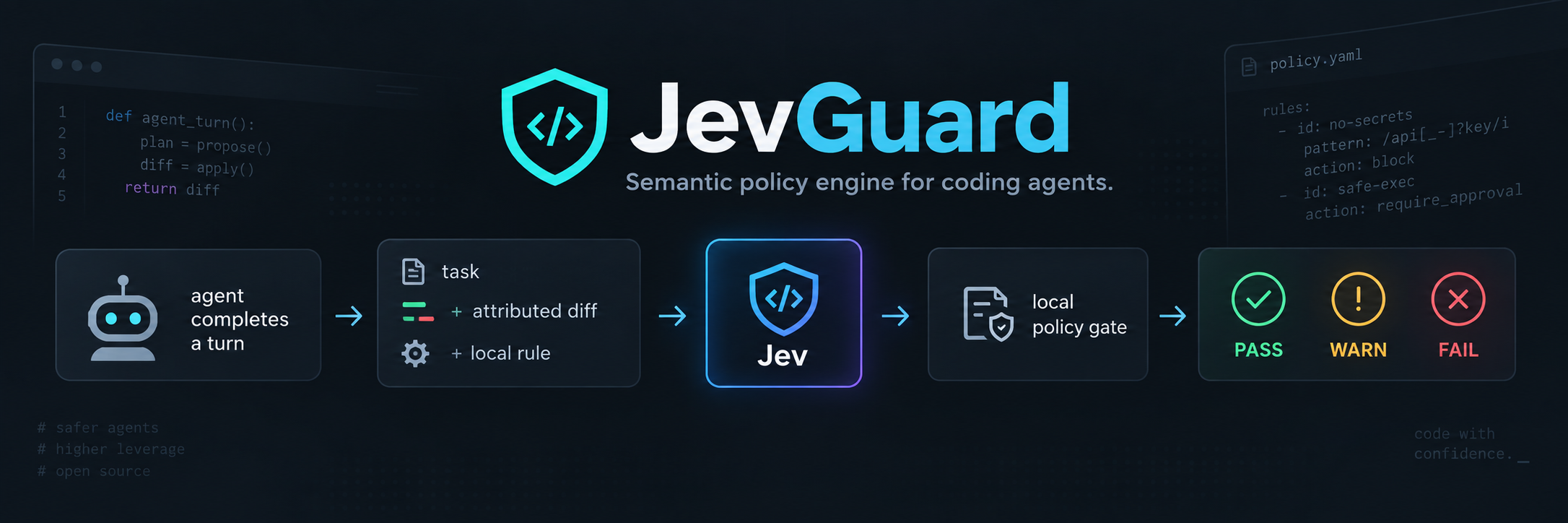
JevGuard checks the code an agent just changed against the policies that matter in
your repository. It uses Jev for a narrow semantic judgment per rule, then applies
your local deterministic gate to return PASS, WARN, or FAIL.
agent completes a turn
        ↓
task + attributed diff + local rules
        ↓
   Jev per rule
        ↓
local policy gate per rule
        ↓
  PASS · WARN · FAIL
Not a code generator. Not a prose review bot. Not another static linter.
JevGuard is a semantic linter: it asks whether a specific change violated a specific policy, and leaves planning, code generation, and correction with the coding agent.
Warning
JevGuard is in active development. The current release targets OpenCode 1.18.31,
evaluates every rule block declared in .jev/rules.md, and runs in observe mode
only: it reports results but never alters the agent context or blocks a task.
Why JevGuard
Traditional linters are excellent at syntax, types, and patterns. They cannot reliably answer repository-specific questions such as:
- Did a controller start making domain decisions?
- Did this business-rule change arrive without meaningful tests?
- Did the agent solve a small task by introducing an unnecessary abstraction?
- Did a change cross an architectural boundary that this codebase protects?
JevGuard makes those questions versioned, scoped, and machine-actionable.
## ARCH-001

severity: error
scope: backend/**

### Rule

HTTP controllers must not contain business logic.

### Violation

A controller performs domain decisions, calculations, or state mutations directly.

### Allowed

Validation, HTTP mapping and delegation to services.
The rule stays in the repository beside the code it governs. Allowed is a real
exception, not a suggestion. JevGuard evaluates it as part of the same rule.
The contract
JevGuard is built around one non-negotiable idea: review the change that belongs to the turn, not whatever happens to be in the worktree.
user task
   ↓
assistant response
   ↓
attributed patch
   ↓
applicable rules
   ↓
one semantic judgment per rule
If complete attributed evidence is unavailable, too large, invalid, or contains a
blocked sensitive file, JevGuard marks the affected rule UNAVAILABLE. It never
turns incomplete evidence into a reassuring verdict. Evidence problems are scoped
to the rules they affect: a rule whose applicable files are all safe still runs
even when another rule's evidence is blocked.
Some failures happen before any policy rule is evaluated — the attributed diff
cannot be built, the policy files cannot be read, or .jev/rules.md is missing.
JevGuard reports those as a single synthetic UNAVAILABLE entry with no rule ID; it
does not invent one result per declared rule.
How a review works
For every applicable rule, JevGuard sends Jev one focused yes/no question:
Does this attributed change violate
ARCH-001?
Jev returns a Noul: the probability that the answer is yes. JevGuard owns the policy that translates it into an outcome.
| Rule severity | PASS | WARN | FAIL |
|---|---|---|---|
error | < 40% | 40%–69% | ≥ 70% |
warning | < 60% | ≥ 60% | never |
Thresholds are locally configurable in .jev/config.yaml.
Install
Once @jevguard/plugin is published to npm, the intended install is one line in
opencode.json:
{ "plugin": ["@jevguard/plugin"] }
OpenCode then resolves the package from the npm registry or its cache and loads it
on the next start. Adding the entry only loads the plugin; it does not put the
jevguard CLI on PATH (see Install the CLI). Restart
OpenCode after changing the plugin list.
Important
@jevguard/plugin is not published to npm yet. The one-line entry above is
future behavior and will not resolve until the package is released. Before
publication, load the plugin as a local artifact plugin instead.
Build the local artifact
The artifact ships the plugin as a locally packed tarball that bundles the
private @jevguard/core and @jevguard/opencode-adapter workspace code, so a
clean consumer installs one tarball and never resolves a workspace link or a
private registry package.
Build the tarball from this repository:
corepack enable
pnpm install
pnpm artifact:build
pnpm artifact:pack
pnpm artifact:pack writes artifacts/jevguard-plugin-<version>.tgz. Both
packages/plugin/dist/ and artifacts/ are build output and are not committed.
The packed manifest depends only on public runtime packages
(@inquirer/password, @napi-rs/keyring, @typesafe-ai/sdk, yaml). Installing
the tarball therefore needs npm registry access for those packages; the artifact
does not vendor them and does not promise an offline install.
Load the local plugin before publication
OpenCode 1.18.31 resolves a bare opencode.json plugin entry from the npm
registry or its cache, not from the consumer's node_modules. Until the package is
published, install the tarball into the project's .opencode directory and load it
through a local plugin shim:
cd /path/to/consumer/.opencode
bun add /path/to/jevguard-plugin-<version>.tgz
// .opencode/plugins/jevguard.ts
export { JevGuardPlugin } from "@jevguard/plugin";
OpenCode loads .opencode/plugins/ with its bundled Bun runtime. The shim runs as
a local plugin module and resolves @jevguard/plugin from
.opencode/node_modules. Do not add @jevguard/plugin to the opencode.json
plugin list before publication; that bare entry does not resolve locally.
Install the CLI
Loading the plugin does not expose the jevguard binary on PATH. Once the
package is published, run the login command without a global install:
bunx --package @jevguard/plugin jevguard login
Or install the package globally so jevguard is on PATH:
bun install --global @jevguard/plugin
jevguard login
Until the package is published, install the local tarball globally instead:
bun install --global /path/to/jevguard-plugin-<version>.tgz
jevguard login
Known limitations:
@jevguard/pluginhas no registry release yet, so the one-lineopencode.jsonplugin entry does not resolve until the package is published.- Target host is OpenCode
1.18.31. Exact1.18.31runtime smoke is still pending; a local1.18.28run worked. - The plugin and CLI run on Bun, and the packed
jevguardbin keeps a Bun shebang. Install and run the artifact with the Bun runtime.
Connect Jev
For local use, connect once with the installed command:
jevguard login
Loading the plugin does not put jevguard on PATH. If it is not installed
globally, run the one-line login instead:
bunx --package @jevguard/plugin jevguard login
JevGuard stores the key in your operating system's credential store instead of a
repository file or shell history. In CI, provide TYPESAFE_API_KEY through the
platform secret manager. See the security model for details.
JevGuard FAIL
pass 1 · warn 1 · fail 1 · skipped 0 · unavailable 0
One toast per turn shows the aggregate outcome and the outcome counts; the structured log carries every rule's result, its raw violation probability or typed reason, and its scoped paths. The counts include every entry, including the single synthetic entry a review-level failure produces.
PASS, WARN, and FAIL are per-rule semantic outcomes. SKIPPED means that
rule had no applicable change to evaluate. UNAVAILABLE means JevGuard could not
safely or completely evaluate that rule.
Implemented behavior
The current release implements the full local, observe-only path:
- OpenCode V1 plugin loads.
- A completed assistant response is detected.
- The direct parent user task and assistant-attributed diff are acquired.
- Every
## <RULE-ID>block in.jev/rules.mdis parsed in source order. Each block is validated independently, so one invalid block does not suppress its valid siblings, and every occurrence of a duplicated ID is invalid. - Each valid rule is processed independently. It asks Jev at most once, and only when the gate config is valid, the rule is applicable, and its scoped evidence is complete and safe; it produces one typed violation probability or an operational outcome.
- A failure before rule evaluation — no attributed diff, unreadable policy files, or
a missing
.jev/rules.md— is reported as one syntheticUNAVAILABLEentry with no rule ID, not one result per declared rule. - The local gate maps each rule to
PASS,WARN, orFAIL; a rule with no applicable scope isSKIPPED, and a rule that cannot be safely evaluated isUNAVAILABLE. - One aggregate TUI toast and one structured log entry report the turn. The log carries every entry's outcome, raw probability, or reason, and the counts include the synthetic review-level entry when there is one.
No feedback is injected into the agent session. No remediation is attempted. No task is blocked.
Roadmap
The multi-rule slice is implemented. Planned work beyond it:
V0.3  Built-in semantic checks: scope creep, complexity, test adequacy
  ↓
V0.4  jev-init: evidence-based policy bootstrap
  ↓
V0.5  On-demand evidence and explanations
  ↓
V0.6  Opt-in, bounded auto-remediation
  ↓
V0.7  Observe / enforce / remediate modes
  ↓
V0.8  Rule packs
  ↓
V0.9  Local feedback and calibration
  ↓
V1    Claude Code and Codex adapters
CI and pull-request policy review come after V1, using the same versioned rules.
Architecture
JevGuard is a pnpm TypeScript monorepo. The core has no dependency on OpenCode or its runtime, which keeps the evaluation model portable to future adapters.
packages/
├── core/                 domain, policy, evaluation, gate
├── opencode-adapter/     OpenCode attribution and presentation
├── plugin/               OpenCode composition root and CLI
└── testkit/              fixtures and contract helpers

plugin → opencode-adapter → core
Status
The multi-rule, observe-only review is implemented. It loads in OpenCode,
attributes one completed turn, parses every rule block in .jev/rules.md, asks Jev
once per applicable rule, applies the local gate to each, and presents one
aggregate result as a transient TUI toast and a structured log entry.
The local, private tarball (pnpm artifact:build, pnpm artifact:pack) packages
that slice so a clean consumer can install it without workspace links.
OpenCode sees only transient toasts and structured logs. JevGuard does not inject
anything into the agent context, does not add session messages, and does not block
a task. Real-host validation against exact OpenCode 1.18.31 is still pending.
Development
Requirements: Node.js >=22.13.0, pnpm 10.33.2 (via Corepack), and the Bun
runtime for the CLI and OpenCode plugin loading.
corepack enable
pnpm install
pnpm typecheck
pnpm test
Use pnpm check to run format, lint, typecheck, and tests in sequence. See
CONTRIBUTING.md for the full contribution workflow.
Documentation
License
MIT — see LICENSE.