BLAZE_PROTOCOL
March 14, 2025 · View on GitHub
Executive Summary
Blaze Protocol eliminates the traditional friction of blockchain applications by separating transaction signing from settlement. Users sign transactions with our Signet Wallet browser extension, creating cryptographically secure digital IOUs that applications can submit for settlement at the optimal time. This approach enables:
- Instant user experience with optimistic UI updates (interface shows changes immediately with settlement later)
- Batch processing of up to 200 transactions in a single on-chain operation
- Private self-custody of signed transactions until the optimal time for revelation
- Application-controlled settlement for maximum efficiency and user experience
By building on the Stacks L1.5 (anchored to Bitcoin), Blaze creates a secure, scalable Layer 2 solution that makes Web3 feel as seamless as Web2.
Seeing is Believing: OP_PREDICT in Action
What if you could use blockchain applications without knowing they're blockchain applications?
Start by experiencing our flagship demo: OP_PREDICT - a fully functional prediction market platform with lightning-fast transactions, immediate UI updates, and no blockchain friction.
Place a prediction in under 3 seconds:
- Browse markets
- Select your prediction
- Confirm with a single click (with fine-grained application permission grants)
- See your transaction processed instantly
No waiting for confirmations. No cryptic wallet popups. Just a seamless web experience backed by the security of blockchain.
The Problem We're Solving
Blockchain applications today suffer from:
- Slow transaction confirmations
- Clunky wallet interfaces that compromise UX
- Technical jargon that alienates mainstream users
Blaze Protocol eliminates these barriers completely.
How Blaze Powers Real Applications
OP_PREDICT: Prediction Markets Reimagined
Our OP_PREDICT platform demonstrates how Blaze transforms the user experience:
- Instant Confirmations: Predictions appear in your portfolio immediately
- Seamless Wallet Integration: Sign transactions without interrupting your flow
- Optimistic UI: Real-time updates in the interface before blockchain confirmation (the UI "optimistically" assumes the transaction will succeed)
- Cost Efficiency: Multiple predictions batched into single on-chain transactions
Behind the scenes, OP_PREDICT leverages Blaze's infrastructure while users enjoy a familiar web experience.
Beyond Prediction Markets
Blaze Protocol can power diverse applications requiring high transaction throughput:
- DeFi Platforms: Trading, lending, and borrowing with instant execution
- Gaming Economies: In-game transactions and NFT transfers without delays
- Social Tokens: Tipping, rewards, and engagement tokens with immediate feedback
- Creator Economies: Seamless monetization for content and digital assets
The Technical Core: How It Works
Dual Authorization Mechanism
The heart of Blaze's innovation lies in its dual authorization approach:
Traditional Smart Contract Authorization:
- Smart contracts typically authorize operations by checking if
tx-sendermatches the sender address - This requires users to submit on-chain transactions for every operation
- Example from standard transfer function:
(define-public (transfer (amount uint) (from principal) (to principal) ...)
  ...
  ;; Auth check - only the owner can send their tokens
  (asserts! (is-eq tx-sender from) ERR_UNAUTHORIZED)
  ...
)
Blaze's Signature-Based Authorization:
- Blaze extends the standard model with cryptographic signature verification
- Users sign messages off-chain using their private keys
- The contract verifies the signature to extract the signer's principal
- This principal is then used for authorization instead of tx-sender
- Example from signed transfer function:
(define-public (signed-transfer (signet {signature: (buff 65), nonce: uint}) (to principal) (amount uint))
  (let
    (
      ;; Extract signer's principal from signature verification
      (signer-principal (unwrap! (verify-transfer-signer signet to amount) ERR_INVALID_SIGNATURE))
      ...
    )
    ;; Authorization happens via signature, not tx-sender
    ;; Check balance of signer, not tx-sender
    (asserts! (>= (get amount (current-from-balance)) amount) ERR_INSUFFICIENT_BALANCE)
    ...
  )
)
This dual approach enables:
- Direct on-chain transactions (traditional approach)
- Off-chain signed operations that anyone can submit to the chain
Digital IOUs: The Core Concept
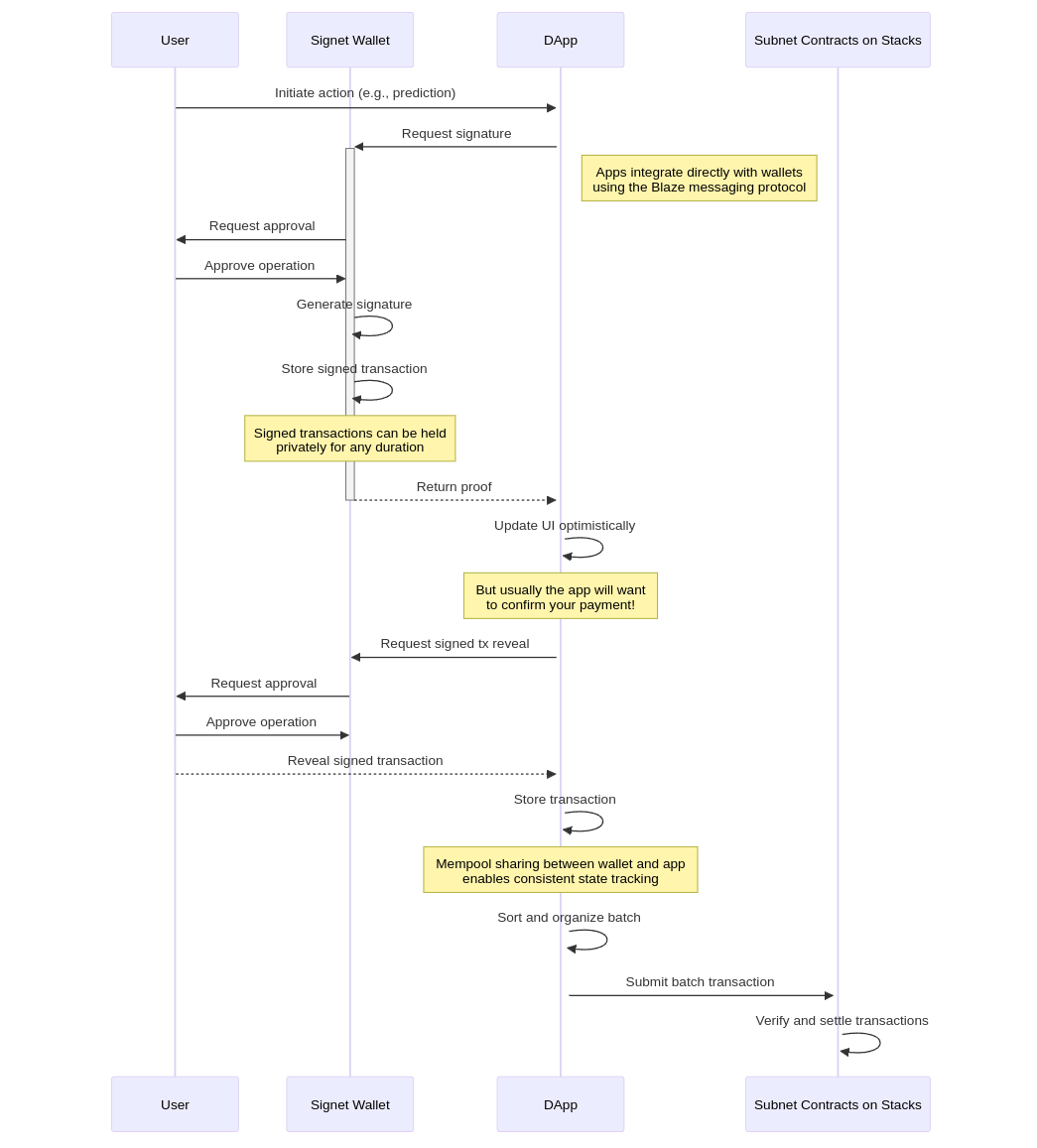
The true innovation of Blaze lies in its ability to create cryptographically secured IOUs that can be settled on-chain at any point in the future. Here's how the system works at its core:
1. Creation of Digital IOUs
- When users sign a transaction (like a prediction in OP_PREDICT), they're essentially creating a cryptographic IOU
- This signature is a binding agreement: "I authorize moving X tokens from my account to Y recipient and will receive NFT Z"
- The signature + transaction data creates a portable, provable claim that can be redeemed later
2. Private Mempool Architecture
- Every Signet wallet contains its own private mempool and transaction processor
- When users sign a transaction, the complete data (transaction + signature) is stored in the wallet's mempool
- Applications running the Signet SDK can request this data through a secure messaging protocol
- This creates a network of distributed mempools, each tracking pending transactions
3. Optimistic Updates with Delayed Settlement
- After a user signs a prediction in OP_PREDICT:
- The app requests the full transaction data and signature
- The app adds this to its own mempool and updates the UI immediately
- The user sees their prediction confirmed instantly
- The app can batch multiple signed transactions later for efficiency
4. Atomic Execution with Failure Handling
- When transactions are submitted on-chain, they execute atomically
- For example, if a user signed a prediction but lacks sufficient funds when it's settled:
- The token transfer would fail
- The NFT mint would also fail (since they're atomically linked)
- The batch operation would track this individual failure
- Other operations in the batch would still succeed
- This handles complex success/failure scenarios without requiring pre-validation
5. Transaction Lifecycle Management
- Before on-chain settlement, signed transactions can be:
- Cancelled by the user (if supported by the application)
- Held pending certain conditions
- Transferred between parties (as tradeable IOUs)
This approach fundamentally changes the blockchain interaction model:
- Traditional: Users must be online, pay gas, and wait for confirmation for every transaction
- Blaze: Users sign once, applications handle settlement, updates appear instantly, and batch processing optimizes costs
Smart Contract Security
Our subnet contracts implement rigorous security measures:
- SIP-018 structured data signing for cryptographic protection
- Nonce-based replay protection prevents signature reuse
- Principal derivation from signatures for secure authorization
- Signature verification against standardized message formats
System Architecture
Blaze implements a multi-layered architecture that separates transaction signing from settlement:
Signet Wallet: The Missing Link for Web3 UX
Our Chrome extension wallet provides the crucial bridge between web applications and blockchain:
- Streamlined Signing: One-click approval for transactions
- Background Processing: Handles blockchain complexity while users enjoy the application
- Developer API: Simple integration for any web application
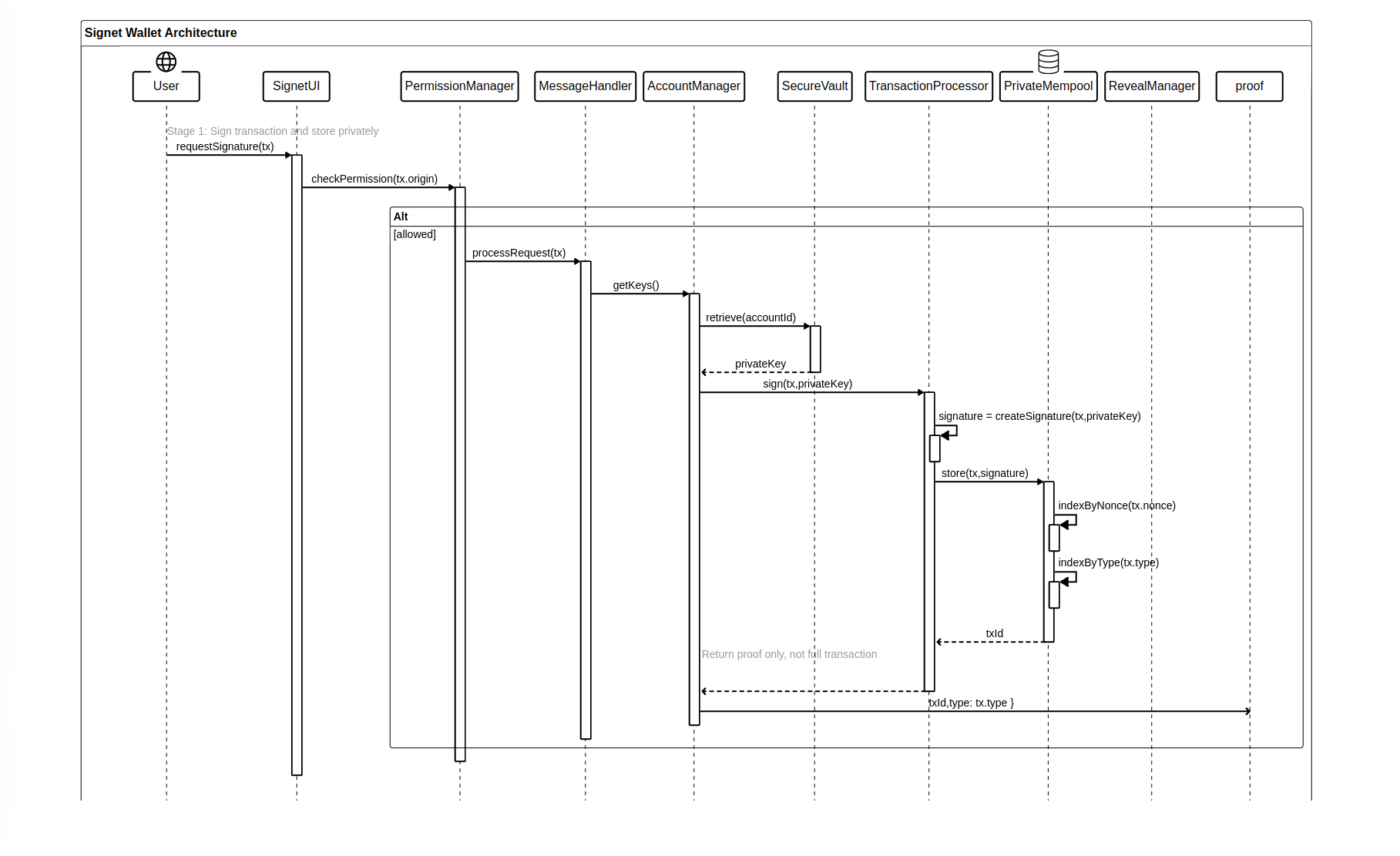
Wallet Architecture
The Signet Wallet implements a self-contained transaction processor with two-stage authorization and data encrypted at rest:
Signature Message Format
Blaze uses the SIP-018 structured data format for cryptographic signatures:
{
  "domain": {
    "name": "blaze",
    "version": "welsh-v1",
    "chainId": "mainnet"
  },
  "message": {
    "signet": {"signature": "0xdeadbeef", "nonce": 1234567890 },
    ...messageArgs
  },
}
Verification Flow
The signature verification process:
- Create structured data hash including domain separation prefix
- Hash the user's operation data (recipient, amount, nonce)
- Recover the signer's public key using secp256k1 recovery
- Convert to Stacks principal for authorization
- Compare against stored balances and permissions
Batch Processing Logic
The core efficiency of Blaze comes from its batch processing system:
- Transactions enter the mempool with cryptographic signatures
- Server nodes organize transactions by sender and nonce
- Up to 200 transactions are bundled in settlement-optimized batches
- A single on-chain operation executes the entire batch
- Each operation's success/failure is tracked independently
Security Guarantees
Despite its Layer 2 design, Blaze maintains critical security properties:
- Non-custodial operation (users control their keys)
- Mathematically verifiable transaction validity
- Fallback exit mechanisms to reclaim funds directly from contracts
- All security ultimately anchored to Bitcoin through Stacks' consensus
Unlocking New Blockchain Paradigms
Blaze's signature-based IOU system transforms what's possible on Bitcoin. Here are real use cases this technology enables:
1. Distributed Mempool Networks
How It Works:
- Applications and wallets share signed transaction data across a network
- Each node maintains its own view of pending transactions
- This creates a more accurate picture of off-chain balances and state
Real-World Applications:
- Cross-Platform Liquidity Tracking: Trading platforms can share pending transaction data to prevent double-spending across exchanges
- Decentralized Settlement Coordination: Nodes can optimize when to submit batches based on network conditions, gas prices, and accumulated fees
- Transaction Routing Markets: Services that collect and route transactions to the most efficient settlement paths, creating a competitive market for transaction processing
2. Signature Marketplaces
How It Works:
- Signed operations become tradable assets with economic value
- Markets emerge where users can buy, sell, or auction their signed transactions
- Since operations have zero on-chain cost until settlement, new incentive models emerge
Real-World Applications:
- Transaction Financing: Users without gas funds can sell their signed transactions to settlement providers who profit from batch execution
- Claim Trading: In prediction markets, users can sell their winning position claims before settlement
- Priority Markets: During high congestion, users can pay for priority inclusion in the next settlement batch
- Algorithmic Batching: Services that analyze the mempool and construct optimal batches, selling guaranteed inclusion
3. Time-Delayed and Conditional Transactions
How It Works:
- Signed transactions remain valid but don't need immediate execution
- Applications can hold transactions and submit them only when specific conditions are met
- Users retain cancellation rights until on-chain submission
Real-World Applications:
- Scheduled Payments: Users sign weekly subscription payments that execute automatically
- Release-on-Delivery Services: Payments that execute only when digital goods are delivered
- Dead Man's Switch: Transactions that execute if a user doesn't cancel them within a timeframe
- Conditional Crowdfunding: Pledges that only execute if a total funding goal is reached
4. Gasless DAO Governance
How It Works:
- DAO members sign votes off-chain without paying gas
- A single submitter batches all votes into one transaction
- The system maintains provable record of all votes through signatures
Real-World Applications:
- Micro-Proposal Voting: Enables frequent voting on small issues without gas costs
- Delegation Chains: Users can sign delegation transactions to other members without on-chain costs
- Quadratic Voting Systems: Complex voting systems become practical when users don't pay for each interaction
- Multi-Stage Governance: Proposals pass through multiple review stages, with signatures collected at each stage
5. Micro-transaction Economies
How It Works:
- Users make many tiny-value transactions that would be impractical with gas fees
- Applications batch these micro-transactions into efficient settlements
- User experience remains instant while dramatically reducing costs
Real-World Applications:
- Content Streaming Payments: Pay-per-second for video or music streaming
- In-Game Economies: Purchase virtual items or perform in-game transactions without blockchain friction
- Micro-Tipping Systems: Reward content creators with tiny amounts for individual posts or actions
- Usage-Based API Services: Pay exactly for the API calls you make, settled in batches
6. Optimistic Rollups Without Operators
How It Works:
- Traditional optimistic rollups require centralized operators
- With Blaze, any participant can submit batches of signed transactions
- The system becomes more decentralized while maintaining efficiency
Real-World Applications:
- Community-Operated Subnet Networks: Groups can form around specific tokens or applications
- Self-Healing Systems: If primary submitters fail, others can take over settlement duties
- Cross-Chain Coordination: Transactions spanning multiple subnets can be atomically settled
- Dynamic Fee Markets: Batch submitters compete based on efficiency and fee structures
7. Frictionless Onboarding
How It Works:
- New users can start interacting with applications immediately
- Their first signed operations are held pending account setup
- A sponsor can cover initial gas costs in exchange for a portion of future activity
Real-World Applications:
- Try-Before-You-Fund: Users test applications before funding their wallets
- Gasless Airdrops: Projects can distribute tokens to users who sign acceptance transactions
- Sponsored Onboarding: Applications pay onboarding costs for valuable users
- Progressive Identity Systems: Start with pseudonymous signatures, gradually building verifiable credentials
Join the Revolution
Blaze Protocol represents a fundamental shift in how blockchain applications can function. By making the technology invisible while preserving its core benefits, we're opening the door to mainstream adoption.
Get Involved
- 🚀 Try the Demo: Experience OP_PREDICT today
- 🔧 Build with Blaze: Integrate our SDK into your application
- 🌐 Join our Community: Follow me on Twitter
Be part of the movement to make blockchain applications accessible to everyone.