syscalls-cpp
May 22, 2026 · View on GitHub
syscalls-cpp is a C++20 policy-based framework for crafting undetectable/protected syscalls (x86 / x64). It leverages a policy-based design to let you mix and match different strategies for memory allocation and stub generation at compile-time, giving you full control over your operational security tradeoffs.
The core principle is modularity. You are not given a black box; you are given building blocks.
The library automatically resolves system call numbers by directly parsing ntdll.dll's metadata. This method is resilient to user-mode hooks by leveraging the PE's structure—the exception directory on x64 and sorted export addresses on x86—and can find adjacent syscalls if a target is patched.
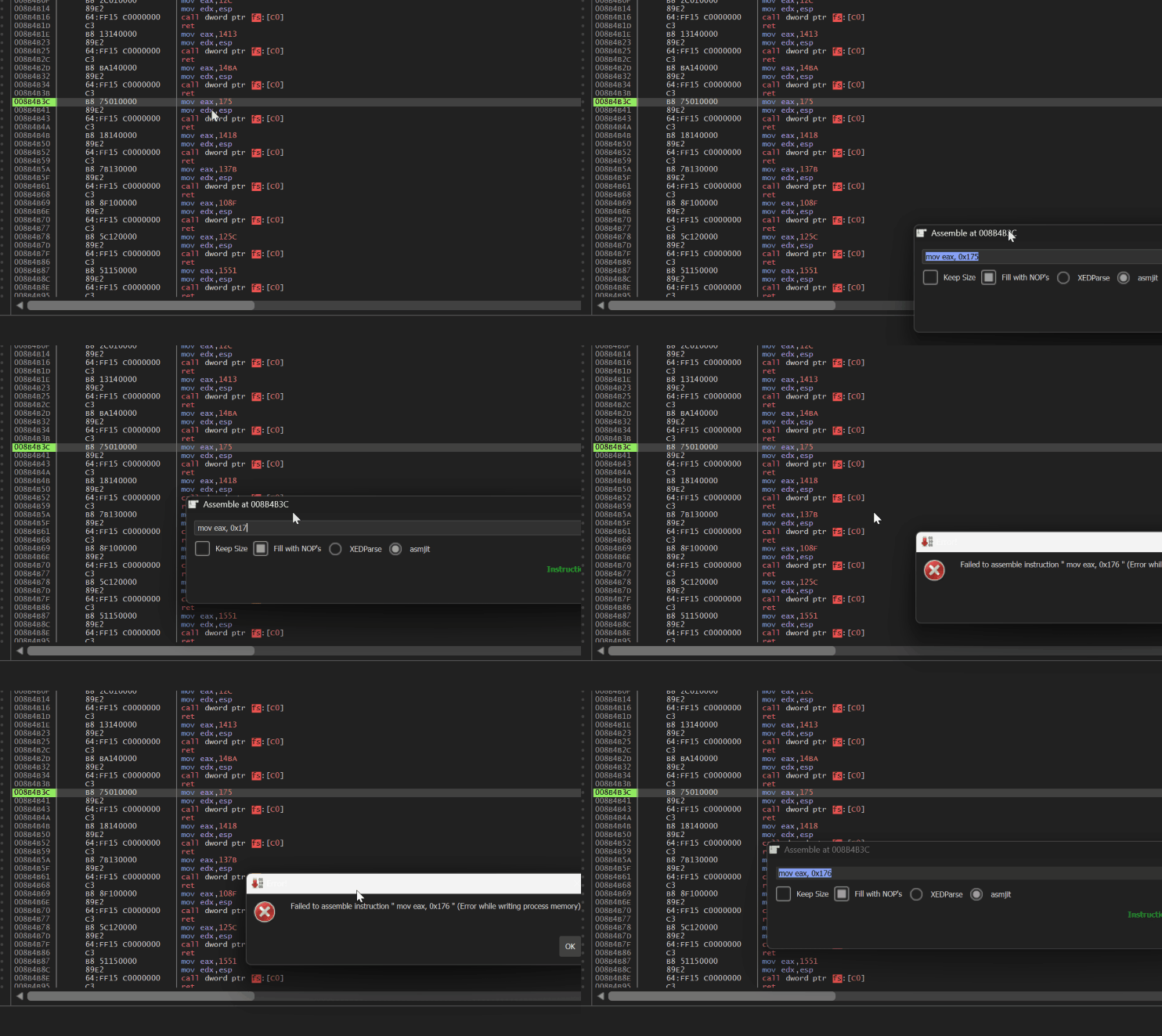
*Allocation demonstration: an attempt to patch a system call located in a section with the SEC_NO_CHANGE flag fails.
The Building Blocks: Provided Policies
You can combine any allocation policy with any stub generation policy.
Allocation Policies (IsAllocationPolicy)
| Policy | Method |
|---|---|
allocator::section | NtCreateSection with SEC_NO_CHANGE flag |
allocator::heap | HeapCreate with HEAP_CREATE_ENABLE_EXECUTE |
allocator::memory | NtAllocateVirtualMemory (RW -> RX) |
Stub Generation Policies (IsStubGenerationPolicy)
| Policy | Method |
|---|---|
generator::direct | Uses a classic, self-contained syscall instruction |
generator::gadget only | (Only x64) Jumps to a syscall; ret gadget found in `ntdll.dll |
generator::exception | Triggers a breakpoint (ud2) to perform the syscall via a custom Vectored Exception Handler (VEH). |
Parsing Policies (IsSyscallParsingPolicy)
| Policy | Method |
|---|---|
parser::directory | On x64, maps the exception directory (.pdata) to the export table to determine the order of syscalls. On x86, it sorts exported Zw* functions by their memory addresses to calculate their numbers. |
parser::signature | Scans function prologues for the mov r10, rcx; mov eax, syscall_id signature with hooks detection. |
Installation
The recommended way to install and manage the library is through the C++ package manager vcpkg.
vcpkg install syscalls-cpp
This command will download, build, and install syscalls-cpp, making it easily accessible for your projects with automatic MSBuild and CMake integration.
Conan
You can also use Conan. Add the following to your conanfile.txt:
[requires]
syscalls-cpp/1.2.0
For manual setup, you can clone this repository and add the include directory to your project's include paths.
Community Ports
Community-maintained ports and bindings:
| Language | Repository |
|---|---|
| Rust | orange-cpp/syscalls-rs |
These ports are maintained by the community and may differ from the C++ implementation in API, features, and release cadence.
Example: Crafting Your Strategy
The power is in the combination. Here is how you build and use a syscall manager.
Standard Usage
#include <iostream>
#include "syscall.hpp"

int main() {
    syscall::SectionDirectManager syscallManager;
    // you can add your own modules for parsing syscalls, by default only ntdll is parsed
    if (!syscallManager.initialize(/* SYSCALL_ID("ntdll.dll"),  SYSCALL_ID("win32u.dll")*/))
    {
        std::cerr << "initialization failed!\n";
        return 1;
    }

    PVOID pBaseAddress = nullptr;
    SIZE_T uSize = 0x1000;

    syscallManager.invoke<NTSTATUS>(
        SYSCALL_ID("NtAllocateVirtualMemory"),
        NtCurrentProcess(),
        &pBaseAddress,
        0, &uSize,
        MEM_COMMIT | MEM_RESERVE,
        PAGE_READWRITE
    );

    if (pBaseAddress)
        std::cout << "allocation successful at 0x" << pBaseAddress << std::endl;

    return 0;
}
Advanced Usage
For more control, you can specify your own policy or build a custom allocators / generators / parsers
#include "syscall.hpp"

using UniqueSecretOwnPolicyManager = syscall::Manager<
        syscall::policies::allocator::heap, // heap allocator
        syscall::policies::generator::direct, // direct!!
        DefaultParserChain  // default exception/sort directory + improved halo gates as a fallback is used
>;

// or, let's build a custom parser chain using the ParserChain_t helper
// imagine you wrote a MyCustomParser policy
/*
using MyParserChain = syscall::ParserChain_t<
    MyCustomParser,
    syscall::policies::SignatureScanningParser
>;

using SuperCustomManager = syscall::Manager<
    syscall::policies::HeapAllocator,
    syscall::policies::GadgetStubGenerator,
    MyParserChain // own custom chain!!!
>;
*/
Warning
NULL vs. nullptr on x64
Always use nullptr instead of NULL when invoking syscalls on x64 platforms.
The NULL macro is often defined as an integer 0 (a 32-bit int). Passing it to a syscall expecting a 64-bit pointer can corrupt the stack, as the compiler may treat it as an integer and fail to properly extend it. This leads to argument misalignment and unpredictable crashes.
nullptr is type-safe and guarantees the correct 64-bit null pointer representation, preventing this subtle but critical bug.
Extensibility
The true power of the framework is its extensibility. You can easily write your own policies. Simply create a class that satisfies the required concept (IsAllocationPolicy, IsStubGenerationPolicy, or IsSyscallParsingPolicy), and it will be seamlessly compatible with the Manager.
Configuration
For easier debugging, you can disable the compile-time hashing mechanism by defining the SYSCALLS_NO_HASH macro. This will cause the manager to use std::string for syscall names instead of integer hashes.
- MSVC:
/DSYSCALLS_NO_HASH - GCC/Clang:
-DSYSCALLS_NO_HASH
Requirements
- A C++20 compatible compiler (MSVC, Clang, GCC).
- Windows targets (x86/x64)
LICENSE
MIT