midi2
July 28, 2026 · View on GitHub

Portable MIDI 2.0 infrastructure. Workbench Compliant MIDI 2.0. Build MIDI 2.0 platforms in any language, for any framework.
Compliant MIDI 2.0, C99, portable, zero-allocation, MIT. From 8-bit MCUs to 64-bit hosts.



The library
midi2 is a small piece of infrastructure for boards that already have too much to do. Sound chips, displays, USB stacks, sensors, network. MIDI 2.0 arrives at the transport layer as 32-bit words; midi2 turns those words into structured events and stays out of the way the rest of the time.
The library implements 100% of the UMP format (M2-104-UM v1.1.2) and 100% of MIDI-CI (M2-101-UM v1.2). The application owns memory and decides which modules to link. The transport (USB, BLE, network, serial) lives somewhere else, by design.
Wrappers
midi2 is the C99 core. Higher-level wrappers build on it and add language-specific ergonomics for each platform target.
The first published wrapper is midi2cpp: a C++17 Arduino-friendly wrapper with m2device, m2host, m2bridge and m2ci classes, distributed through the Arduino Library Manager, the PlatformIO Registry and the ESP Component Registry. It ships 28 platform recipes under midi2cpp/examples/, one per role (device, host, bridge), covering RP2040, RP2350, ESP32-S3, ESP32-P4, ESP32-C6, Teensy 4.1, Daisy Seed, nRF52840, SAMD21, RA4M1 and STM32F411 boards via Pico SDK / TinyUSB native CMake / ESP-IDF / PlatformIO build paths.
Contents
- midi2
- Portable MIDI 2.0 infrastructure. Workbench Compliant MIDI 2.0. Build MIDI 2.0 platforms in any language, for any framework.
- The library
- Wrappers
- Contents
- Spec coverage
- Quick start
- Modules
- Memory
- Error handling
- Continuous integration
- Build and test locally
- Integration
- Examples
- Architecture
- Design goals
- What this library is not
- Sponsor
- About
- Specifications and trademarks
- License
Spec coverage
| Spec | Document | Coverage |
|---|---|---|
| M2-104-UM v1.1.2 | UMP Format and MIDI 2.0 Protocol | 100% (all message types MT 0x0 through 0xF) |
| M2-101-UM v1.2 | MIDI-CI | 100% (all 31 messages, 4 categories, Appendix E responder) |
| M2-115-U v1.0.2 | Bit Scaling and Resolution | 100% (round-trip safe 7/14/16/32 bit) |
| M2-116-U v1.0 | MIDI Clip File | Partial (Delta Clockstamp, Start/End of Clip) |
Quick start
#include "midi2.h"

uint32_t w[2];
midi2_msg_note_on(w, /*group*/ 0, /*channel*/ 0,
                  /*note*/ 60, /*velocity*/ 0xC000,
                  /*attr_type*/ 0, /*attr_data*/ 0);

uint8_t  note = midi2_msg_get_note(w);
uint16_t vel  = midi2_msg_get_velocity(w);

uint16_t vel16 = midi2_msg_scale_up_7to16(127);
With typed dispatch:
#include "midi2.h"

void on_note_on(uint8_t group, uint8_t channel, uint8_t note,
                uint16_t velocity, uint8_t attr_type,
                uint16_t attr_data, void *ctx) {
    /* application logic */
}

midi2_dispatch dp;
midi2_dispatch_init(&dp);
dp.on_note_on = on_note_on;
midi2_dispatch_feed(w, 2, &dp);
Modules
The amalgam (dist/midi2.h + dist/midi2.c) is the recommended path. For finer control, modules can be picked individually:
| Module | Files | State | Purpose |
|---|---|---|---|
midi2_msg | .h | Stateless | UMP construction, parsing, value scaling. All MTs. MT 0x2 / MT 0x4 protocol translation. USB MIDI 1.0 cable event to UMP. |
midi2_dispatch | .h .c | Caller-allocated | Typed UMP dispatch (49 callbacks). Optional MT 0x2 to MT 0x4 upscale. |
midi2_proc | .h .c | Caller-allocated | Group filtering and remap, SysEx7/8 reassembly, UMP Stream and SysEx8 fragmenting senders. |
midi2_conv | .h .c | Caller-allocated | MIDI 1.0 byte stream to UMP (Running Status, streaming SysEx, MT 0x2 to MT 0x4 translation). |
midi2_ci_msg | .h | Stateless | MIDI-CI message construction and parsing. All 32 messages. |
midi2_ci_dispatch | .h .c | Caller-allocated | Typed CI dispatch (33 callbacks). |
midi2_ci | .h .c | Caller-allocated | Convenience CI responder: Discovery, Profiles, PE (Subscribe/Notify), Process Inquiry, MUID collision detection, optional NAK-on-unknown. Appendix E complete. |
midi2_msg alone is a header include with zero overhead.
Memory
Memory belongs to the application. midi2 does not call malloc, does not keep a hidden heap, and does not bake buffer sizes into headers. A 16 KB board declares small buffers. A desktop tool declares large ones. Same source, same API.
uint8_t sysex_buf[256];
midi2_proc_state proc;
midi2_proc_init(&proc, sysex_buf, sizeof(sysex_buf), NULL, 0);

uint8_t profiles[4][5];
midi2_ci_property props[2];
midi2_ci_state ci;
midi2_ci_init(&ci, seed, profiles, 4, props, 2);
Error handling
Functions that can fail return error codes. There is no global errno, no asserts that fire in release builds, no silent truncation.
int rc = midi2_ci_add_profile(&ci, profile_id);
if (rc == MIDI2_CI_ERR_FULL) {
    /* the application decides what to do */
}
Continuous integration
383 tests across 8 suites compile clean with -Wall -Wextra -Wpedantic. CI runs 17 jobs on every push:
| Target | Type |
|---|---|
| gcc Linux x64 | Compile and run |
| clang Linux x64 | Compile and run |
| Apple clang macOS | Compile and run |
| MSVC Windows | Compile and run |
| gcc 32-bit Linux x86 | Compile and run |
| gcc + ASan + UBSan | Compile and run |
| ARM Cortex-M4 | Cross-compile |
| AArch64 Cortex-A | Cross-compile |
| RISC-V 64 | Cross-compile |
| ESP32 (ESP-IDF component) | Cross-compile |
| AVR ATmega328P | Cross-compile (header-only) |
| AVR ATmega32U4 (LUFA example firmware) | Cross-compile |
| C++ header (g++ c++17 / c++20) | Compile |
| CMake (build, FetchContent consumer, sanitizers) | Compile and run |
| Zephyr (native_sim/native/64) | Compile and run |
Build and test locally
make test
make CC=clang test
Integration
midi2 ships in four shapes. Pick the one that matches your build flow.
Arduino IDE / arduino-cli
Install via Library Manager (search midi2, click Install) or manually drop the repo into ~/Arduino/libraries/midi2/. The library.properties declares the library; Arduino IDE compiles the modular src/*.c files automatically. Sketches use the umbrella header:
#include <midi2.h>
Reference sketches appear in the IDE's File > Examples menu after install: teensy-device-midi2, a complete USB MIDI 2.0 device for Teensy 4.x, and atmega32u4-device-arduino, the same device role on the Arduino Leonardo over the midi2duino transport. Both are validated against the official MIDI 2.0 Workbench.
PlatformIO
platformio.ini:
lib_deps = sauloverissimo/midi2 @ ^0.8.0
Library Manager pulls the same src/ modular layout via library.json (srcDir = src).
ESP-IDF (Component Manager)
Published on the ESP Component Registry. Add to your project's main/idf_component.yml:
dependencies:
  idf: ">=5.0"
  sauloverissimo/midi2: ">=0.8.0"
idf.py reconfigure drops the component into managed_components/midi2/. The if(ESP_PLATFORM) gate in CMakeLists.txt routes ESP-IDF builds to idf_component_register with the modular src/midi2_*.c set, so the same source serves IDF, Arduino, PlatformIO, and native CMake without forks.
Zephyr (west module)
midi2 ships a zephyr/ module manifest. Add it to your application's west.yml:
manifest:
  projects:
    - name: midi2
      url: https://github.com/sauloverissimo/midi2
      revision: v0.8.0
      path: modules/lib/midi2
Then enable in prj.conf:
CONFIG_MIDI2=y
west build picks up the module via zephyr/module.yml and compiles the modular src/midi2_*.c set under Zephyr's CMake. midi2 stays at the message layer; pair with CONFIG_USBD_MIDI2 for USB UMP I/O, or with the Network MIDI 2.0 stack for IP-based transport.
A ready-to-flash Zephyr example for the Raspberry Pi Pico (RP2040) lives under examples/rpi-pico-device-zephyr/: full-spec USB MIDI 2.0 device with a 14-scene UMP showcase plus a MIDI-CI responder.
Single-header (stb-style)
Drop dist/midi2.h only. In exactly one .c file:
#define MIDI2_IMPLEMENTATION
#include "midi2.h"
Manual vendor (amalgam pair)
Download dist/midi2.h and dist/midi2.c from the release page. Drop both into the tree. Compile midi2.c alongside the project.
#include "midi2.h"
Works with Arduino, PlatformIO, ESP-IDF, CMake, Make, plain gcc.
Module by module
For finer control, copy individual files from src/:
midi2_msg.h          Always needed. Header-only.
  +- midi2_dispatch  Typed UMP callbacks.
  +- midi2_proc      SysEx reassembly, group filtering.
  +- midi2_conv      MIDI 1.0 byte stream to UMP.
  +- midi2_ci_msg    MIDI-CI message construction and parsing.
       +- midi2_ci_dispatch  Typed CI callbacks.
       +- midi2_ci           Convenience CI responder.
Examples
Five real USB MIDI 2.0 devices live under examples/, each wiring the same C99 core to a different runtime and USB stack.
examples/teensy-device-midi2/: Arduino sketch for Teensy 4.x over the core's nativeusbMIDI2endpoint. A bareloop(), no RTOS.examples/rp2350-device-freertos/: Raspberry Pi Pico 2 (RP2350) on FreeRTOS-Kernel and TinyUSB upstream, with a 58-entry UMP catalog covering every defined message-type category, a MIDI-CI responder, and a stress loopback mode.examples/rpi-pico-device-zephyr/: Raspberry Pi Pico (RP2040) on Zephyr's nativeusbd_midi2class.examples/atmega32u4-device-arduino/: Arduino Leonardo over the midi2duino transport (PluggableUSB, stock Arduino core).examples/atmega32u4-device-baremetal/: Arduino Pro Micro, bare metal C99 over the midi2lufa transport (LUFA), one super-loop at 16 MHz.
All five are validated on hardware against the official MIDI 2.0 Workbench: MIDI-CI Discovery, Profile Configuration, and Property Exchange answer with zero errors and zero warnings.
Architecture
midi2: infrastructure layer 2 of a 4-layer MIDI 2.0 stack:
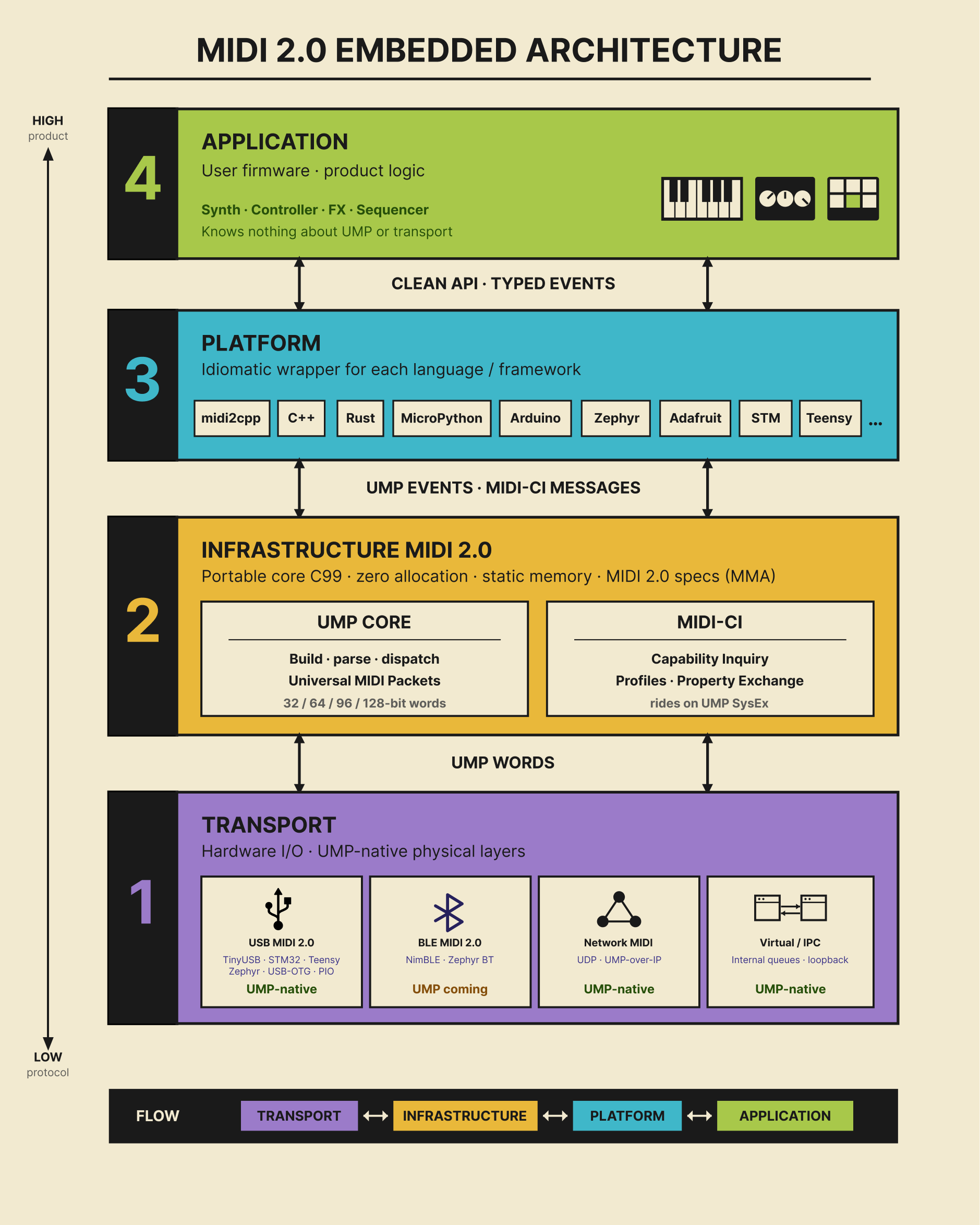
What each layer owns:
| Concern | Layer |
|---|---|
| USB descriptors, endpoints, DMA | Transport |
| UMP construction, parsing, scaling | midi2 |
| Typed dispatch (49 UMP + 33 CI callbacks) | midi2 |
| SysEx reassembly, group filtering | midi2 |
| CI construction and parsing | midi2 |
| MIDI 1.0 byte stream conversion | midi2 |
| CI convenience responder (optional) | midi2 |
Arduino-style callbacks (onNoteOn) | Platform |
| Profile behavior (GM2, MPE) | Platform or App |
| PE JSON schema interpretation | Platform or App |
| FreeRTOS tasks, event queues | Platform |
| Musical application logic | App |
Design goals
- Embedded first. The same source compiles for AVR ATmega328P, Cortex-M0, RISC-V 64, ESP32 Xtensa, and 64-bit desktops. The smallest target dictates the design.
- Zero allocation. No
malloc, no hidden heap, no per-call buffers. The application sizes everything at init. - Stateless where possible.
midi2_msgkeeps no state; the same word array round-trips through any number of helpers without coupling. - Three system headers.
<stdint.h>,<stdbool.h>,<string.h>. That is the dependency list. - Errors are codes, not exceptions. Functions report what happened; the application decides.
- Spec-complete on its own scope. 100% of UMP. 100% of MIDI-CI. Anything outside those documents lives elsewhere.
What this library is not
The boundary is drawn so the core stays portable. A few things deliberately do not belong here.
- Not a transport. USB-MIDI 2.0, BLE MIDI, Network MIDI 2.0, Serial DIN: each has its own driver. midi2 reads and writes UMP words; the wire is somebody else's responsibility.
- Not a JSON parser. Property Exchange headers are JSON, but parsing JSON in a zero-allocation embedded library is a poor fit. The application chooses a JSON parser at the platform layer.
- Not a Profile implementation. GM2, MPE, and the M2-118 through M2-125 profiles describe device behavior. midi2 carries the negotiation messages; the behavior lives in the application.
- Not the fastest UMP library. Speed was not a primary goal. Correctness, portability, and predictable memory were. On a Cortex-M4 at 168 MHz, midi2 dispatches faster than any USB transport can deliver words anyway.
Sponsor
You can sponsor midi2 at GitHub Sponsors. Sponsorship funds spec access, hardware for cross-platform validation, and continued maintenance.
About
midi2 is created and maintained by Saulo Veríssimo.
Specifications and trademarks
The MIDI 2.0 specifications referenced here are copyright of the MIDI Association and available at https://midi.org/midi-2-0.
"MIDI" is a registered trademark of the MIDI Manufacturers Association (now MIDI Association). "MIDI 2.0", "MIDI-CI", and "UMP" are terms defined by the MIDI Association in the public specifications.
License
MIT. Free for commercial and open-source use.