OpenDeck
June 15, 2026 · View on GitHub
OpenDeck is a platform for building interactive control and sensing devices using MIDI and OSC. From USB MIDI DJ controllers and DAW control surfaces to Ethernet-connected OSC nodes, sensor interfaces and media installations, OpenDeck supports a wide range of hardware projects.
The main platform features:
- Browser-based configuration
- No firmware development required
- Hardware-independent - supports multiple MCU families and development boards
- MIDI and OSC support
- Extensible sensor support
The platform lets you focus on hardware and interaction design rather than tweaking and debugging firmware.
Click the image below for a demo video of the OpenDeck configurator
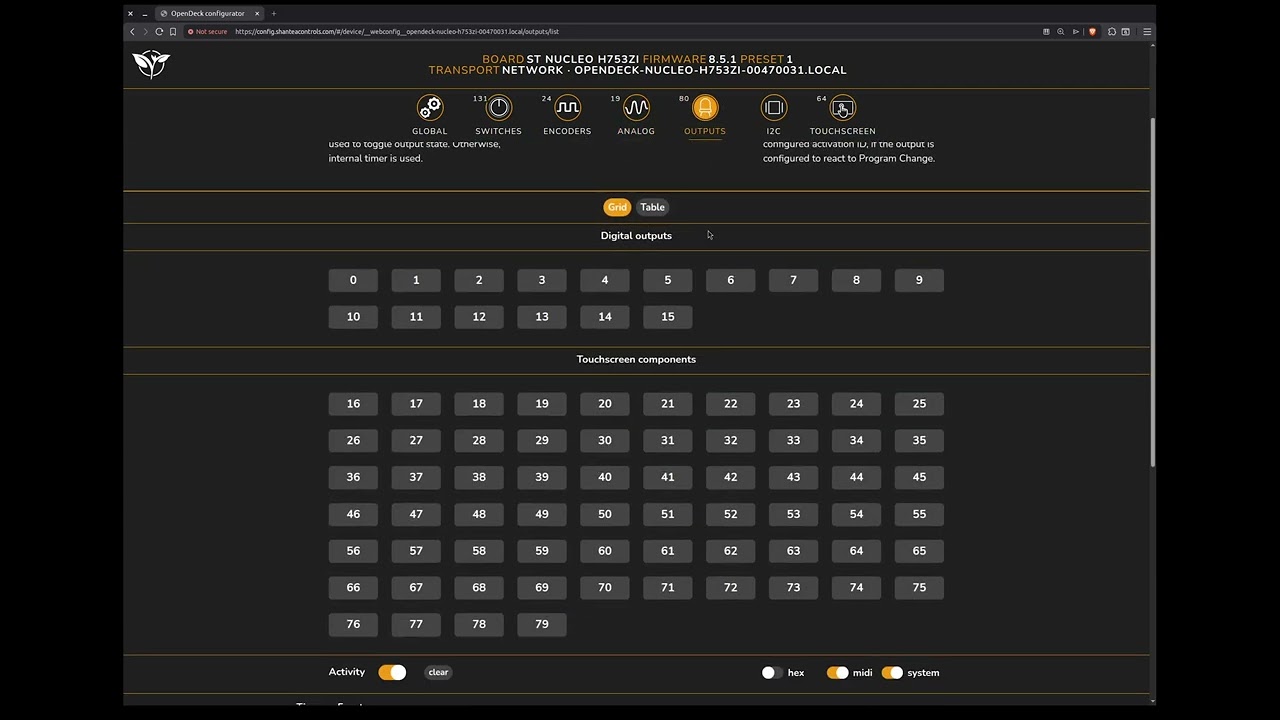
Configurator is available either online or offline.
Some of the devices built with OpenDeck

Peripherals
OpenDeck supports the following peripherals:
Core I/O
- Buttons
- Encoders
- Single-color LEDs and other types of outputs such as relays or transistors
- Potentiometers
- FSRs (force-sensitive resistors)
Displays
- Nextion HMI touchscreen displays
- SSD1306 small OLED display
Sensors
- APDS-9960 proximity, light, RGB, and gesture sensor - OSC only
- CAP1188 8-Key Capacitive Touch Sensor - OSC only
- VL53L4CX time of flight distance sensor - OSC only
- VL53L5CX 8x8 time of flight distance sensor - OSC only
- BNO085 9-DOF orientation IMU fusion sensor - OSC only
Each sensor has specific configuration options such as smoothing, selectable event output etc.


Features
OpenDeck provides extensive MIDI and OSC functionality:
- MIDI: sending of both 7-bit and 14-bit Non-Registered Parameter Numbers (NRPN), latching messages on buttons, various encoding modes for quadrature encoders, output control using MIDI In, configurable MIDI channels for each component individually, Bluetooth MIDI and more.
- OSC: Ethernet transport, configurable destinations, sensor data streaming, output control, automatic network discovery via mDNS, network-based configuration and firmware updates.
A detailed guide to all supported configurable features can be found here.
If the feature you want isn't supported yet, don't feel discouraged. Open up a discussion thread and let's talk about it.
Official board
Currently, there is only one official board available to buy: the L variant, where "L" stands for "large". The board is available on Lectronz store.
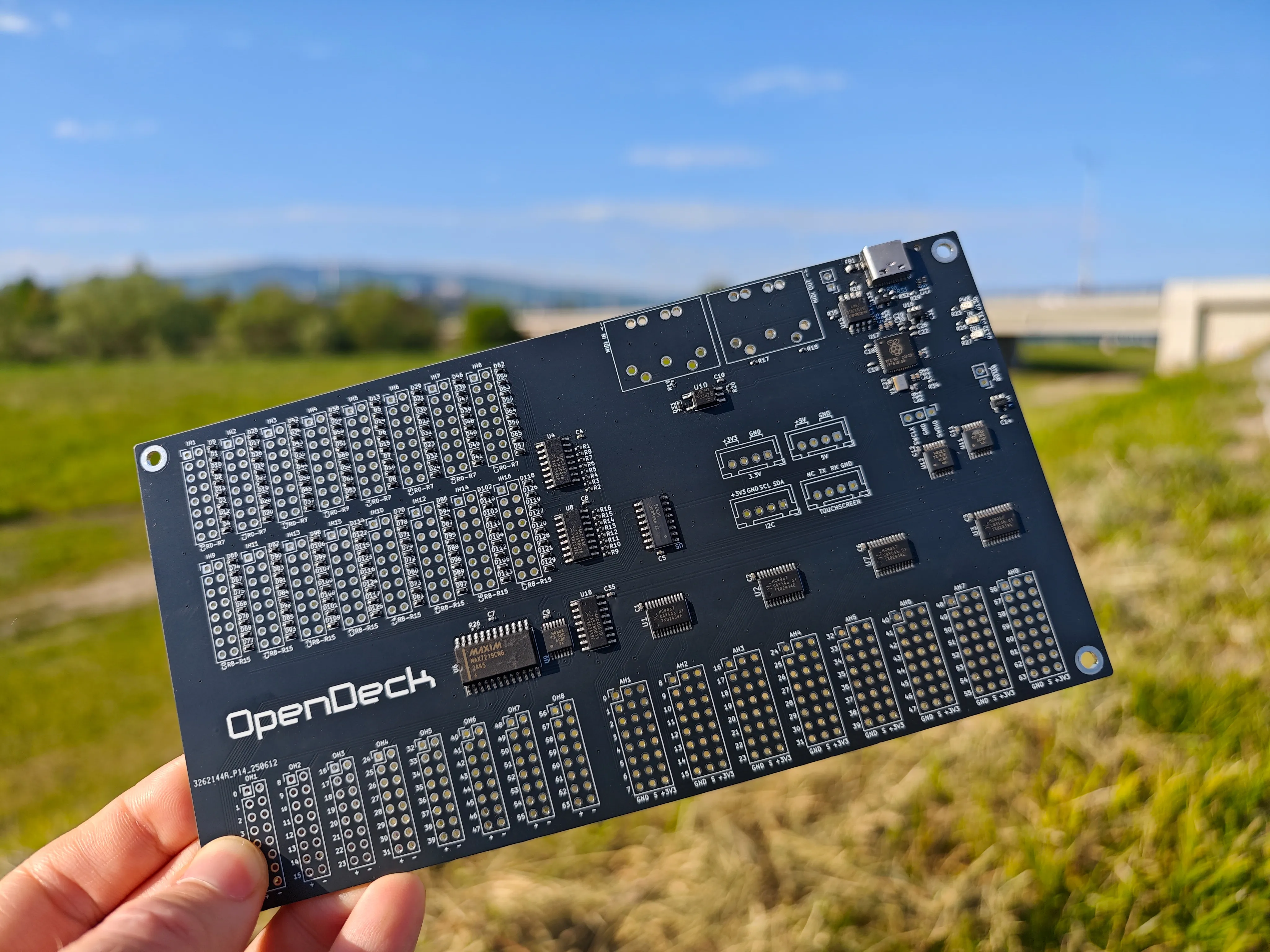
This board is based on Raspberry Pi RP2040 microcontroller and features the following:
- 128 digital inputs
- 64 digital outputs
- 64 analog inputs
- DIN MIDI
- USB MIDI (USB C)
- Connector for touchscreen
- Connector for I2C OLED display
- Additional connectors with 3V+GND and 5V+GND connections
The L board doesn't have OSC support. It focuses on providing lots of I/O specifically for USB and DIN MIDI use-cases. OSC functionality is available on a number of supported Ethernet-enabled boards.
Supported boards
The firmware supports various other boards, both small and large:
| Board | MIDI | OSC |
|---|---|---|
| Adafruit Grand Central M4 Express | USB, DIN | No |
| Adafruit Metro ESP32-S3 | USB, DIN | No |
| Adafruit Metro ESP32-S3 + W5500 Ethernet Shield | USB | Ethernet |
| Adafruit Metro ESP32-S3 + W6100 Ethernet Shield | USB | Ethernet |
| Adafruit Metro RP2040 | USB, DIN | No |
| Adafruit Metro RP2040 + W5500 Ethernet Shield | USB | Ethernet |
| Adafruit Metro RP2040 + W6100 Ethernet Shield | USB | Ethernet |
| Arduino Nano 33 BLE | USB, DIN, BLE | No |
| LILYGO T-ETH Elite | USB | Ethernet |
| nRF52840 DK | USB, DIN, BLE | No |
| nRF5340 DK | USB, DIN, BLE | No |
| Olimex ESP32-POE | No | Ethernet |
| Raspberry Pi Pico | USB, DIN | No |
| Raspberry Pi Pico 2 | USB, DIN | No |
| ST Discovery F407VG | USB, DIN | No |
| ST Nucleo F767ZI | DIN | Ethernet |
| ST Nucleo H563ZI | DIN | Ethernet |
| ST Nucleo H753ZI | DIN | Ethernet |
| STM32F411 Black Pill V3+ with populated external flash | USB, DIN | No |
| Teensy 4.0 | USB, DIN | No |
| Teensy 4.1 | USB, DIN | No |
| Waveshare Core405R | USB, DIN | No |
| Waveshare ESP32-S3-ETH | USB | Ethernet |
| W5500-EVB-Pico | USB | Ethernet |
| W5500-EVB-Pico2 | USB, DIN | Ethernet |
| W6100-EVB-Pico | USB, DIN | Ethernet |
| W6100-EVB-Pico2 | USB, DIN | Ethernet |
| wESP32 | No | Ethernet |
For more details on supported boards, check the wiki page. Support for custom boards can also be added.
Documentation
Available on dedicated Wiki section.
Discussion
Need help? Want to show off your OpenDeck-based builds? Head over to Discussions!
License
OpenDeck source code is available under Apache License v2.0. Zephyr RTOS, which OpenDeck is built on top of, is also licensed under Apache License v2.0.
Third-party components with different licenses:
u8g2: Two-clause BSDvl53l4cx: Three-clause BSDvl53l5cx: Three-clause BSDzlibs: MIT