README.md
August 30, 2026 · View on GitHub
 |
skillsawKeep your skills sharp. A linter for the files that steer AI coding agents. |
|
|
|





Agent instructions behave like code, but most teams still review them like prose. skillsaw gives them a linter. It secures agent context against prompt injections and supply-chain attacks, validates structure across every major AI coding ecosystem, and eliminates content dead zones with deterministic autofixes.
It understands Agent Skills,
Agent Plugins v1, Claude Code
plugins, OpenAI Codex plugins and marketplaces, CLAUDE.md, AGENTS.md,
GEMINI.md, QWEN.md, Cursor, Copilot, Cline, Devin, Kiro, OpenCode, hooks, agent
configuration, MCP Registry server.json publisher metadata, Vercel skills CLI
lockfiles, and evals. Safe structural fixes can be applied automatically;
everything else comes with precise, agent-friendly guidance.
Content installed under APM's apm_modules/ and skills installed from
external skills-lock.json sources are tracked as external in the lint tree.
They are linted by default but never rewritten by skillsaw fix; projects can
set lint-external-content: false to lint only content whose source they
directly control.
Get started | Browse the rules | Read the documentation
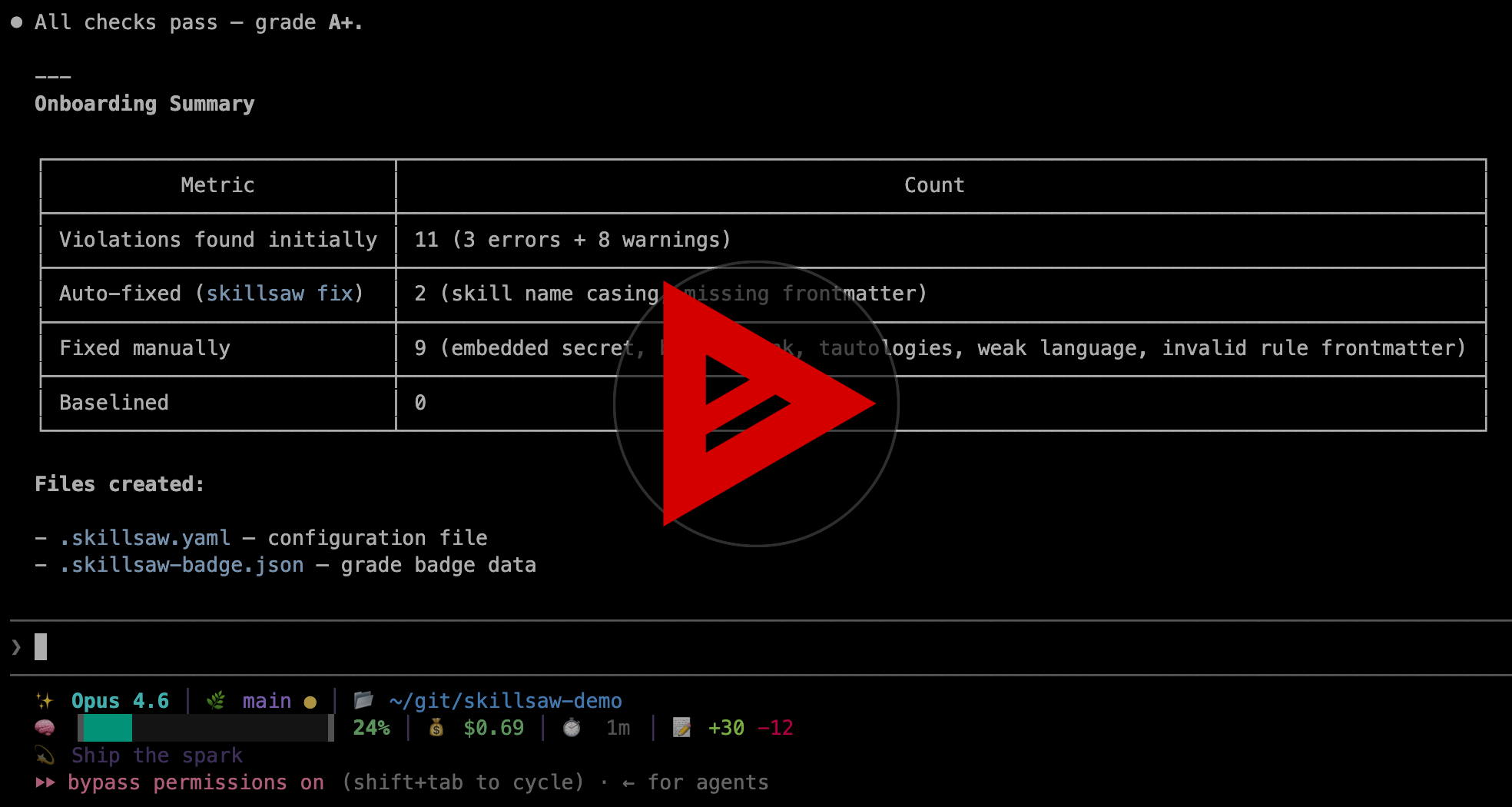
See it work
Watch an AI agent grade, fix, and configure a repository from scratch.
Try it
Paste this into your coding agent to onboard skillsaw now:
Read and follow the instructions at
https://raw.githubusercontent.com/stbenjam/skillsaw/refs/heads/main/skills/skillsaw-onboard/SKILL.md
to onboard this repo to skillsaw.
Or run it yourself. No installation is required with
uvx:
uvx skillsaw tree      # See what skillsaw detects
uvx skillsaw           # Lint the current repository
uvx skillsaw fix       # Apply safe, deterministic fixes
uvx skillsaw baseline  # Accept existing findings and fail only on new ones
What it catches
- Security & supply chain (highest priority):
- Dangerous lifecycle hooks: blocks arbitrary remote code execution, download-and-execute (
curl | sh,wget | bash), and script obfuscation (eval) inhooks.jsonand settings. - Prohibited & unvetted MCP servers: enforces strict MCP allowlists across root, plugin, and custom agent configurations.
- Prompt injection & stealth payloads: detects invisible Unicode (ASCII smuggling, zero-width tags, bidi overrides), high-entropy encoded payloads (base64/hex), and hidden instructions in comments and code fences.
- Environment & context security: flags dangerous environment overrides (
LD_PRELOAD,NODE_OPTIONS,PYTHONPATH), unallowlisted dynamic context injection, and embedded credentials.
- Dangerous lifecycle hooks: blocks arbitrary remote code execution, download-and-execute (
- Multi-ecosystem structure & compatibility: schema, frontmatter, and manifest validation for Agent Skills (
SKILL.md), Claude Code, OpenAI Codex (plugins & marketplaces), Agent Plugins v1 (plugin.json,mcp.json), GitHub Copilot & VS Code custom agents (.github/agents/), OpenCode configuration, APM packages, MCP server maps, and MCP Registry metadata. - Deterministic autofixes: safe, instant automated fixes for invalid frontmatter, broken headings, missing manifests, unclosed code fences, and schema keys via
skillsaw fix. - Content quality & token economy: research-backed rules detecting instruction drift across duplicate files, lost-in-the-middle attention dead zones, cognitive overload, section length violations, weak language, contradictions, and repetitive inline tool-call examples.
- Discovery & repository integrity: unreferenced bundled files, broken internal file references, inconsistent terminology, missing stop conditions, and stale baselines.
skillsaw detects repository types automatically and lints multiple formats in the same project. See supported repository types and the complete rule reference for details.
Built for real workflows
skillsaw works locally, in CI, and inside coding-agent workflows. It provides
line-level findings, explanations for every rule, deterministic autofixes,
baselines for gradual adoption, GitHub and GitLab integration, and text, JSON,
SARIF, HTML, and Code Climate output. Rules are configurable, and projects can
add local rules or install rule plugins. Typo'd or wrong-typed rule options
in .skillsaw.yaml are reported with did-you-mean suggestions instead of
being silently ignored.
| Goal | Documentation |
|---|---|
| Install and run skillsaw | Getting Started |
| Tune rules and exclusions | Configuration |
| Adopt it without fixing everything at once | Baselines |
| Review the security model | Supply Chain Protection |
| Supported ecosystems and tools | Repository Types |
| Add checks to pull requests & CI | CI Integration |
| Understand and apply fixes | Autofixing |
| Convert plugins to Agent Plugins v1 | Porting to Agent Plugins |
| Create project-specific checks | Custom Rules |
| Publish reusable rule packages | Rule Plugins |
| Inspect the typed parse tree | Lint Tree |
| Look up commands and flags | CLI Reference |
| Feed the docs to an AI agent | llms.txt index, llms-full.txt full docs |
Measure the result
Every run produces a letter grade based on weighted violation density. The same data can be rendered as a self-contained report card for a README or project dashboard.
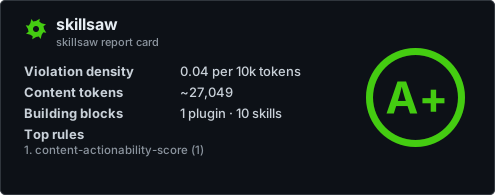
skillsaw's own report card, generated with skillsaw badge --large.
Learn how to generate a grade badge and report card for your project.
Contributing
Contributions are welcome. See CONTRIBUTING.md for the project guidelines and DEVELOPMENT.md for the local setup.
Questions and bug reports belong in GitHub
Issues. For a shareable diagnostic
bundle, run skillsaw feedback in the affected repository and review the ZIP
before attaching it to an issue — files you add with --include are copied in
verbatim. skillsaw is licensed under
the Apache License 2.0.
Thank you to our contributors
skillsaw is better because people contribute code, bug reports, and ideas. Thank you!
| Contributors | |||
|---|---|---|---|
@alSergey |
@amy |
@btiernay |
@cblecker |
@cgwalters |
@ehelms |
@EmilienM |
@jeffreylo |
@jfchevrette |
@kannon92 |
@nyechiel |
@rajusem |
@skyth3r |
@tchughesiv |
@tyraziel |
|