Parallel Constrained Decoding
September 17, 2026 · View on GitHub
Fill a whole JSON schema of booleans and enums in two forward passes instead of generating it token by token — with calibrated confidence per field and output that is schema-valid by construction.
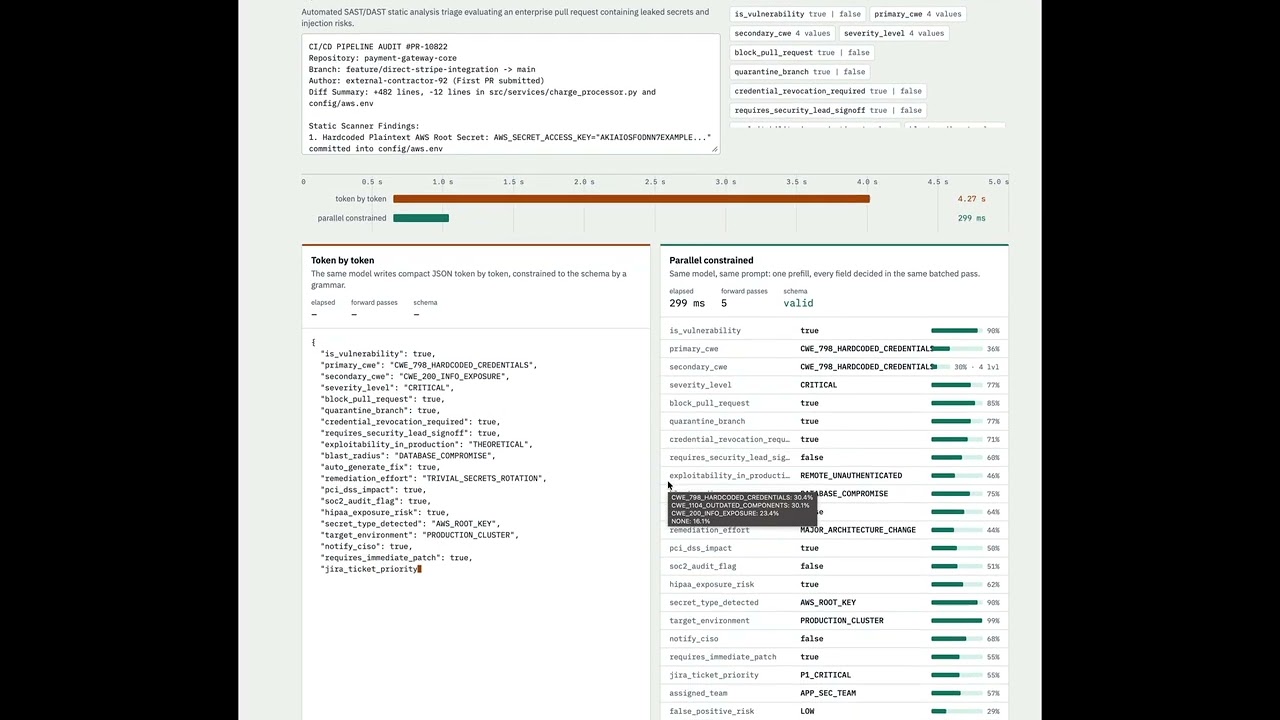
Watch the demo (YouTube, Devoxx): the web app races the parallel engine against grammar-constrained token-by-token generation on the same model.
This repository contains:
java/— a Java implementation of the technique that drives llama.cpp directly through the JDK Foreign Function & Memory API (no JNI). It is the fastest engine measured here, and it ships with a local web app that races it against a grammar-constrained token-by-token baseline on the same model, lets you build your own extraction scenarios, and charts benchmarks. It can load any GGUF, including the models of a local Ollama install.python/— a port of the original engine published at harshatheg/Qwen-2.5-1B-RLCD (MLX, Apple Silicon only), kept for reference and comparison. Despite the name, that Hugging Face repo contains no weights and no fine-tune — it is source code running stockQwen2.5-1.5B-Instructwith a custom decoding strategy. See NOTICE for what was vendored and changed.presets/— extraction scenarios shared by both engines (fraud triage, code-security audit, support triage, a 255-choice tariff router, spam/phishing triage, and Devoxx CFP talk routing with a bank of 100 real talks).
Benchmark summary (Apple M1 Ultra, GPU otherwise idle, median after warm-up)
| Preset | Fields | Token-by-token JSON (Python, MLX) | Python parallel (MLX) | Java native, cold | Java native, warm |
|---|---|---|---|---|---|
| FinTech fraud / AML | 28 | 2388 ms | 337 ms | 266 ms (1.27× vs Python) | 130 ms |
| Code security triage | 28 | 2473 ms | 344 ms | 277 ms (1.24×) | 131 ms |
| Incident triage | 28 | 2360 ms | 361 ms | 269 ms (1.34×) | 131 ms |
| 255-choice tariff | 4 | 476 ms | 170 ms | 158 ms (1.08×) | 67 ms |
"Cold" is the head-to-head: same prompt tokens, full prefill every call, same timing boundary as the Python engine. "Warm" keeps the schema's KV cells between calls (single-pass mode) — a production optimization the Python engine does not have. Full details, per-phase breakdowns and caveats are in Java engine details below.
Install on a local machine
What you need
| Required | Notes | |
|---|---|---|
| OS / hardware | macOS on Apple Silicon (recommended) or Linux x86-64 / arm64 | On a Mac the engine runs on the GPU through Metal (sub-second races). On Linux it runs on the CPU: expect seconds per race, same 2-passes-vs-50 story. |
| JDK | 22 or newer (25 and 27 tested, identical speed) | e.g. brew install openjdk |
| Maven | 3.9+ | brew install maven |
| llama.cpp shared library | v0.4.1 (the tag the Java bindings were generated against) | brew install llama.cpp on macOS; build from source on Linux (below) |
| A GGUF model | any decoder LLM | Qwen2.5-1.5B-Instruct Q8_0 is the default (1.9 GB) |
| Optional | Ollama | its already-downloaded models appear in the model dropdown |
| Optional | Python ≥ 3.10 + uv | only for the Python reference port (Apple Silicon only) |
Steps (macOS)
git clone https://github.com/stephanj/parallelConstraintDecoding.git
cd parallelConstraintDecoding

# 1. llama.cpp (libllama + libggml; Homebrew installs ggml as a separate formula)
brew install llama.cpp

# 2. a model (the default one; any GGUF works, see "Models" below)
mkdir -p models
curl -L -o models/qwen2.5-1.5b-instruct-q8_0.gguf \
  https://huggingface.co/Qwen/Qwen2.5-1.5B-Instruct-GGUF/resolve/main/qwen2.5-1.5b-instruct-q8_0.gguf

# 3. build (compiles and runs the unit tests, produces java/target/pcd-benchmark.jar)
cd java && mvn -q package && cd ..

# 4. run the web app, then open http://localhost:8000
java -jar java/target/pcd-benchmark.jar serve
The first race on a scenario includes a one-off warm-up (Metal compiles kernels for that schema's batch shapes); numbers from the second run on are representative.
Steps (Linux)
Same as above, except llama.cpp is built from source at the pinned tag and the engine is told where the libraries are:
git clone --depth 1 --branch v0.4.1 https://github.com/ggml-org/llama.cpp.git /tmp/llama.cpp
cmake -S /tmp/llama.cpp -B /tmp/llama.cpp/build -DCMAKE_BUILD_TYPE=Release -DBUILD_SHARED_LIBS=ON \
      -DGGML_NATIVE=ON -DLLAMA_CURL=OFF -DLLAMA_BUILD_TESTS=OFF -DLLAMA_BUILD_EXAMPLES=OFF \
      -DLLAMA_BUILD_TOOLS=OFF -DLLAMA_BUILD_SERVER=OFF
cmake --build /tmp/llama.cpp/build --target llama ggml-cpu -j
mkdir -p ~/llama-lib && find /tmp/llama.cpp/build -name 'lib*.so*' -exec cp -a {} ~/llama-lib/ \;

export PCD_LLAMA_LIB_DIR=~/llama-lib LD_LIBRARY_PATH=~/llama-lib
java -jar java/target/pcd-benchmark.jar serve
The CPU backend is built with OpenMP; install libgomp1 (Debian/Ubuntu) if
the JVM reports libgomp.so.1: cannot open shared object file. The engine
uses all available cores.
Models
- Put any
*.ggufinmodels/; the web app's header dropdown lists them all and switches in place.PCD_GGUF=/path/to/model.ggufpicks the one loaded at start (defaultmodels/qwen2.5-1.5b-instruct-q8_0.gguf). - Models of a local Ollama install are listed too, as
ollama:<name>:<tag>(Ollama's store is a directory of GGUF blobs; nothing talks to Ollama and it needn't be running;$OLLAMA_MODELSis honoured). Some Ollama blobs are Ollama-specific conversions upstream llama.cpp cannot load (gemma4:*,qwen3-vl:*at the time of writing) — the dropdown reports the error and keeps the previous model. - Every prompt is rendered with the chat template embedded in the GGUF, so Qwen, Llama 3, Gemma … each get their own format (ChatML fallback when a file has none).
- Useful companions to the default:
Qwen2.5-3B-Instruct$ \text{Q8\_0} (2 \times \text{slower} \text{per} \text{pass}, \text{better} \text{judgement}) \text{and} $Qwen3.5-0.8BQ8_0 fromggml-org(smaller, but its hybrid attention is slower in llama.cpp than the 1.5B).
Environment and options
| Variable / flag | Default | Meaning |
|---|---|---|
PCD_GGUF | models/qwen2.5-1.5b-instruct-q8_0.gguf | model loaded at start |
PCD_LLAMA_LIB_DIR | /opt/homebrew/opt/ggml/lib:/opt/homebrew/opt/llama.cpp/lib:/opt/llama/lib:/usr/local/lib | where libllama / libggml* live (colon-separated) |
PORT / --port | 8000 | web app port |
PCD_BIND / --bind | 127.0.0.1 | bind address (0.0.0.0 to expose on a network) |
PCD_READ_ONLY / --read-only | false | demo mode for a shared instance: scenarios, model and stored benchmark runs cannot be changed; races still run |
PCD_SEQUENTIAL_RACE | false | show the two engines one after the other, each timed live, instead of replayed on one timeline (the honest display on a shared CPU) |
Troubleshooting
ZipFile invalid LOC headerin the browser: the jar was rebuilt while the server was running (the JVM maps the jar). Stop the server, build, start again.- Wrong or crashing behaviour right after
brew upgrade llama.cpp: the FFM bindings bake in llama.cpp's struct layouts. Re-runjava/tools/gen-bindings.sh(downloads jextract 22 intojava/tools/on first use) and rebuild. - Slow numbers on a Mac: anything else holding the GPU (an idle
mlx_lm.server, an Ollama runner with a large model) roughly doubles both engines' times. - Native integration tests run only when
PCD_TEST_GGUFpoints at a model (PCD_TEST_GGUF=… mvn test); otherwise they are skipped.
The web app
java -jar java/target/pcd-benchmark.jar serve # http://localhost:8000
One page, three views, no build step (JDK HttpServer + vanilla JS; Chart.js
is vendored so it works offline).
-
Race — opens on the Devoxx CFP routing scenario with a random talk from its bank; pick another scenario, or paste your own text (an email, a ticket, an abstract), and press Run the race. Both engines run on the same input and the same prompt. The parallel result lands as a block of fields with a confidence bar each (hover for the runner-up probabilities); the baseline streams its JSON, pretty-printed, as it is generated. The verdict line gives the speedup and the forward passes each needed. For scenarios with a sample bank, both panes state per field whether they agree with the human filing ("✓ same as the CFP" / "✗ CFP filed it as …"). By default the two are replayed on one time ruler;
PCD_SEQUENTIAL_RACE=trueruns them visibly one after the other, each timed live. -
Presets — create and edit scenarios in the browser: title, example input, and a table of fields (
true / falseor a list of allowed values, each with a one-line description). Saved topresets/*.json, the same files the CLI benchmark reads. Save and run the race jumps straight to the demo. Any preset may carry asamplesbank ([{label, context, expected}]); the editor leaves it untouched. -
Benchmarks — runs every scenario through both engines, stores runs in
results/, shows a latency table, a token-by-token vs parallel chart and the parallel engine's per-phase breakdown. Runs record which model made them. -
Tetris — the decoder plays Tetris: every falling piece is one extraction call whose single field,
placement, ranges over the legal placements of that piece (so an illegal move is impossible). The board goes in as text, and each candidate's label leads with its outcome computed by the game engine (clears 2 lines - column 4, rotation 0), so the decoder's first scored token is about the outcome and the token tree only then resolves the position. It decides ~3 pieces per second (≈105 ms, 2 forward passes each) and shows the probability of every candidate next to the board, plus what a simple heuristic would have picked. By default the engine offers only the best outcome class — every placement completing the most lines, or, failing that, those creating the fewest holes — so a line is completed whenever the piece can do it and the model chooses among the remaining candidates (~60 pieces, ~13 lines per game). "All legal placements" shows how a small model does on its own: it mostly stacks on the left and dies within ~15 pieces. A temperature slider samples from the distribution instead of taking the argmax.?view=tetris&autorunstarts it.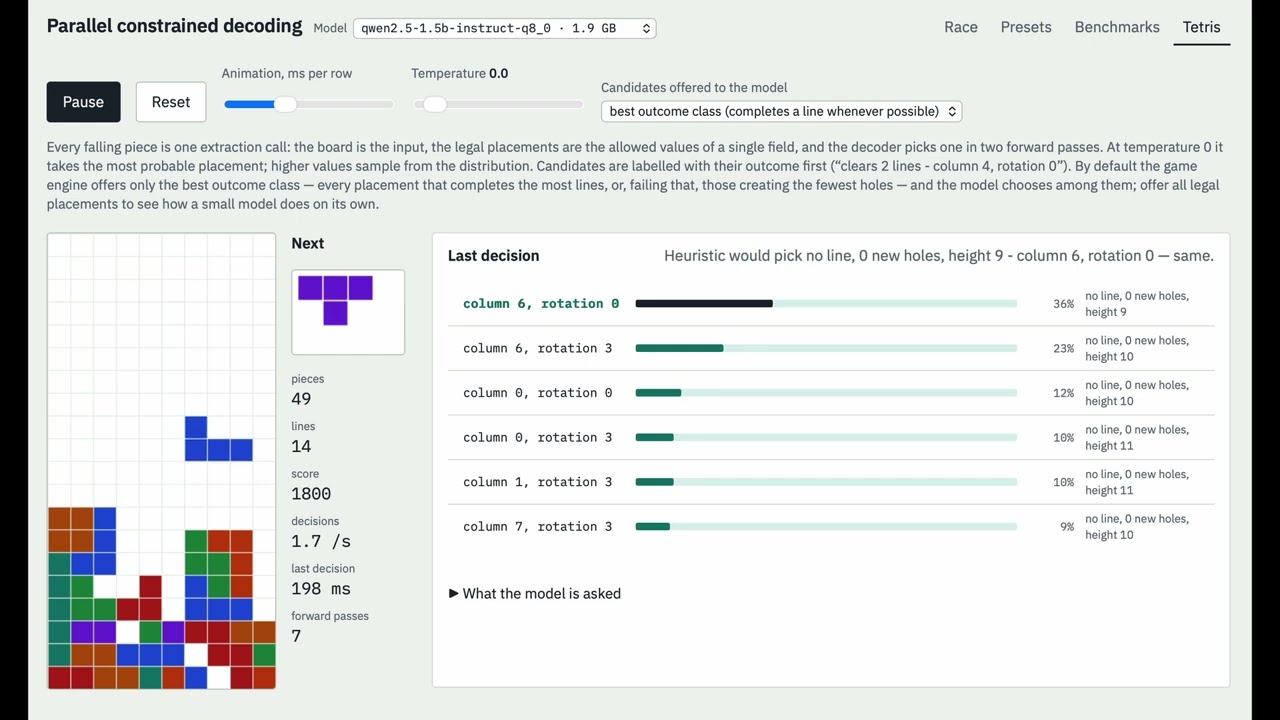
Watch it play (YouTube, Devoxx): Tetris controlled by an LLM Decoder.
?preset=<id> and ?autorun in the URL pre-select a scenario and start a
race on load — handy when presenting. For a live talk on a Mac, expose the
local server to the audience with a tunnel (e.g. cloudflared tunnel --url http://localhost:8000) and start it with PCD_READ_ONLY=true.
The opponent: a grammar-constrained baseline
The token-by-token pane uses GrammarJsonEngine: the same loaded model
generates compact JSON one token at a time under a llama.cpp GBNF grammar that
enforces every field in schema order, boolean types and exact enum strings,
with no extra keys. So both panes are schema-valid by construction and the
race isolates decoding strategy: one forward pass per token versus two
passes for the whole schema. (NaiveJsonEngine, the original prompt-only
baseline that can drop keys or invent values, is still in the code base; the
Python-comparison numbers above were measured against it.)
Scenarios that ship
- Spam & phishing triage — 8 fields (safe to deliver, category, impersonated brand, sender authenticated, asks for credentials, urgency pressure, risk level, recommended action). On the sample phish all 8 are decided in 2 forward passes (~130–200 ms) where the baseline needs ~54 (~530 ms).
- Devoxx CFP talk routing — routes a submitted talk to one of the eight
real Devoxx Belgium 2026 tracks (from the public CFP API at
dvbe26.cfp.dev), plus audience level, main technology and three booleans (AI central, live coding, laptop needed). The preset carries the 100 most-favourited real talks with the track and level the CFP filed them under; each run moves to the next talk (or use Next talk). Refresh the bank withjava -jar target/pcd-benchmark.jar devoxx-samples [--event dvbe26] [--count 100]. Session format is deliberately not a field: any talk can be submitted in any format, so it isn't inferable from an abstract. - The four presets of the upstream project (fraud/AML, code security, support triage, 255-choice tariff), unchanged.
On accuracy, and why the two engines can disagree
Scored against the CFP's own filing on the 100 cached Devoxx talks
(python3 java/tools/eval/devoxx_eval.py with the server running), 1.5B
model, shared prompt: track 44 vs 47, audience level 22 vs 27 (parallel vs
baseline). What the investigation behind those numbers found:
- The disagreement is not the decoding: scoring choices by their first token or by the summed probability of every token that starts them gives identical decisions on all 100 talks.
- It was the prompt. The two engines originally saw different prompts, and a
1.5B model's preferences move a lot with wording. Hence they now share one
(the CLI benchmark keeps the Python port's catalog prompt for comparable
token counts —
CompiledSchema.PromptStyle). - Only
trackis really inferable from an abstract (8 classes, majority 28%): both engines land around 45–50% on the 1.5B, ~53% on the 3B.audience_levelis the speaker's form choice, so "accuracy" there mostly measures majority-class bias. Low confidence on a field is the useful signal: it is where a human should look.
The technique
Structured extraction with bounded field values (booleans, enums) doesn't need autoregressive token-by-token JSON generation:
- Prefill once. The schema (field descriptions and allowed values) and the text go through the model a single time and stay in the KV cache.
- Broadcast. The cached prefix is made visible to one sequence per field
— in llama.cpp with
kv_unified=truethis is a zero-copy tag on the cells. - One batched pass. Every sequence gets its own
"field": "suffix; the logits at each suffix's last token are read from the same forward pass. - Score only the allowed values. Softmax over the candidate tokens gives a calibrated probability per choice; nothing outside the schema can win.
- Resolve shared prefixes level by level. Choices that start with the
same token (
TIER_1_LOW/TIER_3_HIGH) are separated with one more batched pass per level for the still-ambiguous fields only; confidence is the product of the per-level probabilities. - Assemble. The JSON is built from the winners: always valid, never a missing or invented key.
Java engine details
java/src/main/java/pcd/nativeengine/ implements the steps above on
libllama through FFM (JDK 22+):
| Python engine (MLX) | Java native (pcd.nativeengine) |
|---|---|
| prefill prompt into KV cache | one llama_decode of the templated prompt into sequence 0 (flash attention, Metal on macOS) |
mx.repeat the cache M times | llama_memory_seq_cp under kv_unified=true: cells tagged with each field's sequence, zero copy (≈1 ms for 28 fields) |
| one batched pass over padded suffixes | one llama_decode over all (unpadded) suffixes, logits only at each field's last token |
softmax over candidate first tokens, per-candidate float(mx.array) reads | softmax over candidate first tokens, read straight from the logits buffer |
| collisions: unconstrained 4-token greedy decode per field, fabricated ≥0.75 confidence | batched token-tree levels: one decode per level for all still-ambiguous fields, sub-vocabulary softmax at every level |
| programmatic JSON assembly | same |
Optional --single-pass mode tags the prefix tokens with every sequence
inside the same batch as the suffixes (prefill + broadcast + suffix pass in
one forward pass). Optional warm mode keeps the schema's KV cells between calls
and prefills only the context.
CLI benchmark
cd java && mvn -q package
java -jar target/pcd-benchmark.jar bench                    # all presets, cold + warm rows
java -jar target/pcd-benchmark.jar bench -v --single-pass ../presets/fintech_fraud.json
java -jar target/pcd-benchmark.jar bench --grammar --runs 3 # also time the grammar baseline
Flags: -v per-field values/probabilities, --runs N (median of N, default
5), --single-pass, --pad (Python-style right-padded suffixes),
--grammar. PCD_GGUF selects the model. The FFM bindings in
java/src/main/java/llama/ are generated by java/tools/gen-bindings.sh
(jextract 22); re-run it after upgrading llama.cpp.
Results (M1 Ultra, GPU otherwise idle, median after warm-up)
Timing boundary is the same on both sides: tokenize + prefill + passes + assembly; model load and per-schema token compilation excluded. Prompt token counts are identical (901 / 983 / 959 / 567).
| Preset | Fields | Python parallel (MLX 4-bit) | Java native cold | Speedup | Java warm | Java warm, single-pass |
|---|---|---|---|---|---|---|
| FinTech fraud / AML | 28 | 337 ms | 266 ms | 1.27× | 143 ms | 130 ms |
| Code security triage | 28 | 344 ms | 277 ms | 1.24× | 140 ms | 131 ms |
| Incident triage | 28 | 361 ms | 269 ms | 1.34× | 140 ms | 131 ms |
| 255-choice tariff | 4 | 170 ms | 158 ms | 1.08× | 86 ms | 67 ms |
Per-phase breakdown of a cold fintech run (28 fields, 901 prompt tokens): tokenize 1 ms · prefill 182 ms · broadcast 1 ms · suffix pass 61 ms · token-tree 20 ms (3 levels). Where the cold win comes from: prefill is a tie (182 ms vs 174 — llama.cpp Q8_0 prefill ≈5,000 tok/s, MLX ≈5,100); the suffix pass is 61 ms vs 95; collision handling plus host overhead is 21 ms vs ~70.
The numbers are unchanged by the JDK (25.0.2 vs 27, every difference within
±2 ms) and by llama.cpp b8330 → 0.4.1: essentially all the time is GPU
work inside libllama, the JVM executes well under 1 ms per run.
| Preset | JDK 25.0.2 cold | JDK 27 cold | JDK 25.0.2 warm, single-pass | JDK 27 warm, single-pass |
|---|---|---|---|---|
| FinTech fraud / AML | 266.3 ms | 266.0 ms | 129.2 ms | 129.2 ms |
| Code security triage | 277.9 ms | 276.6 ms | 130.5 ms | 129.8 ms |
| Incident triage | 270.6 ms | 269.3 ms | 131.8 ms | 131.0 ms |
| 255-choice tariff | 158.6 ms | 157.2 ms | 66.9 ms | 67.2 ms |
Other models measured with the web app (spam scenario, parallel vs grammar
baseline): ollama:llama3.1:latest (8B) 747 ms / 2 passes vs 2.2 s / 53;
Qwen3.5-0.8B Q8 151 ms / 4 passes vs 1.39 s / 54. On a 20-vCPU Linux box
without a GPU the 1.5B runs the same scenario in ~1.1 s / 2 passes vs ~8.5 s
/ 54.
Caveats
- Different quantization from the Python port: Python runs the MLX 4-bit model, the Java engine a Q8_0 GGUF (same speed here because prefill is compute-bound, closer to full precision). Field-level agreement with the Python engine on the upstream presets: 20/28, 24/28, 25/28, 2/4 — disagreements are low-margin fields.
- Prompt tokenization is llama.cpp's (matches the HF token counts on all presets); suffixes and choice remainders are tokenized separately, as in Python, so candidate first tokens can differ from in-context tokenization.
- Multi-level fields report a product of per-level probabilities, which is naturally lower than a single-token probability.
Why not an HTTP client (langchain4j)?
An earlier Java attempt went through langchain4j against a local
OpenAI-compatible mlx_lm.server: one request per field fired concurrently
with max_tokens=1 and top_logprobs. It produced schema-valid output but ran
at 0.6–0.8× the speed of the naive baseline (≈4 s for 28 fields): the server
has a fixed ~120–140 ms cost per request and thirty requests cost more than
one 290-token generation. A client library cannot touch the KV cache or read
logits directly, which is exactly where the technique's speed comes from.
Python reference port (MLX, Apple Silicon only)
Kept so the Java numbers can be compared with the original engine.
uv venv --python 3.12 python/.venv
uv pip install --python python/.venv/bin/python -e python/
python/.venv/bin/python -m core.benchmark                 # all presets
python/.venv/bin/python python/example.py                 # quickstart
The first run downloads mlx-community/Qwen2.5-1.5B-Instruct-4bit (~1 GB).
Measured (mlx 0.32.2 / mlx-lm 0.31.3), parallel vs the prompt-only autoregressive baseline: 362 vs 2388 ms (6.6×), 365 vs 2473 (6.8×), 376 vs 2360 (6.3×), 181 vs 476 (2.6×) on the four upstream presets; the baseline dropped keys or produced out-of-enum values on three of four.
Local changes to the upstream code (see NOTICE): the PyTorch/Spaces backend router was removed, and the parallel prompt now lists each field's allowed choices — upstream scored first tokens of values the model had never been shown, and listing them moved several fields from wrong to right (agreement with the baseline on the fintech preset 12/28 → 16/28).
Caveats inherited from upstream and left as-is for fidelity: multi-token
choices that share a first token go through an unconstrained 4-token greedy
fallback whose confidence is fabricated (max(min(p, 0.9999), 0.75) — a
prob of exactly 0.75 is the tell) while sequential_forward_passes stays 1;
this affects counterparty_jurisdiction_risk, secondary_cwe,
target_resolution_hours, assigned_agent_tier and the 255-choice
customs_category itself. Only the first token of each choice is scored, and
presets/fintech_fraud.json has its dollar amounts missing upstream. The Java
engine replaces the fallback with the batched token tree.
Layout
presets/            scenario JSONs (context + schema [+ samples]); shared by both engines
results/            benchmark runs saved by the web app (gitignored)
models/             GGUF weights (gitignored)
python/             MLX reference port (core/, example.py, pyproject.toml)
java/
  pom.xml                     Java 22+, Jackson, JUnit; shaded jar target/pcd-benchmark.jar
  tools/gen-bindings.sh       regenerates the FFM bindings with jextract
  tools/eval/devoxx_eval.py   scores both engines against the CFP filing on the cached talks
  src/main/java/pcd/
    Main.java                 entry point: serve | bench | devoxx-samples
    NativeBenchmark.java      CLI benchmark
    Preset.java               scenario model, validation, JSON (de)serialization, sample banks
    ModelCatalog.java         models/*.gguf + Ollama store → loadable models (GGUF header reader)
    Prompts.java              schema catalog and baseline prompt text
    DevoxxSamples.java        fetches tracks + top talks from the Devoxx CFP API
  src/main/java/pcd/nativeengine/
    LlamaRuntime.java         FFM wrapper: model/context, chat template, tokenize, batched decode, logits, KV ops
    CompiledSchema.java       per-schema suffix + choice token metadata (compiled once)
    NativeParallelEngine.java prefill → broadcast → batched suffix pass → token-tree levels
    GrammarJsonEngine.java    grammar-constrained token-by-token baseline (JsonGrammar.java builds the GBNF)
    NaiveJsonEngine.java      prompt-only token-by-token baseline
  src/main/java/pcd/web/
    Server.java               JDK HttpServer: REST + SSE endpoints, static files, read-only guard
    EngineService.java        one locked runtime shared by all requests; model switching
    Stores.java               presets/ and results/ on disk
  src/main/resources/web/     index.html, app.js, tetris.js, style.css, vendor/chart.umd.min.js
  src/main/java/llama/        generated libllama bindings (jextract)